
Category Archives: Pollution

Hazardous Metaphor On Fire in Ohio

When I think “train wreck” I usually think of #45’s presidency. But here I refer to the actual Feb 3, 2023, Norfolk Southern train wreck in East Palestine, OH. A very long train carrying, among other things, tankers of hazardous chemicals had a derailment and fire near the small town of East Palestine, OH, along the southwest Pennsylvania border. It was a true calamity releasing hazardous chemicals, some of which caught fire and burned for days. It isn’t clear as yet as to what burned and what didn’t. The extent of pollution will eventually be released by authorities and monitored for years to come.

Early reports have claimed that the accident started with an overheated wheel bearing. It would be interesting learn how this could lead to a derailment. The root cause analysis will be interesting.

According to Wikipedia

NTSB chair Jennifer Homendy explained that the train in this accident would not have been required to utilize the ECP braking system even if the FAST Act was not repealed, because the term high-hazard flammable train means a single train transporting 20 or more tank cars loaded with a Class 3 flammable liquid. As it had only three such placarded train cars, the derailed train did not meet the qualifications of a “high-hazard flammable” train.

ECP stands for Electronically Controlled Pneumatic brakes. The Wikipedia page describes the pathetic political kerfuffle over these brakes and how certain groups fought the requirements for them.
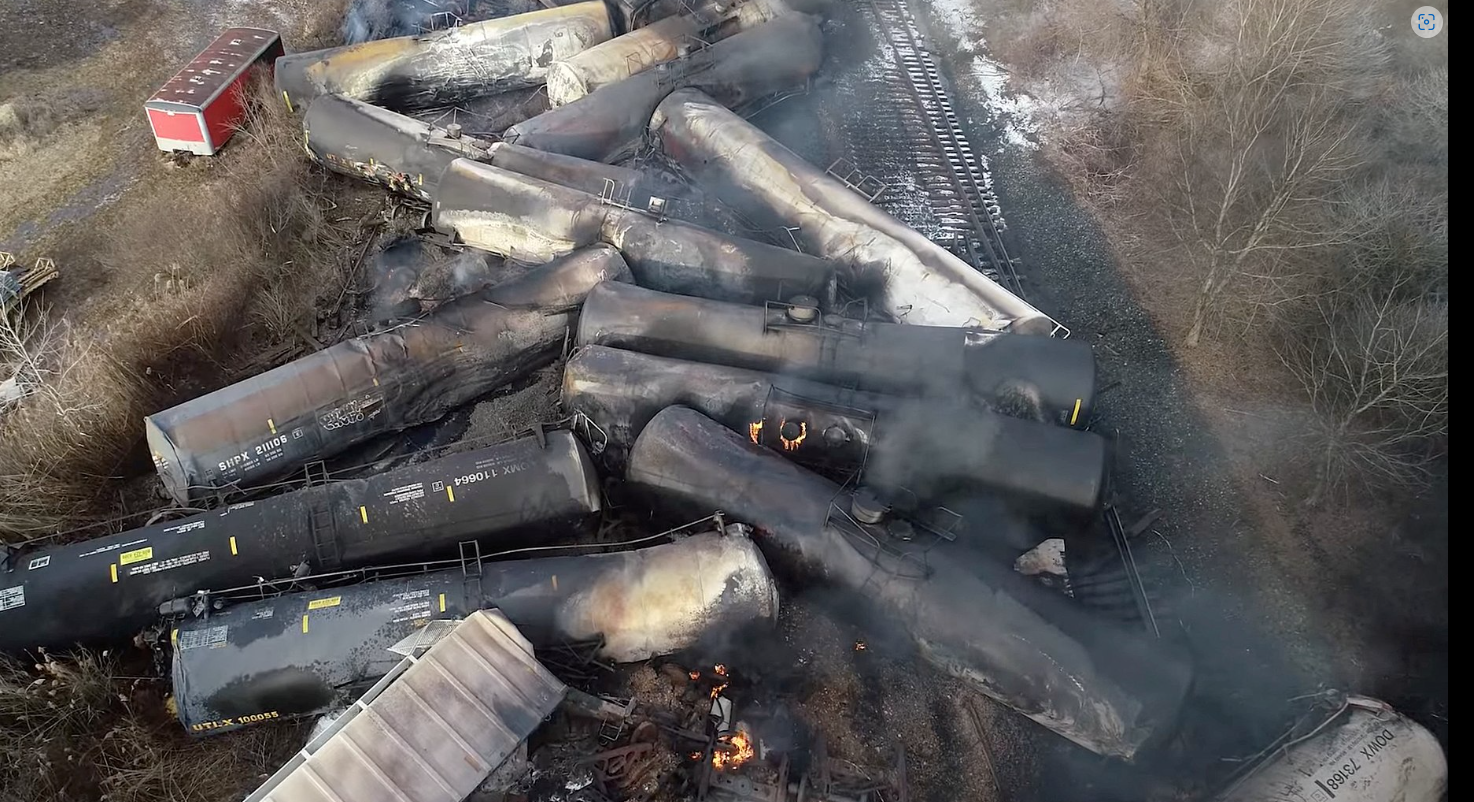
Photo from Wikipedia, https://en.wikipedia.org/wiki/2023_Ohio_train_derailment

The Washington Post released a piece, dated Feb 18, 2023, about it showing some interesting pictures. One aerial shot captures the wreckage along with what the cars were carrying. A security camera caught the train moving along with a large fire blazing under one car minutes before entering town. The video has since been removed.

The burning vinyl chloride (and … ?) produced a toxic plume that by some accounts was also corrosive. I assume this to be due to the burning of an organic chloride releasing hydrochloric acid vapors. According to Wikipedia, of the 150 cars in the train some 38 train cars were derailed.

Substances in cars that were derailed according to the Washington Post-

  • Vinyl chloride
  • Polyethylene
  • Dipropylene and propylene alcohol
  • Semolina (a wheat flour)
  • Polyvinyl chloride (PVC)
  • Ethylhexyl acrylate
  • Petroleum lubricating oil
  • Diethylene glycol
  • Isobutylene
  • Butyl acrylate
  • Benzene

Much was made in the news about burning vinyl chloride and noxious fumes, but I haven’t heard an accounting of what actually burned. Any release of acrylate monomers is especially unfortunate since as a group, they can be nasty lachrymators. This will take years to get through the courts.

LNG Ships and Shipping

An interesting bundle of factoids arrived in my daily newsletter from the American Petroleum Institute, API. The cost of shipping LNG is disclosed. I’ll just cut and paste it for convenience. The source is Freightwaves.

From API- “Liquefied natural gas charter rates were estimated to average $313,000 per day for the most efficient LNG carriers and $276,700 per day for tri-fuel, diesel engine carriers as of Monday, according to Clarkson’s Securities, some analysts predict rates could climb as high as $500,000 per day or even $1 million in the fourth quarter amid tight ship availability on the spot market. “According to brokers, owners can now achieve three-way economics, which means they are compensated not just for a regular round voyage but also for positioning voyages,” said Clarksons Securities analyst Frode Morkedal.”

Ok, I like big boats and I cannot lie. When you look into the shipping vessels themselves you can find a wondrous horde of information on LNG carrier details, such as tri-fuel, diesel engine (TFDE) powered ships. These are ship propulsion systems that drive the propellers with electric motors that in turn are energized by generators driven by engines that can burn diesel oil or LNG.

There are many advantages to the TDFE propulsion systems. Due to the low boiling point of LNG (-161.5 C), loss of LNG to evaporation is unavoidable. Fortunately, the boil-off vapor from the LNG tanks can be piped down to the engine room and used for propulsion. This LNG boil-off can be used to generate steam or can be used directly by powering two-stroke engines. The newer TFDE system, or the DFDE (Di-Fuel Diesel Electric) engines require less space than conventional diesel engines with all of their ancillary features. This leaves more room for payload.

The Bright Hub Engineering site says that a typical TFDE electric generator system produces 8 to 12 megawatts of power from each of its 4 generators at 6600 to 11000 volts at 60 Hz. The electric propulsion motors are coupled together with a reduction gear to turn the props.

As alluded to above there are duel fuel 2-stroke marine engines in use. The duel fuel engines combine Heavy Fuel Oil (HFO), also called bunker fuel, or Marine Diesel Oil (MDO) with LNG in the Diesel cycle with a load range of 10 to 100 %. The mixture of HDO or MDO with LNG is injected directly as opposed to being premixed with air. Because the autoignition temperature of LNG is high, a small amount of pilot oil is injected as well to ensure ignition. The actual mixture used can be adjusted to best match the price and availability of the fuel oil.

The di- and tri-fuel systems have the advantage of producing considerably less pollution that conventional bunker fuels. This is especially important in port where emission controls can be very strict.

LyondellBasell to Produce Pyrolysis Oils from Plastic

According to Reuters, LyondellBasell is considering converting it’s Houston refinery to the production of pyrolysis oils. The Houston crude oil refinery is scheduled to close at the end of 2023. The new operation would recycle plastic waste by pyrolysis and convert it to a stream of hydrocarbons referred to as pyrolysis oil. The company announced that hydrotreaters on the current plant site could be used to upgrade the pyrolysis oil. ICIS reports that they will use a selective catalyst in the process to produce a pyrolysis oil that is said to be similar to naphtha.

ICIS reports that the pyrolysis oil could be transferred to a nearby Channelview cracker by pipeline to crack the pyrolysis oils into a into undisclosed products.

LyondellBasell announced in May of 2021 from Wesseling, Germany, that it has been making steps toward a circular economy by converting polymer waste to virgin quality polymer. It was reported that they intend to produce ethylene and propylene monomer from their process. Virgin quality polymer would open the food contact market to the product. Details are limited.

Polymer waste contains a good deal of potential energy locked in the hydrocarbon chains. Conversion to liquid fuels would represent a type of energy recovery. I have not seen thermodynamic calculations revealing the energy efficiency in converting polymer waste to fuel.

Most synthetic organic polymers are substantially hydrocarbon in composition and can be thermally depolymerized or otherwise cracked to produce valuable liquid chemical feedstocks. Some companies are now realizing the value locked into polymer waste.

LyondellBasell has pledged to reduce CO2 emissions 15 % per ton of product worldwide.