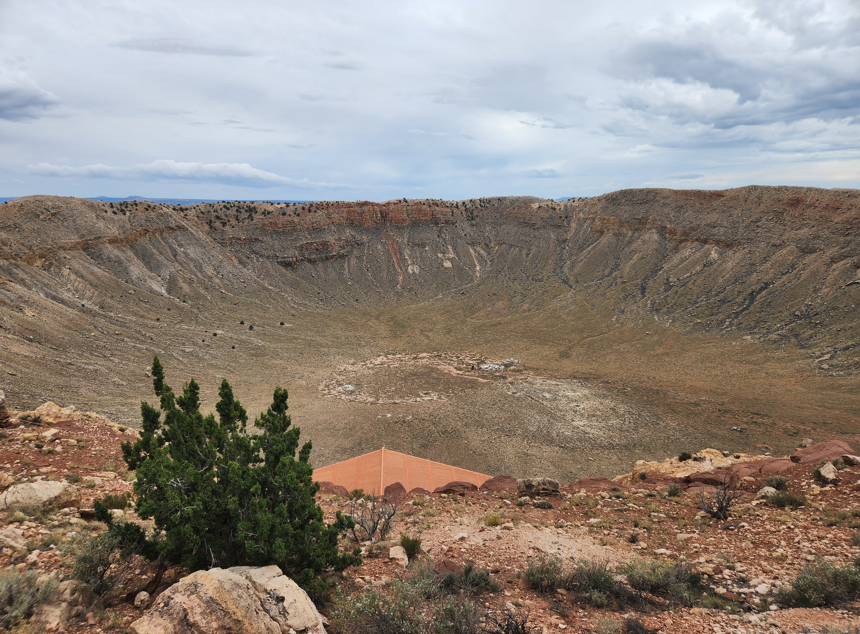
Recently we flew into Albuquerque, NM, and then took I-40 to the Barringer Meteor Crater southwest of Winslow, AZ, and 5 1/2 miles south of I-40. This was a bucket list trip for me but maybe not so much for my long-suffering spouse. I’ll spare the reader of all of the obligatory selfies.
View of the Barringer Meteor Crater from the northern observation area. The brown roof in the foreground is a shelter with seating and with plaques commemorating those who own or have cared for the crater. Photo by Arnold Ziffel.
The meteor hit the AZ location 50,000 years ago and blasted a crater out of the local sandstone. The fellow who first bought the site, Barringer, believed that iron remnants of the meteor were buried within the crater, so he obtained the site by filing mining claims in 1903 that included the crater. He dug a 200 ft mineshaft into the center and drilled exploratory holes hoping to strike a rich lode of iron. Sadly for him, he found only sandstone. In fact, the fragmented remains of the meteor are scattered over the surrounding landscape. Daniel M. Barringer, a mining engineer and businessman, who bought the mining claims believed the crater was due to a meteor impact. It was many years later that professional opinions agreed that the crater was meteoric in origin. The Crater has been in in the hands of the Barringer family from the beginning.
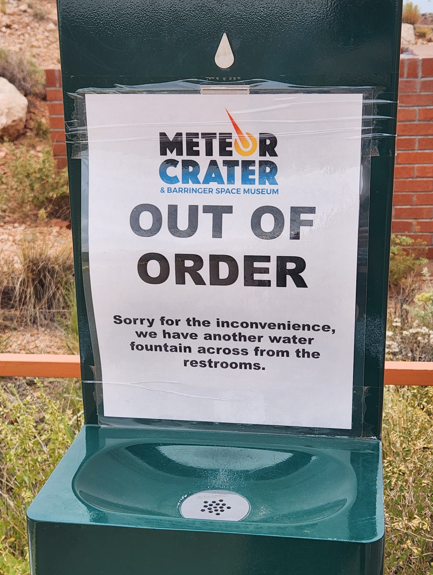
Photo by Arnold Ziffel.
I thought this was amusing at first glance, seemingly warning that the Meteor Crater was out of order, but it was just for the water fountain. The visitor’s center has a large gift shop and an auditorium for a short video of the site and its history. The only path to the crater is through the visitor’s center. It is all private property.
The second big hole in Arizona is a whopper located north of Flagstaff. It is the Grand Canyon, of course. I had scheduled a helicopter tour of the canyon with Maverick Helicopter. at the Grand Canyon National Park Airport. They have 5 gleaming Airbus H130 helicopters that can carry 6 passengers each. Everyone gets headphones to speak in the noisy choppers.
View of the Grand Canyon looking northwest from the south rim. Photo by Arnold Ziffel.
Everybody has seen countless photos with all of the breathless descriptions of the canyon, and yes, it is definitely Grand. We took a ground tour with Pink Jeep Tours in one of their custom pink Jeeps. This was in the fall shoulder season for tourism so the crowds were manageable. Gawping at it from the rim was nice but to have a real canyon experience I think you have to go into the canyon.
Note: Some of the VLA pictures are duplicated from a recent post.
Once we completed our tour of Arizona’s two gaping holes, we pointed the car east and drove to the Very Large Array (VLA) near Magdalena, NM. They put on an open house for the public on Oct. 11, so I was obligated to grab another bucket list trip. Again, the spouse unit was luke-warm but I was impressed.
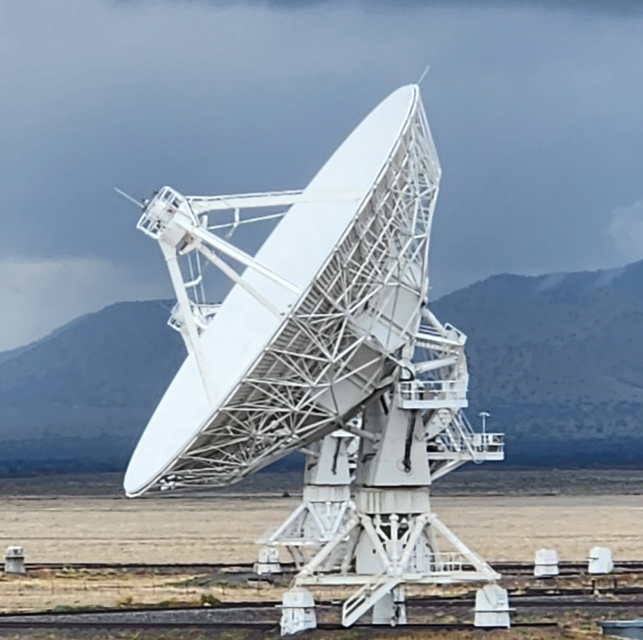
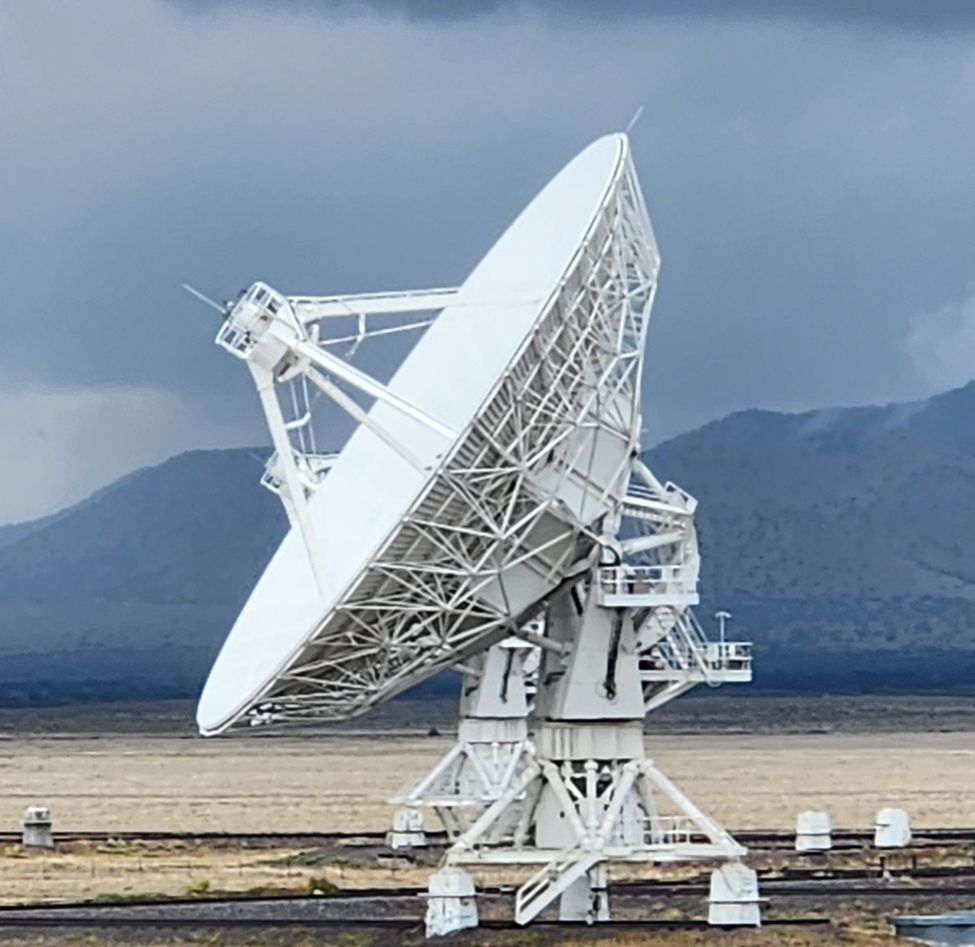
One of the 26 operating dishes at the VLA in New Mexico. Photo by Arnold Ziffel.
One of the 27 dishes is in the shop and 26 are in the field.
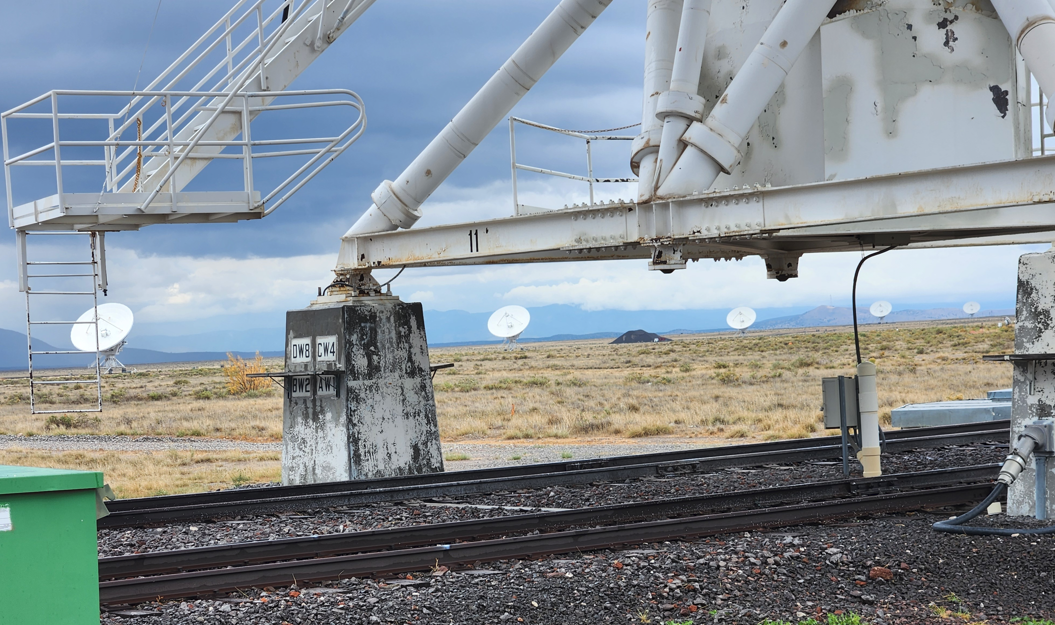
A view from under one of the dishes towards 5 more. Photo by Arnold Ziffel.
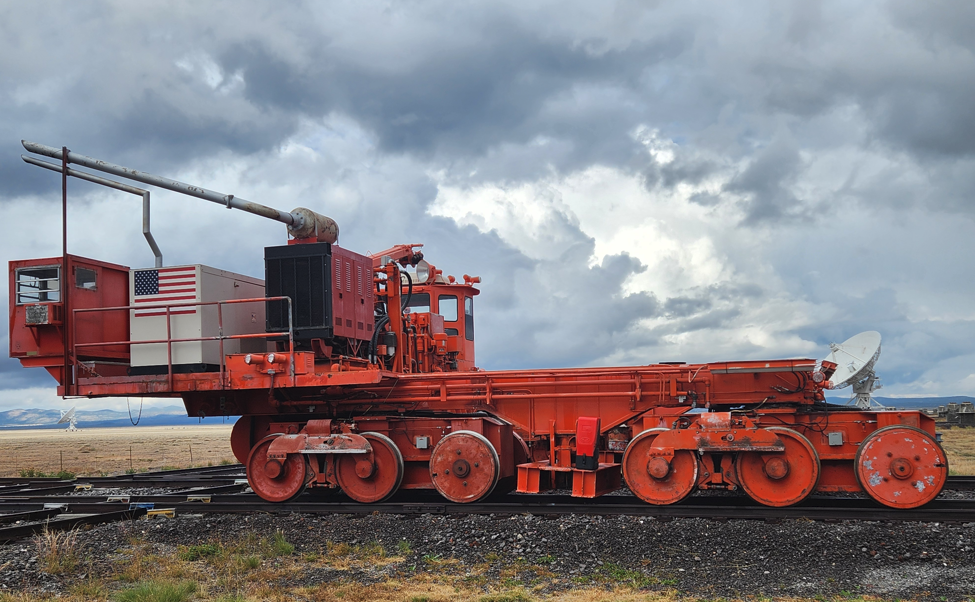
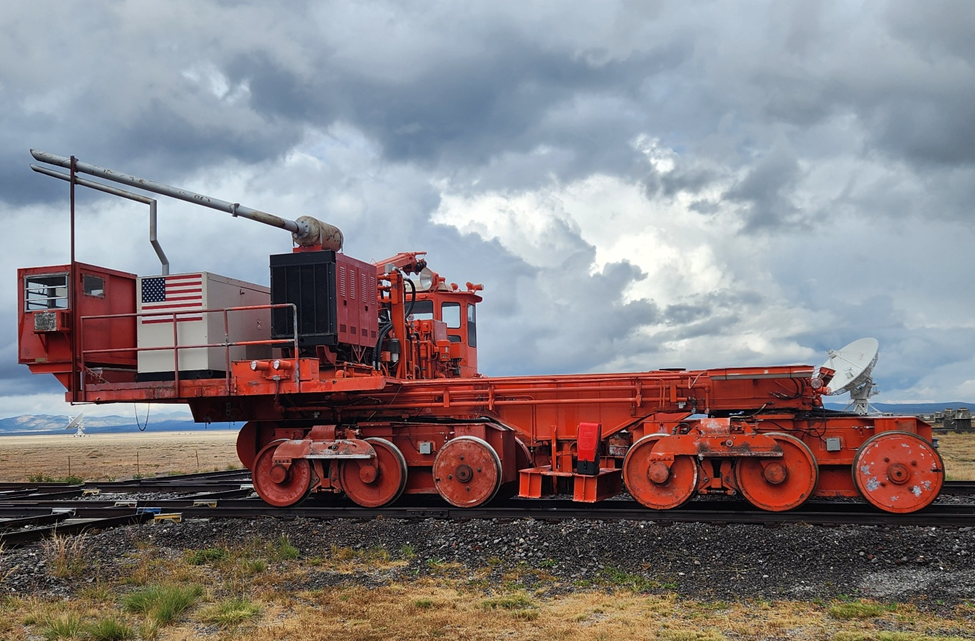
This is the machine they use at VLA to haul around the dishes when they need to be moved. When loaded it moves at 2 mph. Photo by Arnold Ziffel.
It takes the dish transport machine two weeks to reposition all 26 VLA dishes. The rails were installed to be rated for highspeed rail operations. This rating evidently ensures that dish transport is as smooth as possible.
One of the side effects of my 5 years of community theater experience on top of my beta-blocker high blood pressure meds has been that I tend not to get stage fright. I am likely to say things thar ordinarily I might not say. Beta-blockers have been successfully used to suppress the anxiety of stage fright. It works. The young radio astronomer tour guide kept referring to black holes in his spiel. Tired of this patronizing whizbang black hoIe talk, I asked him if it was possible for an astronomer to not mention black holes while speaking. He said he didn’t know. The younger VLA astronomers in the group were greatly amused by this blunt question.
When asked about the sensitivity of the VLA radio telescope system, the guide said that if you were out at the orbit of Pluto and used your cell phone, you would be the brightest radio object in the sky. Yikes.
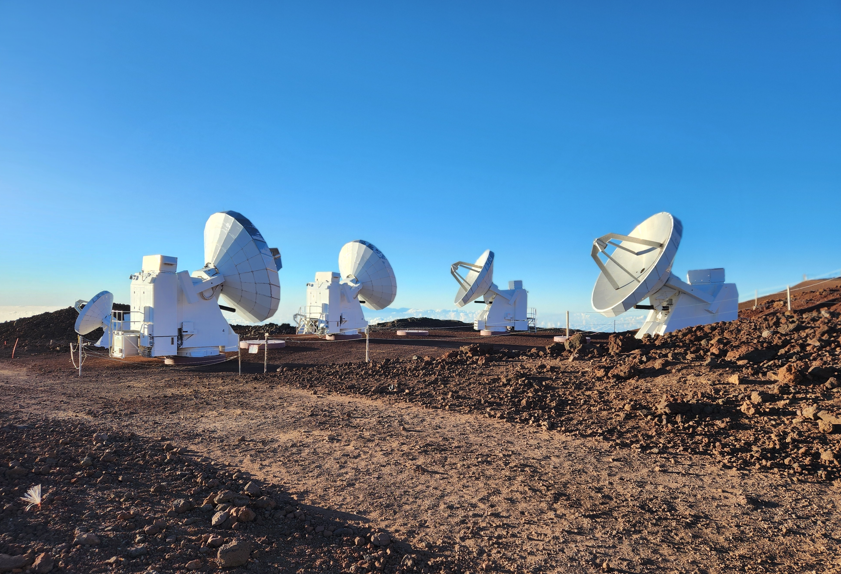
A year ago atop Mauna Kea on the Island of Hawai’i we saw these radio telescopes. The photo does not show the howling, frigid wind. It was dang cold.
Radio telescopes just below the very summit of Mauna Kea on Hawai’i Island. Photo by Ginger Rogers.
After VLA we left for Albuquerque 2 hours to the north. The next day while waiting for our flight, we visited the National Museum of Nuclear Science & History. There was a similar museum in Las Vegas, but a bit smaller. This museum was packed with artifacts from the early nuclear age.
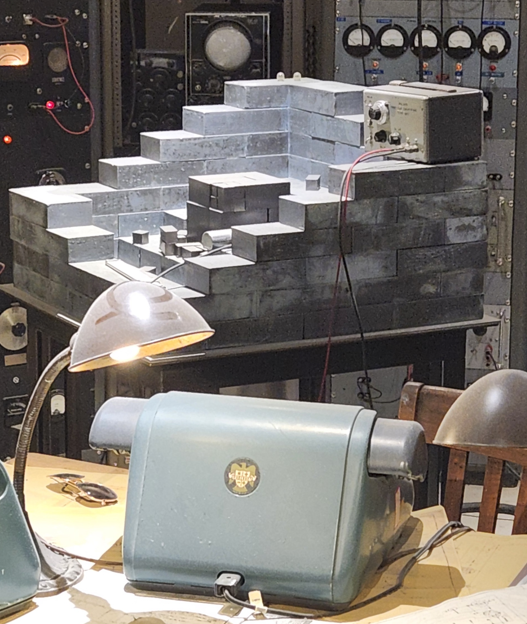
A mockup of an atomic pile used for Dragon’s Tail experiments aimed at finding the critical mass of the explosive pit. Lead bricks were piled up around a stack of what I believe are uranium cubes surrounding the fissile material. Some kind of radiation detector lies next to the pile.
At the time of the Manhattan Project, not much was known about the range of hazards of radiation exposure and dosing. And this may have been especially true for neutron exposure. Neutron activation was known, but the physiological consequences were poorly understood. Large doses of radiation correlates well with physiological effects, but in the low dose range, it begins to be sketchy. Radiation dosing tends to be stochastic in its effects.
Outside of the Nuclear Museum were numerous rockets and aircraft on display. Notably a model of the tower that held the Trinity gadget. On the lower end of the tower the gadget can be seen being hoisted up into the tower.
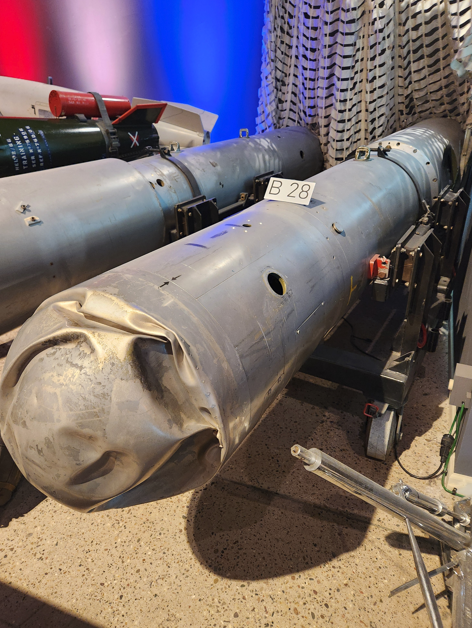
What a thermonuclear weapon looks like after it is dropped from a bomber by accident.
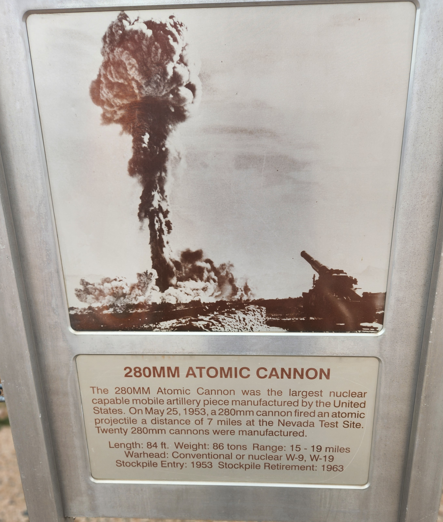
The actual cannon that fired a nuclear cannon shell and seen in film.
A photo after the nuclear cannon shell detonated.
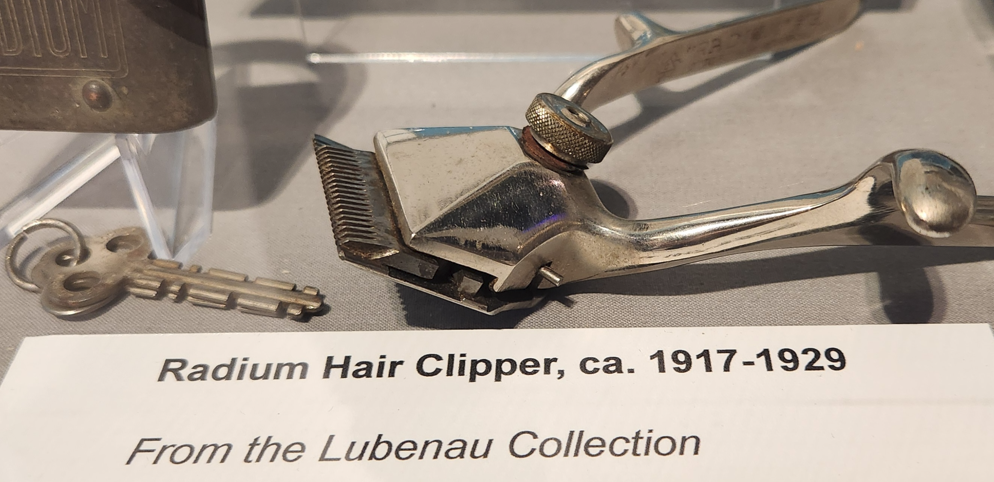
Why a radium hair clipper? Because there is a sucker born every minute.
Early atomic age children’s literature.
On my 50th birthday I actually went uranium prospecting near Idaho Springs, CO. I had a tip that pitchblende had been spotted nearby. All I managed to do was contaminate the Geiger counter with natural radioactive material that spoiled the calibration of the counter. Pisser.
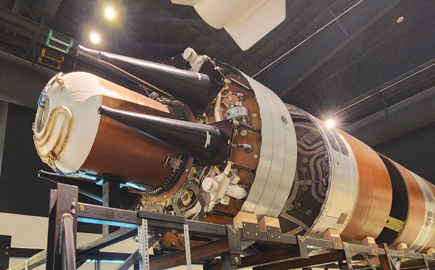
The top end of an ICBM with numerous MIRVs (the black conical objects).
A mockup of the top end of an ICBM with numerous MIRVs, Multiple Independently-targetable Reentry Vehicles.
Alert!! I spotted a Radio Shack store driving through Socorro. Driving by I could see shelves inside- it looked open for business. It was like spotting a wooly mammoth or a Dodo bird. I spent a lot of money at Radio Shack while in high school in the ’70s.
We had the opportunity to visit the Karl G. Jansky Very Large Array, VLA, near Magdalena, NM, last week. They hosted an open house for visitors on the 11th of October, 2025. After we visited the two famous big holes in Arizona, Barringer Meteor Crater and the Grand Canyon, we turned east to the VLA. Recently we toured the summit of Mauna Kea in Hawai’i and saw the optical observatories and NRAO radio astronomy dishes up there.
One of 26 radio telescope in operation dishes at VLA. Photo by Arnold Ziffel
Each dish has 8 antenna receiving elements clustered around the center of the dish, each detecting a different frequency. The continuous receiving range is 1 – 50 GHz. The dish antennas have 4 receiving configurations that they cycle through approximately every 16 months. Looking the secondary reflecting element of the dish in the upper left of the image, you’ll notice that there is a curved reflector. This reflector has a rounded surface that is designed to rotate, steering the focal point to the desired detector.
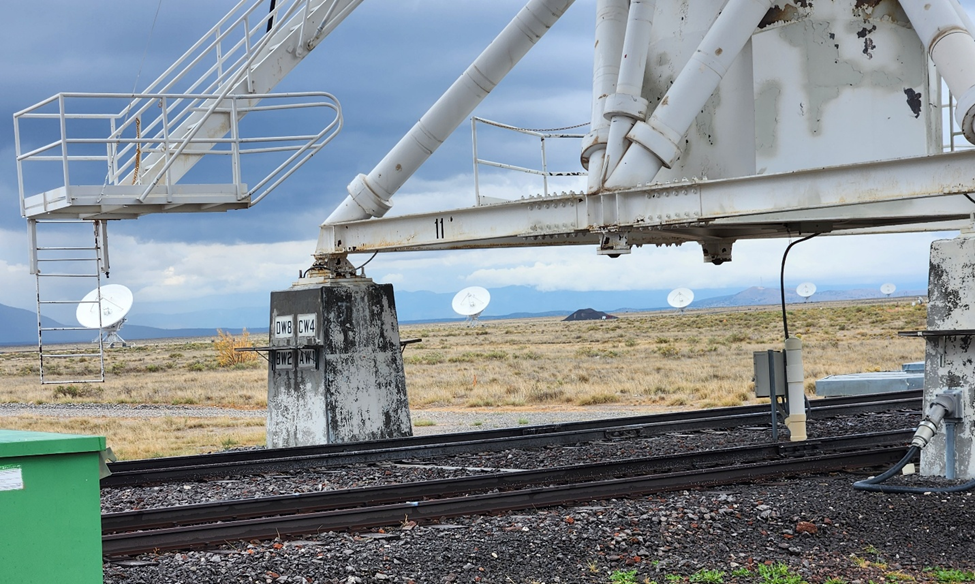
Looking at dishes in the distance from under another dish. Note the concrete pylons upon which the telescope rests. Photo by Race Bannon.
The rails on which the dishes move are of a “high speed rail” quality. The machine that moves the dishes is shown below. We were told by our astronomer tour guide that it takes 2 weeks to re-adjust the entire array of dishes. The “crawler” carrying a dish moves at 2 miles per hour.
The “Crawler” that carries the dishes into position. Photo by Quentin Quest.
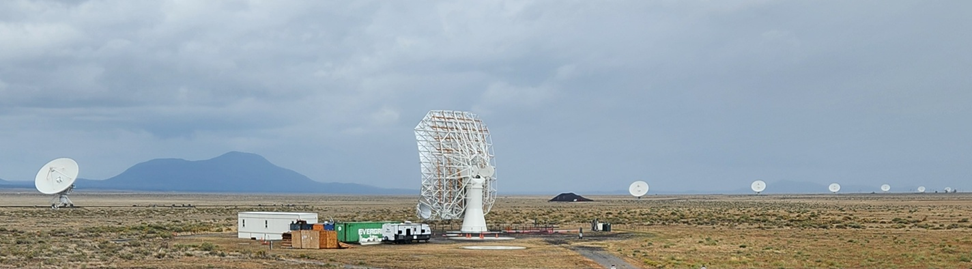
Below is a shot of the proposed next generation of radio telescopes.
In the center of the photo is a prototype radio telescope successor to the dish design of the VLA. Photo by some jabbering old guy.
NRAO has an image gallery at this link. The Astronomer’s link at the VLA website has a wealth of information available. A link to the next generation VLA is found here.
As wondrous as our physical and chemical senses are, they are severely constrained in a few fundamental ways. Our vision is limited to our retinal response to a narrow, 1-octave wide band of electromagnetic radiation. As it happens, this band of light can be absorbed non-destructively by or stimulate change in the outer, valence level of inorganic and organic molecules. Electrons can be promoted to higher energy levels and in doing so temporarily store potential energy which can then do work on features at the molecular level. In the retina, this stimulates a polarization wave that propagates along the nervous system.
Owing to the constraints of the optics of the band of light we can sense, we cannot see atoms or molecules with the naked eye. This is because the wavelengths in the narrow range of visible light are larger than objects at the atomic scale. Instead, we perceive matter as a continuous mass of material with no indication of atomic scale structures. No void can be seen between the nucleus and the electrons. For the overwhelming majority of human history, we had no notion of atoms and molecules.
Democritus (ca 460-370 BCE) famously asserted that there exist only atoms and vacuum, everything else is opinion. The link provides more detail. The point is that atoms and vacuum were proposed more than 2000 years ago in Greece. The words of Democritus have survived over time but I’ll hazard a guess that the words were not influential in the rise of modern atomic theory in the 19th and 20th centuries. A good question for another day.
In all chemistry, energy is added to the valence level of a molecule as electronic, rotational, vibrational or translational energy.
Thumbnail Sketch of the Interaction of Light and Matter
Radio waves are a band of long wavelength that can interact with electrically conductive materials. Electromagnetic waves having a wavelength greater than 1 meter are considered to be radio waves. As a radio wave encounters a conductor, the oscillating electric field of the wave causes charge to oscillate in the conductor and at a rate matching the radio wave. Radio waves, whether in electronic devices or in space, are formed by the acceleration of charged particles. Recall that when you cause a charged particle to change it’s direction of motion, e.g., by a magnetic field, it is undergoing an acceleration. It is useful to know that radio waves are non-ionizing.
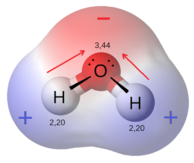
Microwave energy causes dipolar molecules to rotate back and forth by torsion as the waves pass. This rotational energy can be transferred to translational and vibrational energy through collisions, raising the temperature. The molecule does not need fully separated charges like a zwitterion, but molecules may have less than full charge on one side and a less than a full opposite charge on the other side, like water. This is a dipole. Water has a strong dipole and is susceptible to absorbing energy from microwaves.
Water molecule with dipole indicated.
Infrared radiation causes individual chemical bonds and entire frameworks to vibrate in specific ways. The Wikipedia link for this topic is quite good. When a molecule absorbs heat energy, it is partitioned into a variety of vibrational modes which can bleed off into other energy modes, raising the temperature.
Ultraviolet light is energetic enough to break chemical bonds into a pair of “radicals”- single valence electron species. These radicals are exceedingly reactive over their very short lifetime and may or may not collapse back into the original bond. Instead they can diffuse away and react with features that are not normally reactive, leading to the alteration of other molecules. UV light is very disruptive to biomolecules.
X-rays are more energetic than ultraviolet light and can cause destructive ionization of molecules along their path. They can dislodge inner electrons leaving an inner shell vacancy. An outer shell electron can collapse into the inner vacancy and release energy that can eject a valence level electron, called an Auger electron. This alters the atom by ionization and giving a change in reactivity. X-rays are also produced by the deceleration of electrons against a solid like copper though lighter targets can also produce x-rays.
Gamma radiation originates from atomic nuclei and their energy transitions. They are the highest energy form of electromagnetic radiation and cover a broad range of energies at <0.01 nanometer wavelengths. Many radioactive elements emit only gamma rays as a result of their nuclei being in an unstable state. Some nuclei can emit an alpha or beta particle resulting in an unstable nucleus that will then emit a gamma to relax.
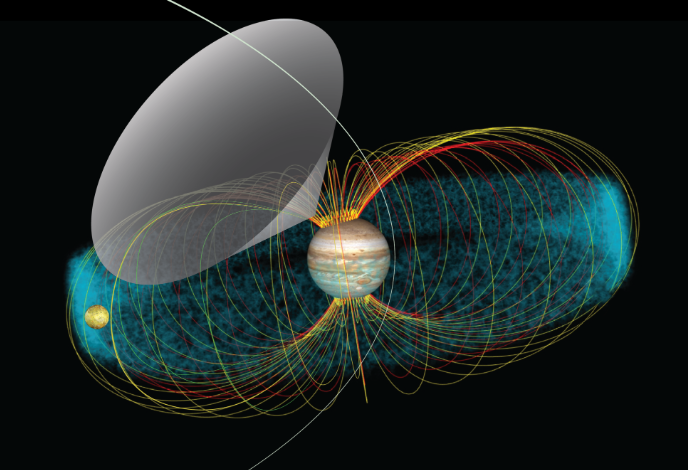
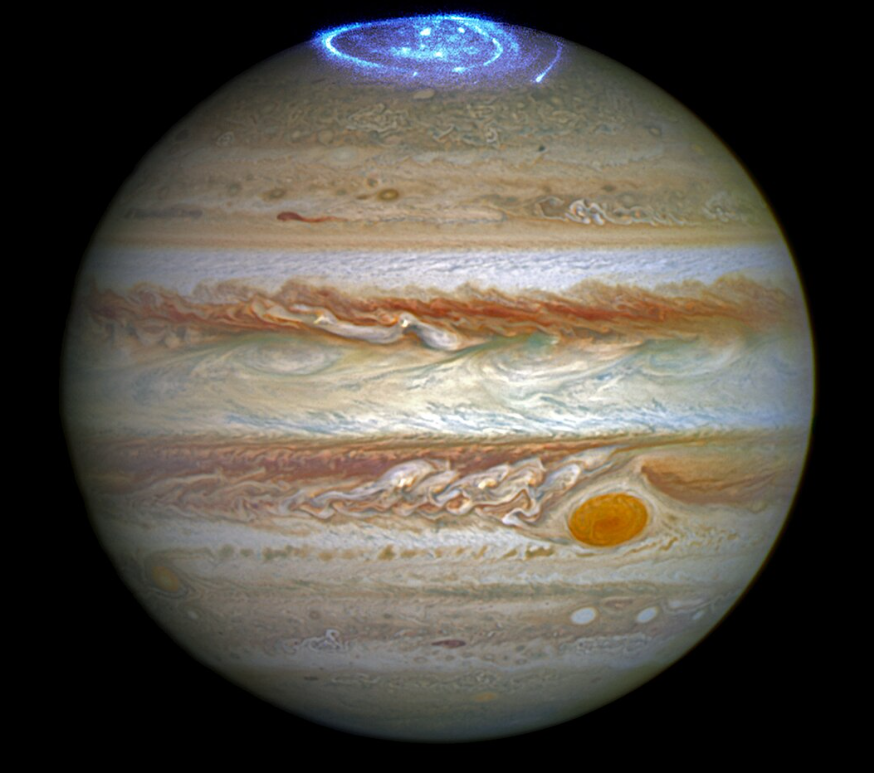
The wavelengths of radio waves are too long and too weak to interact with biomolecules. Some radio waves come from the synchrotron effect where charged particles like electrons will corkscrew around magnetic field lines of a planet and release energy in the form of radio waves. In the case of Jupiter and it’s moon Io, a stream moving charged particles are accelerated by a magnetic field, the particles will emit mainly in the 10 to 40 MHz (decametric) range of radio waves as they spiral around the magnetic field lines into Jupiter. Jupiter’s volcanic moon Io sends charged particles into the planet’s polar regions where the magnetic field lines bunch up. This leaves a visible trace of borealis-like gas that glows. That radiation is emitted in the shape of a conical surface. It is only detectable here when the cone sweeps past earth as Io obits Jupiter.
Image from NASA. “This is a representation of the Jupiter-Io system and interaction. The blue cloud is the Io plasma torus, which is a region of higher concentration of ions and electrons located at Io’s orbit. This conceptual image shows the radio emission pattern from Jupiter. The multi-colored lines represent the magnetic field lines that link Io’s orbit with Jupiter’s atmosphere. The radio waves emerge from the source which is located at the line of force in the magnetic field and propagate along the walls of a hollow cone (grey area). Juno receives the signal only when Jupiter’s rotation sweeps that cone over the spacecraft, in the same way a lighthouse beacon shines briefly upon a ship at sea. Juno’s orbit is represented by the white line crossing the cone.” NASA/GSFC/Jay Friedlander
Jupiter’s volcanic moon Io funnels charged particles into the planet’s polar regions where the magnetic field is strongest. This leaves a visible trace of borealis-like trails that glow. Source: NASA.
An atomic nucleus can absorb or emit gamma rays. For instance the gamma emitter Antimony-124 emits a 1.7 MeV gamma that can be absorbed by Beryllium-9 which photodisintegrates into a 24 kiloelectron volt neutron and two stable He-4 nuclei. This nuclear reaction can be used for surveying for beryllium ore deposits by detecting neutron backscatter.
The purpose of this cooks tour of the electromagnetic spectrum is to suggest that visible light band is uniquely suited to interact with matter just enough to induce valence-level chemical changes. The change can be charge separation or an alteration in the composition or shape of a molecule. The changes may be reversible or not.
Ok, done with that.
So, not all electromagnetic radiation plays nicely or at all with any given chemical substance. The narrow visible band of light is uniquely well suited to interact non-destructively, mostly, with living things. Chemistry is about the behavior of the outer, valence level of electrons around and between atoms and molecules.
The retinas in our eyes send signals to the brain continuously that result in a very curious thing- our perception of color registers instead of just a grey scale. Not just the colors of the rainbow, but also more nuanced perceptions like pastels, brown and in their many textures- all with binocular vision!
The constraints on human vision depend on the chemical composition and anatomical structures of the retina as well as the construction of the brain. As the description of the various bands of electromagnetic radiation suggest, there is much to the universe that our senses cannot detect. We do not directly view the radio, microwave, infrared, ultraviolet, x-ray or gamma ray views of the universe.
Our daily understanding of the universe is mostly framed by what we can see with the unique biochemistry and anatomy of the retina. It’s not a bad thing with its limitations, but for an appreciation of the true scope of the universe we would have to find ways to view in the other electromagnetic radiation bands. And, we do. With radio telescopes and satellites that pickup x-ray and UV energy to give images. Now with JWST, we’re peering deeper into the universe as revealed by infrared energy. The longer wavelengths of infrared can pass through clouds of dust particles that previously blocked our view in the optical spectrum.
The structures of the atom and molecules are characterized by the very large fraction of “empty” space they contain. Electrons seem to be point charges with no measurable size. Yet they have mass, spin and the same magnitude of charge but opposite that of the much heavier proton. And, the proton is not even a fundamental particle but a composite particle. It’s like a bag with three hard objects in it.
The universe is wildly different from what our senses present to us. All matter1 is made of mostly empty space. What we see as color doesn’t exist outside of our brains. Our sensation of smell is the same. Cold is not a thing. It is just the absence of heat energy. Finally, our consciousness exists only in our brains. It is a natural phenomenon that is highly confined, self-aware and may be imaged through its electrical activity or F-19 MRI with fluorinated tracers. This wondrous thing is happening on the pale blue dot floating in the vastness of empty space. So far, we can’t find anywhere else in the observable universe where this occurs.
It is good to remember that we search for extraterrestrial intelligence to a large extent with radio telescopes. On earth, the use of radio communication is a very recent thing, tracing back to the beginning of radio in 1886 in the laboratory of Professor Heinrich Rudolf Hertz at the University of Karlsruhe. Hertz would generate a spark and find that another spark would occur separately.
By 1894, Marconi was working on his scheme to produce wireless transmissions over long distances. The wider development of radio transmissions/receiving is well documented, and the reader can find a rabbit hole into its history here.
In order for the discovery of radio transmission to occur, several other things must have been developed first. The discovery of electricity had to precede the development of devices to generate stable sources of electricity on demand and with sufficient power. Then there is the matter of DC vs AC. Some minimal awareness of Coulombs, voltage, current, electromagnetism, conductors and insulators, and wire manufacturing is necessary to build induction coils for spark generation.
James Clerk Maxwell had developed a series of equations before the discovery of wireless transmission by Hertz. Hertz was very familiar with the work of Maxwell from his PhD studies and post doc under Kirchhoff and Helmholtz. Hertz was well prepared in regard to the theory of electromagnetism and was asking the right questions that guided his experimental work.
Radio transmission came to be after a period of study and experimentation by people like Marconi, Tesla and many others who had curiosity, resources and drive to advance the technology. As the field of electronics grew, so did the field of radio transmission. It’s not enough to build a transmitter- a receiver was required as well. Transmitter power and receiver sensitivity were the pragmatics of the day.
This was how we did it on earth. It was facilitated by the combined use of our brains, limbs, opposable thumbs and grasping hands. Also, an interest in novelty and ingenuity during this period of the industrial revolution was popular. While people who lived 10,000 years ago could certainly have pulled it off as well as we did, the knowledge base necessary for even dreaming up the concepts was not present and wouldn’t be for thousands of years. The material science, mathematics, understanding of physics, and maybe even cultures that prized curiosity and invention were not yet in place.
In order for extraterrestrials reaching out to send radio signals that Earthlings could detect, they would have to develop enough technology to broadcast (and receive) powerful radio transmissions. If you consider every single mechanical and electrical component necessary for this, each will have had to result from a long line of previous developmental work. Materials of construction like electrical conductors could only arise from the previous development of mining, smelting and refining as a prelude to conductor fabrication to produce a way of moving electrical current around.
Radio transmission requires electrical power generation and at least some distribution. None of this could have been in place without the necessary materials of construction, mechanical and electrical components already in place. Most of the materials would have to have been mined and smelted previously. Electrical power generators need to be energized by something else to provide electricity. On earth we use coal or natural gas to produce steam that drives generator turbines to make electricity. Also, there is nuclear and hydroelectric power. ETs would face a similar problem for the generation of electrical power.
If you follow the timeline leading to every single component of an operating radio transmitter, you’ll see that it requires the application of other technologies and materials. It seems as though a radio transmission from extraterrestrial home planets need something like an industrial base to get started.
What if there were intelligent extraterrestrials who were not anatomically suited to constructing radio transmitters for their own Search for Extraterrestrial Intelligence or just for local use? Perhaps they are +very intelligent but not far along enough yet to have developed radio. Or, what if they were just disinterested in radio? What if they used radio for a short window in time and have been using something else not detectable from earth, like what we do with optical cable? The point is that we would never hear them by radio, yet they would be there.
Surely there is a non-zero probability of this happening. This dearth of signal may be so prevalent that we will conclude that we are alone in our local region of space. Perhaps funding will be cut and we’ll quit looking. We can take that finding to fuel our sadness of being alone in the cosmos. Or we could use it to appreciate just how unique life is and take better care of ourselves.
Instead of buying into Elon Musk’s vision of colonizing Mars and somehow terraforming it, why don’t we terraform Earth back into a place where the biosphere is more stable and pollution is pushed back to some lower level? A utopian vision for sure, but it also has a non-zero probability of happening.
1. Not including dark matter, if it really exists. I remain skeptical.
Atomic hydrogen (the major isotope protium) is the simplest, lightest and most abundant neutral atom in the universe. Molecular hydrogen, H2, is the simplest neutral molecule in the universe. Seems very simple. Well, hold on. Turns out that molecular hydrogen has two distinct forms and it relates to the business of nuclear spin.
Quantum mechanics (QM) is a basket of wavy weirdness. It is a model of the universe at the atomic and nuclear levels that is wildly different from the larger scale Newtonian universe of colliding billiard balls we humans casually observe. The QM model of the microscopic universe dates back to the early 1900’s and has been endlessly supported by experimental data, and it continues to surprise to this day. One of the fundamental QM quantities is ‘spin.’
Fundamental particles like electrons and protons have something referred to as spin angular momentum. In the larger scale Newtonian universe spinning is something that we equate with an object that is rotating about an axis. Protons have a measurable diameter- it is a finite sized object with mass, charge and spin. Electrons have mass, charge and spin also. However, electrons do not have a measurable size. They appear to be a point charge. So, how does an electron with no measurable size actually spin? What is it that spins? A point of clarification: Quantum spin has nothing to do with a rotating internal mass. It is a quantized wave property expressed in units the same as classical angular momentum (N·m·s, J·s, or kg·m2·s−1). So, what the hell is quantum spin?
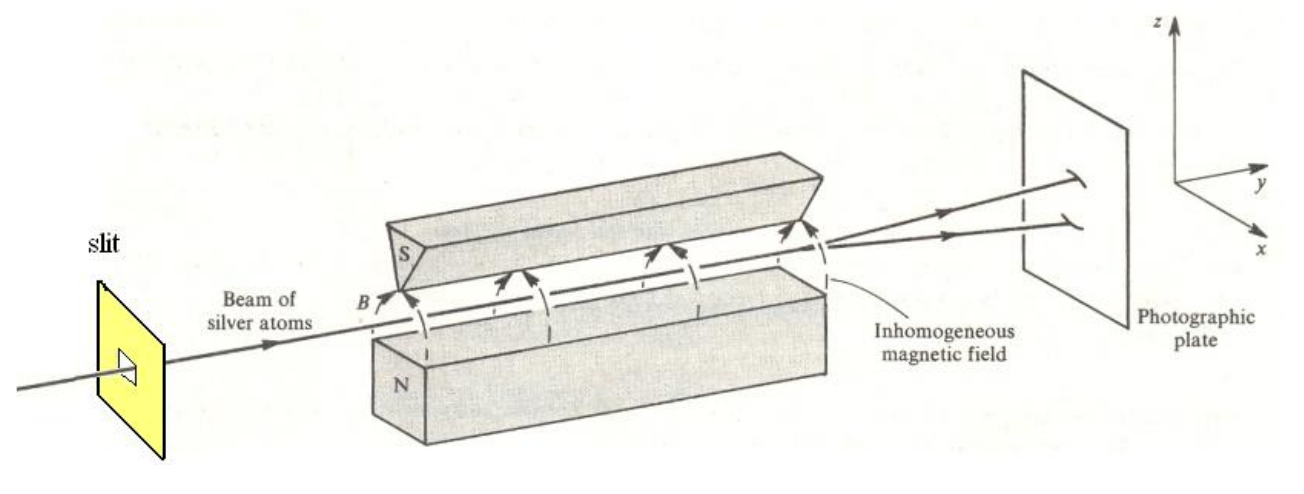
Spin angular momentum was inferred experimentally by the Stern-Gerlach experiment, which was first conducted in 1922. In this experiment, silver atoms were passed through a magnetic field gradient towards a photographic plate. Particles with no magnetic moment** would pass straight through unaffected. Particles with non-zero magnetic moment would be deflected by the magnetic field. In the experiment, the photographic plate revealed two distinct beams rather than a continuous distribution. The results indicate that the magnetic moment was quantized into two states. The magnetic moment at the time was thought to be due to the literal spinning of an electrically charged particle. They deduced that there were two spin configurations- i.e., they were quantized.
If you want to go deeper down the QM rabbit hole, be my guest. We’ll go forward with the notion of spin up and spin down. You’ll see how it works.
Atomic Hydrogen- Things Get Sciency
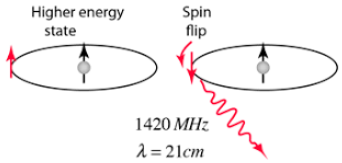
First, let’s look at a neutral hydrogen atom made of a proton and an orbiting electron. Both particles have spin and each can be in one of two states relative to the other- parallel and antiparallel or simply spin up and spin down for the sake of illustration. The spin combinations are up-up and down-up as shown in the figure below. Think of the arrows as bar magnets, so up-up would be two magnets with the north poles in parallel and the down-up would be bar magnets with magnetic poles facing opposite directions, or antiparallel. The arrangement where the magnets are aligned with identical poles in the same direction is less energetically favorable than when they are antiparallel. Since it is energetically down-hill, the up-up will want to flip to down-up or antiparallel lower energy state. The energy difference is lost as radio frequency radiation in the microwave band.
A spin flip to lower energy level results in the emission of a 1420 MHz (21 cm wavelength) radio frequency emission. This can be detected by a radio telescope though with some difficulty due to poor signal to background noise. Credit: http://hyperphysics.phy-astr.gsu.edu/hbase/quantum/h21.html
The spin transition energy is 9.411708152678(13)×10−25 Joules. Regions of space with more intense 21 cm radiation are thought to be regions of greater hydrogen atom abundance. These regions can be examined for redshifting to give clues about relative motion in space. The spiral structure of the Milky Way galaxy was discovered with 21 cm radio observations.
Molecular Hydrogen, H2
Molecular hydrogen consists of two hydrogen atoms that share a pair of electrons which provide the bonding force. The two electrons spend a finite amount of time between the protons canceling the repulsive force between them. It’s called a sigma bond. So far, so good. The bond is springy so the molecule can/does vibrate.
An unfortunate reality of chemistry– Like most topics, the more background you have on a chemistry principle, the more unifying and elegant it becomes. This means that sharing the beauty of the molecular world is a little more difficult that many would like. I regret this most sincerely. Most freshman chemistry involves balancing equations and PV=nRT math. Necessary but not always captivating. Freshman chemistry is much like the Hobbit in the Lord of the Rings trilogy. It’s a necessary prelude.
First, a Dive Down the QM Rabbit Hole
Ok. I couldn’t ignore the QM rabbit hole. The two electrons of an H-H bond must have opposite spins in order to form a covalent bond. An orbital represents a specific occupancy space for one or two electrons around an atom or molecule. They are places, not physical objects. The atomic orbital model is a mathematical construct based on spherical harmonics to define the shapes of space that electrons will occupy around the nucleus, depending on their energy and quantum numbers. The likelihood of finding an electron is wavelike within a region of space.
Two electrons can occupy one orbital if they have opposite spins. It’s referred to as spin pairing. (Note: I posted on the orbital stuff a few posts back.) This hard and fast rule of antiparallel spins occupying the same orbital is formalized by the Pauli Exclusion Principle. The Pauli Principle says specifically that “no two fermions with half-integral spins can occupy the same quantum state within the same quantum system“. Electrons are fermions and the upshot is that only 2 electrons of antiparallel spin can occupy a single orbital. If two or more orbitals of equal energy level are available, the electrons will occupy separate orbitals with the same spin. The manner of the filling of orbitals with electrons is covered by Hund’s Rule.
Finally, QM gives a number to an electron’s spin- the spin quantum number. According to the Pauli Exclusion Principle, two electrons in a single orbital must have different half-integral quantum spin numbers: +/- 1/2, or antiparallel- to occupy the same orbital space.
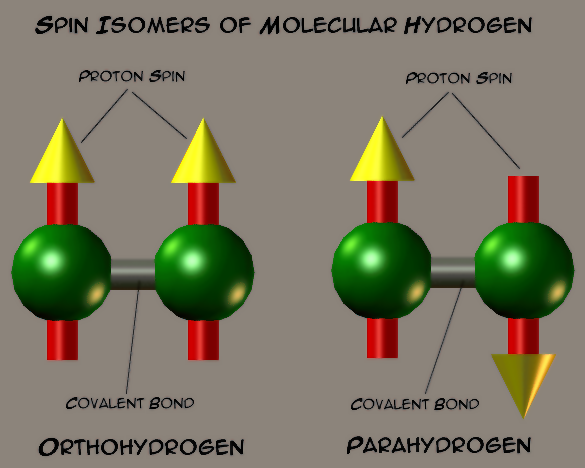
Because the two H-H electrons are spin paired, there is no net spin from them. However, the protons are a different matter. Their spins can be parallel (up-up or down-down) or anti-parallel (up-down). The anti-parallel spins cancel to give no net proton spin to the H-H. But, in the case of spin parallel, the H-H molecule definitely has net spin.
The spin parallel H-H molecules are called orthohydrogen and spin antiparallel H-H molecules are called parahydrogen. They are referred to as spin isomers or allotropes and are each distinct substances. There can be interconversion from orthohydrogen to parahydrogen molecules. The transition does not emit radiation, but it is exothermic. The parahydrogen is more stable by 1.455 kiloJoules (kJ/mol) per mole. Heating hydrogen will bring the composition to a maximum of 25 % ortho to 75 % para. When hydrogen is liquified, there is a slow conversion of ortho to para. It is worth noting that the enthalpy of evaporation of normal hydrogen (1:3 ortho to para) is 0.904 kJ/mol which is smaller than the 1.091 kJ/mole for 1:3 ortho to para conversion enthalpy for “normal” hydrogen. The conversion of orthohydrogen to parahydrogen in liquid form is exothermic and can result in hydrogen boil-off, leading to hydrogen loss and possibly causing a hazardous pressure rise. Those who regularly handle liquid hydrogen must be aware of this phenomenon. Orthohydrogen can also be catalytically converted to parahydrogen by contact with certain substances like ferric oxide, chromic oxide as well as several materials.
** Magnetic moment (from Wikipedia): magnetic moment is the magnetic strength and orientation of a magnet or other object that produces a magnetic field.
An image of Sagittarius A*, the black hole in the center of the Milky Way galaxy, has just been published. This is only the second such feat. The first image was of the central black hole of the galaxy M87. The images were captured through the collaboration of 8 synchronized radio telescopes around the world called The Event Horizon Telescope. It is an impressive technical problem to solve. Seeing something the apparent size of the M87 black hole as viewed from earth is said to be like trying to see a bagel on the surface of the moon. And they did it with sub-millimeter radio waves.
The color of the objects is interesting. I wonder how many folks out there think that radio telescopes can record the visual color of an object?
A recent paper (free) in Geophysical Research Letters reports the discovery of long anticipated ionospheric disturbances caused by the passing of the moon’s shadow over the earth during an eclipse. The paper, submitted by the MIT’s Haystack Observatory, reports the occurrence of ionospheric bow waves associated with the shadow ground-track of the August, 2017, North American eclipse. The online source, MIT News, summarized the discovery.
Check out this great shot of a jet transiting the sun. It happens ca 8 seconds in the sequence. What surprised me was the extent of the forward motion of the contrail vapors. I always imagined that they had closer to a zero ground speed. This is a good visualization of the extent to which the aircraft does work on the atmosphere by accelerating some of it along the direction of motion.
This video was captured by a member of the Radio Jove community. He was shooting a solar prominence with a Coronado PST and a webcam when the jet passed through the field of view. (Obviously, he was not doing radio astronomy at the time.)
Thanks to a friend in Grand Rapids, I was linked to a blog hosted by the NY Times called Tierneylab.com. The writer of the post was sounding off about a pet peeve relating to the use of the term “Organic”. It seems that there is some confusion as to the use of the adjective organic in relation to certain carbon-containing substances. Tempest in a teapot, you ask? Let the chemistry community decide.
The problem begins to show itself when astronomers and planetary scientists start describing carbon containing materials found in planetary exploration as organic. Back on earth, the word organic is burdened with both common and scientific usage. So, when descriptions of organic materials found on other worlds begin to arise in discourse, the intent of the usage becomes unclear.
For instance, it could suggest to people that such discovered materials were put in place by some kind of life form. It could suggest to nondiscriminating audiences that the presence of carbon implies life, past, present, or future. Or it might well suggest to higher level audiences that biology-ready raw materials are in place.
The scientists working with the Phoenix Lander have an interesting analytical chore in front of them. Using a robotic platform on Mars, they want to distinguish the presence of organic vs inorganic carbon. What is meant by organic and inorganic is less than clear. But it seems that organic refers to something other than CO2 and carbonate.
In the relatively few journal articles I’ve seen relating to this, the authors are not always precise about the kinds of molecules they are referring to as organic. Irrespective of what is said in the articles, when this work gets to a public forum, the meaning behind the word organic becomes even less clear.
The TierneyLab post does bring up an interesting question about what is necessary for a substance to be considered organic. Do graphite, diamond, Buckyball, or soot forms of carbon qualify as organic? What about CO2, CS2, carbonates, CO, HCN, or calcium carbide? Does it make more sense to refer to organic and inorganic carbon, where inorganic carbon is defined as … well, what?
Seriously, what would it be? CO2? Carbon dioxide is incorporated into glucose by plants and this seems quite organic. Carbonate? This anion is used to balance our blood pH. Our own metabolic CO2 helps to provide carbonate. This product of metabolism should qualify as organic. CO? Well, Carbon monoxide undergoes Fischer-Tropsch reactions to produce aldehydes. This seems very organic as well. Perhaps the target is a substance with C-H bonds?
There is nothing inherently biological about the C-H bond. The Saturnian moon Titan is blanketed with a thick layer of CH4 (methane) and it seems unlikely that it is of biological origin. Indeed, hydrogen is the most abundant element in the universe and carbon the 4th. That hydrogen and carbon atoms could find each other to form trace methane in a proto solar system isn’t too much of a stretch.
Organic and Inorganic Carbon. How about we just leave it all as organic?
Here is what I think. It does matter if a scientist or writer is using language in an imprecise way. If writing or speech implies, for instance, that Mars is rich in life giving organic nutrients when in fact Martian organic matter is really carbonate and CO2, then I believe the language must be altered to reflect that condition. A writer should not leave an impression of past or incipient planetary fecundity when in fact the planet may be an inert ball of metal silicates dusted with a bit of carbonate when the 6 torr CO2 atmosphere kicks up a breeze.





 Lamentations on Chemistry