
Category Archives: Regulatory

EPA Suspends all US Registrations of Dacthal Herbicide

The Environmental Protection Agency announced on August 6th, 2024 there would be an emergency suspension on all registrations of the preemergent herbicide chlorthal-dimethyl, or dimethyl tetrachloroterephthalate (DCPA or Dacthal). It has been 40 years since the US EPA has issued such an emergency suspension of registrations. This order has immediate effect.

US patent US2923634A was granted to Diamond Shamrock 1960-02-02 with a single claim-

1. THE METHOD OF CONTROLLING UNDESIRABLE PLANT GROWTH WHICH COMPRISES CONTACTING SAID PLANT GROWTH WITH AN ACTIVE AMOUNT OF DIMETHYL 2,3,5,6-TETRAHALOTEREPHTHALATE.

An early patent claiming the use of DCPA, but not the composition.
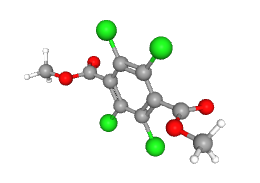
Graphic and physicochemical data. PubChem. DCPA structure tilted just a bit for clarity. Octanol/water partition coefficient: log KOW = 4.40 @ 25 °C, water solubility = 0.5 mg/l @ 25 °C, Vapor pressure: 2.5 x 10⁻⁶ mm Hg at 25 °C

The octanol/water partition coefficient, log KOW, sometimes called Log P, is a measure of how a substance will partition itself between 2 phases, a hydrophilic phase and lipophilic phase. This logarithm is used to give some insight into the type of living tissues a substance will tend to accumulate in on exposure or dosing. A log KOH of 4.40 represents a ratio (antilog) of 25,119 to 1 favoring the octanol. This indicates considerable lipophilicity.

The industrial manufacture of DCPA is neither complicated nor difficult. The terephthaloyl chloride (pronounced: terra THAL oh ill chloride, soft TH as in “thing”) raw material is used in the manufacture of Kevlar and is readily made in several ways. Whether or not the DCPA manufacturer makes their own or outsources it is not available information. In either case, the terephthaloyl chloride is chlorinated to exhaustion (fully chlorinated) and then the methyl ester is prepared by contacting the chloride with methanol to form the diester (pronounced: DYE ester).

Why does DCPA have 4 chlorine atoms on it? Hard to say exactly what the thinking was, but from the process chemistry perspective forcing 4 chlorine atoms on the ring rather than just 1, 2, or 3 solves the problem of ending up with a dog’s lunch of mono-, di-, tri- and tetrachlorinated compounds in the product mix. Individually, each may have differing potency, selectivity, biochemical mechanisms, and human or environmental toxicological properties. Subsequent environmental and tox studies would be complicated by the potential of 4 analogs each possibly requiring individual testing at some point. Another thing to consider is that single component solids are much more easily purified by crystallization than a solution of solid components. A solution of mixed components can be quickly precipitated by cooling or concentrating, but pulling out one pure solid among many solid close analogs can be difficult and low yielding. Single component products are almost always better for ease of processing.
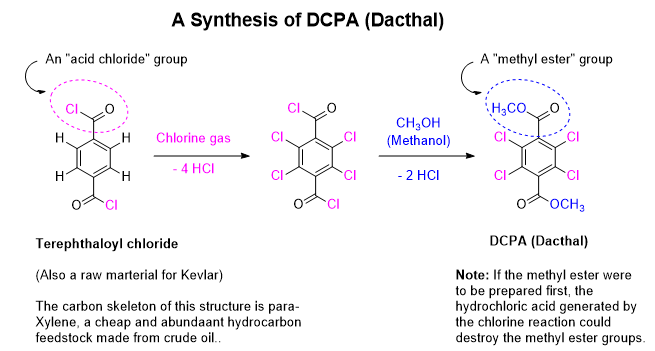
Graphics by John Jacob Jungleheimer Schmidt. The “oyl” fragment of the name indicates the presence of the acid chloride group.

DCPA is a selective non-systemic, or contact, herbicide used for pre-emergence control of annual grasses and some annual broad-leaved weeds. Coverage rates of 6-14 kg/hectare are common.

From PubChem: “/IT IS/ PRESENTLY APPROVED FOR USE ON TURF, ORNAMENTALS, STRAWBERRIES, AND AGRONOMIC CROPS INCLUDING COTTON, SOYBEANS, AND FIELD BEANS. /IT IS/ EFFECTIVE AGAINST SMOOTH & HAIRY CRABGRASS, WITCHGRASS, GREEN & YELLOW FOXTAILS, FALL PANICUM & OTHER ANNUAL GRASSES. /IT IS/ ALSO USEFUL AGAINST CERTAIN BROAD-LEAVED WEEDS SUCH AS CARPET WEED…PURSLANE & COMMON CHICKWEED. /IT IS/ TOLERATED BY MANY CROP PLANTS.”

DCPA is a relatively simple small molecule that is made from cheap and abundant early feedstocks like para-Xylene, Chlorine and Methanol. It has good potency and desirable selectivity in its ability to kill crabgrass in the presence of turf grass. The chemical process steps are well understood, each with a long history of successful use. It can be sold in solid form or in liquid form and may be applied by a large variety of methods. It can be applied for pre-emergence or folial use.

According to EPADCPA is a chlorinated benzoic acid herbicide which inhibits cell division of root tips in target plants. It controls many annual grasses and broadleaf weeds in a variety of agricultural crops and ornamental varieties (e.g., broccoli, onions, tomatoes, cabbage, cauliflower, dogwood, azalea). Annual agricultural use from 1998 through 2008 averaged approximately 500,000 pounds over 100,000 acres with broccoli and onions accounting for 79 percent of that use (Ratnayake, 2011). Information also suggests that on average 50 percent of broccoli is treated and 15 percent of onions (SLUA).

As useful of an herbicide as it may be, it has a dark side that spooked the US EPA into issuing an unusual emergency suspension on August 6, 2024. In particular is the potential toxicity to the unborn and the risk to “post-application workers involved in tasks such as transplanting, weeding and harvesting.” Female farmworkers are at high risk since DCPA has been shown to be toxic to the fetus producing lifelong health problems. The reader is invited to read the link for details in the toxicology. The successive degradation of DCPA is shown below. In addition to hydrolysis, it is also subject to photodegradation in sunlight.
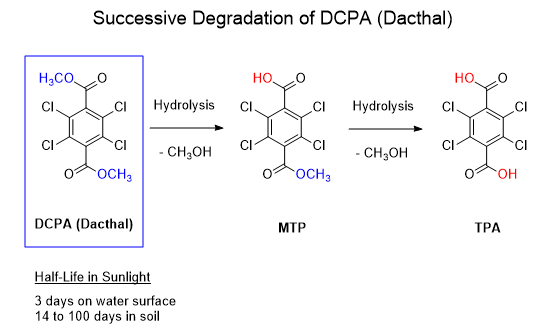
Graphics by John Jacob Jingleheimer Schmidt.

Why wasn’t this discovered earlier? I’m not an EPA pesticide guy, but discovering the specific toxicity of herbicides registered many years previously requires some kind of trigger to get an investigation started. Today, other than an overt incidence of toxic effects making the news, that trigger can be the Registration Review Overview conducted by EPA every 15 years for each registered pesticide.

Having interacted with a certain division of the USEPA for the last 3 years, I can say that there are many intelligent and knowledgeable scientists, engineers and other professionals who try to get things done in a very constricted space bounded by layers upon layers of federal laws converted into regulations. They are about as loved as the Internal Revenue Service and, like IRS, are forced to work wildly understaffed and with an IT system that is decades out of date. A doff of the hat to EPA.

Government Regulations: USC vs CFR

I’m in the middle of sorting through government regulations and I thought I’d pass along some definitions to help grasp just What. The. Hell. Is. The. Difference between the United States Code, U.S.C., and the Code of Federal Regulations (CFR). The EPA has a website that describes the regulatory process.

  • First in the sequence, bills are written, debated, and voted upon. The legislative branches write a law and the President signs it or does not. If signed the law is sent for inclusion into the U.S.C.
  • Next the new law needs to be “codified” into the United States Code. This is the official compilation of US Federal law and is published every 6 years. In between publications, annual cumulative supplements are published.
  • Once codified in the U.S.C., the government agency tasked with putting the law into effect (promulgation) may (or may not) rewrite the code into a comprehensible form that can be understood by the public. The relevant agency is also responsible for enforcement.

Regulations Can Expand or Evolve

If the agency becomes aware of issues in need of regulation, it may generate new regulation and place a “Notice of Proposed Rule Making” in the Federal Register for public study and comment.

After the comment period, the agency may or may not update the proposed regulation(s) and issue a Final Rule. The Final Rule is then published in the Federal Register.

Regulations are codified in the official Code of Federal Regulations (CFR). The CFR is split into 50 subject matter categories called “Titles.” An electronic copy of the CFR called eCFR and is kept online at this link.

Chaos at the EPA

It’s difficult to describe how badly the New Chemicals division in the Office of Pollution Prevention and Toxics (OPPT) at EPA is performing these days, but let me try. The commercialization of new chemicals (not on the TSCA Inventory) not otherwise regulated requires that new chemical substances (NCS) be reviewed and granted following a Pre-Manufacture Notice (PMN) or a Low Volume Exemption (LVE) submission under the Toxic Substances Control Act (TSCA), should they meet internal criteria regarding safety. Exposures and doses to workers or the environment may be measured by the applicant or modeled using EPA in-house software. R&D only chemicals are exempt from such evaluation no matter the scale.

The application process requires the disclosure of the NCS composition and structure, the manufacturing and/or use operation in considerable detail, physicochemical properties and, if available, a wide range of worker and environmental hazards. Imported chemicals not on the TSCA inventory also require TSCA approval just as though they were being manufactured in the USA. Food, drugs and pesticides are not controlled under TSCA. Under penalty of law, all submissions must have the best and most accurate available information, particularly with regard to hazard information. No fibbing allowed.

The issues I’m about to recount started sometime in early 2021. Some speculate that a particular interpretation of the law promulgated by TSCA was adopted. I can’t provide references, however.

By statute, an LVE filing for instance, must be examined and be given a grant, conditional grant, or denial within 30 days. It is currently taking much longer than that: 60 to 100 days or longer. I have some that are still pending after 7 months. PMN filings take longer to process, about 9-12 months. or worse.

Aren’t these delays just a petty annoyance? Well, no. Part of a new product development timeline is getting regulatory approval. If this approval is subject to large delays with uncertain outcomes, then the launch date can become very fuzzy. The consequence for the end user is that scheduling their production activity becomes impossibly vague. Denials of LVE and PMN filings are not uncommon. Don’t expect a lot of sympathy from customers about EPA problems.

The last thing you want is some plebe right out of school with no professional experience in commerce to be handing out the regulatory death penalty to your expensive new technology. Handling hazardous materials safely and without environmental harm is done all day every day all over the world. There is a saying in the chemical industry: If you think safety is expensive try having an accident. There is considerable financial incentive to running a chemical plant safely and within regulations.

There seems to be a troubling issue involving the assumptions that EPA makes in regard to handling the NCS. The feedback I receive suggests that the engineers and toxicologists are ruling based on the worst case exposures that they imagine are going to happen. They imagine that workers and the environment will be exposed to the NCS as if workers aren’t wearing personal protection equipment (PPE) or there was no barrier to the environment. You can plainly state that these exposures won’t happen and state why, but they want evidence evidence that they cannot define that something will not happen. In other words, they want proof of a negative.

Another problem with EPA seems to be the sophomoric view that chemical hazards can always be abated by using safer chemicals. There may be a speck of truth to this generalization. In the formulations industry, for example. Replacing hazardous ingredients in mascara or shampoo with those that are less hazardous may be quite uncomplicated. Reducing chemical hazards is part of ethical business operations and is expected with ISO 9001 registration. The catch for chemical manufacturing is that the chemical features that make chemicals reactive and hazardous are usually the same features that make them essential to synthesis. Except for solvents and filter aid, unreactive chemicals are not very useful in synthesis. Synthetic chemistry is about manipulating the reactive features of one molecule with another to yield a useful product.

The delay issue is not unknown to EPA. In fact they are painfully aware of it all the way up to the EPA administrator. The good folks at EPA are doing their best with absurdly limited resources. We’re told that the TSCA division is 50 % understaffed, and many of the staff they do have are inexperienced. They have a computer system that is obsolete by many generations. You can see this by filing on their website. They have taken to denying submissions that are flawed in a minor way rather than continuing to work with the applicant to fix the problem. This excess fastidiousness ratchets down their backlog, at least in the short term.

The problems at EPA stem from the inability of congress to buckle down and provide proper funding. Only congress can act to boost staffing or computers. Lobbyists are working on it but, unfortunately, this is not an appealing issue for a congress person to take up and run with. Maybe we can get that cancerous A-hole Tucker Carlson to howl about it on the tube. Then we might see some movement.