Category Archives: Russia

Russia Fires Hypersonic Oreshnik Missiles at Ukraine

At a time when the Trump administration is making enemies in the EU with talk of a military adventure in Greenland, Putin has unleashed Oreshnik hypersonic intermediate range missiles at Ukrainian civilians. The targeting of civilians is nothing new for the Russians, but the Oreshnik missiles travel at up to Mach 10 (7610 mph) which makes shooting them down problematic. Russia has held back this missile system until now., though in 2024 it apparently had fired a test shot absent explosive warheads. According to Wikipedia the Oreshnik ballistic missile system is still in the experimental stage.

The Russians have gotten quite peevish lately, claiming that Ukraine targeted the sprawling home of Putin. Targeting civilians in Kyiv as well as Lviv in western Ukraine serves the dual purpose of reminding the NATO and the EU of the threat Russia poses to them. Golly. Imagine a warring state trying to decapitate the leader of its opponent. According to reports Russia has been trying to assassinate Zelinski, so a reciprocal decapitation effort should be expected.

While Russia burns through military resources and personnel, and while the Russian economy teeters on the edge of total collapse, the conventional military threat to Europe should weaken more by the day. They are taking roughly 1000 casualties per day while their recruitment effort is falling short of that number. However, the nuclear threat remains. It is an open question as to whether Putin refrains from releasing nuclear weapons as his tenure becomes endangered. The Oreshnik missile is capable of carrying multiple nuclear warheads- a fact that is lost on nobody.

It’s not in the nature of Putin or his Kremlin to admit even the slightest amount of damage or discomfort caused by Ukraine. One fine day the west will learn that Putin has disappeared and a successor has surfaced. What will Russia do then? A gesture of humanity, perhaps? That would be out of character. A Russian leader could never admit mistakes or defeat. Krushchev did it, but his tenure was cut short by the politburo with Brezhnev taking his place.

Who on God’s Green Earth Wants to Invade Russia?

Putin has said on numerous occasions that the West wants what Russia has. Seriously? You mean permafrost? -61 oF winters. A border with China? A multiethnic and antagonistic population? A shortage of warm, deepwater ports? A long history of brutal authoritarianism?? Its gleaming history with nuclear energy and vast stretches of land contaminated with radioactive soil. Yes, we in the West stare longingly at Russia for this from time to time … NOT!

Oh yes, Pootie-Poot (nickname by George W. Bush) must mean natural resources like petroleum, platinum group metals, gold, titanium, uranium, diamonds, etc. These are valuable natural resources but at what cost for a conquering power. Too high by half would be the conclusion by rational people. Recall the problems Hitler had with Operation Barbarossa. Or the disaster Napolean fell upon with his ill-conceived invasion of Russia. Like any modern state, Russia has much in the way of weapons to bear upon its enemies. But what Russia has in great abundance are brutal winters and a muddy spring season to immobilize invaders.

Like any authoritarian worth his salt, Putin continues to make the case for tightening personal liberty in exchange for layers of “state security”. Citizens have been conditioned to avoid politics in exchange for politics avoiding citizens. It seems to work.

Like nearly everywhere else, Russia is populated by good and decent folks. I’ve been there and have experienced generous hospitality from ordinary citizens in their cramped apartments. How we could be mortal enemies is beyond me.

The people we now call Russians are descended from tough people who survived conquest and occupation by many hostile invaders over the many centuries. Somehow, they even chased out the Mongols and later overcame the mechanized invasion of Nazis. As the Red Army chased the Nazis westward in WWII, they burned down their own villages and even executed Russian citizens who failed to fight and die. My Russian language professor was a Ukrainian kid whose family evacuated Ukraine for Europe in WWII to flee the advancing Red Army.

The title of this post asks, “Who on God’s Green Earth Wants to Invade Russia?” I’d offer that to try would be at best to invite a nuclear exchange, terrible hardships and losses for any invasion force. It would be a supremely bad decision. And even if an invader prevails, what have they gained? A population dedicated to guerrilla warfare and civil disobedience. Sounds like a nightmare.

The consequences of invasion and occupation of any large region would produce guerrilla warfare and civil disobedience by the surviving conquered population.

The West could benefit by making it known out loud to the Russian people and the Kremlin that we understand that an invasion or occupation of Russia by a foreign power would be a suicidal calamity for any invader. The usual rancid Kremlin propaganda must be countered with words of strength, peace and prosperity for all people. We invite Russia to be a member in the community of peaceful states who participate in open commerce and tourism.

Where does Russia go next?

[Edited and Rewritten post.]

Many Western observers often imagine a future in which, after Putin’s departure, Russia evolves into a more open and cooperative nation. Wouldn’t it be appealing if Russia joined the global community of states that embrace free trade and safe tourism? This vision reflects our own ideals, making it easy to assume that Russia might share them—but history suggests the reality may be far more complex.

A review of Russian history from Tsar Nicholas II to the present reveals a persistent pattern of authoritarian governance. Although Tsar Alexander II abolished serfdom in 1861 and introduced several liberal reforms, these changes faced strong resistance. Many reforms were ultimately reversed, as they diminished the power of the nobility, provoking significant opposition despite their positive perception in the West.

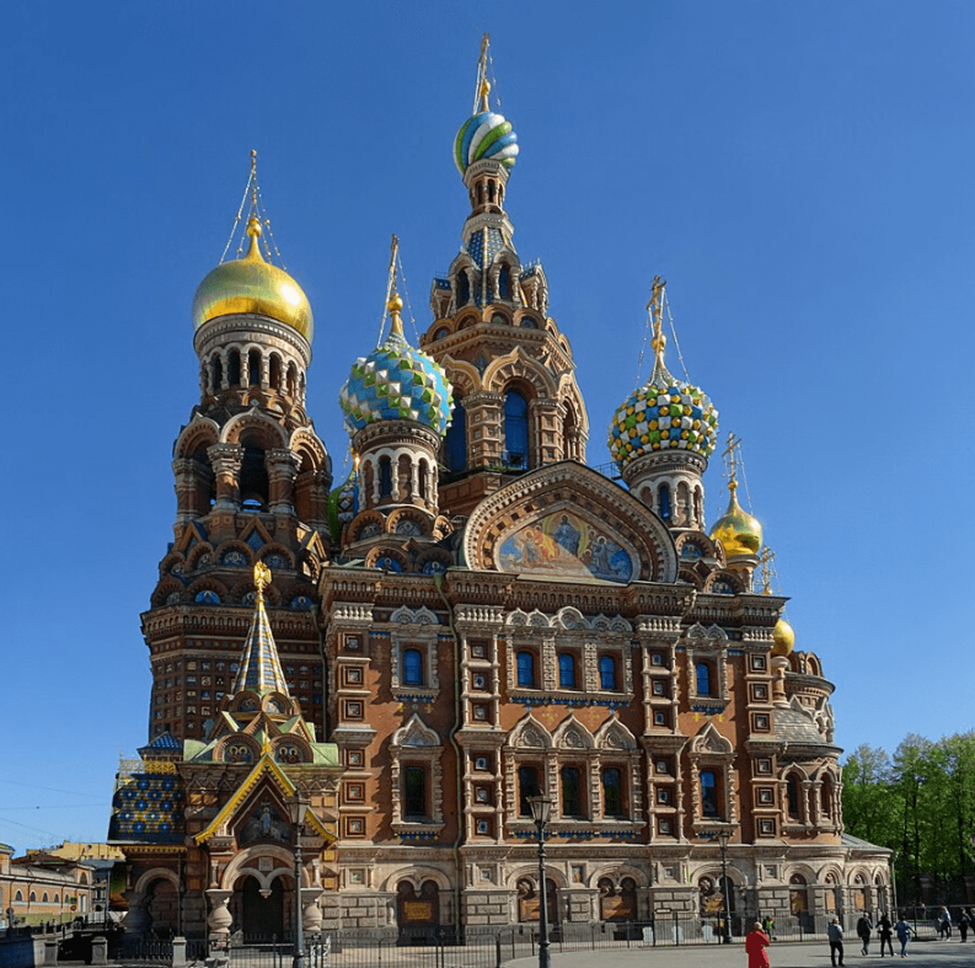
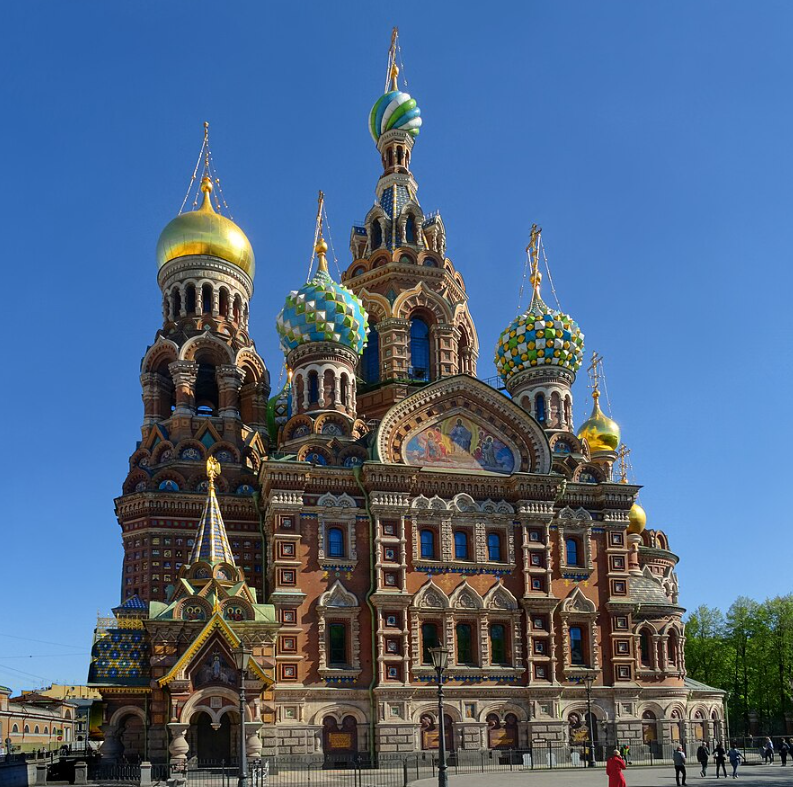
On March 31, 1881, Tsar Alexander II was assassinated in St Petersburg, Russia. His habit was to ride his carriage to a military roll call that day of the week. The route was along the Catherine Canal. An assassin threw a bomb under the horses and it exploded as the carriage rolled over it. The emperor’s carriage was bullet proof, a gift from Napolean III. Alexander exited the damaged carriage uninjured and paused to survey the scene. As he was doing this, a second assassin tossed another bomb at his feet which exploded, later killing him and killing and injuring many others in the vicinity. Afterwards a beautiful cathedral was built on this site called the Cathedral of the Savior on Blood.

Cathedral of the Savior on Blood. Included here only because it is a beautiful image. Image from Wikipedia.

Cathedral of the Savior on Blood. Included here only because it is a beautiful image. Image from Wikipedia. I was awestruck when I visited.

If you end up in Saint Petersburg, which I whole heartedly recommend, this cathedral is well worth a visit. It’s newer and, in my opinion, perhaps even more beautiful than the famous Saint Basil’s Cathedral in Moscow along Red Square,

Following Tsar Nicholas II’s abdication in 1917, a provisional government briefly assumed power before being overthrown by the Bolsheviks during the October Revolution. The ensuing civil war ended with Bolshevik victory, elevating leaders such as Lenin, Trotsky, and Molotov. In November 1917, the Russian Socialist Federative Soviet Republic (RSFSR), the Russian Soviet State declared itself a sovereign state.

The revolution triggered widespread unrest, with numerous factions pursuing divergent objectives. The Bolsheviks relied on the Red Army, while the White Army comprised former imperial officers and Ukrainian anarchists opposed Bolshevik control as well. Additionally, thirteen foreign powers—including Austria-Hungary, Germany, and the Ottoman Empire—intervened against the Bolsheviks.

In 1922, the Russian Socialist Federative Soviet Republic ratified a constitution and formally established the Union of Soviet Socialist Republics (USSR), written in Cyrillic as CCCP.

Amid the turmoil of the Bolshevik Revolution, Russia ceded territories previously seized by Germany during World War I. The collapse of the Russian Empire sparked a protracted struggle among various ethnic groups and factions to reclaim land and assert authority. By 1923, the Russian Civil War had concluded.

Let me say that although the western block vigorously opposed the Soviet communism later in the Cold War, the break from monarchy by popular uprising to form the Federative Soviet Republic and later the Union of Soviet Socialist Republics was a remarkable achievement for that part of the world. To transition from a monarchy with serfdom to the USSR in ~60 years was a world-class achievement. The sad part was the rise of Stalinism and cementing in state authoritarianism as well as revolutionary expansion to global communism. Global socialism was an early goal of the Bolshevik leadership. Socialism was interpreted as a precursor to true communism.

So, why can’t they be like us? Because their history and cultural development never included exposure to free markets, private ownership, foreign travel and individual freedoms we in the west are accustomed to today. No Magna Carta setting limits on the power of the monarch and no parliament sharing power with the monarch. Russia did not participate in global travel as western European nations did which led to colonization and the extraction of wealth from their colonies producing gold, silver, spices, salt peter, slaves, etc. The wealth accumulation and theft of colonial resources set the pace for producing vibrant and wealthy countries in Europe, but not in many of the colonies. The American colonies are a famous exception.

Summary-

This summary only scratches the surface of the October Revolution and the subsequent civil war. For further detail, readers are encouraged to consult additional sources. The period was marked by extreme complexity and violence, resulting in an estimated 7–12 million deaths.

Given this history of conflict, authoritarianism, and systemic repression, it is unsurprising that Russia continues to exhibit traits of a closed and deeply security-conscious state,

Despite a Public A$$ Kicking, Putin Fights On

The history of Ukraine’s abuse from Russia is a sad tale of starvation (Holodomor), banishment to the gulags and ethnic cleansing (1947). Newsletters are available from The Kyiv Independent and try to connect the present Putin-Ukraine war with regional history. This is an email publication that originates in Ukraine and is written by Ukrainians. They try to explain “WTF is wrong with Russia.”

One eastern European scholar, Timothy Snyder, has written extensively about Russia and its influence on Ukraine. The Bloodlands is especially enlightening. After much civil conflict with Ukrainians after the Bolshevik revolution, Lenin relented and allowed Ukrainians to have their “own” state with the proviso that the new Ukraine must be part of the newly forming Union of Soviet Socialist Republics, USSR (or CCCP in Cyrillic alphabet).

Ukraine has a bad history with neighboring Russia dating back to near the beginning of the USSR. Putin’s goal is reclaiming the territory of the former USSR. including Ukraine, Because Ukraine has considerable productive farmland and minerals, and because it provides a land barrier to Moscow, Putin very much wants the land back.

As of this date, Oct. 21, 2025, the Putin-Ukraine war is no longer dominated by Putin’s army on the Ukrainian battlefield. While Ukraine continues to gather sympathies from NATO countries and elsewhere, Putin has turned Russia into an international red-headed stepchild. Sanctioned into bankruptcy and pounded by the Ukrainian military, Putin continues to put on a brave face to the Russian people. The hybrid warfare conducted by Russia continues and is especially problematic for NATO states, USA included.

Even though Putin has won presidential elections in the past, the transfer of power remains very murky to those outside the Kremlin walls. Yes, a new Russian president could conceivably win an election but detaching Putin and the layers upon layers of nervous sycophants as well as his dark income streams will be a problem. It is a stretch to believe that Putin will leave office alive. Maybe they’ll find an apartment for him in Pyong Yang, North Korea?

Adding to the political complexity, there is considerable distrust between the Russian military and the security services, two of which in particular are the FSB and GRU. Some have claimed that the FSB would not allow a military coup owing to past animosity and distrust. Putin’s authoritarian state, while extensive, still is subject to the frigid winds of economics.

Where is Russia Going?

What is the deal with Russia? Why do the Russian people tolerate the lack of basic freedoms we in the West are accustomed to? Dissatisfaction with their government has been there since the beginning. Hundreds of millions have been deprived of liberty and prosperity following Russian revolution.

The history of early 20th century reveals the Bolshevik Revolution in Russia and the formation of the Union of Soviet Socialist Republic (USSR). Later, after much blood and treasure was spilled after the revolution and then through the cold war, the Soviet Union collapsed after a brief attempt at openness. Many around the world saw the collapse as a positive thing and a sign of better times ahead, especially for the people of the former USSR. There was hope in the West for a transition to some variety of Russian-tinted democracy and for freedoms heretofore absent for the average citizens of the former USSR.

To Russians in power, the very idea of a democratic republic is alien and inconceivable. There is a baseline level of distrust and fear of the infectiousness of the democratic spirit among Russian/Soviet leadership. Even the population has been convinced that the moral collapse of the West would spread to their homeland without an iron-fisted leader.

For a part of the world that has been strangling under autocratic rule and economic stratification since before the time of the Tsars, there has not been a historical Russian-style power sharing agreement between the monarchy and the nobility or the serfs from which to build upon. After generations of polarization by Soviet propaganda focused on Western hegemony and the moral turpitude of the West, there was no likelihood of building upon a Western style democratic model. The Russian propaganda engine continues to this day as strong as ever but with the help of the internet, artificial intelligence and widespread political indifference or gullibility.

The decade of the 1990’s following the collapse of the former USSR was a time of redistribution of wealth for a lucky few. Large Soviet industrial sectors were absorbed by a few private interests, producing fabulously wealthy oligarchs. This did not go unnoticed by the populace, who simmered in anger over it because they expected a freedom and prosperity dividend from the collapse. Amidst the confusion and dissatisfaction with Russian President Yeltsin, there arose a growing sense that Russia needed a strongman leader. Many even spoke admiringly of Stalin.

The collapse of the USSR left an internal power vacuum that would soon be filled by former Soviet citizens. Boris Yeltsin was elected President of Russia in December 1991 and remained as President until 1999 when his selected successor Prime Minister and former FSB director Vlad Putin took over as acting president. Putin was elected president in May of 2000.

I’ve been trying to understand why present-day Russia seems so … belligerent. My focus to start with is Putin. Rather than being a one-of-a-kind freak of nature, Putin is rather ordinary as a dictator except that his regime has a nuclear triad. Until its invasion of Ukraine, Russia also had the benefit of whatever left-over respect it may have had from its Soviet military reputation. But that has changed dramatically.

Putin has long expressed the view that the collapse of the USSR was a tragedy. He wants to rebuild the stature of Russia into a global superpower. Soviet leaders held the view that in order for Moscow to be safe from attack by the West, the Slavic eastern European countries bordering Western Russia had to be under the wing of the Kremlin. It was this deep boundary in combination with the Russian winter that helped to wear down the invasions of Napolean and Hitler. Both armies were substantially weakened by traversing the extensive farmlands and steppes of Ukraine and Poland. It is difficult to believe that this thinking has changed since the collapse.

When the USSR collapsed it left much more than empty senior positions and titles to fill. The Soviet governing apparatus was abandoned when the Kremlin finally conceded that the USSR was economically unsustainable. Even a culture built upon bribery and corruption needs an all-encompassing structural skeleton to manifest its national identity and sustain an economy, security and a global presence. Even a corrupt government needs some sustainability.

Unfortunately for present day Russia, extensive government bribery and corruption in all sectors was already baked in from Soviet times. On a practical level, getting things done involved bribery. Bribes were expected and paid as a matter of routine in the military and all other areas of government. Today there have been show trials with certain high-level officials being tried, convicted and imprisoned on bribery charges. It gives the population bread and circuses to consume and hopefully optimism for a brighter future.

The USSR and later the Russian Federation did not have the benefit of English common law which evolved from the Magna Carta. Born of earlier conquest by the Rus, the Bolsheviks had nothing to build upon for a more democratic legal system like the American colonists had. Overall, Bolsheviks forcibly switched from monarchy to an autocratic socialist empire. Conquest of the tsarist Russian empire by the Bolsheviks was difficult because there were numerous groups vying for power, leading to the Russian civil war following the 1917 revolution.

Although Putin and the cranky Dimitry Medvedev have done a bit of nuclear saber rattling, the West has been concerned about Russian nukes since their very first test in the late 1940’s, so not much new here. Putin’s stern public warnings about nuclear retaliation were not necessary for the Western experts to be on alert. This apparent “virtue signaling” in the form of a public warning by Putin is just a part of Russia’s overall hybrid warfare approach. They’ll use every word and inflection uttered by Russian and Western media as well as the Kremlin to fortify their propaganda with doubt, suspicion and existential threats. They are also actively injecting propaganda into every media stream in the West they can manage. Putin’s dire public warnings about lowering the threshold for a tactical nuclear release were meant to cause a great clenching of public sphincters with the usual fear and loathing leading to internal political pressure for its enemies.

/*begin anecdote/*

Russia’s triad of Soviet-era nuclear weapons have been aging in storage. Are Russian nuclear bomb designs immune to shelf-life issues? By comparison, American-style nuclear weapons have a relatively short shelf-life because of their boosted triggers. According to one source, the entire US nuclear arsenal of nuclear triggers are boosted. American nuclear trigger designs have a short shelf-life stemming from tritium’s 4500 +/- 8 day half-life or 12.32 years (NIST, 2000). US fission triggers have a hollow core which contains a 1 to 1 deuterium-tritium mixture. This booster gas undergoes fusion during ignition in the center of the core and increases the fission yield by the release of abundant 14 MeV neutrons into the surrounding fissile material. With the use of a booster to breed neutrons, the critical mass of fissile explosive is reduced because more neutrons are dispersed to initiate a runaway fission while under intense compression. The reduced mass of fissile material in a bomb is also resistant to unintended ignition by a nearby source of neutrons, like a nearby nuclear explosion.

Tritium is 3H, with 1 proton and 2 neutrons. It undergoes a beta decay where a neutron decays to a proton and an ejected electron, forming 3Helium with 2 protons and a neutron. So, wouldn’t you know, 3Helium is a poison with a very high neutron capture cross section. An aging booster gas loses its tritium potency as well as gaining an effective neutron poison.

But for this application to work, an ongoing supply of tritium is required. Tritium must be produced in a breeder reactor or accelerator. In addition to its short half-life, tritium decay is problematic to monitor because of its low 5.7 keV average beta radiation energy. Tritium atoms or molecules can be detected and measured by mass spectroscopy, but its beta decay radiation requires special equipment to detect. Tritium emits very low energy, low penetrating beta particles which are limited to 6 mm of travel in air and are blocked by the dead layer of skin cells on the surface of the skin. Getting through the window of a Geiger-Muller tube is a problem. So, measurement of tritium activity requires a liquid scintillation detector or an ionization chamber. A sample of radioactive material is dissolved in a vial of scintillation cocktail and run through a scintillation detector which detects faint flashes of light corresponding particle emissions. Perhaps detectors using scintillation crystals like cesium iodide are available for tritium detection.

/*end anecdote/*

A History of Conflict

The lands of Eurasia have, over time, been overprinted with layers upon of layers of conflict over thousands of years. While it may seem reasonable to assume that the current national borders of Europe have finally overcome the urge for military conquest, this seems over-optimistic. The ease with which Putin dashed in to grab large tracts of Ukraine in 2014 show that land-grab invasions are not just left to the past.

The more you learn about the last 4000 years of history of the lands covering the British Isles to Portugal to Mongolia to north Africa and the Levant, the more apparent it is that battles of conquest and defense have overwhelmingly been the norm.

There have been so many armies who have fought bloody battles and died or prevailed on the Eurasian landscape since before Roman times, it is a wonder that there aren’t still great heaps of bones wrapped in rotted battle gear. As always, much remains below the surface in history.

Putin’s Botched War

The Putin-Ukraine war is a war of conquest begun by a dictator who somehow didn’t understand or foresee the accurate weapons made available to Ukraine by the USA and Europe. He misunderstood the willingness of the West to come to Ukraine’s aid, but also and maybe more importantly, the magnitude of the relative sophistication of Western armaments and war materiel. This was a major blunder. While Russian military intelligence should have kept the Kremlin updated on Western weaponry, Putin should have asked more penetating questions. But perhaps most importantly, he underestimated the combative spirit of the Ukrainians and their president.

How did Russia manage to fall so far behind the West in the art of war? A high reliance was placed on its giant fleet of tanks, armored personnel carriers and artillery. Much of this equipment was left over from WWII and the cold war. In contrast to its ground operations, Russia’s use of airpower in the early days of the war was weak and ineffective. Western military strategy has a high reliance on air power.

Russia was completely unprepared for the evolving drone tactics used against them. Drones were able to provide intelligence and pinpoint delivery of relatively small bombs at critical locations on launchers, vehicles, individual soldiers and in trenches. While Russian tanks were covered with reactive armor, the Ukrainian drones could place bombs in weak spots on the vehicles or even drop them through crew hatches to the interior where propellant and warheads could be ignited.

Post-War

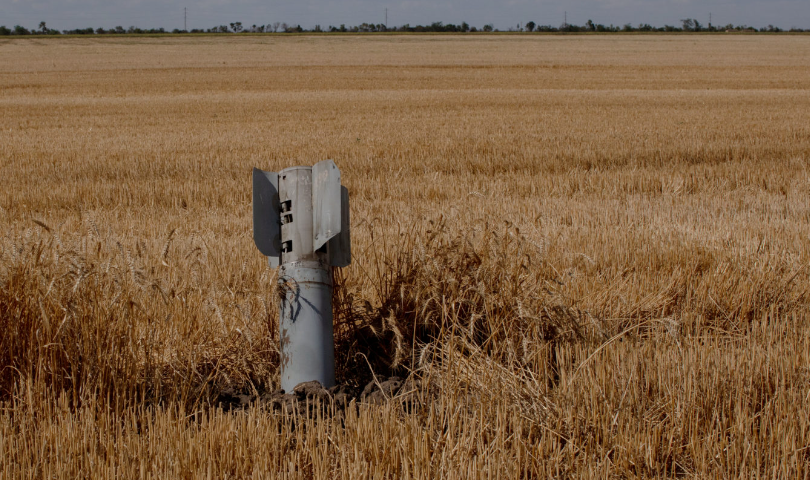
To the discredit of both Russia and Ukraine, extensive use of land mines as well as cluster munitions has been made. The immorality of these munitions lies in what happens to the left-over mines and cluster bomblets remaining after the conflict. After the war, the lands are going to be recovered and farmed or rebuilt. Land mines and cluster munitions are well known to remain extremely dangerous for decades. Other conflict zones that have been so mined have left a legacy of death and mutilation for civilians.

At some point, the victor of the Putin-Ukraine war will want to salvage the scrap metal of the many thousands of vehicle carcasses left on the battlefields. One question relates to the explosive reactive armor (ERA) on the exterior of the destroyed tanks. ERA consists of a sandwich of a metal “flyer plate” facing the incoming projectile, a layer of high brisance explosive, and another metal flyer plate facing the tank armor. In order to respond to a high velocity kinetic or shaped charged projectile, a high shock-velocity, highly energetic explosive is needed for fast response to impact by a projectile. The ERA must be insensitive to small arms fire.

A great many videos of the destruction of tanks show that a tank can be destroyed and its crew killed by artillery or drones, but a large fraction of the reactive armor remains. The reactive armor contains enough high explosive to diffuse some of the incoming projectile’s energy release, yet seems to be rather insensitive to the shock of a hit a few feet away. This unexploded reactive armor will need collection and disposal.

Ukrainian farmers will need to level out the thousands of bomb craters in their fields so their equipment can traverse the ground. Obviously, Sappers or bomb disposal crews will need to de-mine the roads and pathways. Extensive trench systems will need to be filled in to recover the croplands. The environmental insult to the bombed-out battlefields is already substantial. The environmental toxicity of explosive residues may need evaluation.

Finally, in victory the brave people of Ukraine face the daunting prospect of rebuilding their homeland. Generations of children have been exposed to serious trauma and violence that no one should have to face. Their childhoods have been stolen from them and their educational prospects badly damaged.

If Russia prevails, the citizens of Ukraine face loss of their national identity and progressive Russification. All of the post-war issues given above will still be present, but the economic and social upheaval resulting from a vengeful Russian takeover will be traumatic. Many Ukrainian fighters and political leaders will no doubt be jailed, sent to gulags or perhaps defenestration.

A Russian victory in Ukraine signals bad times ahead for the rest of eastern Europe and the Baltic states. These countries, Poland in particular, already understand this and are preparing for this eventuality. Putin has previously expressed a kinship with the Slavic peoples of Eurasia and this may be part of his motivation for establishing a Russian empire.

The Fall of the American Empire

As bad luck would have it, this aggressive act of Putin’s Russia coincided with a political catastrophe in the United States. The Republican Party (GOP) in America has adopted the old Tea Party platform including libertarians and ultraconservative evangelical Christians to morph into a party of fanatical fascists, sometimes called Christo-Fascists. This is a reprehensible development that has taken decades to pull off. These Make America Great Again (MAGA) people have decided that American democracy doesn’t work. They favor a weak, authoritarian flavored democracy, similar to what Orban in Hungary has led.

The combination of the election of Donald Trump along with allowance of dark money OK’d by the US Supreme Court, the fanatical support of MAGA voters and a detailed coup strategy penned by the Heritage Foundation and funded by numerous billionaires has turned America around the corner towards an ultra-nationalist dictatorship. Trump ignores the courts, the legal role of the congress, and has lately taken a fancy to sending troops into US cities.

Some knowledgeable scholars have offered that American hegemony, in place since the end of WWII, is all but over. Some estimate that the American empire reached its peak influence perhaps 15 years ago and has been in decline since then but Americans haven’t paid attention. Trump, with his claims on Panama, Canada and Greenland as well as his manic desire to impose tariffs on globally has sent American credibility into the waste bin. The global economic upset caused by Trump has forced former friends to forge new alliances, leaving America behind.

Even if the stars lined up right and Trump and Vance disappeared tomorrow, a return to the previous status quo is unlikely to happen. The rapid trade disengagement by Canada suggests that they have had serious doubts with the USA already and this Trump fiasco was the last straw. There has been grumbling by other nations in the past that the American 4-year presidential cycle leads to excessive and frequent foreign policy changes that cause difficulties for them.  

Trump’s “America First” declaration and radical disengagement with previous foreign policy has left an apparent power vacuum in the world. This has not gone unnoticed by anyone. Of course, the BRICS nations (Brazil, China, Egypt, Ethiopia, India, Indonesia, Iran, Russian Federation, South Africa, and United Arab Emirates) are taking advantage of this sea change and are considering moving from the US dollar as the principal reserve currency. America is willingly abandoning its historical global stabilizing ability in exchange for a more libertarian internal structure.

Putin: Latter Day Soviet or Just Another Tsar?

Note: Not residing in Russia, I cannot grasp the full extent of the events and mood unfolding there. All that remains is to perch on a power pole across the polar cap and try to discern fact from fiction.

>>> Let’s ask a very basic question about today’s Russia. Why can’t Russia Putin play nice? <<<

Like most, I have anxiously watched Putin’s invasion of Ukraine. The prevailing Russian narrative is trying to say that the sovereign nation known as Ukraine has historically been a part of Russia or some earlier Russian empire, a view promoted by Putin. Following the Bolshevik Revolution, Lenin directed the Bolsheviks to seize the territory now recognized as Ukraine. The goal was to claim territory for the Soviet Union, but also territory that was extremely fertile. Stalin ordered that Ukrainian industry and agriculture were to be collectivized. An independent Ukrainian government was briefly established but just as quickly collapsed. After several years of intense Ukrainian resistance and significant suffering, Lenin conceded and established Soviet Ukraine, enabling its incorporation into the Soviet Union as a constituent republic.

In the current action, with the support of an extensive security apparatus, Vladimir Putin has resolved that what is now Ukraine will be assimilated into a growing Russian empire. The process will methodically transform its Ukrainian identity through Russification, transforming it into southwestern Russia. Ukraine is expected to become an agricultural hub and potentially a strategic forward base for further military operations into Poland the Baltic states, and likely Moldova.

Why does Putin desire Ukraine when there is considerable open land to the east and north? Well, it’s the geography. The land beyond to the north and east of Moscow consists of vast stretches of challenging subarctic taiga and arctic permafrost, much of which is now thawing, making it unsuitable for roads, urban development, agriculture, and industry. In contrast, Ukraine boasts rich, productive farmland with significant annual grain exports. Additionally, along its southern coast, including Crimea, Ukraine possesses the only warm water ports available in the region, other than possibly the Neva River to the north which are vital for commerce and the military.

Historically, western European colonization was driven by the prospect of trade opportunity including raw materials, cheap labor as well as power projection. Like all countries, Russia would like room for its prosperity to grow. It is desirable that agricultural and industrial capacity also rise. However, Russia has learned the hard way the value of having a buffer zone between Moscow and Western Europe. The relative ease with which both Napolean and Hitler crossed the Eastern European territory enroute to Moscow, Leningrad and other cities through greater Russia did not go unnoticed by Stalin. By absorbing the Eastern European territories after WWII, Stalin built a picket fence protecting the Soviet state.

As the Nazi’s Operation Barbarossa was failing and Stalin’s Red Army began pushing the Germans into a westward retreat, the Soviets took advantage of the opportunity to install Soviet political structure in captured Nazi territory like the Baltic states, Eastern Europe and the eastern half of Germany. While Stalin did not share Hitler’s enthusiasm for exterminating Jews, he did act to eliminate preexisting local political structures which included substantial Jewish presence. This meant executions and large-scale banishment of politically unreliable people to the Russian gulag system. Poland was hit particularly hard by both Hitler and Stalin because it was directly between Russia and Germany and had a large Jewish population.

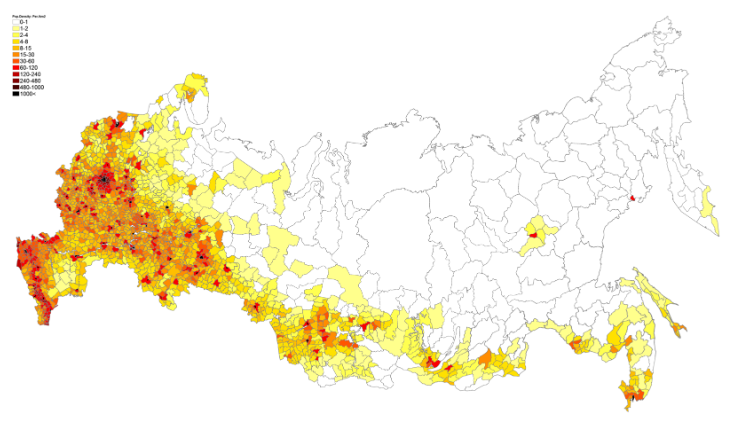
The above map shows the population density of Russia. A substantial fraction of Russians live in the southern and western regions of the country. If you assume that people are living there because it is at least somewhat livable, then the map shows the extent of land poorly suited for habitation.

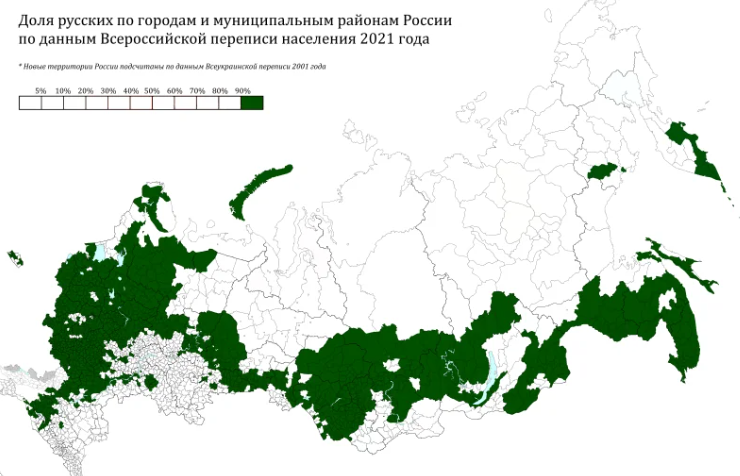
Map of Russia showing areas that are 90 % populated by ethnic Russians.

Russia has a great deal of acreage but the livable turf is much smaller.

Putin views the world partially from the old cold war perspective. It’s Russia against the aggressive, corrupt and immoral west, but without the fever dream of a Soviet-style socialist world. Putin’s state-controlled media endlessly repeats that the west wants what the Russians have and stokes the fires of fear. For the Soviets, “aggressive, corrupt and immoral” included resistance to Soviet influence.

The Soviets were ardent promoters of global socialism. Although not overtly socialist, Putin appears more focused on preserving Russian culture and dominance from across a substantial territorial buffer with the West. He asserts his aim to shield Russia from Western cultural influences and what he perceives as a “belligerent” military stance.

Historically, Russia has endured invasions by King Charles XII of Sweden, Napoleon, and later Hitler. The history of the Kievan Rus from 830 to 1241 is jammed with bloody feuds, wars and invasions. From the Principality of Moscow in 1281 to the end of the Tsardom in 1917, and even beyond into the era of the Soviet Union and into Putin’s time, near continuous conflict has plagued the Russian people. Fortunately, Russia’s northern geography and harsh winters have often played to its advantage, compelling invaders into prolonged conflicts and misery with eventual withdrawal. But not always.

Most nations would like to have global hegemony. Putin is fond of saying that Russia has suffered greatly from American and Western hegemony since WWII and hopes to put an end to it. He has reestablished a Soviet-like security state apparatus with strict media control when he assumed power after the 8 years of Yeltsin’s chaos following the collapse of the Soviet Union. He is trying to resume for present day Russia the former Soviet Union’s international status but largely without the manpower and resources of the former adjacent Soviet states.

Source: The Fuller Project. Unexploded cluster bomb in Ukrainian wheatfield.

Like his Soviet predecessors, Putin both envies and worries about overreach of western hegemony and is moving to unseat the West. For that matter, so is China. This is only natural. I believe they resent western influence generally. The English language as the global lingua franca and the US dollar as the standard international currency are seen as an annoying affront to their own cultures, sovereignty and political significance. Again, this is only natural. And so is the temptation to use power projection or coercive propaganda to achieve their own hegemony. Casualties would be considered the West’s fault for being in the way.

Both Russia and China have long been critical of the West for internal propaganda purposes but to be fair there has been some valid criticism as well. In truth, the US has done some bone-headed things that we should not be proud of and that hardly serve to highlight our presumed “special” nature. But in fairness, most all cultures can look back at regrettable conduct in their history. Neither Chairman Mao’s China or Stalin’s USSR have sparkling clean histories either. Often the benefit of hindsight doesn’t come into focus until far down the timeline.

The Soviet Union in the person of Joseph Stalin, had brutalized Ukraine previously in an attempt to halt its independence. The Holodomor, meaning death by starvation, of 1932-33 is estimated by scholars to have killed 3.5 to 5 million people. This period of time is marked by forced collectivization of agriculture and industry in the USSR and Ukraine. Collectivization meant taking control of farmland owned by the peasants (especially the Kulaks), many times banishing them to the gulags never to be seen again. Already by 1931, Moscow had taken 42 % of the Ukrainian grain harvest, forcing some locations even to turn over seed for the following harvest. By early 1932 some districts in Ukraine were already experiencing famine. The governing committees in Ukraine in 1932 believed that the 6 million tons of grain demanded by Moscow was unachievable, yet they ratified the plan anyway.

The current brutal murder and devastation of Ukrainian citizens and their infrastructure and agriculture will take a generation or more to repair even if Russia prevails. Russia has done great damage to the Ukrainian environment in addition to the many casualties. Much of the country is cratered, littered with destroyed vehicles and war debris, denuded of vegetation, and rendered deadly by the landmines.

The great equalizer among the leading nations is Mutual Assured Destruction, or MAD, by virtue of the threat of the use of nuclear weapons for mutual annihilation. Sometimes just called “the bomb”, it was indeed invented by an international cast of scientists and engineers using American uranium and Plutonium and first used in successive releases by the US on Japan near the end of WWII in the Pacific theater. This will darken a stretch of American history indefinitely. Some continue to argue that the bombing was not necessary because Japan was soon to surrender, but it happened, and nothing can change that. However, to our credit, the US has never used it since and has actively sought with other nations to suppress the proliferation of nuclear weapons and remove the hair triggers for their use. That said, the US remains a no-first-use country but will participate in the principle of Mutual Assured Destruction as needed.

A Nuclear Sidebar

Very soon after the discovery of nuclear fission in December, 1938, in Nazi Germany by German-born chemists Hahn and Strassmann, and Austrian-born physicists Meitner and Frisch, the theoretical potential of using the vast energy output of nuclear fission for a bomb was quickly realized.  On May 4, 1939, Frédéric Joliot-Curie, H. Von Halban and L. Kowarski in Paris filed for three patents using a fission chain reaction. Two involved power generation and the third was for an atomic bomb, patent No. 445686. Fission was experimentally discovered in Dec. 1938, theoretically explained in January 1939, and a patent for the atomic bomb was filed on May 4, 1939.

The point of this atomic interlude is to highlight the short time interval between the discovery of nuclear fission, conceiving the idea of the atomic bomb and filing for a patent by scientists. On August 2, 1939, a letter written by Leo Szilard and signed by Albert Einstein was sent to President Franklin D. Roosevelt warning that Germany may be developing an atomic bomb. This led to the Manhattan Project and America’s entry into nuclear weaponry.

During and after the Manhattan Project, Stalin’s spies detected and infiltrated the American bomb project and presumably used important stolen information for their own nuclear program. This was an important shortcut benefitting the Soviets greatly. The first Soviet atomic bomb burst so soon after the war shocked the world.

Humans have a gift for the invention and use of weapons. I’m sure it has always been that way for humans. The inclination for war and conquest is also an ancient instinct. It is hard to see how aggression will ever change. In view of this distressing thought, how are we to proceed?

Looking forward

In the short term we in the west must continue to discourage Putin’s expansionist push. A win for Ukraine will set a precedent that might even unseat Putin. It is up to the many good people in Russia to be rid of him. However, Russian citizens will have to struggle against the vast authoritarian political machine in place just like the Poles, East Germans and the other Soviet states had to do in the late 1980’s. The intimidation and resources of the Putin authoritarian state are a huge obstacle.

My guess is that in general, doing the “right thing” in a culture of normalized authoritarianism, bribery and corruption is more difficult to accomplish than doing the “right thing” in a free and open culture where doing the right thing is occasionally practiced and always admired.

To a westerner like me, Russian withdrawal from Ukraine seems like the optimal solution to Russia’s present economic and military race to the bottom. Even in winning, Russia will inherit a devastated region that will require vast resources and a decade to repair, as well as a population of angry and vengeful citizens looking to kill a Russian or two. Then there are all of the land mines to contend with. There is amputation or death by landmines in the future for many unsuspecting people regardless of who wins.

A cessation of hostilities led by Putin is likely to end his career. Thus far, Putin’s invasion has led to over 500,000 Russian casualties, of which there have been over 80,000 Russian fatalities. In a way, this pales in comparison to Stalin’s murderous handiwork, but the comparison is really more like “terrible versus really, really terrible.”

Whether or not Putin is a reanimated Soviet leader or “just” another Tsar isn’t a question to dwell on. He is a creature of his time who happens to be a former Soviet KGB officer but has rejected Marxist/Leninism and rules by a roughly mafia-style kleptocracy behind closed doors in the Moscow Kremlin. For Russian citizens, the rule of thumb is if you stay out of political business, the government will stay out of your business.

Why Can’t Vlad Play Nice?

Here is a truly naïve question: What is wrong with Russia? Why can’t Russian leaders focus on their own damned affairs rather than conquest or their clandestine efforts to destabilize other governments? From the western side of the globe this seems like a fair question. Are their lessons from history so scrambled that they have not learned some basic axioms of humane civilization? What happened to them? Why the perpetual paranoia, brutishness and authoritarianism?

It is important to separate “Kremlin” from “Russian people”. The Kremlin is a Moscow-based institution presided over by Russia’s national leadership. The Russian people are those working citizens distant from the Kremlin. Naturally, the Kremlin purports to represent the interests of the Russian people. Many say that the Kremlin represents an oligarchy inside and outside of the government. Most would say that Russia’s tradition of bribery and graft is rampant and even a built-in feature and not a bug. Whatever the case, it seems clear from the news that Russia’s military/industrial complex is riddled to the core with corruption.

The USSR and later Russia claim that they are threatened by Western adventurism and interference in their sovereign affairs. The lengthy Cold War between NATO and the Kremlin was largely about the spread of Soviet socialism and undesired political alignments between factions. Western countries were busy in the post-WWII years waging proxy battles and clandestine buggery with client states of the USSR and China. For our part, America didn’t do so well. In contrast with the Allied victory in Europe and Japan in WWII, the US had to sign an armistice with North Kores, a peace accord with North Viet Nam with the lightning-fast collapse of South Viet Nam, followed by the clumsy hijinks leading to the Iran-Contra scandal in the 80’s.

The US and coalition forces successfully routed the Iraqis in Kuwait in 1990 with the start of what became Gulf War I. After liberating Kuwait, US President George H.W. Bush invaded the Republic of Iraq destroying a good bit of their military but left Saddam Hussein in power. By 2003 George H.W.’s son, President George W. Bush, oversaw a clearly bogus campaign to take down Saddam right after the 2001 invasion of Afghanistan. The smoke and mirrors show put on by the Bush administration conflating al Queda in Afghanistan with imaginary Iraqi weapons of mass destruction led to Saddam being quickly toppled and captured while hidden is a hole in the ground, tried and finally hung by his own people.

What the US-led coalition failed to appreciate was that Saddam held together Iraq by brute force and murder. Coalition forces swooped in and shut down his government without any thought as to the pragmatics of who will run the country the next day. There was the intent of giving birth to democracy with elections, but the power vacuum created by the toppling of Saddam and the dissolution of his government gave opportunity to numerous factions who jumped at it. This was the Iraqi insurgency which lasted until the US withdrawal in 2011.

US interventionism aimed at regime change by force or by covert efforts to remove certain leaders has a spotty record. Chili, Cuba and Nicaragua for example. The point is that US leaders have badly botched many schemes to cultivate governments friendly to US ambitions.

The first thing to remember is that we Americans view Russia through the smudged lens of our own popular culture and history. Over the decades since the end of WWII our self-appraisal of our many merits has swollen and become distended. The MAGA crowd seems to think there was a period of time when America was “Great”. I’d like to know when this happened. I’ve never heard MAGA people cite a particular time when this greatness occurred. Maybe they are thinking of the outcome of WWII and the succeeding few years. Perhaps it was their senior year of high school or during the summer break after third grade. When people?

As I survey American history as an amateur historian I have yet to find a halcyon period in America when peace and calm enveloped the land and all was well. With magnification, history is very granular and every year is a braided stream of tragedies, scoundrels and bad luck with the occasional patches of wonder and joy somewhere for a few. Well, perhaps this is all we can expect. Maybe the world really is a grubby place occupied mostly by people who are often nice, and with more than a few crackpots and psychopaths sprinkled here and there to round out the bell curve.

The land that we call Russia, apart from the Siberian reaches of eastern Russia, has been home to many diverse peoples. One Wikipedia reference cites the beginning of Russia in the north with the Eastern Slavs in 862 CE and ruled by Viking conquerors. On this timeline, it is clear that people in the region have been in war, civil conflict or crushing poverty and authoritarianism almost continuously since then. The baseline condition of a great many people of Russia and nearby lands was the grinding poverty of serfdom and were only emancipated in 1861 by Tsar Alexander II. There have been invasions by the Mongols, Ottomans, Swedes, Napolean, Hitler, uprisings and fratricidal infighting for power. It is hard to know what occupants of the Moscow Kremlin are thinking. Russia seems destined to be ruled by an iron fist.

Unlike the English-speaking peoples, Russia never had a Magna Carta in their past outlining agreed upon limits to the power of the monarch. The very notion of wider participation in the conduct of government affairs was unknown. Democratic virtues taken for granted by western states never took hold in Russia. There was initially some hope for democracy after the fall of the Soviet Union by some, but there were no institutional and legal structures in place from which to operate a democratic republic. Worse yet, people were unemployed en masse and became frustrated by the lack of a “freedom dividend” and eventually there was support for a strongman leader. The collapse of the USSR left a power vacuum waiting to be filled. Yeltsin proved to be the wrong guy to inherit the reigns of power from the collapsed Soviet Politburo. He was widely seen as a drunken fool.

Russia had no history of conducting private business within the umbrella of international business law and capitalistic norms. What business law and intellectual property protection there may have been was from the Soviet era. Instead, there was a scramble to acquire the big industrial and financial pieces left over from the old USSR.

I’ve not found anything in the history of Russia that may have been a home-grown template for constructing a workable version of democracy. Russia’s long geographic and cultural isolation from the West doesn’t seem to have helped with the migration of what we might call the norms of democratic society. To be sure, Tsar Peter I (Peter the Great) had spent time in England and learned a great deal about shipbuilding and navigation, eventually leading to the formation of the Russian Baltic Fleet. King William III of England welcomed Peter because of the potential for trade with Russia.

The Soviets were successful in adopting some Western technologies and just enough consumerism to placate their population … partly. Unlike Western Europe, the USA, Canada and even Mexico who continue to be inundated by migrants wanting to get in, the USSR, on the other hand, had to contend with its citizens trying to escape. This is still a problem today in Russia. People vote with their feet.

Back to the initial question. Why can’t Vlad play nice? We can only guess. He is not burdened with a national history of a capitalistic democratic republic or with utopian visions of a liberal democratic society bursting with opportunities for everyone. Vlad is a product of his upbringing as a KGB officer in a closed and isolated security state with a population long accustomed to going along with what the central authoritarian leadership forcibly requires. As a former KGB operative in East Germany, he understands authoritarian rule at the ground level. While bubbling up the chain of command he mastered the complex internal Kremlin politics and managed to get selected by Yeltsin to succeed him. Lucky guy. But when will he decide enough is enough? Today, his poorly conceived plan to expand Russian influence by overtaking Ukraine has backfired, leading to over 500,000 Russian military casualties. Along with the loss of a large fraction of his conventional military armaments like tanks, cannon, radar, air defense systems, aircraft, naval vessels and so on, he has singlehandedly exposed the Russian military for what it is- a paper tiger, but only in conventional arms. He still has a potent nuclear triad to serve as his final stinger.

American Isolationism and the World

The reverberations of Trump’s South Carolina comments on NATO continue. Being a thuggish racketeer himself, he sees something like freeloading or racketeering in the motives of the NATO states. With his disparaging rants about NATO and proposing that the US stands back while Putin pushes west, he emboldens the Kremlin to maintain their aggression in the hope of the US standing down. There should be no mistaking Putin’s motives- he wants to recover the territory once controlled by the Soviet Union. Some suspect that Belarus will be annexed next.

Isolationism has been a Republican reflex since before the formation of NATO. It seems to be a part of the libertarian worldview of the isolated and rugged individualist. Either they do not care about the global balance of power or are ignorant of it. We are seeing a wave of Russian aggression disguised as self-defense or the defense of “ethnic Russians” living across borders. Hitler used this trick to grease the skids for his takeover of the Sudetenland in neighboring Czechoslovakia in 1938.

Putin’s invasion of Ukraine was partly justified with the lie that Ukraine is infested with Nazis who are threatening Mother Russia. In 2014 Putin had slyly marched into southern Ukraine annexing the Crimean Oblast. Shielded from critics by his extensive blackout of international media, Putin dispatched troops for the “Special Military Operation”.

On September 30, 2022, Putin gave a speech declaring annexation of Donetsk, Kherson, Luhansk and Zaporizhzhia. In an angry, ranting speech Putin said “They don’t want us to be free, they want us to be a colony; they don’t want equal partnership, they want to steal from us,”

In Ukraine, Russia has inadvertently revealed itself to the world as a paper tiger. However, they are still in possession of a large stockpile of tactical and strategic nuclear weapons with its own triad of delivery systems. Russia’s policy has always been to use nuclear weapons in the event of the possible downfall of the state. By that they mean the downfall of Putin by outside forces. Russia is not burdened by having a policy of “no first use” of nuclear weapons like the West.

So what about Putin’s comment that “They don’t want us to be free …”. This is the autocrat who has shut down all independent news reporting within Russia, disconnected internet access to much of the world, normalized defenestration and has criminalized even the smallest whiff of dissent. Like autocrats often do, he accuses others of what he does himself. His rationale is that harsh measures are necessary to resist outside threats. He also claims that the West wants to steal from Russia. When you are an isolated and naturally secretive country, accusations of thievery are a soft sell. Accusations like this are part of the feedback loop of paranoia, hardening resolve to resist by being more secretive and brutal.

Imagine the ridiculous folly of attempting to invade or colonize Russia or take resources from it for any reason. Really, who the hell wants to be in control of Russia other than some Russian? What would a foreign invader of Russia hope to accomplish by taking control of this giant, multiethnic country? Decades of bickering, insurgency and violence? The taiga? It is a stupid plan, yet Putin frightens the population with visions of American attack and along with its sexual perversion.

Putin’s lessons from history come from Soviet times when the KGB watched for spies behind every tree and surveillance of the citizenry was justified for “state security”, a catchall for close control of its citizens. Escape from the USSR was difficult and getting caught could mean long imprisonment in a gulag.

Putin’s protestations are little more than a trademark display of strongman fulminations meant to justify the slaughter of his own military in Ukraine. I’m surprised he doesn’t do it shirtless on horseback to display his lean and mean musculature.

The Russian people deserve much better than a long history and an extended future of oppression. The region has seen immense suffering over the decades from invasion by Hitler, deadly oppression from Stalin and privation and imprisonment by its own leadership. Today, the strong arm of the Kremlin regime reaches deep into their lives, preventing a popular uprising or just expressions of discontent. What Russia lacks is an army of martyrs willing to die for freedom because that is what it would take. Putin keeps them comfortable enough to stay out of politics.

MIRV Talk

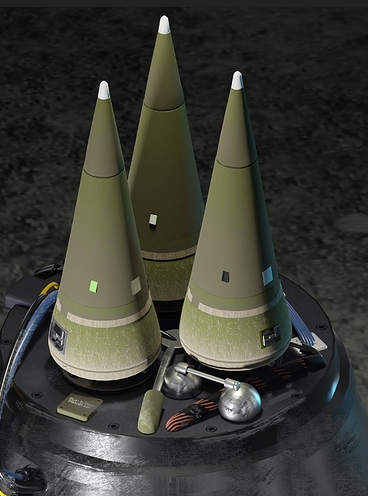
Some vocabulary from bad old days of the Cold War has come back to haunt us. Russia has announced that it has deployed its RS-28 Sarmat intercontinental ballistic missile (ICBM) in Belarus. The 112 ft long, 211 ton missile is said to carry 15 Multiple Independent Reentry Vehicles (MIRVs). As new and scary as this sounds, the US first conceived of the MIRV in the early 1960’s and deployed its first MIRV’d ICBM (Minuteman III) in 1970 and the first MIRV’d SLBM (Poseiden Sea Launched Ballistic Missile) in 1971. The USSR followed suit in 1975 and 1978, respectively.

In the early 1960’s it was believed in the US that it was behind the USSR in what was called the “Missile Gap”. It turns out this was incorrect and that, in fact, the US had a large advantage in the number of ICBM strategic delivery vehicles. For a long while we in NATO thought the Soviets were 10 feet tall and that turned out to be an exaggeration. From their performance in conventional battle, they have diminished in stature just a bit. However, their nuclear triad is to be respected.

The initial purpose of the MIRV concept was to compensate for inaccurate delivery. It has evolved to include decoys and multiple target delivery. There is a good deal of non-classified information on MIRV systems on the interwebs.

Putin’s threat of a new MIRV’d missile is just more nuclear bluster to frighten NATO citizens. For the present time his nuclear weapons are more valuable in storage as they have been all along with the Mutual Assured Destruction policy. That said, they have a policy of using nukes if the security of the state itself is under threat. I would guess that Putin sees himself as the state.

I wonder if it has dawned on the Russians that nobody in their right mind would actually make a preemptive attack on Russia or its former Soviet satellites. Who actually wants the place? What benefit is there in trying to subdue 140 million angry Russians and their huge frozen taiga? That’s nuts.

Russia Spies on North Sea Infrastructure

Reuters has reported that Russian ships have been observed in the area of North Sea energy resources of The Netherlands. MIVD head General Jan Swillens stated that “Russia is mapping how our wind parks in the North Sea function. They are very interested in how they could sabotage the energy infrastructure.”

The Reuters article went on to say “Dutch intelligence agencies MIVD and AIVD, in a joint report published on Monday, said critical offshore infrastructure such as internet cables, gas pipes and windmill farms had become the target of Russian sabotage activities.”

Norway is in a state of heightened alert because of recent appearances of unidentified drones buzzing over North Sea oil platforms, airfields and other sensitive sites. Norway has replaced Russia as a major supplier of natural gas. Norwegians believe that espionage, sabotage and false messaging are a means of intimidation. Though not a member of the EU, Norway mirrors the EU in many ways.

According to AP, seven Russian citizens have been arrested recently for flying drones or taking photographs of sensitive areas. In Norway it is illegal for Russian citizens or companies to takeoff, fly over or land on Norwegian Territory.

The clear intent of Russia Putin is to map out North Sea infrastructure for purposes of sabotage. Doing it in the open gives them the added benefit of intimidation. The UK and EU have considerable dependence on oil and gas from the North Sea. Plenty of communication cables lie there as well. Obviously, interruption of these resources will cause great economic and political disruption in affected countries. It is hard to believe, however, that Russia doesn’t already have data on the North Sea infrastructure.

Russia is sending a message that they consider North Sea Infrastructure a critical target for attack at some point. They know that winning a war is about removing your opponent’s will to fight. Collapsing your opponent’s economy and industrial base by shutting down the flow of energy is probably most likely very early in hostilities with the West. This should be nothing new to Western war planners. But to politicians and business leaders it might be a wakeup call.

Putin’s criminal invasion of Ukraine has given the West motivation to assess its defensive resources and move to beef them up. Putin has also given the West a picture of how the future world order could look. The West has ignored or underestimated the threat that Russia poses at its own peril. We’ve already begun Cold War II.

Putin’s Russia excels at brinksmanship and psychological operations. The Putin/Ukraine war is stalled for the Russian land forces at present, but he still has assets for conventional air and sea operations. Building on his lies that the “western Nazi’s” pose an existential threat to Russia, he can deflect attention elsewhere at least for internal consumption.

It is my sense that Putin and others like the NPRK would like nothing more than to be sure the continental US takes battle damage in the next big war. Just like our nuclear submarines, Russia’s large fleet of nuclear submarines can navigate around the world quietly in stealth. They can park off the US coasts and deliver whatever they want.

The West must absolutely stand firm on resisting Putin’s threats and holding back the conquest of his neighbors. I believe that Putin will remain a serious threat to the West as long as he is alive. His crimes are so extensive now that he can never safely retire from office and live in a dacha somewhere. It seems doubtful that his successor will be much different.

An open question is, why would Russia think that the West would preemptively attack them? Because we yearn for their vast stretches of taiga? Maybe they fear for their hydrocarbon reserves? Let ’em have their oil and gas. It is theirs. An attack on the Russian homeland would go nuclear early in a conflict. There is no future for anyone in nuclear war. Once that genie gets out of the bottle, there is no stuffing him back in like we did post-WWII. Like anyone else, the Russian people are nice folks. Except for their government. Rancid leadership is something their people will have to overcome.