Category Archives: Science Education

The latest hiss from Jupiter

The 20.1 MHz radio receiver kit we ordered from Radio Jove arrived last week.  Lots of tiny components to solder onto the PC board.  I seem to have forgotten the color code for resistors. 

The kit comes with conductors and fittings for a dual dipole antenna. I’ll have to go to Home Depot and buy parts for the support structure.  The antenna is going to take a bit of real estate to set up.  Given that Jupiter is low in the sky for a few years, it is desirable to contrive a means for narrowing the antenna beam to help with some noise rejection.  A properly configured dual dipole 15 or 20 ft off the ground helps a bit. 

A powerful station already broadcasts at 20 MHz (WWV), out of Ft. Collins, CO, so the receiver is offset at 20.1 MHz.  Jupiters cyclotron radio emissions are strongest between 18 and 24 MHz.  For locations distant from Ft. Collins, the broadcast at 20 MHz may be irrelevent. The ionosphere is mostly transparent to 20 MHz radiation on the night side of the earth, so transmissions from interfering sources in this band tend to propagate into space at night rather than reflect off the ionosphere and go beyond the horizon.

Th’ Gaussling has been busy studying the basics of antenna theory.  It’s quite interesting, really.  An antenna is basically a transducer, converting energy from one form into another.  The knowledge of antennae is something of a dark art.  I have had to scrounge to find resources that explain without too much forgotten calculus. 

Once you have antennae on your brain, you begin to notice them everywhere. All sorts of them. Yagi’s, dipoles, dishes, mast antennas, and folded dipoles jutting off of every imaginable high spot. I have one bolted to my house. 

The side benefit for yours truly is that it has forced me to have a hard rethink about electromagnetic radiation and the mechanism for its generation. We organikkers generally don’t spend a lot of time thinking about radiation emission and propagation. 

There could be some pedagogical advantages to introducing students to electromagnetic radiation in the radio spectrum rather than the visible range. The acceleration of charges in an antenna element and the subsequent perturbation in the charge field around the charged particle seems to be conceptually easier to reach than the usual abstractions showing the 3-D rendering of a sinusoidal wave in most textbooks. In fact, I have never seen a good representation of visible photon emission beyond arrow pushing on an energy diagram.   Who knows, maybe a student would learn something about electricity as well?

Hey. Check out the Quantum Slacks by Haggar.  The first of their Non-Newtonian line.
Mixing and Unmixing

Today was take-your-kid-to-work-day.  In honor of this we put on a chemistry show in one of the labs.  Burned some Mg ribbon, shrunk some balloons in LN2, blew up some balloons with dry ice, reduced iodine with ascorbic acid, and we unmixed some NaCl and carbon black. 

One of the barriers to teaching chemistry is a level of physical abstraction that is hard to get around.  It is hard to get around trivial explanations when the audience is not ready to discuss electrons.  Many of the really insightful concepts in chemistry are inherently abstract and age inappropriate for the younger crowd, so to compensate, chemistry demonstrations are often heavy in the whizbang components.  That’s fine.  It should be fun and visually appealing, especially for K-6. 

I like to do mixing and unmixing because it demonstrates something about materials handling.  It also represents an activity that occupies much of our time.  Separation science is not commonly called “unmixing”, but for chemistry demonstrations it causes kids to ponder the problem for a bit.  They all have experience in mixing things- we talk about that.  Then I ask the question “What if I asked you to unmix that KoolAid”?  A few of the more worldly ones might suggest boiling off the water.  But most kids seem to be stumped- they will admit that they would have never considered the possibility of unmixing. 

So we dissolve some NaCl in water and make a solution.  The use of a magnetic stirrer and stirbar makes way for a minor diversion with magnets and iron filings. Then we blend in a bit of carbon black. Using a Buchner Filter, filter paper, and Celite, we do the vacuum filtration, showing the remains of the carbon in the Celite.  The filtrate is then treated with some “Anti-Solvent” like acetone and the salt comes crashing out. 

Yeah, I know. It is pretty tame.  But it can be done cheaply in 45 minutes and the kids can see their parents actually doing something. 

Jane Goodall

Went to a public lecture by Jane Goodall last night. The arena was packed.  She and members of her institute have found a type of formula for combining conservation and economic growth.  At some point she realized that you can’t sell conservation in a vacuum.  People who live near fragile preserves like Gombe have to make a living.  They need food and firewood. 

Human population pressures also threaten the shrinking wildlife preserves all over the world and in Africa in particular. One way to encourage lower population growth is to look after public health and, in particular, the welfare of women. They’ve noticed that families naturally tend to have fewer babies when infant mortality rates lower. Lower mortality rates can be achieved through the application of very fundamental improvements in hygiene and health care.

One of the critical approaches they are taking in Africa is to improve the life of women through micro loans.  This has proven effective in many other parts of the world and Goodall reports it is having a beneficial effect in Africa as well.

As I sat and listened to the lecture, I was overcome with the futility of our ever increasing consumerism.  Take our collective response to the increasing scarcity of petroleum.   The big ideas seem to involve finding new ways to sustain high consumption- e.g., the replacement of petroleum with ethanol or hydrogen.  The idea that we might have to throttle back our per capita consumption of stuff extracted from the ground is ignored.

Well, of course the national stage isn’t filled with people promoting reduced consumption.  There is no money in reducing demand. Who wants to hear that? 

Minimally, the USA must go the way of Europe in terms of lower average consumption.  Higher population density combined with higher priced energy will lead to more modest consumption of goods due to lifestyles adjusting to scarcity. 

Along Came ChemSpider

There is a new resource out there called ChemSpider.  In the few searches I’ve had a chance to do, it seems to be pretty efficient at separating a lot of the wheat from the chaff that you’d get just using Google.  It would be interesting to hear what others think of it.  According to the informative FAQ page, ChemSpider is a highly specialized chemistry search engine.  And, did I mention it’s free?  Yeah baby.

To begin you enter a name, CASRN, tradename, synonym or SMILES. This generates a report of hits. Click on an ID number or a structure and another page brings up hotlinks to various resources on the web. Click on the Data Sources link and another page will come up with a variety of data sources and their unique external ID numbers. Click on the molecular formula link and it pops off a Google search of the formula.

Obviously, this isn’t the same as a SciFinder search- you don’t get access to journal downloads and article bibliographies.  It connects you to a variety of public access sites that appear to be data repositories and collections of commercial suppliers.  But it is a real improvement over a raw Google search.  You don’t get the rats nest of links to publishers (i.e., Wiley, Elsevier, etc), expired colloquium notices, or literature citations from curriculum vitae on faculty websites.  

It will convert names to structures and, using ACD/Labs software, generate calculated physical properties.  I would be hesitant to enter the identities of confidential materials just yet. I do not know if they compile entries into a database or not.  I’m not convinced that I would enter a sensitive confidential material on it until I had a chat with an attorney about the question of disclosure.

All in all, it seems to be a useful tool for web searches.  I have only scratched the surface of what this thing will do.  Give it a try and see what you think.

Plasma Songs From Space

The radio telescope project has begun. Today I ordered a 20 MHz receiver from Radio Jove.  While we wait for that to arrive we have to source an 8 channel Analog to Digital Converter (ADC) for the data feed into RadioSky-Pipe.  RadioSky has run out of ADC’s, but they recommend Kitsrus out of Hawii.  

We have three surplus computers I bought from work.  Have to pick one and get an operating system (Windows 2000, probably, though Linux is a possibility), a monitor, and a keyboard. 

The biggest issue is the recommended dipole antenna. The kit specifies an East/West 23′ 3″ ft dipole with a 32 ft footprint, is ca 10 ft high, and uses guy wires to stabilize it. Sounds like a trip hazard and a target for vandalism to me.  In that vein, I have been looking at alternative antenna configurations. The folks at Radio Jove are reticent to recommend one, presumably because it is a step away from simplicity for classroom use.  That’s fine. I’m an experimentalist.

One problem with moving away from the dipole antenna design is the unwieldy half-wavelength dimensions. While the dipole eats up real estate, it is structurally simple.  One interesting design is the Moxon antenna.  This antenna uses a bent driven element with a bent reflector element.  Most people use it with the elements in the horizontal plane, thus picking up horizontally polarized signals.  While this makes sense for communications, I’m guessing that the 20 MHz signals from the sun and Jupiter are probably not significantly polarized.  

The Moxon is significantly more directional than a dipole with a front to back ratio 15 to 20 db.  This means that it must be pointed at the radio source for maximum gain.  But its directionality also confers some rejection of terrestrial signals from other directions. From what I can tell, the gain from this design with its reflector element is on the order of 5 db.  This is higher than a dipole but lower than a multi-element Yagi.

We’ll get some baseline experience with the recommended antenna and then begin to look at other configurations.

In my view, one can never know too much about electronics.  This site has some interesting circuit animations.  Cheers!

The Zen of Hazardous Materials

My first experience with truly hazardous materials was in 1981.  It was a sophomore organic lab and we were making sulfanilamide.  Using chlorosulfonic acid, we attached a ClSO2 group in the para position of acetanilide.  Pedagogically, it was a very rich experience because it validated the idea of O,P-directors, protecting groups, medicinal chemistry, and offered real experience in the handling of hazardous materials.  And, at least as corrosive materials go, they don’t get much more obnoxious than chlorosulfonic acid.

The preparation of sulfanilamide was an excellent lab experience because it brought home some fundamental truths about nature.  Namely, that physical and chemical properties of matter can be “tuned” and tweaked by people to give a desired outcome.  For students, this lab experience connects the inorganic, inanimate world of the periodic table to something closer and more personal.  It gets to the very nanomachinery of life itself.  It is a glimse of how drugs work. It gets right to the pointy end of the stick- Drugs are about selective toxicity. 

Once you have taken the time to gain some understanding of how drugs work at the molecular level, you are forever changed.  One begins to realize that biochemical “mistakes” can happen naturally and are part of the game.  Suddenly, the world is full of rogue “isosteres” and “pharmacophores“.  You can no longer accept blithe generalizations about toxicity and chemical hazards.  There is truth in the First Law of Toxicology- Dose makes the poison.  Your working definition of toxicity takes on new forms, like the notion of endocrine disrupters

As time goes on and my view of the natural world becomes increasingly molecular in scope, I find that my working definition of what constitutes “hazardous” has skewed a bit as well. Hazardous does not automatically equal “bad”. The modern material world is now a swirl of substances synthetic and substances natural.  Industry has given us dioxin and nature has given us aflatoxin.  But at worst nature is indifferent; human activity can be negligent or even malevolent. 

A mature view of hazardous materials must simultaneously accomodate physical/chemical reality with certain norms of conduct, with prompt and delayed biological effects of hazardous materials, and with consequences to the biosphere.  In truth, modern society must use hazardous materials to produce goods and services vital for healthy living.  But we chemists must find ways to limit the number of moles of hazardous waste we generate. Especially the persistant substances- metal salts, halogenated hydrocarbons, etc.

Synthetic chemistry relies on reactive materials in order to do bond making and bond breaking.  There really is no getting around the need for reactive materials. But we can find ways to generate reactive materials in situ.  Reactive intermediates are generated in a catalytic cycle and used on the spot.  More pervasive use of catalysis could be a contributor to lower generation of haz waste or a greener chemistry.  This is just a corollary to Trost’s Atom Efficiency concept.

Hazardous materials have a utility that is similar to a knife.  A knife is a tool that does a very useful thing- it cuts. Every single time you pick it up you have to be wary of the edge and the point.  It is a persistant hazard.  But we continue to use it because of it’s utility.  In a way, chemicals are the just like that.

Organic Qualitative Analysis. RIP.

One of the chemistry classes I took as an undergrad continues to assist me in my synthetic endeavors mid-career.  The class was organic qual.  It was designed to take the student through the determination of an unknown organic compound , or mixture, with the aid of qualitative tests and derivitization to figure out the compound. We did small visual tests to guage acidity, basicity, water solubility, etc. We did sodium fusions to look for halides, 2,4-DNP hydrazones for carbonyls, picrates of amines, and flame tests to make a guess at saturation. We were given just so many grams of unknown and we had to perform several tests to support a claim of identity. It was an excellent experience because an organic prof taught the actual lab section.  We had access to the lab during the week to work on the unknowns. 

We used derivitization to determine some of the more difficult unknowns. CRC Press had a book of physical properties of a large range of known compounds that were derivatized, so you’d compare mp’s, color, bp, solubility, etc., to make a case for identity.

I would be interested to hear if this is still in the curriculum out there. I fear that it has passed along into history in the face of the hyphenated cryptozoology of todays analytical instruments.  That’s a pity.  Organic qual gave me the chance to handle chemicals, perform reactions, deal with ambiguity,  and do tests that might be hard to work into the rest of the curriculum.   Part of being a good organic chemist is racking up lots of time in the lab doing stuff, polishing up the physical intuition and mechanical skills.

I am embarrassed to admit that at one time I embraced the idea that the organic microlab experience was good pedagogy.  I now see it as more of a phenomenon meant to stretch department budgets. The idea of giving students barely enough reagents to make 100 mg of something is pretty dubious.  If the student goofs and spills something or makes a mismeasure, they might end up with 25 mg of product. The isolation of this amount of mass is problematic for fresh learners.  I miss the days when the organic lab kit had 25, 50, 100, and 250 mL flasks in it (19/22 ST joints, of course). 

The argument goes something like this: Our conversion to microlab equipment is justified because of the cost saving gained by going to a lower scale. We buy fewer grams of expensive reagents and we lower waste generation for the department. Well, this is a bunch of self-serving crap. I can just see the department chair’s pointed head nodding in agreement as some tenured Poindexter drones on about minimizing the negative impact on the environment.  

For Christ’s sake, we’re talking about chemistry, not church camp.  Minimally, chem majors should not be cheated by limiting them to the microscale experiments.

If you want to save the environment, stop driving your SUV down to 7-11 to get cigarettes.  Or, don’t bring home so much cheap plastic crap from Big Box Mart.

Colleges should be giving their chemistry majors more synthesis experience, not less.  In industry it can be a real problem finding fresh BS/BA graduates that have lab experience beyond sophomore organic lab.  Schools that promote lab-based synthesis research for undergrads (as opposed to computation) are doing their students a bigger favor than they may realize. 

A mote in the eye of Schrodingers Cat

I have made some adjustments to the blogroll. It turns out that physicists, to a greater extent than chemists, have taken up the craft of blogging.  Why chemists seem less inclined to blog remains unclear.  This tendency is seen on the shelves of book stores as well.  Whereas, bookstore science shelves are clogged with treatises on Quantum _____ (fill in the blank), works on chemistry are often limited to chemical dictionaries or Schaums Outlines.  Here in Colorado, where the per capita college education is reasonably high, in certain counties at least, urban bookstores may have chemistry titles that go ever so slightly beyond the study guides and dictionaries. 

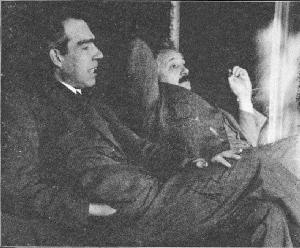
It seems to me that many of the popular quantum mechanics books on the market are peddling to people looking for a mystical experience.  Fred Alan Wolf and a few others have made a career of feeding this need.  I recall the quote by Niels Bohr-

‘There is only an abstract quantum physical description. It is wrong to think that the task of physics is to find out how nature is. Physics concerns what we can say about nature.“. 

 Bohr and Einstein

But I’ve ventured out on a limb. I am but a lowly synthetic organic chemist, a plebian scribbler in the scientific pecking order, who has not used a Hamiltonian operator or a Kroniker delta since grad school. My fragmented knowledge of quantum mechanical formalism is but a mote in the eye of Schrodingers cat.

Note: I’ve deleted The Volokh Conspiracy from the blogroll. They have developed an unfortunate neocon twitch that I find distasteful. 

Why Teach Science?

Here is the text of a comment I made over at the Volokh Conspiracy. I have pasted it here so I don’t forget it.  OK, so there is a little bit of vanity here. But I do want to build on this theme. The context of this comment pertained to the teaching of science and the influence of proponents of Intelligent Design.

In the end, we who teach want students to be able to use their brains. We want them to be able to construct or use a theory to make predictions about the observable universe and then devise experiments to test their hypotheses. We want them to design positive experiments rather than negative experiments. We want them to use language and math to express what they are thinking. We want students to be comfortable using a working hypothesis while they are working on a problem, just as long as they remember that it is just that- a working model.

We want students to learn to follow the evidence and draw a conclusion rather that start with a conclusion and cherry-pick the data to be consistent with preconceptions. The glory in science is to be able to tip over the established order in favor of new insights and understanding based on data. In the end, scientific methodology is about intellectual honesty and accountability.

All measurement involves error which causes a certain amount of uncertainty in a result. You don’t have to invoke Heisenberg to consider uncertainty. A result is only as good as your worst data. This leads to my final point.

A sign of good training or instinct in science is the ability to be sceptical or at least a bit hesitant about your conclusions. Hesitant in the sense that your conclusion is to be considered within a set boundary conditions.

A scientific outlook has served me well in general. At least so far. The world would be much more complex if I had to invoke a miracle every time something odd happened.

As is common at this site, a cluster of blood-sucking fuss budgets are haggling over minutae.  I’ll bet not a damned one of them ever had to make sense out of a mass spectrum or isolate a new substance and prove it.