Category Archives: Science

Bleaches and in-process checks of the enlightenment

In his 1736 publication Smegmatalogia, or the Art of Making Potashes and Soap, and Bleaching of Linens, James Dunbar describes a process for the preparation of potash.  The intended user of the process was the common Scottish farmer. Dunbar was anxious to imbue the common Scot with the ability to “bleach” his own linens.  It is important to realize that the meaning of the word bleach in the early 18th century is different from contemporary use.  The modern use comprises notions of decolorization through oxidation of color bodies to produce a white appearance.  The 18th century concept involves the apparent cleansing and subsequent lightening of a fabric.

The book begins by detailing the preparation of a solution or extract from ashes called Lee.  To obtain this solution, the “Country-Man” would carefully collect Scottish vegetables such as the wood of oak, ash, beech, “thorns”, juniper trees, and “whins”. Suitable herbs included fern, breckens (or brackens), wormwood, thistles, stinking weed, and hemlock. 

Dunbar is careful to instruct that the vegetation should be burned in the shelter of a house but in such a way as to avoid burning down the house. The purpose of burning the vegatation in a shelter is to avoid having rainwater come into contact with the ashes.  My interpretation of this is that runoff carries away soluble potash.

The ashes are placed in a container and covered with water. The ashes are soaked in water until such time that the Lee “carries an egg on its surface”.  What Dunbar is telling us is that the extraction of the ashes needs to go until the worker obtains in the solution a particular specific gravity- this is a specification. There is some minimum specific gravity of the Lee that will float an egg.  And the higher the specific gravity, the more volume of the egg rises from surface of the Lee. The specification herein is required for the next operation.  In order to carry out a successful saponification of tallow, the Lee solution must be sufficiently concentrated. 

Dunbar then describes steps where the Lee is combined with the ashes of ash, beech, or fern followed by boiling the water off to afford “thickens of pottage“.  The residue is shaped into balls which are then calcined in a fire to afford a substance that may be stored in a dry container for the purpose of making soap. 

The discovery of chlorine in 1774 by Scheele and the subsequent of discovery of chlorine bleaching by Berthollet gave us our modern conceptual notion of bleach and bleaching. The develoment of bleaching powder was made by Scottish chemist Charles Tennant who took a patent in 1799.  Tennant’s associate, Charles MacIntosh, is thought to be a contributor to this invention.  Bleaching liquors and powders soon became an important raw material for the bleaching of paper and fabric.

The procedure described by Dunbar is a chemical process.  It tells the user when the extraction is complete, qualitatively at least, by a folksy means of specific gravity determination. This is really very clever- it uses a common object to do the test and the result is readily apparent.  Bleaching in the early 18th century involved the use of soaps and of urine treatment and bleaching fields- a far cry from what we now think of as bleaching.
Astronomers talking about matter again

I’m always a little skeptical when I hear astronomers talking about specific compositions of matter out in the universe.  The recent gushing press release from Reuters about a diamond planet orbiting a neutron star just adds to my burden of disbelief. 

I truly hope there is more evidence than that revealed in the press release. That is, the assignment of the diamond allotrope of carbon based on density (3.53 g/cm3).  The report seems to express amazement that the planet is “so dense”.  A specific gravity of 3.53 is not that high. Many other compositions are possible.  Perhaps Reuters should look at high density objects closer to home.

In praise of polyolefins

Being a person nestled in the dark and humid recesses of industry, I find myself boggling at certain things out in the bright and sunny world.  Truly, it boggles my mind how little appreciation people have for polyolefin resins. That is to say, polyethylene, polypropylene and all the myriad copolymers and formulations found thereto.  Ok, let’s throw PVC and polystyrene in the mix as well.

Why do I boggle at this? What makes my head spin in puzzlement? I’m so glad someone asked.  Polyolefin films look innocent enough to be ignored. In their uncompounded state they are clear and colorless or they may be white.  Polyolefin films and extruded components are ubiquitous in packaging and thus are not normally an object of desire. They serve the object of desire. They occupy a lesser state interest in nearly all contexts.   They are made inexpensively enough to be torn asunder from the desired object and tossed wantonly to the side for later clean up.

But if the uneducated user of polyolefins only knew the extent to which modern science and engineering had been carefully applied to the lowly stretch wrap or the roll of 1 mil PE film. If they only knew the scientists and engineers who carefully devised the ethylene crackers to produce high purity ethylene, or if they knew the highly educated people who devise the polymerization process, they might have heard an account of the long march to produce water white films with properties matched to the end use.

Puncture resistance, elongation, fish-eyes, haze, modulus, crystallinity, glass transition temperatures, melt points, low volatiles, melt viscosity and strength- all attributes carefully tended to so that the film appears invisible to the consumer. High gloss, low haze films to make the product look even better.  Low volatiles and residues for food contact use.  Polyolefins engineered for specific densities for the global market.

All of the attributes above to attend to with a continuous polymerization loop that spews 50,000 to 80,000 lbs per hour of pellets into silos and rail cars. Pellets that will eventually go to converters who will blow films and extrude widgets all day long.  All so the consumer product can arrive at its destination wrapped unscuffed and free of dust.

Polyolefin materials are incredibly useful and amazing in their own right. We should have more appreciation for these materials and how they serve our needs.

Encounter with the K-T Boundary

Th’ Gaussling drove to the southern border of Colorado to have an up close and personal view of an exposure of the K-T boundary. The coordinates are N 37º 7.335′, W 104° 36.248′. This exposure is perhaps 150 meters in length and is no more than a quarter mile hike from the parking area. The exposure is within Trinidad Lake State Park, so a $7 one day park pass is required for entry.

The term “K-T boundary” refers to both a layer of sediment and to a step change transition in paleoecology. The sediment layer was laid down at a time coincident with an extensive plant and animal extinction event. This period and the sediments put down then make up the boundary between the Cretaceous and Tertiary periods. Nomenclature alert:  According to some sources, the use of Tertiary time or rock is discouraged in favor of Paleogene and Neogene. Under this terminology, it is referred to as the K-Pg boundary.

It is widely accepted that a large impactor collided with the earth forming the Chicxulub Crater approximately 65.5 MA.  The Chicxulub  (CHEEK sheh loob) crater was first observed from gravity mapping by Robert Baltosser in the 1960’s and later rediscovered by geophysicists Camargo and Penfield while doing geomagnetic work for Pemex in 1978.  Pemex would not allow the disclosure of the data supporting the presence of the crater for several years. Eventually, Penfield was allowed to disclose their work at a conference.

The Chicxulub crater is found below the surface along the northern coast of the Yucatan Peninsula in Mexico.  Gravity maps show evidence of a circular feature consistent with an impact crater. Sediment associated with the impact contains tektites, shocked quartz, vitrification and elevated levels of iridium. A common mistake propagated in the popular literature is that the layer consists of iridium. In fact the layer contains variously ppt or ppb levels of this platinum group element.

The theory of asteroid impact arose from the anomalous Ir content of the thin sediment layer found to have been deposited at the time of the K-T extinction. Geologist Walter Alvarez, son of non-other than Manhattan Project physicist Louis Alvarez, determined that significant iridium was found only in the K-T boundary layer and not in the layers above and below.  The determination was had via neutron activation analysis and was carried out at Lawrence Berkeley Laboratories.  After a variety of postulates were considered, the theory of asteroid impact ending the age of dinosaurs was born.  The theory was disclosed in 1980, but was met mostly with derision. However, with the disclosure of the Chicxulub crater in the late 1980’s, the theory has since met with widespread acceptance.

Across the earth in what is now India and roughly contemporaneous (68 to 60 MA) with the Chicxulub event was a prolonged period of extensive vulcanism. The formation from that period that remains today is the Deccan Traps.  According to one source, the word “trap” is a geological term from the Swedish word for “stairs”. This period of vulcanism is thought to have produced enough atmospheric pollutants to have raised the average atmospheric temperature by 2º C and enough lava to have covered half of present day India.

Whether or not the fullness of the transition from Cretaceous to Paleogene is due to the Chicxulub event or in combination with the Deccan vulcanism is unclear. What is clear is that the Chicxulub impactor delivered an estimated 4.0 E17 MJ jolt of energy to the planet, resulting in mega-tsunamis throughout what is now the Caribbean basin and the injection of vast amounts of dust and aerosols into the atmosphere.

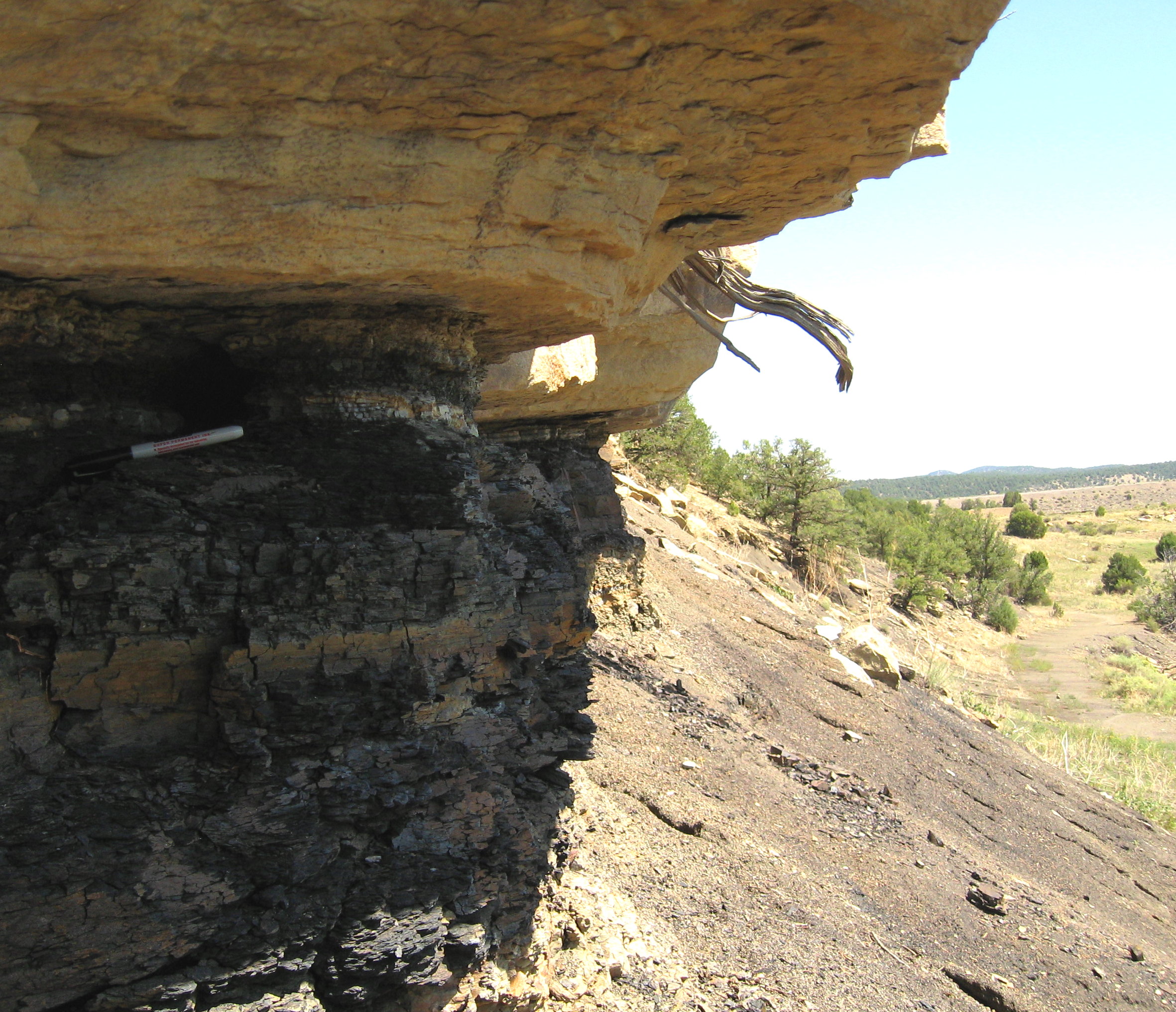
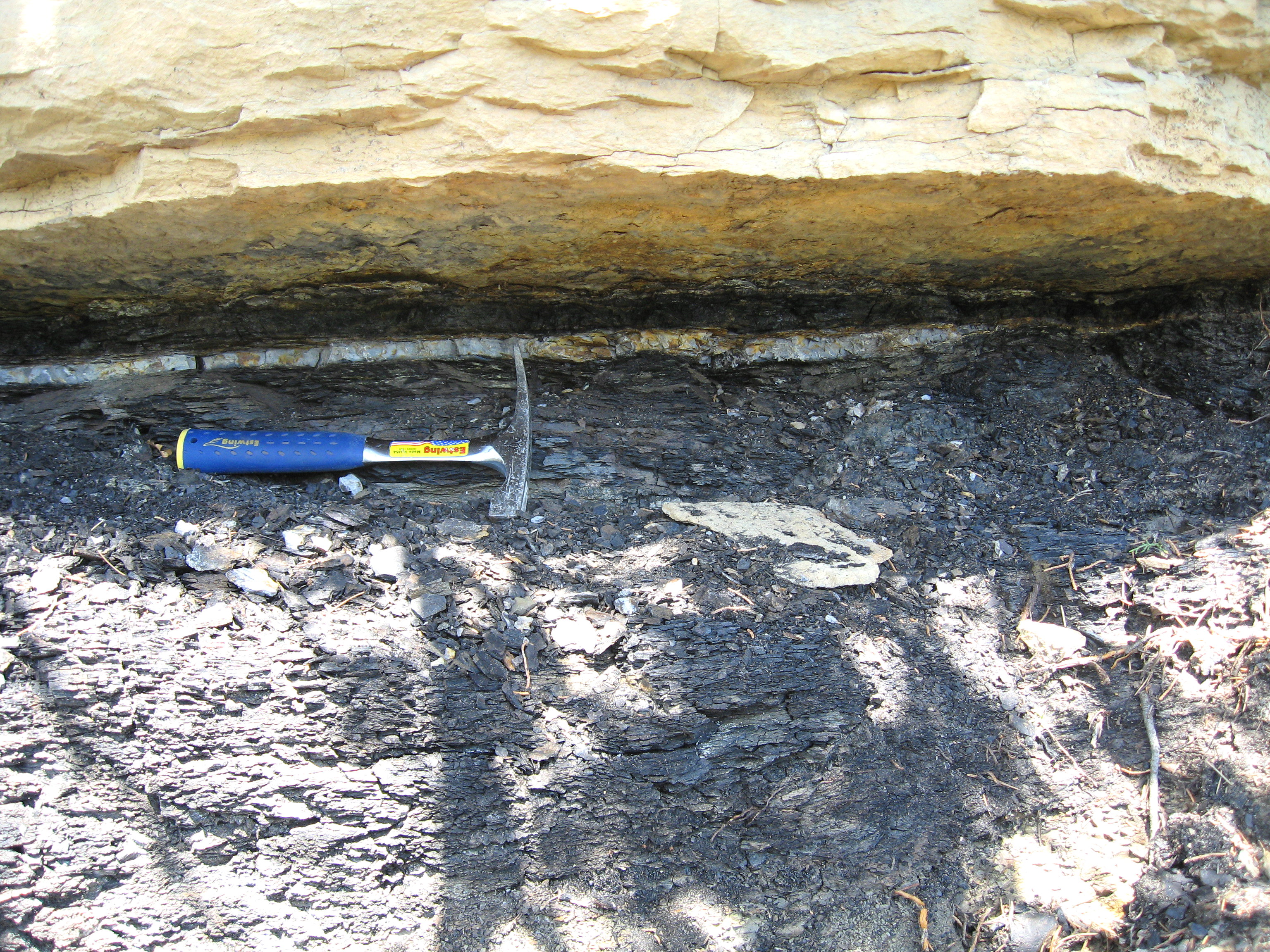
An exposure of the K-T boundary can be found in an outcrop just west of Trinidad Lake in southern Colorado. The thin, off white layer lies within a seam of coal and under a cap of sandstone at this location. Note the rock hammer for scale.

Exposure of the K-T Boundary, Trinidad, Colorado.

View of the K-T Boundary sitting under a cap of sandstone. Note Sharpie marker just below layer.

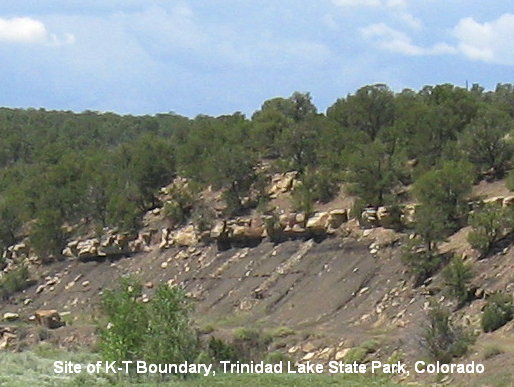
K-T layer in context.

The K-T layer at the Trinidad site is comprised of claystone which is weathered and crumbles easily. If the material contains parts per trillion quantities of iridium, then sending a sample out for GDMS is likely to be futile.

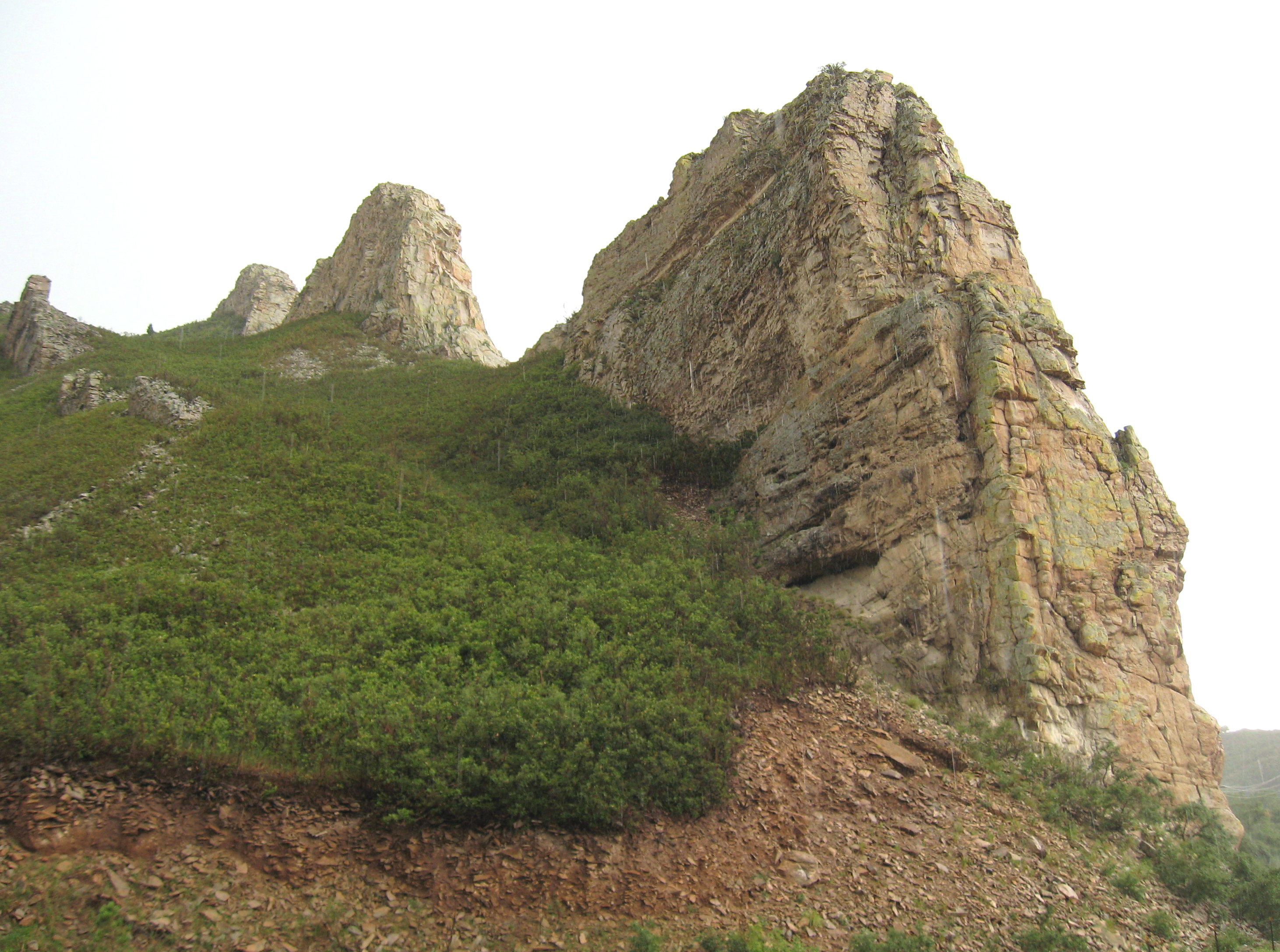
North of Trinidad are the Spanish Peaks. These peaks are of volcanic origin and are associated with a substantial array of dikes, a great many of them visible from the road. The photo below was snapped from a roadcut during a recent rainstorm. To the west is the Sangre de Cristo Mountain range. This range is what is called a horst, which is an uplifted block of crust. Just west of this range is the San Luis Valley containing the Rio Grande rift formation.

Dike formation south of La Veta, Colorado

Dike formation south of La Veta, Colorado.

Recently on an airplane I sat next to a 1948 chemistry graduate of UC Berkeley. We were enroute to John Wayne airport from Denver.  As we both marveled at the majestic topography of the Grand Canyon below she told me of her experience of having both Luis Alvarez and Glenn Seaborg as professors. Alvarez, she said, gave an exam with 7 % as the high score. She shook her head, laughed, and asked, “can you imagine”?

Play it forward. Science as an extended subsidy.

I search chemical abstracts nearly every day. What occurs to me is that this vast treasure of knowledge is substantially the result of tax revenue channeled into scientific research by numerous technologically advanced societies. While at the time of any given publication, the value might seem minimal. But over time people like me, people in applied industrial science, consume this treasure for the purpose of generating new goods and services. Rather than reinvent the wheel, we consult the subsidized results of other workers in the field. Subsidies of the past play forward to subsidies of the future. If we can’t lift an exact procedure from the scientific literature, then often we can apply new substrates to known transformation. 

In a very real sense, a resource like Chemical Abstracts is an engine of ingenuity. It’s content provides the means to innovation by outright disclosure or by sparking the imagination.  This work is enabled by government organizations funding people and institutions for the purpose of placing technology into the public domain.

While industrial or private organizations have the ability to generate a knowledge base as substantial and as in-depth, the fact is that the imperatives of private business are not in the direction of public disclosure. The imperative of the private sector is to channel wealth to the ownership. The free exchange of knowledge, in the context of business, is discouraged in that it amounts to the free distribution of cash. 

I hear people saying or implying that all things government are bad and that the private sector is inherently “more efficient” and therefore more meritorious.  What we have gotten from government subsidized science is an everlasting fountain of knowledge available to all to put into practice for whatever lawful purpose they can envision. 

An efficient life seems like a puritanical and regimented life.  And the application of efficiency will always fall under the control of the dominant social order. Is this really so desirable?  

Intellectual property has two sides. On one side, the generators of intellectual property can have the right to a timed monopoly on their art via patents. On the opposite side, the public treasury releases national treasure in order to educate the citizens who then generate proprietary art that is withheld from public use.  This amounts to a subsidy of the private sector.  It is a subsidy that sees little acknowledgement in the politics of today.  But such a thing has actually worked well for generations.  

What we are seeing in contemporary politics is the attempt to vilify and deconstruct government. But government has been central to the technological and consequently the economic expansion in the post WWII era.  The mechanism of collecting resources and focusing them on the solution of certain kinds of problems cannot be matched by the private sector. How would you operate the Centers for Disease Control on a greed based system like capitalism? 

Libertarians are always acknowledging the fundamental nature of greed and how it can be channeled into the efficient use of goods and services. I don’t disagree. What I take issue with is that greed must then be acknowledged as the dominant and true influencing force in society. We cannot allow this to be true. We must make provisions for tight control of greed. It is a useful but savage animal. 

In my view, the generation of knowledge and expertise is time and resource consuming. In order to have a particular amount of practical expertise on any given thing, you have to turn over a great many stones and learn an amount of art that is in large excess of the problem of the day. This actually applies to a definition of expertise- the ability to deal with problems that at first seem to be bigger than you can get your arms around. Expertise brings knowledge in the form of facts and problem solving skills. In order to attain expertise you have to absorb to information that at the moment seems superfluous.  In the end, the expert has a grasp of the length and breadth of a topic in excess to any given problem.

Our national system of scientific discovery and information abstracting serves to provide the reservoir of information that serves users into the future.  This information forms the basis of economic growth well into the future. As we go forward with the seemingly inevitable deconstruction of government, let us not forget what government has given us.

The Quicksilver Monopoly

Hydrargyrum, also known as mercury (Hg) or more colloquially as quicksilver, was in the 19th century the object of monopolistic desire by a large banking concern. In 1835 the Rothschilds acquired the rights from the Spanish monarchy to manage the production of quicksilver in the village of Almaden, located approximately halfway between Seville and Madrid.

The Rothschilds, being ever more interested in controlling their bullion trade, understood that the key to the control of the silver market lay in the disposition of quicksilver. The liquid metal was crucial in the extraction and refining of silver. Silver was purified by amalgamation with quicksilver. Control over the distribution and price of quicksilver in America would put the market in their pocket. They were monopolists- it’s what they do.

Quicksilver has been known for more than 2000 years.  Since Roman times it has been known that everything but gold will float on a pool of quicksilver.  Artisans in Idria, an important old-world reserve of cinnabar in what is now Slovenia, observed quicksilver in its native form in1497.  Quicksilver was mined in earnest in Almaden, Spain, since perhaps the 4th century BC or earlier, according to Pliny. 

Alternating conquests transferred control of Almaden from the Romans to the Visigoths to the Moors and to the crown of Spain, among others.  Having been the seat of mercurial desire for two thousand years, the Almaden cinnabar mines have only recently shut down in the name of public health. Spain’s epic quest for silver and gold in the new world was made feasible through it’s own natural abundance of quicksilver.

Quicksilver was discovered in California in 1845. The New Almaden and subsequently the New Idria mines were quickly pressed into production. The smelting of cinnabar (HgS) into fluid quicksilver is simple in concept and relatively uncomplicated in practice.  A stream of hot flue gases are played over a bed of crushed cinnabar. Oxidation of the sulfide to oxide and subsequent thermal decomposition produces mercury vapor which flows to a condenser surface (brick) where it is knocked down into the liquid state and collected.  Simple technology to perform in undeveloped territory.  Quicksilver was sold in 76 pound lots called a flask. This is thought by some to represent what a laborer (or slave) could reasonably carry.

Within a short time the Californian supply of quicksilver robbed the Rothschilds of their monopoly, resulting in strong price pressure on the European suppliers.  For a few decades, the American quicksilver dominated the Pacific rim. Chinese demand for quicksilver or cinnabar for vermilion was strong.  Silver mining in Mexico and the Andean districts to the south was dependent on quicksilver, most of which was controlled by Spain and later Mexico after its independence. Eventually, the Rothschilds regained control of the market, but at a time when cyanidation and chlorination were playing a larger role in gold extraction. The Rothschilds relenquished their hold on Almaden in 1921.

It is interesting to note that quicksilver, so crucial to the isolation and refinement of gold and silver, was discovered a few years before the discovery of placer gold at Sutters Mill. This happy circumstance surely facilitated the prompt extraction of wealth from the gold and silver mining districts that opened up in the west.

A Fine Caloric

I’m getting to know the RTCal software that animates my RC1.  Thinking about reactions in terms of their enthalpy profile continues to provide deeper insights for an organikker like me.  It is yet another indication that P-Chem is the central pillar of the central science.  

Our culture is driven foreward by exothermicity. We energize the machines of progress and of war by harnessing the exothermic drivers, be they nuclear or chemical.  

Our exothermic sun pumps a global weather machine that provides the motive force to spin the wind turbines to energize our iPads. The sun evaporates water for it’s eventual depostion at high gravitational potential for the release of hydroelectrically accelerated electrons.  Hydroelectric power is an expression of stellar nuclear exothermicity.

The thermal web of our world is an eternal equilibrium of latent and sensible heat flows.  Water’s latent heat of condensation helps to ramp up thunderstorm formation with the result of flowers and high fructose corn syrup and tornados.  The metabolic heat of formation of water and CO2 warms our bodies and provides animation for our desires and our many methods of locomotion.   Dancing and laughter and lust thrive because of exothermicity.

Our lives are spent in the semi-fluid atomic matrix of our bodies while a continual stream of energy flows through them, energizing  metabolism through the magic of ATP and then diffusing into the surroundings.  This energy has resulted in the universe becoming self-aware through the sentience of material beings.

Eventually, because of the disorder accumulated by the large number of exothermic transformations inherent to continuous metabolism, our legs will stiffen and our jaws will lock shut in death as the stream of energy ceases to issue from us. The transience of sentience is rooted in thermodynamics.  How this can be is still quite mysterious.

Retro NMR

We received our picoSpin 45 MHz NMR last week. It’s the size of a toaster and sits on the benchtop next to the computer. We brought in a bunch of chemists to see a demonstration. Most of them were fresh PhD’s on their first job out of grad school. I think they were non-plussed. What on God’s green earth would someone accustomed to using 300-500 MHz NMR want with a low field FT instrument like this?

Let me say that I am a fan of this thing and the company. Yes, it is retro in some ways. It lacks the sensitivity and features many of us are used to. However, it is an FT instrument and can be used to examine a great many substances. In a high field instrument, it seems like everything  is a doublet of doublets. Not in this instrument. For routine analysis of reaction completion, for instance, you may already know the spectrum of your product or starting materials. One or two reasonably isolated diagnostic peaks is all you need to gauge the state of your reaction. You almost never need coupling constants and fancy 2-D spectra at this point. Often, high resolution amounts to excess capacity. And you can have picoSpin in the lab with you. No need to trudge to the NMR room for a routine spectrum. Oh yes, it’s $20,000 for the unit.

We have a high field instrument, but not at my location. Between the GCMS and the picoSpin, I have a good bit of analytical capability.  What I like about this is that the picoSpin offers a lot of analysis per dollar. Of course a high field instrument offers superior capability. But the fact is that most instrumentation on the market today provides considerable excess capacity. For instance, how much of the capability of Microsoft Excel or Word do you actually use? Perhaps 10 %?  I’d offer that a large fraction of the total dollar amount spent on scientific instrumentation worldwide amounts to excess capacity.  People are easily dazzled by the possibilites in a list of features. Sales people know this and actually depend on it.

So, I’m exploring how this miniature marvel can be integrated into daily use in a chemical manufacturing plant. Chemists are a stubborn lot and it may be that I can’t crack this nut. We’ll see.

Misc Sciency Stuff

Think it’s possible to build an electron microscope in your garage?  This guy did it. Ben Krasnow built himself a scanning electron microscope at home with salvaged electronic parts.  This is beyond cool.

Final flight of Endeavor. Cool shot of rocket in the clouds. Could be photoshopped with all of the color saturation, but maybe not.

Neuroscientists in the UK think that the brains of Apple enthusiasts are stimulated by Apple imagery in the same way that religious adherents are stimulated by religious imagery.

It has been suggested that flood plains exist because of flooding.  Something to consider on your next home purchase.

Nasa is floating the idea that there may be more free floating, lone planets than stars.  Sounds very cold.

The destruction of the world commences this weekend.  I guess we’d better get packed.

Notes from the South Pole

A friend is a winter-over staff member this season at the Amundsen-Scott South Pole station. The station is accessable by air only for part of the year.  The last flight left more than a month ago or so. This is her second tour at the south pole.  The elevation there is at 2835 meters above sea level, so not only is the cold due to the low sun angle, but also due to altitude.

Life here at Pole is quite the experience. Today’s winds are up around 20 knots and that knocks visibility down to about nothing. The snow is so dry and icy, any winds kick it up like a sand storm. So no outside treks for yours truly today. In fact, I only make it outside maybe twice or three times a week. If auroras are dancing, I’ll suit up and make the effort because standing under the amazing manifestation of solar winds is just breathtaking.  –South Pole Susan 5/8/11

My friend said that her colleague, Marco Polie, is still skiing every day, but lately it’s too extreme even for him with wind chill temps down to -130 F and zero visibility.  Getting lost in a whiteout would be tragic.

People used to joke that the only difference between going to sea and going to jail is the added risk of drowning. Sounds like a similar thing could be said about wintering at the pole.