Category Archives: Science

Gravity Probe B Results

NASA has just announced the results from its Gravity Probe B mission.  The mission found data that support the hypothesized phenomena of frame dragging.  This effect is the result of vortex-like distortion of space-time around the earth resulting from the earths rotation. The earth distorts space-time owing to its mass and this effect is further shaped by the earth’s rotation.  The effect of this is minute.

Scientists and engineers assembled 4 ultra-precise niobium coated spheres which when spun individually in a hard vacuum and at liquid helium temperatures, produced a highly stable superconducting gyroscope. This superconducting gyroscope produces a weak magnetic field which can be monitored with a SQUID.  Wobble induced by frame dragging would be detected as changes in the alignment of the gyro’s magnetic axis relative to a star in the background. 

All of this is super precise work and a great deal of credit goes to the all those involved.  It is an amazing experiment. It is a true wonder.

Helium

With uptick of natural gas exploration and “recovery” happening, you have to wonder if anyone is bothering to look for helium in it? And I’m referring to the Marcellus shale formation in particular.  Wouldn’t it be nice for some forethought here and try to recover some of the helium that may be lost.  Helium is a non-renewable resource and is critical to many industrial sectors, including superconductor applications.

The US has held helium in reserve since 1925. Helium extraction has been most fruitful from gas wells in the western states. The Helium Privatization Act of 1996 has resulted in the release of the helium reserve to the private sector at a federally mandated price. The FY2011 price is$75.00 per thousand cubic feet.  

According to the BLM, the agency that manages the strategic reserve, their enrichment facility in Amarillo, TX, can produce 6 million cu ft per day of crude helium at ca 80 % purity. The Amarillo plant provides crude He to refiners who polish it to the necessary level of purity for the end user.

XRF Up Close

Had the chance to visit a lab today with an XRF and a GDMS. It was very interesting. Even though I’m an organikker by training, I have to say that I really dig haunting other parts of the periodic table. Organic chemists are spoiled by the splendid richness of multinuclear, multidimensional NMR.  But when you stray from C,H,N, & O, composition and structure can become much more problematic.

The XRF samples were prepared as a lithium borate fusion in a Pt mold in the muffle furnace. The vitreous buttons were then placed in the instrument sample station. One of the problems with XRF, like any other kind of spectroscopy, is the occasional interfering peak.  But, like the famous British philosopher M. Jagger once said, you can’t always get what you want.

The GDMS was a sight. This instrument is sensitive to sub ppm levels all over the periodic table. At this level, just about everything shows up to some extent. The concept of purity becomes muddied a bit, at least for mining samples. For most things there aren’t good standards at this level. You have to trust in the linearity of the instrument and be happy with 30 % error.

Startup Failures

Having been a part of several startups that failed, I think I can speak credibly about aspects of the startup phenomenon.  My friend Bill who lives in a state shaped like an oven mit sent a link to a blog written by a venture capitalist (VC). The long and short of it is that, according to this VC, too many discoveries reported in the biotech literature are based on very slender threads of experimental evidence and often have been performed by a limited number of people.  He ges on to lament that the nature of grant funding may contribute to an R&D style that focuses on reporting only the best looking data that supports the hypothesis forming the basis of the grant.  The basis of his commentary is his experience funding biotechstartups.

Based on my life experiences I have no doubt that his comments are reasonable.

The unspoken rule is that at least 50% of the studies published even in top tier academic journals – Science, Nature, Cell, PNAS, etc… – can’t be repeated with the same conclusions by an industrial lab. In particular, key animal models often don’t reproduce.  This 50% failure rate isn’t a data free assertion: it’s backed up by dozens of experienced R&D professionals who’ve participated in the (re)testing of academic findings. This is a huge problem for translational research and one that won’t go away until we address it head on.     –Bruce Booth, Life Sci VC.

The thing is, this phenomenon doesn’t have to be based on dishonesty, though sometimes it is.  It is in the nature of entrepreneurs to be extremely (or rabidly) optimistic about the value of their ideas.  Entrepeneurs who are specialists with some kind of standing in their field, ie., minimally having tenure or a tenure track slot at a reputable institution, can produce very convincing PowerPoint presentations and handwaving arguments to support their assertions. Especially in front of viewers and investors who are desperate to find the “next big thing”.  Finding investors is a numbers game. You simply have to go out in the big, big world and talk to a great many people. Eventually you will find people who want to invest in a startup.  It is a form of enchantment. And charismatic entrepreneurs learn early on that they can do this.

If you thought that this is limited to biotech or to academic entrepreneurs, you’d be wrong.  I’ve seen this kind of thing up close in other areas of technology. I can say that the prospect of riches just over the horizon can move otherwise sober individuals to commit significant resources to the startup wagon train. 

Especially dangerous is the entrepreneur with a patent or even a portfolio of them.  Having a patent amounts to an endorsement by the US government, or so it would appear to the unwary.  I’ve witnessed entrepreneurs collect and spend millions of dollars of investors money on nothing more than a patent based on handwaving. Remember, patent examiners do not require that you trot out a working model and run it for a while.  Before you invest, I would recommend that you demand to be shown a working model or some other hard evidence of proof of concept.

There are several ways to set up shop in the world economy. One is to steal market share. This is the better mousetrap world of “market pull”.  You develop a product or service that is superior in some way and compels customers to abandon their loyalties. You depend on taking someone else’s share of the pie.

The other way to set up shop is a bit harder. And riskier.  It is the “technology push” domain and consists of introducing new capability through goods and services.  It is more than taking a share of the pie- it is baking a new kind of pie.  This is the realm of the paradigm shift. Examples are the introduction of petroleum, electricity, vacuum tube electronics, synthetic chemistry, semiconductors, and the internet to name some of the really big ones. 

But not all technology push history is so grand. Most technology push is incremental.  Marketing products that create new capability requires early  investors and early adopters. And not everyone wants to be an early to the show.  The trick for purveyors of technology push is to get the cash flow going by selling to early adopters.

I would offer this to those who want to be involved in a startup.  Demand results from a marketing study and examine them as closely as you might the technology. If the entrepreneurs are hazy on how the sales part will look, then watch out.  If they have not included money people and marketing people early in their adventure, then the investor or employee should beware. It’s not all about the technology in the startup.  The entrepreneurs should be as focused on sales and marketing as the tech package. This is where academic entrepreneurs can be extremely weak.

South Pole

A friend and colleague is currently wintering over at the Amundson-Scott station on the south pole.  She is sending us periodic email updates on life at the station.  As they come along I’ll share bits of them.  A colleague of hers posts his observations on his blog. They recently celebrated their once-per-year sunset at the equinox.

There are all sorts of station closing activities I volunteered for early on. I trained for what is called “Flight Following” to man the Comms Center in the winter whenever any flights are flying farther South than 60 degrees. South Pole’s unique position on top of the plateau makes radio reception unusually clear while closer to the coast it is often obscured. So our job is to relay messages if we hear the pilot unable to reach his coast air traffic control. I also periodically do checks in the Power Plant so those people can occasionally get a day off.

It’s almost like a commune down here. Or at least what I assume communal living would have been like in the ’60s, Kind of a fun existence for a few months. But it is damn COLD! I took my glove off to operate my camera to film sunset up on the roof of the station – our daily temps are about -80 F, with windchill well below -100 F. A gust of wind kicked up after I had been filming for less than 2 minutes and I almost couldn’t make my hand work well enough to climb back down the steps. Today there is still a blister on my pinkie finger from frostnip. Human flesh freezes within a minute when exposed to that sort of cold. –South Pole Susan

I guess I won’t be complaining about the cold anymore.

Geysers of Enceladus

My day job requires that I can practice the art of calorimetry with some reasonable extent of expertise, so in that vein I have been cracking open some of my dusty p-chem texts and revisiting basic thermo.

The other day while on an excursion to a bricks and mortar bookstore to pick up some of my favorite periodicals (Kitplanes and Vanity Fair), I happened upon a copy Elements of Chemical Thermodynamics by Leonard K. Nash (1970, Dover, $12.95). Feeling bad for Borders and their current run of poor luck, I bought the book as though it would make some difference.

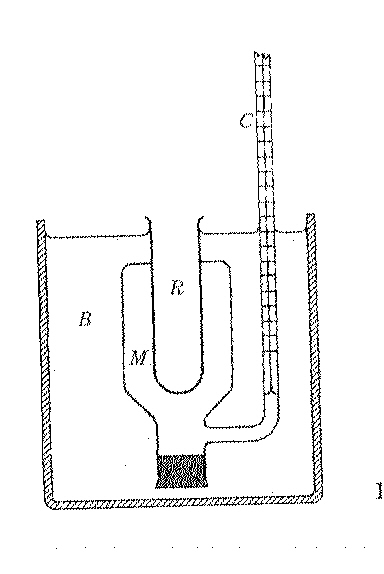
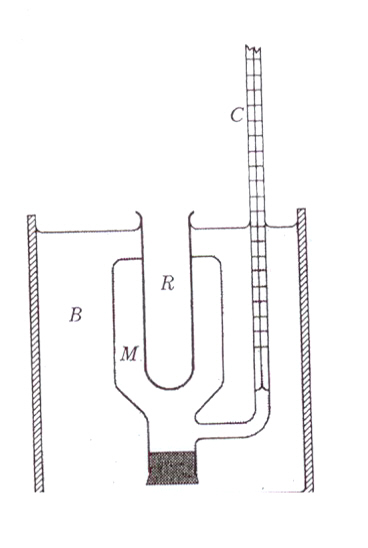
Figure 2 on p 5 (below) shows a schematic of a ice calorimeter.  An ice calorimeter uses a thermally isolated enclosed space M completely filled with liquid and solid water immersed in an insulated tank of ice and water B. The internal, thermally isolated, working volume of water has two important features- it has a small volume sample container R protruding into it and it has a calibrated small inside-diameter expansion capillary C. 

A sample in container R is in thermal contact with reservoir M.  Heat absorbed in M melts some ice and results in the loss of low density ice and the formation of higher density liquid water. The net volume of the contents then decreases and is registered as a column height change in capillary C.

Given the volume change and knowing the density and heat of fusion of water at 0 C, one can calculate the heat absorbed by the reservoir.

So, what about Saturn’s moon Enceladus? The moon is thought to be covered by water ice with liquid water underneath. It’s reasonable to assume that if some volume of water below the ice transitions to the solid phase then the collective volume for liquid water is decreased resulting in an uptick in pressure.

If this happens, it could provide a mechanism for the geyser phenomenon witnessed by the Cassini probe. The geyers could simply be a result of PV work energized by gravity and radiative cooling of the surface and subsequent thickening of the surface ice into the underlying liquid phase.

I’m sure the boys and girls at Cassini have thought of this, but since I’m not tied into the literature I have not heard anybody express it.

On the pitfalls of science outreach to the public

There was a time when I cared about spreading the gospel of the periodic table. I was a believer in the inherent good of knowledge and in chemistry in particular.  I knew in my heart that the examined life was a good life and that knowledge of chemical phenomena could enrich ones life greatly. And for me it has for the most part.

I flamed out a few years ago in the public outreach of science. I was involved in an organization that had some astronomy equipment that was available for public use.  I was enthusiastic about science and gave a lively talk that was often well received by members of the public. I had been an astronomy hobbiest since I was a boy.

But over time, I began to see that a sizeable fraction of people weren’t really too interested at all. Parents there with their kids usually just sat there waiting for it to be over.  The kids, usually boys, wanted to hear about black holes. In fact, we could have gone “All Black Holes All the Time” and could have kept the attendance up. All people wanted to hear about was black holes and aliens, it seemed. On occasion there would be some interest in eclipse phenomena. But how fascinating can a shadow be, anyway? It’s just a shadow people. Let’s move on.

Being bored with black hole talk (or my superficial understanding of them) I began to talk about matter and how it seems to have come about. I read about nucleosynthesis and stellar novae phenomena. I read about the insanely energetic Wolf-Rayet stars and tried to introduce the matter side of things.  People would politely sit and listen for a while, but eventually the squirming kids would blurt out a request to hear about black holes.  So,  I would relent and give the canned spiel.  Nobody was interested in hearing about matter. I was on a fools errand.

Space science people and astronomers would come by now and then and speak about star stuff to the community during an open-house. I became increasingly impatient with this and began to ask questions about the star stuff. What the hell is it? What do you mean when you use the word “ice”. 

I finally realized two things. That I’m not an amateur astronomer and I have no interest whatever in being one. And I was bone-weary of the public.  I was not indifferent to the public. Rather, I was annoyed by the public and had no business standing in front of them trying to sell science because, in the end, I just didn’t care if they got it.

Why was I annoyed? Because they didn’t want to work for their insights. They just wanted to pick through it like a box at the flea market. Screw ’em, I thought. The ones who go home and continue their search will eventually get the prize. That I could respect. The rest are out of luck.

I realized that as a PhD scientist I was a member of a small group of actual freaks who were set well apart from the rest of the bell curve in at least one regard. The willingness to dive into deep and prolonged study on really basic concepts and phenomena. I imagine a similar situation for a sculptor facing a block of marble. The answer is in there, but you have to work to bring it out.

All this being said, what about chemistry?  I have done some classic demonstrations for the public. People like watching flash-bang demo’s or other fairly superficial displays. But what everybody wants to see is razzmatazz. The underlying principles are where the deep and meaningful beauty is. But this is to be enjoyed by the few who are willing to hike deep into the bush for a glimpse of it.   I can’t say for the life of me if my talks and demos made a whit of difference to anyone beyond simple entertainment.

Fact is, society doesn’t need a lot of actual scientists at any given time.  It doesn’t even need too many to be even moderately educated in science.  But we do need to provide opportunity for some to learn and grow in scientific concepts. I’m inclined to think that those who show a natural interest in science are the ones we should take care to educate and cultivate. Most people can lead a perfectly happy life without knowing the work of Newton or Einstein, Seaborg or Woodward. For most of human history, this has been the case. Yet we got to the moon and developed the microprocessor.

The real motivation behind broad science education is in the matter of public funding. We need public funding to support the scientific culture. The public needs to feel that it is important to justify the expenditure. So, to keep up appearances, we beat the drum.

Th’ Gaussling’s 14th Epistle to the Bohemians. Enjoy the Ineffable.

Here is a great title for a post- “Effing the Ineffable“.  I wish I’d thought of it.  The author, Roger Scruton, a philosopher, attempts to circumscribe the indescribable and unquantifiable by revealing those who have tried to describe the ineffable. His conclusion is to relent and accept it.  

Having a brain and sensing the external world means that our sensory apparatus and our internal private monolog are interpreting a continuous stream of perceptual input whose format is based on the constraints of molecules and molecular orbitals. Is it possible that this organic object- the brain- is capable of  a broad enough spectrum of perception that it can understand its place in the universe?

I too am tempted to eff the ineffable. Like my philosophical predecessors, I want to describe that world beyond the window, even though I know that it cannot be described but only revealed. I am not alone in thinking that world to be real and important. But there are many who dismiss it as an unscientific fiction. And people of this scientistic cast of mind are disagreeable to me. Their nerdish conviction that facts alone can signify, and that the “transcendental” and the eternal are nothing but words, mark them out as incomplete. There is an aspect of the human condition that is denied to them. –Roger Scruton

Scientists are reductionists by nature. Scientists naturally seek an irreducible representation of a phenomenon and attempt to describe it symbolically. The symbols may be words or mathematical constructs (what ever it takes to get through peer review).

I think where scientists are not so welcome is in the aesthetic domain of the human experience.  Perhaps our place in the universe is simply to be the conduit through which the broader universe is self-aware. We sentient beings should enjoy that role and have some fun with it.

The Illuminating History of Rare Earth Element Technology

Until the invention of the electric lamp, the illumination of living and working space was very much the result of sunlight or of combustion.  Since the development of fire making skills in prehistoric times, the combustion of plant matter, fossil fuels, or animal fat was the only source of lighting available to those who wanted to illuminate the dark spaces in their lives.

From ancient times people had to rely on flames to throw heat and an agreeable yellowish light over reasonable distances. A good deal of technology evolved here and there to optimally capture the heat of combustion to do useful work (stoves, furnaces, and boilers) from readily available fuels.

Lighting technology also evolved to maximally produce illumination from flame.  High energy density fuels that offered a measure of convenience for lamp users evolved as well. Liquid fuels like vegetable oils, various nut oils, whale oil and kerosene could flow to the site of combustion and were in some measure controllable for variable output. The simple wick is just such a “conveyance and metering device” for the control of a lamp flame. Liquid fuels flow along the length of a wick by capillary action to a combustion zone whose size was variable by simple manipulation of the exposed wick surface area.

The first reported claim of the destructive distillation of coal was in 1726 by Dr Stephen Hales in England. Hales records that a substantial quantity of “air” was obtained from the distillation of Newcastle coal. It is possible that condensable components were generated, but Hales did not make arrangements to collect them.  Sixty years earlier an account of a coal mine fire from flammable coal gases (firedamp) highlighted the dangerous association of coal with volatiles. So, flammable “air’ was associated with coal for some time.

By 1826 a few chemists and engineers were examining the use of combustible gases for illumination. The historical record reveals two types of flammable gas that were derived from coal- coal gas and water-gas. Both gases came from the heating of coal, but under different conditions. Coal gas was the result of high temperature treatment of coal in reducing conditions. It is a form of destructive distillation where available volatiles are released.  Depending on the temperature, there was the possibility of pyrolytic cracking of heavies to lights as well.

Water-gas was the result of the contact of steam with red hot coal or coke. The water dissociates into H2 and CO. Water gas is a mixture of hydrogen and carbon monoxide, both of which are combustible. The formation of water-gas is reported to have been discovered by Felice Fontana in 1780.

One of the properties of burning coal gas or water-gas was the notably meager output of light from the flame. Workers like Michael Faraday and others noted that these new coal derived gases provided feeble illumination, but if other carbonaceous materials could be entrained, then a brighter flame could result. It was during the course of investigations on illumination with carburized water-gas that Faraday discovered bicarburet of hydrogen, or benzene.

About this time, an engineer named Donovan also noted that if other carbonaceous materials were to be entrained into water-gas, then the light output was enhanced. So, in 1830, engineer Donovan installed a “carburetted” water-gas lighting system for a short run in Dublin.

Coal gas was first exploited for lighting by the Scottish engineer William Murdoch.  Murdoch began his experiments in 1792 while working for Watt and Boulton in England. By the late 1790’s, Murdoch was commercially producing coal gas lighting systems. His home was the first to be lit with coal gas.

The carburization of water gas eventually became an established industry in America in the second half of the 19th century. The treatment of gases, especially with the discovery of natural gas in Ohio, increased the commercial viability of lighting with gas. Carburization of water gas was aided by the discovery of hydrocarbon cracking to afford light components that could be used for this purpose.

Here is where the subject of this post comes in. Since thorium is frequently associated with rare earth elements (REE)  the connection of REE’s to the issue of illumination begins in the laboratories of Berzelius in about 1825. Berzelius had observed that when thoria and zirconia were heated in non-luminous flames, the metal oxides glowed intensely.  But this was not a new phenomenon. Substances like lime, magnesia, alumina, and zinc oxide were known to produce a similar effect. Goldsworthy Gurney had developed the mechanism of the Limelight a few years before. In the limelight, a hydrogen-oxygen flame played on a piece of lime (calcium oxide) to produce a brilliant white glow.  This effect was soon developed by Drummond to produce a working lamp for surveying.

The work of Berzelius was an important step in the development of enhanced flame illumination. He had extended the range of known incandescent oxides to include those that would eventually form the basis of the incandescent mantle industry.  Thoria (mp 3300 C) and zirconia (mp 2715 C) are refractory metal oxides that retain mechanical integrity at very high temperature. This is a key attribute for commercial feasibility.

Numerous forms of incandescent illumination enhancements were tried in the middle 19th century. Platinum wire had the property of glowing intensely in non-luminous flames. But platinum was not robust enough for extended use and was quite rare and consequently very expensive. By 1885, a PhD chemist named Carl Auer von Welsbach patented an incandescent mantle which was to take the gas light industry to a new level of performance. Welsbach studied under professor Robert Bunsen at the University of Heidelberg.

Welsbach fashioned the incandescent mantle into the form that is familiar to anyone today who has used a Coleman lantern. The original mantle was comprised of a small cellulose nitrate bag that had been impregnated with magnesium oxide, lanthanum oxide, and yttrium oxide in the ratio of 60:20:20.  The mantle gave off a greenish light and was not very popular.

By 1890, Welsbach produced an improved incandescent mantle containing thoria and ceria in a ratio of 99:1. This mantle emitted a much whiter light and was very successful. Many combinations of zirconia, thoria, and REE metal oxides were tried owing to their refractory nature, but the combination of thoria-ceria at the ratio of 99:1 was enduring.

Welsbach made another contribution to the commercialization of REEs. Welsbach had experimented with mischmetal and was interested in its pyrophoric nature. He had determined that a mixture of mischmetal and iron, called ferrocerium, when struck or pulled across a rough surface, afforded sparks. In 1903 Welsbach patented what we now call the flint.  In 1907 he founded Treibacher Chemische Werke GesmbH. Today Treibacher is one of the leading REE suppliers in the world.

See the earlier post on REE’s.

REE’s in Greenland.

REE Bubble?

REE’s in Defense.

REE’s at Duke.

Heck and Grubbs

Richard Heck and Bob Grubbs, Gordon Conference, Salve Regina, 2005

Here is a picture I took of Richard Heck in the spring of 2005 posing with Bob Grubbs before his trip to Sweden. This was taken at the Organometallic Chemistry section of the Gordon Conference at Salve Regina in 2005.  It is a great place to spend a few days giving or listening to chemistry talks, though the dorm accommodations are a bit spartan.

I think the 2010 Nobel Prize in Chemistry for Heck, Suzuki, and Negishi was well deserved.  The coupling reactions they uncovered are a great alternative to some otherwise awkward transformations and have enabled much development around the world.

Here is my question- Is -B(OH)2 a meta or an ortho-para director for electrophilic aromatic substitution? At least in principle. In practice it is difficult to determine due to competing deborylation.

This was taken on one of my very last rolls of Kodacolor film.