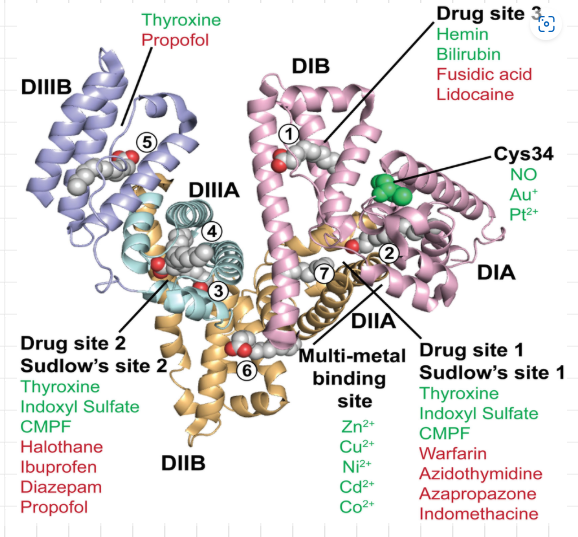
It is amazing what you’ll find by just looking around. While reviewing recent blood test results it occurred to me that I didn’t know the first thing about albumin as a protein. A Google word search led to numerous links but provided many images as well. The crystal structure is below.
Source. The crystal structure of human albumin. The albumin was crystallized in the presence of excess palmitic acid for x-ray analysis. Front. Immunol., 25 January 2015, Sec. Vaccines and Molecular Therapeutics Volume 5 – 2014 | https://doi.org/10.3389/fimmu.2014.00682
It is not uncommon to describe the enzyme-substrate complex as a highly specific lock and key structure. In the earlier literature is was axiomatic that enzymes are described as being highly substrate specific and use a single binding site for a given substrate. This notion is not always correct as the above graphic shows. Albumin is produced in the liver and is sort of a molecular ox cart- it can transport many substrates in the blood.
The job of human albumin is to get various substrates mobilized in the bloodstream and offer them at a desirable location. With the high molecular weight of enzymes, and the consequent low molarity available, it is astonishing that the heat of binding of substrate to enzyme can be measured at all.
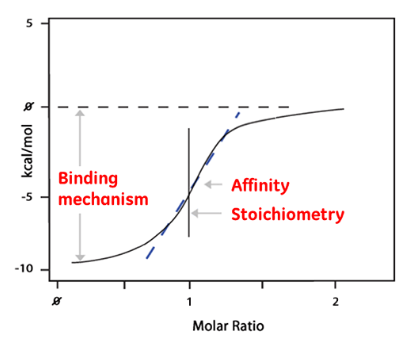
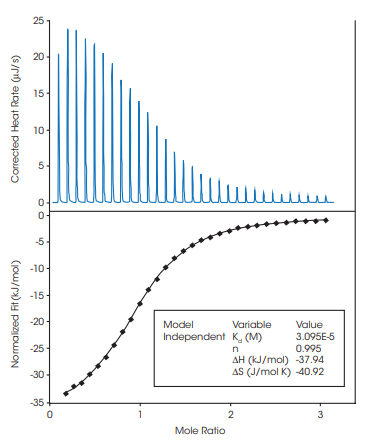
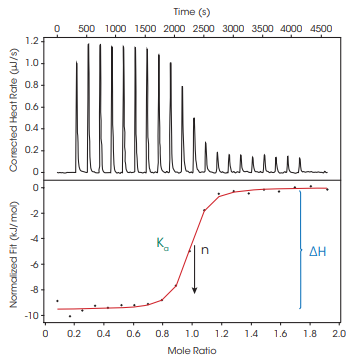
One way to determine binding enthalpy and stoichiometry of a substrate to enzyme is ITC- Isothermal Titration Calorimetry. These calorimeters are available from several manufacturers such as TA Instruments and Malvern. ITC is just a type of reaction calorimeter that allows for immediate access to the reaction mixture. It is a microscale RC1 in effect. An enzyme solution can be titrated with substrate allowing for a visual determination of an equivalence point where 1 eq of enzyme active sights just matches the titrant equivalents. From such an experiment both enthalpy and stoichiometry can be measured. The image below is from TA Instruments and nicely shows the graphic output of an ITC experiment.
Source: TA Instruments product brochure. Each peak is an aliquot of titrant. Note how cleanly the signal goes to baseline between aliquots.
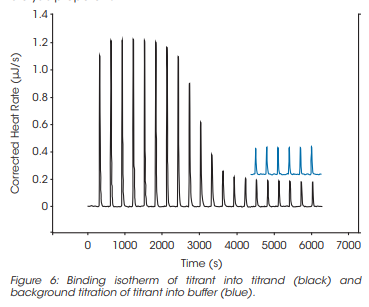
This graphic shows the baseline signals from titrating directly into buffer. This is subtracted from an actual run. From TA Instruments sales brochure.
Above, the background signal from the buffer represents noise in the enthalpy signal.
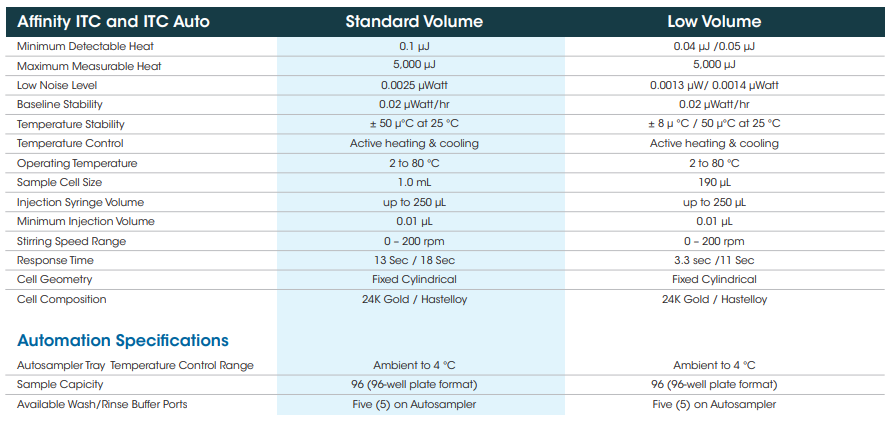
TA Instruments also offer equipment for so-called nano scale experiments. See below.
The TA ITC specification table. Note the minimum heat in the low volume column: 0.04 to 0.05 microJoules with a 190-microliter sample cell size.
Albumin is endowed with binding sites open to a variety of substrates. It is like a wheelbarrow or an ox cart. It can ‘carry’ numerous substrates across several categories.
The downside of such low specificity is that albumin can bind many drug compounds at the expense of dose delivery to the desired site. Doses of drugs must be adjusted to account for drug lost to blood proteins like albumin.
Some folks have all the luck. America’s Orange Jesus has been (or will be) offered a Boeing 747 to use in place of the two presidential B747s which had developed an annoying rattle and had to be taken out of service. They are presently parked at Oskar’s Jet Shop and Grill somewhere in the Pacific Northwest. In sympathy to this niggling inconvenience to #47, an old man, the royal family of Qatar has generously stepped forward and offered a super luxury B747 for the Great One for his weekly trips to his many resorts. The B747 will transfer to #47’s Presidential Library foundation where it will remain. Some are saying that it will cost a gigabuck to upgrade it as necessary.
Keeping a third B747 ready to fly at any given moment will be expensive as are the 2 presidential jets now in the shop. In the new B747, the lavatories will have to be reduced in size for the media’s discomfort. Vending machines will be added for feeding the media but will be limited to exact change only. The machines will also offer #47’s trading cards which will include a 5 % discount coupon for his golden sneakers. As always, payment can be made with #47’s cryptocurrency plus a $50 service charge.
As the authoritarian regime of #47 continues to take hold, an increasing number of governments will express fealty and line up to offer something special, which #47 will gladly take and keep, the emoluments clause notwithstanding, found in Article I, Section 9, Clause 8 of the U.S. Constitution. It has already begun to turn stomachs worldwide but others will be attracted to the new ‘democratic dictatorship’ ramrodded by the GOP and led by the Orange Jesus himself. Many people around the world tolerate authoritarian leaders or see them as admirable strongmen. Kick ass and take names, some say. But too often the names aren’t taken or made available to anyone. There is just the ass kicking and transfer to a holding facility. Habeas Corpus? Gone! Evidence of a crime? Nah. Filing an appeal? What, are you being serious?
To the many readers outside the USA, know that a very large number of US citizens are horrified and in serious opposition to #47 and his MAGA movement. However, it seems that the Founders of this country failed to anticipate a situation where a single party rules both houses of Congress, the White House, the Supreme Court, and the governors and legislative bodies of many states. The Founders assumed that the checks and balances between the three co-equal branches of government and built into the government they designed would protect the democratic republic and keep essential government services working. They could not anticipate a simmering populist movement amplified by instantaneous social media. Whereas in times before the internet and smart phones, a large number of disaffected and under-educated citizens in America now have access to media of all kinds and can gravitate towards whatever populism that appeals to them. There seems to be little in the way of concern about truthfulness.
The single party dominance of MAGA in US government means that enforcement of federal laws or procedure will be ignored. The Department of Justice has been slow to enforce checks and balances or just ignore it altogether. MAGA GOP politicians know that endorsement by #47 ensures that they will get votes from MAGA block and assure their political careers.
Roughly 30 % of the voting population will support #47 until their dying day, regardless of his behavior. Resistant to the lessons of history and logic, they are essentially lost to modern times. They are angry from seeing and hearing the hype surrounding modernity and the corrosive conspiracy theories involved. Not having a college education, they missed out on opportunities that open up by living in a college environment. All of the job descriptions and opportunities requiring college education aren’t necessarily posted off-campus and are therefore missed.
Until I entered the university, I was completely unaware of a host of career choices available. I grew up in a rural midwestern blue collar environment and was completely unaware of the various futures available. Many have glorified our rural culture, but I found it quite boring in my years from birth to 14 years. Sure, there are wide open spaces and nature. But the fifth time you wander out into a large pasture you begin to realize that solitude is nice but quite boring.
I was introduced to science and technology by watching the progress of the Apollo moon mission in the 1960s. It was thrilling but there was no one around who could hold a decent conversation about it with me. Basically, if you were a kid into science at that time in my state, you were alone. Just knowing about sciency topics wasn’t enough. It is nice and necessary to have discussions to explore ideas and ask better questions. To share in the wonder and majesty of the universe. That’s not too much to ask, isn’t it?
Notice: As an organic chemist and not a geochemist I will be using descriptions and vocabulary that may not ordinarily be used in geology. While a geochemist might easily write a lovely article that could bring tears to the eyes of the most sour geochemist, I will stumble forward with just my trailer park chemistry background- organometallic, organic, inorganic, physical and quantum chemistry.
When you step back and view mining technology as a whole, it becomes apparent that two of the largest scale inputs in mineral refining are water and electrical energy. On Earth diesel is also required in large quantities.
A good question for those who propose mining asteroids is this: Have you solved the water and electric power requirements for unit operations? Let’s say it is solved for one mineral. How will the value be mined, transported and gently lowered to the Earth’s surface without breaking into flaming pieces on re-entry or forming a crater in a city? Is there an element or mineral that is so valuable as to justify the costs and risks to be met for a space mining mission? Is it rhodium? Gold? Diamonds? Or what?
Do the people behind the fanciful images and hype believe that they only have to dock with the asteroid and grab valuable minerals from the surface? There is a good chance that the target ore will need exploration, excavation, and possibly some kind of blasting. The target elements may well be dispersed within the host rock. This will require comminution in preparation for further processing. The ore will likely need ore dressing which is the job of removing undesired rock from the valuable ore. This lowers the quantity of ore to be processed.
The rocky bodies in the solar system have surfaces of regolith. Regolith is an unconsolidated jumble of loose rock and dust presumably overlying a solid body. Given that the regolith may well be consist of rocks and dust accreted from a distant source, merely assaying the regolith might not reveal the minerals that could be there in abundance just below the regolith. There is no way around it- core samples will be needed to properly assess the economic geology.
PGM Mining on Earth
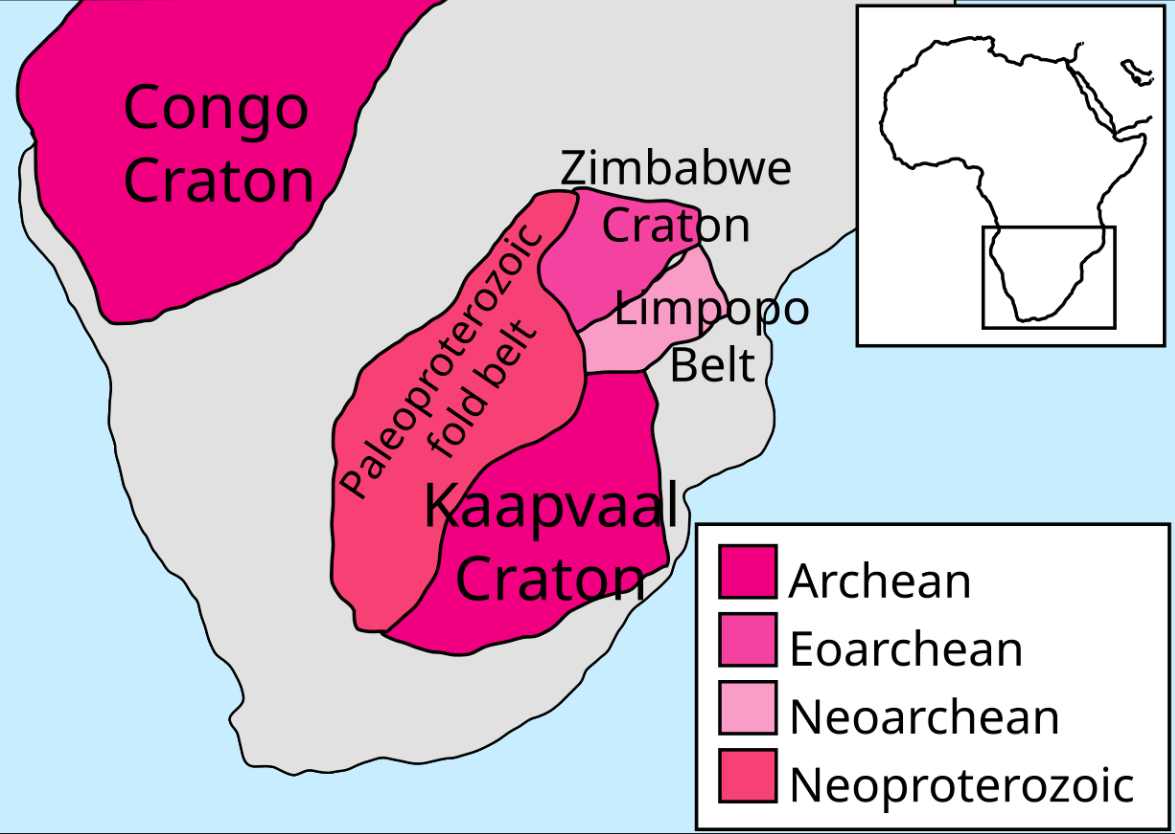
A look at the large-scale Platinum Group Metal (PGM) production activity in South Africa is instructive. The Bushveld Igneous Complex (BIC) near Limpopo and North-West provinces contains some of the richest PGM deposits in the world. The BIC is found in the Kaapvaal craton. The BIC also extends into Zimbabwe.
The Bushveld complex is located on a ‘craton‘ which is a section of continental crust that has been stable for 400 million years or so. Over that time period some portion of crust has not been subjected to subduction or rifting as an effect of continental drift. A craton is relatively untouched by continental drift over some lengthy time interval and as a consequence the crustal rocks found in a craton may be quite old. Here, ‘old’ means rock that has not been metamorphosed recently, vented out of a volcano or eroded and stratified in a sedimentary formation within several hundred MA.
The Bushveld complex is found in the Kaapvaal craton of South Africa, extending into Zimbabwe. A consequence of this location on a very stable parcel of continental crust is that vertical transposition of rock formations, i.e., subduction activity, has not led to metamorphism or folding of strata. This stability has allowed a relatively undisturbed magma chamber to form and cool, producing layered cumulates.
The formation of cumulates is a partitioning process within the magma chamber that produces solid minerals that can float or sink within the magma. Cumulates with higher density than the magma will tend to sink, building a layer, and lower density minerals will float to the top of the chamber and form an upper layer. In this way, minerals can self-purify and stratify by fractional crystallization.
While fractional crystallization can result in enhanced purity of specific minerals, the melt from which the crystals precipitate is also changing in composition. Magma is a viscous fluid and its components can undergo anion/cation exchange to produce new minerals upon further cooling. Anions include silicate, aluminate, sulfide, hydroxide, chloride, oxide, and a whole basket of metal oxyanions like titanate, tungstate, molybdate, chromate, etc. Cations include most every metal, sometimes including the noble metals. Every metal has a set of positive oxidation states that may be subject to reduction or oxidation to afford a different oxidation state or charge.
While both anions and cations present in magma have a particular charge, their individual size is important as well. Size and charge matter most when crystals are assembling. When, for instance, a calcium-containing mineral is crystallizing, the crystal lattice is subject to collisions with the whole gamut of species in the magma. If the temperature and pressure are appropriate, calcium (+2) cations nestle into a vacancy in the lattice. This is controlled by the concentration, temperature and Gibbs energy of the placement of the cation. However, if a different cation of +2 charge and similar ionic radius happens by, that different +2 cation may find itself occupying calcium’s place in the lattice. An example would be where the Ca+2 cation was replaced by Mg+2 or Fe+2.
Mineral crystal formation is a type of equilibrium wherein lattice anions and cations at the surface of the crystal are in equilibrium with anions and cations in the melt. The rate of crystallization or dissolution is driven by several things. Substitution of a Ca+2 ion in a lattice with Mg+2 or Fe+2 ions retains the charge balance in the lattice. But if a too large or too small +2 cation attempts to sit in place of Ca+2, a mismatch occurs which may be energetically favorable, but as a result may be much more prone to removal by equilibration. The interloping cation could be of such a size that its heat of formation is small and therefore subject to replacement by equilibration. Or not. The resulting mineral could be comprised of Ca+2 cations and M+2 cations in a non-stoichiometric ratio. Or a new mineral comprising a stoichiometric ratio of both cations.
The anions in a mineral substance can be quite varied and several may exist in a mineral at the same time as in the case of anions silicate and aluminate.
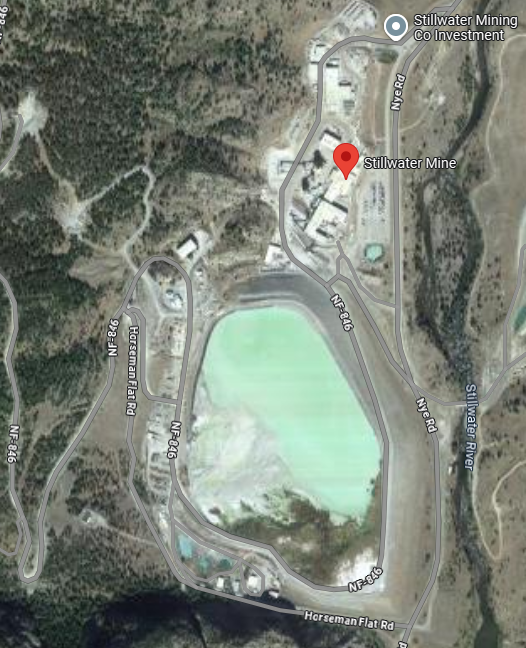
The Stillwater Igneous Complex in Montana, USA; the Sudbury Basin in Canada; and the Norilsk-Talnakh deposits north of the arctic circle on the Siberian Craton.
The Stillwater Igneous Complex in south central Montana, USA. Source: Google Maps.
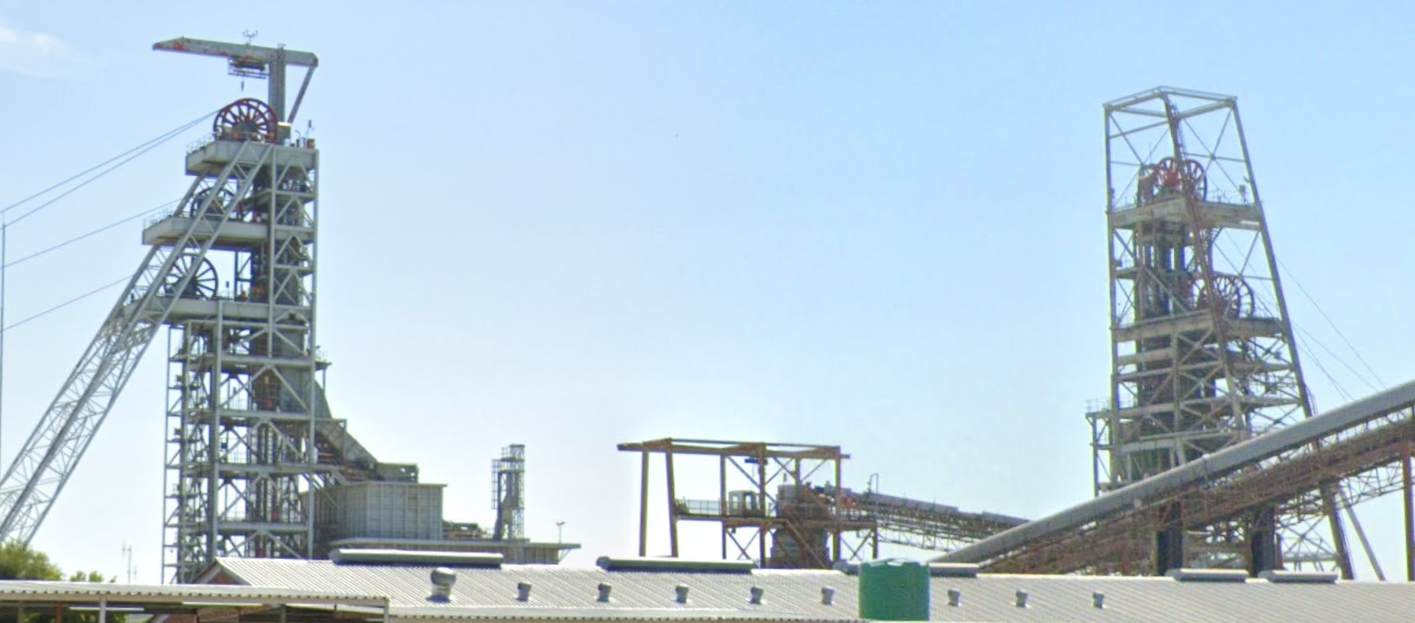
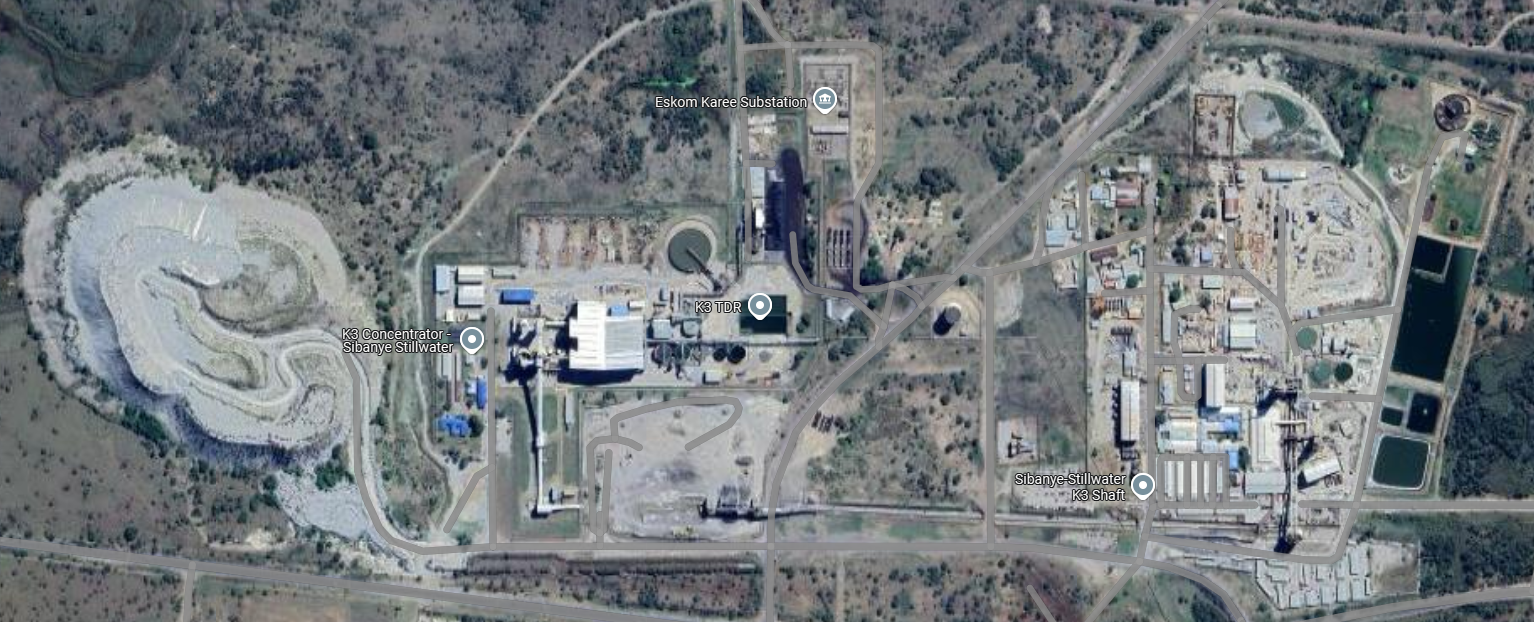
Image from Google Maps. The Sibanye-Stillwater K3 shaft, South Africa.
Russia is the leading producer of palladium with 40 % of the global market. Norilsk Is also known as a center of non-ferrous metallurgy as well as noble metals. Norilsk Nickel, also known as Nornickel, is a mining and smelting company. Platinum Group Metals (PGM) have been recovered as a side stream of nickel and copper mining by Norilsk Nickel.
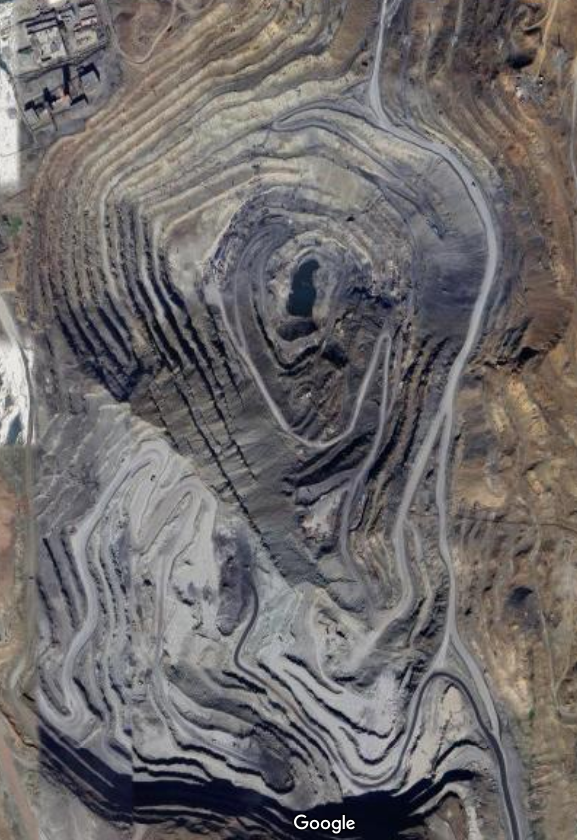
Open pit mile near Norilsk, Russia. Norilsk was originally started as a gulag in the far north of Siberia and eventually became a mining community.
The aerospace proponents of asteroid mining should spend some time at an actual mine. Breaking rock and hauling it around is simple on Earth but consider doing this in a vacuum at near-zero gravity. Look at all of the methods of conveyance and processing in operation at a mine that works only in a gravitational field. Blasting, front-end loaders, haul trucks, conveyor belts, crushers, ball and rod mills, flotation and settling tanks, lixiviation in sulfuric acid and several shifts of staff to operate and maintain it. Don’t forget the analytical lab and chemist or the maintenance group.
Proponents will always say that with the right technology, asteroid mining could work. But in the airgap between could and will is the nagging question of why? Maybe asteroid mining is best left to our descendants in the 22nd century.
A human trip to an asteroid, which is always in orbital motion and probably rotating, to mine and return with paydirt for the investors will always be high cost. Bodies outside of the Earth-Moon system will be nearby only for a short time, depending on the orbital period of the asteroid. While our Earth is measurably overheating, the biosphere is disintegrating and political turmoil is rampant on Earth, perhaps we should focus closer to home?
Humanity must stay focused on critical housekeeping activityhere on planet A. Monetizing the outer worlds can wait.
I do believe that eventually somebody will design mining technology to solve the unique problems of mining smaller asteroid bodies with negligeable gravity. Energy dense power sources will be needed to move commercial scale machines and ore. The big problem will be the economics. What mineral is so valuable as to justify the trillion-dollar expense of finding an asteroid with suitable quantities of mineral, up front R&D costs, and beneficiation and isolation of the mineral?
Minerals dispersed in the regolith matrix will need comminution, extraction by lixiviation, floatation, isolation and packaging. Now, we can get it back to earth orbit but then what? Do we just deorbit in the usual way?
Bringing home the paydirt
Let’s say they return 1000 kg (contained) of rhodium valued at todays price of $5400/toz (toz = troy ounce). 1000 Kg contained of rhodium = 32150.7 troy ounces, so 32150.7 toz x $5400/toz = $173,613, 780. However, just the rumor of 1000 kg of new rhodium about to come on the market will drive rhodium prices down. So, $174 million sounds like a lot of money and in a sense it is. But in aerospace and heavy industry, millions are quickly consumed.
Rhodium was chosen for its general scarcity and high price. There is no reason to suppose that rhodium will be more abundant on a given asteroid than on earth so numerous asteroids may need exploration by geologists. Core samples might be needed for the economic geologists to sketch out the size and value of an ore body.
There will be a threshold price of rhodium that must me exceeded before rocket launching and asteroid digging begins. This is how mining works on earth. Until then, the celestial rhodium discovery will just keep orbiting the sun into the future.
An aspect of PGMs is that the very few mines that produce them do so in a unique geological feature on a craton. The mechanism for PGM mineralization in districts like the Bushveld Igneous Complex in South Africa took place in a magma chamber where over time the magma began to cool. Magma gets its minerals from the mantle far below and from the walls of the magma chamber. In subduction zones the subducting crust is pushed downwards causing rising temperatures.
Subducting oceanic crust is loaded with water in several forms. Many minerals are ‘hydrated’ meaning that one or more water molecules are strongly attached to the mineral. These might be called coordinated water. The oxygens are strongly attracted to a cationic feature of the mineral. Interstitial water molecules may be occupying voids in the mineral lattice. Discrete water is only weakly attached and may diffuse elsewhere. Interstitial and discrete water may evaporate readily if exposed to air or heat. At the elevated pressures and temperatures of magma at depth, the three kinds of water are hot enough to flash to steam if the pressure was released. However, as the magma rises to the surface to cooler surroundings and lower pressures, eventually the water will flash to the gas phase moving magma in the direction of lower pressure. Just below the surface the dissolved gases including CO2, steam and SO2 will expand as a gas and push magma to the surface causing a volcanic eruption.
As the magma cools, the substances with the highest melting point begin to crystallize. If the crystals that have a higher density than the magma, they will settle lower in the magma chamber and form a distinct layer. While this layer is building, other minerals will follow in a similar process. The layers of precipitated minerals are called cumulates.
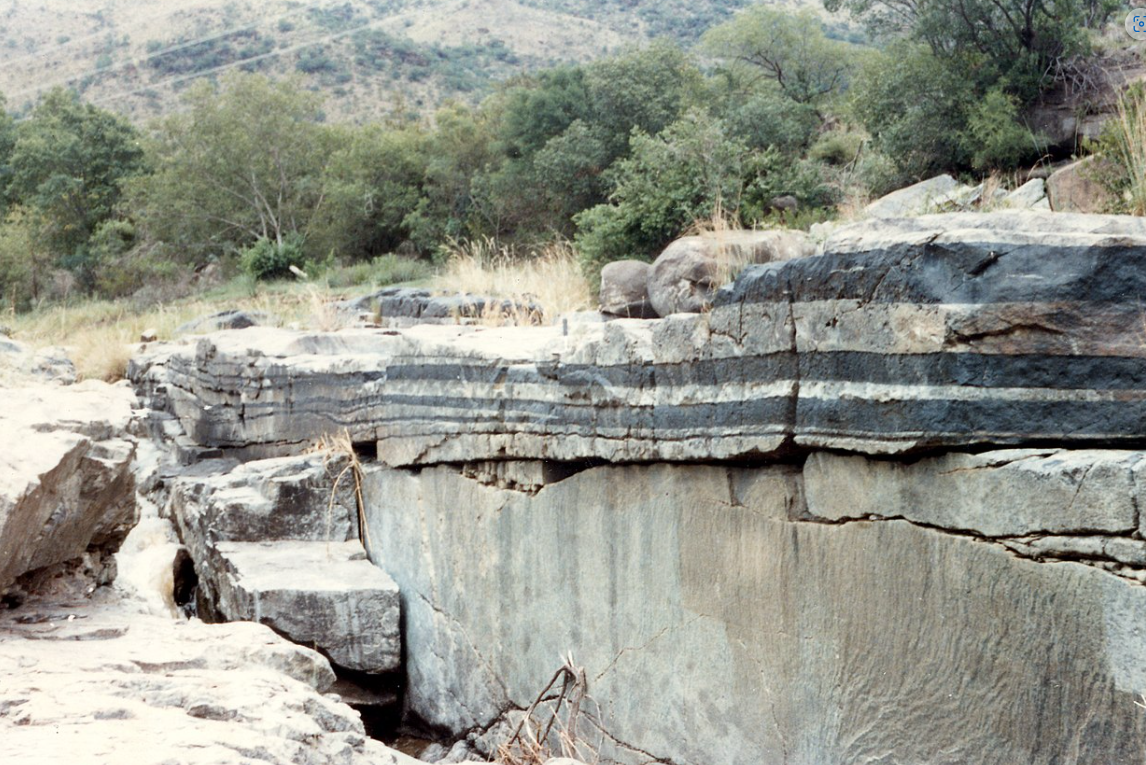
The process of minerals selectively crystallizing and precipitating to the upper or lower zones of the magma chamber. The overall process is called fractional crystallization and layers called cumulates can form. In the photo below are several layers of dark chromite cumulate.
From the Bushveld Igneous Complex. Exposure of cumulate layering of dark chromite. Mining involves following the cumulate layers.
Now that I have expressed my doubts about asteroid mining, I must ask ‘Am I being a Luddite’? Maybe a little bit, but even the doubts of a Luddite can be on the mark now and then. Asteroid mining will be an adventure for a few astronauts, profitable for aerospace contractors and an entertainment spectacle for the public; however, resources seem better used on Earth for remediation of the biosphere, diplomatic solutions for the conflict of the week, lower hydrocarbon consumption and better education, especially in the area of civics.
The whole purpose of mentioning PGM geology and mining in a post titled Asteroid Mining is that we on Earth are fortunate to have concentrated mineral deposits that exist only because of unique geological processes. These processes only work in Earth’s gravitational field. The upwelling of lower density hot hydrothermal fluids. The formation of evaporites rich in borax. Lithium brines.
Take my uranium, please
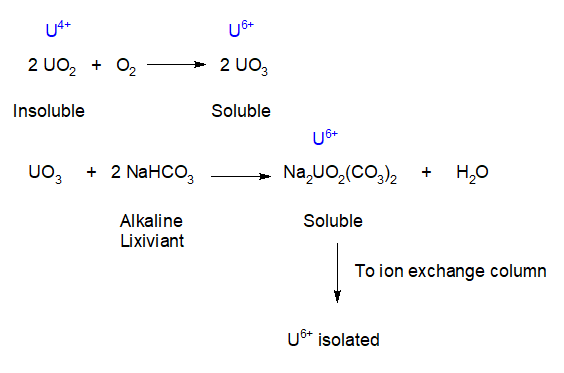
The formation of cumulates in lava chambers relies on differential density driven by gravity. The ability of rain and snow runoff to mobilize gold sulfides will produce lode gold and placer deposits. The ability of oxygenated meteoric water to oxidize insoluble U4+ to soluble U6+ in sandstone formations to form concentrated roll front deposits. The ability of oxygen to switch uranium oxidation states from U4+ to produce a soluble form (U6+) that can migrate and concentrate leading to the partitioning of U6+/U4+ species. Underground formations of uranium can be dissolved in a solution of sodium bicarbonate by injection and pregnant solutions of the uranium carbonate can be brought to the surface as a solution. This solution is run through a column of ion exchange resin beads which exchange chloride ions for the uranium complex. Once loaded, the beads are washed with a special solution to remove the uranium (6+) concentrate.
Oxidation and isolation of U6+ from U4+. Graphics by Arnold Ziffel.
Our ability to mine and isolate minerals is uniquely enabled by planet earth. The ability of nature to dissolve, mobilize and concentrate minerals into ore bodies from highly dispersed placement in source rock has been positive for humanity. A great many elements are found in a dispersed condition in the continental crust. For some, there are natural processes for concentration. For others, they form secondary minerals that end up mined with the primary ore. A few like gallium, indium and bismuth are valuable but are only available as a side stream from the primary ore. Copper is an excellent example of a primary metal whose ore includes many other metals like zinc and bismuth. Copper can be electro-refined to 99.99 % purity. The slimes left behind after the electrolysis and dusts caught in ventilation systems can be enriched in useful metals and are often collected for processing.
The purpose of citing the large-scale processes in use on the home planet is not to suggest that asteroid mining must start out at large-scale. It would likely start out as a small-scale surface or underground operation with a small crew or with robotics. Only a few select minerals would be economically suitable for recovery. Platinum Group Metals are mentioned above because of their high intrinsic value and ability to exist as the native metal. If luck is with the astro-miners, the motherlode might be easily visible so later the gangue material can be chipped off. The process of trimming ore to retain the value and discard the gangue was called ore dressing. Being quite dense, the volume of PGM metal ore may be low, but the density and mass is quite high.
If a given asteroid has never been part of a larger system with magma and sufficient gravity to force stratification by density, the cumulate model may not apply. A given asteroid having never been exposed to bulk water and consequently never been subject to hydrothermal flows and weathering may not have minerals that here on Earth are known to be formed with water or partitioned as a result of hydrothermal flows. Lake and ocean sedimentary units are almost surely absent as are processes requiring aqueous migration through porous rock as in the case of uranium roll fronts.
Asteroid mining will be a totally new activity and most all of the natural geological processes on earth will have been absent. Many geological processes on earth produce economic ore bodies. These will be largely absent on an airless, dry asteroid.
One thing to consider: Most of the rock accessible at the Earth’s surface is not economic ore. The surface of the Earth brimming with carbonates, silicates and aluminates bound to a variety of ‘ordinary’ metals like calcium, magnesium, iron, sodium, potassium and a handful of other common metals. While there are important and valuable uses for these common metals, they are predominantly found dispersed in surface rock comprised of many individual minerals, or that an ore body is too small for economic recovery.
The fraction of the desired mineral in the ore can be highly variable. Depending on the market, some parts of the ore body may be economical to mine while other parts may not. This is why cores are drilled to locate the 3-dimensional extent of the ore body, estimate the potential value and minimize the expense of digging and processing uneconomical ore.
It seems reasonable to suppose that, just as much of the surface of the earth is covered with rocks made from mineral constituents of low economic value like crushed roadbed rock or sand and cement for concrete use, why should we assume that a given asteroid would be any better endowed with value than Earth’s surface? Asteroid mining will necessarily be preceded by expensive exploration. Obviously, right? But it means that considerable money and time will be spent up front finding an asteroid that is sufficiently ‘pregnant’ with valuable metal ore. Finding investors to fund exploration and mining development today is based on economic geology surveys and signed off by certified experts.
A mine is a hole in the ground with a liar standing at the top. –Attributed to Mark Twain
On Earth many mineral deposits have been located historically by surface exposures that are part of a larger ore body. The economics of isolating any one mineral or metal in the presence of the others will depend heavily on the % concentration of the target mineral, the processing methods available and the market price of the final product. A market downturn can last months, years or represent new long-term realities in demand for the product.
Note: This post appeared May 15, 2007, as “Infotainment, Chemistry, and Apostasy“. I have pulled it up through the mists of time for another go and with a few edits.
In the normal course of things I used to give school chemistry talks or demonstrations a couple of times per year and until recently, I had been giving star talks at a local observatory more frequently. The demographic is typically K-12, with most of the audience being grades 3-8. From my grad student days through my time in the saddle as a prof, I was deeply committed to spreading the gospel of orbitals, electronegativity, and the periodic table. I was convinced that it was important for everyone to have an appreciation of the chemical sciences. I was a purist who knew in his bones that if only more people were “scientific”, if greater numbers of citizens had a more mechanistic understanding of the intermeshing great world systems, the world could somehow be a better place.
In regard to this ideology that everyone should know something about chemistry, I now fear that I am apostate. I’m a former believer. What has changed is an updated viewpoint based on experience.
Let me make clear what science is not. It is not a massive ivory tower that is jealously guarded ajd intended to be impenetrable by mortal folk. Big science requires big funding and organizational support, so big administrative structure forms around it. At its core, science is concerned with learning how the universe works by observation, constructing a good first guess (theory) on what is happening, measurement (conducting quantitative experiments), analysis (quantitative thinking), documentation and communication. The common understanding is that a scientist is someone who has been educated and employed to do these activities. However, anyone who conducts a study of how some phenomenon happens is doing science whether for pay or not.
What science has learned is that the universe is quite mechanistic in how it works. So much so that it can be described by or represented with math. At the fundamental level of ions, atoms and molecules, constraints exist on how systems can interact and how energy is transferred around. At the nanometer-scale, quantum mechanical theory has provided structure to the submicroscopic universe.
Chemical knowledge is highly “vertical” in its structure. Students take foundational coursework as a prerequisite for higher level classes. Many of the deeper insights require a good bit of background, so we start at the conceptual trailhead and work our way into the forest. But in our effort to reach out to the public, or in our effort to protect a student’s self-esteem, we compress the vertical structure into a kind of conceptual pancake. True learning, the kind that changes your approach to life, requires Struggle.
What I found in my public outreach talks on science- chemistry or astronomy- was the public’s expectation of entertainment. Some call it “Infotainment”. I am all in favor of presentations that are compelling, entertaining, and informative. But in our haste to avoid boredom, we may oversimplify or skip fascinating phenomena altogether. After all, we want people to walk out the door afterwards wanting more. We want science to be accessible to everyone, but without all the study.
But I would argue that this is the wrong approach to science. Yes, we want to answer questions. But the better trick is to pose good questions. The best questions lead to the best answers. People (or students) should walk out the door afterwards scratching their heads with more questions. Science properly introduced, should cause people to start their own journey of discovery. Ideally, we want to jump-start students to follow their curiosity and integrate concepts into their thinking, not just compile a larger collection of fun facts.
But here is the rub. A lot of folks just aren’t very curious, generally. As they sit there in the audience, the presentation washes over them like some episode of “Friends”. I suspect that a lack of interest in science is often just part of a larger lack of interest in novelty. It is the lack of willingness to struggle with difficult concepts. But that is OK. Not everyone has to be interested in science.
Am I against public outreach efforts in science? Absolutely not. But the expectation that everyone will respond positively to the wonders of the universe is faulty. It is an unrealistic expectation on the 80 % [a guess] of other students who have no interest in it. I’m always anxious to help those who are interested. It’s critical that students interested in science find a mentor or access to opportunity. But, please God, spare me from that bus load of 7th graders on a field trip.
What we need more than flashier PowerPoint presentations or a more compelling software experience is lab experience. Students need the opportunity to use their hands beyond mere tapping on keyboards- they need to fabricate or synthesize. You know, build or measure stuff.
It is getting more difficult for kids to go into the garage and build things or tear things apart. Electronic devices across the board are increasingly single component microelectronics. It is ever harder to tear apart some kind of widget and figure out how it works. When you manage to crack open the case what you find is some kind of green circuit board festooned with tiny components.
And speaking of electronics or electricity, I find it odd that in a time when electric devices have long been everywhere in our lives, that so FEW people know even the first thing about electricity. I instruct an electrostatic safety class in industry and have discovered that so very, very few people have been exposed to the basics of electricity by graduation. I spend most of the course time covering elementary electrostatic concepts along with the fire triangle so the adult learners can hopefully recognize novel situations where static electric discharge can be expected. Of course, we engineer away electrostatic discharge hazards to the greatest extent possible. But if there is a hole, somebody will step in it. It’s best they recognize it before stepping into it.
The widespread educational emphasis on information technology rather than mechanical skills ignores the fact that most learners still need to handle things. There is a big, big world beyond the screen. A person will take advantage of their mechanical skills throughout their life, not just at work. Hands on experience is invaluable, in this case with electricity. Computer skills can almost always be acquired quickly. But understanding mechanical, electrical and chemical systems need hands-on experience.
Global demand for helium is expected to double by 2035. Helium is a critical, non-renewable resource used across the world. It is found in natural gas deposits in limited number of gas wells. Helium is the second most abundant element in the universe behind hydrogen. But this is averaged across the universe. Any helium the earth’s early atmosphere may have had has long ago diffused into space. At present, helium from terrestrial sources is derived from radioactive decay of uranium, thorium and daughter products within the Earth over eons of time. Underground structures suitable for the accumulation of natural gas may also accumulate helium.
Helium is useful in science and industry for many reasons, but mostly for its extreme chemical inertness and ultra-low boiling point. A gas with a very low boiling point, and if you manage to condense it, finds use as a low temperature coolant. Helium serves as an inert atmosphere in many applications including nuclear power, semiconductor manufacturing, welding and for pressurizing rocket propellant tanks. In liquid form, it boils at the low absolute temperature of 4.2 Kelvin (-261.1°C) and is indispensable as a cryogen for many applications from medical Magnetic Resonance Imaging (MRI) and quantum computing to other superconductor applications. Those of us who make great use of nuclear magnetic resonance spectroscopy (NMR) are highly dependent on it as an analytical tool. NMR has made identification and quality control possible in many kinds of chemical manufacture.
According to one source a single MRI unit can contain up to 2000 Liters of liquid helium and consume 10,000 Liters over its 12.8-year lifespan. If you condensed the helium gas into liquid from the balloons at the Macy’s Thanksgiving Day Parade, there would be enough liquid helium to keep two MRIs running for their lifetimes. The US presently has approximately 12,000 MRI units across the country. The good news is that helium recycling equipment can be fitted on to an MRI machine to greatly extend the life of a helium charge. Usually, a liquid helium dewar is immersed in a liquid nitrogen filled dewar which is inside a vacuum insulated container. The liquid nitrogen bath helps with the helium boil-off somewhat, even though the bp of nitrogen is considerably higher than that of helium, yet much lower than room temperature.
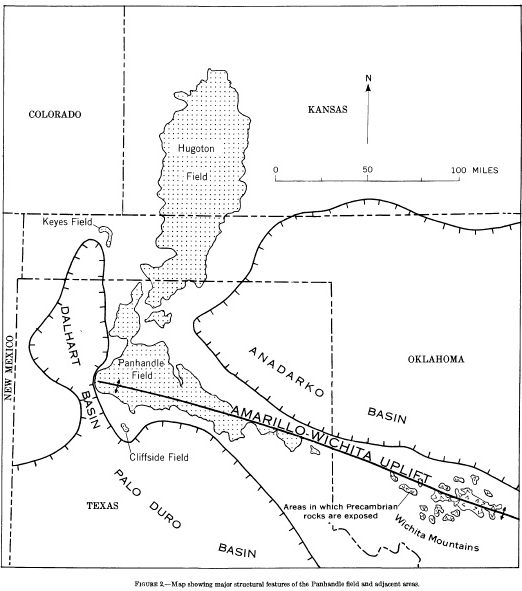
Source: Wikipedia. The Hugoton and Panhandle gas fields rich in helium. There are many other helium-rich gas fields in the US, but none as large as the Hugoton and Panhandle gas fields.
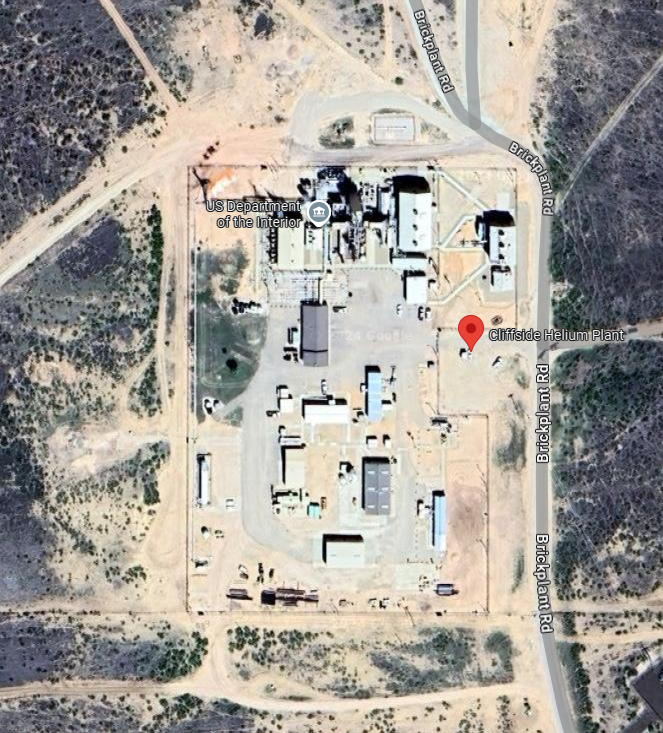
Source: Google Maps. Aerial view of the Cliffside Helium Plant. If there are actual cliffs near Cliffside then the panhandle folks are calibrated differently from me as to what constitutes a cliff.
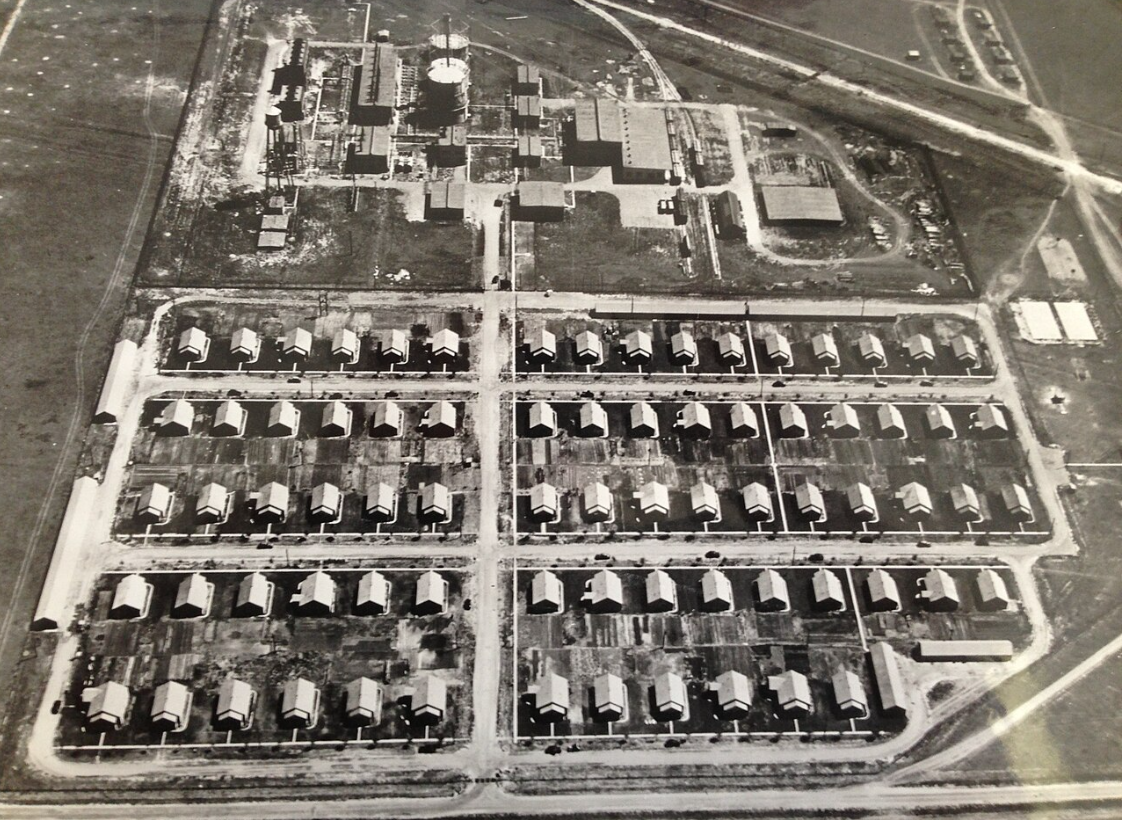
Source: Wikipedia. The Excell helium plant, ca 1945. Note the company housing.
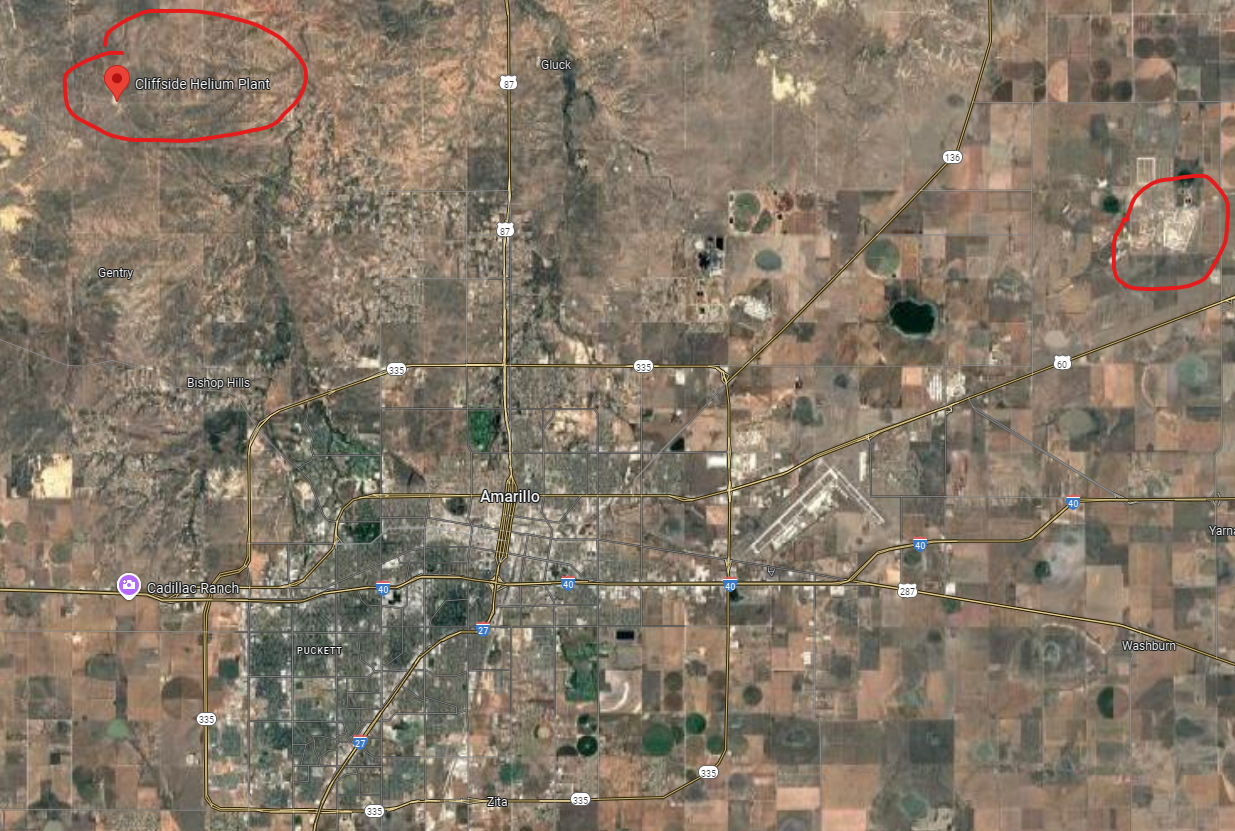
Helium is isolated from natural gas. According to the American Chemical Society, the US, Algeria and Qatar have the major the helium reserves while the US, Russia and Algeria are the top suppliers of helium. The majority of US reserves are in the Texas & Oklahoma panhandles and Kansas. The Cliffside helium plant is located a 15 miles NNW of Amarillo, TX, over the Cliffside dome. It is in the red circle on the upper left in the photo.
The Amarillo Helium Plant got its start in 1929 when the federal government bought 50,000 acres NNW of Amarillo for a helium extraction plant. The motivation was to accumulate helium for lighter than air aircraft like balloons and blimps.
Source: Google Maps. Cliffside Helium Plant, Amarillo, and Pantex.
It is interesting to note that the Pantex nuclear weapons plant is about the same distance but to the NE of Amarillo, TX. It is circled in red in the upper right. It is the primary site in the US where nuclear weapons are assembled, disassembled or modified. Uranium, plutonium and tritium bearing components are stockpiled there. Weapons that use tritium in their booster gas have a shelf-life constraint due to tritium’s very short half-life, so the gas must be periodically upgraded.
The facility opened in 1942 for the manufacture of conventional bombs and was shut down shortly after the Japanese surrendered in 1945. The site was purchased in 1949 by what is now Texas Tech and used for research in cattle-feeding operations. In 1951 it was surrendered to the Atomic Energy Commission (now the National Nuclear Security Administration) under a recapture clause.
So, we might ask the question: Why was anyone looking for helium in natural gas at the time? The easy answer is that nobody was looking for it. In May of 1903 in Dexter, Kansas, a crowd had gathered at a natural gas well to celebrate this exciting economic find. A celebration had been planned and the towns folk were there to see it ignited. It was called “a howling gasser” and there was much anticipation of a spectacular fire. After much ballyhoo and speeches, a burning bale of hay was pushed up to it in anticipation of ignition of the gas jet, but the burning bale was extinguished. This was repeated several times, but no fire. The disappointed crowd wandered off. Later Erasmus Haworth, the State Geologist and geology faculty member at the University of Kansas, got word of this curious event and managed to get a steel cylinder of gas sent to the university.
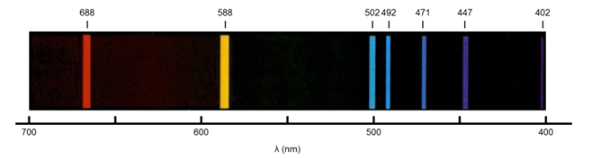
At the University Haworth and chemistry professor David F. McFarland determined that the composition of the Dexter gas was 72 % nitrogen, 15 % methane and 12 % of an “inert residue.” Soon, McFarland and chemistry department colleague Hamilton P. Cady began “removing the nitrogen from the gas sample by applying a spark discharge with oxygen over an alkaline solution.” This tedious procedure was soon replaced by using a glass bulb of coconut charcoal immersed in liquid air. This method had been shown to adsorb all atmospheric gases except helium, hydrogen, and neon at the temperature of boiling liquid air” (-310° F). The unabsorbed gas was collected in a glass tube and examined by emission spectroscopy. The spectrum showed all of the optical lines of helium. This discovery by McFarland and Cady showed that sizeable quantities of helium did exist on the Earth. The total amount of helium in the Dexter gas was 1.84 %.
The nagging question I have is how did the nitrogen content in the Dexter sample come to be? The thinking is that N2 gas found in natural gas derives from chemical alteration of organic ammonium compounds deep in the natural gas forming strata. To a chemist “ammonium” has a specific meaning. To a geologist it may just mean “amine”: hard to tell. N2 molecules are in a deep thermodynamic well, meaning that once formed, the nitrogen is very stable and not readily altered without large energy inputs. So, the formation equilibrium of N2 could favor its formation rather than returning to a precursor.
The removal of nitrogen, called nitrogen rejection, is a normal part of natural gas processing. The incentive for its removal is that it lowers the BTU content and thus the value of the gas. According to one source, the Midland gas field in the Permian formation of Texas is unusually high in nitrogen, from 1 % to 5 %. Given that the usual specification for nitrogen content is 3 %, excessive nitrogen must either be reduced by dilution or removed.
The problem of nitrogen becomes especially acute for gas that is condensed to LNG (Liquified Natural Gas). Natural gas that has too much nitrogen in it has a higher partial pressure of nitrogen and as a result it occupies space in a pipeline or LNG carrier that could be occupied by a gas that pays- natural gas. Non-combustible gas in the liquefaction train at the LNG terminal wastes its processing capacity. The specification mentioned above becomes more problematic when it is realized that the N2 content of natural gas may vary considerably from one wellhead to the next, adding to the overhead cost of quality control of the output gas.
Back to the Howling Gasser, the fact that the natural gas screaming out of the wellhead wouldn’t ignite was an extreme example of the effect of nitrogen in the formation. What saved the day was the high enrichment in helium. But, you would have to know to look for it. That a curious geologist and two chemists were able to isolate the helium and perform emission spectroscopy on it without a clue as to what it was stands as an excellent example of what curious, knowledgeable folks can do when given the resources. The state of Kansas is to be congratulated as well for providing the research facilities at the University of Kansas in Lawrence, KS.
Historically, scientific papers have been not where loud, confident proclamations are made about academic research results. The trend has been a sort of unpretentious modesty to avoid overconfidence and exaggerated claims. A sort of snobismus. Instead, conclusions from research results tend to be more guarded in the interpretation of data. An article in the Scienceinsider section of the AAAS journal Sciencepublished 28 July, 2023, has reported that of 2600 papers published in Science between 1997 and 2021, there was a drop of about 40 % in the use of hedging language. Researchers in the study scanned for about 50 terms including “might,” “probably,” “could,” “approximately,” “appear to” and “seem.” They found that these hedging words dropped from 115.8 per 10,0000 to 67.42 per 10,000.
Analyses of other scientific journals and a 2022 paper that examined nearly the same group of papers from Science have found growing use of a positive, promotional tone—expressed with superlatives such as “groundbreaking” and “unprecedented”—which may lead to exaggerated claims.
The authors suggested that researchers are increasingly unwilling to undersell their work and instead, are using more hyperbolic language such as “groundbreaking” and “unprecedented.”
In an earlier study by C.H. Vinkers et al., published in BMJ, 2015, finished his paper with the following paragraph-
“Currently, most research findings could be false or exaggerated, and research resources are often wasted. Overestimation of research findings directly impairs the ability of science to find true effects and leads to an unnecessary focus on research marketability. This is supported by a recent finding that superlatives are commonly used in news coverage of both approved and non-approved cancer drugs. The consequences of this exaggeration are worrisome since it makes research a survival of the fittest: the person who is best able to sell their results might be the most successful. It is time for a new academic culture that rewards quality over quantity and stimulates researchers to revere nuance and objectivity. Despite the steady increase of superlatives in science, this finding should not detract us from the fact we need bright, unique, innovative, creative, and excellent scientists.”
If you sit through a week of presentation sessions at an American Chemical Society national meeting or walk through a poster session, you’ll see a mix of enthusiastic young chemists standing next to their posters and you’ll sit through talks by more established researchers anxious to emphasize the importance of their work. Giving a talk or a poster at a meeting is inherently a promotional activity. It is getting the word out about you and your work in a particular area in front the scientific community and possibly some influential people. It also is something to add to your resume.
Self-promotion by scientific publishing and participation in meetings, called “ballyhoo” in the movie business, is a great way to expose yourself to greater and more frequent opportunity. Make no mistake, the quality and frequency of publications is a very important metric of your accomplishments and potential. This is a sad reality for some and a fortunate reality for a few, but it is reality.
It is hard to draw much from the above research on the hedging frequency as a metric of … what, the unseemly disappearance of proper modesty? The competitive environment of “big academic science” for funds and exposure to impress colleagues and the rank and tenure committee is inevitable. It has been like that for a very long time, but perhaps hidden under the veil of snobbery.
You never know who you might meet at these venues for academic ballyhoo. I once loaned my laser pointer to Al Cotton (who kept it!) and I met Glenn Seaborg at a poster session at the Disney Hotel in Anaheim, CA. I had too many gin & tonics before I spoke with Seaborg and I’m sure that it showed. At a symposium at Purdue University in honor of H.C. Brown (in attendance), I got to see two prominent scientists get into a rather strong “discussion” during a question-and-answer period about who discovered what first. Professor Suzuki (Suzuki coupling) from Japan said something that got under the skin of prof Negishi (Negishi coupling) from Purdue, so they began with point-counter-point exchange (a type of coupling?) which soon accelerated into an argument. As it got more contentious, they switched to speaking Japanese and continued their argument. After a short time, they realized it was best to just sit down as they were providing a “Clash of the Titans” spectacle. This is not a criticism, just an amusing anecdote. Guys like this should battle it out in public more often.
Self-promotion using exuberant language isn’t inherently bad. It is likely that others have already judged you based on far smaller misperceptions. If someone wants to embarrass themselves, let ’em.
Most people have heard of fracking in the context of oil and gas (O&G) drilling and maybe a few of them know that this can be done in horizontal drilling at a distance from the surface well hole. Explosives or hydraulic pressure is used to fracture a section of rock formation surround the drill hole and then frac sand is forced into the fractures to prop them open. Sometimes the sand is referred to as a proppant. This increases the permeability of the formation and, hopefully, increases the productivity of the well.
The first directional drilling was performed in 1930 from shore at Huntington Beach, CA, into an offshore deposit of oilsands.
The fracking controversy stems from evidence that fracturing can lead to O&G migration into ground water and then into drinking water. This essay does not address this matter.
Within the O&G drilling world is the question of how far laterally a hole can be drilled and to what extent it pays. According to one source, in 1997 the lateral distance stood at about 500 ft to completion. At present it stands at 3 miles with 4 miles becoming more common. Greater length requires an upgrade in drilling equipment to handle the extra power demands.
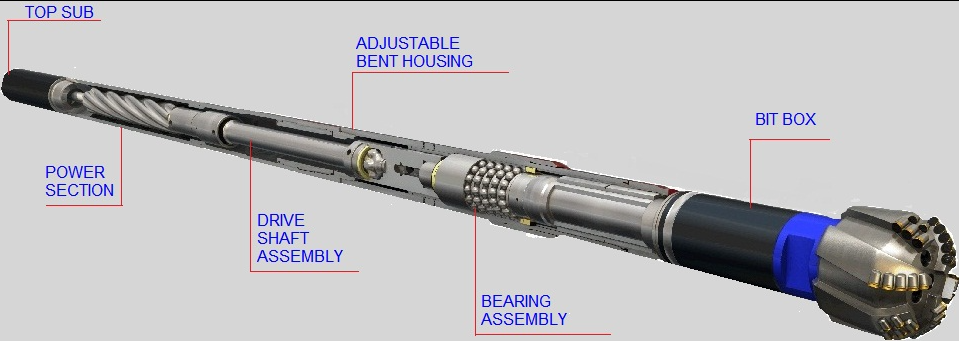
Today there are steerable down-hole mud motors that can rotate the drill bit independent of the drill string. Mud is pumped downhole at high pressure to rotate a rotor connected to the bit. The rotor fits in a stator near the end of the drill string. A steerable feature is able to bend ~3 to 4 degrees.
In the literature there is mention of the issues in vertical drilling through a steeply inclined fault. As the bit penetrates a steep fault surface it could slip and lead to damage of the drill string and casing. Better to penetrate a fault perpendicular to the fault plane with directional drilling.
There are many good reasons for a driller to use directional drilling.
A borehole that has gone off-course can be redirected to the desired direction from the same borehole.
From a single drilling site multiple boreholes can be drilled, each going to a different part of the formation.
During a well blow-out or fire, a new borehole can be drilled from a distance to intercept the blown-out borehole and pump material into it to control the blow-out.
A drilling site can be situated away from a settlement or body of water and still get to the oil reservoir by directional drilling.
Directional drilling can be performed in an existing well where equipment or debris is blocking the original bore hole.
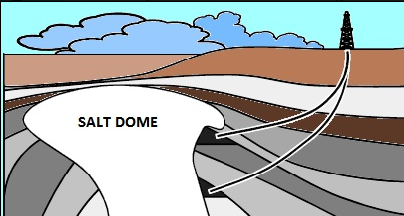
Drilling through a salt dome is problematic for several reasons. A soft formation like a salt dome can result in bit balling where the tricone bit packs with debris and the wheels quit turning. Wellbore erosion, salt creep, and excessive mud losses can occur as well.
Salt domes form from plastic deformation of an underlying low density and ductile salt layer (90 to 99 % halite) into a fault or fracture where it is subject to movement by lateral forces of the surrounding sediment layers. These lateral forces push the salt formation in the direction of weakest forces which is generally upwards. Irregular features in the salt dome can lead to collection of oil and gas pockets. Lateral drilling can be used to access the reservoirs, bypassing the salt formation.
A few thoughts on struggle in learning. I’ll confess to having taught undergraduates in the classroom and the research lab environment. My classroom teaching bona fides are limited to 6 years of college level chemistry lecture/lab and quite a bit of one-on-one chemistry tutoring.
Many students approach college chemistry courses with caution. For some, a year of freshman general chemistry is mandatory for their major. Majors such as pre-med, physical therapy, and veterinary medicine require organic chemistry in addition to general chemistry. As my specialty lies in organic chemistry, I have experience teaching both general and organic chemistry students..
From my perspective, general chemistry is as much a mathematics course as it is a science course for many first-year students. A significant portion of general chemistry involves establishing and solving problems that necessitate fundamental algebraic manipulations and calculations. Skills such as balancing equations, maintaining units throughout calculations, and understanding significant figures are essential to master. Additionally, there is the challenge of learning the new vocabulary.
Students who managed to avoid chemistry in high school sometimes found themselves treading water in college chemistry and were afraid of taking two 5 credit hour hits to their GPAs. Most pushed on and got through it. General chemistry is a foundation course and is critical for further pursuits in fields related to the use of chemicals. Unfortunately, a year of gen chem doesn’t really make a person able to function as an independent chemist. It is helpful, though, for technicians in a lab doing routine chemical tests.
Gen chem is to chemistry as The Hobbit is to The Lord of the Rings– it is the necessary prelude to a larger story.
A common problem I encountered while teaching chemistry was the desire of some students to give up hope of ever “getting it”. They would hold off attending office hours to discuss their difficulties until it was too far down the semester timeline. This was usually after a few botched regular exams or a low midterm grade. Frequently the struggling student was having trouble with or neglecting the assigned homework from the text.
Now and then you’d run into a prof who had performance expectations that even they might not have met as an undergrad. They’ll strut around acting as though they were singlehandedly maintaining “proper” academic ideals. Who knows, maybe they had a point. You can try to enthuse everyone using words and pictures, but inevitably there are those who are utterly disinterested, inept or just anxious to put chemistry behind them.
In retrospect, I should have been more direct in calling in more students to office hours who were in grade trouble early in the term. Unfortunately, like many other profs I sometimes subscribed to the sink or swim approach to college education where unsuitable students are culled from the herd. It is a sort of Darwinistic mindset that is easy to fall into. In the end, we have to give all students a fair chance or even a second chance to earn the credentials that the institution confers.
Colleges are organizations that award credentials to verify achievement in meeting or exceeding educational standards set by in-house professors. It tells people that you completed what you started: you navigated a complex maze of intellectual achievements and came out the other side a success.
For any given subject there are always those who struggle with it to some extent. It could be from simple boredom, distractions from real life or the comprehending of difficult material. It may be that the subject just isn’t for them. For myself, I struggled with a foreign language and eventually gave up. I needed full immersion and that wasn’t going to happen. I still regret giving up.
One problem that can often be addressed, however, is the matter of struggle. It seems that many students are not accustomed to struggling with learning. All of us have learned particular subjects successfully because it “just fit” our cognitive abilities, interest or perhaps it was brilliantly presented to us. Or it was a special time in our lives when we were uniquely receptive. It could very well be that previous exposure to the subject was a bit shallow with grade inflation, leading to overestimation of their abilities.
Unfortunately for some, the very necessity of struggle convinces them that the subject is beyond their abilities. They come to believe that if the subject does not immediately stick or appear obvious, then they might as well give up because they will never “get it” along with a collapse of self-esteem.
Giving up on a subject early-on could allow them to switch directions in their education with less time lost and perhaps they would be relieved by that. In this case, giving up is just making a better choice based on experience. Regardless, students should be unburdened early on of the idea that struggle is a predictor of failure. In reality, most learning involves struggle at least to some extent.
Remedies for Struggle
Reading the assigned chapters several times is helpful. First pass, scan the content for a general idea of where the topic is going. A careful reading next with a focus on the example problems is very helpful. Try to understand the example problems and the reasoning presented. Next work on the problem set. If there is time, a third reading can help to cement in the concepts in the chapter. Before going on, work on the assigned problems. Open the solutions manual only if stuck. Struggle with the problem a bit. Success with solving assigned problems can be extremely helpful for a student.
If laboring alone isn’t helping, some schools have tutoring resources available. If not, there are often tutors who will charge on an hourly basis. A few hours of tutoring may be all it takes to get back on track. Sometimes there may be study partners from your class who can study with you. Then again, office hours with your prof or TA can help you over some rough spots. The point is- Struggle!
When I was writing exams, I would look at the example problems in the text as well as the assigned problems. I chose the problems to assign because I felt that they got to the heart of the concepts I held as important to the subject at the level of the content. I would use the assigned problems or those from lecture to write problems using different substances where a reaction would lead to an unambiguous answer. It’s ok to write some questions that require bit of logic to solve, but you can’t turn the exam into an intelligence test.
I once taught a course in chemistry for non-majors. These were students who had tried to get into Geology for Poets or Astronomy but couldn’t get in. They were trapped into taking chemistry for their science requirement for graduation! Early on, a few “representatives” of the class cornered me after a lecture and informed me that “everyone” expected true/false questions on the exams. Pausing, I said I would give them true/false questions, but they would get 1 point for a correct answer, 0 points for no answer, and -1 point for an incorrect answer. The lesson was that if you don’t know something it might be better to just be quiet. After a single exam they never mentioned true/false questions again.
Students eventually realize that chemistry is a highly vertical subject. The more advanced and interesting concepts are built upon or knitted together from those learned earlier. Later coursework will assume that the student has a grasp of content from earlier prerequisite courses. Thirty-one years later the 95 course evaluations from that Catholic women’s college still sit in an unopened envelope in my office.
Find a way to deal with anxiety. Exercise or find a councilor, psychologist, or psychiatrist for help. Anxiety is “druggable”, that is there are meds for it that are very effective. I’m sure there are exceptions, but a family practice doc can’t go very far down the road in treating anxiety. A psychiatrist can fine tune and mix the individual meds to best suit you. It really works.
Most importantly, the student should not EVER get behind in the coursework. It might even be better to drop the class than try to make up for much lost time. The normal rate of chemistry content flow to be absorbed is already high. To have to make up for time lost while also keeping up with the current content flow is often impossible.
Finally, consider that struggle just means that you have to put forth effort to learn. True learning means that your neurons are making new connections in your brain, not just images of something new. To have learned means that your brain has found a way to take diverse inputs and assemble them into part of your consciousness. Sometimes it isn’t easy, but persistence is the key.
As wondrous as our physical and chemical senses are, they are severely constrained in a few fundamental ways. Our vision is limited to our retinal response to a narrow, 1-octave wide band of electromagnetic radiation. As it happens, this band of light can be absorbed non-destructively by or stimulate change in the outer, valence level of inorganic and organic molecules. Electrons can be promoted to higher energy levels and in doing so temporarily store potential energy which can then do work on features at the molecular level. In the retina, this stimulates a polarization wave that propagates along the nervous system.
Owing to the constraints of the optics of the band of light we can sense, we cannot see atoms or molecules with the naked eye. This is because the wavelengths in the narrow range of visible light are larger than objects at the atomic scale. Instead, we perceive matter as a continuous mass of material with no indication of atomic scale structures. No void can be seen between the nucleus and the electrons. For the overwhelming majority of human history, we had no notion of atoms and molecules.
Democritus (ca 460-370 BCE) famously asserted that there exist only atoms and vacuum, everything else is opinion. The link provides more detail. The point is that atoms and vacuum were proposed more than 2000 years ago in Greece. The words of Democritus have survived over time but I’ll hazard a guess that the words were not influential in the rise of modern atomic theory in the 19th and 20th centuries. A good question for another day.
In all chemistry, energy is added to the valence level of a molecule as electronic, rotational, vibrational or translational energy.
Thumbnail Sketch of the Interaction of Light and Matter
Radio waves are a band of long wavelength that can interact with electrically conductive materials. Electromagnetic waves having a wavelength greater than 1 meter are considered to be radio waves. As a radio wave encounters a conductor, the oscillating electric field of the wave causes charge to oscillate in the conductor and at a rate matching the radio wave. Radio waves, whether in electronic devices or in space, are formed by the acceleration of charged particles. Recall that when you cause a charged particle to change it’s direction of motion, e.g., by a magnetic field, it is undergoing an acceleration. It is useful to know that radio waves are non-ionizing.
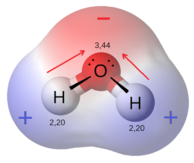
Microwave energy causes dipolar molecules to rotate back and forth by torsion as the waves pass. This rotational energy can be transferred to translational and vibrational energy through collisions, raising the temperature. The molecule does not need fully separated charges like a zwitterion, but molecules may have less than full charge on one side and a less than a full opposite charge on the other side, like water. This is a dipole. Water has a strong dipole and is susceptible to absorbing energy from microwaves.
Water molecule with dipole indicated.
Infrared radiation causes individual chemical bonds and entire frameworks to vibrate in specific ways. The Wikipedia link for this topic is quite good. When a molecule absorbs heat energy, it is partitioned into a variety of vibrational modes which can bleed off into other energy modes, raising the temperature.
Ultraviolet light is energetic enough to break chemical bonds into a pair of “radicals”- single valence electron species. These radicals are exceedingly reactive over their very short lifetime and may or may not collapse back into the original bond. Instead they can diffuse away and react with features that are not normally reactive, leading to the alteration of other molecules. UV light is very disruptive to biomolecules.
X-rays are more energetic than ultraviolet light and can cause destructive ionization of molecules along their path. They can dislodge inner electrons leaving an inner shell vacancy. An outer shell electron can collapse into the inner vacancy and release energy that can eject a valence level electron, called an Auger electron. This alters the atom by ionization and giving a change in reactivity. X-rays are also produced by the deceleration of electrons against a solid like copper though lighter targets can also produce x-rays.
Gamma radiation originates from atomic nuclei and their energy transitions. They are the highest energy form of electromagnetic radiation and cover a broad range of energies at <0.01 nanometer wavelengths. Many radioactive elements emit only gamma rays as a result of their nuclei being in an unstable state. Some nuclei can emit an alpha or beta particle resulting in an unstable nucleus that will then emit a gamma to relax.
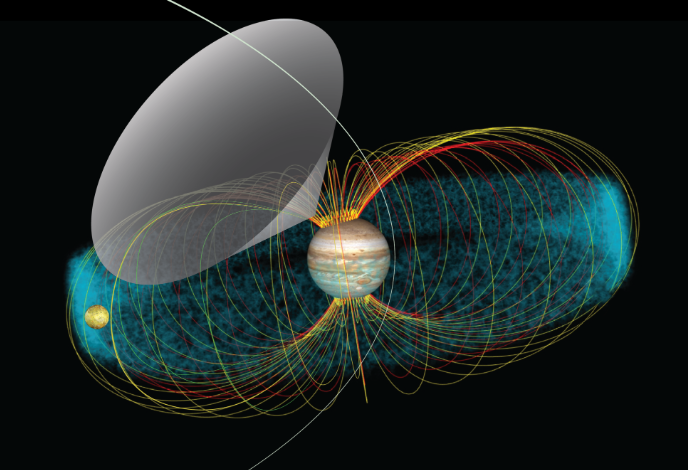
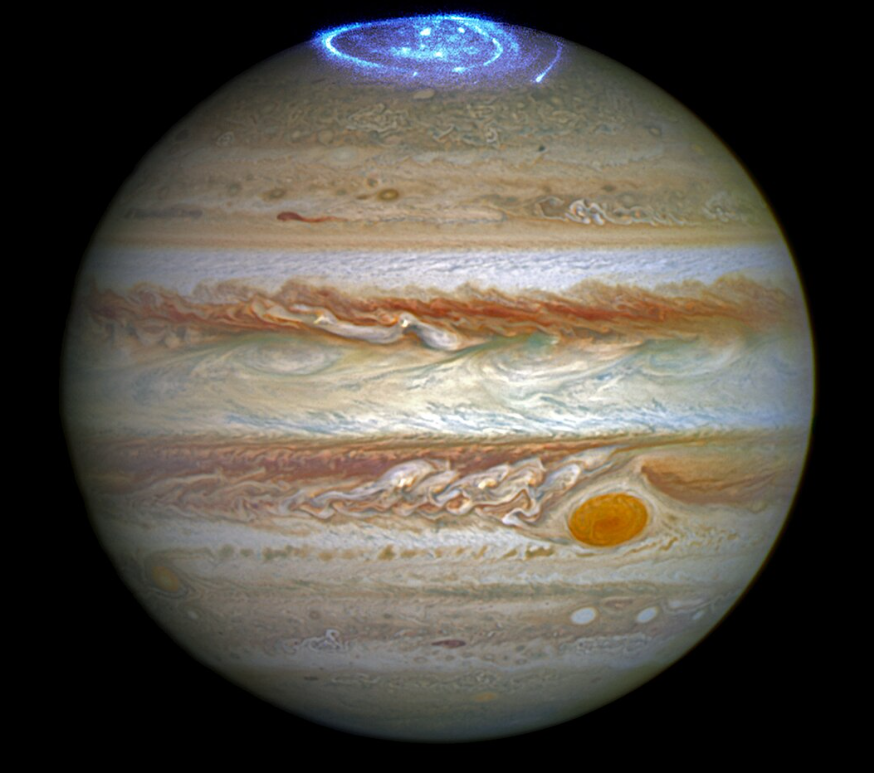
The wavelengths of radio waves are too long and too weak to interact with biomolecules. Some radio waves come from the synchrotron effect where charged particles like electrons will corkscrew around magnetic field lines of a planet and release energy in the form of radio waves. In the case of Jupiter and it’s moon Io, a stream moving charged particles are accelerated by a magnetic field, the particles will emit mainly in the 10 to 40 MHz (decametric) range of radio waves as they spiral around the magnetic field lines into Jupiter. Jupiter’s volcanic moon Io sends charged particles into the planet’s polar regions where the magnetic field lines bunch up. This leaves a visible trace of borealis-like gas that glows. That radiation is emitted in the shape of a conical surface. It is only detectable here when the cone sweeps past earth as Io obits Jupiter.
Image from NASA. “This is a representation of the Jupiter-Io system and interaction. The blue cloud is the Io plasma torus, which is a region of higher concentration of ions and electrons located at Io’s orbit. This conceptual image shows the radio emission pattern from Jupiter. The multi-colored lines represent the magnetic field lines that link Io’s orbit with Jupiter’s atmosphere. The radio waves emerge from the source which is located at the line of force in the magnetic field and propagate along the walls of a hollow cone (grey area). Juno receives the signal only when Jupiter’s rotation sweeps that cone over the spacecraft, in the same way a lighthouse beacon shines briefly upon a ship at sea. Juno’s orbit is represented by the white line crossing the cone.” NASA/GSFC/Jay Friedlander
Jupiter’s volcanic moon Io funnels charged particles into the planet’s polar regions where the magnetic field is strongest. This leaves a visible trace of borealis-like trails that glow. Source: NASA.
An atomic nucleus can absorb or emit gamma rays. For instance the gamma emitter Antimony-124 emits a 1.7 MeV gamma that can be absorbed by a Beryllium-9 nucleus which photodisintegrates into a 24 kiloelectron volt neutron and two stable He-4 nuclei. This nuclear reaction can be used for surveying for beryllium ore deposits by detecting neutron backscatter.
The purpose of this cooks tour of the electromagnetic spectrum is to suggest that visible light band is uniquely suited to interact with matter just enough to induce valence-level chemical changes. The change can be charge separation or an alteration in the composition or shape of a molecule. The changes may be reversible or not.
Ok, done with that.
So, not all electromagnetic radiation plays nicely or at all with any given chemical substance. The narrow visible band of light is uniquely well suited to interact non-destructively, mostly, with living things. Chemistry is about the behavior of the outer, valence level of electrons around and between atoms and molecules.
The retinas in our eyes send signals to the brain continuously that result in a very curious thing- our perception of color registers instead of just a grey scale. Not just the colors of the rainbow, but also more nuanced perceptions like pastels, brown and in their many textures- all with binocular vision!
The constraints on human vision depend on the chemical composition and anatomical structures of the retina as well as the construction of the brain. As the description of the various bands of electromagnetic radiation suggest, there is much to the universe that our senses cannot detect. We do not directly view the radio, microwave, infrared, ultraviolet, x-ray or gamma ray views of the universe.
Our daily understanding of the universe is mostly framed by what we can see with the unique biochemistry and anatomy of the retina. It’s not a bad thing with its limitations, but for an appreciation of the true scope of the universe we would have to find ways to view in the other electromagnetic radiation bands. And, we do. With radio telescopes and satellites that pickup x-ray and UV energy to give images. Now with JWST, we’re peering deeper into the universe as revealed by infrared energy. The longer wavelengths of infrared can pass through clouds of dust particles that previously blocked our view in the optical spectrum.
The structures of the atom and molecules are characterized by the very large fraction of “empty” space they contain2. Electrons seem to be point charges with no measurable size. Yet they have mass, spin and the same magnitude of charge but opposite that of the much heavier proton. And, the proton is not even a fundamental particle but a composite particle. It’s like a bag with three hard objects in it.
The universe is wildly different from what our senses present to us. All matter1 is made of mostly empty space. What we see as color doesn’t exist outside of our brains. Our sensation of smell is the same. Cold is not a thing. It is just the absence of heat energy. Finally, our consciousness exists only in our brains. It is a natural phenomenon that is highly confined, self-aware and may be imaged through its electrical activity or F-19 MRI with fluorinated tracers. This wondrous thing is happening on the pale blue dot floating in the vastness of empty space. So far, we can’t find anywhere else in the observable universe where this occurs.
It is good to remember that we search for extraterrestrial intelligence to a large extent with radio telescopes. On earth, the use of radio communication is a very recent thing, tracing back to the beginning of radio in 1886 in the laboratory of Professor Heinrich Rudolf Hertz at the University of Karlsruhe. Hertz would generate a spark and find that another spark would occur separately.
By 1894, Marconi was working on his scheme to produce wireless transmissions over long distances. The wider development of radio transmissions/receiving is well documented, and the reader can find a rabbit hole into its history here.
In order for the discovery of radio transmission to occur, several other things must have been developed first. The discovery of electricity had to precede the development of devices to generate stable sources of electricity on demand and with sufficient power. Then there is the matter of DC vs AC. Some minimal awareness of Coulombs, voltage, current, electromagnetism, conductors and insulators, and wire manufacturing is necessary to build induction coils for spark generation.
James Clerk Maxwell had developed a series of equations before the discovery of wireless transmission by Hertz. Hertz was very familiar with the work of Maxwell from his PhD studies and post doc under Kirchhoff and Helmholtz. Hertz was well prepared in regard to the theory of electromagnetism and was asking the right questions that guided his experimental work.
Radio transmission came to be after a period of study and experimentation by people like Marconi, Tesla and many others who had curiosity, resources and drive to advance the technology. As the field of electronics grew, so did the field of radio transmission. It’s not enough to build a transmitter- a receiver was required as well. Transmitter power and receiver sensitivity were the pragmatics of the day.
This was how we did it on earth. It was facilitated by the combined use of our brains, limbs, opposable thumbs and grasping hands. Also, an interest in novelty and ingenuity during this period of the industrial revolution was popular. While people who lived 10,000 years ago could certainly have pulled it off as well as we did, the knowledge base necessary for even dreaming up the concepts was not present and wouldn’t be for thousands of years. The material science, mathematics, understanding of physics, and maybe even cultures that prized curiosity and invention were not yet in place.
In order for extraterrestrials reaching out to send radio signals that Earthlings could detect, they would have to develop enough technology to broadcast (and receive) powerful radio transmissions. If you consider every single mechanical and electrical component necessary for this, each will have had to result from a long line of previous developmental work. Materials of construction like electrical conductors could only arise from the previous development of mining, smelting and refining as a prelude to conductor fabrication to produce a way of moving electrical current around.
Radio transmission requires electrical power generation and at least some distribution. None of this could have been in place without the necessary materials of construction, mechanical and electrical components already in place. Most of the materials would have to have been mined and smelted previously. Electrical power generators need to be energized by something else to provide electricity. On earth we use coal or natural gas to produce steam that drives generator turbines to make electricity. Also, there is nuclear and hydroelectric power. ETs would face a similar problem for the generation of electrical power.
If you follow the timeline leading to every single component of an operating radio transmitter, you’ll see that it requires the application of other technologies and materials. It seems as though a radio transmission from extraterrestrial home planets need something like an industrial base to get started.
What if there were intelligent extraterrestrials who were not anatomically suited to constructing radio transmitters for their own Search for Extraterrestrial Intelligence or just for local use? Perhaps they are +very intelligent but not far along enough yet to have developed radio. Or, what if they were just disinterested in radio? What if they used radio for a short window in time and have been using something else not detectable from earth, like what we do with optical cable? The point is that we would never hear them by radio, yet they would be there.
Surely there is a non-zero probability of this happening. This dearth of signal may be so prevalent that we will conclude that we are alone in our local region of space. Perhaps funding will be cut and we’ll quit looking. We can take that finding to fuel our sadness of being alone in the cosmos. Or we could use it to appreciate just how unique life is and take better care of ourselves.
Instead of buying into Elon Musk’s vision of colonizing Mars and somehow terraforming it, why don’t we terraform Earth back into a place where the biosphere is more stable and pollution is pushed back to some lower level? A utopian vision for sure, but it also has a non-zero probability of happening.
1. Not including dark matter, if it really exists. I remain skeptical.
2. I’ve come around on this business of the atom being almost entirely empty space. This is a firmly established bit of folklore in chemistry. It makes sense only if we look at the electron as a solid or material object buzzing around the nucleus which it is not. The electron is a point charge manifestation of the electromagnetic force. It is a disturbance in the electric field. It doesn’t fly like a ball, it propagates in the manner of a wave. It has none of what humans think of as material substance, rather it is purely a quantum mechanical manifestation. It is shaped by 3-dimensional probability density standing waves surrounding the nucleus. This probability density is defined by a spherical harmonic wave series. We chemists know this harmonic series as s, p, d and f “orbitals”. Electron probability density extends from the nucleus to the frontier orbitals of the atom with s, p, d, and f orbitals occupying space according to its unique wave equation.
This is a reprint of an October 25, 2010, piece that I wrote about illumination with flames. I did tweak the title a bit for the sake of accuracy. -Th’ Gaussling
Until the invention of the electric lamp, the illumination of living and working space was very much the result of sunlight or of combustion. Since the development of fire making skills in prehistoric times, the combustion of plant matter, fossil fuels, or animal fat was the only source of lighting available to those who wanted to illuminate the dark spaces in their lives.
From ancient times people had to rely on flames to throw heat and an agreeable yellowish light over reasonable distances. A good deal of technology evolved here and there to optimally capture the heat of combustion to do useful work (stoves, furnaces, and boilers) from readily available fuels.
Lighting technology also evolved to maximally produce illumination from flame. High energy density fuels that offered a measure of convenience for lamp users evolved as well. Liquid fuels like vegetable oils, various nut oils, whale oil and kerosene could flow to the site of combustion and were in some measure controllable for variable output. The simple wick is just such a “conveyance and metering device” for the control of a lamp flame. Liquid fuels flow along the length of a wick by capillary action to a combustion zone whose size was variable by simple manipulation of the exposed wick surface area.
The first reported claim of the destructive distillation of coal was in 1726 by Dr Stephen Hales in England. Hales records that a substantial quantity of “air” was obtained from the distillation of Newcastle coal. It is possible that condensable components were generated, but Hales did not make arrangements to collect them. Sixty years earlier an account of a coal mine fire from flammable coal gases (firedamp) highlighted the dangerous association of coal with volatiles. So, flammable “air’ was associated with coal for some time.
By 1826 a few chemists and engineers were examining the use of combustable gases for illumination. The historical record reveals two types of flammable gas that were derived from coal- coal gas and water-gas. Both gases came from the heating of coal, but under different conditions. Coal gas was the result of high temperature treatment of coal in reducing conditions. It is a form of destructive distillation where available volatiles are released. Depending on the temperature, there was the possibility of pyrolytic cracking of heavies to lights as well.
Water-gas was the result of the contact of steam with red hot coal or coke. The water dissociates into H2 and CO. Water gas is a mixture of hydrogen and carbon monoxide, both of which are combustible. The formation of water-gas is reported to have been discovered by Felice Fontana in 1780.
One of the properties of burning coal gas or water-gas was the notably meager output of light from the flame. Workers like Michael Faraday and others noted that these new coal derived gases provided feeble illumination, but if other carbonaceous materials could be entrained, then a brighter flame could result. It was during the course of investigations on illumination with carburized water-gas that Faraday discovered bicarburet of hydrogen, or benzene.
About this time, an engineer named Donovan also noted that if other carbonaceous materials were to be entrained into water-gas, then the light output was enhanced. So, in 1830, engineer Donovan installed a “carburetted” water-gas lighting system for a short run in Dublin.
Coal gas was first exploited for lighting by the Scottish engineer William Murdoch. Murdoch began his experiments in 1792 while working for Watt and Boulton in England. By the late 1790’s, Murdoch was commercially producing coal gas lighting systems. His home was the first to be lit with coal gas.
The carburization of water gas eventually became an established industry in America in the second half of the 19th century. The treatment of gases, especially with the discovery of natural gas in Ohio, increased the commercial viability of lighting with gas. Carburization of water gas was aided by the discovery of hydrocarbon cracking to afford light components that could be used for this purpose.
Thorium is frequently found in the ores of rare earth elements (REE) and the connection of REE’s to the issue of illumination begins in the laboratories of Berzelius in about 1825. Berzelius had observed that when thoria and zirconia were heated in non-luminous flames, the metal oxides glowed intensely. But this was not a new phenomenon. Substances like lime, magnesia, alumina, and zinc oxide were known to produce a similar effect. Goldsworthy Gurney had developed the mechanism of the Limelight a few years before. In the limelight, a hydrogen-oxygen flame played on a piece of lime (calcium oxide) to produce a brilliant white glow. This effect was soon developed by Drummond to produce a working lamp for surveying.
The work of Berzelius was an important step in the development of enhanced flame illumination. He had extended the range of known incandescent oxides to include those that would eventually form the basis of the incandescent mantle industry. Thoria (mp 3300 C) and zirconia (mp 2715 C) are refractory metal oxides that retain mechanical integrity at very high temperature. This is a key attribute for commercial feasibility.
Numerous forms of incandescent illumination enhancements were tried in the middle 19th century. Platinum wire had the property of glowing intensely in non-luminous flames. But platinum was not robust enough for extended use and was quite rare and consequently very expensive. By 1885, a PhD chemist named Carl Auer von Welsbach patented an incandescent mantle which was to take the gas light industry to a new level of performance. Welsbach studied under professor Robert Bunsen at the University of Heidelberg.
Welsbach fashioned the incandescent mantle into the form that is familiar to anyone today who has used a Coleman lantern. The original mantle was comprised of a small cellulose nitrate bag that had been impregnated with magnesium oxide, lanthanum oxide, and yttrium oxide in the ratio of 60:20:20. The mantle gave off a greenish light and was not very popular.
By 1890, Welsbach produced an improved incandescent mantle containing thoria and ceria in a ratio of 99:1. This mantle emitted a much whiter light and was very successful. Many combinations of zirconia, thoria, and REE metal oxides were tried owing to their refractory nature, but the combination of thoria-ceria at the ratio of 99:1 was enduring.
Welsbach made another contribution to the commercialization of REEs. Welsbach had experimented with mischmetal and was interested in its pyrophoric nature. He had determined that a mixture of mischmetal and iron, called ferrocerium, when struck or pulled across a rough surface, afforded sparks. In 1903 Welsbach patented what we now call the flint. In 1907 he founded Treibacher Chemische Werke GesmbH. Today Treibacher is one of the leading REE suppliers in the world.