Category Archives: Science

Organic Qualitative Analysis. RIP.

One of the chemistry classes I took as an undergrad continues to assist me in my synthetic endeavors mid-career.  The class was organic qual.  It was designed to take the student through the determination of an unknown organic compound , or mixture, with the aid of qualitative tests and derivitization to figure out the compound. We did small visual tests to guage acidity, basicity, water solubility, etc. We did sodium fusions to look for halides, 2,4-DNP hydrazones for carbonyls, picrates of amines, and flame tests to make a guess at saturation. We were given just so many grams of unknown and we had to perform several tests to support a claim of identity. It was an excellent experience because an organic prof taught the actual lab section.  We had access to the lab during the week to work on the unknowns. 

We used derivitization to determine some of the more difficult unknowns. CRC Press had a book of physical properties of a large range of known compounds that were derivatized, so you’d compare mp’s, color, bp, solubility, etc., to make a case for identity.

I would be interested to hear if this is still in the curriculum out there. I fear that it has passed along into history in the face of the hyphenated cryptozoology of todays analytical instruments.  That’s a pity.  Organic qual gave me the chance to handle chemicals, perform reactions, deal with ambiguity,  and do tests that might be hard to work into the rest of the curriculum.   Part of being a good organic chemist is racking up lots of time in the lab doing stuff, polishing up the physical intuition and mechanical skills.

I am embarrassed to admit that at one time I embraced the idea that the organic microlab experience was good pedagogy.  I now see it as more of a phenomenon meant to stretch department budgets. The idea of giving students barely enough reagents to make 100 mg of something is pretty dubious.  If the student goofs and spills something or makes a mismeasure, they might end up with 25 mg of product. The isolation of this amount of mass is problematic for fresh learners.  I miss the days when the organic lab kit had 25, 50, 100, and 250 mL flasks in it (19/22 ST joints, of course). 

The argument goes something like this: Our conversion to microlab equipment is justified because of the cost saving gained by going to a lower scale. We buy fewer grams of expensive reagents and we lower waste generation for the department. Well, this is a bunch of self-serving crap. I can just see the department chair’s pointed head nodding in agreement as some tenured Poindexter drones on about minimizing the negative impact on the environment.  

For Christ’s sake, we’re talking about chemistry, not church camp.  Minimally, chem majors should not be cheated by limiting them to the microscale experiments.

If you want to save the environment, stop driving your SUV down to 7-11 to get cigarettes.  Or, don’t bring home so much cheap plastic crap from Big Box Mart.

Colleges should be giving their chemistry majors more synthesis experience, not less.  In industry it can be a real problem finding fresh BS/BA graduates that have lab experience beyond sophomore organic lab.  Schools that promote lab-based synthesis research for undergrads (as opposed to computation) are doing their students a bigger favor than they may realize. 

A mote in the eye of Schrodingers Cat

I have made some adjustments to the blogroll. It turns out that physicists, to a greater extent than chemists, have taken up the craft of blogging.  Why chemists seem less inclined to blog remains unclear.  This tendency is seen on the shelves of book stores as well.  Whereas, bookstore science shelves are clogged with treatises on Quantum _____ (fill in the blank), works on chemistry are often limited to chemical dictionaries or Schaums Outlines.  Here in Colorado, where the per capita college education is reasonably high, in certain counties at least, urban bookstores may have chemistry titles that go ever so slightly beyond the study guides and dictionaries. 

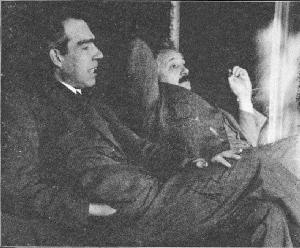
It seems to me that many of the popular quantum mechanics books on the market are peddling to people looking for a mystical experience.  Fred Alan Wolf and a few others have made a career of feeding this need.  I recall the quote by Niels Bohr-

‘There is only an abstract quantum physical description. It is wrong to think that the task of physics is to find out how nature is. Physics concerns what we can say about nature.“. 

 Bohr and Einstein

But I’ve ventured out on a limb. I am but a lowly synthetic organic chemist, a plebian scribbler in the scientific pecking order, who has not used a Hamiltonian operator or a Kroniker delta since grad school. My fragmented knowledge of quantum mechanical formalism is but a mote in the eye of Schrodingers cat.

Note: I’ve deleted The Volokh Conspiracy from the blogroll. They have developed an unfortunate neocon twitch that I find distasteful. 

Now, I am become Death, the destroyer of worlds

The news of North Korea’s announcement of the detonation of their first nuclear weapon is reverberating around the world.  It is certainly an unwelcome development if true.  Now the question is, can that junior varsity Stalinist Kim Jong Il resist the temptation to use it in a warshot? Or, sell copies to a growing list of unwholesome groups bent on the delivery of radioactive hellfire to the infidel crusaders?  What may actually be worse than having one go off in the US is our possible response and the cascade of events that follow.  What would we actually do? Whose home soil would we vitrify in our wrath? Whom would we smite? I fear that our reply would have an Old Testament ring to it. 

 I’m reminded of the famous quote by J. Robert Oppenheimer-

We knew the world would not be the same. A few people laughed, a few people cried, most people were silent. I remembered the line from the Hindu scripture, the Bhagavad-Gita. Vishnu is trying to persuade the Prince that he should do his duty and to impress him takes on his multi-armed form and says, “Now, I am become Death, the destroyer of worlds.” I suppose we all thought that one way or another.

I vaguely remember talk of the nuclear genie when I was a skinny Iowa farm boy in the 1960’s.  Knowledgeable people assured that once the nuclear genie was out of the bottle there was no putting him back in.  North Korea and Iran remind us that the nuclear genie is still out of the bottle.  And while we worry less about a barrage of ICBMs flying over the north polar cap towards us, or Warsaw Pact forces storming into western Europe, we are stirred out of our slumber by third or fourth tier states cobbling together a fission apparatus. 

An hour and a half drive from where I am typing this can be found missile silo’s.  Deep underground in undisclosed locations Air Force Missileers monitor the status of their squadron of missiles while maintaining readiness.  Kim Jong Il’s shenanigans have brought back an immediacy to the matter.

 Mushroom Cloud

Kim is aware that the fact of power is the act of power. And swinging around a nuclear bomb is definitely an act of power.  The real danger of a North Korean Bomb isn’t just in the immediate threat to possible victims. The larger threat lies in how the existying nuclear powers respond.  Once a North Korean nuclear bomb is triggered in anger, restraint will fly out the window. It would be a difficult time for the North Koreans and whomever bought their bomb.

Why Teach Science?

Here is the text of a comment I made over at the Volokh Conspiracy. I have pasted it here so I don’t forget it.  OK, so there is a little bit of vanity here. But I do want to build on this theme. The context of this comment pertained to the teaching of science and the influence of proponents of Intelligent Design.

In the end, we who teach want students to be able to use their brains. We want them to be able to construct or use a theory to make predictions about the observable universe and then devise experiments to test their hypotheses. We want them to design positive experiments rather than negative experiments. We want them to use language and math to express what they are thinking. We want students to be comfortable using a working hypothesis while they are working on a problem, just as long as they remember that it is just that- a working model.

We want students to learn to follow the evidence and draw a conclusion rather that start with a conclusion and cherry-pick the data to be consistent with preconceptions. The glory in science is to be able to tip over the established order in favor of new insights and understanding based on data. In the end, scientific methodology is about intellectual honesty and accountability.

All measurement involves error which causes a certain amount of uncertainty in a result. You don’t have to invoke Heisenberg to consider uncertainty. A result is only as good as your worst data. This leads to my final point.

A sign of good training or instinct in science is the ability to be sceptical or at least a bit hesitant about your conclusions. Hesitant in the sense that your conclusion is to be considered within a set boundary conditions.

A scientific outlook has served me well in general. At least so far. The world would be much more complex if I had to invoke a miracle every time something odd happened.

As is common at this site, a cluster of blood-sucking fuss budgets are haggling over minutae.  I’ll bet not a damned one of them ever had to make sense out of a mass spectrum or isolate a new substance and prove it.

Scathing Diatribe on RTIL’s

The 2006 ACS meeting in SF was interesting. In a much earlier post I lamented the recent trend of boring ORGN section meetings. That was definitely not the case this time around.  Of course, there was the usual assortment of faculty rockstars with their fawning groupies (OK, I’ve done that too). A lot of interesting insights into obscure stuff.  But I have to say that there was more buzz in the air in the ORGN talks.  My favorite profspiels included Toste, Doyle, Knochel, and Trost.

This time I noted a distinct lack of talks on room temperature ionic liquids (RTIL’s). After far too much breathless ballyhoo, the worker bees in this “area” seem to have hunkered down a bit.  Do I sound cynical? I have actually developed a manufacturing process for a commercial RTIL species. I can say that the economics of RTIL manufacture and certain kinds of applications of these expensive solvents can be awful.  At least awful in direct comparison to solvents like THF, toluene, ether, etc. If you’re using an RTIL, say, in a two-phase catalytic extraction process, then the comparison is faulty and the RTIL may be quite efficient to use.  However, if you need batch reactor volumes, i.e., 50 to 1000 gallons, then the batch process costs may require scientific notation.

Even pharma companies with deep pockets extending to the MOHO layer will worry about these economics.  In order to justify an $50-$250/kg solvent (!!), there has to be some whiz-bang process improvent to justify such costs.  In batch processing, RTIL’s are prone to the concentration of ionic species or water from the previous run. The practical consequence of this is that the RTIL may be a different material from one run to the next. It may or may not be an issue. But you’ll have to investigate and qualify it. You may have to polish the solvent (!!!) after each run to qualify the subsequent use of the RTIL. How green can that be?  

I cannot speak from the perspective of a pharma industry chemist. But I can speak as someone who makes specialty products for the pharma business. From bitter experience I can testify that the last thing you want to be is the supplier of the most expensive reagent in the customers process.  It is like a rock in their shoe. They’ll squirm and fitch around until they find a cheaper supplier or engineer a way around the offending reagent. Hell, I’d do the same thing in a heartbeat. Nothing wrong with that. But it is this sort of raw cost pressure that makes the commercial viability of RTIL’s difficult. 

The disposal of bulk RTIL’s may be expensive too.  Since as a group they are resistant to incineration, the natural question is- How do we safely and ethically dispose of bulk RTIL’s?  I’m sure that someone out there in the blogosphere has a comment on this.

<END RANT>
 

Research and Development Horsepower

What is becoming more apparent in the chemical industry is the rapid rise of R&D horsepower in countries that had only recently been known for low cost manufacturing. Previously, the universe of nations known for their R&D engines was limited to the familiar players- USA, Japan, EU, and to a lesser extent Russia (or FSU). These countries have extensive institutional and university infrastructure that can be applied one way or another to manufacturing output. 

Today, India, China, Taiwan, and South Korea in particular have begun to apply considerable traction with their R&D engines. Really, anyone who reads C&EN, Chemical Week, or CMR knows this. 

But reading about it is just an abstraction. It is quite another thing to witness it face to face. It is especially obvious at chemical trade shows like Informex, ChemSpec, or CPhI. Large tracts of the exhibition halls are literally crammed with small booths- perhaps 25 % or more filled with representatives of Asian firms bearing exotic names unfamiliar to attendees from the western hemisphere. Many exhibitors have product lists that seem strangely similar: generic API’s, heterocyclic intermediates, natural products, etc. It is all quite bewildering to Americans who still swagger with the attitude of Manifest Destiny.

As everyone knows, there has been a positive trend in outsourcing raw materials and intermediates from outside the USA. Having participated in this myself, I can say that foreign outsourcing allows much US manufacturing to remain competitive in world markets. However, it is one thing to outsource raw materials and quite another to outsource R&D.

While Americans must learn to adapt to the irreversible trend of positive growth in chemical discovery and manufacturing around the world, we should be a bit more circumspect about outsourcing R&D.

I’ve had the occasion to listen to more than a few American business leaders- smart upper level R&D management- crow about the cost savings they are seeing by outsourcing some of their R&D activity. In particular, we are seeing companies outsource custom synthesis of R&D materials or opening off-shore R&D centers. One US contract Pharma R&D firm specializing in API’s has been making hay about their outsurcing capabilities in discovery and process development to highlight their cost effectiveness.

These managers and executives give impressive talks at symposia and conferences. Their PowerPoint skills are impeccable, though no doubt aided by invisible in-house staff who gin up the cool graphics. These folks attend all of the trendy business method classes like Six Sigma and toss around quotes by Jack Welch.  They read all of the right business books found at airport bookshops. The obligatory and right-thinking buzzwords roll off their MBA tongues like melted chocolate, all carefully crafted to reassure stockholders that spending is being contained.

The out-sourcing of R&D doesn’t always begin with the outright execution of contracts to foreign comnpanies. It may begin more modestly, with the outsourcing of R&D custom projects. As relationships build and as project managers cycle through projects, greater and greater comfort with the outsourcing arrangement is felt. Soon, scale-up happens and substantial subunits of molecules are manufactured off-shore. Eventually, US plants are shut down and the equipment shows up on Dovebid for auction.

Yet for all the apparent good economic sense that R&D outsourcing may provide, I find myself uncomfortable with the concept. At one extreme there is the corporate cosmology spoofed in Sidney Lumet’s movie “Network“, where the real nations of the world are the multinational conglomerates who wield major currencies like an occupying army and nationality is an archaic formalism.  R&D is only the wagon that carries the troops for the greater glory and profit of the shareholders.

The other extreme would be the notion that R&D is part of our culture and is something to be guarded as national treasure. It is is an extension of who we are.

It’s obvious that R&D is part of the American economic driver and it should be expoited to bring prosperity to our nation. But that is not to say that US companies should provide companies in competing nations with a critical skill set in exchange for short term gain. Irrespective of non-compete agreements and secrecy arrangements, the fact is that once valuable technology is divulged you can depend on ambitious players to learn from it and accelerate their growth.  While apparently sensible in the short term, exporting your magic is ultimately foolish.

This essay may be a bit parannoid and provincial, but the USA is rapidly de-industrializing itself under the enchantment of its own intoxicating doctrine of promulgating laissez-faire. Allowing the progress of de-industrialization to occur under the influence of quarterly profit reports is perhaps inevitable under our present political era. 

I would argue that industry and commerce are not just a business math exercise. They are part of the fabric of our culture. Adopting abstract economic formalisms and dressing them up as social policy is to neglect why we start businesses at all. If the acquisition of money were the only goal, then we’d all go into finance. We start businesses in areas we prefer in order to make money and to have something constructive to do. It stimulates our brains and drives progress. It contributes to the common good. Work and industry are part of anthropology, not just economics.