Category Archives: Social Issues

Drowning Gov’t in the Bathtub

In this politically turbulent time, I can’t help but recall a quote from Grover Norquist in 2001. From Liasson, Mara (May 25, 2001). “Conservative advocate”Morning Edition. NPR.

“I don’t want to abolish government. I simply want to reduce it to the size where I can drag it into the bathroom and drown it in the bathtub.”Grover Norquist

The anti-government coup that is taking place presently resembles closely an attempt to convert the USA into a libertarian state. {How the Project 2025 elite will tolerate Trump’s authoritarian reflex is unclear.} More than just economics, there is also a component of Christian nationalism as well. From what I know about the John Birch Society, the combination of libertarianism and enthusiastic support from far-right Christian evangelicalism adds up to a theocratic-leaning anti-democracy regime. What’s wrong with minimal government? Some negatives are listed below. The six bullet points are copied directly from Google using the searched under libertarian negatives.

===========

  • Increased inequality: Critics worry that with minimal government intervention and lower taxes, the gap between the wealthy and the poor could widen significantly. 
  • Difficulty addressing social and environmental problems: A philosophy that advocates for very limited government is criticized for being unable to effectively address issues like pollution, climate change, and other negative externalities that require collective action and regulation. 
  • Neglect of public goods and services: The libertarian ideal of minimal government may lead to underfunding or elimination of essential public services, which may negatively impact infrastructure, education, and social welfare programs. 
  • Conditional freedom: Some argue that a purely libertarian framework might make freedom conditional on an individual’s ability to afford certain protections or opportunities, failing to provide a baseline of security for everyone. 
  • Challenges in complex societies: The principles of libertarianism, which often rely on small-scale, community-based reasoning, may struggle to provide adequate solutions for the scale and complexity of modern societies and economies. 
  • Limited safety net: The minimal government model may not provide the necessary social safety net for those who are unable to work or are facing hardship, leaving vulnerable populations without support. “

============

What’s appealing about libertarianism? Again, straight from Google and searched under libertarian positives-

  • “Libertarians advocate the expansion of individual autonomy and political self-determination,
  • Emphasizing the principles of equality before the law and the protection of civil rights, including the rights to freedom of association, freedom of speech, freedom of thought and freedom of choice.”

============

What’s not to like about libertarianism in the above libertarian positives bullet points? In a more humorous mood, I might joke that libertarianism is the theoretical foundation which supports and normalizes greed. If not here already, we are approaching a new gilded age and Project 2025 will lock it into place. The lion’s share of natural resources and related industry is in the hands of fewer and fewer people and corporations. Theoretical question: Shouldn’t a child today expect that by virtue of being born on this planet expect to share in the resource wealth of this world? Every minute of every day, children are born into a world where its riches have already been hoarded by people or by entities far away.

The world is a hazardous place, and nature has many tricks to kill us. Our government in the US has been active in managing our safety and to construct frameworks to monitor infectious disease, dangerous weather, the actions of potential enemies, food safety, pollution, work safety, chemical and nuclear safety, air, land and sea transportation safety, and put in place and maintain the national highway system. Oh yes, and the US military is busy guarding our borders to protect commerce.

Over time our gov’t has identified ways to make life safer and healthier for all citizens, irrespective of race, color or creed. After WWII, the US became the global hegemon. While very far from perfect, the US has contributed to the health and wellbeing of countless people and countries. Where do so many people emigrating from their homelands want to go? To Russia or China? Until now the US was synonymous with opportunity and freedom. But the world has tired of US hegemony and new alliances are being forged.

The sly schemers at the Heritage Foundation who dreamt up Project 2025 seem to have put into play a populist movement that closely rhymes with Norquist’s idea. Make the unpopular cuts in the federal government during a conservative supermajority with a president who has risen to folk hero status. Presently, we are in a 2-year span between national elections. By the time the Democratic party has legislative or executive control, untying the MAGA/GOP web snugged into place will take a new Congress and a new president years to repair, if ever.

Trump is still in office partly because the bulk of the US population respects the national election schedule. In doing so, citizens are trapped in the stretch of history with him in office. This respect is in contrast to Trump’s disrespect for government institutions and the Constitution. His greed mentality, animated by his transactional approach to seemingly everything, keeps him pushing the boundaries of presidential norms. Instead of legislating his plans for the country, he rules by executive order and relies on the courts to validate his actions. The GOP strategy from years back of filling the courts with conservative judges is paying off by planting Trump-friendly judges in many districts. However, it doesn’t always payoff for the orange Jesus.

The viewpoint voiced by Michelle Obama saying to the effect of “if they go low, we go high” has fallen limp and become only a hopeful aphorism. The power of this statement seems inadequate to win many elections for liberal candidates. Part and parcel of the “Woke” accusation by MAGAs is the idea that liberals can’t stomach what needs to be done. It comes from the same playbook that includes advice to spank your kids and ignore the tragedy of gender misclassification. Dems, they say, are too soft headed to apply tough love.

In politics and religion, you find people who are devotees of particular doctrines that they perhaps do not understand clearly. If you are a devotional thinker, you strive to absorb doctrine. If you are an analytical thinker, you will make the effort to dissect an assertion and examine it for accuracy, clarity and implications. This is obviously a spectrum and “devotional” and “analytical” are the bookends of that spectrum. America is a mix of doctrinaire and analytical thinkers who may respond differently to a given idea or point.

The most effective way to outfox your political opponents is to make outrageous statements and repeat them endlessly à la Trump. An outrageous sentence takes only a few seconds to utter but can take many hours or days to research and prepare a rebuttal. Worse yet, the rebuttal isn’t guaranteed to get popular airtime unless delivered by a famous person like a late-night TV host, George Clooney or Gov. Newsom. We’ve become accustomed to outrageous statements paraded in the media in the form of a freak show. Everyone has watched satire and absurdism as entertainment. Superficially, Trump’s absurd statements seem to cray that no one could believe him. But people do take his ridiculous utterances seriously.

All of the legacy news organizations in the US media are owned by corporations. Corporations have both stockholders and stakeholders. Stockholders (owners) of a corporation can be the public, select individuals or the founder and/or upper management. The stakeholders are customers, employees, vendors and other organizations whose livelihood depends on the corporation. The management and stockholders of the major media outlets demand maximum quarterly profits (normal), so news directors have no motive to risk losing eyeballs to the competition for fear of losing their jobs. Newsrooms usually have a well-honed sense of what it takes to hold the flighty attention span of its audiences. Factually accurate and rational analysis, if ever delivered, are likely to remain on a hard drive unless there are some important heart strings to tug. News directors and editors are loathe to broadcast or print content that Dan Rather once called MEGO- My Eyes Glaze Over.

One of the attributes of stockholder ownership of a public stock is that the stockholders are very often like absentee landlords. They have nothing to do with the actual day-to-day operation of the corporation other than apply pressure on C-Suite management from a distance. To them, a given company is just a profitable parking spot for their cash irrespective of the merits of the company’s product to society. They have been given legal personhood but without the expectation of kindness and other human attributes. It’s hard to fathom how this might be different.

While the news media have been bathing in the warm glow of its status as the 4th Estate, the inherent attribute of being a corporate entity with stockholders as absentee landlords is approaching the corporate bookend. That bookend can be found in the curriculum of any popular MBA program. Find the gap between the current state and the desired conditions and use KPIs, Key Performance Indicators, to close the gap. The more quantitative the KPIs, the more enshrined they’ll become in the C-Suite. It allows the accounting and finance MBAs to sit at their spreadsheets and plot impressive bar graphs with hockey stick projections of near-term EBITDA.

I will offer that if Trump somehow gets elected for a 3rd term, the USA as we knew it has collapsed. If a single party can manage to illegally keep a man in office for an extra term, then the government is very much out of control. At that point, what are the citizens to do? Sit and endure the new authoritarian state like so many have in history? Or do we take up arms and fight a tyrannical government? Isn’t that what the 2nd amendment to the Constitution is for? Something to think about.


Revolution Underway in America

Videos posted featuring a larger-than-life President Trump. A video was posted on Truth Social and appears to be straight out of 8th grade. Screen grabs are shown below.

King Donald flying a jet ready to defecate on his opposition.

Shit Bombs away!

This is straight out of National Lampoon. Way to show ’em GOP. Slam dunk those libs.

Is it even necessary to comment? I’m posting this primarily so my small international audience can see the adolescent work of MAGA. I doubt this was posted by the White House, though I’m sure it drew laughter there. To paraphrase someone at the McCarthy hearings, have you no decency sir? Trump loves stochastic troublemakers- when random followers do something political of their own accord.

For international readers, liberal and centrist US citizens are reeling from a rogue wave of an all-Republican power structure in Washington DC and in many ‘red’ state governments too numerous to list here, Plus a radical conservative majority in the supreme court and in congress who are implementing a strategy conceived of by a far right think tank called The Heritage Foundation. They released Project 2025.

Americans are trapped between elections with the majority Republican Party running things. Only the Republican Party doesn’t exist anymore. They have transmogrified into a movement for illiberal democracy. They are convinced that American democracy is a failure and are moving to install a government that is structured in favor of conservatives.

There is also a theocratic element built into the MAGA strategy. Conservative evangelical Christians are pushing to put supernatural forces into US government.

I can’t get over the feeling that the present revolution underway in the US is a libertarian maneuver aimed at privatizing everything in the US and putting into position a MAGA government workforce owing fealty to the MAGA President. MAGA libertarians (?) are convinced that every service provided by the government is a lost profit opportunity for some capitalist. This reminds me of John Birch Society ideas.

Democrats are engaging in politics, but the MAGAs are not. Theirs is a preplanned armored attack on liberal democracy and they don’t care who knows. This has been brewing since the Reagan years and has now been activated in a safe 2-year slot with a Republican super majority. Trump unified the people now described as “MAGA”. He promised to go after people targeted as responsible for “waste, fraud and abuse” of federal government services and money.

Democrats need to fight dirty for survival like the MAGA movement has, but I don’t think the Dems will. The MAGA movement was built on and is sustained by anger. Dems are playing by the norms of politics and are not resorting to the whole grab bag of dirty tricks the other side enjoys. That is my take on the matter.

GOP Evangelical Dread-Fear Machine in Action.

Note: This is a repeat of a post I uploaded in 2017. I thought it was worth posting again for the new folks.

=================

The weighty voices of the GOP evangelical propaganda wing have activated following the awful soaking that Houston received. The wagging fingers of TV evangelists were not far behind to remind us of the looming existential threat.

We’ve witnessed a burlesque of righteous-sounding preachers leaning in from the video pulpit and warning, solemnly and in no uncertain terms, that hurricane Harvey is only the latest in a series of calamities to befall our nation. Our corrupt society is wallowing in a fetid pit of sin and depravity. The storms were heaven sent they intone, to show Who is actually in charge.

It’s all so very clear to these folks. According to many evangelicals the root cause of the mass murder at Sandy Hook and hurricanes Katrina, and now Harvey is the grievous sin of omission. But of what? For failing to put an end to abortion and gay marriage. They’ve been connecting the dots and these dots lead to perdition. An existential threat is on the move. It’s Old Nick up to no good.

The conservative fear machine has kicked into full ruckus configuration. They deploy their weapons of incitement via their heavy presence on AM radio and cable TV. For elections and in the face of national debate, these evangelical conservatives know that they can dependably frighten just enough people to swerve the Republican hive mind. Who are these pliable voters? I think more than a few of them are people who for one reason or another did not take advantage of the education opportunities decades ago and now find themselves near the terminus of a life of toil.

Conveniently for those left of center, the Democratic Party is comatose and strapped into an iron lung, wheezing away the years in an undisclosed location.

9/10/17, Addendum. In case I was not clear, it’s my observation that conservative protestant evangelical organizations have become a menace to American civilization. It seems to me that the election of Trump and the support bestowed upon him by conservative Christian groups, many of whom can be found out in the open on his evangelical board, has opened the door to opaque theocratic influence on the large scale conduct of American government.

It’s axiomatic that people have an inherent right to worship as they please. So imagine the nightmare of trying to control what people believe when religion is folded into the curriculum of the public schools. What a tragic misunderstanding of human nature it would be to attempt to impose religious doctrine upon students. Public school parents would have none of it. But, a private school may have much more flexibility to teach a particular sect of religious belief. Is it a coincidence that privatizing schools is favored by many religious organizations?

Finally, there is the matter of magisteria. Steven J. Gould wrote about religion and science as being non-overlapping magisteria. A magisterium is defined as a “a domain where one form of teaching holds the appropriate tools for meaningful discourse and resolution”. A magisterium may or may not recognize an external system of laws, facts, or values. Gould maintained that science and religion were non-overlapping magisteria in the sense that the tools of science were of no use in solving religious questions.

The secular world can be thought of that which describes what is human made and of human concern. It can also be thought of as that which is independent of religion. It is not atheistic or better or worse in any way. In chemistry we might say that the secular is orthogonal or perpendicular the religious. A bolt, an integrated circuit, or a tractor would be in the domain of the secular. So would the National Electrical Code, city ordinances, and state and federal law. All of these items are contrivances made by people for purposes living a better and safer life. Added to these items would be mathematics, the sciences and engineering. That which is measurable like the volt or the kilogram have no defining attribute which traces back to religious definition.

It has been said that the purpose of government is to protect ourselves from each other. I would extend that to include the general domain of the secular. Having secular government means that subjective interpretations of religious matters must be secondary. This is owing to the reality that there are many religious beliefs in the world and the question of whose religion will prevail in an action involving the public will rapidly become intractable due to disparate beliefs. The secular world has elements of logic, measurement and guidelines for evidence or objective observation. All of these examples could be contained within a secular magisterium.

Public schools have long been the institutions where secular matters were introduced and learned. Government at all levels has been steadfastly kept within the secular domain. There was and remains to be a need for government to manage the secular details of a thriving civilization. The religious magisterium has a heavy reliance on beliefs which is a subjective matter subject to interpretation. A democracy requires a goodly amount of objectivity and evidence.

The notion of non-overlapping magisteria raises an interesting question. What if elements in one magisterium want control of elements in another magisterium? To have elements of a subjective domain in control of elements in the objective domain is to introduce chaos in both. Since neither side has the toolkit to operate in the other, we have to conclude that this circumstance makes no sense for either domain.

Where is the Fourth Estate? Hello, Anybody Home?

The major media outlets and the myriad sources online seem to be failing to ask certain key questions and avoiding important topics all together. For example-

  • Who and where are these “radical leftist terrorists” the White House keeps mentioning?
  • Where are the communists, socialists and Marxists Trump keeps referring to?
  • Where is even the slightest bit of evidence for “war torn Chicago, Portland, Los Angeles, New York City?
  • Why, oh why is Stephen Miller in the our White House? Journalists, if this guy does not ring alarm bells for you, we need better journalists!
  • Is Trump really the author of his policies? Or does he just endorse the ideas of others?

Such questions should be asked loudly and repeatedly, just like the right-wing media does. The Fourth Estate is today a miserable failure.

Corporate media are primarily responsible to their stockholders like all corporations are. The vindictiveness of the Trump administration worries corporate executives and I understand that. But to have a broadcasting apparatus and not use it to closely cover the obvious lies of the Trump administration is to stand by the roadside and watch the American civilization collapse.

The Tylenol Debacle

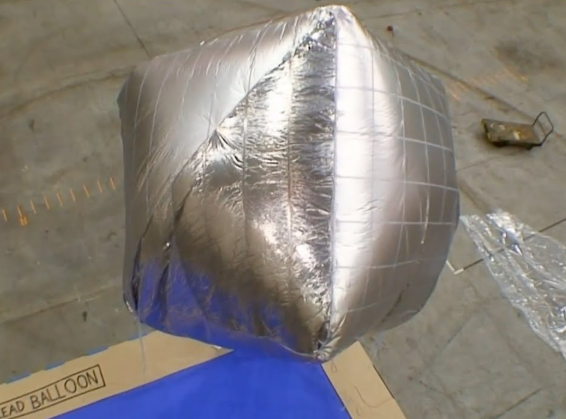
RFK, Jr., and his overlord, the Orange Jesus, have announced a possible link between acetaminophen and ADHD and autism. When they announced it, the trade name Tylenol was used. We can be certain that it went over like a lead balloon in the acetaminophen manufacturer’s world. But, first things first: Myth Busters were able to get a balloon made of lead sheets to actually float.

Lead balloon from Myth Busters episode. Source: Adam Sandler, YouTube.

It was announced that the FDA will be adding language to acetaminophen packaging warning. of the risk of ADHD and autism. To be sure, acetaminophen is capable of causing injury to the liver when an overdose is taken. Snakes in particular are very sensitive to acetaminophen poisoning. The island of Guam embarked on a program to rid the island of the invasive brown tree snake. A total of 2000 mice laced with acetaminophen were air-dropped over Guam in 2013 in an attempt to knock down the population on the island. The linked article did not mention the success rate. In addition to hepatotoxicity, apparently acetaminophen also converts hemoglobin to methemoglobin in just a few hours. Scientific details were behind a paywall which I generously leave to the reader to scale.

Our hospitals and medical staff prescribe acetaminophen because it does not interfere with blood clotting like the NSAIDS do. The makers of acetaminophen would like us to believe that their product is a superior pain reliever or anti-inflammatory to aspirin or ibuprofen. Decide for yourself.

How long will Kennedy continue to make faulty assertions, generally? As long as King Louie continues to keep him in the cabinet.

Disney’s King Louie. Source: Wikipedia.

Also, don’t forget. In Ohio they’re eating the cats … they’re eating the dogs.

Progressive Voices From America

Colorado, 8/12/25. I find myself in the murky world of the Anti-Trump movement. Millions of voices cry out in opposition of this American President, yet he remains in office supported by the current House and Senate Republican majorities and the election cycle. America is stuck with this condition at least until the 2026 election. At that time the majority leadership of both houses could fall to the Democrats. or not.

The current plague of house and senate MAGA elected officials is with us at least until 2026. The present deconstruction of the US federal government was planned out by the American political group Heritage Foundation and published for all to see in the form of “Project 2025“. Musk’s DOGE may have been connected, but I do not know.

Some people trace the current political catastrophe to President Reagan in the 1980s. This is when he endorsed the trickle-down supply side Laffer Curve to press forward the view that returning tax dollars to the wealthy would in return result in greater general prosperity for all. Wealth would “trickle down” from the wealthy and onto the millions of pointy heads who believed it.

The world should know that a large liberal progressive population still exists in America and is getting stronger. The problem is that the liberal Democratic Party in America has failed to surface any charismatic leadership beyond a few individuals. There are no liberal rallies to attend in my part of the US. Democratic politicians seem to have their heads down trying to plow through endless political outrage.

America’s current president, #47, is a huge embarrassment for most Americans. I can say that we apologize to the western nations for letting this buffoon loose on the world. For America to fall apart because a greedy and precocious real estate developer is building an authoritarian state is just too much to comprehend.

I began to notice cracks in the political foundation around 1976. I stopped at a booth on the July 4th fair fairgrounds and listened to the people there. They were the John Birch Society and were supporting anti-communism, right wing populism and libertarianism. They were unrepentant in their focused anti-establishment views on how to carry out American civilization. What they described resembled anarchism but with close ties to conservative protestant evangelicalism. Never a churchy person or a fan of communism, I stood and listened for a while just to hear their screwy arguments. I found it unworkably utopian and their conspiracy arguments for their ideology too much of a stretch. Their interlocking diatribes match with what I see today.

To my European friends, there is hope for the USA yet in the coming few years. I have to believe that our culture is still strong enough to survive this orange monstrosity in the White House. We cannot allow this guy to convert a long term liberal democracy into an illiberal democracy.

Deconstruction of the USA

The idiot RFK, Jr

The very idea that a person like RFK, Jr, would land in Trump’s cabinet as the Secretary of Health and Human Services seemed so farfetched as to be bad pulp fiction. Yet there he is.

I have no special insights or knowledge on HHS other than what I read. Everything that could be said about the pathetic case of RFK, Jr, and his place in pseudoscientific madness has already been stated by better writers than I.

If you wanted to purposely obliterate certain patches of modern medical developments from the last 120 years, there are few better hatchet-men than RFK, Jr. RFK, Jr., is not without a certain charisma. His strength of conviction is taken as a measure of truth. He is a talented speaker despite his speech impediment and, like most popular speakers, is a performer playing to the entire USA. His compelling position on the stage lends a credibility to his assertions. His slashing of HHS funding and staff is jaw dropping in its extent and coverage.

The University-Government-Industry R&D Complex

Until Trump, the USA had accumulated considerable technological ‘soft power‘ internationally since WWII. An element of that soft power is the American University-Government-Industry research complex. The government funds basic university research across the spectrum of science and the universities provide basic research and training of scientists and engineers. Industry taps into this valuable technology resource for skilled technologists and develops applied science for their projects.

The USA has been a very productive engine of ingenuity, especially since the beginning of WWII. However, our dear leader’s administration has been deconstructing agencies in the name of rooting out the deep state. In reality he is busy putting in place his own deep state.

Project 2025, hosted by the Heritage Foundation, amounts to a libertarian coup backed by libertarian hardliners and supported by conservative protestant evangelical Christians. I’m trying to be fair to the evangelicals, but they have woven Trump into their Christian eschatology. They may still support #47, but many are holding their noses in doing so.

Why not remove the university research funding and leave it to industry? To our neoliberal friends that might sound appealing. Universities could continue to produce scientists and engineers but leave the R&D to industry. After all, letting the open market take care of R&D is one of the goals, right? Let industry produce and pay for their own R&D talent.

The problem will be that new R&D chemists hired into a company at the PhD level would have to be trained on how to execute chemical R&D. Normally this happens in graduate school and in a post doc appointment. But wouldn’t business prefer to hire walking, talking, trained, young and energetic chemistry researchers? I think so.

In #47’s administration, research efforts are being discontinued willy nilly by inexperienced and scientifically untrained actors whose only goal is to rack up dollar savings. Their amateur appraisal of what constitutes valuable scientific activity is cartoonish.

Having been in both academic and industrial R&D, my observation is that basic and commercial science can be quite different activities. Universities have a continuous stream of fresh students and post docs to do the actual work of research at a time period in their lives when they are the most productive and at a far lower labor cost than could industry. Benefits, if any, are quite modest.

The current approach simultaneously trains scientists and engineers while at the same time developing basic science and engineering for the price of a one or more grants. In the process, the advanced instrumentation and the many subject matter experts walking around in the building aid academic research greatly. If a transformation (i.e., a reaction) goes poorly, an academic lab may try to find a mechanism. A commercial R&D lab exists solely for the purpose of supporting profitable production. This means developing the best routes for the fastest conversion and highest yields of chemicals into money. Along the way, commercial chemists may discover new chemistries or have unexpected outcomes. If they are lucky, any given R&D ‘discovery’ may lead to a new product or better control of a reaction. The result of commercial R&D may be more profitable processing but also it may be of scientific interest.

The role of the university is quite different from the role of industry in our society. Universities are funded to provide leading edge research. Here, knowledge is acquired by exploring the boundaries of particular chemical transformations or in the realm of calculation. The driving force in academic R&D is funding and publication. Every scientist wants to be the first person to discover new processes and compositions. It is not uncommon in academics for a research program to finish with a sample of 2 milligrams of product for spectroscopic analysis. For a proof-of-concept result, a sample small enough to analyze and still get a mass for the yield closes the work.

The preferred role of industry is to take up where academia leaves off. If a known composition and/or process is commercially viable, the captains of industry would prefer not to fund enough basic R&D to get a product to market. Thirty minutes on SciFinder should provide an indication of the viability of a process to produce a given chemical substance. They would prefer their chemists work on scaleup to maximize the profit margin of a market pull product rather than wading into the murky waters of technology push.

You learn to do laboratory research by doing laboratory research. Reading about it is necessary but not enough. The success of much research requires broad and deep knowledge and specialized lab and instrument skills.

The industrial end is a bit different from academia. In applied science there are two bookends in business-to-business product development-

In order for a company to allocate resources for an R&D project, sales projections, cost and margin studies must be performed to convince management to proceed. A great starting point is with a known substance and a good public domain procedure for it. This is where academia really shines. Industrial R&D will collect academic research papers on all aspects of the production of a new product.

One serious caveat for industrial R&D is the intellectual property (IP) status of all of the compositions of matter and the processes used therewith. In chemistry, IP is divided between the composition of matter and the method or process. Chemistry patents are often written with Markush claims that use variables to enrobe vast swaths of compositions of matter within patent coverage.

Some academics file for patents as inventors, leaving the ownership costs to the university assignees. The thinking has been that the university may someday collect license fees from the invention. The wild-eyed inventors may honestly believe that industry will beat a path to their door wanting licenses. More chemical patents of all kinds are allowed to quietly expire unlicensed than most realize.

Research IssueUniversityIndustry
Discovery of new chemistryBuilt to excel in itCan do but would much rather avoid the expense and time
Publication of resultsCritical to career growth and scientific progressResearch developments are confidential
Patenting IPMixed views. Some patents may provide revenue to the university. Patents that are contested are very expensive to protect.Patents enforce exclusivity for 20 years and cement competitiveness of the assignees.
R&DMuch time and care can be spent on the research. Research is distributed through publications and seminars.Prefers that existing R&D be applied to scale-up and process improvements
Career growthStudents, post docs and professors can choose academics or industryScientists can take the business path or stay on the R&D path
Safe and smart technologyAcademics have the ability to pursue environmental and safety matters with the chemistry.Industry is a slave to quarterly growth. Changes that will increase the quarterly EBITDA are most favored by the C-suite and the board of directors.
“A patent is only as good as the latest attempt to invalidate it”. -Arnold Ziffel.

Some loose talk about patents

Many in academia view a patent as a publication that they can stuff into their vitae. While being awarded a patent is a validation of an idea, it also means that the examiner was unable to find a reason to deny the patent. Citizens are entitled to patents and the USPTO must find a reason to deny the application. The language in a patent application must be internally consistent, be written in the ‘patent dialect’ and provide a description for others to understand the claimed art enough to avoid infringement. The USPTO does not require that the reality of the claims be proven. (I’ve been involved in 2 technology startups based on patents that were not proven by prototyping because it was not required by the USPTO. Both were business disasters because the claimed art didn’t work well enough).

Patents can induce a high credibility impression that may or may not be valid. Patents are commonly used to impress investors and are found stapled to a business plan. The startup may have an attorney on the board of directors who is supposed to serve as council. The attorney may or may not be a patent attorney. But if they do not possess patent and technical knowledge, they can only help with word smithing documents like NDAs, contracts, and sitting in on meetings to catch the odd procedural misstep. They can bring confidence and comfort to the startup founders with business structure, agreements, and negotiations etc., sorta like a big ole’ teddy bear for the CEO.

Summary

One of the purposes of government is to protect ourselves from each other. Another purpose that has worked well until now is that gov’t has been able to blunt many of the harsh and brutal forces of nature like disease, famine, drought, earthquakes and storms.

The USA has excelled in medical research for decades. The Food and Drug Administration (FDA) was begun to assure that food and drugs were safe for the public to consume. Every new drug developed in the USA has a paper storm trailing behind it. To be compliant with FDA generally, a sizeable amount of operational rigor must be demonstrated and practiced. Food safety in restaurants and in the food supply chain as well as drug development and testing are all subject to complacency or outright evasion without gov’t oversight. People and organizations will always drift away from safe practices if nobody is watching and auditing.

Sustainability? Can We Reinforce the House of Cards that Civilization has Become?

Ask yourself this- will your descendants in the year 2125 share in the creature comforts coming from the extravagant consumption of resources that we presently enjoy? Shouldn’t the concept of “sustainability” include the needs of 4-5 generations down the line?

The word ‘sustainability’ is used in several contexts and in contemporary use remains a fuzzy concept with few sharp edges. In this post I will refer to the sustainability of raw materials, fully recognizing that it covers numerous aspects of civilization.

There are wants and there are needs. For the lucky among us in 21st century developed nations, our needs are more than satisfied leaving surplus income to satisfy many of our wants. Will our descendants a century from now even have enough resources to meet their needs after our historical wanton and extravagant consumption of resources dating to the beginning of the industrial age? Our technology stemming from the earth’s economically attainable resources has done much to soften the jagged edges of nature’s continual attempts to kill us. After each wave of nature’s threats to life itself, survivors get back up only to face yet more natural disasters, starvation and disease. This is where someone usually offers the phrase “survival of the fittest”, though I would add ” … and the luckiest”.

What will descendants in 100 or 200 years require to fend off the harshness of nature and our fellow man? Pharmaceuticals? Medical science? Fuels for heat and transportation? Will citizens in the 22nd century have enough helium for the operation of magnetic resonance imagers or quantum computers? Will there be enough economic raw materials for batteries? Will there be operable infrastructure for electric power generation and distribution? Lots of questions that are easy to ask but hard to answer because it requires predicting the future.

Come to think about it, does anyone worry this far in advance? The tiny piece of the future called “next year” is as much as most of us can manage.

Humans would do well to remember that a great many of the articles that we rely on are manufactured goods, such as: automobiles, aerospace-anything, pharmaceuticals, oil & gas, metals, glass, synthetic polymers (i.e., polyethylene, polypropylene, PVC, polystyrene etc.), medical technology and electrical devices of all sorts. Each of these categories split off into subcategories all the way back to a farm or a mine. And let’s remember that both mining and farming are both reliant on big, expensive machinery and lots of water.

Each of the contributing technologies holding up any given apex technology were new and wondrous at one time. Think of a modern multicore microprocessor chip. Follow the chip’s raw materials back to the mines and oil & gas wells where the raw materials originated. Once you’ve done that, consider all of the people and inputs necessary in each step getting from the mine to the assembly of a working microprocessor. Each device, intermediate component or refined substance is at or near the apex of some other technology pyramid. To keep moving forward, people need to connect each apex technology input in a way to get to their own apex endpoint.

We mustn’t forget all of the machinery and components, energy to power them, transportation and trained personnel needed to manufacture any given widget. Skilled hands must be found to make everything work.

A given technology using manufactured goods is a house of cards kept upright by constant attention, maintenance, quality control and assurance, continuous improvement and hard work by sometimes educated and trained people. Then, there is a stable society with institutions, regulations and a justice system that must support the population. The technology driving our lifestyles does not derive from sole proprietor workshops in a corrugated iron Quonset building along the rail spur east of town. The highly advanced technology that is driving economic growth and the comfortable lives we enjoy comes from investors and factories and international commerce. A great many products we are dependent on like cell phones are affordable only because of the economies of large-scale production.

So, what is the point of this? Sustainability must also include some level of throttle back in consumption without upsetting the apple cart.

A plug for climate change

For a moment, let’s step away from the notion that the atmosphere is so vast that we cannot possibly budge it into a runaway warming trend. The atmosphere covers the entire surface of the planet with all of its nooks and crannies, but its depth is not correspondingly large. In fact, the earth’s atmosphere is rather thin.

At 18,000 feet the atmospheric pressure drops to half that at sea level. The 500 millibar level varies a bit but is generally near this altitude. This means that half of the molecules in the atmosphere are at or below 18,000 feet. This altitude, the 500 millibar line, isn’t so far away from the surface. From the summits if the 58 Fourteeners in Colorado, it is only 4000 ft up. That is less than a mile. The Andes and the Himalayan mountains easily pierce the 500 millibar line.

Our breathable, inhabitable atmosphere is actually quite thin. The Earth’s atmosphere tapers off into the vacuum of space over say 100 km, the Kármán line. Kármán calculated that 100 km is the altitude at which an aircraft could no longer achieve enough lift to remain flying. While this is more of an aerodynamics based altitude than a physical boundary between the atmosphere and space, the bulk of the atmosphere is well below this altitude. With the shallow depth of the atmosphere in mind, perhaps it seems more plausible that humans could adversely affect the atmosphere.

The lowest distinct layer of the atmosphere is the troposphere beginning as the planetary boundary layer. This is where most weather happens. In the lower troposphere, the atmospheric temperature begins to drop by 9.8 °C per kilometer or 5.8 oF per 1000 ft of altitude. This is called the dry adiabatic lapse rate. (With increasing altitude the temperature gradient decreases to about 2 oC per kilometer at ~30,000 ft in the mid-latitudes where the tropopause is found. The tropopause is where the lapse rate reaches a minimum then the temperature remains relatively constant with altitude. This is the stratosphere.)

Over the last 200 years in some parts of the world, advances in medicine, electrical devices, motor vehicles, aerospace, nuclear energy, agriculture and warfare have contributed to what we both enjoy and despise in contemporary civilization. The evolving mastery of energy, chemistry and machines has replaced a great deal of sudden death, suffering and drudgery that was “normal” affording a longer, healthier lives free of many of the harmful and selective pressures of nature. Let’s be clear though, continuous progress relieving people of drudgery can also mean that they may be involuntarily removed from their livelihoods.

It is quintessentially American to sing high praises to capitalism. It is even regarded as an essential element of patriotism by many. On the interwebs capitalism is defined as below-

As I began this post I was going to cynically suggest that capitalism is like a penis- has no brain. It only knows that it wants more. Well, wanting and acquiring more are brain functions, after all. Many questions stand out, but I’m asking this one today. How fully should essential resources be subject to raw capital markets? It has been said half in jest that capitalism is the worst economic system around, except for all of the others.

I begin with the assumption that it is wise that certain resources should be conserved. Should it necessarily be that a laissez faire approach be the highest and only path available? Must it necessarily be that, for the greater good, access to essential resources be controlled by those with the greatest wealth? And, who says that “the greater good” is everybody’s problem? People are naturally acquisitive- some much more than others. People naturally seek control of what they perceive as valuable. These attributes are part of what makes up greed.

Obvious stuff, right?

The narrow point I’d like to suggest is that laissez faire may not be fundamentally equipped to plan for the conservation and wise allocation of certain resources, at least as it is currently practiced in the US. Businesses can conserve scarce resources if they want by choosing and staying with high prices, thereby reducing demand and consumption. However, conservation is not in the DNA of business leaders in general. The long-held metrics of good business leadership rest on the pillars of growth in market share and margins. Profitable growth is an important indicator of successful management and a key performance indicator for management.

First, a broader adoption of resource conservation ideals is necessary. Previous generations have indeed practiced it, with the U.S. national park system serving as a notable example. However, the scarcity of elements like Helium, Neodymium, Dysprosium, Antimony and Indium, which are vital to industry and modern life, this raises concerns. The reliance of Magnetic Resonance Imaging (MRI) operations on liquid helium for their superconducting magnets poses the question of whether such critical resources should be subject to the whims of unregulated laissez-faire capitalism. While some MRI operators utilize helium recovery systems, not all do, leading to further debate on whether the use of helium for frivolity should continue, given its wasteful nature.

Ever since the European settlement of North America began, settlers have been staking off claims for all sorts of natural resources. Crop farmland, minerals, land for grazing, rights to water, oil and gas, patents, etc. Farmers in America as a rule care about conserving the viability of their topsoil and have in the past acted to stabilize it. But, agribusiness keeps making products available to maximize crop yields, forcing farmers to walk a narrower line with soil conservation. Soil amendments can be precisely formulated with micronutrients, nitrogen and phosphate fertilizers to reconstitute the soil to provide for higher yields. Herbicides and pesticides are designed to control a wide variety of weeds, insect and nematode pests. Equipment manufacturers have pitched in with efficient, though expensive, machinery to help extract the last possible dollars’ worth of yield. Still other improvements are in the form of genetically modified organism (GMO) crops that have desirable traits allowing them to withstand herbicides (e.g., Roundup), drought or a variety of insect, bacterial, or fungal blights. The wrench in the gears here is that the merits of GMO crops have not been universally accepted.

Livestock production is an advanced technology using detailed knowledge of animal biology. It includes animal husbandry, nutrition, medicines, meat production, wool, dairy, gelatin, fats and oils, and pet food production. There has been no small amount of pushback on GMO-based foods in these areas, though. I don’t follow this in detail, so I won’t comment on GMO.

The point of the above paragraphs is to highlight a particular trait of modern humans- we are demons for maximizing profits. It comes to us as naturally as falling down. And maximizing profits usually means that we maximize throughput and sales with ever greater economies of scale. Industry not only scales to meet current demand, but scales to meet projected future demand.

Essentially everyone will likely have descendants living 100 years from now. Won’t they want the rich spread of comforts and consumer goods that we enjoy today? Today we are producing consumer goods that are not made for efficient economic resource recovery. Batteries of all sorts are complex in their construction and composition. Spent batteries may have residual energy left in them and have chemically hazardous components like lithium metal. New sources of lithium are opening up in various places in the world, but it is still a nonrenewable and scarce resource. This applies to cobalt as well.

Helium is another nonrenewable and scarce resource that in the US comes from a select few enriched natural gas wells. At present we have an ever-increasing volume of liquid helium consumption in superconducting magnets across the country that need to remain topped off. This helium is used in all of the many superconducting magnetic resonance imagers (MRI) and nuclear magnetic resonance (NMR) spectrometers in operation worldwide. Quantum computing will also consume considerable liquid helium as it scales up since temperatures below the helium boiling point of 4.22 Kelvin are required.

As suggested above, today’s MR imagers can be equipped with helium boil off recovery devices that recondense helium venting out of the cryostat and direct it back into a reservoir. One company claims that their cold head condensers are so efficient that users do not even have to top off with helium for 7-10 years. That seems a bit fantastic, but that has been claimed. Helium recovery is a good thing. Hopefully it is affordable for most consumers of MRI liquid helium.

In the history of mining in the US and elsewhere, it has been the practice of mine owners to maximize the “recovery” of run-of-mill product when prices are high. Recovery always proceeds to the exhaustion of the economical ore or the exhaustion of financial backing of the mining company. Uneconomical ore will remain in the ground, possibly for recovery when prices are more favorable. It is much the same for oil and gas. As with everything, investors want to get in and get out quickly with the maximum return and minimum risk. They don’t want their investment dollars to sit in the ground waiting for the distant future in order to satisfy some pointy headed futurist and their concern for future generations.

What is needed in today’s world is the ability to conserve resources for our descendants. It requires caring for the future along with a good deal of self-control. Conservation means recycling and reduced consumption of goods. But it also means tempering expectations for extreme wealth generation, especially for those who aim for large scale production. While large scale production yields the economies of scale, it nevertheless means large scale consumption as well. In reality, this is contrary to the way most capitalism is currently practiced around the world.

Sustainability

The libertarian ideal of applying market control to everything is alleged to be sustainable because in appealing to everyone’s self-interest, future economic security is in everyone’s interest. If high consumption of scarce resources is not in our long-term self-interest, then will the market find a way to prolong it? As prices rise in response to scarcity, consumption should drop. ECON-101 right? Well, what isn’t mentioned is that it’s today’s self-interest. What about the availability of scarce resources for future generations? Will the market provide for that?

Is the goal of energy sustainability to maintain the present cost of consumption but through alternative means? Reduced consumption will occur when prices get high enough. As the cost of necessities rises, the cash available for the discretionary articles will dry up. How much of the economy is built on non-essential, discretionary goods and services? The question is, does diminished consumption have to be an economic hard landing or can it be softened a bit?

Where does technological triumphalism take us?

The generation and mastery of electric current has been one of the most consequential triumphs of human ingenuity of all time. It is hard to find manufactured goods that have not been touched by electric power somewhere in the long path from raw materials to finished article. As of the date of this writing, we are already down the timeline by many decades as far as the R&D into alternative electrification. What we are faced with is the need to continue rapid and large scaling-up of renewable electric power generation, transmission and storage for the anticipated growth in renewable electric power consumption for electric vehicles.

Our technological triumphalism has taken us to where we are today. The conveniences of contemporary life are noticed by every succeeding generation who, naturally, want it to continue. This necessitates that the whole production and transportation apparatus for goods and services already in place must continue. We have both efficient and inefficient processes in operation, so there is still room for more triumph. But eventually resources will become thin and scarcity of strategic minerals becomes rate limiting. Economies may or may not shift to bypass all scarcity of particular articles.

Perhaps a transition from technological triumphalism to minimalist triumphalism could take place. The main barrier there is to figure out how to make reduced consumption profitable. Yes, operate by a low volume, high margin business model. That already works for Rolls Royce, but what about cell phones and sofas?

Something else that stymies attempts at reduced consumption is price elasticity. This is where an increase in price fails to result in a drop in demand. Necessary or highly desirable goods and services may not drop in demand if the price increases at least to some level. As with the price of gasoline, people will grumble endlessly about gas prices as they stand there filling their tanks with expensive gasoline or diesel. Conservation of resources has to overcome the phenomenon of price elasticity in order to make a dent without shortages.

A meaningful and greater conservation of resources will require that people be satisfied with lesser quantities of many things. In history, people have faced a greatly diminished supply of many things, but not by choice. Economic depression, war and famine have imposed reduced consumption on whole populations and often for decades. When the restriction is released, people naturally return to consumption as high as they can afford.

The technological triumph reflex of civilization has allowed us to paint ourselves into a resource scarcity corner.

I’d like to believe that humanity could stave off the enviable conflict that would spark from numerous critical resource shortages, but I doubt the people and nations of the world can do it.

Reuters Receives Raw Materials for Fentanyl

The news service Reuters recently published an article on the ease with which the raw materials for the production of the opioid Fentanyl. From their $3600 expenditure on raw materials they estimate they could have produced $3 million worth of Fentanyl.

For an estimated 74,702 Americans in 2023, Fentanyl provided them with a narcotic experience prior to death. The lethal dose is reported to be 2 milligrams for an adult. It is 20 to 40 times more potent than heroin.

Outside of medical use Fentanyl should be described as a highly (neuro)toxic substance rather than just an opioid. Yes, it is an illegal narcotic, but it is also a potent deadly poison. Hidden with other illegal drugs in pill form, it is just a highly toxic contaminant.

On January 5, 2024, I posted a piece titled “A Bit of Fentanyl Chemistry” which is reproduced below. It turns out that the Janssen synthetic chemistry I wrote about then is quite close to what the investigators at Reuters had in mind for their story. In the world of chemical commerce, a process using easily available raw materials is highly favored.

My take-home message from the Reuters story is that unless China seriously clamps down on those who export the raw materials, all that is left to do is to suppress demand. The import of Fentanyl raw materials is aided by deceptive packaging and small quantities needed. Worse, Fentanyl raw materials have other uses in pharmaceutical chemistry and are too useful to completely shut down. The death and incarceration that Fentanyl can bring in the US does not appear to be sufficiently convincing to the at-risk American population. Nothing new here.

=========================

A recent raid on a clandestine drug lab in the Hatzic Valley east of Vancouver, BC, netted 25 kg of “pure” fentanyl and 3 kg which had already been cut for street use. Precursor chemicals used to manufacture the fentanyl were also seized. Along with the drug, the raid also seized 2,000 liters of chemicals and 6,000 liters (about 30 drums) of hazardous chemical waste, according to an RCMP news release 2 November, 2023.

The police said that the seizure represented 2,500,000 street doses.

In August of 2023 the police in Hamilton, Ontario, announced the results of Project Odeon. This was a large-scale sweep of illicit drug production in the Hamilton and Toronto area. From January 1, to July 30, 2023 there were 606 incidents related to suspected opioid overdoses and 89 suspected drug related deaths in the Hamilton area. Twelve people were charged for a total of 48 criminal charges. The police disclosed the following items that they seized-

  • An operational fentanyl drug lab at 6800 Sixteen Road, Smithville.
  • A dismantled fentanyl drug lab at 4057 Bethesda Road, Stouffville.
  • Approximately 3.5 tons of chemical byproduct from fentanyl production.
  • 800 gallons of chemicals commonly used in the production of fentanyl
  • Lab equipment commonly used in the production of fentanyl
  • 64.1 kg of illicit drugs, including 25.6 kg of fentanyl, 18 kg methamphetamine, 6 kg of ketamine
  • A loaded, Glock firearm and ammunition and four extended magazines
  • Over $350,000 of seized proceeds, including cars, jewelry, furniture and cash

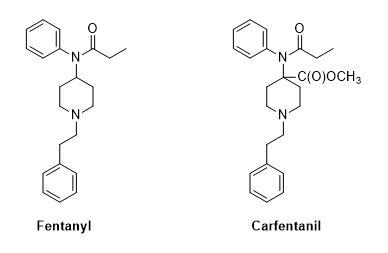
Fentanyl is a synthetic drug first prepared in 1959 in Belgium by Paul Janssen (1926-2003). Janssen was the founder of Janssen Pharmaceuticals, now a subsidiary of Johnson & Johnson. In addition to fentanyl, the Jenssen team developed haloperidol, the ultrapotent carfentanil, and other piperidine based congeners. Piperidine itself is a DEA List 1 substance in the US.

Carfentanil is just modified fentanyl. Graphics: Will O. de Wisp

The elephant in the room with fentanyl is its extraordinary potency as an opioid. In pharmacology, potency is a quantitative measure of the amount of dose needed to elicit a specific effect on an animal or human in terms of dose weight per kilogram of body mass. Potency is subject to variability across a population and rises to an asymptote which can be difficult to pin down. For these reasons potency is reported at 50 %. For highly potent drugs like fentanyl, the measure is expressed as milligrams or micrograms of dose per kilogram body weight (mg/kg or mcg/kg body weight). One milligram per kilogram is one part per million (ppm).

When matters of toxicity arise, it is important to remember the maxim that “the dose makes the poison”. This observation traces back to Paracelsus in the mid-sixteenth century.

Fentanyl acts much like morphine in regard to its affinity for one particular opioid receptor. Morphine is commonly the “standard” with which other opioids are compared. For instance, fentanyl is said to be 50-100 times more potent than morphine. Only 2 mg of fentanyl is equivalent to 10 mg of morphine. Carfentanil is more potent still at 10,000 times the potency of morphine.

Morphine is an agonist which activates the μ-opioid receptor. Activation of this receptor with morphine produces analgesia, sedation, euphoria, decreased respiration and decreased bowel motility leading to the earthly delights of constipation. Fentanyl is thought to interact with this receptor as well.

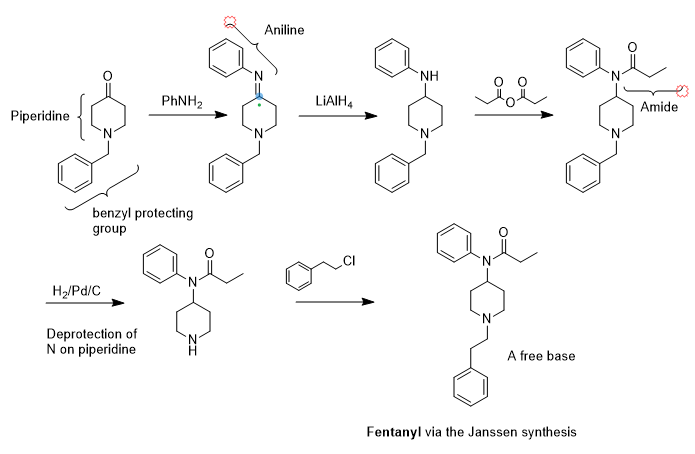
Original fentanyl synthesis by Janssen. Graphics: Will O. de Wisp

So, how is fentanyl synthesized? See the synthetic scheme above. I’ll just comment on the Janssen synthesis and some issues. I have no idea of how it is made out in there by the Mexican cartels and in ramshackle American trailer parks. The synthesis above has some steps that may be undesirable for backwoods or jungle operations like hydrogenation. In the first step, aniline will be needed to make the phenyl imine. It’s pretty toxic and stinks to high heaven. Next, lithium aluminum hydride is needed to reduce the imine double bond to an amine. This innocent looking grey powder is very hazardous and should only be used by an experienced chemist. It is also available as a solution in tetrahydrofuran. The next step is the formation of the amide with propionic anhydride. While the reaction entails a simple reflux, you still have to isolate the product. Once you have recovered the amide, the benzyl protecting group on the piperidine nitrogen must be removed. It allowed amide formation exclusively on the upper aniline nitrogen and has served its purpose. Finally, the piperidine nitrogen must be festooned with a phenylethyl group and phenylethyl chloride was used to afford the fentanyl product. 

An excellent review of the pharmacology and drug design of this family of opioids, see Future Med Chem. 2014 Mar; 6(4): 385–412.

In chemical synthesis generally, substances are prepared in a stepwise manner and with as few steps as possible to give high isolated yields. To begin, one must devise a synthesis beginning with commercially available raw materials as close to the target as possible. If the product has many fragments hanging off the core structure, it’s best to solve that problem early. Synthetic chemistry is almost always performed in a non-interfering solvent that will dissolve the reactants and allow the necessary reaction to occur. A low boiling point is preferable for ease of distillation. An important side benefit from a solvent is that it will absorb much of the heat of reaction which can be considerable. Left on its own, a reaction might take its solvent to the boiling point by self-heating, generating pressure and vapor. The benefit from evaporation or reflux boiling is that as a solvent transitions from liquid to vapor there is a strong cooling effect which helps to control the temperature. An overhead condenser will return cooled solvent to prevent solvent loss.

You can do any chemical synthesis in one step with the right starting materials. Unfortunately, this option is rarely available. The next best option is to take commercially available starting materials through a known synthetic scheme. People who run illicit drug labs are never interested in R&D. They want (and need) simple chemistry that can be done by non-chemists in buckets or coke bottles at remote locations. Chemical glassware can be purchased but sometimes the authorities will be notified of a suspicious order. This is especially true with 12 liter round bottom flasks.

The most difficult and risky trick to illicit drug synthesis is obtaining starting materials like piperidine compounds in the case of fentanyl and its congeners. In the case of heroin, acetic anhydride shipments have been investigated for a long time because it is used to convert morphine to heroin- an unusually simple one-step conversion. Solvent diethyl ether is similarly difficult to get outside of established companies or universities. Many other common drug starting materials are difficult to obtain legally in the US or EU by the criminal element. However, China is thought to be a major supplier of starting materials outside the US and EU. Countries with remote coastlines, loose borders, lackadaisical or corrupt law enforcement reduce the barriers for entry of drug precursors.

China in particular has a large number of chemical plants that make diverse precursors for legitimate drugs. Unfortunately, some of these precursors can also be used for illicit drugs or existing technology adapted for this use. Precursors can be sold to resellers who can do as they please with them. Agents may represent many manufacturers and can mask the manufacturer’s identity and take charge of the distribution abroad. Shady transactions become difficult for authorities to detect and trace. The identity of illicit precursor chemicals are easily altered in the paperwork to grease the skids through customs. Resellers can repackage chemicals to suitable scale, change the paperwork and jack up the price for export. It has been my experience that many if not most Chinese or Japanese chemical manufacturers conduct business through independent export agents. However, behind the curtains there often a byzantine web of connections between companies and agents, so you may never know who will manufacture your chemical. As an aside, this complicates getting technical information from the manufacturer since the agent will not disclose a contact at that manufacturer.

Highly potent drugs like fentanyl must be taken in very small dosages which means that kilo-scale batch quantities of drug result in many individual sales per kilo. Small quantities of highly potent drugs are more easily smuggled than bulky drugs like weed with its strong odor.

There is a down-side to the illicit manufacture of drugs like fentanyl. It is quite toxic at very low dosages and must be handled with the greatest of care lest the “cook” and other handlers get inadvertently and mortally poisoned. Good housekeeping helps, but I have yet to see a photo of a tidy drug lab.

Fentanyl can be sold as a single drug but perhaps is cut with a solid diluent that some random yayhoo decided was Ok to use. Other drugs of abuse like heroin may be surreptitiously spiked with fentanyl to kick up the potency. In either case, a given dosage may or may not be safe even for a single use. There is no way for a user to know. Also, the concentration or homogeneity of mixed solids may be subject to wide variation. For more than a few people, their first fentanyl dose will be their last.

Standing up for what you believe

I’ve long had difficulty with the validity of advice that says “always stand up for what you believe.” Superficially, it is inspirational to those working in a difficult and discouraging situation. It is meant to convey encouragement that a person should strive not to give up on a difficult goal. Keep chipping away at the problem. You can eat an elephant, but only by one bite at a time. There are many aphorisms that tie into this sentiment. A crisp analysis of this is not like a problem in algebra, you know, a problem with a unique solution. If you share the person’s subjectivity, then perhaps there is no problem.

Standing up for what you believe is often used to proclaim a refusal to give up some action or view. It can telegraph moral clarity and devotion to an ideal.

What are we to think when a leader stands up and proclaims that they intend to stand firm on their convictions? Irrespective of whether or not you agree with them, doesn’t their proclamation to stand fast say something about flexibility in the face of contrary evidence or logic? If new thinking comes along, wouldn’t we want a leader who can turn the boat around to a better heading?

We don’t want wishy-washy or indecisive leaders- don’t we really want action based on the best thinking? In a democracy it is our job to put the best thinkers in the important slots.

The weakness of this advice comes into view when you consider whether any given goal is “worthy” or not. Is there objective information or reason supporting going after a goal or maintaining a belief? Even if a belief or goal is objectively valid, is it something worth committing your life to? Will it really lead to the desired end? On the personal level, someone may be convinced that a goal is indeed worthy and is backed with good intentions, tight reasoning or what appears to be justifying evidence.

A person may be genuinely convinced that their goal or belief is worthy irrespective of objective fact or analysis. They would be making a subjective decision to stay on the path for reasons of comfort or aesthetics. As long as your path is not harmful to those around you, why not?

People possessed of divine certitude in their politics or religion, for example, will often claim that a particular hill really is worth dying on. They are willing to defend their beliefs to their last breath, a few in the literal sense but most metaphorically speaking. Righteous though they may seem, are we obliged to stand by and let the firmly held but baseless or insane beliefs of others swerve our democracy into an autocratic swamp of fringe beliefs and looney political theories?

The societal problems are supposed to be addressed by voting based on rational thought and conveyed through freedom of speech. Today in the US, large and well-funded forces are focused on eliminating time-tested elements of democracy based on firmly held beliefs.

The practical difficulty in the US is that monied interests have the cash to buy media time to persuade the masses. Repetition of untruthful assertions and fearmongering are highly effective. Recruiting and inciting people into the dark side of politics is all too easy as the GOP has shown for decades. And yes, I’m taking sides.

This is my theory: From the view at 30,000 feet we can broadly divide thinking into two manifolds- analytical thinking and devotional thinking. Analytical thinking is that in which conclusions or practices are based on consideration of established secular principles, measurable evidence and the science behind cause and effect.

Devotional thinking is rationale based on adherence to doctrine- be it religious or political. A particular doctrine guides a person’s beliefs, emotions and actions or conclusions, maybe even in the face of contrary evidence.

Analytical thinking is my preference but it can go awry. Conclusions may be drawn from faulty evidence or previous thinking that is factually incorrect or poorly conceived. Worse, human thinking is subject to stranding in the cul-de-sac of confirmation bias. Many of us get stuck in this appealing comfort zone indefinitely. Beliefs or opinions are often cherished and difficult to release.

So, what do you say to a person who adheres to a belief that can be objectively contradicted with arguments based on data or rational analysis? How far along are we obliged to indulge a person in a faulty belief? Should we be supportive and encourage them to “stand up for what you believe” knowing full well that they are on a fool’s errand or their belief leads to actions troublesome for others?

This is where politics comes in as useful. In principle, poor thinking can be outvoted. A majority of poor thinkers with bad ideas is a problem as history shows. Assuring the survival of liberal democracy takes continual monitoring. Oh yes, the continuance of liberal democracy is axiomatic in my view.

No doubt this ground has been plowed by philosophers for centuries. But, I don’t call myself a philosopher.

Is it really our place to correct a person’s belief? Who am I to reset an adult’s thinking? If someone is operating on the basis of incorrect information, like a definition or a piece of data, it could be argued that correcting them would be an act of kindness. If someone is just full of harmless baloney, then perhaps they should be left to wander through life as is.

This situation has been part of the human condition forever. Everyone has the right to be an idiot now and then. But what happens when their idiocy becomes a problem for others or too self-destructive to stand by and watch in civil society?

Speaking for myself only, I’m inclined to ignore those who espouse ignorant or magical beliefs. I’ll steer clear of the flat-earthers or Baptists, for instance, as not worth the effort to engage. With homeopathy believers, in a moment of weakness I might engage with some words about basic chemical principles relating to dose/response relationships. With the anti-vaccine crowd … this a tough one. All too frequently I go non-linear and become scornful of those harboring misplaced fear or anger towards vaccination. I’ll start gibbering and sputtering if I don’t quit thinking about it.

Speaking of goofy beliefs, I’ve had a longstanding issue with most religions, the big 3 in particular. To me, standing up for something that derives from magical thinking and no evidence seems foolish. Writings of dubious origin and translated or edited over the millennia could be as source of fiction or a mixture of truth and fiction. Followers of religion operate under the belief that their religious doctrines are set in stone and are the basis for all moral behavior.

Religion finally boils down to being a theory of the universe. The big 3 religions have always struck me as transparently anthropomorphic rationalizations of the universe using iron age thinking. I used to engage with others on this for fun but it’s nothing but aggravation now.

Does science give us the ultimate view of the universe? We only get pieces of it directly. The universe most of us know is substantially based on our what our brains perceive via stimulation of the nervous system. What we can see is limited to a very narrow slice of the electromagnetic spectrum, maybe one octave wide. Light waves exist many octaves distant on either side of the visible range. On the high energy side, there is the gamma ray universe shining brightly from nuclear reactions in stars and other objects. On the low energy side is the radio universe shining away by larger scale mechanisms. Adjacent to the visible spectrum is the x-ray and ultraviolet spectrum. On the opposite side are infrared and microwaves. All can reveal insights based on how they interact with matter. We exploit imaging, spectroscopy and mathematics to understand the universe outside of the solar system.

But maybe the reality we experience is just a type of baseline hallucination that we think of as our “normal” consciousness.

Science is unable to help with the desire to know the supernatural. Science requires observation, quantification, measurement and analysis. I suppose that if you could start classifying and counting miracles per square kilometer, you could begin to understand the effects of location and type of miracle. Anyway …

Gosh. It seems that I’ve painted myself into a corner.