Category Archives: Social Issues

Drill baby dr … what was the question?

I keep seeing video footage of citizens who have been asked to comment on the recent plan to open up offshore oil exploration. President Obama and his crew have read the tea leaves and have concluded that, in addition to advancing alternative fuel technologies and markets, it would be useful to open up offshore drilling, at least a bit. Invariably the people who appear on air seem to concur that we need to find and tap the petroleum resources under the sea floor.

Rarely one hears an interviewee who will openly say that we should reduce petroleum consumption, or at the very least, its growth rate.

Here is my question. Why are we so anxious to tap all of our resources as soon as possible?  Isn’t oil in the ground a little like money in the bank? Oh, I forgot. We are not a savings culture.

Obviously, the new exploration emphasis is to support a decent growth rate in consumption. A high throughput of fossil carbon and energy is needed to sustain the profitability of certain large public corporations.

As I see it, the problem with public corporations is that they are run on behalf of what are essentially absentee landlords. The stockholders demand a good return on their investment or they’ll bail. Can’t blame someone for that. So, management runs the corporation in a way that affords maximum profit rather than maximum sustainability. As a result, in the same manner as absentee landlords, management drifts into the mindset that they can justifiably milk the resource to depletion for fast cash. If cash is king, fast cash is divine.

The market is very much like a stomach. It cannot plan. It only knows that its hungry or not hungry. It seems to me that an organ with a bit more wiring should be in charge of energy resources.

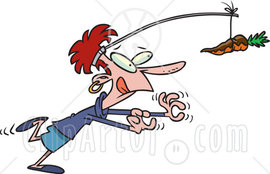
Euphemisms gone bad. The carrot and stick.

Good lord. Do I have to explain everything??  It’s not “carrot or stick”. It’s “carrot AND stick”. The phrase “carrot and stick” is not meant to imply a choice between pain and pleasure. It is meant to suggest motivation by the placement of  a reward that is always just beyond reach. It’s motivation for donkeys, oxen, and the physics challenged. And the talking heads who read news in front of cameras.

This is what is meant by "carrot and stick"

Zoning and Hard Times

Many have written about the essential fragility of the economic situation of most American workers. We save too little and accumulate too much high interest debt.  Our consumption in every context seems unsustainable. The fragility of the monetary system with its lack of dependence on gold and the cosmic-scale debt that our country has racked up has many people worked into an existential lather.

The hard reality is that a worker can lose his/her job and all of the forms of stability that comes with it. We have become absolutely dependent on the economic system of the “employment” by people and organizations. We exchange our labor for payment on an hourly or salary basis and hope to sustain a stable and predictable lifestyle therefrom.

When a person loses their job, the reality of maintaining shelter and keeping everyone fed and clothed pops straight up into view. Because we have structured our culture and economic system on sustenance by employment, our ability to improvise is weak. Our ability to get another cashflow stream going is limited and most people pursue solutions that consist of finding other employment.

What workers in America lack is something that is available in much poorer countries. When an American worker loses their job, either they must find another job or start a business to sustain a living income. But if an American worker wants to start a business making something or retailing, chances are that local zoning codes will bar them from operating out of their home.

There are certain kinds of business activity that people can do out of their residence. Many people do office type work like accounting, consulting, writing, and other information intensive services out of a home office. Baby sitting, daycare, sewing, and small scale construction contracting are commonly based in a residence.

But if you want to repair cars, retail specialty parts of all kinds, or manufacture widgets at the microscale, chances are that your activity will be banned either by municipal ordinance or by a home owners association.

If you visit a city in a poorer country- say, Thailand- what you will see are large sections of housing where people combine their occupation with their residence. I recall being lost on foot somewhere in Bangkok a few years ago, wandering through neighborhoods where families lived in small shops that had a metal overhead door for street access by potential customers. At sundown, the shop activity ceased and the stove came out and a pot of soup was put on the heat. Fans, televisions, and music would blare into the sweltering streets along with the aroma of food.

Poor as these folks might be, they have something that American city dwellers absolutely lack. They have the ability to consolidate their resources to provide shelter and an income. By day a family might sell parts for small gas engines or some particular range of plumbing fittings. By night they repair to the back room for supper and relaxation.

An American facing the prospects of no job and left with only industrial skills is in a bit of a pickle.  While they might have very valuable skills, chances are that these skills are not readily transferable to common home-based activities. Someone with retail experience, on the other hand, might be able to put together a small shop.

What would stop an American city dweller from starting a home retail business is the issue of zoning and code compliance.  If an unemplyed person wanted to sell articles of clothing in a converted garage shop, there would be a long list of problems with the town board and the neighborhood. There would be applications and appeals, neighborhood input, and public hearings for a variance to the code. Zoning, parking, fire codes, and handicap access are just the start.

Then there is the matter of neighbors and their firm theories on property value. US culture has long been aloft on an arc of gentrification. People invest heavily in their homes and view their shelter not just as something that keeps out the weather. We festoon them from a vast array of manufactured decorative goods. We slather them with paint and adorn them with “accessories”.  

We have come to rely on our homes as repositories of personal wealth. And this notion, evolved from countless proposals before countless town boards, has become a complex web of building codes and ordinances controlling seemingly every degree of freedom to act that you can imagine.

Go to a town board meeting anywhere and look for those who seek to influence the board. Much of the time they are people related to real estate and development. Much of the gentrification we see has its roots with developers seeking to provide a sense of exclusivity. 

The result is that wealth creation by the appreciation of residential property value has been given a privileged position over wealth creation by the productive use of that property.

Our ability to sustain ourselves through hard times is constrained by rules to meant to protect property value and provide a basis for notions of the residential ideal. Americans are poorly prepared to be poor. We have an infrastructure that is not well adapted to allowing the unfortunate unemployed the option to scratch out a living from their homes. So pervasive is the residential ideal that the options for shelter are few in gentrified areas of the country. We have zoned ourselves into a corner based on bourgeois notions of aesthetic tidiness.

Schneier on Security

Over at CNN.com there is an excellent post by the security expert Bruce Schneier. Finally, somebody has spoken what must be said. Schneier, by the way, was the one who invented the Blowfish encryption algorithm.

“Security theater” refers to security measures that make people feel more secure without doing anything to actually improve their security. An example: the photo ID checks that have sprung up in office buildings. No one has ever explained why verifying that someone has a photo ID provides any actual security, but it looks like security to have a uniformed guard-for-hire looking at ID cards …

Despite fearful rhetoric to the contrary, terrorism is not a transcendent threat. A terrorist attack cannot possibly destroy a country’s way of life; it’s only our reaction to that attack that can do that kind of damage. The more we undermine our own laws, the more we convert our buildings into fortresses, the more we reduce the freedoms and liberties at the foundation of our societies, the more we’re doing the terrorists’ job for them. –Bruce Schneier

My take on Schneier’s thesis is that the public, i.e., the teeming masses, must not allow the many arms of government to further tighten its grip on our liberties. Liberties once taken are hard to recover. The combination of media sensationalism, advanced information gathering, and authoritarian reflex is driving the USA into a permanent security state. A mature and thinking public must buffer the exaggerations and sensationalism that is broadcast into our homes every minute of every day.

Counterterrorism is also hard, especially when we’re psychologically prone to muck it up. Since 9/11, we’ve embarked on strategies of defending specific targets against specific tactics, overreacting to every terrorist video, stoking fear, demonizing ethnic groups, and treating the terrorists as if they were legitimate military opponents who could actually destroy a country or a way of life — all of this plays into the hands of terrorists. –Bruce Schneier

By closely following the exploits of a handful of radicals as though they could bring down our civilization, we legitimize their efforts as being worthy of our sustained attention. These are low frequency high visibility events.  Unfortunately, lingering and repeated gawking at sensational events against a constant buzz of soaring narrative is what television does best.

MRI MRI on the Wall

What the world needs is a good $1000 MRI scan. Why can’t we talk about how to bring down the cost of MRI scanners so that one can be parked in a non-magnetic quonset at Wal-Mart?  After all, the next wave of clinical business innovation has to crack the problem of how to provide lower octane health care.   To be sustainable, the system requires a selection of non-premium services that are modern and sensitive, but are robust and inexpensive enough to operate at $1000 a pop.

Health care organizations need to stop sending the message to Siemens, Fujitsu, GE or whomever else makes MRI scanners that they need to offer more premium scanners with expensive features because others are paying for it.  This is an amped up case of creeping featurism. What about moderate resolution with a basic package of options?   Perhaps this is already happening?

Someone needs to offer the “Kia” of MRI scanners- a moderately priced system with enough features to be useful to 80 % of patients. If the 1 kilobuck scan turns up nothing, then the Doc ratchets up the horsepower another notch.  This is the kind of thinking that is needed to keep the cost of treatment in line with inflation.

Is Private Sector Buggery Better than Gov’t Incompetence?

Healthcare in the USA is wildly expensive and is growing more so at a rate that exceeds inflation. This is well known. The battle for healthcare reform in DC is bogging down under the weight of private interests and infighting.  Soaring rhetoric from both left and right is mistaken for intellection and reason. It is evident that the fix to the problem was started before there was a clear understanding of the variables.

If you look at healthcare as a manufacturing activity with labor, capital equipment, and materials as input and some sort of health benefit as the output, you can start to see what cost inputs may begin to dominate. Of course this is very simplistic, but hang with me.

A round of health care involves attention by highly trained and expensive labor. A health care worker can only attend to one person at a time, though that worker may have many patients under his/her supervision. If a patient is stabilized, the care worker can also attend to other patients and achieve some sort of parallel production for better cost containment. In the heirarchy of medicine, the docs are managers who provide oversight to nurses who manage the patients. Docs also do consultations, examinations, and perform surgery, so they are not pure people managers- they get their hands dirty. Docs are a unique class of management all by themselves.

To exaggerate the effects of labor costs, imagine if you had a doc or a nurse picking strawberries, how expensive would the strawberries be? Even if Dr. Picker was very fast, the berries would be expensive. To have reasonably priced berries you have to find workers who will do the work at a lower wage. Lower wages derive from an abundance of willing labor.

In the end, medical schools control the scarcity of physicians by controlling enrollment. And the enrollment is defined by the curriculum, faculty size, and the particulars of the coursework- availability of clinical experiences, lab space, equipment, etc. But, you have to wonder what would happen to medical costs if there was less labor scarcity.

The most important resource a medical school has, other than faculty, might be the university hospital. What if more hospitals had medical schools rather than the other way around? I don’t think that the existing medical schools have absorbed all of the bright candidates out there.

Health care is a kind of economic chimera. The recipient of medical treatment is not the person in control of the costs. Physicians prescribe the type and extent of resources and the insurance companies release the funds. The medical establishment receives payment for services irrespective of outcome. Insurance companies profit by denial of services. The patient is left to sort out how to get the best value from available treatment.

American medicine is very much influenced by technological triumphalism.  New and expensive materials and devices hit the market all of the time. The question every potential marketer of medically related items must ask is- will the docs use or prescribe it? The most powerful instrument in medicine is the physician’s pen. The question for drug and equipment makers is, how do you get the docs to use their pens to your advantage?

The view that a disease or an injury is a sales opportunity is what drives for-profit clinics and hospitals. Without chronic disease, accidents, and sporadic outbreaks of mayhem, growth and profit in the healthcare industry might be more static.

So in the end, who do you trust? Do you put your faith in the private sector whose avowed goal is to profit on your illness? Or do you trust the government which, though accountable to its citizens, is prone to profound organizational inertia and a lackluster draw to talented staff?  This is the balance of opposing forces the fools in Washington are trying to sort out. Howard help us all.

HR 2868- Good intentions gone sour

There is a fine line between good sense and paranoia and HR 2868 has definitely crossed over into deep paranoia. This resolution, sponsored by Rep. Thompson (Mississippi), Rep. Waxman of CA, Rep. Jackson-Lee of TX, Rep. Markey of CA, and reps Clarke and Pascrell, is an amendment to the Homeland Security Act of 2002.  Its purpose is

“to extend, modify, and recodify the authority of the Secretary of Homeland Security to enhance security and protect against acts of terrorism against chemical facilities, and for other purposes.”

Well, how could anyone be against such a noble sounding piece of code? The sponsors are struggling to protect the homeland against attack on chemical facilities. Facilities whose hazardous material inventories could be maliciously released to cause harm to the surrounding neighborhoods of innocent and helpless citizens.

Sec. 2102 (a) (1) allows the Secretary to designate any chemical substance as a “substance of concern” and establish a threshold quantity for each substance of concern.

There are many goodies and zingers in this bill. Sec. 2115 (a) (1) (A) requires that the Secretary issue regulations for substantial background checks to establish personnel surety in covered chemical facilities. The security check will be deep and will serve as a reservoir of information collected by company on citizen employees and subject to inspection on demand by the Secretary.

Sec. 2116 (a) (1) states that any person may commence a civil suit against any person “who is alleged to be in violation of any standard, regulation, condition, requirement, prohibition, or order which has become effective pursuant to this title; or … “.  This citizen lawsuit provision will open the floodgates to lawsuits on companies running chemical plants and in so doing, under the rules of discovery, break through the IP protection afforded by trade secrecy.

This proposed law also provides for close oversight by the Secretary of Homeland Security as well as civil penalties (Sec. 2107 (b) (1)) of up to $50,000 per day of violation.

OK. Nobody wants acts of terrorism to happen and especially not on the site of a chemical plant. But to legislate the transformation of chemical plants into a “Fort Apache” scenario in the absence of a history of attacks on US plants is to invite needless cost and complication to an industry that is already heavily regulated. This is plainly the result of irrational fearfulness on the part of congressional sponsors. And Congressmen are in a position to convert their fears into law.

Compliance with this law will require considerable effort and expense to be carried by industry. The downside to being out of compliance is too expensive. Over time companies may opt out of processes that use chemicals of concern simply to reduce the risk of noncompliance as determined by government audit.

The chemical industry uses hazardous chemicals of many varieties. Hazardous chemicals are often reactive chemicals. And reactive chemicals are useful chemicals.

The entire chemical industry is built around the exploitation of reactive attributes in order to cause a desired change in chemical composition. The unintended consequence of this legislation is that useful but reactive chemicals may be inherently prone to identification as chemicals of concern. The effect would then be that key substances at the core of a given technology platform would be regulated on the basis of what a terrorist could do with it rather than its value to technology and to civilization.

What constitutes adequate security? Who is to say what security measures are satisfactory? The security industry seems to attract the paranoid who see threats behind every shrub. To have such people deciding what chemical is acceptable for use in manufacturing is unacceptable.

Talibanistan

Holy smokes. Who’da thought that Pakistan’s western frontier would fold like a lawn chair to an invasion of jabbering, hairy, religious freaks? Someone has commented that while most countries have an army, Pakistan was really an army that had a country. It is difficult to understand the dynamics of this part of the world and how Pakistan could allow the Taliban warriers such a generous incursion.

North Korea is another army that has a country. As bad as the Pakistan situation is and no matter how belligerent the Iranians are, I suspect it will be North Korea who pops off the first nuclear warshot since Nagasaki. The question is, will it be against Japan, South Korea, or the US Navy? 

Then there is China which is apparently in possession of anti-ship ballistic missile technology (ASBM). This capability basically nullifies US superiority in force projection in the China Sea by our carrier fleet. US surface ships are helpless against attack by smart ballistic missiles raining in at Mach 10 or whatever the particular hypervelocity is.

Biohackers

A recent article in the WSJ solemnly described several amateur biologists who were doing simple molecular biology experiments in their homes. Naturally, this has not escaped the attention of certain authorities and certain deeply conservative establishment news corporations.

What is distressing is the reflexive conclusion that their activity is automatically dangerous and likely to be symptomatic of malevolent intent.  It is common for those in power to look over their ramparts and view the world as a spectrum of threats. And so it is in this case that distrust has arisen and reporters are using the words “weapons of mass destruction” or “ebola virus”. 

Could it not be that some people outside of the heavily in-bred fields of science have a genuine and scholarly interest in molecular biology but no interest in grad school?

The entrance to scientific activity is highly formalized with layers of degree requirements, preferred pedigree, institutional infrastructure, regulatory complications, and a mafia-like oligarchy that disperses the resources and opportunity that is so necessary for buoyancy in science.

How does a creative amateur scientist get to take a jouney of discovery in a field that is institutionally inaccessible to them? And how does an interested individual who is clever enough to conduct experiments deal with a government whose reflex is to see WMD and terrorists behind every lilac bush? There are serious civil liberties problems here that pit the brain stem against the frontal cortex.

It is in the nature of some people to be distrustful and find threats behind every shrub. It has been my observation that people who default into a distrustful posture are very often not trustworthy themselves. The distrustful often invoke slippery slope arguments as rhetorical devices to block their opponents move into new conceptual turf. What the distrustful and paranoid fail to see is that we live every minute of every day on multiple slippery slopes, yet we somehow survive and thrive.

Land of the Peckerwoods

One of the strangest phenomena that I am aware of is the matter of Po-folk republicans. You know, the folks who are the working dirt poor, but somehow are abidingly aligned with deep conservatism?  These folk are part of the masses who follow the GOP propaganda organs- Fox News and Rush Limbaugh. It is beyond my comprehension as to how people who are at the bottom of Ronald Reagan’s trickle down economics cascade can support policies that clearly give preference to the wealthy and to corporations. WTF???

So, what about the Land of the Peckerwoods? Margaret and Helen put it well-

Margaret dear, I need your help sorting all this out.   Rush Limbaugh has a daily audience of 14 million morons- give or take a few rednecks – Howard excluded of course.   So are we to believe that they all want Obama to fail?   Do I have that right?  I am a little confused by this recent turn of events because weren’t these the same peckerwoods who got so upset a  few years back when a famous country western singer told about 2,000 people at a concert in London that she was ashamed that George Bush was from her home state?  

Actually I believe her exact quote was, “Just so you know, we’re on the good side with y’all. We do not want this war, this violence, and we’re ashamed that the President of the United States is from Texas.”   If I am not mistaken, conservatives everywhere were enraged – albums were burned, death threats ensued.  It was treason.

 Well put, Helen dear. I have a lot to say about this topic as well, but much of it is dripping in bile.