Category Archives: Technology

Navigating the Rocky Coastlines of the Chemical Business

[Note: Formerly named “PhD Chemists are freaks!!,” this essay has been renamed to better match the content.]

Preamble: Yes, yes, yes. Obviously, I’m aware that my experience in no way represents the careers of nearly all chemists. As usual, I drift into adjacent chemistry topics. Get your hands away from the keyboard and just read.

Bud (a pseudonym), a PhD chemist consultant and coworker, claimed that people with the exalted PhD degree were freaks of nature. Bud opined “Just look at us! Who goes to school for as long as we did and then ends up in a place like this?” I didn’t add at that moment that between a BA, PhD, 2-year postdoc and a stint in the professor trade, I was in academics for 16 years and walked away from it. Just then I couldn’t defend how smart it might have been to tread down this path only to end up in an old office trailer where we were sitting at that moment.

Bud used to argue that PhDs in general were freaks in society. Only a small fraction of undergrads will go on to grad school and fewer still complete a PhD program. The fraction is smaller yet in the general population.

In science you need a PhD in order to have even a hope of leading an R&D project, technical C-Suite corporate position, institute or professorship. The degree isn’t intended to resemble a trade, but rather to be a highly educated scholar and a subject matter expert with good communication skills and a sharp mind. If one is investigating for new phenomena, an intimate knowledge of known phenomena is needed to discriminate a finding. No awards for rediscovery.

Bud retired from a career at a big chemical corporation only to jump back into the hairball as a sales consultant for us in his retirement. I was a couple of years into what would be my major career “choice” and was managing the sales & marketing department then. Somehow, I had stumbled into the business side.

Our other sales consultant, the “Great Gondini”, retired from a photocopier company as a PhD chemist developing magnetic media, charge transfer agents and other xerographic-related materials. From his soapbox he advised us to-

It’s not that non-chemical-company chemists couldn’t rise up the career ladder, but being in a niche subspecialty at a company that produced photocopiers was not the way to grow your career in chemistry. Often such a chemist may be the only chemistry PhD on site and is likely to suffer from professional isolation. Experience with project execution on time and on budget is a great way to rise in a company. Engineers frequently rise to top level positions because they understand technology AND quantitative economics.

I knew 2 BS/BA level chemists and 1 PhD level chemist who obtained MBAs. Their careers leapt into higher gear with their move to the business side. In business it is important for at least someone to understand how finance works in addition to the technology. Even graduating with a business minor might be helpful but not as much as an MBA. I got an A in ECON 101 but only I cared. Education in basic accounting is very helpful on the business side.

As I see it, some realities of being in industrial chemistry R&D.

In my organic-synthesis-oriented research group in grad school, the big dream was to get an R&D job in pharma R&D. Cool medicinal chemistry and a chance to help to cure disease for the benefit of mankind. It is an honorable and, if I may be permitted to say so, prestigious career as a pharmaceutical scientist. At least in the world of chemistry.

Since then, more than a few in my grad school cohort had been laid off by the pharma companies or joined another. A few have been laid off 3 times from what they believed were secure slots. Pharma companies, like most others, aren’t run by chemists for the most part. Quarterly EBITDA is a major driver for the board of directors. The C-Suites are packed with corporate and patent lawyers, retired CEOs, MBAs, Md/PhDs, CPA finance people and perhaps a PhD chemist heading up the R&D operation as a Director or Vice-President.

After my academic career and my short rotation through the polymer world, I ended up for 6 years in chemical sales and marketing which was limited by my personal geographic requirement of living in the mountainous western US. As my opinion of the pharma business matured, I discovered that, as a raw material vendor, to be ever so careful with pharma customer promises and purchase orders. Not because they are liars, but because many felt free to cancel orders even after bulk raw materials arrived and after our R&D effort to meet specs. Their interest in us was based on using our low bid to leverage another supplier on price. This is common actually and I have done it myself. They waved future business in our faces knowing that, probably, they would never send receive an invoice. Still, not unheard of. But the hassle and our wasted R&D and opportunity costs were especially galling. But we were a spot supplier and susceptible to such disruption. My company didn’t like to sign contracts at that time, so we always took the risk on spot buys. Spot sales gave us manufacturing flexibility as a custom chemical producer, but at the expense of uncertainty. Later, attracted by the same sweet songs of Lorali that led hapless sailors into the rocks, we would repeat this fool’s errand once more.

Off-topic advice

Back to our regularly scheduled programming

On one occasion a big pharma customer wanted a product delivered across the Atlantic to Ireland. Time and distance weren’t the issue, though. It would equilibrate and precipitate below about 15 oC on the transatlantic voyage, so we bought heated shipping containers and installed them in Ireland on a site that wasn’t afraid of the W (indicating a water-reactive hazard) on the hazard labels or the safety data sheets. Scheduling heated transport could be sketchy in fall, winter and spring because most were booked for shipping fruits and vegetables. So, a month into the campaign and after an encouraging site visit by two of us sales guys (Tipperary isn’t so far after all), I received a call saying that they had changed their process (!?) and that a competing European supplier was chosen to ship directly from the continent on demand and without the (our) expense of staging heated storage. Once a pharma company writes in each raw material into their drug filing, changing suppliers or a change in specifications requires the heavens to open up and thunder “make it so.” In the end, they reimbursed us for raw material costs only. &#$@%*&^!! This would happen again later but with a more difficult product to produce.

My early career path led me away from the fabulous pharma world and into undergraduate teaching, initially. The other group members achieved their goals of a pharma R&D position. While I spent the next 6 years in academia one way or another, my grad school colleagues were drawing big salaries with 401(k)s in well-equipped labs, but in locations on the US East Coast, Gulf Coast or Midwest- regions that I would never consider moving to. In the end, most buoyantly bobbled up the career ladder to become directors and vice-presidents of R&D or technology as their final positions. No disrespect, just envy.

A few talented chemist colleagues from grad school climbed up the corporate ladder without business training, learning what they need on the job. Most others, though, remained in the tech end. The reality of being a scientist in industry is that upward mobility in a large corporation very much depends on your improvements in job performance, profitability, volume or especially the successful execution of a capital project. But capital projects are normally given to engineers because they are trained to deal with the cost of the equipment and in the cost of operation.

In my experience, a BA/BS, MA/MS or PhD chemist can usually retire as a senior bench chemist, analyst or lab project leader managing bench chemists. If you enjoy lab work, this is it. By retirement you’ve already topped out on the salary scale and have put away a fair sum in the 401 (k). It is a good life for a great many. But for myself, my interest in bench work dropped from hot to tepid after my 2-year postdoc. I got into molecular modeling and dynamics as a postdoc and actually answered a vexing question about kinetic vs thermodynamic control in a reaction that gave contradictory results. Even got a JACS paper out of it. It was fascinating stuff, but it made me look away from straight synthetic chemistry long enough to appreciate computational and physical chemistry.

As a postdoc I used AMBER and SPARTAN, I did molecular dynamics and molecular mechanics to make a stab what was possibly the global minimum strain energy. Ring strain calculations were used as a coarse screen for potential comonomers for the ring-opening polymerization (OP) reaction we were hoping to commercialize. The homopolymer was amber colored, brittle and rattled when handled as film. The comonomer idea based on the notion that the homopolymer contained too much crystallinity. The glass transition temperature needed to be at least below room temp. Suppressing the crystallinity and retaining certain key properties along with biodegradability was crucial. Even worse, the proposed comonomer must participate in reactive extrusion with the original monomer and be available in commercial quantities at a low cost. Finally, the copolymer needed to be water white. The color spec was difficult to achieve.

Final Comments:

My comments in this essay are based on personal experiences in my world. Your world is almost certainly quite different.

I haven’t mentioned analytical chemists because their world continues to be overtaken by automated instrumentation that will calculate the results and put together a report for you. Sampling and wet chemistry are still hands-on operations as far as I can tell. But this is taken as a challenge to instrument makers who will try to engineer around the hands-on requirement to provide something that can be automated. In my world I see more employee turnover with BA/BS analytical chemists than with organic R&D chemists.

As far as employee turnover goes, analysts are under continuous pressure to produce results so that production can proceed or to get product out the door. With hundreds of raw mats, intermediates, and final products, each with their own standard test methods and specs, I certainly wouldn’t last long as an analytical chemist.
Deconstruction of the USA

The idiot RFK, Jr

The very idea that a person like RFK, Jr, would land in Trump’s cabinet as the Secretary of Health and Human Services seemed so farfetched as to be bad pulp fiction. Yet there he is.

I have no special insights or knowledge on HHS other than what I read. Everything that could be said about the pathetic case of RFK, Jr, and his place in pseudoscientific madness has already been stated by better writers than I.

If you wanted to purposely obliterate certain patches of modern medical developments from the last 120 years, there are few better hatchet-men than RFK, Jr. RFK, Jr., is not without a certain charisma. His strength of conviction is taken as a measure of truth. He is a talented speaker despite his speech impediment and, like most popular speakers, is a performer playing to the entire USA. His compelling position on the stage lends a credibility to his assertions. His slashing of HHS funding and staff is jaw dropping in its extent and coverage.

The University-Government-Industry R&D Complex

Until Trump, the USA had accumulated considerable technological ‘soft power‘ internationally since WWII. An element of that soft power is the American University-Government-Industry research complex. The government funds basic university research across the spectrum of science and the universities provide basic research and training of scientists and engineers. Industry taps into this valuable technology resource for skilled technologists and develops applied science for their projects.

The USA has been a very productive engine of ingenuity, especially since the beginning of WWII. However, our dear leader’s administration has been deconstructing agencies in the name of rooting out the deep state. In reality he is busy putting in place his own deep state.

Project 2025, hosted by the Heritage Foundation, amounts to a libertarian coup backed by libertarian hardliners and supported by conservative protestant evangelical Christians. I’m trying to be fair to the evangelicals, but they have woven Trump into their Christian eschatology. They may still support #47, but many are holding their noses in doing so.

Why not remove the university research funding and leave it to industry? To our neoliberal friends that might sound appealing. Universities could continue to produce scientists and engineers but leave the R&D to industry. After all, letting the open market take care of R&D is one of the goals, right? Let industry produce and pay for their own R&D talent.

The problem will be that new R&D chemists hired into a company at the PhD level would have to be trained on how to execute chemical R&D. Normally this happens in graduate school and in a post doc appointment. But wouldn’t business prefer to hire walking, talking, trained, young and energetic chemistry researchers? I think so.

In #47’s administration, research efforts are being discontinued willy nilly by inexperienced and scientifically untrained actors whose only goal is to rack up dollar savings. Their amateur appraisal of what constitutes valuable scientific activity is cartoonish.

Having been in both academic and industrial R&D, my observation is that basic and commercial science can be quite different activities. Universities have a continuous stream of fresh students and post docs to do the actual work of research at a time period in their lives when they are the most productive and at a far lower labor cost than could industry. Benefits, if any, are quite modest.

The current approach simultaneously trains scientists and engineers while at the same time developing basic science and engineering for the price of a one or more grants. In the process, the advanced instrumentation and the many subject matter experts walking around in the building aid academic research greatly. If a transformation (i.e., a reaction) goes poorly, an academic lab may try to find a mechanism. A commercial R&D lab exists solely for the purpose of supporting profitable production. This means developing the best routes for the fastest conversion and highest yields of chemicals into money. Along the way, commercial chemists may discover new chemistries or have unexpected outcomes. If they are lucky, any given R&D ‘discovery’ may lead to a new product or better control of a reaction. The result of commercial R&D may be more profitable processing but also it may be of scientific interest.

The role of the university is quite different from the role of industry in our society. Universities are funded to provide leading edge research. Here, knowledge is acquired by exploring the boundaries of particular chemical transformations or in the realm of calculation. The driving force in academic R&D is funding and publication. Every scientist wants to be the first person to discover new processes and compositions. It is not uncommon in academics for a research program to finish with a sample of 2 milligrams of product for spectroscopic analysis. For a proof-of-concept result, a sample small enough to analyze and still get a mass for the yield closes the work.

The preferred role of industry is to take up where academia leaves off. If a known composition and/or process is commercially viable, the captains of industry would prefer not to fund enough basic R&D to get a product to market. Thirty minutes on SciFinder should provide an indication of the viability of a process to produce a given chemical substance. They would prefer their chemists work on scaleup to maximize the profit margin of a market pull product rather than wading into the murky waters of technology push.

You learn to do laboratory research by doing laboratory research. Reading about it is necessary but not enough. The success of much research requires broad and deep knowledge and specialized lab and instrument skills.

The industrial end is a bit different from academia. In applied science there are two bookends in business-to-business product development-

In order for a company to allocate resources for an R&D project, sales projections, cost and margin studies must be performed to convince management to proceed. A great starting point is with a known substance and a good public domain procedure for it. This is where academia really shines. Industrial R&D will collect academic research papers on all aspects of the production of a new product.

One serious caveat for industrial R&D is the intellectual property (IP) status of all of the compositions of matter and the processes used therewith. In chemistry, IP is divided between the composition of matter and the method or process. Chemistry patents are often written with Markush claims that use variables to enrobe vast swaths of compositions of matter within patent coverage.

Some academics file for patents as inventors, leaving the ownership costs to the university assignees. The thinking has been that the university may someday collect license fees from the invention. The wild-eyed inventors may honestly believe that industry will beat a path to their door wanting licenses. More chemical patents of all kinds are allowed to quietly expire unlicensed than most realize.

Research IssueUniversityIndustry
Discovery of new chemistryBuilt to excel in itCan do but would much rather avoid the expense and time
Publication of resultsCritical to career growth and scientific progressResearch developments are confidential
Patenting IPMixed views. Some patents may provide revenue to the university. Patents that are contested are very expensive to protect.Patents enforce exclusivity for 20 years and cement competitiveness of the assignees.
R&DMuch time and care can be spent on the research. Research is distributed through publications and seminars.Prefers that existing R&D be applied to scale-up and process improvements
Career growthStudents, post docs and professors can choose academics or industryScientists can take the business path or stay on the R&D path
Safe and smart technologyAcademics have the ability to pursue environmental and safety matters with the chemistry.Industry is a slave to quarterly growth. Changes that will increase the quarterly EBITDA are most favored by the C-suite and the board of directors.
“A patent is only as good as the latest attempt to invalidate it”. -Arnold Ziffel.

Some loose talk about patents

Many in academia view a patent as a publication that they can stuff into their vitae. While being awarded a patent is a validation of an idea, it also means that the examiner was unable to find a reason to deny the patent. Citizens are entitled to patents and the USPTO must find a reason to deny the application. The language in a patent application must be internally consistent, be written in the ‘patent dialect’ and provide a description for others to understand the claimed art enough to avoid infringement. The USPTO does not require that the reality of the claims be proven. (I’ve been involved in 2 technology startups based on patents that were not proven by prototyping because it was not required by the USPTO. Both were business disasters because the claimed art didn’t work well enough).

Patents can induce a high credibility impression that may or may not be valid. Patents are commonly used to impress investors and are found stapled to a business plan. The startup may have an attorney on the board of directors who is supposed to serve as council. The attorney may or may not be a patent attorney. But if they do not possess patent and technical knowledge, they can only help with word smithing documents like NDAs, contracts, and sitting in on meetings to catch the odd procedural misstep. They can bring confidence and comfort to the startup founders with business structure, agreements, and negotiations etc., sorta like a big ole’ teddy bear for the CEO.

Summary

One of the purposes of government is to protect ourselves from each other. Another purpose that has worked well until now is that gov’t has been able to blunt many of the harsh and brutal forces of nature like disease, famine, drought, earthquakes and storms.

The USA has excelled in medical research for decades. The Food and Drug Administration (FDA) was begun to assure that food and drugs were safe for the public to consume. Every new drug developed in the USA has a paper storm trailing behind it. To be compliant with FDA generally, a sizeable amount of operational rigor must be demonstrated and practiced. Food safety in restaurants and in the food supply chain as well as drug development and testing are all subject to complacency or outright evasion without gov’t oversight. People and organizations will always drift away from safe practices if nobody is watching and auditing.

Sustainability? Can We Reinforce the House of Cards that Civilization has Become?

Ask yourself this- will your descendants in the year 2125 share in the creature comforts coming from the extravagant consumption of resources that we presently enjoy? Shouldn’t the concept of “sustainability” include the needs of 4-5 generations down the line?

The word ‘sustainability’ is used in several contexts and in contemporary use remains a fuzzy concept with few sharp edges. In this post I will refer to the sustainability of raw materials, fully recognizing that it covers numerous aspects of civilization.

There are wants and there are needs. For the lucky among us in 21st century developed nations, our needs are more than satisfied leaving surplus income to satisfy many of our wants. Will our descendants a century from now even have enough resources to meet their needs after our historical wanton and extravagant consumption of resources dating to the beginning of the industrial age? Our technology stemming from the earth’s economically attainable resources has done much to soften the jagged edges of nature’s continual attempts to kill us. After each wave of nature’s threats to life itself, survivors get back up only to face yet more natural disasters, starvation and disease. This is where someone usually offers the phrase “survival of the fittest”, though I would add ” … and the luckiest”.

What will descendants in 100 or 200 years require to fend off the harshness of nature and our fellow man? Pharmaceuticals? Medical science? Fuels for heat and transportation? Will citizens in the 22nd century have enough helium for the operation of magnetic resonance imagers or quantum computers? Will there be enough economic raw materials for batteries? Will there be operable infrastructure for electric power generation and distribution? Lots of questions that are easy to ask but hard to answer because it requires predicting the future.

Come to think about it, does anyone worry this far in advance? The tiny piece of the future called “next year” is as much as most of us can manage.

Humans would do well to remember that a great many of the articles that we rely on are manufactured goods, such as: automobiles, aerospace-anything, pharmaceuticals, oil & gas, metals, glass, synthetic polymers (i.e., polyethylene, polypropylene, PVC, polystyrene etc.), medical technology and electrical devices of all sorts. Each of these categories split off into subcategories all the way back to a farm or a mine. And let’s remember that both mining and farming are both reliant on big, expensive machinery and lots of water.

Each of the contributing technologies holding up any given apex technology were new and wondrous at one time. Think of a modern multicore microprocessor chip. Follow the chip’s raw materials back to the mines and oil & gas wells where the raw materials originated. Once you’ve done that, consider all of the people and inputs necessary in each step getting from the mine to the assembly of a working microprocessor. Each device, intermediate component or refined substance is at or near the apex of some other technology pyramid. To keep moving forward, people need to connect each apex technology input in a way to get to their own apex endpoint.

We mustn’t forget all of the machinery and components, energy to power them, transportation and trained personnel needed to manufacture any given widget. Skilled hands must be found to make everything work.

A given technology using manufactured goods is a house of cards kept upright by constant attention, maintenance, quality control and assurance, continuous improvement and hard work by sometimes educated and trained people. Then, there is a stable society with institutions, regulations and a justice system that must support the population. The technology driving our lifestyles does not derive from sole proprietor workshops in a corrugated iron Quonset building along the rail spur east of town. The highly advanced technology that is driving economic growth and the comfortable lives we enjoy comes from investors and factories and international commerce. A great many products we are dependent on like cell phones are affordable only because of the economies of large-scale production.

So, what is the point of this? Sustainability must also include some level of throttle back in consumption without upsetting the apple cart.

A plug for climate change

For a moment, let’s step away from the notion that the atmosphere is so vast that we cannot possibly budge it into a runaway warming trend. The atmosphere covers the entire surface of the planet with all of its nooks and crannies, but its depth is not correspondingly large. In fact, the earth’s atmosphere is rather thin.

At 18,000 feet the atmospheric pressure drops to half that at sea level. The 500 millibar level varies a bit but is generally near this altitude. This means that half of the molecules in the atmosphere are at or below 18,000 feet. This altitude, the 500 millibar line, isn’t so far away from the surface. From the summits if the 58 Fourteeners in Colorado, it is only 4000 ft up. That is less than a mile. The Andes and the Himalayan mountains easily pierce the 500 millibar line.

Our breathable, inhabitable atmosphere is actually quite thin. The Earth’s atmosphere tapers off into the vacuum of space over say 100 km, the Kármán line. Kármán calculated that 100 km is the altitude at which an aircraft could no longer achieve enough lift to remain flying. While this is more of an aerodynamics based altitude than a physical boundary between the atmosphere and space, the bulk of the atmosphere is well below this altitude. With the shallow depth of the atmosphere in mind, perhaps it seems more plausible that humans could adversely affect the atmosphere.

The lowest distinct layer of the atmosphere is the troposphere beginning as the planetary boundary layer. This is where most weather happens. In the lower troposphere, the atmospheric temperature begins to drop by 9.8 °C per kilometer or 5.8 oF per 1000 ft of altitude. This is called the dry adiabatic lapse rate. (With increasing altitude the temperature gradient decreases to about 2 oC per kilometer at ~30,000 ft in the mid-latitudes where the tropopause is found. The tropopause is where the lapse rate reaches a minimum then the temperature remains relatively constant with altitude. This is the stratosphere.)

Over the last 200 years in some parts of the world, advances in medicine, electrical devices, motor vehicles, aerospace, nuclear energy, agriculture and warfare have contributed to what we both enjoy and despise in contemporary civilization. The evolving mastery of energy, chemistry and machines has replaced a great deal of sudden death, suffering and drudgery that was “normal” affording a longer, healthier lives free of many of the harmful and selective pressures of nature. Let’s be clear though, continuous progress relieving people of drudgery can also mean that they may be involuntarily removed from their livelihoods.

It is quintessentially American to sing high praises to capitalism. It is even regarded as an essential element of patriotism by many. On the interwebs capitalism is defined as below-

As I began this post I was going to cynically suggest that capitalism is like a penis- has no brain. It only knows that it wants more. Well, wanting and acquiring more are brain functions, after all. Many questions stand out, but I’m asking this one today. How fully should essential resources be subject to raw capital markets? It has been said half in jest that capitalism is the worst economic system around, except for all of the others.

I begin with the assumption that it is wise that certain resources should be conserved. Should it necessarily be that a laissez faire approach be the highest and only path available? Must it necessarily be that, for the greater good, access to essential resources be controlled by those with the greatest wealth? And, who says that “the greater good” is everybody’s problem? People are naturally acquisitive- some much more than others. People naturally seek control of what they perceive as valuable. These attributes are part of what makes up greed.

Obvious stuff, right?

The narrow point I’d like to suggest is that laissez faire may not be fundamentally equipped to plan for the conservation and wise allocation of certain resources, at least as it is currently practiced in the US. Businesses can conserve scarce resources if they want by choosing and staying with high prices, thereby reducing demand and consumption. However, conservation is not in the DNA of business leaders in general. The long-held metrics of good business leadership rest on the pillars of growth in market share and margins. Profitable growth is an important indicator of successful management and a key performance indicator for management.

First, a broader adoption of resource conservation ideals is necessary. Previous generations have indeed practiced it, with the U.S. national park system serving as a notable example. However, the scarcity of elements like Helium, Neodymium, Dysprosium, Antimony and Indium, which are vital to industry and modern life, this raises concerns. The reliance of Magnetic Resonance Imaging (MRI) operations on liquid helium for their superconducting magnets poses the question of whether such critical resources should be subject to the whims of unregulated laissez-faire capitalism. While some MRI operators utilize helium recovery systems, not all do, leading to further debate on whether the use of helium for frivolity should continue, given its wasteful nature.

Ever since the European settlement of North America began, settlers have been staking off claims for all sorts of natural resources. Crop farmland, minerals, land for grazing, rights to water, oil and gas, patents, etc. Farmers in America as a rule care about conserving the viability of their topsoil and have in the past acted to stabilize it. But, agribusiness keeps making products available to maximize crop yields, forcing farmers to walk a narrower line with soil conservation. Soil amendments can be precisely formulated with micronutrients, nitrogen and phosphate fertilizers to reconstitute the soil to provide for higher yields. Herbicides and pesticides are designed to control a wide variety of weeds, insect and nematode pests. Equipment manufacturers have pitched in with efficient, though expensive, machinery to help extract the last possible dollars’ worth of yield. Still other improvements are in the form of genetically modified organism (GMO) crops that have desirable traits allowing them to withstand herbicides (e.g., Roundup), drought or a variety of insect, bacterial, or fungal blights. The wrench in the gears here is that the merits of GMO crops have not been universally accepted.

Livestock production is an advanced technology using detailed knowledge of animal biology. It includes animal husbandry, nutrition, medicines, meat production, wool, dairy, gelatin, fats and oils, and pet food production. There has been no small amount of pushback on GMO-based foods in these areas, though. I don’t follow this in detail, so I won’t comment on GMO.

The point of the above paragraphs is to highlight a particular trait of modern humans- we are demons for maximizing profits. It comes to us as naturally as falling down. And maximizing profits usually means that we maximize throughput and sales with ever greater economies of scale. Industry not only scales to meet current demand, but scales to meet projected future demand.

Essentially everyone will likely have descendants living 100 years from now. Won’t they want the rich spread of comforts and consumer goods that we enjoy today? Today we are producing consumer goods that are not made for efficient economic resource recovery. Batteries of all sorts are complex in their construction and composition. Spent batteries may have residual energy left in them and have chemically hazardous components like lithium metal. New sources of lithium are opening up in various places in the world, but it is still a nonrenewable and scarce resource. This applies to cobalt as well.

Helium is another nonrenewable and scarce resource that in the US comes from a select few enriched natural gas wells. At present we have an ever-increasing volume of liquid helium consumption in superconducting magnets across the country that need to remain topped off. This helium is used in all of the many superconducting magnetic resonance imagers (MRI) and nuclear magnetic resonance (NMR) spectrometers in operation worldwide. Quantum computing will also consume considerable liquid helium as it scales up since temperatures below the helium boiling point of 4.22 Kelvin are required.

As suggested above, today’s MR imagers can be equipped with helium boil off recovery devices that recondense helium venting out of the cryostat and direct it back into a reservoir. One company claims that their cold head condensers are so efficient that users do not even have to top off with helium for 7-10 years. That seems a bit fantastic, but that has been claimed. Helium recovery is a good thing. Hopefully it is affordable for most consumers of MRI liquid helium.

In the history of mining in the US and elsewhere, it has been the practice of mine owners to maximize the “recovery” of run-of-mill product when prices are high. Recovery always proceeds to the exhaustion of the economical ore or the exhaustion of financial backing of the mining company. Uneconomical ore will remain in the ground, possibly for recovery when prices are more favorable. It is much the same for oil and gas. As with everything, investors want to get in and get out quickly with the maximum return and minimum risk. They don’t want their investment dollars to sit in the ground waiting for the distant future in order to satisfy some pointy headed futurist and their concern for future generations.

What is needed in today’s world is the ability to conserve resources for our descendants. It requires caring for the future along with a good deal of self-control. Conservation means recycling and reduced consumption of goods. But it also means tempering expectations for extreme wealth generation, especially for those who aim for large scale production. While large scale production yields the economies of scale, it nevertheless means large scale consumption as well. In reality, this is contrary to the way most capitalism is currently practiced around the world.

Sustainability

The libertarian ideal of applying market control to everything is alleged to be sustainable because in appealing to everyone’s self-interest, future economic security is in everyone’s interest. If high consumption of scarce resources is not in our long-term self-interest, then will the market find a way to prolong it? As prices rise in response to scarcity, consumption should drop. ECON-101 right? Well, what isn’t mentioned is that it’s today’s self-interest. What about the availability of scarce resources for future generations? Will the market provide for that?

Is the goal of energy sustainability to maintain the present cost of consumption but through alternative means? Reduced consumption will occur when prices get high enough. As the cost of necessities rises, the cash available for the discretionary articles will dry up. How much of the economy is built on non-essential, discretionary goods and services? The question is, does diminished consumption have to be an economic hard landing or can it be softened a bit?

Where does technological triumphalism take us?

The generation and mastery of electric current has been one of the most consequential triumphs of human ingenuity of all time. It is hard to find manufactured goods that have not been touched by electric power somewhere in the long path from raw materials to finished article. As of the date of this writing, we are already down the timeline by many decades as far as the R&D into alternative electrification. What we are faced with is the need to continue rapid and large scaling-up of renewable electric power generation, transmission and storage for the anticipated growth in renewable electric power consumption for electric vehicles.

Our technological triumphalism has taken us to where we are today. The conveniences of contemporary life are noticed by every succeeding generation who, naturally, want it to continue. This necessitates that the whole production and transportation apparatus for goods and services already in place must continue. We have both efficient and inefficient processes in operation, so there is still room for more triumph. But eventually resources will become thin and scarcity of strategic minerals becomes rate limiting. Economies may or may not shift to bypass all scarcity of particular articles.

Perhaps a transition from technological triumphalism to minimalist triumphalism could take place. The main barrier there is to figure out how to make reduced consumption profitable. Yes, operate by a low volume, high margin business model. That already works for Rolls Royce, but what about cell phones and sofas?

Something else that stymies attempts at reduced consumption is price elasticity. This is where an increase in price fails to result in a drop in demand. Necessary or highly desirable goods and services may not drop in demand if the price increases at least to some level. As with the price of gasoline, people will grumble endlessly about gas prices as they stand there filling their tanks with expensive gasoline or diesel. Conservation of resources has to overcome the phenomenon of price elasticity in order to make a dent without shortages.

A meaningful and greater conservation of resources will require that people be satisfied with lesser quantities of many things. In history, people have faced a greatly diminished supply of many things, but not by choice. Economic depression, war and famine have imposed reduced consumption on whole populations and often for decades. When the restriction is released, people naturally return to consumption as high as they can afford.

The technological triumph reflex of civilization has allowed us to paint ourselves into a resource scarcity corner.

I’d like to believe that humanity could stave off the enviable conflict that would spark from numerous critical resource shortages, but I doubt the people and nations of the world can do it.

Smartphone Elements: Metalloids and Rare Earths

Note to readers: The post formerly titled ‘Smartphone Chemistry: An Embarrassment of Riches‘ was poorly titled and has been disappeared. This is an updated version and one titled more appropriately.

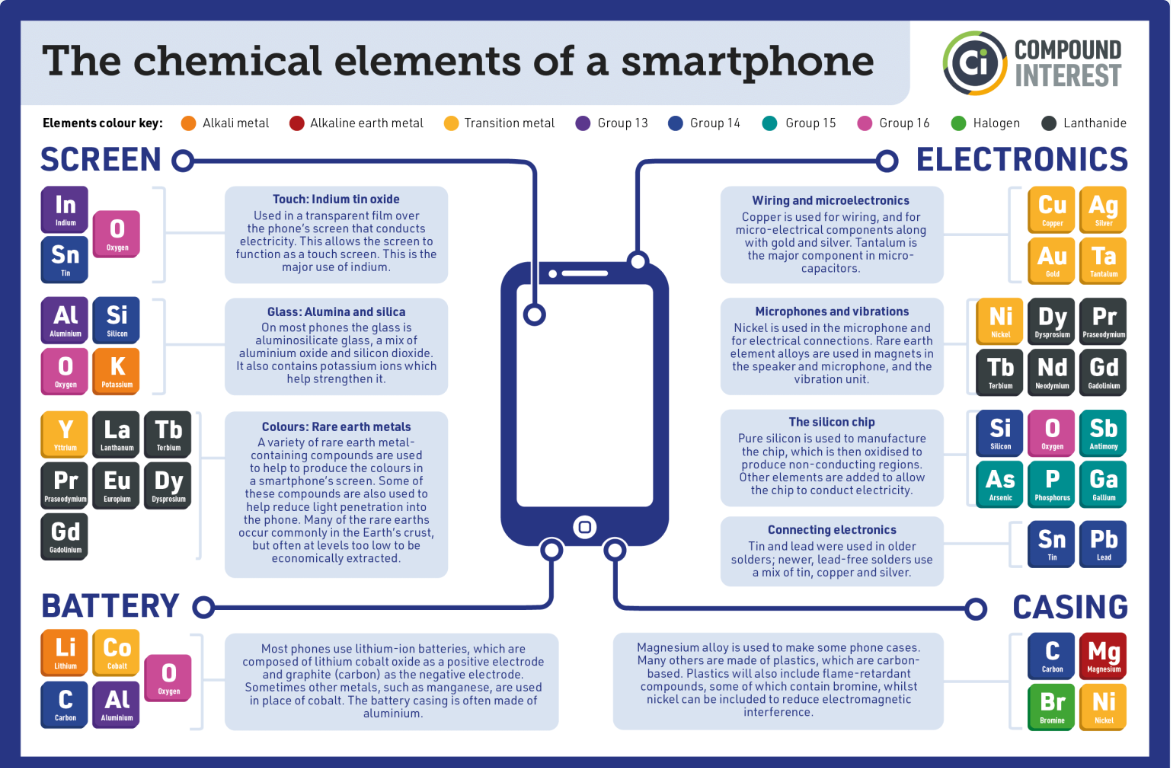
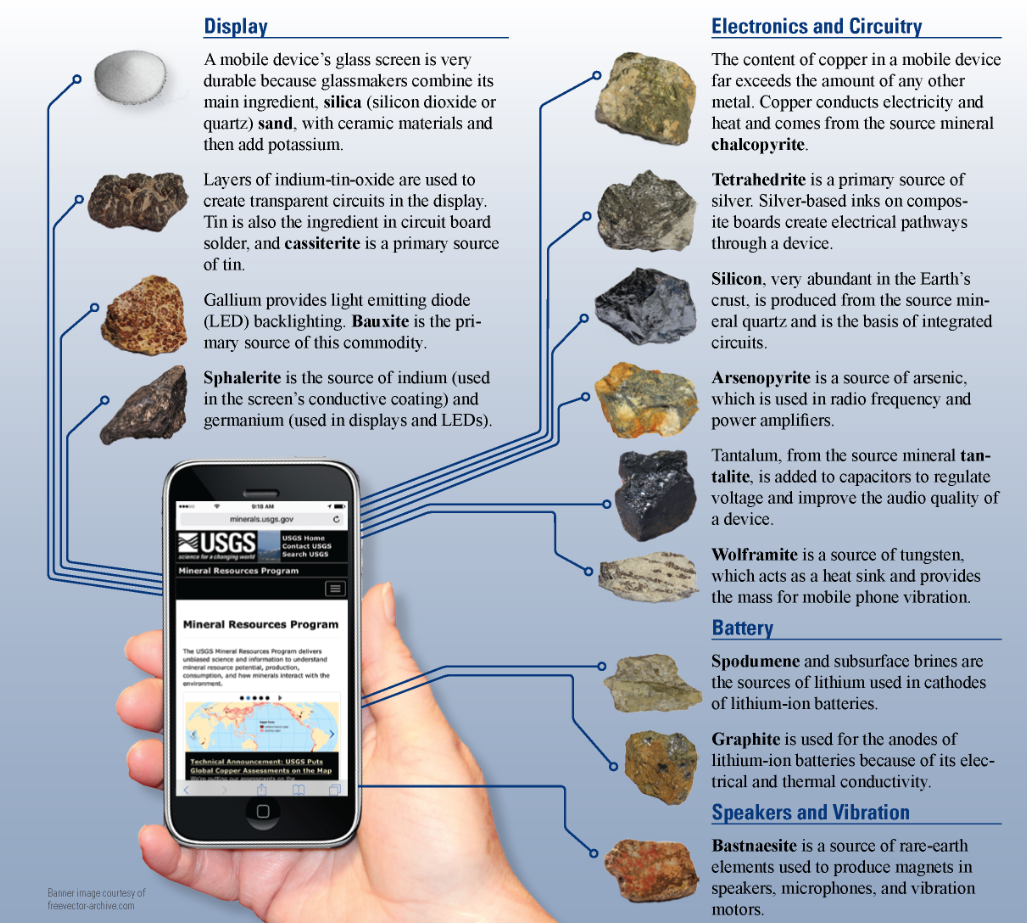
The modern smartphone is made from many different chemical elements, some much more scarce than others. The elements found in a smartphone are distributed around the world, with some countries being more favored by geology than others. With perhaps the exception of silica and silicon, the elements below are found in localized ore bodies that are enriched in particular elements in the form of minerals. ‘Enriched’ is a relative term meaning anywhere between a few 10s of percent to 100 parts per million or less. The word ‘enriched’ also implies another attribute wherein the extraction of the desired element is economically feasible. With the exception of carbon listed below, most of the elements are metals or metalloids. Metalloids are elements that are not entirely metallic but not entirely non-metallic either. Many are found in the p-block of the periodic table.

Source minerals for smartphone manufacture. This public domain image is provided by the USGS.

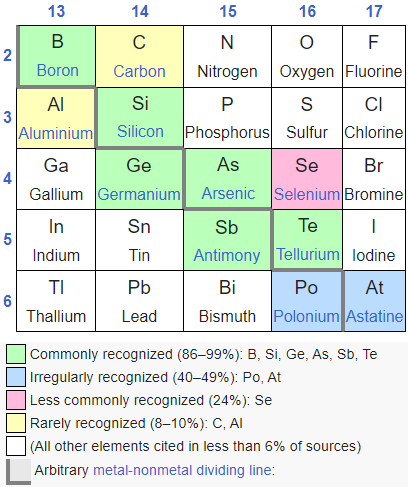
This intermediate chemical nature of the elements we call metalloids may seem a bit dodgy and imprecise, but the term metalloid, while not precisely defined, is thriving out in the big, big world. The metalloids are found in the p-block of the periodic table. Below is a partial chart of p-block elements. Elements polonium and astatine are too rare and too radioactive to be of any practical relevance. It seems as though there is some disagreement as to which elements should be in the set of metalloids.

Source: Wikipedia. The green boxes are the metalloids. They may have some limited ability to conduct electricity or heat, but little of the classic properties of metals like luster, malleability or ductility. The bottom part of the graphic shows that there is some disagreement as to which elements are properly defined as metalloids.

Here is the deal with metalloids. While they may not be used for their physical properties as other metals like in bridge or shipbuilding, their electronic properties provide valuable utility to civilization. By ‘electronic’ I specifically refer to the valence level electrons around the atoms and how they interact.

Source: http://www.compoundchem.com. Copyright/ Andy Brunning 2023 | Creative Commons Attribution-Noncommercial-NoDerivatives License.

The black element boxes above represent the Rare Earth Elements (REE) and includes the whole 15 element lanthanide series plus scandium (Sc) and yttrium (Y). Note that Sc and Y are in the same column as lanthanum which is the beginning of the lanthanide series. Generally, elements in the same column share certain chemical properties like in this case the +3 oxidation state, so this is why Sc and Y are considered by some to be in the REE group. The truth is that REE is a woefully antiquated term that just won’t disappear.

The “rare” in the name “rare earths” has more to do with the difficulty of separating of the individual elements than the scarcity of any of them.” [Wikipedia]

..,. these elements are neither rare in abundance nor “earths” (an obsolete term for water-insoluble strongly basic oxides of electropositive metals incapable of being smelted into metal using late 18th century technology.” [Wikipedia]

All REEs share the +3 oxidation state, but some of them can have other oxidation states as well. Samarium, europium, thulium and ytterbium can be in the +2 and +3 oxidation states. Cerium, praseodymium, neodymium, terbium and dysprosium all have the +3 and +4 oxidation states. The dissimilarities do not end there. Of the lanthanides, the bookend elements lanthanum and lutetium are often not counted as REEs. The reason is that lanthanum has zero f-block electrons and lutetium has a stable, full f-block of 14 electrons, so neither participates in much f-block chemistry. Lanthanum, [Xe] 5d1 6s2, and lutetium, [Xe] 4f14 5d1 6s2, may be better considered as d-block transition metals.

The lowest energy arrangement in which electrons naturally organize themselves under ‘ordinary’ conditions around an atom, molecule or ion is called the ‘ground state’. In the ground state all electrons occupy the lowest energy and oddly shaped regions of space called orbitals, with a maximum of two electrons per orbital. Orbitals are places, not things. There is plenty of information on this quantum chemistry business on the interwebs.

A walk on the wild side

Source: Pinterest. This is a spherical harmonic series of wave functions (orbitals) defining the space that electrons can occupy when in orbit around an atomic nucleus. Each can be occupied by two electrons, but with opposite spins- ‘spin up’ and ‘spin down’.

In the image of atomic orbitals above, each orbital can ‘contain’ one or two electrons. Rather than say ‘contain’, let’s say that the orbitals describe the region of space where the one or two electrons have some probability of being found, depending on their energy. The greater the chance of finding an electron in a particular space, the greater it’s probability density. Note that the orbitals have fuzzy edges. This is because the probability density doesn’t drop abruptly to zero at the edges but rather tapers off. The Uncertainty Principle tells us that it isn’t possible to know both the momentum and the position of a particle simultaneously to high level of accuracy. It turns out that quantum mechanics can’t tell us where an orbital electron is from moment to moment. What it can do is to provide a coherent set of rules for the manner in which electrons are ‘stacked’ in the orbitals as the orbital energy changes.

Alright, we’re back

Scandium and yttrium are d-block transition metals but are sometimes lumped in with REEs because they share the Group IIIB column with lanthanum. The elements cerium through ytterbium do participate in the chemistry of f-block electrons and when REEs are spoken of, there is a good chance that the elements Ce thru Yb are the topic. Is the terminology really as higgledy-piggledy as it appears? Ah, yep.

All of the materials found in electronic devices are there as a result of performance optimization by the manufacturer’s R&D. Many elements are quite expensive, such as indium. The performance uptick from expensive elements must translate into increasing EBITDA. C-suite careers live and die by quarterly and annual EBITDA. Increased performance can be in many forms like longer battery life or increased electronic performance in a chip. Chips require electrical conductors, semiconductors and non-conductors. This is the realm of material science which overlaps with chemistry.

Some of the material science challenges facing smartphone makers might seem a bit arcane. For example, when putting down a layer of material on a chip, will the substrate be wetted by the new layer so that the surfaces contact as desired? An engineering solution may require that a compatibility layer be put down first. Or do the materials have the desired dielectric constants? If you want capacitance in the device, a dielectric layer that is easy and cheap will be required. If you are doing vapor deposition, then the low dielectric material must come from the vapor phase at elevated temperatures. Can it withstand the temperature? Do your semiconductor devices have the desired band gap? What elements affect this? What kind of chemical purity is needed for your CVD or ALD process? Four, five, six or seven nines purity (99.99 % to 99.99999 %)? The more nines of purity specified the more expensive the material and the fewer suppliers there may be.

Companies search all over the periodic table for substances that boost performance and keep Moore’s Law going. All of this must be done in a field full of patent land mines that you don’t want to step on. Invention can lead to big trouble for the unwary.

Lamentations on Science Infotainment Rev 2.

Note: This post appeared May 15, 2007, as “Infotainment, Chemistry, and Apostasy“. I have pulled it up through the mists of time for another go and with a few edits.

In the normal course of things I used to give school chemistry talks or demonstrations a couple of times per year and until recently, I had been giving star talks at a local observatory more frequently.  The demographic is typically K-12, with most of the audience being grades 3-8.  From my grad student days through my time in the saddle as a prof, I was deeply committed to spreading the gospel of orbitals, electronegativity, and the periodic table. I was convinced that it was important for everyone to have an appreciation of the chemical sciences.  I was a purist who knew in his bones that if only more people were “scientific”, if greater numbers of citizens had a more mechanistic understanding of the intermeshing great world systems, the world could somehow be a better place. 

In regard to this ideology that everyone should know something about chemistry, I now fear that I am apostate.  I’m a former believer.  What has changed is an updated viewpoint based on experience.  

Let me make clear what science is not. It is not a massive ivory tower that is jealously guarded ajd intended to be impenetrable by mortal folk. Big science requires big funding and organizational support, so big administrative structure forms around it. At its core, science is concerned with learning how the universe works by observation, constructing a good first guess (theory) on what is happening, measurement (conducting quantitative experiments), analysis (quantitative thinking), documentation and communication. The common understanding is that a scientist is someone who has been educated and employed to do these activities. However, anyone who conducts a study of how some phenomenon happens is doing science whether for pay or not.

What science has learned is that the universe is quite mechanistic in how it works. So much so that it can be described by or represented with math. At the fundamental level of ions, atoms and molecules, constraints exist on how systems can interact and how energy is transferred around. At the nanometer-scale, quantum mechanical theory has provided structure to the submicroscopic universe.

Chemical knowledge is highly “vertical” in its structure.  Students take foundational coursework as a prerequisite for higher level classes.  Many of the deeper insights require a good bit of background, so we start at the conceptual trailhead and work our way into the forest. But in our effort to reach out to the public, or in our effort to protect a student’s self-esteem, we compress the vertical structure into a kind of conceptual pancake.  True learning, the kind that changes your approach to life, requires Struggle.

What I found in my public outreach talks on science- chemistry or astronomy- was the public’s expectation of entertainment. Some call it “Infotainment”.  I am all in favor of presentations that are compelling, entertaining, and informative.  But in our haste to avoid boredom, we may oversimplify or skip fascinating phenomena altogether. After all, we want people to walk out the door afterwards wanting more. We want science to be accessible to everyone, but without all the study.

But I would argue that this is the wrong approach to science.  Yes, we want to answer questions.  But the better trick is to pose good questions.  The best questions lead to the best answers. People (or students) should walk out the door afterwards scratching their heads with more questions.  Science properly introduced, should cause people to start their own journey of discovery. Ideally, we want to jump-start students to follow their curiosity and integrate concepts into their thinking, not just compile a larger collection of fun facts. 

But here is the rub. A lot of folks just aren’t very curious, generally.  As they sit there in the audience, the presentation washes over them like some episode of “Friends”.  I suspect that a lack of interest in science is often just part of a larger lack of interest in novelty.  It is the lack of willingness to struggle with difficult concepts.  But that is OK.  Not everyone has to be interested in science.

Am I against public outreach efforts in science?  Absolutely not.  But the expectation that everyone will respond positively to the wonders of the universe is faulty.  It is an unrealistic expectation on the 80 % [a guess] of other students who have no interest in it. I’m always anxious to help those who are interested.  It’s critical that students interested in science find a mentor or access to opportunity.  But, please God, spare me from that bus load of 7th graders on a field trip. 

What we need more than flashier PowerPoint presentations or a more compelling software experience is lab experience.  Students need the opportunity to use their hands beyond mere tapping on keyboards- they need to fabricate or synthesize. You know, build or measure stuff. 

It is getting more difficult for kids to go into the garage and build things or tear things apart.  Electronic devices across the board are increasingly single component microelectronics.  It is ever harder to tear apart some kind of widget and figure out how it works.  When you manage to crack open the case what you find is some kind of green circuit board festooned with tiny components. 

And speaking of electronics or electricity, I find it odd that in a time when electric devices have long been everywhere in our lives, that so FEW people know even the first thing about electricity. I instruct an electrostatic safety class in industry and have discovered that so very, very few people have been exposed to the basics of electricity by graduation. I spend most of the course time covering elementary electrostatic concepts along with the fire triangle so the adult learners can hopefully recognize novel situations where static electric discharge can be expected. Of course, we engineer away electrostatic discharge hazards to the greatest extent possible. But if there is a hole, somebody will step in it. It’s best they recognize it before stepping into it.

The widespread educational emphasis on information technology rather than mechanical skills ignores the fact that most learners still need to handle things. There is a big, big world beyond the screen. A person will take advantage of their mechanical skills throughout their life, not just at work. Hands on experience is invaluable, in this case with electricity. Computer skills can almost always be acquired quickly. But understanding mechanical, electrical and chemical systems need hands-on experience.

Gasoline and Diesel Prices are Creeping Upwards

First, the word is out. According to the EIA, the US was the world’s leading oil producer for the 6th straight year in 2023 producing 12.6 million barrels per day.

It is common for people to blame rising US gasoline and diesel prices only on restrictions in crude oil production and alleged government regulatory overreach. Indeed, pressure on the gas and oil supply side or even just the threat of it can lea to unstable retail gasoline and diesel prices. What is less appreciated is the role of petroleum refineries on prices. To be sure, there is always price speculation on both the wholesale and retail sides of gas and diesel pricing to consider no matter the throughput. Like everywhere else, sellers in the petroleum value chain seek to charge as much as they possibly can 24/7/365. Everyone is itching to charge more but are hindered by competition and risk.

Refineries are only one of several bottlenecks in the gasoline and diesel supply chain that can influence retail prices. In principle, more gas and oil can always be produced at the wellhead by increased exploration or increased imports. Even so, there are constraints on transporting crude to refineries. Pipelines have flow rate limitations and storage tank farms and ocean tanker fleets all have finite capacity. Another bottleneck today is access to both the Suez and Panama canals. Suez Canal traffic is threatened by Houthi missile strikes on commercial shipping in the Red Sea and the Panama Canal seems to be drying up. The result is increased shipping costs and delays for international transport which the consumer will have to bear.

What do refineries do?

Refineries are very special places. Within the refinery there is 24/7 continuous flow of large volumes of highly flammable liquids and gases that are subjected to extreme temperatures and pressures for distillation, cracking, alkylates, hydrogenations and reformates. The whole refinery is designed, built and operated to produce the fastest and highest output of the most valuable group of products- fuels. This group would include gasoline, diesel, aviation fuel, and heating oil.

Petrochemicals account for approximately 17 % or refinery output. These petrochemical streams account for pharmaceutical raw materials, polymer products, coatings and films, synthetic fibers, personal hygiene products, synthetic rubber, lubricating grease and oils, paint, cleaning products and more. Regardless of what we may think of plastics and other synthetic materials, the 17 % produced by refineries feeds a very large fraction of the global economy. If plastic bags went away overnight, the whole world would begin to search immediately for alternatives like wood, metal or cotton/wool/flax/hemp.

Occasionally technological challenges confront refineries. An early challenge was the production of high octane anti-knock gasoline. This was investigated thoroughly as early as the 1920’s as the demand for more powerful automotive and aircraft engines was rising. Luckily for the USA, UK, and Germany, the anti-knock problem was solved just prior to WWII. This breakthrough led to aircraft engines with substantially increased power per pound of engine weight.

Leaded Gas

The petroleum that goes into gasoline is naturally rich in a broad range of straight chain hydrocarbon molecules. Straight chain hydrocarbons were used in the early days of happy motoring, but the engine power remained low. While these straight chain hydrocarbons have valuable heat content for combustion, the problem with these molecules is that in a piston engine, they cannot withstand the pressures in the compression stroke that would give greater power. To get maximum power from a gasoline engine, it is desirable to have the piston move up and down as far as possible for maximum power delivery to the crankshaft. However, a long stroke length means greater compression and higher pressure near the top of the compression stroke. Straight chain hydrocarbons could not withstand the higher pressures coming from the compression stroke and would detonate prior to reaching top of the cycle. This effect results in knocking or destructive pre-detonation with power loss.

Tetraethyllead was invented in 1921 by Thomas Midgley, Jr, working at General Motors. After some deadly and dissatisfying work by DuPont, General Motors and Standard Oil Company of New Jersey started the Ethyl Gasoline Corporation in 1924, later called Ethyl Corporation, and began to produce and market tetraethyllead. Within months of startup, the new company was faced with cases of lead poisoning, hallucinations, insanity and fatalities.

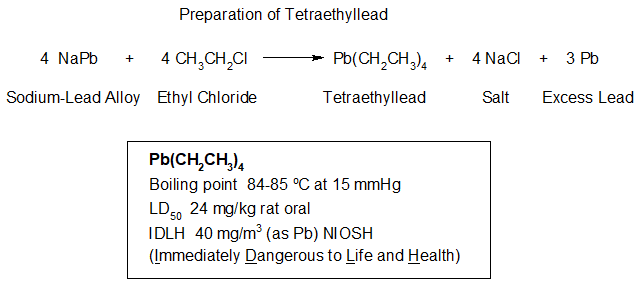
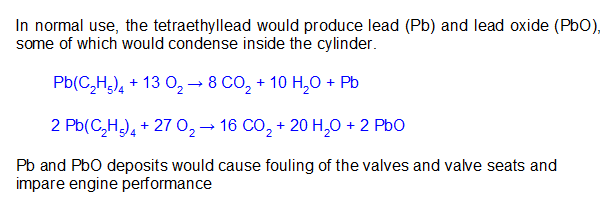
The first commercially successful fuel treatment to prevent this pre-detonation was tetraethyllead, (C2H5)4Pb, produced by Ethyl. This is the lead in “leaded” gasoline. The use of (C2H5)4Pb began before WWII and just in time to allow high compression aircraft engines to be built for the war. It allowed for higher powered aircraft engines and higher speeds for the allies which were applied successfully to aerial warfare. The downside of (C2H5)4Pb was the lead pollution it caused. Tetraethyllead is comprised of two chemical features- lead and 4 tetrahedrally arranged ethyl hydrocarbon groups. The purpose of the 4 ethyl groups (C2H5) on (C2H5)4Pb was their ability to give hydrocarbon solubility to a lead atom. It was the lead that was the active feature of (C2H5)4Pb that brought the octane boosting property. At relatively low temperature the ethyl groups would cleave from the lead leaving behind a lead radical, Pb., which would quench the combustion process just enough to allow the compression cycle to complete and the spark plug to ignite the mixture as desired.

Data from Wikipedia.

While tetraethyllead was especially toxic to children, it was also quite hazardous to (C2H5)4Pb production workers. Its replacement was only a matter of time.

Data from Wikipedia.

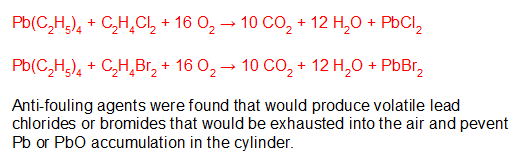
Fuel additives were found that would reduce engine fouling by scavenging the lead as PbCl2 or PbBr2 which would follow the exhaust out of the cylinder. While this was an engineering success, it released volatile lead products into the atmosphere.

Data from Wikipedia.

Eventually it was found that branched hydrocarbons could effectively inhibit engine knock or pre-detonation and could replace (C2H5)4Pb … which it did. While lead additives have been banned for some time from automotive use, general aviation has been allowed to continue with leaded aviation gas (avgas) in light piston engine aircraft like 100 octane low lead (100LL). Only recently has leaded avgas become a matter of public concern.

A refinery not only engineers the production of fuel components, it must also formulate blends for their customers, the gas stations, to sell. The formulations will vary with the season and the location. Some gasolines have ethanol, other oxygenates like MTBE, octane boosters, detergents and more. One parameter is the volatility of the fuel. When injected into the cylinder, it must evaporate at some optimum rate for best fuel efficiency. This will depend on the vapor pressures of the components.

Back to Refineries

The production volumes of the individual fuel products will not match the contents of the crude oil input. Gasoline is the most valuable product, but more gasoline leaves the refinery than arrives in the crude. Any given grade of gasoline has many, many components and the bulk of them have somewhere around 8 carbon atoms in the hydrocarbon chain. Wouldn’t it be nice if longer hydrocarbon chains could be broken into smaller chains to be added into the gasoline mix? And guess what, that is done by a process called “cracking”. A piece of equipment called a “cat cracker” uses a solid ceramic catalyst through which hot hydrocarbon gases pass and get cut into smaller fragments.

But what about straight chain hydrocarbon molecules? Wouldn’t it be nice to “reform” them into better and higher octane automotive fuels? There is a process that uses a “reformer” to rearrange hydrocarbon fuels to give better performance. The products from this process are called reformates.

Reforming is a process that produces branched, higher-octane hydrocarbons for inclusion in gasoline product. Happily, it turns out that gasoline with branched hydrocarbons are able to resist pre-detonation and have come to replace tetraethyllead in automotive fuels entirely. Today we still refer to this lead free gasoline product as “unleaded”.

Octane and Cetane Ratings

Octane rating is a measure of resistance to pre-detonation and is determined quantitatively by a single-cylinder variable compression ratio test engine. Several octane rating systems are in use. RON, the Research Octane Number, is based on the comparison of a test fuel with a blend of standard hydrocarbons. The MON system, Motor Octane Number, covers a broader range of conditions than the RON method. It uses preheated fuel, variable ignition timing and higher engine rpm than RON.

Some gasoline is rated in the (R + M)/2 method which is the just average of the RON and MON values.

In both the RON and MON systems, the straight chain hydrocarbon standards are n-heptane which is given an octane rating of 0 and the branched hydrocarbon 2,2,4-trimethylpentane, or isooctane, which is given an octane rating of 100.

Tetraethyllead and branched hydrocarbons are octane boosters. Methyl tert-Butyl Ether (MTBE), ethyl tert-butyl ether, and aromatics like toluene are also used to boost octane values. Internal combustion engines are built to use a gasoline with a minimum octane rating for efficient operation. A rating of 85 or 87 are often the octane ratings of common “unleaded” gasoline. Higher compression ratio engines require higher octane fuel- premium grade -to avoid knocking.

For comparison, diesel has a RON rating of 15-25 octane so it is entirely unsuitable for gasoline engines. Diesel has its own system called the Cetane rating. The Cetane Number is an indicator of the combustion speed of the diesel and the compression needed for ignition. Diesel engines use compression for ignition unlike gasoline engines which use a spark. Cetane is n-hexadecane which is a 16-carbon straight chain with no branching. Cetane is given a Cetane Number (CN) of 100. Similar to the Octane rating, the branched 16-carbon hydrocarbon heptamethylnonane, or isocetane, is given a CN of 15. Included in the Cetane number.

Refineries must keep close tabs on seasonal demand for their various cetane and octane-rated products as well as the composition of the crude oil inputs which can vary. Each gasoline product stream has performance specifications for each grade. While gasoline is a refined product free from water, most sulfur and solid contaminants, it is not chemically pure. It is a product that contains a large variety of individual hydrocarbon components varying by chain length, branching, linear vs cyclic, saturated vs unsaturated members that together afford the desired properties.

Specific Energy Content

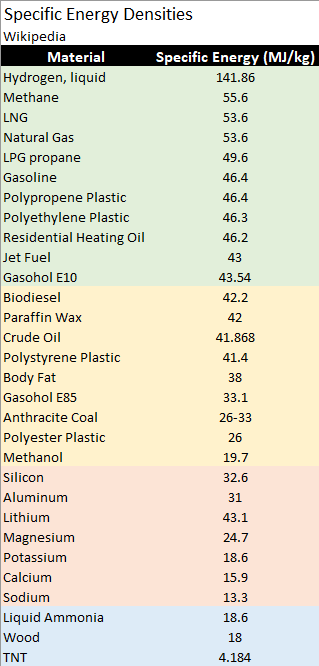
Absent ethanol, the combustion energy values of the various hydrocarbon grades are so similar as to be negligeable. The energy content of pure ethanol is about 33 % lower than gasoline. Any energy differences would be due to subtle differences in blending to achieve the desired octane rating or proprietary additives like detergents. A vehicle designed to run on 85 octane will not receive a significant boost in power with 95 octane unless it is designed to operate on higher octane fuel.

Source: Wikipedia

From the Table above and looking at the polypropylene (PP) and polyethylene (PE) entries then comparing to gasoline, we see that the specific energies are the same. The two polymers and gasoline are saturated, hydrocarbons so it is no wonder they have the same specific energies. Polystyrene is a bit lower in specific energy because the hydrogen content is lower, reducing the amount of exothermic H2O formation as it burns. The point is that by throwing away millions of tons of PP or PE every year, we are throwing away a whopping amount of potential fuel for combustion and electrical energy generation.

Petroleum based liquid fuels burn readily because of their high vapor pressure and low flash points. Polyolefins like PP and PE by contrast have virtually no vapor pressure at room temperature and consequently are difficult to ignite. In order to burn, polyolefins need to be thermally cracked to small volatile fragments in order to provide enough combustible vapor for sustained combustion. Plastic fires tend to have an awful smell and dark smoke because the flame does a poor job of energizing further decomposition to vapor.

Going from E10 to E85, the specific energy density drops considerably from 43.54 to 33.1 MegaJoules per kilogram (MJ/kg). Replacing a significant quantity of gasoline with the already partially oxidized ethanol lowers the potential energy. In the tan colored section, we can see the elements silicon to sodium. These elements are either very oxophilic or electropositive and release considerable heat when oxidizing. Some metals amount to a very compact source of readily oxidizable electrons.

Refinery Troubles

According to the US Energy Information Agency (EIA) US refinery output in the first quarter of 2024 has dropped overall by 11 % and has fallen as low as 81 % utilization. Decreasing inventories are causing rising retail prices. Still, average gasoline and diesel prices are currently below the same time period in 2023.

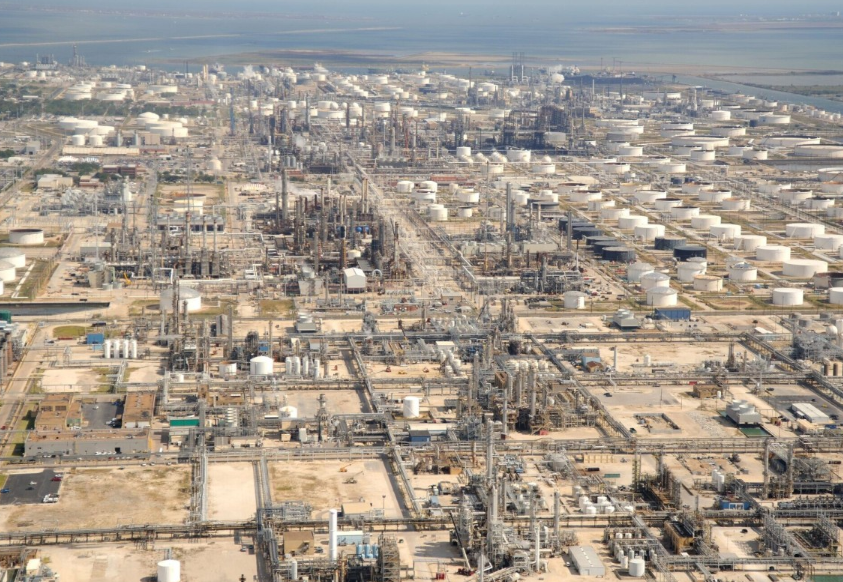
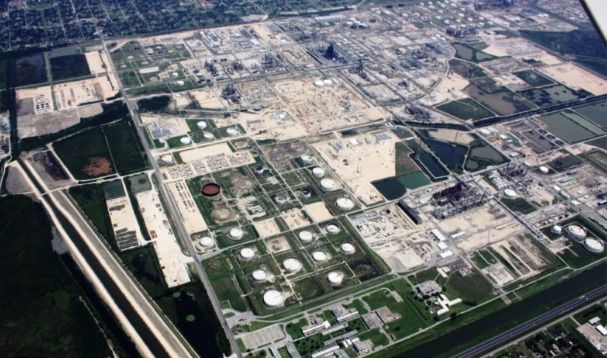
According to EIA, the US Gulf Coast has seen the largest 4-week average drop in refinery utilization at 14 % since January, 2024. This is attributed in part to the early start of maintenance shutdowns of Motiva Port Arthur and Marathon Galveston Bay refineries which account for 7 % of US capacity.

Galveston Marathon Refinery. Source: Google Images.
Motiva, Port Arthur, TX. Source: Google images.

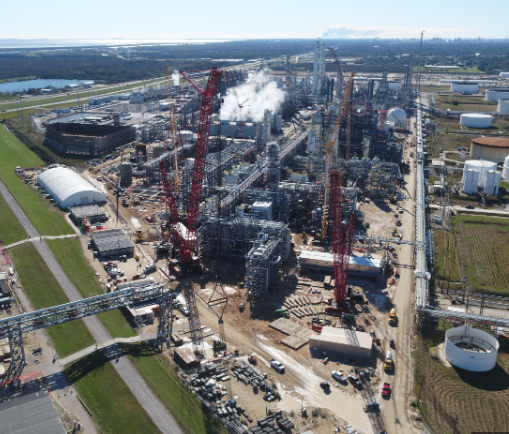
Weather has factored-in this year as refinery production was halted in several locations in the US. A severe winter storm shut down the TotalEnergies’ 238,000 barrel-per-day refinery in Port Arthur, Texas.

TotalEnergies, Port Arthur, TX.

Oil production in North Dakota fell to half. Oil production was estimated to have fallen between 600,000 and 650,000 barrels per day.

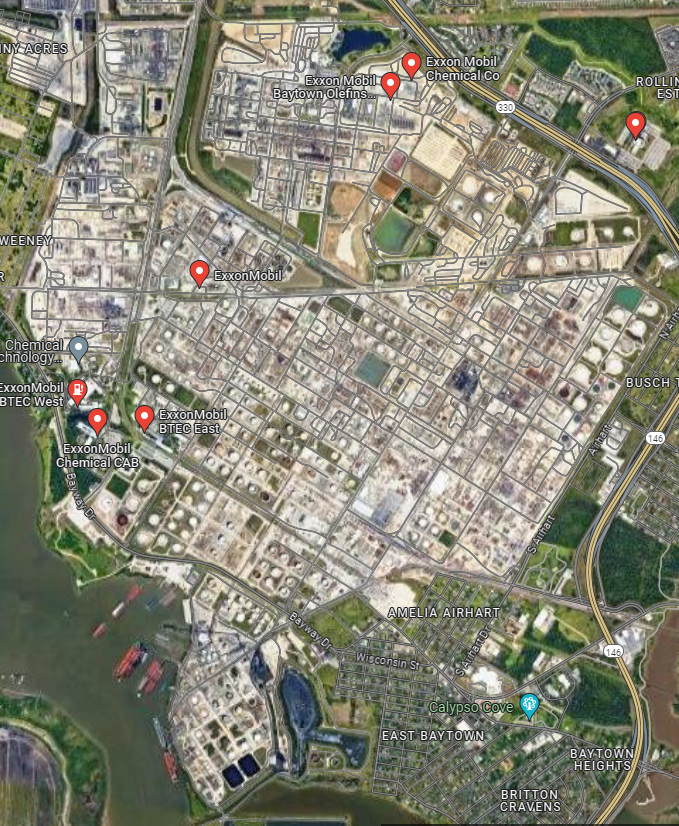
Exxon Mobil Corp returned a fluidic catalytic cracker and a coker to normal operation at its 564,440 barrel per day refinery in Baytown, Texas.

ExxonMobil Corp, Baytown, TX. Source: Google Maps.

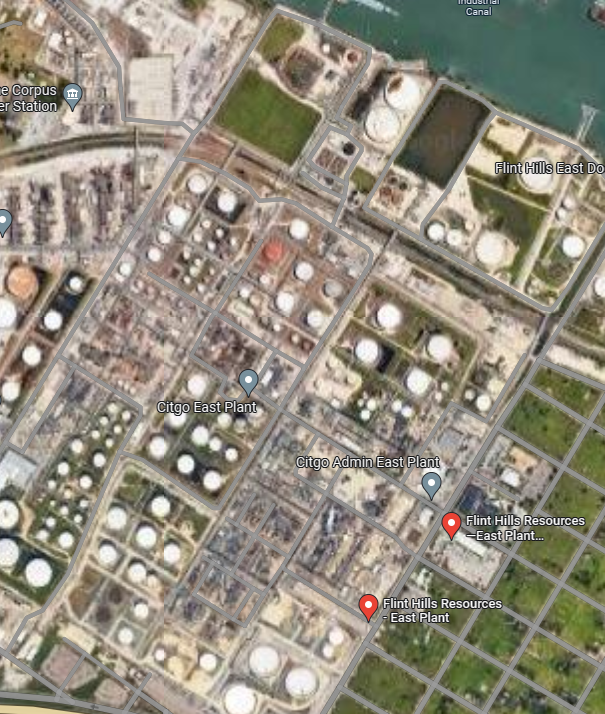
A Flint Hills Resources 343,000 barrel per day refinery in Corpus Christi, Texas, was significantly impacted by unseasonably cold weather including freezing rain.

Flint Hills Resources, Corpus Christi, TX. Source: Google Maps.
Flint Hills Resources East Plant, Corpus Christi, TX. Source: Google Maps.

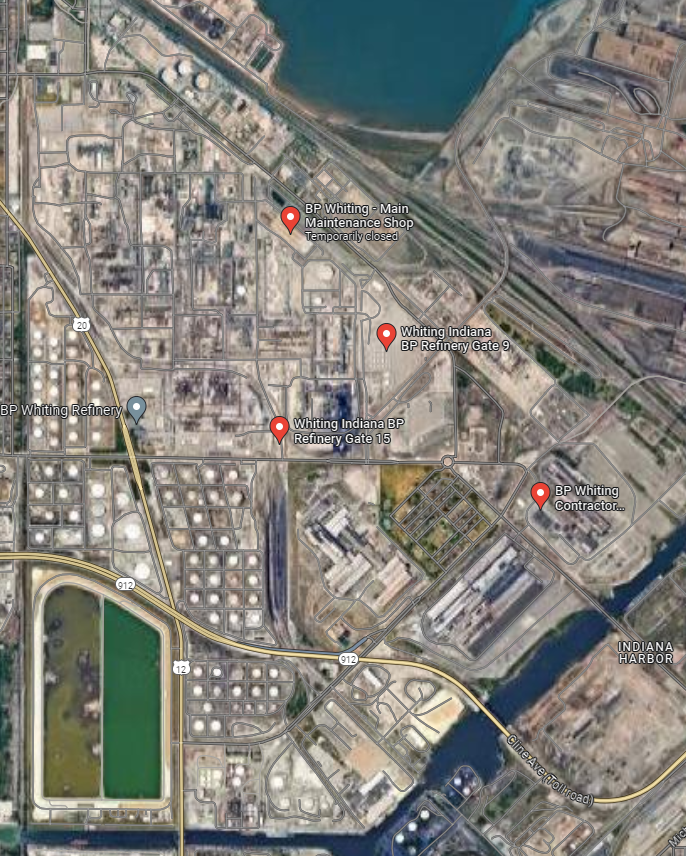
The largest refinery in the Midwest, BP’s 435,000 barrel per day refinery in Whiting, Indiana, was taken off-line by a power outage and forced a 10 % drop in refinery utilization in the Midwest the first week in January. Normally the Midwest region produces as much gasoline and diesel as it consumes. This rich local supply leads to somewhat lower prices in the region.

BP’s Whiting, IN, refinery along the southern shore of Lake Michigan, between Gary and South Chicago.

The Mother of Invention

There is an old saying that goes “necessity is the mother of invention.” Its meaning is obvious. It says that when you run into a problem, you can invent your way around it. Or at least try to. The other solution to a problem is simply to live with it.

I recall that during the Apollo project in the late 1960’s, many conservatives would complain about the cost of going to the moon. Social progressives likewise made a complaint that was directed at shifting those NASA funds to social programs here on earth. Technology progressives would retort that it is worth it because of all of the spin-offs that were appearing out of the effort. The reply to this was that if you wanted some shiny new widget, just invent it. You don’t have to go to the moon.

Presently I can look back at the two major research domains, academic and industrial, and make comparisons. In academia, a professor’s work product is split between research, teaching and service to the school. Research is commonly measured by the number of papers published, especially in the prestigious journals. In some institutions, patenting is also taken into account. As for teaching, there are student evaluations and performance reviews by the department chair or the dean. This includes past performance in committees. A motivation in the first few years is to get tenure. Academic research includes putting research results in the public literature for all to use.

So, what about the mother of invention? Generally, in chemistry an invention comes from some kind of investigative activity, curiosity or need. Sometimes you may want to invent around an active patent rather than go into a licensing agreement.

The US patent office allows only one invention per application. If you choose, you can lop off your other invention and file it separately as a divisional patent. You would do this because the patent examiner will have raised an objection to your original filing. Doing a divisional filing allows you to use content from the first, or parent, patent application and you get the filing date of the parent as well. Early filing dates are very important.

Sometimes patents are written very narrowly and leave “white space” or potential claims around them. This is not always desirable so the matter can be solved by the use of “picket fence patents.” You patent your core art as broadly as the patent office will allow, then you file for patents that cover related art that a competitor could conceivably patent that would allow them to compete against you. By raising the cost of entry into your market or narrowing the scope of new art, you can dissuade competitors from entry or at least make them pay a heavy price for it. Who knows, maybe they’ll decide to buy a license from you or even an entire patent. An argument against picket fence patenting is that patents can be very expensive.

Academic research has a high reliance on external funding. This requires that the funding organization recognizes the novelty and p[otential intellectual value of the research proposal. Industrial research has a high reliance on market potential of an invention. What is the breakeven time and sales potential of the invention? Will demand last long enough for the invention to provide a healthy return on investment?

Academics can and do patent their work on occasion, especially if the university pays for it. The thing I object to is that a great deal of research is paid for by the taxpayers. We pay for the research and then it gets patented and its use is restricted for 20 years. Maybe taxpayers (businesses) can enter into a licensing agreement, but maybe someone else has bought exclusive rights. Licenses can be somewhere between reasonable to absurdly restrictive, depending on the terms of the agreement. Many will want to add an extra fee based on the sales income of the product. This means that there will be an annual audit with pencil neck auditors poking around your business. It’s like having a ferret in your shorts. Avoid if at all possible.

But, many companies leverage their output through licensing agreements of technology they have no interest in developing.

Industrial research is quite different in terms of administration of the endeavor. Industrial chemists are supervised by an R&D director and use in-house technology and science and/or what they learned in college, but here the results are aimed at producing something for sale or improving the profit margin of a process. There is no desire to share information. Industrial research produces in-house expertise as well as, hopefully, patentable inventions. Industrial invention can be driven by competition in existing markets or by expansion into something entirely new. Often it is to provide continuous margin growth if market expansion is slow.

The argument can be made to keep everything as a trade secret. Publishing your art in the patent literature can help competitors have their own brainstorms about the subject, or some may even be tempted to infringe on your art that is carefully laid out in front of their eyes. Competitors may be cued into a new product’s capabilities and gives insight into new products.

Both academic and industrial chemists invent. The difference is that in industry some inventions or art are held in trade secrecy, even if they never get commercialized. Academic researchers can and do keep secrets when they are aiming for a patent, at least until the patent is granted. Compartmentalization in a research group is critical, since disputes about inventorship can kill a patent. Once issued, academics will publish as many papers about the patented art as possible. Commonly, patents are assigned to whoever pays for it- usually an organization. An academic patent is assigned to the inventor’s institution while in industry the company is the assignee. In both cases the inventor is usually awarded only a token of appreciation and the “satisfaction” of having a patent.

So, what about “necessity is the mother of invention”? There are some inventive projects that are too large or risky for a business or even a consortium of businesses to handle. I’m thinking of the Apollo Moon Landing program. The project required the resources of a government. A great deal of invention by many players allowed the moon landing to happen. The necessity for all of this invention was that the US government set a goal and farmed out thousands of contracts with vendors to make it happen. Much wealth was spread around into the coffers of industry, but with contracts having stringent specifications for man-rated spaceflight and tight timelines to be met.

That’s one of the values of having a government like we had in the 1960’s. They created the necessity and private industry made it happen. Despite the cultural upset of the 1960’s and the Viet Nam war, the Apollo Project worked. No astronauts died in space. This necessity/invention pressure does work.

Dehumanization of the American Experiment

A few years ago I found myself wandering through the Denver Museum of Nature and Science where I happened upon a robotics exhibition. In terms of the museum arts and sciences it was well conceived and executed, complete with a topical gift shop in the exit. All of the displays were accessible to the public in terms of language or hands-on widgetry. At each hands-on exhibit there stood a determined 5 to 8 year old yanking the controls around in a frantic effort to steer the robotic device away from the wall of the test area while onlookers yawned, waiting their turn. A visitor might have concluded that the purpose of the robot was to become stuck against an obstacle- a task it performed well.

These kinds of future technology exhibits are always popular at the museum. The lead-up to the exhibit is given all of the ballyhoo that the museum could afford. The theme of the exhibit is supercharged with the promise of a brighter tomorrow through the use of snazzy technology. If automobiles can be tied in, so much the better.  It is a celebration of the triumph of technology for the everyman. The subtext was that only by the clever application of technology will we continue to improve our lives. These wonderful robots with their mechanical limbs and primate form would free humans from the dangers and tedium of the work-a-day world.

As I threaded my way through the exhibit I was struck by a sad realization. We’re celebrating the replacement of people with automation. The exhibit was a valentine to all of the entrepreneurs, engineers, investors and vendors who are trying their best to render obsolete much of the remaining workforce. This planned obsolescence has been going for many, many years.

Despite being against our own best interest, we patrons excitedly embrace these “futurama” style exhibitions, perhaps because secretly all of us believe that we will evade the job title of “obsolete”. Absent in the exhibit was a display on what the redundant workers would be doing with their involuntary free time. Fishing or golfing no doubt.

The top-level beneficiaries of robotics are the owners of the factories that make and use them. The driver is that robotics properly done may extend margin growth into the future. A way to overcome foreign competition is by reducing overhead, especially labor costs. Robotics and AI are economic bubbles in the same manner that computers and smart phones have been. The early adopters could enjoy a competitive advantage by the way they use their resources. Profits are unlikely to be channeled into hiring because, well, they’re profiting from the use of robotics. Once automation becomes normalized, there is no going back.

Insider business tip: Healthy companies match labor to the demand for product. More demand, more labor. Increased profits may go towards growth and acquisition, or it may go to the stockholders or to bonuses for management. But rarely if ever a price reduction to the public. If you are making a dandy profit and sales are strong, why hire or reduce prices?

The secondary level beneficiaries will be the consumer who will likely be oblivious to the fact that widget prices have not risen lately. Lower overhead does not automatically result in price savings for the end user. Extra margins will be absorbed by the manufacturer or seller. Just as likely, extra margins may be consumed by the manufacturer in wholesale price negotiations with retailers in the eternal battle for retail shelf space.

Many will offer that the history of man’s use of tools from the stone axe and wheel to AI driven automation is/was inevitable. The ascent of mankind is driven in part by our ability to use tools and develop a command of energy. It is difficult to think of a progressive industrial technology that did not result in the reduction of labor contribution to the overall cost of production. Nobody mourns the loss of the mule team and wagon, steam locomotives, or whale oil. We celebrate obsolescence and we take rapid progress for granted. Technological triumphalism is what we all celebrate.

But we should remind ourselves that there exists a substantial negative aspect of the story of technological progress. It is the very thing it enables: the reduction of labor hours per unit of production. The drive to raise profit margins is relentless, partly because the cost of doing business rises always rises and eats into margins.  Labor costs in particular are always front and center in the mind of business owners.

The situation today is different than when Henry Ford developed his form of mass production. Then there was a smaller population with a significantly larger fraction of people living on farms capable of growing their own food. Many common goods and services were in the hands of local business operators who produced locally and distributed locally. Restrictions on manufacturing and business operations were less onerous than today allowing for greater flexibility in methodology. It may be fair to say that mass production is now widespread and optimized to some degree as a whole. Early automation with just limit switches and relays has given way to microprocessor-controlled process machinery. What is happening presently is the introduction of artificial intelligence (AI). This is the natural progression of technology.

However, we can look a step or two ahead further and ask the question, when will an AI system take over the total management of a factory? When will an AI system have human subordinates? How tight of a leash would we allow an AI system to have on the management of people? The presence of slack in the organization no doubt makes many job descriptions tolerable. What if AI tightened all of the slack in business operations where every half second is accounted for? Would people consent to working for an AI? Companies like Amazon are getting close to this, but there is still human oversight. Extrapolating, it is easy to predict that one day, very quietly, human management will disappear at some level and in its place will be an AI system.

AI has to be taught. Will there be standards of behavior built-in governing how AI interacts with its human subordinates? Will everyone want their companies managed by an AI programmed to have a Jack Welch profile? My god, I hope not.

Another awful thought is the possibility of government and the military run by AI. Let that roll around in your mind for a bit.

There is a need to get back to basic principles here. What is our purpose in life? For most I think it is to love and be loved as well as to participate in some kind of rewarding activity. We all want to be useful and to leave behind some kind of legacy. There is no doubt that the replacement of human labor by AI-driven systems will continue to move forward, encroaching on all of our lives. Ultimately this is driven by a few people at the top who will reap the rewards to the greater concentration of wealth by a few trillionaires. Is concentrated control of limited resources a good thing? Is there any choice?

There is also a large fraction of the population that is not very progressive or forward looking at all. While they enjoy the devices and comforts of advanced technology, they neither understand or care about what is needed to develop a drug or design a new semiconductor chip. Behind our modern civilization is an educated and skilled workforce. However, the US is comprised of many people who are anti-intellectual by nature. This trait has been there all along and will into the future.

In some ways these people are disruptive to the progress and stability of the American experiment and, as of this writing, it isn’t at all clear how this will play out. The USA may well not be a stable enough environment in the future to sustain the continued, very expensive growth of technology. Technological advance requires highly educated workforce who can afford the training to get there. Just to stay even with what we already have, the pipeline of educated people needs to be full.

Forward looking people, the ones who want to sustain our advanced civilization, must step up and be counted or the thing will expire. For all of its problems, the US has nonetheless been a productive incubator of innovation and a great many positive aspects of advanced civilization in the form of a noisy, somewhat chaotic liberal democracy. The goose that laid the golden egg is still alive. Shouldn’t we keep it going?

For Students. Thoughts on Chemical Process Scale-Up.

Chemical process scale-up is a product development activity where a chemical or physical transformation is transferred from the laboratory to another location where larger equipment is used to run the operation at a larger scale. That is, the chemistry advances to bigger pots and pans, commonly of metal construction and with non-scientists running the process. A common sequence of development for a fine chemical batch operation in a suitably equipped organization might go as follows: Lab, kilo lab, pilot plant, production scale. This is an idealized sequence that depends on the product and value.

Scale-up is where an optimized and validated chemical experimental procedure is taken out of the hands of R&D chemists and placed in the care of people who may adapt it to the specialized needs of large scale processing. There the scale-up folks may scale it up unchanged or more likely apply numerous tweaks to increase the space yield (kg product per liter of reaction mass), minimize the process time, minimize side products, and assure that the process will produce product on spec the first time with a maximum profit margin.

The path to full-scale processing depends on management policy as well. A highly risk-averse organization may make many runs at modest scale to assure quality and yield. Other organizations may allow the jump from lab bench to 50, 200, or more gallons, depending on safety and economic risk.

Process scale-up outside of the pharmaceutical industry is not a very standardized activity that is seamlessly transferable from one organization to another. Unit operations like heating, distillation, filtration, etc., are substantially the same everywhere. What differs is administration of this activity and the details of construction. Organizations have unique training programs, SOP’s, work instructions, and configurations of the physical plant. Even dead common equipment like a jacketed reactor will be plumbed into the plant and supplied with unique process controls, safety systems and heating/cooling capacity. A key element of scale-up is adjusting the process conditions to fit the constraints of the production equipment. Another element is to run just a few batches at full scale rather than many smaller scale reactions. Generally it costs only slightly more in manpower to run one large batch than a smaller batch, but will give a smaller cost per kilogram.

Every organization has a unique collection of equipment, utilities, product and process history, permits, market presence, and most critically, people. An organization is limited in a significant way by the abilities and experiences of the staff who can use the process equipment in a safe and profitable manner. Rest assured that every chemist, every R&D group, and every plant manager will have a bag of tricks they will turn to first to tackle a problem. Particular reagents, reaction parameters, solvents, or handling and analytical techniques will find favor for any group of workers. Some are fine examples of professional practice and are usually protected under trade secrecy. Other techniques may reveal themselves to be anecdotal and unfounded in reality. “It’s the way we’ve always done it” is a confounding attitude that may take firm hold of an organization. Be wary of anecdotal information. Define metrics and collect data.

Chemical plants perform particular chemical transformations or handle certain materials as the result of a business decision. A multi-purpose plant will have an equipment list that includes pots and pans of a variety of functions and sizes and be of general utility. The narrower the product list, the narrower the need for diverse equipment. A plant dedicated to just one or a few products will have a bare minimum of the most cost effective equipment for the process.

Scale-up is a challenging and very interesting activity that chemistry students rarely hear about in college. And there is little reason they should. While there is usually room in graduation requirements with the ACS standardized chemistry curriculum, industrial expertise among chemistry faculty is rare. A student’s academic years in chemistry are about the fundamentals of the 5 domains of the chemical sciences: Physical, inorganic, organic, analytical, and biochemistry. A chemistry degree is a credential stating that the holder is broadly educated in the field and is hopefully qualified to hold an entry level position in an organization. A business minor would be a good thing.

The business of running reactions at a larger scale puts the chemist in contact with the engineering profession and with the chemical supply chain universe. Scale-up activity involves the execution of reaction chemistry in larger scale equipment, greater energy inputs/outputs, and the application of engineering expertise. Working with chemical engineers is a fascinating experience. Pay close attention to them.

Who do you call if you want 5 kg or 5 metric tons of a starting material? Companies will have supply chain managers who will search for the chemicals with the specifications you define. Scale-up chemists may be involved in sourcing to some extent. Foremost, raw material specifications must be nailed down. Helpful would be some idea of the sensitivity of a process to impurities in the raw material. You can’t just wave your hand and specify 99.9 % purity. Wouldn’t that be nice. There is such a thing as excess purity and you’ll pay a premium for it. For the best price you have to determine what is the lowest purity that is tolerable. If it is only solvent residue, that may be simpler. But if there are side products or other contaminants you must decide whether or not they will be carried along in your process. Once you pick a supplier, you may be stuck with them for a very long time.

Finally, remember that the most important reaction in all of chemistry is the one where you turn chemicals into money. That is always the imperative.

A bit of aerospace

On a recent vacation trip to the Puget Sound area I managed to take a public tour of the Boeing manufacturing facility in Everett, WA. They don’t give away the tour- it costs $25 for adults and lasts about 90 minutes. For cash you get a movie highlighting the history of Boeing and a trip to a few mezzanines overlooking the 787 Dreamliner and 747 manufacturing areas. And just like Disney, you exit the attraction tour through the gift shop.

The first thing you notice is that security is very stringent. No phones, bags or purses, etc., once the tour begins. They are an important military contractor after all. As technically savvy as they may be though, the communication level of the tour guide was roughly 6-7th grade. The reason might be the wide range of visitor ages and nationalities. One Asian visitor on our bus wore a blue track suit bearing the name “Mongolia”.

It is easy to forget just how brilliant the US is and has long been in the broader aerospace world. Of course, other countries have developed advanced aerospace platforms, and produced their share of talent too, notably France, England, Germany and Russia. But one must admit that considerable advancement has happened here for some reason. A broad industrial base with access to raw materials and capital is certainly a big part of it. Perhaps our remote location between two great oceans and historical absence of the distraction of carpet bombing by foreign adversaries has a little to do with it as well.

Balloon on a hazy day.

For many of us, aerospace brings out excitement and optimism by its very nature. It embodies much of the best in people. The pillars of aerospace are many and rely strongly on ingenuity and engineering disciplines. By discipline I mean rigorous design-then-test cycles. A human-rated flying machine is a difficult and expensive build if the goal is for people and equipment to return intact.  Unlike SpaceX who has launched much cargo, and among other things, a cheese wheel and a car, NASA has been launching people for a long time. Not to diminish the fine work of SpaceX or the other commercial efforts, it’s just that NASA takes a lot of heat for their deliberate pace.

Erie Airport, Colorado, from a hot air balloon at ca 2000′.

The last week has been a period of many modes of transportation. It’s been planes, trains, automobiles, ferry boats, and a hot air balloon. The nightmare of Seattle traffic is best forgotten. If you can avoid driving in Seattle during rush hours, do so.

If you can swing a hot air balloon ride, do it. Dig up some of that cash you have buried in the back yard and spend it. I found the ride to be absent any nerve wracking moments and to be quite a serene experience. There is no wind aloft and it is dead silent when the burners aren’t going. Do bring a hat, however. The burners are bloody hot.

Getting ready for a 4-balloon launch.

Like all pilots, balloonists enjoy low level flight.

The burners emit tremendous radiant heat. A wise passenger wears a hat for this reason.