Category Archives: Travel

Plum-bummin’ in Leadville

After an insane week in the lab a road trip to the cool meadows of the nearby mountain range was just what the doctor called for. It was the last weekend before the family- one teacher and one kid-  return to school. Summer break 2009 is history.

We piled in the car and pointed it uphill towards Leadville, Colorado. The planetary atmosphere thinly blankets this insanely high mountain city. It was just what I needed to clear my scrambled mind. Nothing like blinding sunshine and mild oxygen starvation to reset a brain in chronic spasm from sensory overload.

Leadville sits at 10,152 feet above sea level.  If you doubt the effect on your stamina, just take a short sprint in any direction. Or just plod up the stairs of your hotel. Lordy.  All of those business dinners- all that lovely Cabernet and creme brulee- and years of driving a desk have caught up with me.

Leadville is located in the Colorado mineral belt and began to populate with fortune seakers about the time of the Colorado gold rush in 1859. Some placer gold was found in the streams, particularly in what was then called California Gulch, but for the most part Leadville became a silver camp.

In 1874, two investors with metallurgical training, Alvinius B. Woods and William H. Stevens arrived in Leadville and analyzed the muds found in the local sluicing operations. According to A Companion to the American West, edited by William Francis Deverell, (2004, Blackwell Publishing, ISBN 0-631-21357-0, p. 319)  Woods and Stevens found the heavy black mud so problematic for gold sluicing was in fact composed of lead carbonate with high levels of silver.  Woods and Stevens invested $50,000, quietly buying as many claims as they could and began hydraulic mining operations immediately.

By 1890 there were nearly 90 mines in operation employing 6000 miners. At its peak there were 14 smelter operations supporting the mines. Leadville was a genuine boom town with the expected mix of characters.

A mine is a hole in the ground with a liar standing at the top.

All mining towns have characters who go on to dominate local legends and stories. Among the well-known-for-being-famous rags to riches to rags players in Leadville are Horace and Agusta Tabor, along with Horace’s mistress and 2nd wife, Elizabeth “Baby Doe”.

To make a long story short, Horace was a struggling shop keeper who invested in a mine east of Leadville. Though it was salted by the previous owner to entice buyers, Tabor dug 25 ft further down the shaft and struck a rich and extensive vein of silver ore.  The operation was called the Matchless Mine, after Tabor’s favorite brand of chewing tobacco.

According to the tour operators, Tabor operated the Matchless Mine 24/7 for 13 years, pulling an average of $2000/day of silver out of it. At its peak, the mine is said to have employed 100 people. Miners were paid the common rate of $3.00 per day to climb 365 ft to the bottom of the shaft for 12 hour shifts.
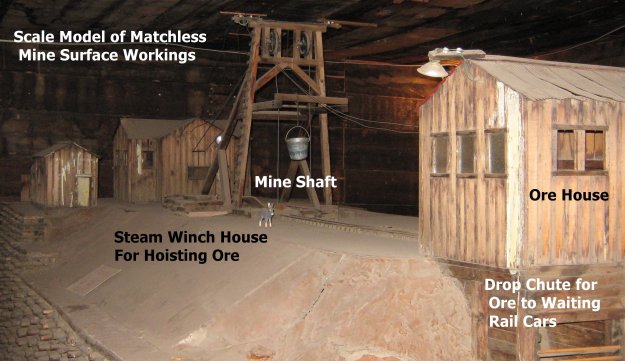
Matchless Mine Surface Workings
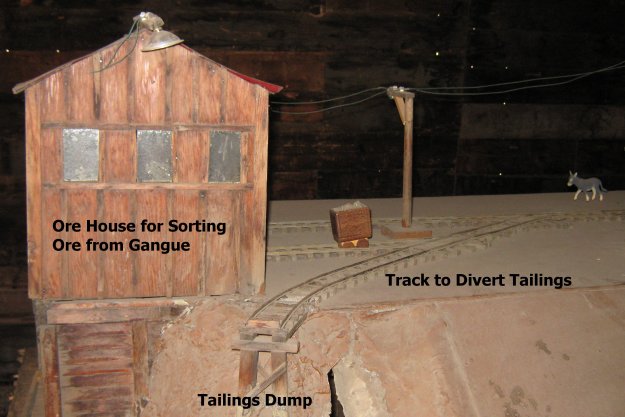
Matchless Mine Surface Workings

Gangue Dump Detail

Tailings Dump Detail

The underground workings of the mine followed the vein structure and focused on sending concentrated ore to the surface. Buckets carrying approximately one ton of ore per load (my estimate) were tipped into ore carts and rolled into the ore house for hand sorting. The most highly concentrated and valuable ore was dumped down a chute for loading into a rail car and the gangue (or tailings) was dumped into the gulch.

An assay building (not shown) was on site to provide a continuous assay and accounting of silver sent to the smelter in Pueblo, Colorado. Unlike many other mine operators, Tabor owned a rail operation and had a spur at the mine for pickup and delivery of ore. Many mine operators had to employ mule-skinners to cart wagon loads of ore to a rail siding for transport to the nearest smelter.

In 1893 the repeal of the Sherman Silver Purchase Act and the collapse of the railroad industry bubble were part of a panic that lead to a crash in silver prices. Tabor lost everything and, as a respected public figure, was appointed postmaster of Denver for a short time. Eventually Tabor died at age 69 in 1899. Ex-wife Agusta had invested her divorce settlement wisely in Denver and lived comfortably. Widow Baby Doe Tabor was found frozen stiff in her shack at the Matchless Mine in 1935.
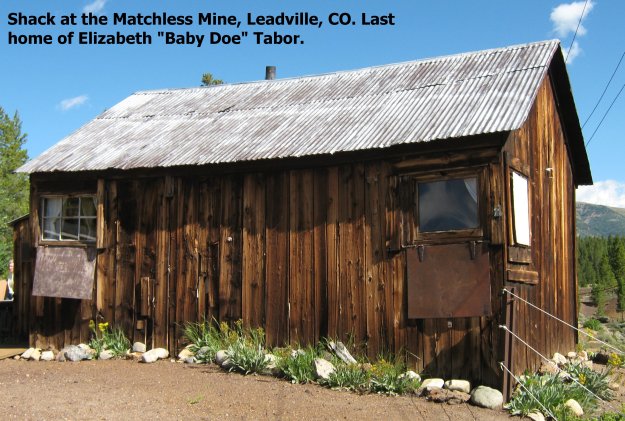
Matchless Mine Shack

Matchless Mine Shack

All of the digging from the boom time of Leadville has left an enduring legacy for those who live in the watershed. Much of the mining activity occurred uphill, east of the city and as a result, that area is pock marked with many large colorful tailings heaps. While the colors are interesting to ponder and sample, the ground and surface waters are greatly affected by aqueous extraction of metals from these piles.

If you stand next to one of these heaps, you can’t help but notice the smell of sulfur. The ore and tailings are enriched in sulfides and once exposed to air and water, oxidation occurs to make corrosive runoff. This is a kind of heap leaching phenomenon that will eventually exhaust itself, but only at the cost of water quality.
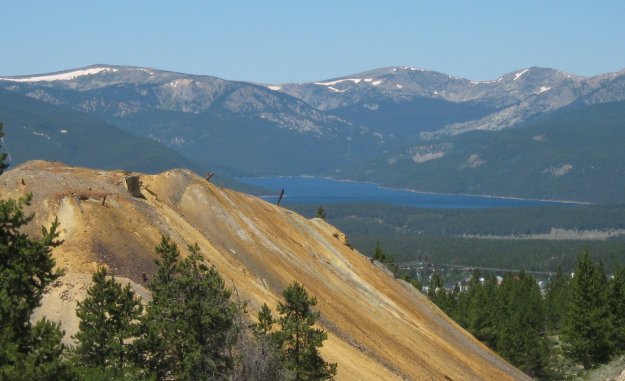
Boomtown Legacy

Boomtown Legacy (Copyright 2009 All rights reserved)
Touring the Mollie Kathleen Mine, Part 1.

By way of a prelude to this post let me say that, as a child, I was plagued with nightmares about elevator shafts. A tallish building in a nearby city had an elevator that, in the style of WWI-era buildings, was comprised of an open cage controlled by a matronly operator. On each floor the entrance to the elevator shaft was guarded by a collapsible metal gate that allowed the visitor to see, hear, and smell the greasy workings of the elevator in all its cabled creepyness.

I would stand next to the gate as the elevator went about its single-minded business and peer down into the dark shaft with its writhing black cables, fascinated yet deeply in tune with the prospects of what a fall down this hole would mean.  Like most young boys, I had bitter experience with the unblinking and impersonal side of gravity.

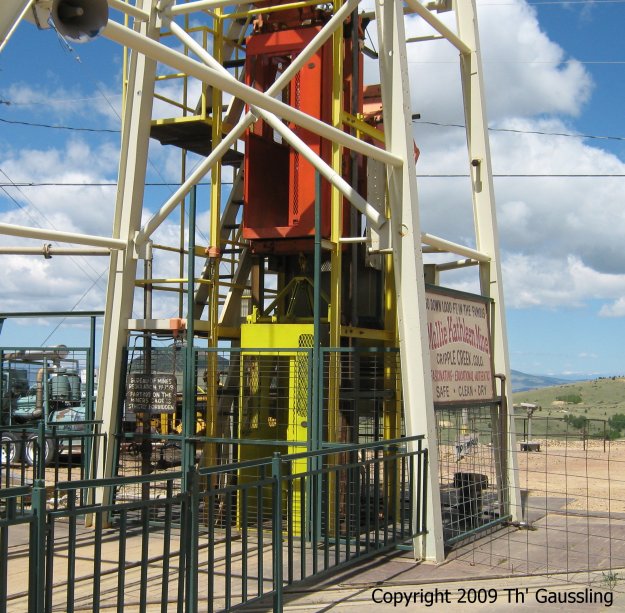
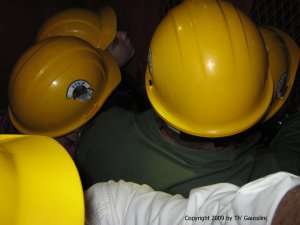
It was this memory that flashed into my mind yesterday as I stood in a manlift the size of a large domestic refrigerator, crammed tightly into the cramped cage with 6 other people. We looked like a can of vienna sausages.  The lift was a double-decker, with an identical cage of sausages below.

Crammed in Manlift

Crammed in Manlift

There we stood- a squashed parcel of humanity and hard hats in the orange lift, dangling above a 1000 ft column of air. Outside I could see the town of Cripple Creek, Colorado, sitting in the valley 400 ft below us. In two minutes, we would be 600 ft below the level of the town. As we began the descent and as daylight fell to darkness, I felt a my autonomic system select “Panic Mode”. But it was too late, we were committed. After 30 seconds, a graveyard calm replaced my momentary panic and all was well.

Double Decker Manlift at Mollie Kathleen Mine

Double Decker Manlift at Mollie Kathleen Mine

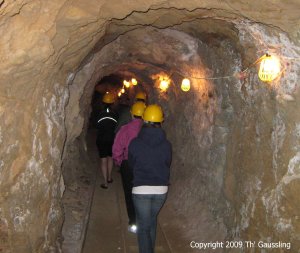
This was my first entry into the Mollie Kathleen Mine outside of Cripple Creek, CO. The tour begins in a drift 1000 ft below surface level. A “drift” is just a horizontal tunnel in an underground mine. I have toured a number of mines and caves and the common attribute to all of them is the absolute silence that is found underground. Today’s tour would be different.

The Mollie Kathleen Mine sits on the side of a mountain adjacent to the mammoth Cripple Creek and Victor (CC&V) open pit gold mine. The operators of both mines have independent claims to different parts of the same confined geological formation. The Mollie Kathleen is one of a great many underground mines in the area, of which only a very few are in operation today. It is presently open only for tours.  The CC&V mine is the only large gold mining operation in the area.

The CC&V mine is an open pit operation. Large hauling trucks carry 300 ton loads of ore rubble from the pit to nearby crushers which reduce the rock to 3/4 inch pebbles in preparation for the cyanide extraction process on the heap.  The rubble is the result of large scale bench blasting with ANFO blasting agent.

The CC&V does blasting on a regular basis. That day, while we were underground about 1-3 miles distant (my estimate), they set off a blast. We were down in the mine when the underground rumble hit. There was no ramp-up to maximum force- it began as a loud, strong rumble seemingly from every direction. We stopped in our tracks and instinctively looked at the ceiling trying to decide if this was a normal or off-normal event and, oh golly, will the the tunnel collapse? After 30 to 40 seconds the rumble subsided and the mine was silent again except for a few heartfelt expressions of relief. Clearly there was no danger for anyone, but the abruptness and the magnitude of the explosion only serves to remind one of the compromises made and the options lost while working underground.

1000 Ft down into the Mollie Kathleen Mine

1000 Ft down into the Mollie Kathleen Mine

The tour guide was a young ex-miner from Montana who explained mining practices and demonstrated the numerous pneumatic tools used by hard rock miners.  In part 2, we will look at some of the mine workings and other features of the Mollie Kathleen Mine.

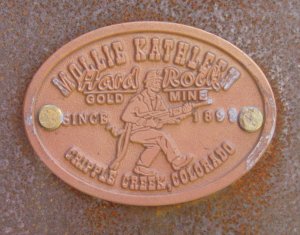
Hard Rock Placard. Photo Copyright 2009 Th' Gaussling.

Hard Rock Placard. Photo Copyright 2009 Th' Gaussling.

California- Our Problem State

It would be easier and would consume less bandwidth if the days in California without a wildfire were reported, since they seem to be fewer in number.

What will the Feds do if California legalizes and taxes pot? Will they declare it a Narco-state and allow Lou Dobbs to supervise the construction of a morality fence along the borders? What affect will it have on the SWAT apparel and black helicopter industries?

This could give a whole new range of possibilities for our next Disneyland vacation. To hell with Florida!

Morning Vegas

Wynn Resorts and Trump Tower

Wynn Resorts and Trump Tower

Mr Wynn admitted to Charlie Rose the other day that the only way to make money in a casino is to own one.

The white skinny tower right of center is Donnie Trumps building just off the Las Vegas Strip.

No booze and no gambling. Gaussling- the worlds dullest boy.

[Photo by Th’ Gaussling]

Return to Vegas

Th’ Gaussling departs for a few fun filled days in Las Vegas as a conferee. I’ll be doing my bit for God and Company speaking before a smattering of government and contractor ubermenschen through the cybermagic of PowerPoint and laser pointer. As tacky and grotesque as Las Vegas is, it certainly beats a motel on the Sam Houston Tollway as a conference destination.

Bat flys to that big belfry in the sky

Pity Brian the Bat. This innocent winged creature just wanted a place to rest. Unfortunately, he chose to rest upon the liquid fuel tank of the Space Shuttle Discovery prior to liftoff. Brian was last seen clinging to the shuttle as it cleared the tower during launch into the night sky.

Brian Bat resting on Shuttle Discovery. NASA Photo.

Brian Bat resting on Shuttle Discovery. NASA Photo.

It is not known how far Brian rode the spacecraft. NASA speculates that Brian was blown into the exhaust plume shortly after clearing the launch tower and fried to a crisp. The acoustic energy on the exterior of the shuttle during launch is around 149 db. The little bugger was surely stunned by the noise.

The Brian Bat foundation has been started in its honor (wink wink, nod nod). I’m sure that all people of goodwill will contribute to memory of this hapless fellow.

Carlsbad Caverns

Carlsbad Cave Popcorn

Carlsbad Cave Popcorn

The problem with Carlsbad Caverns today is the same problem that plagued it from the very beginning- it is very isolated and is not even on the way to many other places of major interest (except El Paso, of course). For the first 20 years or so, the cavern was primarily a source of bat guano fertilizer for the California citrus orchards. Slowly, and with the persistance of a few key individuals, word of this wondrous underground cathedral spread.

Today, Carlsbad Caverns is visited by approximately 500,000 people per year. The cavern is in remarkably good shape considering the large number of people who walk the several miles of underground trails 364 days per year.  Curiously, one of the big pollution concerns is lint from the clothing of shuffling visitors which settles on the formations.

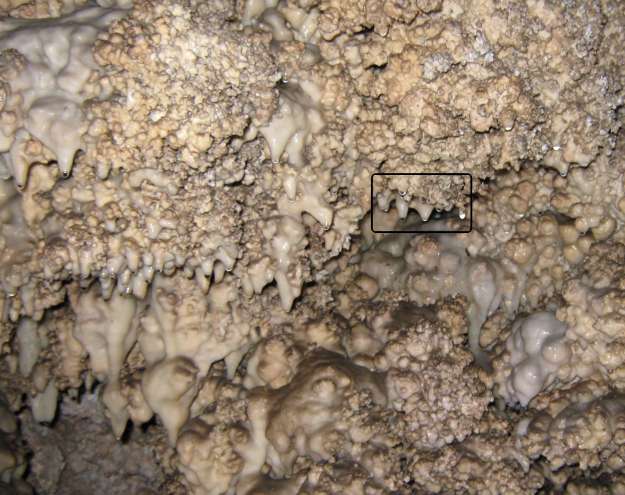
The above photo is a snapshot of a common evaporite formation referred to as cave popcorn. The box in the photo encloses an area about the size of the palm of your hand and if you look closely, you can see water droplets clinging to the small mineral protuberances.  The colors in the photo are a good representation of most of the cavern.

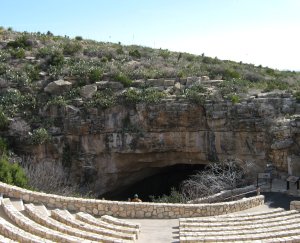
Entrance to Carlsbad Caverns

Entrance to Carlsbad Caverns

The decorated caverns are the result of several kinds of chemical processes. The internal spaces were dissolved out of the regional limestone formation. This formation is thought to be the remnant of an ancient reef. It is believed that aqueous hydrogen sulfide migrated up from the anaerobic permian formations below and was subsequently (air) oxidized to more corrosive species.

The park people point out that H2S was oxidized to sulfuric acid which is responsible for the chemical digestion of the limestone. Sounds reasonable to me, though the chemistry of sulfur oxidation is full of many kinds of intermediary species on the way from sulfide to sulfate. The presence of gypsum (calcium sulfate) inside the cavern supports the claim that sulfuric acid was the corrosive agent. What was not mentioned was whether or not sulfate is found in the surrounding formations. [Note: a commenter made a good point about the bio-oxidation of sulfide]

Stalactites festooned with cave popcorn, Kings Palace caves, Carlsbad Caverns

Stalactites festooned with cave popcorn, Kings Palace caves, Carlsbad Caverns

The decoration of the interior spaces left by digestion of the limestone happened by the action of seepage of rainwater and carbonic acid though the upper layers of sedimentary rock. The water dissolves many mineral components including calcium. The calcium carbonate rich liquors seeping in from the roof of the caverns wetted the surfaces below and deposited calcite and other mineral species by way of intermittant accretion.

If you examine the few smaller and broken mineralizations along the trail, you can clearly see that the accretion results in substantially crystalline material. So, while the formations are not large calcite or aragonite crystals, the small scale structure is crystalline.

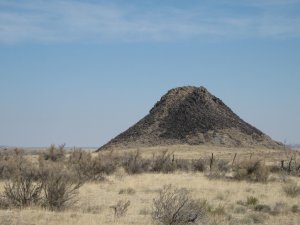
There is much to see in the world if you just bother to look. Along I-25 in southern Colorado is a modest looking feature. It is called Huerfano Butte and sits along the highway near Walsenburg. This igneous intrusion is more resilient to weathering than the surrounding sedimentary formations.  Radiating from the nearby Spanish Peaks are an array of dikes indicating the presence of past magma intrusion.

Huerfano Butte- a weathered igneous intrusion.

An synthetic chemist is in a great position to absorb some geochemistry. Once one is keyed into a bit of geology, the mechanisms of mineral formation begin to become apparent, with a little study of course. For myself, this is a great motivation to kick around in the weeds and explore the world. Gotta watch out for rattle snakes, though.

Encounter with Roswell, NM

No trip to Roswell is complete without a visit to the UFO Museum. While this may be one of the most amateurish exhibitions apart from the county fair, it does put a face on the UFO phenomenon in the USA.

Which One is From Outer Space?

Which One is From Outer Space?

Most of us have heard of the supposed crash of an alien spacecraft near Roswell (or Corona), New Mexico in 1947. The whole fantastic tale seems to be based on a few slender threads of testimony. A trip to the museum clinches the notion that the whole phenomenon is based on innuendo and 2nd or 3rd party stories.

It’s another example of people hustling to conclusions based upon low signal-to-noise observtions. Faint indications of phenomena against a noisy background. Like cold fusion in the 1980’s, a whisper of signal appears now and then.

I recall from freshman psychology that the human brain is especially vulnerable to such glimmers of off-normal stimulus. Gamblers are attracted to the very irregularity of positive feedback that is provided by random events. Perhaps there is a similar neurochemical origin in the obsession with spaceships and alien abductions. It seems to be more than simple curiosity.

It is apparent by casual observation that the city of Roswell has not lovingly embraced the UFO phenomenon with an enthusiastic plunge into full scale commercial exploitation. The Wal-Mart on the north end of town is decorated with a few fanciful alien festoons, but the extent of it amounts to a “museum” and a few worn looking establishments along the main drag.

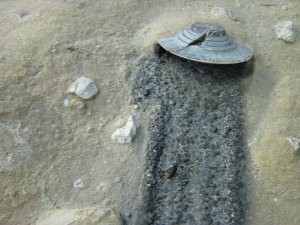
Saucer Crash

The saucer shape we have come to associate with alien spaceships is based on early sightings of unidentified flying objects. Latter day sightings (LDS? wink wink) comprise a range of shapes and designs.  What I would like to know is this- does the saucer shape make any sense in the context of interstellar travel? What are the aerodynamics of the saucer shape through the full range of velocity regimes? A saucer must eventually transition from operation in a vacuum to hypersonic entry into an atmosphere. Also, the ratio of surface to volume is relatively high, so how do you pack enough luggage & provisions for a lengthy trip?

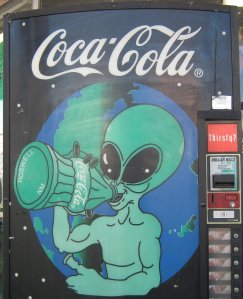
Take me to your cola!

Take me to your cola!

Land of Enchantment

Th’ Gaussling & family are off on a springbreak motoring tour of that mysterious Land of Enchantment, New Mexico. The main destination is Carlsbad Caverns. We’ll take a cave tour and refresh ourselves with the wondrous magic of decorative columnar evaporites and ancient guano. Along the way we’ll visit Roswell for a close encounter with cosmic kitsch. In Sante Fe we’ll see Pueblo kitsch. And in Almagordo, there is space kitsch. Remember Col. John Stapp?   

Like Texas, New Mexico has an abundance of miles and miles of miles and miles. We’ll see about six hundred of them, one at a time.

Ciao, baby.

Motoring on the Chao Phraya

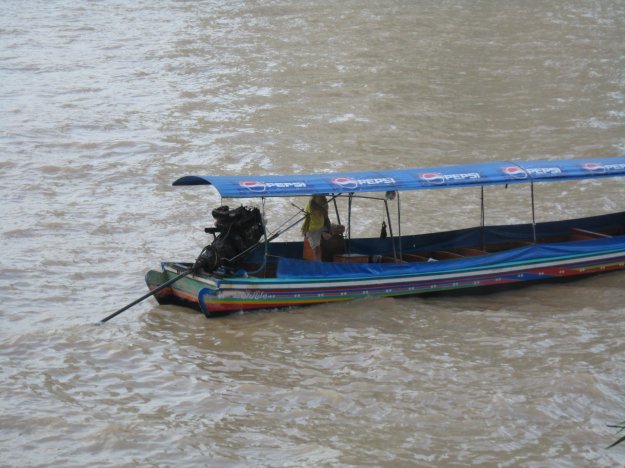
Th’ Gaussling had the occasion visit Bangkok a while back. Like any large city, Bangkok is bustling with tourist operators anxious to provide carriage to any point of interest. Along the river you can see long boats fitted with automobile engines and long propeller shafts. The engine is attached to a swivel and a tiller arm with throttle controls. The engine fan blades spin without any kind of guard to protect the operator.

Muscle boat for Tourists

Muscle boat for Tourists

To steer, the operator simply pivots the power train and adjusts the throttle. These narrow craft shuttle their perspiring payload up and down the river from stop to stop at bridges and the finer hotels.