
Category Archives: Travel

Tuk Tuk Scam

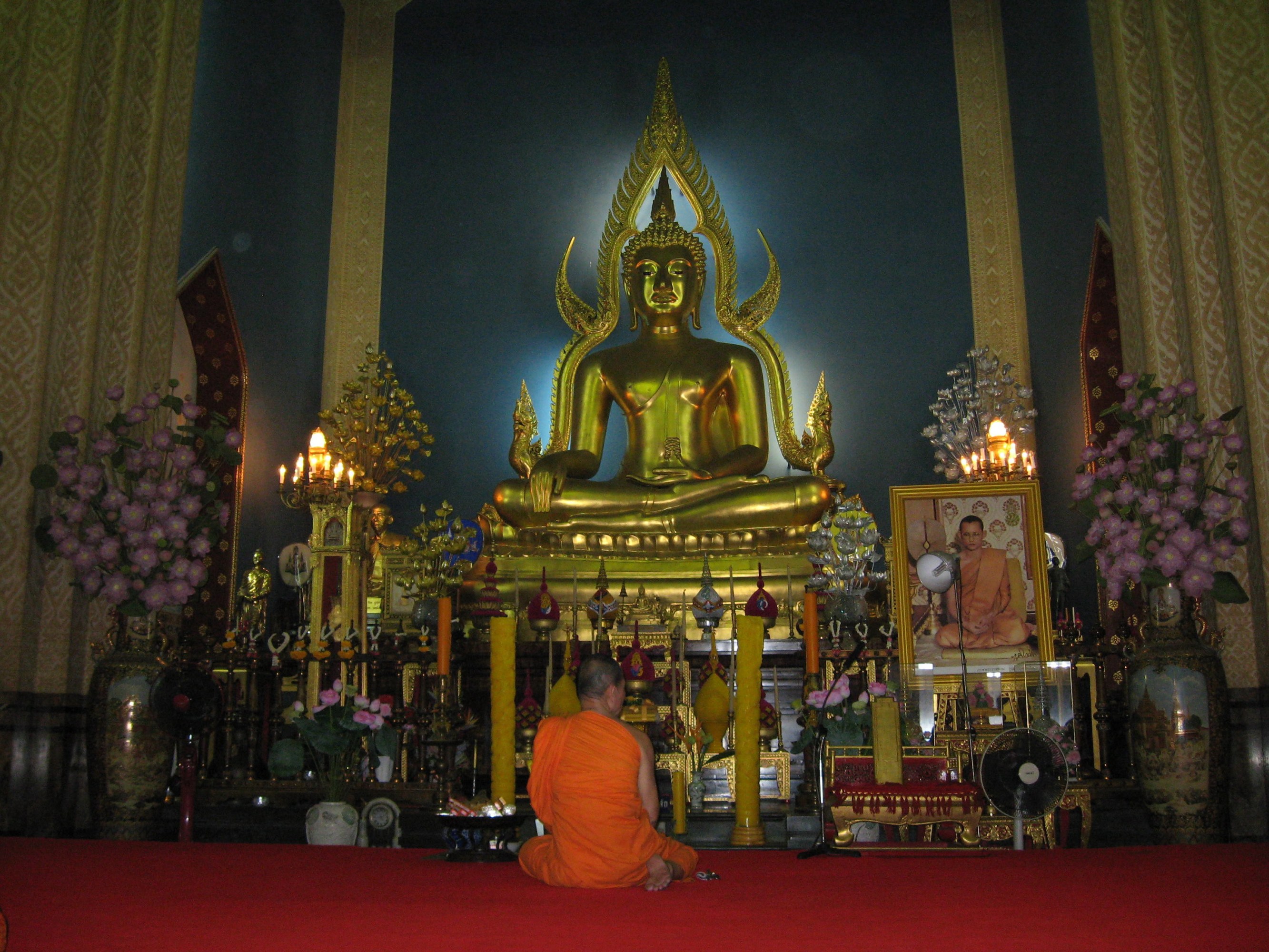
Temple Buddha

When you get to the streets of Krung Thep, one of the things you first notice is the insane traffic density. The interstitial spaces between cars and buses is filled with pedestrians, tuk tuks, and scooters. The sidewalks are crammed with tables and displays of every imaginable consumer good. At street level, overhead doors are open and shops filled to the brim with stuff of all discription- lawn mowers (where is the grass??), clothing, plastic flotsam, industrial pumps & valves, … everything.  In the evening, the shop owners throw a mattress on the floor between the stacks of merchandise and light up the TV. A pot of soup is on the heat and folks begin winding down for the night.

Like a lot of tourists, we found ourselves stuffed in a noisy tuk tuk careening down the streets of Bangkok being hustled to a well known temple, but with a few stops at the lapidary, clothing story, and jewelry store. It is a well known scam advanced by obnoxious confidence men and women who feign interest in your well being.

It all began when we arrived at the Grand Palace at closing time and were immediately “greeted” by official looking characters.  They took the initiative without delay and directed us to the tuk tuk driver along the curb. Careful to ask our nationality and the nature  of our business, these overseers directed our attention to the identification badges worn by the drivers. Thirty baht for the ride to the Golden Mountain Temple. This was a bargain, we thought.

A tuk tuk is an open air three wheeled vehicle with a sheet metal roof and lots of colorful decoration meant to dazzle tourists into indulging in the local color. 

The driver starts the two-stroke engine and we lurch into traffic. Driving in Bangkok consists of an extended series of lunges for position in the heavy traffic. It’s not at all obvious what is forbidden in traffic, other than running over someone. The tuk tuk driver pulls into oncoming traffic for a few tens of meters gain, then overtakes a car as it turns into a narrow street.  Pedestrians jump out of the way.

In the states, one or two discourtesies that are ordinary here would likely provoke a murderous episode of road rage. No big deal in Krung Thep. 

It became apparent that taking us to the temple was a ruse. The real itinerary was a tour of pre-arranged shops whose proprietors would reward the drivers with a cut of the action. Of course, this is nothing new or novel. It is a form of industry common to many ports of call.

After we visited 3 shops, we convinced our young driver that we were finished and he left us at one of the many gold-leaf festooned temples in the core of the city. Numerous drivers approached with offers of carriage, but we were determined to walk to the Standing Buddha. And walk we did.

Eventually we made our way to a backpack hotel near the river where we enjoyed some liquid refreshment. Using a tourist map meant for advertising, not navigation, we finally found the standing Buddha at sundown. From there we made a circuitous path to a water taxi on the Chao Phraya river and made excellent time back across the city for 30 cents US.

I’m left with some grudging admiration of our Calvinistic traffic system back in the states.

Photo Credit: Th’ Gaussling 2007. All Rights Reserved.
Notes from Krung Thep

Of the great Pastry and Confectionary Nations of the World, few of them seem to be located in Asia. 

Thailand is not a member of the Organization of Chocolate Consuming States. Chocolate is scarce here. You can get it in small aliquots at the Hotel Gift shop.

Dim Sum is a good thing.

Travelling is fun and easy as long as you have money. Travelling without money is called “walking”.

Thailand is a Kingdom and the King is highly respected.

When greeting, put your hands together under your chin and say “Sawadee Khrap” if you are male and “Sawadee Kha” if a female. It is appropriate and appeciated.

A Week in Krung Thep

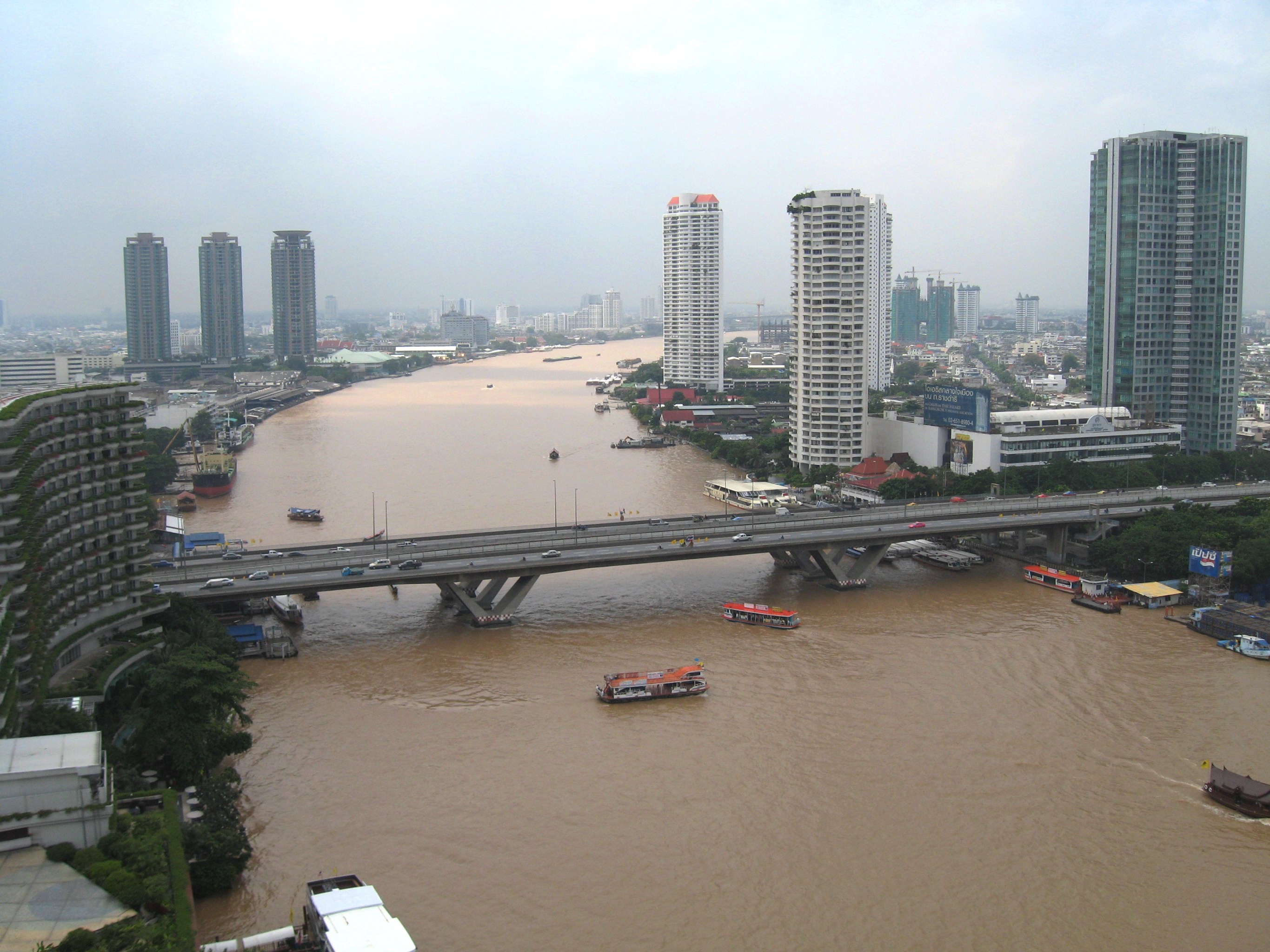
I startled to wakefulness by the sharp crack of nearby lightning. I had resolved to synch into the local time by remaining awake until evening, but failed shamefully. I stumbled to my feet and walked to the rain spattered window of my 21st floor room.  From this vantage I could study the cityscape of Krung Thep (Bangkok) and marvel at the activity on the muddy Chao Phraya river below. 

BKK

The television blares out that reassuring theme music of the BBC- the one with the swirling red pattern against the beeping time signal in the background. Despite all of my travel, it still boggles my mind how comfortable it is to go to distant places. You sit in an aluminum tube for a while, get out, and hop into a taxi.

The conference is in a 5-star luxury hotel, filled to the brim, it seems, with nattering western 60-somethings on holiday. Prosperous Europeans and North Americans out for a taste of exotic Siam. Nothing too strong mind you, just a taste.  The air-conditioned, hospital-clean hotel offers the one thing that you can’t get otherwise in Krung Thep- solitude.

A step into the streets of the city is, for this North American, a step into the heart of metropolitan Asia. It is monsoon season, so the air envelops you like a hot, wet sweater smelling of diesel and oily 2-stroke motor exhaust. Everyone is busy. Some are just moving from point A to B. Others are eyeing you from their narrow kiosks and calling out for your business.  Like the stationary bivalve that eats only when it can suck in some bystander, the kiosk proprietor has but 15 seconds to get catch your fancy before you leave the field of view. As a westerner, you resemble a big block of cheese and everyone wants a slice.

All of the motion, the incessant bartering and angling for prices is always a shock to Americans who are used to the economic firmament of price tags and the taboo of public bickering over prices.  Americans pride themselves on capitalism, but are reluctant to let it equilibrate to the microscopic level of one-on-one haggling with shopkeepers. Too untidy and confrontational. Americans would rather go to another store than attempt to haggle for a better price.  But this reluctance only serves to dilute the power of the consumer. This is a lesson we can take from Asia.

Chemical Business in Russia- One Experience

Hearing of the passing of Boris Yeltsin, I can’t help but remember my trip to his northern empire in 2000.  We boarded a Lufthansa flight in Frankfurt, seemingly filled to the scuppers with jabbering Russian tourists anxious to return from their trip abroad. We left rainy Germany for the port city of St. Petersburg, near the mouth of the Neva River. Most of the terrain was obscured beneath heavy clouds so there was nothing to see until our descent at 10:30 pm. The sun sets late at 60 degrees north in the spring.  As we were coming down from cruise altitude, the lush green landscape became visible through breaks in the clouds.  We were going to land in Russia.

While the purpose of the trip was business, I was determined to soak in as much of the experience as possible. I had a total of one paltry year of Russian language in college so I could at least sound out the words and recall a tiny bit of vocabulary. 

In the late 1990’s doing business in Russia- that is, buying Russian goods- could be complicated. This was late in Yeltsin’s term and a kind of cynical take on the free market was beginning to set in.  Earlier, the eastern bloc had imploded and the communist hold on Russia was in deconstruction. Under Yeltsin a select few had managed to amass wealth- the so-called Oligarchs.  But as a few like Khodorkovsky were to eventually learn, wealth does not automatically confer political power in Russia.

Doing business in Russia was a highly manual activity. In 2000, the start of the Putin years, Russia lacked much of the business infrastructure that we in the west take for granted. When I say “business infrastructure”, I refer to the whole picture- commercial credit; internationally compatible contract and tort law; credible mechanisms for the flow of currency; GAAP; a multimodal transportation network; a comprehensible market exchange for commodities; and a market place with suppliers and specialists for the many instruments of finance and insurance. 

In the Yeltsin years, many formerly state-owned factories came under control of people who conducted business in facilities through quiet arrangements behind the curtain.  Factories would operate at low intensity or would even be shut down until orders came in.  Workers were furlowed and operated taxi’s or did other odd jobs until an order arrived.  Maybe this still happens today.  I don’t know.

We needed product that was made by a very few specialists in the world and one of those vendors was in central Russia.  Russian manufacturers are as skilled as we are of course, but there are differences in business culture that may be hard to anticipate.  Western standards concerning documentation was a particular problem.  I recall that our vendor was quite carefree about lot traceability and packaging.   They also had the maddening habit of reusing old lot numbers.

Then there was the problem of shipping.  Russia did not then, and still may not, have anything remotely similar to Aldrich.  Now, you probably think of Aldrich as the “chemical supply house” and you’d be right. But I’m thinking of Aldrich as the “master of logistics”.  Logistics in Russia was a problem.  Ground transportation was unreliable. Our solution was to hire a local to bird-dog the whole process.  It was worth every penny.

One of the differences I found was in the attitude of the few manufacturers I was in contact with.  They were usually aware of western prices for their goods and were never afraid to demand Aldrich-type pricing.   In the west, the customer is king.  That is just taken for granted.  Uppity suppliers are soon former suppliers. 

What I ran into in Russia was something that I hadn’t seen anywhere else, including China or Taiwan.  Our Russian supplier wanted to dictate terms and was unwilling to budge- I think they call it “Vlast”.  We absolutely needed better prices for the raw material.  I’m sure that there were urgent arrangements behind the curtains that were part of the need to stand fast. But in the end, it was their absolute inflexibility that caused them to lose the business. 

While in Russia I did try to source other raw materials and “vendors” who could supply spot buys of particular compounds.  At the time, many chemical factories were partially shuttered, so custom chemical processing capacity was very much hit and miss.  Processing equipment sat in dark and idled buildings waiting for a purchase order and prepayment. 

We met with principals in an empty flat to talk about the manufacture of custom compounds. But the same problem always arose. They wanted cash up front, preferably deposited in a European bank.  I was very clear that this was not the transaction model that we were accustomed to and in fact, this requirement was a showstopper. My Russian contacts were mystified that an American would come all this way only to refuse to pony up the cash to get the ball rolling. And that is where my attempts at trying to do business with Russia ended. 

The operators of the factories I was in contact with had the pots and pans, skilled staff, and expertise in the technology- these guys were first rate technocrats. At first glance, what they lacked was the benefit of investment capital to plow into their operations to find and service customers.  But, digging deeper, it wan’t just the hard cash they lacked. There was a system-wide lack of free market history and culture that, elsewhere, would have provided the institutions and mechanisms to exploit opportunity. 

I admire Russia and I believe that they will eventually get their system working well.  But they do need to get away from the fascination with the strongman model of governance. From my travels I have concluded that countries with cultures that date far back are simultaneously blessed and cursed by it.  They are blessed by the warm embrace of cultural richness. But they are also cursed by it because it can be a sort of ball and chain that complicates the adoption of change.

Note: This was written a few months prior to posting.

Copyright 2007

Colorado History- Gold and Tuberculosis

Recently Th’ Gaussling & family spent some time at a mineral spa in Idaho Springs, CO. Having been to a number of mineral springs in the West, I have some sense of what is reasonable and ordinary.  All hot spring operators preach or otherwise encourage the benefits of soaking in a hot mineral bath. Mud treatments and massage are lucrative extras offered by proprietors of mineral springs.  Sadly, by constitution Th’ Gaussling is refractory to the mystical enchantments of this hot saline jive (wisdom or weakness?). I really need to see a mechanism.

Hot springs are egalitarian destinations where the young and old, rail-thin and morbidly obese, tatoo’d and blank skinned can comingle in the hydrothermal aqua from the plutonic realm. 

This particular hot spring was a hotel-pool establishment that had seen better times, but the proprietors were managing growth by adding cabins and a ribs catering operation.  We enjoyed our stay there and will probably return.

My only critical comment is that the water was not particularly loaded with minerals and didn’t favor the bather with even a whiff of sulfur.  A hydrothermal pool without the primordial tang of sulfur is but half of the experience. 

We visited the Phoenix Mine, which is a shoestring gold mining operation a few miles west of Idaho Springs.  If you want to understand Colorado, you have to come to grips with mining. It is one of the two great enthusiasms that lead the settlement wave in Colorado in the mid 1800’s- gold / silver and sanitariums (tuberculosis).  

Much of the activity stemming from the gold rush of 1859 occured along what is now the I-70 mountain corridor.  The discovery of placer deposits of gold and silver quickly lead to hard rock mining activity in the many canyons connecting with Clear Creek.  Placer gold was also found in streams in what is now the Denver Metro area and Cripple Creek.

The recovery of gold from stream sediment (placer gold) is called prospecting.  Hacking it out of hardrock is called mining.  The recovery of placer gold uses somewhat different technology from hardrock mining. Placer gold is isolated by direct settling of the higher density metal from a slurry of gravel and sand. The prospector uses a pan, sluice, rocker, or trommel. The owner of this particular mine has several miles of stream that you can pan from to get the experience of seeing placer gold first hand.  It is hard work and seems to appeal to people who like to gamble.

The tour guide stated that the Phoenix mine operation is centered on a sandstone vein containing 6-15 troy oz of gold per ton (the number varied considerably during the tour so it is hard to tell what it actually is).  But what is interesting is that the vein is a sandstone matrix varying from a few inches to 4 ft thick with a large variety of metals- Au, Ag, Cu, Pb, and Zn.  Glinting xtal faces could be seen as well as green Cu salts in the “Resurrection” vein.  As you walk through the mine it can be seen quite plainly.  The miners just follow the vein where ever it goes.

This is a type of mining that targets a highly concentrated vein, so the amount of mass that has to be processed is relatively small as these things go. This is in contrast to very large ore bodies that contain highly dilute levels of gold value. Such operations require large scale equipment for beneficiation and produce vast quantities of tailings. The operators of the Phoenix mine limit their beneficiation to milling and frothing. Concentrates are sent to Canada for the final recovery and refining. The guide was reluctant to say it, but my guess is that they ship out drums of liquid concentrate.

The other great enthusiasm for Colorado in the 19th century was for the convalescence of patients afflicted with consumption, later called tuberculosis. The thin dry air and the sunny climate was thought to be beneficial for consumption patients. Throughout history, hot springs have attracted the afflicted and the infirm.  The abundance of hot springs in Colorado attracted spa operators who catered to tourists.  The railroad provided the means of transportation for patients to arrive from distant quarters for their convalescence.  

Colorado Springs was an early destination for consumption patients as was Glennwood Springs. The ill-tempered old west figure Doc Holliday died from a long bout with consumption and is buried somewhere under a subdivision in Glennwood Springs, his marker sits on a hilltop cemetery above town. 

Career Change in Chemistry? Be a HazMat Driver!

Looking for a career change in chemistry?  Tired of loading other peoples samples into that GC sample carrousel? When you close your eyes do you see the pink color of phenolphthalein swirling in a flask? If so, then maybe it’s time to step up to the fabulous world of Over The Road Trucking- OTR.

I understand that drivers with a CDL and a hazardous materials endorsement can expect to find many well paying opportunities out there. 

On the Road in the Land of GM

Th’ Gaussling has been on the road the last few days visiting one of the states shaped like an oven mit up along the north coast.  This is my first visit to this area during the summer. It is very beautiful country.

We had an inflight medical emergency enroute to a stop in the Windy City.  The call came over the PA “Is there a doctor on the plane?”.  Two vacationing MD’s, one in a fishing vest, rendered aid to a fellow who had a seizure.  They had the poor sod on the floor with a saline i.v. and O2 for 90 minutes. The guy was lucky that he had more than an Untied (Airline name purposely altered) Stewtron to look after him. A business associate had the same experience the same day on the same route, but on a different flight. Curious.  [Note to self: Bring meds on trip.]  

Farewell, Cutty Sark!

Th’ Gaussling is still reeling from the news from London that the magnificent tea clipper, the Cutty Sark, has burned.  This great wooden vessel was dry-docked in or in the vicinity of Greenwich, England. 

Officials connected with the ship stated that “This is a significant blow and a major set back for the ship.”  Well, yeah.

Perhaps the ship can be reconstructed and the duplicate put in place.  Who knows? What a bummer.

A380 Evacuation Test

Here is a link showing the evacuation of an A380. This airplane disgorged 873 people in 77 seconds.   So I’m thinking, what if you don’t have a planeload of orderly Germans who know how to get moving? What if you had a load of fat, jetlagged American touristas with expensive stuff in the overhead storage? You’d never get out of that airplane alive because some nimrod would have to get up and grab something out of the inside of a zipped bag, dooming everyone to incineration.

When one of these meat wagons eventually goes down, it is going to be like a small town got wiped out.  Like a screaming village falling out of the sky.  In a water landing, this thing is going to cartwheel like a drunken gymnast when a wing dips and grabs the water, and from the parts of the fuselage that shredded open will fly whole rows of horrified passengers, some still gripping their bags of pretzels.  The cabin sections will come to a halt and sink like a stone. 

Oh.  Well, I guess most of them do that.  Regardless, it ain’t gonna be pretty.

Here is a test of the braking system of the A380.  Ever wonder what happens when a big turbofan throws a blade?  The folks at Rolls Royce released this video of a test.  P&W released one as well.  This is what you try to avoid when working around jet engines.