Category Archives: Uncategorized

Hail, Domes, and Beets

We were treated to two hail storms today. The last one was unusually generous in the size and volume of hailstones that issued from the sky upon us. The jeep picked up a few dimples on the hood. Several tornados were spotted in the Denver metro area- It provided some real excitement for the emergency people besides the usual fare of grisly car wrecks and domestic abuse calls.

A low level easterly upslope flow injected humid, unstable air into westerly higher level flows. The result? A large scale shear zone with lots of convection potential. Vigorous convection and lots of moisture energizes hailstone growth.

Hail Gaussling!

Hail Gaussling!

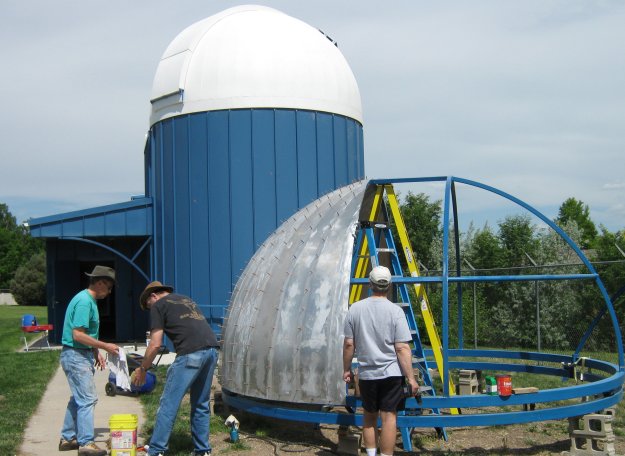
Work is progressing on the new dome at the LTO. The observatory is adding a second dome for a very special 24 inch reflector- The Cole Telescope. Another fellow and I from LTO took posession of this telescope at the Mt. Wilson Observatory several years ago with the understanding that we will provide continued public access.

Funding for the operation of the telescope at Mt Wilson had dried up and the scope was taken out of service. We will be attaching a camera at the Newtonian focus for remote and internet use rather than for eyeball action. The instrument also has a Cassagrainian focus. This telescope was used in the 1960’s during the Apollo project for IR study of possible landing sites on the moon. The primary does have a ding in it due to a gravity accident. Supposedly, a grad student or post doc dropped an object on the 24 ” primary and chipped it. Today, the chip is painted black and it produces only gasps of horror by visitors.

An addition to the observatory building was completed a year ago. The steel pier that will support the telescope has been fabricated and painted. A new drive mechanism and software is in the works and is supported in part by a donation by Software Bisque. Once the scope and mount is bolted onto the pier, the dome will be lifted into place. A solar trickle charger/car battery power supply will energize the electromechanical worlkings like the slit and windscreen.

New dome bristling with Cleco's awaits the riveting crew

New dome bristling with Cleco's awaits the riveting crew

Rivet crew skins the frame of the new dome

Rivet crew skins the frame of the new dome

On a different topic, the first production of Rick Padden’s Beets was a genuine success. We came up short 30 seats for an all time attendance record for a play at the Rialto in Loveland. The play was well recieved and we look forward to doing another production in the area.

Back Porch Set for "Beets"

Back Porch Set for "Beets"

The Chemical Entrepreneur. Part 2.5.

There are as many ways of starting a chemical business as there are people starting them. Entrepreneurs range in profile from smooth talking slicksters to sober, ROI-calculating engineers. Entrepreneurs can also be rather unruly folk. It is not automatically true that business founders are inherently talented at designing and running orgainzations. In fact, they are frequently poor at it.  But, successful founders are usually highly focused and are able to attract resources.

A common motivation for starting a business is that the founder is possessed with existential certainty that he/she can operate a business venture better than, say, a former boss or rival. A business founder may be a free spirit, refractory to sensible advice, or may be a solemn Harvard MBA operating by the book. It is not uncommon for a founder to have had several previous failed ventures prior to a successful one.

And make no mistake, the sense of power that a founder feels in the execution of a business plan can be as addictive as heroin or crack. Once a person has had the experience of successfully gathering resources and then allocating them to leverage progress to a goal, they are forever changed. Whether or not they continue the role of managing funds or personnel, their eyes have been opened to the real meaning of power.

Power is the ability to allocate resources.

No matter what kind of chemical business one wishes to start, it is crucial to understand that it will require the accumulation of some kind of resource that you can apply to a problem. That resource can range from your technical reputation, 30 days net of commercial credit, VC monies, or a chemical processing plant. It is all a form of leverage toward the greater goal converting streams of goods and services into streams of cash.

Try to get cash flowing from sales as early as possible. Choosing a Market-Pull activity is the best way to do this.

A chemist starting up a business is able to choose several kinds of general business activities.  If you want to be a consultant, you must determine the boundaries of your knowledge and then find demand for that expertise.  If you are truly an expert in a field, then more likely than not you know who might buy your services.

If you choose a Technology-Push approach, try to target customers who are willing to be early adopters.

A chemist may be well situated to start an operation offering analytical services. In that case, the enterprising analyst needs to know about underserved demand out in the marketplace. You need to offer a service that prompts people to send a purchase order to you.

If your startup is a one-act pony, it is critical that the pony actually be able to jump through the flaming hoop as advertised. Try to avoid one-act pony business plans.  Find Market-Pull products to pay the bills while your Technology-Push products are under development.

A chemist is in a great position to get into formulations.  While this might not be strictly a “chemistry’ activity, the walking-around-knowledge of chemicals that a chemist might have probably well exceeds the basic chemistry knowledge of many “experts” in the formulations business. However, a chemists general knowledge may not be applicable for direct application to formulations. A formulator must accumulate specialized knowledge and analytical methods for the materials they handle, including things like rheology, cloud and pour points, fungal contamination, and miscibilities. The level of infrastructure for doing formulations can be dramatically less stringent than chemicals manufacturing as well, requiring less startup capital. That said, formulations may be in demand at the large scale. Puttering around at only the less-than-drum scale may have no future.  Again, to be a formulator you need to know what is in demand.

Remember-Sometimes it is dumb to be too smart about things. Be customer oriented. Be honest about strengths and weaknesses.  Learn the difference between smart and cagey. Dick was a cagey businessman. Don’t be a Dick.

Fine chemicals manufacture has many success stories.  Alfred Bader started his Aldrich empire making what we now call Diazald. Bader was extremely customer service oriented and I believe this was the key to his success. He visited laboratories and asked workers what they needed. If the request was reasonable, he would put the material in the catalog collection. If the chemist-entrepreneur desires to start a catalog fine chemical company to sell reagent chemicals and widgets, then I would advise making a study of that business arena.

An understanding of the regulatory compliance world is critical as well, especially relating to the Toxic Substances Control Act, TSCA. A company may have to start out as being a provider of ‘R&D Only’ products. To freely sell commercial quantities of specialty and fine chemicals, a substance must be on the EPA’s public or confidential lists. If not, then permission must be granted by EPA. This will require a special filing which discloses its manufacturing and/or use process, Personal Protection Equipment (PPE), fugitive dust and corresponding controls on exposures to workers and the environment, vapor releases and method of control, a disclosure of how much of the New Chemical Substance (NCS) gets into the environment, any and all available toxicity data, a Safety Data Sheet, physicochemical data, waste NCS disposal, batch size and yearly production. For less than or equal to 10,000 kg per year a Low Volume Exemption (LVE) can be filed. This is an abbreviated version of a Pre-Manufacturing Notification (PMN) filing which will be examined in greater detail and will take much longer for EPA to complete. EPA has the right to require the submitter to collect certain kinds of toxicological data at the submitters expense. These tests are standardized and are performed by certified labs.

Most advisors to entrepreneurs will say that the prospective businessperson is well advised to put down a written plan. This is important on many levels. The act of writing a business plan is useful to the entrepreneur in several ways.  It causes the writer to focus his/her ideas and energy as well as to clarify the goal and how to track towards it. A well written business plan is critical if you need to attract funds to get the operation started. Investors and bankers need a document to study and to bring before others for analysis and buy-in. Just gotta have it.

Starting a drug company is going to be quite difficult for a few isolated chemists to do. It is a complex and insanely expensive and risky business that requires a wide diversity of players to be on board and committed. Somewhere you have to get an MD or MD/PhD, finance people, former pharma executives, regulatory affairs peoples, etc., on the board to add gravitas to your plan. A whole circus of expensive prima donnas. Sounds like a nightmare to me.

Drill Baby Drill!! The GOP Call to Arms.

I recall sitting on the sofa watching the 2008 GOP convention and hearing the intoxicating refrain “Drill Baby Drill”. It was like the sensation of sitting in the dentist chair with my brainstem bathed in cool nitrous oxide vapors and face numbed with lidocaine.  I found myself tumbling head over heals in a mild, drooling, narco-twilight state while my twitching eyeballs attempted to focus on McCain.  My fellow citizens had drummed themselves into an enchanted war dance and gathered to hear Colonel Kurtz, but without the banana leaves.

Then I snapped out of it.  Drill baby drill. This was not just a work order or a requisition for drilling staff to please set up a few drilling rigs in the morning. This was an exhortation to rip those smirking tree huggers from their stations, pulp the trees to make a paper dunce cap for Pelosi, and call in the Air Force to oversee saturation drilling of the continental shelves, and do it pronto!

“Drill baby drill ” was a catch phrase along the lines of “Damn the torpedoes! ” or “somebody get a rope! ” Its conception and use was a masterful bit of applied propaganda- A figurative running of the liberals out of town on a rail.

But what was lost in the excitement were the pragmatics of oil production. You need to boost refinery capacity to increase the supply of refined fuels.  And, what oil company is going to attempt to flood the market in a bid to drive down oil prices? What oil company is going to step in and provide cheaper crude to US refiners so that they can, dutifully, distribute cheaper gasoline when the global market price is so high? Only the dumb ones. Do they think that Santa Claus runs Exxon?

I thought GOP’ers were market savvy, laissez faire devotees swingin’ the big stick of Ronnie Reagan tough love? What has happened to these people?

Seems to me that oil in the ground is like money in the bank. Why are we so anxious to deplete North America of its supply??  What about pulling back on demand to counter the high prices? That is the one big stick that consumers have in the market.

A Case of the Vapors

There is an interesting debate happening in the weather and climate modeling wing of the blogosphere. Seems that over at Wattsupwiththat someone has pointed out the significant part water vapor may play as an absorber of solar energy. All you have to do is look at the absorbance spectrum of water vs CO2 and you’ll see that the game is suddenly more complex than the incessant drum beating about CO2 would suggest.

There are a number of good websites on weather and climate out there. Rabett Run seems well centered in terms of the science.  If you are interested in the level of play happening in the real, behind the scenes debate, check out the references to Kirchoff’s law.  Physical meteorology is at the center of the whole debate. Assumptions about the applicability of certain laws, assumptions about the value of key variables, and other details of equation building can drive the nature of the conclusions. Planetary atmospheres are really quite complex!

I think it will be several more solar cycles before the right modeling assumptions shake out.

Bagpipes, Bangers, and Beer!

7 September, 2008, Estes Park, Colorado.  It is the last day of the Scottish Festival in Estes Park. Th’ Gaussling and family made way to this annual festival to hear bagpipe music and to see the spectacle.  There were several quite decent bands as well as a variety of highland games to watch. You could even lunch on haggis.

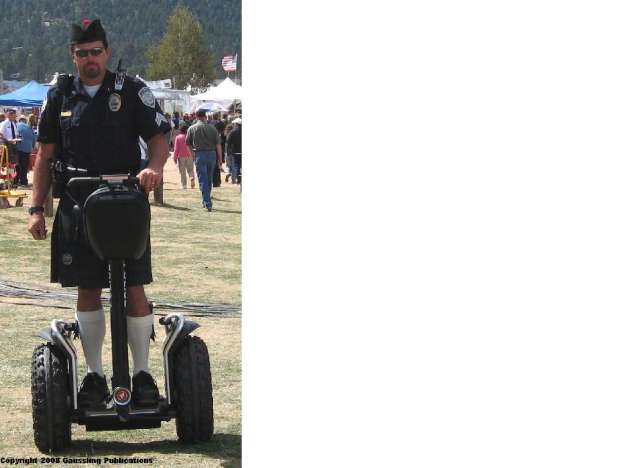
It was interesting to see a police officer dressed up in a kilt and scooting around on a Segway. Then there was the curious juxtaposition of holstered stun gun and a kilt.
Parade of the Clans

Parade of the Clans

These highland festivals seem to involve quite a bit of pomp and circumstance. The Marine Corp Marching band put on a show bobbing and weaving to the tuba playing a jazzy beat. Cannons were fired on the top of every hour and a collection of siege engines (wooden trebuchets) hurled stones towards an inflatable Nessie floating in Loch Estes. And at noon, a pair of WWII training aircraft did a formation flyover. Airplanes, beer & bangers, and bagpipes. It just doesn’t get any better than that!


Self-Imposed Complexity and the Ratchet Principle

The portfolio of laws that American citizens are subject to seems to grow without bounds. Every year our congress drafts a new collection of laws to submit to the process of enactment. State legislatures, county and city governments all are able to add new rules and constraints on our degrees of freedom. As if that weren’t enough, people willingly move into convenant controlled communities where they sign away basic freedoms like the freedom to choose house paint or to leave the garage door open.

We are gradually fencing in all of the free space where conduct is unregulated. Our Nanny State leaders are scaring the bejeebers out of us through defense initiatives and dire warnings about what could happen if terrorists took an interest in disrupting industry and infrastructure.

Our town of 6,000 has to comply with Homeland Security requirements by fencing in the town water tank in a certain way.  Some terrorist could poison the water. In fact, that fiend would probably be a psychotic local citizen bent on retribution, not a Shiite saboteur in sandals. Collectively, we are at much more risk from fellow citizens than from foreign bad guys. Perhaps that is the hidden agenda.

Citizens are turning over priceless freedom artifacts in exchange for promissory notes claiming to protect the bearer. Once we give up degrees of freedom in the conduct of our lives, we can never get them back. Govennment will not refund units of control.  As we increase the complexity of our world through an ever increasing statutory web of control, we forfeit degrees of freedom. It is like a ratchet. You can click forward, but there is no going back.

New subject. Read Jim Kunstlers post “Reality Bites“.

Dinner, a movie, and fireworks

It is our custom to view the fireworks show from a certain spot. It is not the best possible spot for viewing. It is a very convenient spot, however. Th’ Gaussling has a deep aversion to crowds. Near the local fairgrounds where the fireworks are launched is a movie theater. We park near a grassy spot and then go to the 7 pm showing so that, when the movie is over, we just stroll out to the grassy spot and wait 15 minutes for the fireworks to begin.  Last nights movie was “Hancock“. 

My subjective and after-the-fact test for the value of a movie is this binary criterion- is it worth a regular admission ticket, yes / no? In the case of Hancock, I would say yes to the ticket. I would caution that it may not be worth an additional US$14.75 worth of soda and popcorn.

On the other hand, I would say that Wall*e is worth both the price of a ticket and an obscenely priced coke from the snack bar. But continue to sneak in the Milk Duds.

From NIMBY to BANANA

The 2005 government report entitled Peaking of World Oil Production: Impacts, Mitigation and Risk Management, by Hirsch, Bezdek, and Wendling, is a sobering tally of the current picture of oil production and consumption in the world today. Often referred to as the Hirsch Report, the authors take a “now shot” of the global oil production scene and speak directly to the matter of mitigating the approaching economic disruption that must usher an unprepared nation into a future of peak and declining oil production.

If you read the Hirsch Report and pay attention to current events, you may be gripped by a kind of cognitve dissonance, or a haunting sense resembling a schizophrenic episode of contradictory voices in the collective consciousness.  While the global warming showboat is paddling up and down the Mississippi blowing steam and calliope music, nationalized oil producers are failing to answer calls for increased production in reply to a dramatic ramp-up in petroleum demand. Some call for increased exploration and others call for drop in replacements for petroleum. All the while, evidence accumulates that the ecosystem suffering from consumption and waste generation.

As with any discussion involving economics, it is possible for people to speak imprecisely when discussing supply and demand. Econobrowser takes Hirsch to task in this manner. It seems that many of us confuse demand with desire.

Supply equals demand today, supply will equal demand in 2025, and supply will equal demand in 2050. Whatever Hirsch means by “peaking of world conventional oil production,” it certainly isn’t the condition that “production will no longer satisfy demand.”

Our news media, now almost fully morphed into a perverse mix of gibbering Bill O’Reilly clones and entertainment news programming, prattles endlessly about the hurtful gasoline prices and truncated vacation plans. Government makes flatulent noises about more drilling, but hardly a peep about reduced consumption.  Where is the journalist corps? Who is asking the tough questions?

In isolation, either climate change or an exponential oil shock are more complex than nimrods leaders in the Bush administration can process. Together, these stresses add up to a major challenge to the way we live.  Maybe the situation is more complex than any nation can reasonably respond to. With global prosperity comes global demand for resources.  Western nations have built a house of cards based on cheap petroleum. Instead of wage growth in the past 20 years, we have been given easier access to credit. Instead of increased savings, we have found ways to burn up discretionary income.

A major part of what has to happen to adapt to the new reality of petroleum scarcity is a remodel of our infrastructure. We need more passenger rail lines and terminals with the necessary right-of-way issues taken care of. Workers need to live closer to their place of employment. The airlines have to figure out how to operate profitably with reduced passenger miles. We must upgrade our electric power distribution system to accommodate the increasing reliance on electrical energy. If wages do not change, we must adapt to having less discretionary income to spend. 

But a remodel of infrastructure will require that we adapt to living nearer to it. In the past, a proposal to build a power plant is met with a chorus of outrage or “concern”. It used to be called NIMBY- Not-In-My-Back-Yard.  The latest acronym is BANANA- Build-Absolutely-Nothing-Anywhere-Near-Anything. New power transmission lines and generating plants will have to go up and it will have to happen somewhere. People naturally fret about real estate prices and their view from the dining room window. I foresee more exercise of eminent domain in the future.

July 4th, National Explosives Day

The one day of the year when it is acceptable to discharge fireworks and openly show a fascination with all things pyrotechnical is July 4th, National Explosives Day.  This day of national deflagration and detonation comes only once per year outside of Disney themeparks.  For our pious environmentalist friends, there is even a green fire available for a more righteous, earthy, celebration.

Farewell George Carlin

June 22, 2008, Santa Monica, California. Comedian and satirist George Carlin died sunday evening after checking into a Santa Monica hospital complaining of chest pains. He was 71.

Carlin was a brilliant social satirist and comic. He had the ability to look at ordinary things from a different angle and see the obvious obsurdity in things most of us accept as simple background noise. This is one of the key attributes of a successful satirist and comedian.

I think it’s the duty of the comedian to find out where the line is drawn and cross it deliberately. 

The very existence of flamethrowers proves that some time, somewhere, someone said to themselves, “You know, I want to set those people over there on fire, but I’m just not close enough to get the job done.”

I went to a bookstore and asked the saleswoman, “Where’s the self-help section?” She said if she told me, it would defeat the purpose.

There’s no present. There’s only the immediate future and the recent past.

Not only do I not know what’s going on, I wouldn’t know what to do about it if I did.

-George Carlin

Carlin was a serial quipster who pushed the boundaries of social norms. His Seven Dirty Words ended up as the center of a 1978 Supreme Court ruling that affirmed the right of the state to bar “indecent” of speech on the public airwaves.

While it is common for contemporary comedians to exploit “indecent” speech for shock value today, few seem to have the facility with language that Carlin had. He was able to reduce to a few short humorous sentences the dark uncertainties that many of us have with common subjects.  Carlin’s observations on taboo subjects put him well ahead of his time.