Category Archives: Uncategorized

Bigger Glass

One of my other interests involves an astronomical observatory. I and many others volunteer at a completely volunteer-based operation. We recently obtained a telescope via Telescopes in Education. The deal is that we have to put the scope to use educating the public, especially K-12 kids. Sounds easy enough. That is what we do with the 18″ Cassegrain we already have. But the catch is that we have bigger plans for this scope than just serving the locals. The idea is to put the scope to use over the internet. Why not make it available to any teacher over the internet who wants to have an astronomy lab session? That is the plan. Fortunately, we have a telescope guidance engineer, an astronomer, an aerospace engineer, as well as several other resourceful folks on the board of directors. I think it’ll work.

Mt. Wilson 100 Inch Telescope24

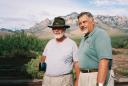
Gil and Meinte

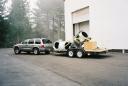
We drove to Mt. Wilson Observatory in July of 2006 to retrieve the Cole 24″ telescope, which was taken out of service in 2004 due to loss of funding. We estimated it weighed about one ton. We bolted it down to the trailer and drove it back to the front range of Colorado. We estimate that it’ll be up and running in 12-18 months. We’ll install an upgraded drive system and attach a weather station input to allow for automated weather sensing for the dome controls. The ideal configuration is to have a system that can be operated remotely without having a staff member in the dome. 

Putting together a Telescopes in Education equipment installation requires the overlap of some unusual characters. Gil Clark, the founder of TIE, and Meinte Veldhuis, President of the Little Thompson Observatory (see photo) are exactly the sort of people who are able to pull off such a thing. Gil’s (left) background is in computer science and he spent much of his career at JPL in Pasadena. Meinte (right) is a Dutch-born mechanical engineer and develops satellite payloads for an aerospace company. They are both one-in-a-million sort of guys and have the means and the vision to bring this scientific capability to a younger crowd. I tip my hat to them and the dozens of others who quietly go about this business.

What next for organic chemistry?

Due to a festering project at work I had to miss the Gordon Conference in Newport, RI, this year. I attended the organometallic session last year for the first time and found it to be a very stimulating experience.  Some background for context- My graduate & post-doc training is in organic synthesis. I did my graduate work in a group well known for asymmetric C-C bond forming chemistry in the 80’s. My post-doc was in catalytic asymmetric C-C synthesis with rhodium carbenoids.  It is with this background that I have noticed a bit of a sea change in the big ocean of Organic Chemistry.

Salve Regina and the Gordon Conference

At ACS meetings lately it seems that most of the excitement is at the INORG sessions. I’ll qualify that. The excitement for me seems to be at the organometallic sessions. Some pretty stunning work continues to pour out of the labs of the usual rock stars of academia- Bergman, Fu, Grubbs, etc. If you go to INORG talks you could see Harry B. Gray give a rousing account of electron quantum tunneling in enzymes before a packed house. It really is quite a thing to see.

Organic talks at the national meetings seem to be fewer in number than in years past. I don’t have hard numbers, but qualitatively it seems so. Since my grad school time in the 80’s we’ve seen asymmetric synthesis bloom and then go to seed as mechanisms were elucidated and high % ee’s became fairly commonplace. We’ve seen an almost fractal-like growth in catalysts come along to make transformations more efficient. We’ve seen combichem and cheminformatics multiply the efficiency of discovery.

A cryptozoology of hyphenated analytical devices have come along. They can be quite invaluable, but they can choke the budgets of anayltical departments in academia and industry alike, filling disc drives with galaxies of data and graphic user interfaces with an explosion of windows and settings. 

Have I become a Luddite?  No, but I am fussier about commiting hours and hours to learning new software and having to adapt to the machine’s “requirements”.

Obviously, the past 20 years of organic chemistry have been very fruitful. But, the Organometallic people are coming up with the really interesting new examples of organic transformations. Why the lull, why the lack of buzz at ACS meetings in the ORGN sessions? Will the upcoming San Francisco meeting be alight with some new excitement, or will it be a pageant of variations on a theme? I’ll be there to have a look.