“In order to pay for tax cuts for the wealthy, which member of your family should take a cut in Medicare, Medicaid or Social Security?
Pick one whose benefits you can chisel down or who could move in with you for 24/7 care. You’ll need to stock up on Depends disposables and grab bars in the bathroom. Should we have a louder voice in this or do we leave it to a pack of red-state Bible-belt slicksters? Looks we just blew our chance.
Abstract ideas about tax cutting for large companies and claw back of benefits all need to be personalized. Who exactly are the princely congressional GOP elites trying to impress by their talk of cutting or eliminating the social safety net? Each other? The mandarins at the various conservative think tanks? The talking heads at Fox News? The MAGA-folk just getting by? It would appear that the House and the Senate are just runways for the preening members to catwalk for validation.
Guess what? In response to the Biden’s administration’s efforts to restrict US companies from doing business with 140 Chinese companies, severe export license controls have been put in place. China has responded by banning export of materials critical to the production of semiconductors and other electronic-related articles. This includes gallium, germanium, graphite and antimony- materials required to practice much of our electronics technology. The ban includes diamonds and super-hard synthetic materials (abrasives?). Tungsten, magnesium and aluminum may be next.
The US has previously “restricted advanced semiconductor technology to companies in other countries, though it excluded companies in key allies like Japan, South Korea and the Netherlands that are thought to have adequate export controls of their own” according to Elaine Kurtenbach writing for Manufacturing.Net.
Not helping is Trump’s loud and repeated yammering about import duties. Is he unaware of China’s considerable ability to strike back? Or can’t he be bothered with details like this during his nationalistic diatribes?
Maybe the Biden/Trump Whitehouse is not aware or troubled by the extent to which China has been blessed with most of the world’s supply of many critical elements. The materials subject to Chinese export controls are included in the 50 critical minerals as identified by the US Geological Survey. Key among them are gallium and germanium. Neither of them have been exported to the US by China for a long time. Antimony shipments to the US have plunged as well.
Germanium comes from zinc refining and the US gov’t has a large stockpile. Gallium is a byproduct from bauxite in aluminum production. Antimony is often isolated as a side stream in silver, copper and lead production. Antimony is alloyed at 0.5 to 1.5 % with lead electrodes in lead-acid batteries to harden them. Antimony can be recovered from the lead.
And then there are the rare earth elements (REE). China has the largest deposits and has become unwilling to export unprocessed REEs, instead preferring to sell up the value chain. It is the business savvy way to do it, after all.
Note to readers: The post formerly titled ‘Smartphone Chemistry: An Embarrassment of Riches‘ was poorly titled and has been disappeared. This is an updated version and one titled more appropriately.
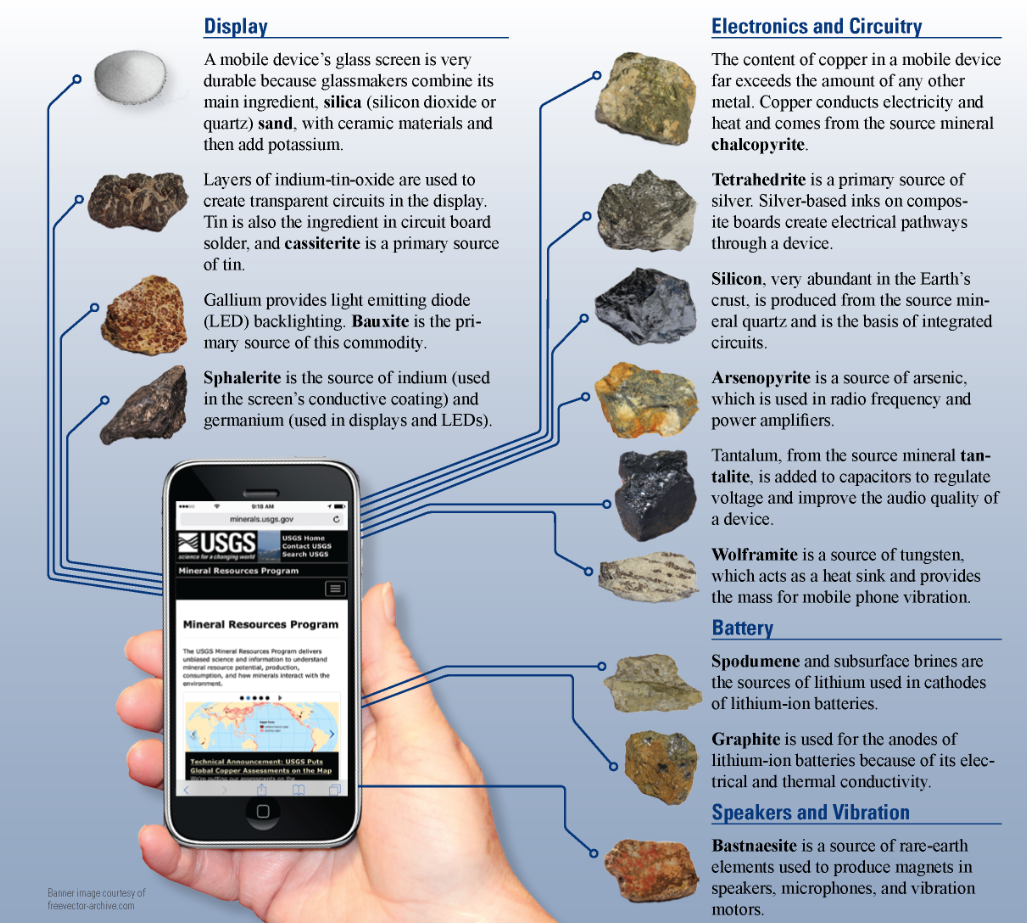
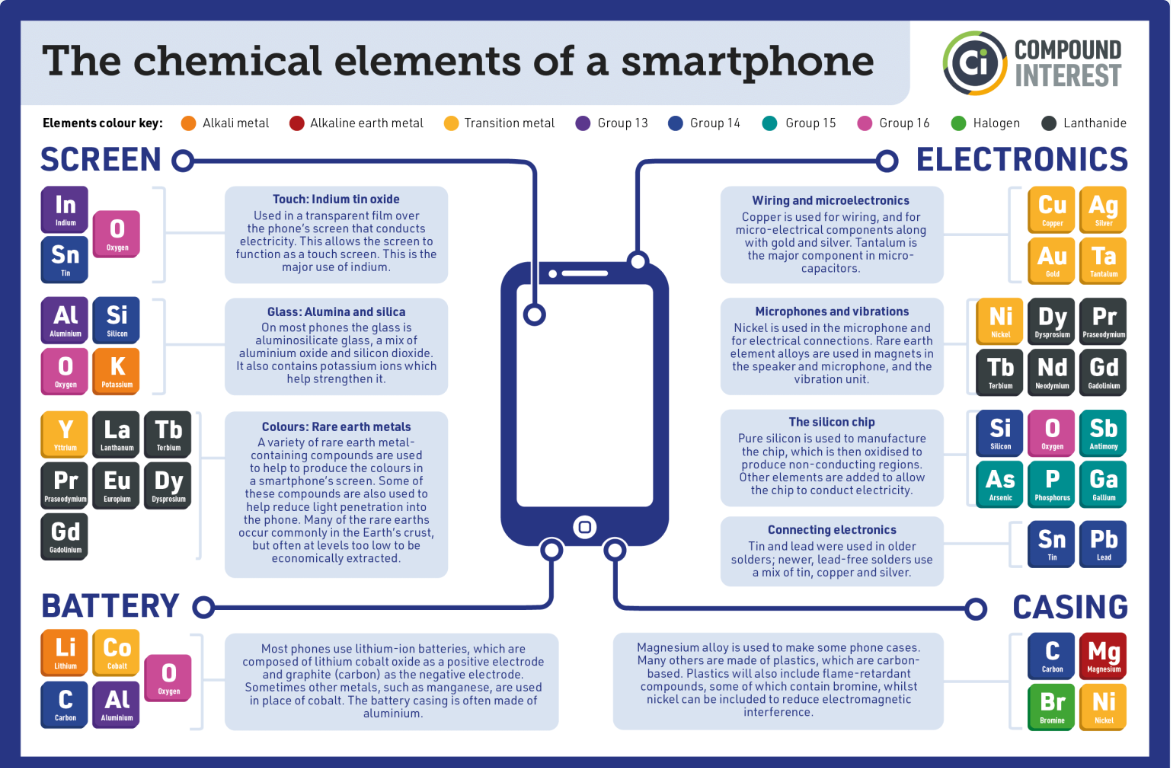
The modern smartphone is made from many different chemical elements, some much more scarce than others. The elements found in a smartphone are distributed around the world, with some countries being more favored by geology than others. With perhaps the exception of silica and silicon, the elements below are found in localized ore bodies that are enriched in particular elements in the form of minerals. ‘Enriched’ is a relative term meaning anywhere between a few 10s of percent to 100 parts per million or less. The word ‘enriched’ also implies another attribute wherein the extraction of the desired element is economically feasible. With the exception of carbon listed below, most of the elements are metals or metalloids. Metalloids are elements that are not entirely metallic but not entirely non-metallic either. Many are found in the p-block of the periodic table.
Source minerals for smartphone manufacture. This public domain image is provided by the USGS.
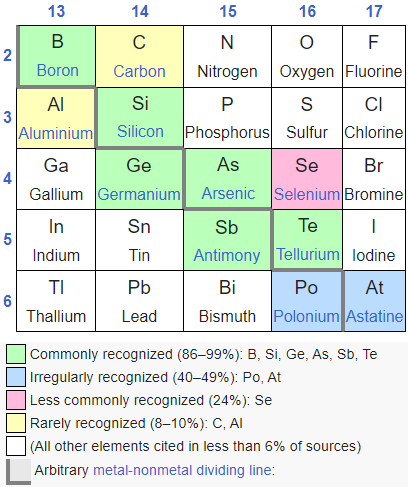
This intermediate chemical nature of the elements we call metalloids may seem a bit dodgy and imprecise, but the term metalloid, while not precisely defined,is thriving out in the big, big world. The metalloids are found in the p-block of the periodic table. Below is a partial chart of p-block elements. Elements polonium and astatine are too rare and too radioactive to be of any practical relevance. It seems as though there is some disagreement as to which elements should be in the set of metalloids.
Source: Wikipedia. The green boxes are the metalloids. They may have some limited ability to conduct electricity or heat, but little of the classic properties of metals like luster, malleability or ductility. The bottom part of the graphic shows that there is some disagreement as to which elements are properly defined as metalloids.
Here is the deal with metalloids. While they may not be used for their physical properties as other metals like in bridge or shipbuilding, their electronic properties provide valuable utility to civilization. By ‘electronic’ I specifically refer to the valence level electrons around the atoms and how they interact.
‘Valence-level’ refers to the outermost layer of atomic or molecular orbitals that are partially filled with electrons. It is at the valence-level where interactions with other atoms and molecules take place. Both the valence-level electrons and empty orbitals are where reaction chemistry occurs.
The black element boxes above represent the Rare Earth Elements (REE) and includes the whole 15 element lanthanide series plus scandium (Sc) and yttrium (Y). Note that Sc and Y are in the same column as lanthanum which is the beginning of the lanthanide series. Generally, elements in the same column share certain chemical properties like in this case the +3 oxidation state, so this is why Sc and Y are considered by some to be in the REE group. The truth is that REE is a woefully antiquated term that just won’t disappear.
“The “rare” in the name “rare earths” has more to do with the difficulty of separating of the individual elements than the scarcity of any of them.” [Wikipedia]
“..,. these elements are neither rare in abundance nor “earths” (an obsolete term for water-insoluble strongly basic oxides of electropositive metals incapable of being smelted into metal using late 18th century technology.” [Wikipedia]
All REEs share the +3 oxidation state, but some of them can have other oxidation states as well. Samarium, europium, thulium and ytterbium can be in the +2 and +3 oxidation states. Cerium, praseodymium, neodymium, terbium and dysprosium all have the +3 and +4 oxidation states. The dissimilarities do not end there. Of the lanthanides, the bookend elements lanthanum and lutetium are often not counted as REEs. The reason is that lanthanum has zero f-block electrons and lutetium has a stable, full f-block of 14 electrons, so neither participates in much f-block chemistry. Lanthanum, [Xe] 5d1 6s2, and lutetium, [Xe] 4f14 5d1 6s2, may be better considered as d-block transition metals.
Snorkeling in Deeper Waters: The notation for the electronic configuration of the elements has a long and an abbreviated form. For heavier elements like lanthanum or lutetium, it is convenient use the abbreviated form showing the nearest noble gas with its orbitals filled- in this case it is xenon, abbreviated [Xe]. Now the orbital levels are filled according to a few rules that look like this for lutetium- [Xe] 4f14 5d1 6s2 . This shows that the f-orbitals are filled with their 14 f-electrons and that the remaining three electrons, 5d1 6s2, are left in partially filled s- and d-orbitals. Filled energy levels (like f14) are very stable and are often quite inert. The three remaining 5d1 6s2electrons are available for chemistry, namely to be removed to form Lutetium (3+).
The lowest energy arrangement in which electrons naturally organize themselves under ‘ordinary’ conditions around an atom, molecule or ion is called the ‘ground state’. In the ground state all electrons occupy the lowest energy and oddly shaped regions of space called orbitals, with a maximum of two electrons per orbital. Orbitals are places, not things. There is plenty of information on this quantum chemistry business on the interwebs.
A walk on the wild side
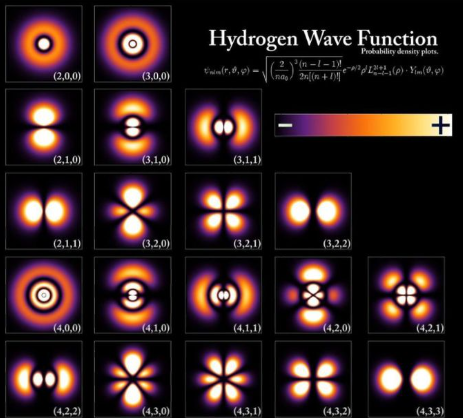
Source: Pinterest. This is a spherical harmonic series of wave functions (orbitals) defining the space that electrons can occupy when in orbit around an atomic nucleus. Each can be occupied by two electrons, but with opposite spins- ‘spin up’ and ‘spin down’.
In the image of atomic orbitals above, each orbital can ‘contain’ one or two electrons. Rather than say ‘contain’, let’s say that the orbitals describe the region of space where the one or two electrons have some probability of being found, depending on their energy. The greater the chance of finding an electron in a particular space, the greater it’s probability density. Note that the orbitals have fuzzy edges. This is because the probability density doesn’t drop abruptly to zero at the edges but rather tapers off. The Uncertainty Principle tells us that it isn’t possible to know both the momentum and the position of a particle simultaneously to high level of accuracy. It turns out that quantum mechanics can’t tell us where an orbital electron is from moment to moment. What it can do is to provide a coherent set of rules for the manner in which electrons are ‘stacked’ in the orbitals as the orbital energy changes.
Alright, we’re back
Scandium and yttrium are d-block transition metals but are sometimes lumped in with REEs because they share the Group IIIB column with lanthanum. The elements cerium through ytterbium do participate in the chemistry of f-block electrons and when REEs are spoken of, there is a good chance that the elements Ce thru Yb are the topic. Is the terminology really as higgledy-piggledy as it appears? Ah, yep.
All of the materials found in electronic devices are there as a result of performance optimization by the manufacturer’s R&D. Many elements are quite expensive, such as indium. The performance uptick from expensive elements must translate into increasing EBITDA. C-suite careers live and die by quarterly and annual EBITDA. Increased performance can be in many forms like longer battery life or increased electronic performance in a chip. Chips require electrical conductors, semiconductors and non-conductors. This is the realm of material science which overlaps with chemistry.
Some of the material science challenges facing smartphone makers might seem a bit arcane. For example, when putting down a layer of material on a chip, will the substrate be wetted by the new layer so that the surfaces contact as desired? An engineering solution may require that a compatibility layer be put down first. Or do the materials have the desired dielectric constants? If you want capacitance in the device, a dielectric layer that is easy and cheap will be required. If you are doing vapor deposition, then the low dielectric material must come from the vapor phase at elevated temperatures. Can it withstand the temperature? Do your semiconductor devices have the desired band gap? What elements affect this? What kind of chemical purity is needed for your CVD or ALD process? Four, five, six or seven nines purity (99.99 % to 99.99999 %)? The more nines of purity specified the more expensive the material and the fewer suppliers there may be.
Companies search all over the periodic table for substances that boost performance and keep Moore’s Law going. All of this must be done in a field full of patent land mines that you don’t want to step on. Invention can lead to big trouble for the unwary.
It is my sincerest hope that someday mankind will develop a coffee pot that does not dribble when pouring water into the water reservoir of a drip coffee maker. As a chemist and one with no little expertise in the pouring of liquids, I’m shocked at the careless and wanton disregard for such a fundamental aspect of life. Isn’t the marketplace supposed to mop up problems like this? The invisible hand of the market is busy pleasuring itself elsewhere, I suppose. Ya know, it does that quite often.
For the love of Pete and all that is good and worthwhile, won’t some industrial designer step up and see to this?
Added after posting
There is a solution to this problem, apparently. Applying a light coating of beeswax to the lip of the coffee pot allegedly solves the problem. Makes sense, I suppose. A wax coating prevents water from following the surface to the outside of the pot. The beeswax is a hydrophobic coating with low surface energy. In principle, any hydrophobic material should work.
Come to think of it, certain glass chemical bottles and jugs have a polymer ring on the sealing surface of the glass bottle or jug. I’ve noticed that after dispensing a polar liquid from a jug that the polymer fitting on the sealing surface does not wet, but the liquid will form beads. The polymer ring could be a flat sealing ring or a dribble-proof surface or both. Nice to have when pouring conc sulfuric or triflic acid.
Thanks to the Berlin Packaging Company for posting the splendid graphic to the interwebs.
Source: Berlin Packaging. The names of the various parts are there because they are important to the bottle manufacturer. Imagine the conversation- “Say Andrea, did you notice that the neck ring is a bit fat?” Or, “Bob, what’s the deal with the shoulder? The radius of curvature is too small. Crimony sakes alive! The Acme Blinker Fluid Company is really going to be hacked off.”
I posted this essay December 19, 2016, and am reposting it with some editing today, November 22, 2024.
Much as I would like to indulge in witty and ironic commentary about the results of the 2016 general election, it would be yet another steaming load of pathetic word paste gumming up the internet. There are no words or sentences you could construct that would make a meaningful difference in the direction our wobbling American culture seems headed for.
I’m left with the conclusion that only civil disobedience can disrupt the unholy congress of corporate media, banking, energy and the foetid red-light district of governmental-industrial conjugation. After all, aren’t the B-school gurus always going on about disruption? It’s good, right?
Could it be that donors and lobbyists amount to a 3rd house of Congress?
Enormous corporations, it seems, no longer have need of our democratic republic. Fortunes are stashed abroad, sheltered in tax havens lest a slice finds its way into public kitty. Corporations benefit from the use of American infrastructure- you know, public education, Army, Navy, Air Force, Marines, Coast Guard, Border Patrol, FBI, FDA, NIH, NASA, NSF, public highways, airways, NOAA, etc., etc. Deregulation is creeping forward. We live in a period of reconstruction. Neoliberal doctrines are taking hold in state and federal government.
America has become a big barrel of fish, stunned by the high voltage of short life-cycle consumer goods and ever spiraling planned obsolescence. Neoliberalism seeks to help businesses harvest these fish. We relent and become increasingly compliant with the tightening harness of ever advancing complexity and the cloying whispers of big data and AI.
Neoliberalism has hoped for this moment for decades when a character like Trump and both houses of congress filled with MAGA Republicans take control the government. Project 2025 is a grocery list of desired policy reforms the bastards have been wanting forever. Like the quivering desire of a lusty 18-year-old, capitalism knows only one thing- that it wants more. Always more and in bigger gulps. The acceleration of dollars over time squared must be greater than zero in perpetuity. Our brains soon grow tired of static luxury and comfort. Satisfaction is only transient.
The invisible hand of the market, we’re told, will surely trickle down a baptism of unexpected benefits to the masses, if only the rotten buggers would let the acquisitive 1 % have their way. After all, if your taxes are lower, the first thing a business owner will do is to add hirelings. Right? Wrong. The extra profits will be socked away. Why hire people if demand is level but taxes drop? This libertarian dream was fomented in the early Reagan years as supply-side economics postulated by economist Arthur Laffer and his famous curve.
In the inflationary period we are just coming out of, why not raise your prices 25 % even though your costs have only risen 10 %? If other companies are raising their prices, raise yours by a like percentage to match. Your price increase may be taken by customers as part of the wide-spread inflation. After all, price is what the customer is willing to pay, right? If they are accustomed to inflation elsewhere, maybe they will just pay your new price, bogus as it may be.
The gospel of laissez-faire is practically physics if you listen to the economists and B-school graduates. A force of nature both inevitable and irreducible. Capitalism is fine if you have capital to use. If your capital is your own stoop labor or assembly work, then maybe it isn’t such a great thing.
Taking to the streets is a form of persuasion that has rewarded many movements here and abroad. In thermodynamics, power is the rate at which work is done through the transfer of energy. Anthropological power lies in the ability to allocate and focus resources on a need or desire. Money is power because for a price, you can persuade someone to get most anything done. There is no shortage of those who would step up to the challenge or sell their souls or accept any spiritual disfigurement for the hefty jingle of lucre in their pockets.
If the tin ears of corporate media are deaf to the reasoned voices of those who don’t buy advertising, then what is left for us to do? In this general election cycle a species of disrupter was reelected president. This charismatic fellow can work a crowd like Castro or Hugo Chavez or Mussolini or (add your own dictator)? A large crowd in the spell of a colorful and grandiose orator seeking high office meets the show business (i.e., news) definition of “compelling.” If the event results in fisticuffs or tempers flaring like Roman candles, so much the better. Media is hyper-focused on “compelling”. Either as a savior or a freak show, Trump attracts the eyeballs and pumps up the ratings. He has been on television every day somewhere for over 8 years.
Electronic news broadcasting is to a large extent a freak show. The whole news industry exists because of our irresistible primate compulsion to stand and stare. A key element of a good story is conflict. Look at any movie. The writers take a sympathetic character and do terrible things to them. There is a chase, violence, intrigue and reconciliation with a twisty ending in three acts. Sound familiar? TV is constructed to do this and they are good at it. And it sells. Watch Chomsky’s Manufacturing Consent.
Civil disobedience, as opposed to mere picketing, makes meaty footage because there is the possibility of imminent violent conflict. It is compelling. As an exercise in power, though, immediate resolution rarely happens. The power aspect comes to play when and if establishment politicians are forced to face reelection. Often establishment authority is refractory to public scrutiny. But when voter support disappears, it can fold like a lawn chair.
To overcome Trump we must put together compelling footage for broadcast.
Having been born, educated and now nearing retirement from a scientific career in the USA, there are things about this country I am proud of and things that I’m ashamed of. I take ‘pride’ to mean that ‘I value my association with’. I take ‘shame’ to mean my negative reaction to and regret with certain instances of moral turpitude.
What shame I may have in my country’s actions and policies over time isn’t necessarily due to uniquely American traits. We’re humans after all with all of the pluses and minuses that go with it. However, the pluses and minuses in conjunction with our burgeoning economic power over time and the rich natural resources we hold allow us to impose our will with in-house treasure. Conveniently, we don’t have to invade another country for oil or iron ore to drive our industry. However, our lust for cheap oil & gas has led to considerable trouble.
American Pride
I’m proud of the founders who disconnected from Great Britain despite the sacrifices in blood and treasure during the late 18th century and founded this unique republic. While the founders wisely developed a founding document to avoid the problems of monarchy and establish a functioning republic, there were significant omissions such as banning slavery or establishing equal rights for women.
I’m proud of our steady progress in all of the various technologies that have removed the sharp edges from what nature has historically imposed on us: Disease, predation, high infant mortality, brief lifespans and primitive life. In many ways the march of technological advancement has been a benefit to all of us and the rest of the world as well.
I’m proud of the advancement of women, albeit too slow, in our civilization. The march forward is not nearly finished, but to have advanced women from chattel to some level of equality is a plus.
I’m proud of our country for the advancements made towards global peace and prosperity since WWII. The years of our liberal democracy since then are unmatched in history.
I’m proud of the positive global interventions for peace we’ve made since the start of WWI.
I’m proud that my country has been a prominent global influence for peace and justice.
I’m proud of my country’s positive moral actions toward feeding the hungry and spreading medical care.
I’m proud of our periods of military restraint and our caution with nuclear weapons after having once used them.
I’m proud of America’s role in restraining Chinese, Japanese, Russian and Soviet imperialism.
American Shame
I am ashamed of our part in the worldwide patriarchy and the lethargic progress towards equal rights for women.
I am ashamed of the horrors that befell the Native Americans throughout the American settlement of North America. The murderous expansion by fortune-seekers and land-grabbers across the continent and the penury and ten thousand privations forced on them is inexcusable and remains a bloody disfigurement on the American character.
I am ashamed of our part in the slavery industry in the Americas and the number of people who had to die in a bloody civil war to end it.
I am ashamed of my country’s covert meddling into the affairs of other nations as in Southeast Asia, South and Central America, Cuba and elsewhere.
I am ashamed of the many wars and conflicts we have participated in over absolutist ideologies and the deep senselessness of our political parties.
I am ashamed of our enthusiastic part in the development of nuclear weapons and our perverse cleverness in optimizing their design.
I am ashamed of the influence of capitalism on internal and foreign policy and the greedy idolatry it brings.
I am ashamed of the neoliberal right turn the country is presently taking and the acceptance of autocratic enthusiasm asserted therein.
I am ashamed of America’s reelection of a felonious man of low moral character and proven dishonesty and especially the large-scale support he enjoys among voters.
Trump and his MAGA followers are now preparing to decapitate the government of the USA. It is outlined in the Project 2025 document put together by the Heritage Foundation. The overall goal is to increase presidential power and set in place an ultra-conservative government. Part of that plan is populating the federal bureaucracy with politically reliable conservatives in addition to appointments. This is a kind of political ballast designed to keep the GOP takeover sailing along in an upright posture.
I say ‘decapitation’ because our present liberal democracy is in danger of disassembly by the wild-eyed MAGA version of the GOP. Below I have copied a definition verbatim from Wikipedia of a description of ‘Liberal Democracy’. The links were left intact for your convenience.
What is set to happen to the federal government is something that until now has only been dreamt of by libertarian-minded citizens. To complicate matters, very early in the Reagan administration the Moral Majority took up the cause of libertarian republicanism but added its own flavor of supernatural (read protestant) favoritism. Yes, it seems that the invisible Celestial Being had been watching American politics very closely and became alarmed enough to place Jerry Falwell as his earthly avatar. Now the GOP is backed by Jesus himself. What a credential.
I’ve always felt that Trump was best suited to be an after-dinner speaker, which, I’m sure he has done many times. He is an excellent speaker and carries the gravitas of a billionaire TV star. He was the golden boy of NYC until, well, you had a closer look.
Many are saying now that Trump is pulling his cabinet from his junk drawer of supporters. His latest nomination is former WWE CEO and billionaire donor Linda McMahon for the position of Secretary of Education. If you’re wondering what WWE is, it is World Wrestling Entertainment and it turns out that Trump was inducted into the WWE Hall of Fame in 2013. His history with WWE goes back to WrestleMania IV in 1988. That said, I’m confident that he has never been pinned to the floor while wrestling. Trump comes from the TV entertainment business and well knows the power of celebrity.
McMahon has no evident credentials for any cabinet post in DC, as if that mattered. She’ll just be one of the many lackeys in the obedient wrecking crew in place to decapitate the federal government. She comes from the TV wrestling business which, as we all know, is not so much a sport as a burlesque.
Robert F. Kennedy, Jr., is Trump’s pick to head ___. He seems to be a genuine crackpot with righteous ancestry. During COVID-19 he gained notoriety for his anti-vaccination stance. He was no friend of trump in 2016 either. He was captured on tape saying, while quoting Taibbi’s writing, “‘We may not have that many outright Nazis in America, but we have plenty of cowards and bootlickers, and once those fleshy dominoes start tumbling into the Trump camp, the game is up.” Fleshy dominoes. Love it.
Dr. Mehmet Oz is Trump’s pick to head the Centers for Medicare & Medicaid Services. The former surgeon and TV show host got his start appearing with Oprah, eventually peeling off to a show of his own. He comes from the TV entertainment business. His choices and public exposure has led to scandal.
Donald Trump on Monday nominated former MTV “Real World” contestant and current Fox News host Sean Duffy as Transportation Secretary. He comes from the TV entertainment business- Fox News.
Pete Hegseth of Fox News is Trump’s nominee to lead the Department of Defense. Many of us didn’t know that the Secretary of Defense was an entry level position- all these days I’ve been aiming too low. He comes from the TV entertainment business and the House of Representatives.
And perhaps the most ridiculous lackey nomination of all is Matt Gaetz as Trump’s choice for Attorney General, the chief law enforcement official. I can’t bear to think about it. Heavy sigh.
Good news- Gaetz removed himself from consideration for Trump’s AG. He has been replaced with former Florida AG and Trump loyalist Pam Bondi.
Another day of grinding tedium at work. I’m rattling around in the ever-diminishing operating space of EPA regulatory compliance, bouncing off the statutory walls. Between myself, an industrial organic chemist, and a regulatory toxicologist we attempt to convince EPA that no, we will not be splashing new chemical substances (NCS) over workers and the environment. We are legally bound to be truthful and disclose any and all tox data there might be on an NCS. We have the full support of a very safety-oriented management. Our business practice and mission statement mandates that we be in compliance. We are strictly business-to-business and not a single thing goes directly to consumers or is meant to be strewn about in the environment. Everything we make is meant to have a temporary existence. Every single bit of chemical waste goes off-site to incineration.
EPA levies fines that are based on a per day, per violation basis. This can rack up the cost of an incident to a company dramatically. Civil action fines can be up to $37,500 per day per violation to a maximum of $295,000 for a Clean Air Act violation. And, even if they cannot pin a specific violation on you, there is still the General Duty clause (same as with OSHA). Companies commonly lawyer-up when dealing with EPA (and OSHA) on a violation matter because not only are there the CFRs, but case law as well to understand. Only a fool does not bring in a specialist lawyer.
All this being said, the folks who review our applications for commercial production are deeply skeptical about everything and require evidence of claims. They are statutorily obligated to approve commercial production only if there is no “unreasonable risk” to workers, the public or the environment. EPA’s use of unreasonable risk substantially relies on numerical data. In the case of missing data, they use computer models to estimate exposure if there are analogs. The human health group uses the exposure data to guide them through the maze of health effects possible.
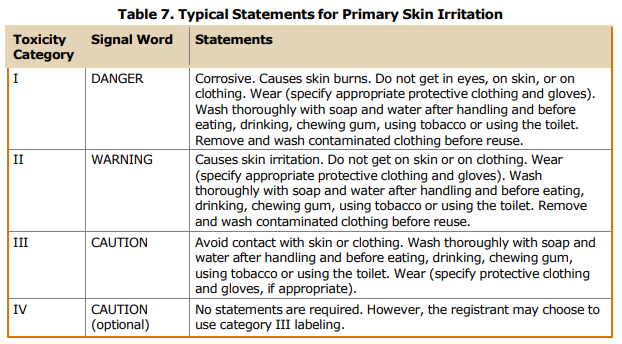
One thing I have learned from my toxicologist colleague is that health effects that I thought were easily described as “irritant” or “corrosive” are actually full of subclassifications. It’s not enough to say on the Safety Data Sheet not to breathe it or get it on you. There are categories of hazard that matter and must be ascertained by testing.
The upshot is that EPA takes exposure to new chemical substances very seriously and does their best to protect everyone and the environment from unreasonable risk. The “trick” to getting them to approve the commercial manufacture of an NCS is to have proper engineering controls in place, industrial hygiene data, appropriate PPE and compliant waste management. OSHA defines proper engineering as being Recognized And Generally Accepted Good Engineering Practices–RAGAGEP. This should be followed anyway, irrespective of regulatory compliance.
EPA has been accumulating public comment on its impending ruling on the phaseout of methylene chloride (dichloromethane, DCM, CH2Cl2). This might lump together fine chemical and pharmaceutical manufacturing with paint stripping and degreasing.
The present situation is one whereby a large swath of the population, including K-12 students, are being exposed to an increased risk of bloody, violent death sustained by those who fetishize firearms. Whatever you may think of the 2nd Amendment to the US Constitution, the fact is that we are prioritizing an originalist interpretation over the lives of school children. We are allowing children to be sacrificed on the alter of the 2nd Amendment in order to satisfy people who idolize the idea of boundless access to metal tubes that discharge high energy bits of metal. We are not officially at war defending our borders in the US nor are we on the verge of a civil war. By far, most guns are not used to hunt. Most Americans lead peaceful lives in their neighborhoods without the need to shoot at people.
The very notion that the US government is going to wrench guns away from citizens in one of the most heavily armed democratic countries in the world is the fever dream of a fool. Any full-scale attempt to do this would lead to armed rebellion and the collapse of the USA as a democratic republic. Widespread gun confiscation is not politically feasible today or in the foreseeable future.
We must tone down and be less tolerant of the image of inflated machismo that guns confer to their users. Both in real life and in entertainment, gunplay is used to resolve conflict. By far, most gun owners do not commit violent acts with their guns. While they should not be penalized for the crimes committed by others, accepted mechanisms like driver’s and pilot’s licenses are a form of limitation and standardization that could be applied to access to firearms. But this reliably produces hysteria among the armed public. Like everything else in society, a few people have to ruin it for the rest of us.
The basic utility of a gun is to deliver crippling or fatal kinetic energy, or the threat of it, from a safe distance. The need for guns for peacekeeping use will last as long as there is dangerous criminality. What the US is presently suffering from is the use of rapid-fire, high-energy projectiles from guns designed to hit as many targets as possible in the shortest time. Man killers.
Sidebar
I took the hunter’s safety course sponsored by the NRA at the age of 9. The truth is that firing a gun is both fun and stimulating. I recall stealthily walking along a muddy creek in the Iowa countryside with a bolt action 0.22 caliber rifle desperately looking for some reason the fire the gun. I spotted fish, turtles and birds but something held me back from shooting at them except for once a few years later. With a BB gun I shot a sparrow perched on a small twig of an elm tree. The bird rotated backwards, still gripping the twig, and hung upside down for a minute or two. Then it released and dropped into an irrigation ditch with a small splash.
I was immediately gripped with regret and sorrow for what I had just done. I had just killed a random sparrow for utterly no reason than to see what happens. Even as a teenager I could see that this was a senseless action. I am sorry for killing the sparrow to this very day and, except for a few mice and bugs, I have never killed wildlife since.
Back to the essay
The point of the story above is that, for me, being in possession of a firearm could sometimes produce a strong urge to fire it. I’m confident that there are others who have felt the same way. The healthy release is to do target practice. Some people enjoy hunting. I do not indulge in this because I prefer the flavor of beef, pork and fish which, conveniently, are already butchered.
Male characteristics can have both good and bad attributes. A measure of focused male aggressiveness, ambition and territoriality can be beneficial for the wellbeing of loved ones and the community. Brute strength can be quite useful in providing for a family. Male rage, however, can be very destructive wherever it is directed, as we all know. A firearm or other weapon is a force multiplier for a raging male. Recent mass killings prove the point. Firearms provide the ability to kill or wound from a safe distance and the value of this is lost on no one.
It is hard to imagine that some restraint in the use of firearms without addressing the cultural and natural phenomenon of male aggression can be successful. We are saturated with violence in entertainment, on the streets and in the news. As long as we seek entertainment violence, show business will anxiously provide it.
I’m neither a Quaker nor a pacifist but I do admire their sincere dedication to non-violence. We need many early adopters of non-violence with considerable social standing and a non-violence vibe across the whole country. Destructive male behavior can be tamed to a great extent, but it has to start early and be immersed in non-violent surroundings. Where is the sign that Americans can summon the discipline to do it. I’m not seeing it.
Note: This post appeared May 15, 2007, as “Infotainment, Chemistry, and Apostasy“. I have pulled it up through the mists of time for another go and with a few edits.
In the normal course of things I used to give school chemistry talks or demonstrations a couple of times per year and until recently, I had been giving star talks at a local observatory more frequently. The demographic is typically K-12, with most of the audience being grades 3-8. From my grad student days through my time in the saddle as a prof, I was deeply committed to spreading the gospel of orbitals, electronegativity, and the periodic table. I was convinced that it was important for everyone to have an appreciation of the chemical sciences. I was a purist who knew in his bones that if only more people were “scientific”, if greater numbers of citizens had a more mechanistic understanding of the intermeshing great world systems, the world could somehow be a better place.
In regard to this ideology that everyone should know something about chemistry, I now fear that I am apostate. I’m a former believer. What has changed is an updated viewpoint based on experience.
Let me make clear what science is not. It is not a massive ivory tower that is jealously guarded ajd intended to be impenetrable by mortal folk. Big science requires big funding and organizational support, so big administrative structure forms around it. At its core, science is concerned with learning how the universe works by observation, constructing a good first guess (theory) on what is happening, measurement (conducting quantitative experiments), analysis (quantitative thinking), documentation and communication. The common understanding is that a scientist is someone who has been educated and employed to do these activities. However, anyone who conducts a study of how some phenomenon happens is doing science whether for pay or not.
What science has learned is that the universe is quite mechanistic in how it works. So much so that it can be described by or represented with math. At the fundamental level of ions, atoms and molecules, constraints exist on how systems can interact and how energy is transferred around. At the nanometer-scale, quantum mechanical theory has provided structure to the submicroscopic universe.
Chemical knowledge is highly “vertical” in its structure. Students take foundational coursework as a prerequisite for higher level classes. Many of the deeper insights require a good bit of background, so we start at the conceptual trailhead and work our way into the forest. But in our effort to reach out to the public, or in our effort to protect a student’s self-esteem, we compress the vertical structure into a kind of conceptual pancake. True learning, the kind that changes your approach to life, requires Struggle.
What I found in my public outreach talks on science- chemistry or astronomy- was the public’s expectation of entertainment. Some call it “Infotainment”. I am all in favor of presentations that are compelling, entertaining, and informative. But in our haste to avoid boredom, we may oversimplify or skip fascinating phenomena altogether. After all, we want people to walk out the door afterwards wanting more. We want science to be accessible to everyone, but without all the study.
But I would argue that this is the wrong approach to science. Yes, we want to answer questions. But the better trick is to pose good questions. The best questions lead to the best answers. People (or students) should walk out the door afterwards scratching their heads with more questions. Science properly introduced, should cause people to start their own journey of discovery. Ideally, we want to jump-start students to follow their curiosity and integrate concepts into their thinking, not just compile a larger collection of fun facts.
But here is the rub. A lot of folks just aren’t very curious, generally. As they sit there in the audience, the presentation washes over them like some episode of “Friends”. I suspect that a lack of interest in science is often just part of a larger lack of interest in novelty. It is the lack of willingness to struggle with difficult concepts. But that is OK. Not everyone has to be interested in science.
Am I against public outreach efforts in science? Absolutely not. But the expectation that everyone will respond positively to the wonders of the universe is faulty. It is an unrealistic expectation on the 80 % [a guess] of other students who have no interest in it. I’m always anxious to help those who are interested. It’s critical that students interested in science find a mentor or access to opportunity. But, please God, spare me from that bus load of 7th graders on a field trip.
What we need more than flashier PowerPoint presentations or a more compelling software experience is lab experience. Students need the opportunity to use their hands beyond mere tapping on keyboards- they need to fabricate or synthesize. You know, build or measure stuff.
It is getting more difficult for kids to go into the garage and build things or tear things apart. Electronic devices across the board are increasingly single component microelectronics. It is ever harder to tear apart some kind of widget and figure out how it works. When you manage to crack open the case what you find is some kind of green circuit board festooned with tiny components.
And speaking of electronics or electricity, I find it odd that in a time when electric devices have long been everywhere in our lives, that so FEW people know even the first thing about electricity. I instruct an electrostatic safety class in industry and have discovered that so very, very few people have been exposed to the basics of electricity by graduation. I spend most of the course time covering elementary electrostatic concepts along with the fire triangle so the adult learners can hopefully recognize novel situations where static electric discharge can be expected. Of course, we engineer away electrostatic discharge hazards to the greatest extent possible. But if there is a hole, somebody will step in it. It’s best they recognize it before stepping into it.
The widespread educational emphasis on information technology rather than mechanical skills ignores the fact that most learners still need to handle things. There is a big, big world beyond the screen. A person will take advantage of their mechanical skills throughout their life, not just at work. Hands on experience is invaluable, in this case with electricity. Computer skills can almost always be acquired quickly. But understanding mechanical, electrical and chemical systems need hands-on experience.


 Lamentations on Chemistry