Wow. I think I’m finally tired of blogging. Perhaps the time has come to move on to other things. I’ll go to the end of June and decide then.
Blogga Boatman
7 Replies

Wow. I think I’m finally tired of blogging. Perhaps the time has come to move on to other things. I’ll go to the end of June and decide then.
My search continued today for an exposed contact between the upthrusted proterozoic igneous rock of the Rock Mountains and the Fountain sandstone formation. I returned to an obscure roadcut site I had examined a few months ago. Three (male) cyclists outfitted in expensive cycling couture (Spandex) were standing there nibbling on dainty little energy snacks next to the spot I needed to be as I pulled up and exited my vehicle with a rock hammer in hand. One seemed taken aback momentarily as I walked towards them with the chisled masonry hammer. It didn’t dawn on me until after they left why they were acting strangely- I startled them. Sorry fellas! \;-)
With rock hammer in hand I scrambled up a steep and unstable scree slope adjacent to what appeared to be disturbed layer next to a gneiss formation. Down below, along the roadcut, a contact was visible between the gneiss and what appeared to be schist. This dark material has a preponderance of mica with little gross evidence of stratification. I wrongly concluded that I was not near the proterozoic contact.
But as I followed this discontinuity further up the mountain I found clear evidence of a stratified sedimentary formation adjacent to the igneous rock. On a ledge high above the road I found an actual contact between what appears to be modified sandstone and gneiss. I found a sample that has the gneiss fused onto the layered rock that fractures into thin sheets much like sandstone or shale. Regrettably, I left the camera in the Jeep.
What appears to have happened is that the sandstone layer has been thermally modified along the interface due to the intimate contact with the upthrusted igneous rock. I had half-expected to see a simple interface between sandstone and an igneous rock. Instead, what I seem to be seeing at this site is a modified sedimentary layer that shows evidence of some localized metamorphic modification.
A nearby thin layer of rock in the interface zone appears to be glassy or vitrified, as though it has been partially melted. I do not interpret this to be a result of weathering. A rapidly approaching lightning storm forced me to cut my exploration short and run for cover.
So, I have some hypotheses beginning to take shape. Now the question is, how do I falsify my interpretations? I certainly have much to learn about petrology.
“Will ya shut up already? You talk worse than six barbers!”
Uncle Junior The SopranosAn excellent entry into interesting and high quality articles on the net can be found at Arts & Letters Daily. I found an interview of physicist Freeman Dyson. In the interview, the writer is trying to understand how someone of Dyson’s stature could be skeptical of anthropogenic global warming. Basically, Dyson is skeptical of the models used and is skeptical of the assumption that the pre-industrial climate is automatically a valid baseline climate. Dyson accepts that there may be more desirable climate scenarios and that climate change is not automatically bad.
What is lost in most of the public discussion is the history of climate over the past million or so years. The fossil and geological record does not support the assumption that the global climate is static. We’re presently 10 or 12 thousand years past the latest glaciation episode in a series of glaciation episodes. As I recall, the interglacial periods in North America have averaged something like 10-15 thousand years.
What happens to atmospheric CO2 levels as the temperature rises or falls? Does rising atmospheric CO2 lead to a temperature rise or is it a result of a temperature rise? I have not encountered an adequate explanation taking into account the temperature sensitivity of carbonate equilibrium.
CO2 is not an inert substance. It reacts strongly with water to form carbonate. Obviously CO2 will get absorbed by the biosphere. Do the atmospheric models take the various carbon sinks into account? Perhaps a reader knows.
Water vapour is a potent greenhouse gas and is certainly more abundant than CO2. It must account for some aspect of atmospheric temperature change. Do cloud aerosols and sea spray absorb significant CO2? It’s kinda complex.
My final attendance at the National Organic Symposium was Wednesday evening. An award was presented to editor-in-chief, Scott Denmark, on behalf of the monograph series Organic Reactions. The original editor was none other than Roger Adams. Denmark presented a retrospective slide show on the history of Organic Reations.
The speaker for the evening was Prof. Paul Wender from Stanford. Wender presented a long but fascinating talk on his work with several complex molecules including bryostatin. I have to say that I was rather blown away by this work. I guess I’ve been living on a desert island.
Wender has the great fortune of having access to facilities and people who can do complex chemical synthesis and biological assays and all of the other wondrous things that are necessary to rapidly expose a valuable biopharmaceuticals. The payoff is that questions relating to the biological activity of particular derivatives can be answered rapidly and productive leads can be isolated and further cultivated.
This confederation of resources is perhaps as important to Wender’s productivity as anything. My point is that to be a Wender, you need more than just smarts and money. You need a network of like-minded coworkers whose particular strengths can mesh with yours to produce these kinds of results. I think that his ability to pull together these kinds of resources is just as impressive as his native ability with chemistry.
Bad day for Th’ Gaussling to be away. The hounds are snapping at my heels at work.
I managed only to see Eric Jacobsen‘s talk on catalytic urea chemistry. Jacobsen’s system is pretty much a chiral proton ligand that can carry along a nucleophilic counter anion. Configured differently, urea’s and thiourea’s with BARF groups on the nitrogen can coordinate with chloride. This can lead to the abstraction of chloride to give a carbenium ion that can then participate in a enantioselective Pictet-Spengler type reaction.
Jacobsen’s system resembles a radically stripped down enzyme in terms of 3-point binding interactions by hydrogen bonding. Where Jacobsen went askew is the use of calculations to justify his mechanistic model. The models did not include solvent interactions when affording only 0-2 kcal/mol (!!) differences in energy. Naturally this did not set well with certain distinguished members of the Audience. The ΔΔG’s did not correlate with the ee’s at all either.
A certain J.D. Roberts took great exception to Jacobsen’s molecular modeling results, resulting in the spectacle of a Harvard Professor frantically qualifying his slides and words as he back pedalled for all he was worth. There was some actual contrition there on the stage. It was quite a thing to see. There but for the grace of God go I.
The speakers for the morning of June 8th were Bob Grubbs and Magid Abou-Gharbia. As usual, Bobby Grubbs’ talk was concerned with the latest wonders of olefin metathesis. We saw ATM’s of molecular Cheerios. Pretty cool, actually. Grubbs got the trip to Stockholm for a reason and the work of his group continues to produce molecular wonders. He was able to demonstrate the production of rings with degrees of polymerization in excess of 5000. Using NMR and a carefully chosen ring monomer, they could sort out linear polymers from cyclic polymers. Linear polymers will thread a crown ether while the cyclic form will not. By attaching a crown ether (24-crown-8 ??) to polystyrene beads, they could collect and physically separate the linear from the cyclic forms. They were also producing brush polymers.
Prof. Magid Abou-Gharbia, Temple University, gave a talk with lots of fascinating insights into some current thinking on industrial drug discovery. At least from the point of view of a former Wyeth guy. I have been away from the pharma-related work for a number of years now and haven’t really missed it. But his talk has revived enthusiasms in me that have been in a long slumber.
Anyway, he described the development of the anti-depressant Effexor and their efforts to keep the molecule simple and free of excessive stereocenters. Studies of the metabolism of Effexor lead to the discovery of the des-methyl analog, now called Pristiq.
Concerning High Throughput Synthesis (HTS)-
“… you’re going to get a lot of decorated molecules, but they are not going to be biopharmaceutically useful.”
Abou-Gharbia lamented the languishing of natural products chemistry. He gave some examples of Rapamycin work, which according to his presentation, was originally isolated from a soil sample from Easter Island. Much productive work apparently has been derived from the modification of this macrocycle. It’s all in the literature.
One of the main take-away lessons from Abou-Gharbia is that workers shouldn’t get too focused on SAR. His advice was that structure-property relationships need an early examination as well. Dual optimization. If the bioavailability is low, then the in vivo activity will not match the in vitro activity- an expensive and time consuming realization.
We were treated to two hail storms today. The last one was unusually generous in the size and volume of hailstones that issued from the sky upon us. The jeep picked up a few dimples on the hood. Several tornados were spotted in the Denver metro area- It provided some real excitement for the emergency people besides the usual fare of grisly car wrecks and domestic abuse calls.
A low level easterly upslope flow injected humid, unstable air into westerly higher level flows. The result? A large scale shear zone with lots of convection potential. Vigorous convection and lots of moisture energizes hailstone growth.
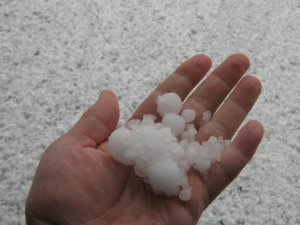
Hail Gaussling!
Work is progressing on the new dome at the LTO. The observatory is adding a second dome for a very special 24 inch reflector- The Cole Telescope. Another fellow and I from LTO took posession of this telescope at the Mt. Wilson Observatory several years ago with the understanding that we will provide continued public access.
Funding for the operation of the telescope at Mt Wilson had dried up and the scope was taken out of service. We will be attaching a camera at the Newtonian focus for remote and internet use rather than for eyeball action. The instrument also has a Cassagrainian focus. This telescope was used in the 1960’s during the Apollo project for IR study of possible landing sites on the moon. The primary does have a ding in it due to a gravity accident. Supposedly, a grad student or post doc dropped an object on the 24 ” primary and chipped it. Today, the chip is painted black and it produces only gasps of horror by visitors.
An addition to the observatory building was completed a year ago. The steel pier that will support the telescope has been fabricated and painted. A new drive mechanism and software is in the works and is supported in part by a donation by Software Bisque. Once the scope and mount is bolted onto the pier, the dome will be lifted into place. A solar trickle charger/car battery power supply will energize the electromechanical worlkings like the slit and windscreen.
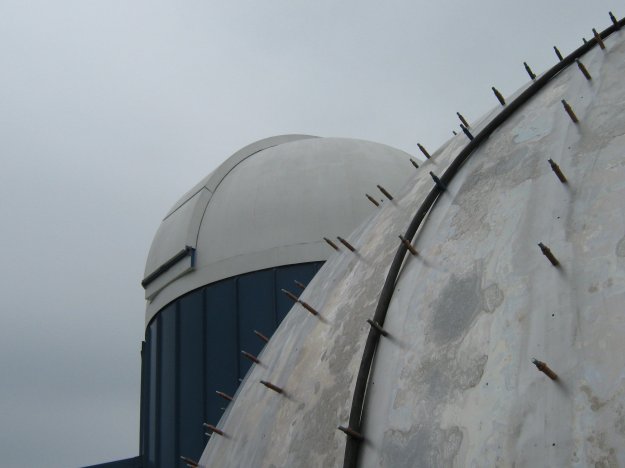
New dome bristling with Cleco's awaits the riveting crew
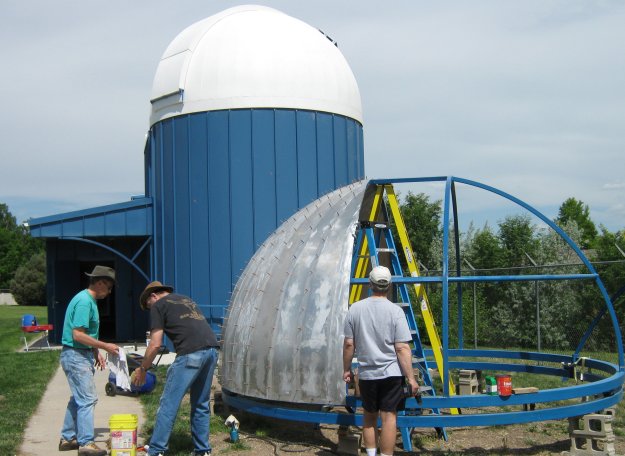
Rivet crew skins the frame of the new dome
On a different topic, the first production of Rick Padden’s Beets was a genuine success. We came up short 30 seats for an all time attendance record for a play at the Rialto in Loveland. The play was well recieved and we look forward to doing another production in the area.

Back Porch Set for "Beets"
Despite my previous gritching about it and despite trying to stay below the radar at work, the boss has requested and required that I attend the Organic Symposium at CU Boulder. I’ll bop over there later today to register and walk the poster session. Maybe there will be some useful grist for the blogmill.
No better reminder of the scientific pecking order than to skuttle around in the shadows of the great grant writers of our time. A certain speaker with a Nobel Prize casts a shadow so large that it is reported to weigh nearly 5 kilograms. Fancy that!
Odd descriptions of matter and the peculiar turn of phrase abound in the chemical patent literature. Here are just a few of my favorites (italics mine)-
The deal with the devil that you make in getting a patent is this- in exchange for a 20 year monopoly, you must disclose to the public enough enabling information that a confused citizen could determine if he/she is infringing on the patent and reasonably avoid infringement. But this does not stop the use of opaque vocabulary and unusual juxtapositions because, after all, one skilled in the art should be able to decode the many obfuscations applied to their area of specialty. Shouldn’t they…? Or, perhaps the obtuse vocabulary is meant to daze and confuse the judge and jury. Hmmm.
 Lamentations on Chemistry