
“Don’t Even Taste Like Sewage”

I spent 4 1/2 hours saturday touring our town’s water system from both ends. It was quite a detailed tour and, since it involved chemicals, how could I not tag along?

We began with the sewer reclamation plant first. Lots of interesting details here. Turns out that one of the big problems to running a waste treatment plant has to do with keeping large debris out of the pumps- rags, underwear, shoes, plastic parts, etc.  Once you get past the shock of learning what your fellow citizens can and do flush down the toilet, it is plain to see that a bit of money spent on screening out the the big chunks is returned in the form of reduced down time and pump repair costs.

Our little hamlet of 6,000 souls sends 450,000 gallons of waste water to the reclamation plant on an average day. The flow peaks at about 8 am every day in the form of a sudden 5-6 x increase in flowrate. It takes about 90 minutes for an average volume (i.e., a flush) of wastewater to get to the plant. A lot of groggy citizens hop into the shower at around 6:30 am.

After the incoming stream passes through a grit removing station at the entrance, it is lifted to the first treatment operation for aeration and fermentation. This is the physical high point in the process, meaning that the stream is subsequently transferred by gravity for the remaining process steps.

I won’t go into further process details other than to say that the final step prior to discharge into the stream is a sanitizing step where the effluent is exposed to a large jolt of UV radiation. At this point in our tour, the plant manager dipped a sampler into the flow and withdrew one liter of clear, colorless liquid with a few strings of algae floaters. Only too eager demonstrate his faith that the water was sanitary, he dipped a finger into the effluent, put it into his mouth and exclaimed with a grin as wide as his mullet

“It don’t even taste like sewage!” 

As he passed the sample around so others could share in the experience, I wandered over to the control panel and feigned interest in the LCD display. The UV just renders the wee beasties non-viable. Their little microbial carcasses are still there. Pathogen free it may well be, I didn’t have the stomach to taste it. Yes, I know that microbes are everywhere and that our notions of what constitutes “clean” are merely a fantasy. But I just couldn’t do it.
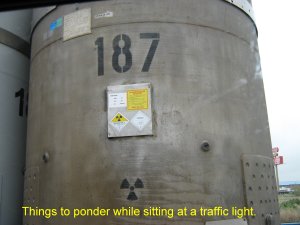
A hot little number

hot-load-on-the-interstate1

I see these shipping casks on the highway at least once a month.  This time I had a Canon with me (Powershot A470, you know, a camera). While sitting at the off-ramp stop light next to this container I began to wonder how much activity shines through the shielding. I began to daydream … if I could see in the gamma spectrum, would this thing be bright or dim?

Then, in the blink of an eye the spell was broken. The light turned green and I parted company with this hot little number.

Franz Ritter von Soxhlet and the Hungarian Siphon

Franz Ritter von Soxhlet is credited with inventing an extraction apparatus in 1879 that now bears his name. Soxhlet was a German agricultural chemist of Belgian “extraction” from Brünn (now Brno in the Czech Republic) working in the area of milk characterization at the Vienna Agricultural Institute.

Soxhlet spent most of his career in the analysis of milk and its constituents. In an attempt to isolate the fatty constituents from milk, he (and students) had been attempting to use an extraction apparatus developed by another Brno chemist, Professor Zulkowski. Soxhlet developed a technique whereby milk was absorbed into a quantity of calcium sulfate powder and then submitted to extraction by ether. The Zulkowski apparatus proved problematic, however. Solids were able to find their way over the extraction tube and into the solvent reservoir. Modifications of the design also suffered from inefficiencies that apparently required extended operation.

A student of Soxhlet, a Hungarian fellow by the name of Mr. Szombathy, contrived a solution to the problem. Szombathy is credited with coming up with the clever siphon feature that so distinguishes what we now call the Soxhlet extractor.

It has been lamented that the efficiencies gained by the siphon discharge design have been partially lost due to the entertainment effect. Generations of chemists have dropped what they are doing to stand and watch the collection thimble fill and subsequently discharge dramatically through the siphon. You have to take your fun where you can find it.

Well done, Szombathy!

Mineral deposits on other worlds

As one begins to understand the manner in which mineralization and elemental concentration occurs as a result of terrestrial geology, it is only natural to wonder how this would occur on other worlds. On earth, the concentration of the elements in the form of mineral deposits is a partitioning phenomenon that benefits greatly from fractional crystallization, metamorphic modifications, and from a variety of transport mechanisms.

Fractional crystallization of magmas provides a condition whereby a mixture of simple and complex ions may associate to form mineral compositions that partition from the molten phase by virtue of high solidification temperature. In this way, solid, higher melting compositions precipitate from a melt sequentially, leading to the selective partition of certain combinations of elements into a new solid phase. The molten phase may be enriched in certain combinations of other elements by default- many of which may be relatively volatile.

The composition and cooling rate of the magma will determine the nature of the solid rock that is formed after cooling.  Over time, rock may be lifted toward the surface and subjected to modification by hydrothermal action or by erosion and redeposition by gravity. Cooled igneous rock may be subjected to crystalline modification by exposure to heat further down the timeline.

Hydrothermal water, superheated under high pressure, is a major force in the formation of mineral deposits. The sulfides (and hydrosulfides) of transition metals (i.e., Au) are thought to be transported from source rock through cracks, faults, and porous formations to be deposited in locations where transport can no longer be sustained. The accumulation of economic quantities of uranium are thought to be the result of hydrothermal or aqueous transport as well.

So here is the point of this essay–  If preconcentration of elements to viable deposits is critical for the success of value extraction on earth, what about mining on the moon or Mars? To what extent are we dependent on these mechanisms to make viable the mining and extraction of useful materials?  If lunar geology has not been quietly concentrating minerals in the manner to which we earthlings have been accustomed, how will we come to grips with using native materials on the moon for self-sustaining habitation?

It is one thing to find x ppm of oxygen or y ppm of titanium in the lunar regolith. It is quite another to enable extraction of critical elements from low-value (dilute) material. The chemical energy inputs for processing will be severely limited owing to the scarcity of reducing materials on the moon or Mars. Reducing materials are really just reservoirs of inexpensive and useful electrons. Reducing materials would include carbon or electropositive metals for the reductive winning of other metals. 

In the absence of an inexpensive supply of electrons, all phases of extraterrestrial mining and processing will be subject to large cost multipliers. Cheap electrons are required to energize machinery, move materials, or conduct refining. All of these familiar activities are energy intensive on earth and there is no reason to think it will be different on another world. On earth, cheap electrons come in the form of diesel and coal. On the moon and Mars, it seems likely that solar and nuclear will energize most work for those who try to set up camp there.

Beryllium Mining

The aerial view above shows the location of the Brush Wellman beryllium mine near Spor Mountain, Utah. It is reportedly the only major beryllium mining operation in the USA and one of the very few economic beryllium ore locations in the world. The host materal is called “tuff”- a compacted and cemented volcanic ash composition. Coincident with this Be deposit is low grade uranium and fluorspar. Occurances of Cu, Au, and other base metals can be found in the area.

The concentration of Be in the ore body is thought to be due to the mineralization action of meteoric and hydrothermal fluids. The region is marked by the presence of 3 Oligocene-era calderas, with the Spor mountain Be mineralization found along the ring structure of the Thomas caldera.

The action of hot, saturated aqueous flows transporting solublized components from distant host bodies is one of the chief mechanisms for the appearance of “ore bodies” near the surface of the earth. Very often, such deposits are found in regions of faults and fractures of various kinds of rock formations. Mineral laden water follows the fracture system and, as it moves toward the surface, begins to cool and deposits the burden of now insoluble compounds. Deposition can occur due to simple solubility properties, redox from exposure to atmospheric oxygen, or via ion exchange with available chemical species to form high Ksp compositions.

This is nothing new to geologists who have been aware of these mechanisms for generations. But for a non-geochemical chemist like myself, the matter of how elements like beryllium come to be concentrated is less than familiar. Indeed, the question of how any element comes to be concentrated in rock formations is a question of increasing interest to Th’ Gaussling. I hope to spend a lot of time in the future exploring this matter.

Libertarians and Epidemics

If the USA were more substantially libertarian in construction and demeanor, how would we respond to the arrival of an epidemic or pandemic of some nasty pathogen like swine flu? If the USA were decentralized into quanta of individual market units, each responsible for his/her own well being, how could the spread of contagion be averted?

Would a libertarian republic be philosophically opposed to collectivist activity like combining resources to marshal a defense against a virus. Or, would the Austrian-school economists brush off the event as nothing more than a Malthusian disturbance in the direction of a much needed equilibrium between resources and population? If you cannot afford to protect yourself, then you are lazy or sadly unlucky. In any case, you’re on your own.

Would a Libertarian system first act to protect property and guns? Would libertarian economists issue a statement condemning collectivism and promoting the rights of individuals to buy as much Lysol, duct tape, plastic drop cloths, and surgical masks as the market will allow? Perhaps a Libertarian President (whatever that means) would put a team of economists on a pandemic, or better yet, the lowest bidding epidemiologists available from Craigs list?

Libertarians make a good deal of noise about the horrors of taxation and their unflinching admiration for the genius of the marketplace, property, and the right to stockpile guns and ammo.  I agree, we’re paying too much in taxes. Government is way too big. And the dynamics of the market do provide lots of cool stuff for better living. True enough.

But the market is like a stomach (I had a better analogy, but it was rather unwholesome). It only knows that it is hungry. The stomach has no brain. The stomach only wants more. The stomach did not invent antibiotics, polyethylene, Buicks, antacid, jet engines, or bikinis. But the stomach did facilitate the invention of each of these items. We need a market mentality, but we also need an overarching sense of direction. We need a market that can sense and avoid driving off a Malthusian cliff.

Civilization is about infrastructure. And part of the infrastructure that the country as a whole can provide is biotechnology.  Biotechnology was not developed by Warren Buffett or Ronald Reagan or the legions of celebrated MBA’s. It was slowly developed by publically financed university institutions over many years of apparently irrelevant research projects. University educated scientists were hired by private and public corporations who began to find ways of marketing biomedical technology.  It evolved into molecular biology and medicine and eventually commercialized as a result of front funding by millions of skeptical and myopic taxpayers over several generations. Yes, the market has a big part in this in terms of the rational distribution of goods.

As a result of all of the initial “collectivism” through publically funded science, we have a first class infrastructure (the CDC) that is capable of monitoring the onset and progress of contagious diseases. This system funded originally by the public is able to mobilize vaccines and small molecule medicines to prevent suffering and the spread of disease.  It is able to coordinate efforts and resources to benefit even the chronically irritable Libertarians.

CNN and Fox Stimulate LIV Wing of GOP

How can it be that people like CNN’s Glenn Beck and Fox brainwave Sean Hannity can land high paying spots on cable television? It obviously not because they are scholars. These professional 8th graders may have a grasp on something, but it’s sure not high level thinking. Aren’t they embarrassed? I’ll bet their mothers are. Obama a socialist? WTF?? Fascist?? WTF?? Have they bothered to look up the definition of these words?

Fascist: a political philosophy, movement, or regime (as that of the Fascisti) that exalts nation and often race above the individual and that stands for a centralized autocratic government headed by a dictatorial leader, severe economic and social regimentation, and forcible suppression of opposition2: a tendency toward or actual exercise of strong autocratic or dictatorial control <early instances of army fascism and brutality (from Merriam Webster).

Socialism:  1: any of various economic and political theories advocating collective or governmental ownership and administration of the means of production and distribution of goods2 a: a system of society or group living in which there is no private property b: a system or condition of society in which the means of production are owned and controlled by the state3: a stage of society in Marxist theory transitional between capitalism and communism and distinguished by unequal distribution of goods and pay according to work done (from Merriam Webster).

The very notion that Obama is a fascist or a socialist is barking mad. If anybody was a fascist, it was Dick Cheney and his band of goons. Nobody has the political power to convert this nation of unruly curs into a socialist country. The notion that anybody, even the most irate left wingers, could undo centuries of private property ownership in favor of socialist wetdreams is absurd on its face. The 20th century’s big socialism experiment failed. Who wants to try that again.  Obama is no socialist.

I’m sure these curs and mental halflings on cable clearly understand that they are spouting nonsense. It is all a put-on to get America’s legions of low information voters (LIV) out of the pews and into the community centers for some old fashioned swift-boating. Republicans know that if you hurl enough shit, some of it is bound to stick to something and the LIV’s will pick up on it.

What lit my fire this day? See the HuffPo article.

Liptonian Symbolism

Never one to allow reason to interfere with sentimentality, my blackened heart is softened somewhat by the recent shipment of Lipton Tea bags delivered to Th’ Gaussling from an online admirer via the US Postal Service. 

The tea in this gift shall be symbolically applied to the local waterway, but not before being used to formulate some refreshing iced beverage via aqueous extraction.  A vessel filled with aqueous goodness (OPE-Our Pure Essence) will be charged with the anthocyanin and alkaloid laden forest litter for extended exposure to solar radiation. Brownian motion will be relied upon to disperse the colloidal value away from the biomass.

Once so processed, the fortifying beverage will be passed through a pair of kidneys as a symbol of my dark contempt for the IRS. This nephro-raffinate will be discharged into the municipal fluid collection system for a kind of Nicene rectification that will provide further philosophical processing of the symbolic gesture. Finally, after the Liptonian fluids have been subjected to Libertarian aeration and Calvinist filtration, the clarified symbol will be discharged into the river for its turbulent hero’s journey to the drinking water inlets of New Orleans and beyond.

The Cresson Vug

The history of the Territory and State of Colorado is inextricably tied to base metals and precious metals. Gold and silver strikes were a big draw for the migration of population to Colorado from the 1859 Pikes Peak Gold Rush onward.  A map of the ore geology of Colorado reveals a few key districts or zones of enhanced mineral abundance. The Colorado Mineral Belt (CMB) is a band of ore deposits that are positioned diagonally across the middle of the mountainous part of the state, SW to NE, roughly from Durango to Boulder.

Other districts containing economically viable ore bodies exist outside of the CMB, notably the Thirtynine Mile Volcanic Field west of Colorado Springs. While rich deposits of gold were found near Central City and many other locations in the CMB, the relatively rare  gold/tellurium ore found near Cripple Creek and Victor on the periphery of the Thirtynine Mile Volcanic Field have provided approximately half of all the gold mined in Colorado. Gold has an affinity for tellurium and may be found combined with it in the form of the mineral calaverite.

In particular, the Cresson mine near Cripple Creek has been an especially rich producer of gold. In November of 1914, a 4 m x 8 m x 13 m cavity or “vug” at the 1200 ‘ level was found to be lined with gold telluride and other minerals.  Depending on which source you believe, it is reported that from 20,000 to 60,000 ounces of gold were removed from this small space.

The Cripple Creek volcanic complex is a highly altered, highly brecciated formation that has been described in detail elsewhere. The link provides a more detailed description and a bibliography.

Links updated 7/2/19.