Carlsbad Caverns

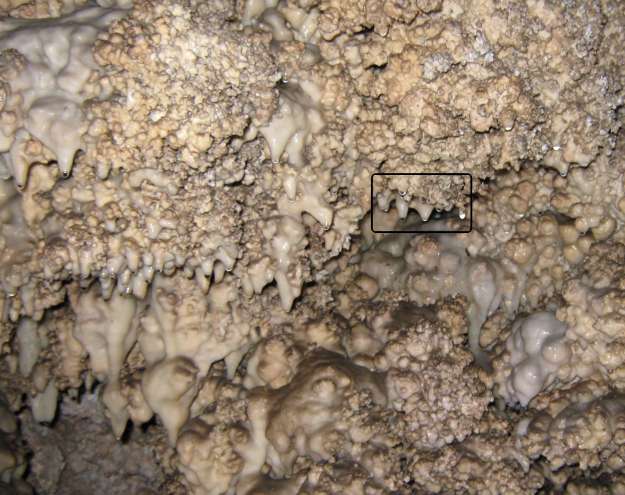
Carlsbad Cave Popcorn

Carlsbad Cave Popcorn

The problem with Carlsbad Caverns today is the same problem that plagued it from the very beginning- it is very isolated and is not even on the way to many other places of major interest (except El Paso, of course). For the first 20 years or so, the cavern was primarily a source of bat guano fertilizer for the California citrus orchards. Slowly, and with the persistance of a few key individuals, word of this wondrous underground cathedral spread.

Today, Carlsbad Caverns is visited by approximately 500,000 people per year. The cavern is in remarkably good shape considering the large number of people who walk the several miles of underground trails 364 days per year.  Curiously, one of the big pollution concerns is lint from the clothing of shuffling visitors which settles on the formations.

The above photo is a snapshot of a common evaporite formation referred to as cave popcorn. The box in the photo encloses an area about the size of the palm of your hand and if you look closely, you can see water droplets clinging to the small mineral protuberances.  The colors in the photo are a good representation of most of the cavern.

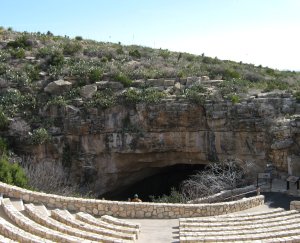
Entrance to Carlsbad Caverns

Entrance to Carlsbad Caverns

The decorated caverns are the result of several kinds of chemical processes. The internal spaces were dissolved out of the regional limestone formation. This formation is thought to be the remnant of an ancient reef. It is believed that aqueous hydrogen sulfide migrated up from the anaerobic permian formations below and was subsequently (air) oxidized to more corrosive species.

The park people point out that H2S was oxidized to sulfuric acid which is responsible for the chemical digestion of the limestone. Sounds reasonable to me, though the chemistry of sulfur oxidation is full of many kinds of intermediary species on the way from sulfide to sulfate. The presence of gypsum (calcium sulfate) inside the cavern supports the claim that sulfuric acid was the corrosive agent. What was not mentioned was whether or not sulfate is found in the surrounding formations. [Note: a commenter made a good point about the bio-oxidation of sulfide]

Stalactites festooned with cave popcorn, Kings Palace caves, Carlsbad Caverns

Stalactites festooned with cave popcorn, Kings Palace caves, Carlsbad Caverns

The decoration of the interior spaces left by digestion of the limestone happened by the action of seepage of rainwater and carbonic acid though the upper layers of sedimentary rock. The water dissolves many mineral components including calcium. The calcium carbonate rich liquors seeping in from the roof of the caverns wetted the surfaces below and deposited calcite and other mineral species by way of intermittant accretion.

If you examine the few smaller and broken mineralizations along the trail, you can clearly see that the accretion results in substantially crystalline material. So, while the formations are not large calcite or aragonite crystals, the small scale structure is crystalline.

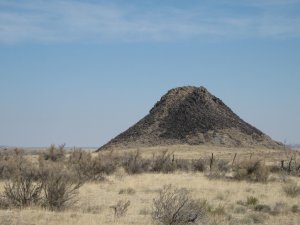
There is much to see in the world if you just bother to look. Along I-25 in southern Colorado is a modest looking feature. It is called Huerfano Butte and sits along the highway near Walsenburg. This igneous intrusion is more resilient to weathering than the surrounding sedimentary formations.  Radiating from the nearby Spanish Peaks are an array of dikes indicating the presence of past magma intrusion.

Huerfano Butte- a weathered igneous intrusion.

An synthetic chemist is in a great position to absorb some geochemistry. Once one is keyed into a bit of geology, the mechanisms of mineral formation begin to become apparent, with a little study of course. For myself, this is a great motivation to kick around in the weeds and explore the world. Gotta watch out for rattle snakes, though.

Encounter with Roswell, NM

No trip to Roswell is complete without a visit to the UFO Museum. While this may be one of the most amateurish exhibitions apart from the county fair, it does put a face on the UFO phenomenon in the USA.

Which One is From Outer Space?

Which One is From Outer Space?

Most of us have heard of the supposed crash of an alien spacecraft near Roswell (or Corona), New Mexico in 1947. The whole fantastic tale seems to be based on a few slender threads of testimony. A trip to the museum clinches the notion that the whole phenomenon is based on innuendo and 2nd or 3rd party stories.

It’s another example of people hustling to conclusions based upon low signal-to-noise observtions. Faint indications of phenomena against a noisy background. Like cold fusion in the 1980’s, a whisper of signal appears now and then.

I recall from freshman psychology that the human brain is especially vulnerable to such glimmers of off-normal stimulus. Gamblers are attracted to the very irregularity of positive feedback that is provided by random events. Perhaps there is a similar neurochemical origin in the obsession with spaceships and alien abductions. It seems to be more than simple curiosity.

It is apparent by casual observation that the city of Roswell has not lovingly embraced the UFO phenomenon with an enthusiastic plunge into full scale commercial exploitation. The Wal-Mart on the north end of town is decorated with a few fanciful alien festoons, but the extent of it amounts to a “museum” and a few worn looking establishments along the main drag.

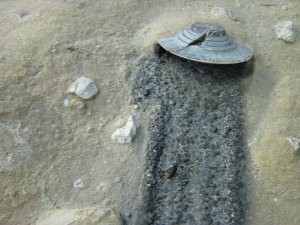
Saucer Crash

The saucer shape we have come to associate with alien spaceships is based on early sightings of unidentified flying objects. Latter day sightings (LDS? wink wink) comprise a range of shapes and designs.  What I would like to know is this- does the saucer shape make any sense in the context of interstellar travel? What are the aerodynamics of the saucer shape through the full range of velocity regimes? A saucer must eventually transition from operation in a vacuum to hypersonic entry into an atmosphere. Also, the ratio of surface to volume is relatively high, so how do you pack enough luggage & provisions for a lengthy trip?

Take me to your cola!

Take me to your cola!

Land of Enchantment

Th’ Gaussling & family are off on a springbreak motoring tour of that mysterious Land of Enchantment, New Mexico. The main destination is Carlsbad Caverns. We’ll take a cave tour and refresh ourselves with the wondrous magic of decorative columnar evaporites and ancient guano. Along the way we’ll visit Roswell for a close encounter with cosmic kitsch. In Sante Fe we’ll see Pueblo kitsch. And in Almagordo, there is space kitsch. Remember Col. John Stapp?   

Like Texas, New Mexico has an abundance of miles and miles of miles and miles. We’ll see about six hundred of them, one at a time.

Ciao, baby.

Pi Day 3-14

Another magic day is before us- Pi Day on Saturday, March 14 (that’s 3-14). Lets hope that the celebration does not lead to jail time or excessive brain damage. Pi to a million decimal places, a partial listing of which is below-

3.
1415926535897932384626433832795028841971693993751058209 7494459230781640628620899862803482534211706798214808651 3282306647093844609550582231725359408128481117450284102 7019385211055596446229489549303819644288109756659334461 2847564823378678316527120190914564856692346034861045432 6648213393607260249141273724587006606315588174881520920 9628292540917153643678925903600113305305488204665213841…

In the interest of preserving bandwidth, I’ve deleted most of the first 50 thousand or so numbers.

…5115448491268584126869589917414913382057849280069825519 5740201818105641297250836070356851055331787840829000041 5525118657794539633175385320921497205266078312602819611 6485809868458752512999740409279768317663991465538610893

Bronx Cheer for National Geographic

After supper last night I parked in front of the tubule and switched on the Discovery Channel. There was an intriguing program on the Cueva de los Cristales (Cave of Crystals) in Mexico. The Naica mine has become famous for its gigantic selenite crystals (calcium sulfate). National Geographic filmed a program on these wondrous crystals and it has been broadcast on the Discovery Channel.

What has raised my ire on this is not the production value. As usual, the cimematography was superb. What is disappointing is the story they chose to tell.

What I have noticed in the public science programming world is a particular weakness that quietly infects writers, directors, and producers. The weakness has to do with the fear of boring their audience. Rather than risk a pandemic of somnolence, writers kick up the script a notch with undercurrents of intrigue and a suggestion of danger for the intrepid parties crawling in the muck or harassing gators.

That’s fine. It never hurts to plan for short attention spans in the audience. But what suffers is a sense of proportion. When the focus shifts from the subject of the expedition to the members of the expedition, the program crosses the line into the tawdry world of show business.

Yes, it is quite hot in the cave. Yes, heatstroke is an issue to be wary of. But, what about the crystals?? What are they made of? Where is the water from which they were precipitated from? How does crystallization work?

And, where is the chemist on the team? National Geographic brought together a geologist, a planetary astronomer, a nuclear physicist, a biologist, and a few others who were not identified. This is a common omission on the part of people outside of the chemical sciences. Nobody knows what the hell we do!

For the showbiz effect, they brought in a planetary astronomer, Dr. Chris McKay, to examine the cave for possible implications on Martian exploration and the Evolution of Life. To media people, science equals- 1) Space Science, 2) Medicine, 3) Computer Science, and 4) oh, did I say Space Science?

It turns out I used to know Chris McKay. He was a TA in an astronomy course I took at the University of Colorado ca 1978. He was a geat guy and, unlike other misfits misanthropes bed wetters grad students in the astro/geophysics program, an attentive and caring instructor. He was (and is) a true believer in space exploration. We spent a long and chilly evening together in the Sommers Bosch Observtory at CU manually guiding the 24 inch telescope on a guide star for some lengthy time exposures of a string of galaxies. We used 3×5 Tri-X plates hypered in H2.

This showbiz reflex is a chronic condition and I am sorry to see National Geographic succumb to it.

Submersible Aviation

Sharpen your pencils boys and girls. DARPA is soliciting proposals for Submersible Aircraft.  Here is the synopsis-

DARPA is soliciting innovative research proposals on the topic of a Submersible Aircraft. In particular, DARPA is interested in a feasibility study and experiments to prove out the possibility of making an aircraft that can maneuver underwater. The proposal needs to outline a conceptual design along with identifying the major technological limitations that need to be overcome in order to maneuver an aircraft underwater. In addition to the conceptual design studies, performers need to outline experiments or computational models that will be used to demonstrate that the major technological limitations can be overcome.

Aircraft are constructed to withstand loads from particular directions arising from the airstream and from dynamic loads imposed on the airframe by accelerated maneuvers. A submersible aircraft must be constructed to withstand additional compressive loads all over the airframe from all directions due to conducting operations in water and at depth.

Perhaps crew chiefs will have to deal with seaweed and barnacles in addition to damage from FOD and birdstrikes. A whole new skill set will arise for naval aviators. Will these craft require anchors and bilge pumps? It is fun to speculate.

It may well be easier to devise a submersible aircraft carrier. I can see it now

Sunset in the north Atlantic. A blood red sun sets over the gray Atlantic rollers. Suddenly, the surface is broken by a large craft abruptly surfacing. The bow rises into the air then splashes to the surface as the large gray ship glides onto the surface at full speed.

Moments later, a hatch on the offset conning tower opens and sailors spill onto the broad flat deck.  Large sections of deck open skyward and elevators lift folded aircraft to the deck. These strange craft are rolled into position while scurrying crews fuel and arm them in the muted red running lights. Curling streams of steam spill to aft from vents on the carrier deck as the vessels screws push it forward.

Elsewhere on deck, sailors mount antenna arrays and open ports revealing defensive weapons. Soon, a fleet of submersible men-of-war have surfaced and set up a defensive perimeter around the submersible aircraft carrier.

After a few minutes, the aircrews run toward the aircraft and strap in. Turbine engines begin to whine as they spool up. Crews disconnect startup carts and run with their equipment to designated locations. As the aircraft power up, their wings unfold and lock into place.

Pilots engage the flapping box and the turbine powered ornithopters begin to flap their articulated wings. The pilot of the lead craft advances the throttle and rolls to the takeoff position while exercising control surfaces. The airboss clears the flight for takeoff and the pilot salutes smartly and advances the thrust to military power.

The black stealth gullwing craft diverts full power to the flapping mechanism and leaps into the air, vanishing into the dark sky.  The vacancy is quickly filled by the next craft. Moments later, another takes wing followed by the rest of the squadron.

At altitude the squadron members meet and assume formation flight. Below, the carrier has already begun to submerge to loiter in position until the appointed time where it will surface and recover the flight if any manage to return. It will be a harrowing night.

Static in the Attic

Some scattered thoughts and links, each too small for a single post-

Given that we are near planting season for 2009, I wonder how the loan picture is for farmers wanting to borrow money for the upcoming crop. It’d be a form of catastrophy if money was too tight for farmers to buy seed, fertilizer, and diesel.

One of my favorite reference books is by Francis X. McConville, The Pilot Plant Real Book, 2nd Edition, FXM Engineering and Design, 2007;  ISBN 0-9721769-2-6.

Glass blowing supplies are available here. Here is some coursework.

The Very Large Array (VLA) sits 50 or so miles west of Socorro, NM, just south of Hwy 60. A few hours east on Hwy 60, across White Sands, is Roswell, NM.

Atomic tourists should know that the Trinity site is open only twice per year: once in April and once in October.

Godwins Law.

A new POS (warning- really bad language!).

The ARC, the CHETAH, and the Organikker

Just received a copy of CHETAH 8.0.  This is a program for thermochemical and energy release evaluation and is distributed by ASTM. It will calculate enthalpy of combustion and thermochemical properties of compounds and reactions including- LFL, LOC, MIE, lower limit flame temperatures, maximum flame temperature, fundamental burning velocity, and quenching distance.

I have only had it installed for 2 days, so it’s way too early to give an appraisal. It came highly recommended by several colleagues in the process safety field.  The only snag so far is a balky SMILES input module. This feature was very appealing because it allows one to copy a ChemDraw structure in SMILES format and paste it into the CHETAH GUI. The rep at ASTM gave me a link which ended up offering very cryptic instructions. Naturally, the problem is some obscure setting in Windows.

Until I get this fixed, I’ll have to enter Benson groups by hand. As it happens, I began studying guitar in my spare time, so there are all kinds of new things for my addled brain to stumble over assimilate. So when I’m not picking at strings, I’m picking at Benson groups.

Update 3/5/09:  After a service pack download, the SMILES module is functioning. This is a very powerful tool.

We’ve recently caught up with the times and have been pressing Accelerating Rate Calorimetry (ARC) into service. Or more accurately, paying to have the data collected.  ARC is really quite informative in that it can offer a Time to Maximum Rate (TMR) equation from which a TMR can be determined for any desired temperature. You can calculate an adiabatic delta T as well. I do not know how reliable this number is, but it certainly reminds one of the importance of considering the effect of phi factor in process scale up.

The ARC data I get includes an Antoine curve which can indicate that the accelerated rate behavior is or is not characteristic of classical liquid/vapour equilibrium behavior. What this says to the wary is that other volatiles (besides the subject material) may be generated which are not condensable. This is helpful in considering what kind of controllability is available to the process engineers.

Lamentations on the screw and the chip

At a meeting recently the topic of a particular computer was put on the table for discussion. A colleague who fancies himself a bit of a computer wrangler kept referring to the computer as a machine. This machine runs on Vista or that machine runs on XP. Jargonese flew out of his cake hole with such fluid grace and certitude that I found myself momentarily drawn in by the minute details of Cat 5 and internet protocols. I had to force myself to snap out of it.

This use of the word “machine” in reference to computers has always annoyed me, but in this case the annnoyance was starting to raise welts on my brain. This madness has to stop.

A computer is a circuit, not a machine. Get that? It’s a circuit comprised of chips soldered to a board.

I’ll give an example of a machine. The screws holding down the circuit board to the frame are elementary machines. A screw is a machine that converts rotational motion to translational motion. Oh yeah, it is a great fastener as well.

A machine can remove body parts, deglove your hand, or unload a cargo ship. A computer is a circuit that at worst, can provide annoyance, vexations, and spam.

Fellows, if you want to swagger around with manly bravado, stick to manly things. Sports cars, bulldozers, and beer. Computer jargon is for prissy little Nancy-boys with overbearing mother figures.

The Spring Burn

Spring is surely approaching because the local farmers are burning their irrigation ditches in preparation for the first release of irrigation water. A few minutes ago I passed a farmer driving a tractor with his ditch burner flaring away. It consisted of a long boom attached to the rear hitch and was fitted with a downward facing burner that rides over the ditch. This flame from above brings sudden hellfire to field mice and rabbits crouching in the ditch. Potbellied farmer dudes with shovels and a 4-wheeler watch the fire from a distance ready to spring into action if the fire gets out of control.  A hawk studies the activity from atop a nearby power pole.

The local reservoirs have been silently filling up with water in preparation for the seasons long discharge into the downhill maze of irrigation canals. Things are happening in the background.