A Constitution in Need of a Few Revisions

An article in the Alantic Monthly by Garrett Epps entitled “The Founders Great Mistake” offers some observations on weaknesses in the US constitution regarding the Presidency.  In particular –

The most dangerous presidential malfunction might be called the “runaway presidency.” The Framers were fearful of making the president too dependent on Congress; short of impeachment—the atomic bomb of domestic politics—there are no means by which a president can be reined in politically during his term. Taking advantage of this deficiency, runaway presidents have at times committed the country to courses of action that the voters never approved—or ones they even rejected.

Epps offers several examples of runaway presidency. The example of Andrew Johnson is particularly good-

Andrew Johnson was the next unelected runaway. Politically, he had been an afterthought. But after Lincoln’s assassination, Johnson adopted a pro-Southern Reconstruction policy. He treated the party that had nominated him with such scorn that many contemporaries came to believe he was preparing to use the Army to break up Congress by force. After Johnson rebuffed any attempt at compromise, the Republican House impeached him, but the Senate, by one vote, refused to remove him from office. His obduracy crippled Reconstruction; in fact, we still haven’t fully recovered from that crisis.

Epps, a law professor at the University of Baltimore, points out the origin of the mysterious electoral college-

The system that the Framers developed for electing the president was, unfortunately, as flawed as their design of the office itself. When Madison opened discussion on presidential election in Philadelphia, he opined that “the people at large” were the “fittest” electorate. But he immediately conceded that popular election would hurt the South, which had many slaves and few voters relative to the North. To get around this “difficulty,” he proposed using state electors. Electoral-vote strength was based on a state’s total population, not on its number of voters—and the South received representation for three-fifths of its slaves both in the House of Representatives and in the Electoral College.

The electoral college was merely a scheme to manipulate the weighting of ballots in states with a low fraction of voters among the population. In other words, it was a “duct tape and baling wire fix” to accomodate the slave states embarrassingly low fraction of voting adults. This antebellum artifact should be abandoned in favor of simple vote counting.

The citizens of the USA need to have a better mechanism with which to fire a President who is crooked or incompetent. The provision for impeachment carries a high threshold for activation. A president must engage in some kind of serious malfeasance to provoke the congress to vote for impeachment. But the application of this provision has been very nonlinear. Clinton was impeached for lying about consensual sex. Bush arguably lied or at least tolerated falsehoods leading to the invasion of Iraq and the resulting civil war with tens of thousands of deaths. Depending on the congress for an even application of its powers is a sketchy proposition.

The framers of the constitution did not anticipate the situation where an incompetent president might be elected by “low-information voters”.  A government that has usurped the consensus of the electorate and is allowed to remain in play because of a fixed period of tenure is a government that serves only itself.  This is wrong and we should not stand for it.

Russian Nuclear Lighthouse

Here is an obscure topic- the Nuclear Lighthouse. Seems the Russians set up lighthouses in remote coastal locations in the north. These stations would beam light generated by a power source utilizing decay heat from a radioactive source.  As you can see from the photographs, the facility has seen better days. There was no mention by the writer of any measures taken to monitor their exposure during the visit to this nuclear hellhole.  Crimony.

PbNN- Plumbum News Network

Some folks get more than 15 minutes of fame. Case in point- Joe the Plumber.  The career arc of Joe “The Plumber” Wurzelbacher continues to cover new terrain, this time landing him a gig with Fox News as a correspondent specializing in media bias. Joe’s impeccable credentials as just plain folks and his compelling profile has caught the attention of the News Department at Fox. His brush with the McCain-Palin juggernaut was possibly helpful as well.

Joe has been sent abroad to investigate disturbing reports of liberal American media bias. News organizations covering the freedom crusade being waged in the middle east by George II have been less than forthcoming about our inherent righteousness.

This regular Joe has been imbedded in the field to faithfully report the unvarnished truth in a manner recognizable to the sensibilities of the Everyman. And since Fox News has a special knack for speaking truth, Joe was anointed by these Sons of Murdoch to follow the star of freedom eastward and bring back the truth to quench the thirst of a nation parched for hopeful news.

Alright. I’ve finished my lampoon. Joe has become a cartoon character but doesn’t seem to be aware of it yet. There must be some kind of PT Barnum character in Joe’s life who is milking the media’s tongue-in-cheek fascination with him.

I sincerely hope that something good might come from Joe’s expedition to Israel. But there seems to be little original analysis possible for the sad and tragic situation between Israeli Jews and the nascent Muslim caliphate. Each party claims a special relationship with the Diety and, accordingly, each has no option but to prevail.

Solar Transit of Jet

Check out this great shot of a jet transiting the sun. It happens ca 8 seconds in the sequence.  What surprised me was the extent of the forward motion of the contrail vapors.  I always imagined that they had closer to a zero ground speed. This is a good visualization of the extent to which the aircraft does work on the atmosphere by accelerating some of it along the direction of motion.

This video was captured by a member of the Radio Jove community. He was shooting a solar prominence with a Coronado PST and a webcam when the jet passed through the field of view. (Obviously, he was not doing radio astronomy at the time.)

Chemist Alert! NFPA 400 to be posted in May 2009.

The National Fire Protection Association (NFPA) is an international nonprofit organization dedicated to the prevention of fire related incidents. The have recently pitched a set of regulations as NFPA 400 pertaining to the storage of hazardous materials. The comment period is long over and soon the rules will be issued as a published document.  While the NFPA is not a regulating body, their rules are widely adopted by government organizations and promulgated.

If you have not taken the chance to review some of these documents, it is well worth your time as a chemical professional to do so. Why? Because the practice of chemistry is being dramatically necked-down in terms of the kinds of chemistry that can be practiced and the manner in which materials are stored. Not only is your local fire marshal packing a stack of NFPA based fire codes, but a whole host of federal regulators are armed with regulations from Homeland Security, EPA (i.e., TSCA), DOT, REACH, and an alphabet soup of regulatory coverage aimed at every conceivable substance.

Organizations that oversee chemical operations include the chemical industry, hospitals, agriculture, mining, and academia. All organizations are under the obligation to provide a safe workplace for the employees. It makes sense to minimize employee exposure to risk. But the web of applicable regulations for any given chemical operation is expanding by the day.

Not only is an organization obliged to conduct business in compliance, but quite often there is the requirement of self-reporting of noncompliance. An organization finding itself out of compliance is an organization in need of legal representation. The nuances relating to most any kind of regulation are such that your average company president will generally be unwilling to settle the malfeasance with the regulatory agency without the help of an attorney. This is the point where a jet of cash starts flying out of the company coffers.

So, the question of the effect on academic chemistry arises.  Academic chemistry departments are seeing increased coverage under the regulatory umbrella as well. Should academic research labs have some sort of dispensation given the nature of the activity? Given that OSHA regulations may not be applicable to students, academic labs are already under somewhat less scrutiny. More to the point, how much government intrusion should researchers accept in relation to the kinds of chemicals they work with and store and the kinds of risks that are taken during research?

This is important for a very good reason. The issuance of proposed rules by organizations like NFPA results in regulatory pressures that eventually find their way to individual researchers. But the researchers don’t hear about it directly from NFPA. The University Health and Safety department hears about the regulations (or guidelines) and they apply requirements on chemistry departments. Faculty being faculty, they’ll perform a gritching ritual and eventually comply.

Generally, the arrival of new regulations results in new constraints. The end result is that the department has to spend more to operate the labs and students receive less experience with interesting chemistry. This whole unfortunate trend of increasing government oversight of all things chemical will eventually neuter US chemical education and industry leaving a bland and uncompetitive culture averse to risk.

I hate to be critical of fire safety people. But I also hate to see chemical education and research hamstrung by well intended parties who have devised highly detailed and extensive rules that will seep into every aspect of the chemical sciences. I am aware of absolutely no pushback of any kind when it comes to this matter.

There Be Dragons!

There is a theory brewing that the ignorant wielding of statistics-based risk management is deep at the heart of the current financial panic. Nassim Nicholas Taleb is quite outspoken in this matter. He goes on at length about the inadequacies of statistical methods for financial risk management.

NY Times writer Joe Nocera [link may require free subscription] echoes this sentiment- but in greater breadth- in a recent article in the NYT. Nocera focuses on Value at Risk- VaR.  Since my statistics training is limited, the reader will have to draw their own conclusions on the merits of this methodology.

Taleb warned about “Black Swans” a while back in a book by that title.  A man not overly burdened with modesty, Taleb has transcended to the status of an Illuminati due to his prescience on the blindness of statistics-based financial risk management in predicting low frequency catastrophic events, or Black Swans.

Perhaps the old cartographic flourish “There Be Dragons!” should be updated to “There Be Black Swans!”

Flux-O-Links

The US Nuclear Regulatory Commission website offers a downloadable set of documents pertaining to Fire Dynamics along with a few spreadsheets and loads of worked problems. The set of documents is quite well done in my estimation and is entirely suitable for we industrial chemists. My operating principle is that it never hurts to keep learning about fire phenomena when you work around flammable materials.

Gotten a little rusty in your welding theory?

An affordable spectrum analyzer is just what a fellow needs for the radio observatory.

Need pure Astatine, see p 19.  Light up the accelerator and dial up the proton current.

Empty Seat on the Carbon Bandwagon

Sometimes it is best to simply shut up and link to a superior post. This is such a time. In a recent posting, one writer, Harold Ambler, comes out against Al Gore in the global warming debate. While I am skeptical about his assertions on the effect of the solar flux on the earths geomagnetic dynamo, I think Ambler otherwise brings together quite a few good points I have seen elsewhere.

The ticket to my seat on the carbon bandwagon will soon post on Ebay.

Motoring on the Chao Phraya

Th’ Gaussling had the occasion visit Bangkok a while back. Like any large city, Bangkok is bustling with tourist operators anxious to provide carriage to any point of interest. Along the river you can see long boats fitted with automobile engines and long propeller shafts. The engine is attached to a swivel and a tiller arm with throttle controls. The engine fan blades spin without any kind of guard to protect the operator.

Muscle boat for Tourists

Muscle boat for Tourists

To steer, the operator simply pivots the power train and adjusts the throttle. These narrow craft shuttle their perspiring payload up and down the river from stop to stop at bridges and the finer hotels.

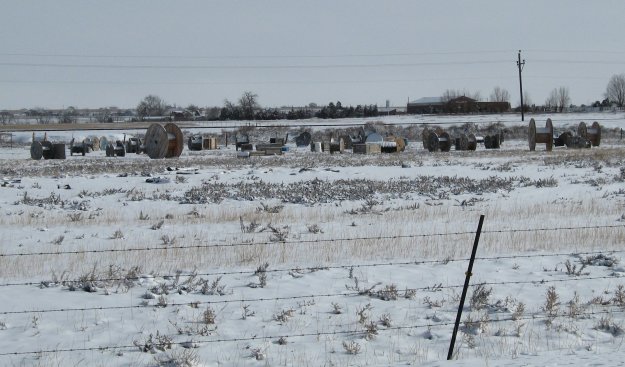
Spoolhenge

Unlike many of my colleagues in the Chemical Industry, say in New Jersey for instance, Th’ Gaussling is able to enjoy a pleasant country drive to and from work every day. Among the many sights to enjoy is Spoolhenge. This curious archeological artifact is thought to have been constructed by ancient electricians in the early Cupracene Age of the Sparkezoic Era.

Who were these people? What strange rituals did they perform in this maze of paleospools? Only a few crude wirenuts fashioned out of elk antler remain in the soil surrounding these ruins.

Writer and amateur paleophrenologist Anders van der Klopp suggests the ruins may have been part of a temple built by ancient astronauts who crash landed on earth in the distant past. Van der Klopp’s panspermia theory is not taken seriously by mainstream paleophrenologists who balk at the idea of electricians in space. Perhaps one day we will solve the mystery.

Spoolhenge

Spoolhenge