Thermal Decomposition of Sucrose in Nitrogen Atmosphere

Below is a thermogravimetric (TG) scan of commercial grade sucrose. Over the course of the experiment, the compound is quite stable to decomposition to the gas phase under N2 up to the onset temperature of ~226 C. This is indicated by the constant temperature line leading up to the onset.  Above 226 C it begins to evolve gas or aerosols.

The furnace temperature ramp is 10 C/minute, the purge gas is nitrogen, and the crucible is platinum. The software that presents the data determines an onset and offset temperature by intersecting lines extending from the slopes of the lines at points chosen by the operator. In this way, the computer “squares” the broad curves and reports a temperature at that point.

Not shown is the % mass loss; from ambient to 500 C the sample lost 78.55 %. The slope of the curve from the onset to offset temperature is 0.69 %/deg C. Multiplying by 10 deg C/min, the cook off rate is 6.9 wt %  per minute in the temperature ramp. An isothermal run could be performed to look at behaviour under constant temperature.

The value of information presented by this analysis is somewhat limited to the relevance of conditions in the crucible. TGA can be a big help in determining the onset and extent of dehydration or other decomposition transformations. It can easily detect the ability of a material to sublime as well.  And, it can provide information to process chemists and engineers regarding certain aspects of temperature stability and thermal safety.
 

Fire Extinguisher Training

Everyone should have a chance to use a fire extinguisher on a real fire. The trouble with this idea is that the annual discharge of fire extinguishers is expensive, training fires can be problematic, and the discharge from the extinguishers can leave a big mess.

I had the chance recently to undergo annual training with a new controlled fire training system made by BullEx. I’ll admit to being skeptical at first. It seemed awfully contrived and … safe. But watching the tenderfoot office staff line up with their backup buddies to use pressurized water to put down a controlled and “adjustable” fire, I finally came around and had to agree that the system has considerable merit. For us, the system pays for itself in 1 year of training in terms of retiring dry chemical recharge costs.

Most would agree that a fire extinguisher is fairly simple to use. What seems to be the hard part for many is overcoming the uncertainty about whether they should use the extinguisher and under what circumstances. While the simulator does not produce smoke, obnoxious fumes, and there is no dust cloud from a dry chemical extinguisher discharge, the system does a good job of building confidence in people who may be a bit timid.

US Mint Suspends Sales of Gold Coins

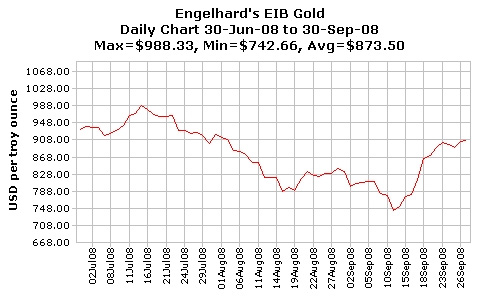
Reports have been circulating that the US Mint has suspended the sales of gold coins. The mint has been experiencing unprecedented demand for gold and silver coins. A short list of favored dealers has been drawn up for distribution of the limited supply.

What is curious about this is that the US Mint has “suspended” sales rather than simply announcing that it has a backlog. Only the govenrment would respond to demand in this way. I understand that minting gold coins is not nearly as automated and fast as base metal coins. But by their manner of responding to the demand, they can only accelerate the rise in price for these coins.

I have captured a snapshot of PGM pricing from the BASF EIB website. I hope BASF isn’t too hacked off.

The Canadian Maple and South African Krugerrand gold coins are available, as far as I can tell from internet sources.

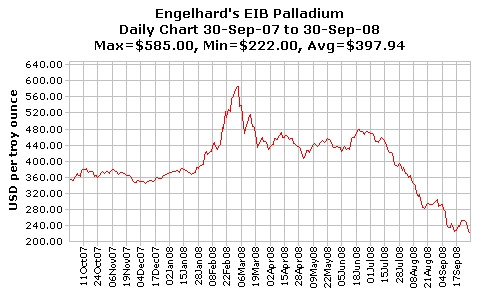
Of interest to the catalyst world is the falling price of Palladium. The chart below is scaled to show the price of bullion for the last 12 months. This is surely a kind of economic indicator affording a clue as to the vitality of some particular and narrow market sector.

I wonder where the opportunities are in this difficult time? Now is a good time to keep your head on a swivel for unique opportunity.

Lets All take a Deep Breath and Stop the Hyper-Analysis

Could it be that we Americans are over reacting to the problems in the market? The market is very much a collaborative structure resting heavily on trust in the power of the vast American economic engine. What we are witnessing right now is the multichannel, speed-of-light, propagation of panic through the miracle of electronic communication. Wagging tongues and chin music from our esteemed news commentators as well as we, the blogging community, are only fanning the fire of panic. The USA is on the verge of freaking itself into an economic collapse.

We don’t need additional and more concise descriptions of the foolishness of the players. That’s been done. I participated in this too. Ascerbic wit and biting rhetoric needs to be turned to constructive service. The first thing that we can do as bloggers citizens is to tone down the negative buzz and quit getting each other twittered. It serves no purpose and is counter-productive.

Citizens need to start asking constructive questions and make suggestions to all who will listen on how best to minimize panic and the damage it will cause to our economy. We need to take some time from blogging to focus on communicating with our friends and colleagues and members of congress to keep a steady hand in the coming months.

We also need to start asking about the details of the financial mess. Of the “bad mortgages” we hear about, how many are actually in default vs how many are just in the category of subprime? Are the banks possibly exaggerating the size of the losses? If banks are over extended in their loans, what fraction of their subprime loans are still in good graces? In other words, exactly how is the bad debt manifested? What is the true magnitude of the thing? How many mechanisms are available to bring this thing to a survivable landing?

It is not unheard of for a company to write off as much loss as it can if it is inevitable that it must report losses. An MBA friend pointed this out to me. He worked for a semiconductor firm whose habit was to maximize the losses if it could not avoid reporting a loss. They’d throw some of the ugly furniture overboard with the trash to clean house. To what extent is this happening now?

Maybe we can raise the bar a bit by helping to ask better questions. The best questions get the best answers.

Faculty Position Announcement

Pultroon College in Guapo, Arizona, situated in the beautiful Nitpiq Valley, is seeking to fill two high level postions. Position A1301– The college is accepting curriculum vitae from exceptional candidates for the position of Dean of Entertainment Arts and Sciences. The College is seeking senior level applicants with experience in catering and screenplay writing. While accomplished sitcom writers are encouraged to apply, preference will be given to writers of action/adventure feature length films. Coen Brothers experience is considered a plus.  Position R2139– An exceptional candidate is sought to fill the position of Hector Shushmann Professor of Docent and Concessionaire Studies. This Chair is endowed by the Juju Family Foundation. The successful candidate is expected to carry out an aggressive research and recruitment program in any of the following areas: advanced concessions studies; soda fountain technology; advanced Usher and Ticket studies; or theater seating design. The application period closes December 1, 2008. Pultroon College is an Equal Discrimination Employer. Persons of gender are especially encouraged to apply:  http://www.pultroon.org.

A Life in Industrial Science

There are many ways to live a scientific life in chemistry. The obvious examples are the lives of chemistry faculty. A chemistry prof’s time is split between teaching, managing a research group, grant writing, committees, giving seminars, academic advising and, oh yes, a home life. 

In industry, the life of a scientist can be split between several layers of applied research, management of a budget and directly reporting staff, occasional patent work, meetings, writing reports, and if there is a spare minute, leafing through a journal.

I could have never anticipated the job description that I now hold. The specifics aren’t important for the purpose of this essay. What I want to describe is the extent to which I am constantly juggling numerous diverse, often intractable, open-ended tasks. It dawned on me recently that my job description sets me up for a career of dealing with thorny problems that few want and could or would handle.

Is this shameless self-admiration? No, it’s really a kind of lamentation. It would be nice to do something straightforward now and then. I used to do the advertising. Then we got back the C&EN survey results. I don’t do the advertising anymore. I’d like to meet a few of those rotten commenters … \;-)

Because I share office space with the accounting group, I have the chance to lunch and banter with the bean counters. It doesn’t take long to realize that theirs is a life of well defined tasks with built in cross-checks and monthly cycles. These accountants have their work cut to size and funneled to them by highly formalized and structured norms. Their job is to enforce consistency and eliminate surprises. They express discomfort and fear near the boundaries of their knowledge.

In contrast, scientists are people who seek out the boundary waters of knowledge and actually set up camp there. A scientist is someone who finds a way to acclimate to a life of uncertainty. A scientist knows that ignorance and uncertainty can be ground down with hard work and a bit of luck. Luckily for me, dogged persistance can partially make up for the lack of genius.

But despite the high minded platitudes about the endeavor of science, I’ve come to appreciate washing glassware and cobbling together a plumbing solution to a problem with an apparatus exactly because it is so concrete. Unlike molecules, I can actually see the results of my plumbing handiwork of compression fittings, steel tubes, and rubber hose. Sometimes it is nice to leave the abstract behind and make something simple but sturdy.

Ike and Gus

Hurricanes Ike and Gustav have disrupted the ebb and flow of hydrocarbons out of the US gulf coast. Lots of plant shut downs and supply chain interruptions for those in the petrochemical supply chain. It really plays havoc with just-in-time delivery of raw materials. The jabbering masses whining about gasoline prices are insulated from the real magnitude of what a hurricane and a banking catastrophy can do to their supply of hydrocarbyl necessities.  It’s like the food web, only you can’t eat it. It’s the petroleum web of commerce.

The banking fiasco is unlikely to directly harm the chemical industry other than spot problems due to the unavailability of cash to borrow for big projects. The bigger problem for the chemical industry lies on the demand side. If money isn’t available for consumers to borrow to energize the construction, automotive, machinery, and durable goods industries, the polymers and coatings supply chain will see a slow down. This will affect the specialty value-added companies as well as basic feedstock suppliers.

Pharma could be hurt if there is a big uptick in people who lose their insurance benefits to pay for the expensive namebrand pills. On the other hand, the generic drug business could gain from the slow down, based on the assumption that people will still demand drugs from someone.

In the end, the Wal-Mart to China cash conveyer will do just fine as shoppers downrate their expectations for the good life. So, what are lipstick sales looking like?

Dog that caught the car

I’m off to participate (in a minor way) in a local historical reinactment this afternoon. Have to dress up as a beet farmer.

Like a dog that finally caught the car, my recent audition for a part in a local play resulted in my getting the part. Good god, what have I done?

Views on the Subprime Mortgage Mess

I have no real expertise in banking or real estate. Neither fields hold much interest for me. But I am interested in failure behaviour of large complex systems. There are a few posts out there that hold better than average insights on the current financial mess and I wanted to post links to them.

Jim Kunstler‘s blog, the full name of which is a bit too coarse to post here. None-the-less, Kunstler writes one of the best blogs out there on business topics.

Georgetown Law Faculty Blog has posted part of an article intended for the banking community. It is lifted from the American Banker which, sadly for me, requires a subscription. The theme supports my contention that business- banking included- should be treated as part of contemporary anthropology rather than an abstract exercise in arithmetic.

Business isn’t just an math exercise. There is a lot of anthropology to it. Unfortunately, anthropology isn’t on the curriculum of most MBA programs.  MBA’s worry me. They seem to be hustling the rest of us into an Orwellian future with methodologies taught by faculty members who are more interested in tidy formalisms than people. 

There are a lot of cocky bastards in business who are always certain, but frequently wrong. This banking mess is an example of what happens when they achieve a quorum. In fact, I think they have ascended to the level of mythical archetype.