Vocabulary gained while watching British crime shows. I will only show the meaning from the context in which they were heard.
Putrescible, noun or adjective: liable to decay; subject to putrefaction, “putrescible domestic waste”
Summat, pronoun: a British dialect form of the word ‘something.’
Kip, noun: sleep, a nap: ‘I might have a little kip’
Egg sucking, phrase: used as an expression of anger or scorn, ‘go suck an egg if you don’t like it’
Gaffer, noun: a person in charge of others; a boss.
Scarpered, intransitive verb, to flee or run away.
Minging, adjective: very bad or unpleasant.
Parkour, noun: the activity or sport of moving rapidly through an area.
Gutted, adjective: Very disappointed or upset.
Bloke, noun: a man, guy or dude.
Knackered, adjective: Worn out or tired.
Bollocks, : nonsense or rubbish.
Ta, : Thank you.
To leg it, phrase: To run away.
Daft, : A bit stupid.
Gob, noun: Mouth.
Cuppa, noun: Shorted version of ‘cup of tea.’
To Crack on, : To get started or to finish something.
Innit, : Short for ‘isn’t it?’
I like and would adopt most of these here in the US if others knew what they meant. My favorites are the words in orange.
Editorial
Let me say a few things about British television in general. We subscribe to both BritBox and Acorn TV found on Prime streaming service. First, in American TV entertainment, most of the actors tend to be very pretty and young- even the men. It’s a bit too saccharine. British TV has young and pretty people too, but with a large dose of people who ordinarily wouldn’t fit that description. Perhaps the talent pool there is small. My point is that the Brits use older folks to a larger extent than in the US. Another noticeable difference is the use of gun play in the cop shows. British TV uses far less shooting or even just the pointing of guns in their screen plays. There is some, granted, but far less than in the US. I like that. The Brits have a tradition of parlor murder mysteries where the killer is identified by deduction. On Brit TV, conflicts or apprehensions of suspects is frequently handled without excessive violence.
Another refreshing aspect of BritBox and Acorn TV is the availability of continental European programming. I’ve never been bothered by reading subtitles, so the authenticity of language and the drama is unfettered. Truthfully, the use of subtitles for English, Scottish and Irish programming is necessary when accents are too thick to understand, which is not infrequent.
One thing I have noticed is the adoption of American English vocabulary abroad. It is a bit sobering to see the extent of influence abroad by the US movie and television industry.
Global demand for helium is expected to double by 2035. Helium is a critical, non-renewable resource used across the world. It is found in natural gas deposits in limited number of gas wells. Helium is the second most abundant element in the universe behind hydrogen. But this is averaged across the universe. Any helium the earth’s early atmosphere may have had has long ago diffused into space. At present, helium from terrestrial sources is derived from radioactive decay of uranium, thorium and daughter products within the Earth over eons of time. Underground structures suitable for the accumulation of natural gas may also accumulate helium.
Helium is useful in science and industry for many reasons, but mostly for its extreme chemical inertness and ultra-low boiling point. A gas with a very low boiling point, and if you manage to condense it, finds use as a low temperature coolant. Helium serves as an inert atmosphere in many applications including nuclear power, semiconductor manufacturing, welding and for pressurizing rocket propellant tanks. In liquid form, it boils at the low absolute temperature of 4.2 Kelvin (-261.1°C) and is indispensable as a cryogen for many applications from medical Magnetic Resonance Imaging (MRI) and quantum computing to other superconductor applications. Those of us who make great use of nuclear magnetic resonance spectroscopy (NMR) are highly dependent on it as an analytical tool. NMR has made identification and quality control possible in many kinds of chemical manufacture.
According to one source a single MRI unit can contain up to 2000 Liters of liquid helium and consume 10,000 Liters over its 12.8-year lifespan. If you condensed the helium gas into liquid from the balloons at the Macy’s Thanksgiving Day Parade, there would be enough liquid helium to keep two MRIs running for their lifetimes. The US presently has approximately 12,000 MRI units across the country. The good news is that helium recycling equipment can be fitted on to an MRI machine to greatly extend the life of a helium charge. Usually, a liquid helium dewar is immersed in a liquid nitrogen filled dewar which is inside a vacuum insulated container. The liquid nitrogen bath helps with the helium boil-off somewhat, even though the bp of nitrogen is considerably higher than that of helium, yet much lower than room temperature.
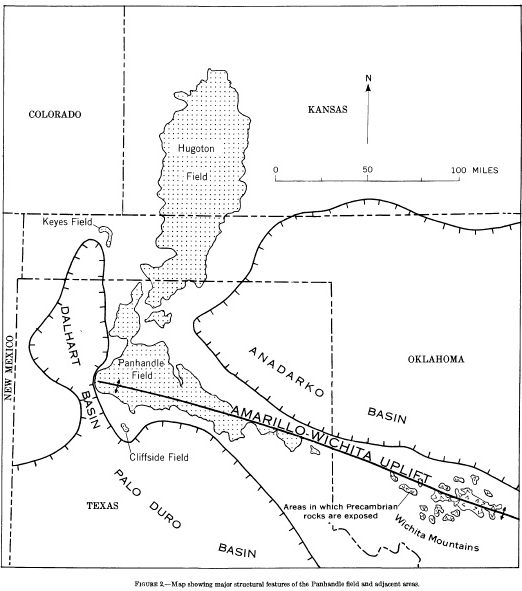
Source: Wikipedia. The Hugoton and Panhandle gas fields rich in helium. There are many other helium-rich gas fields in the US, but none as large as the Hugoton and Panhandle gas fields.
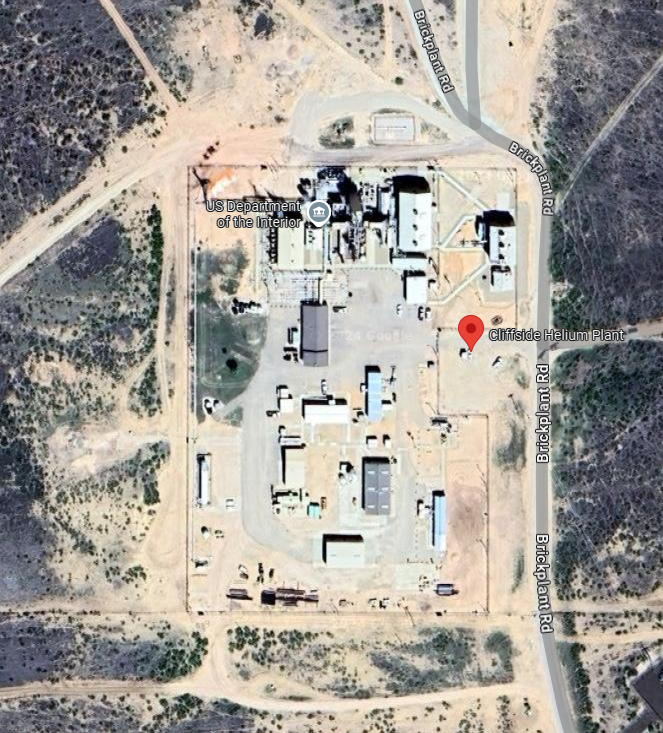
Source: Google Maps. Aerial view of the Cliffside Helium Plant. If there are actual cliffs near Cliffside then the panhandle folks are calibrated differently from me as to what constitutes a cliff.
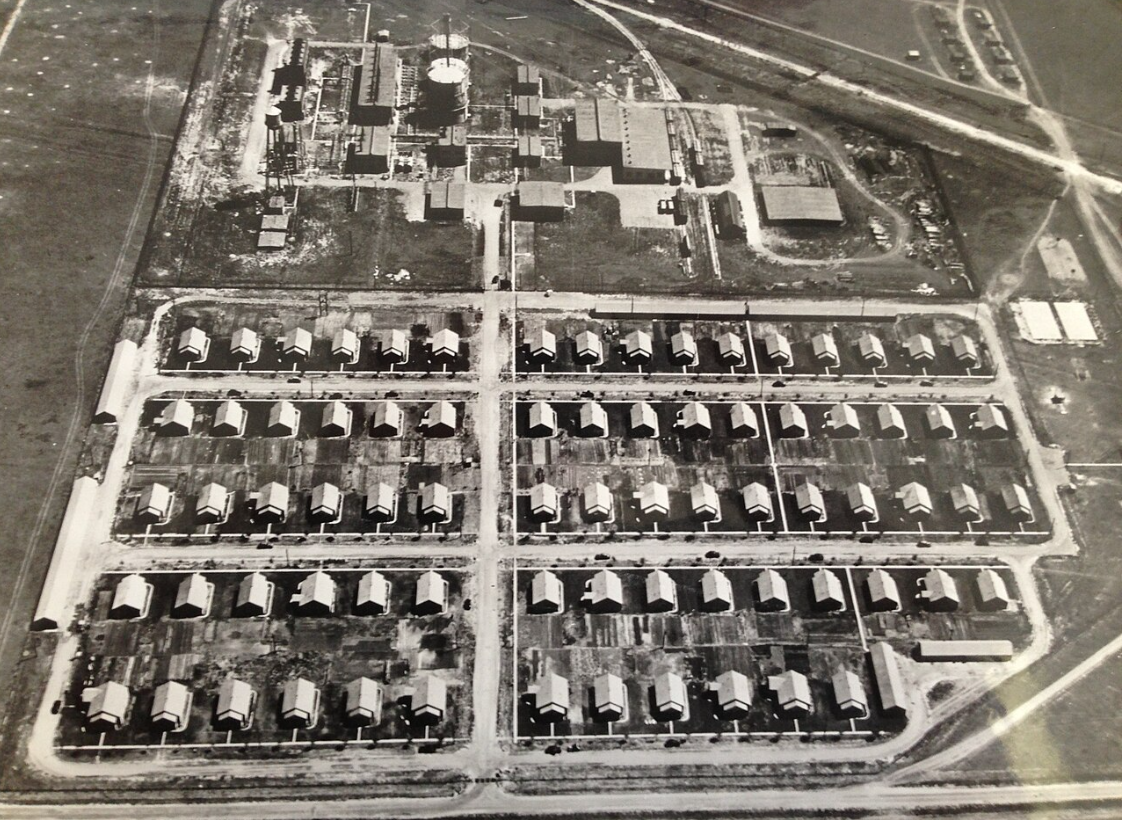
Source: Wikipedia. The Excell helium plant, ca 1945. Note the company housing.
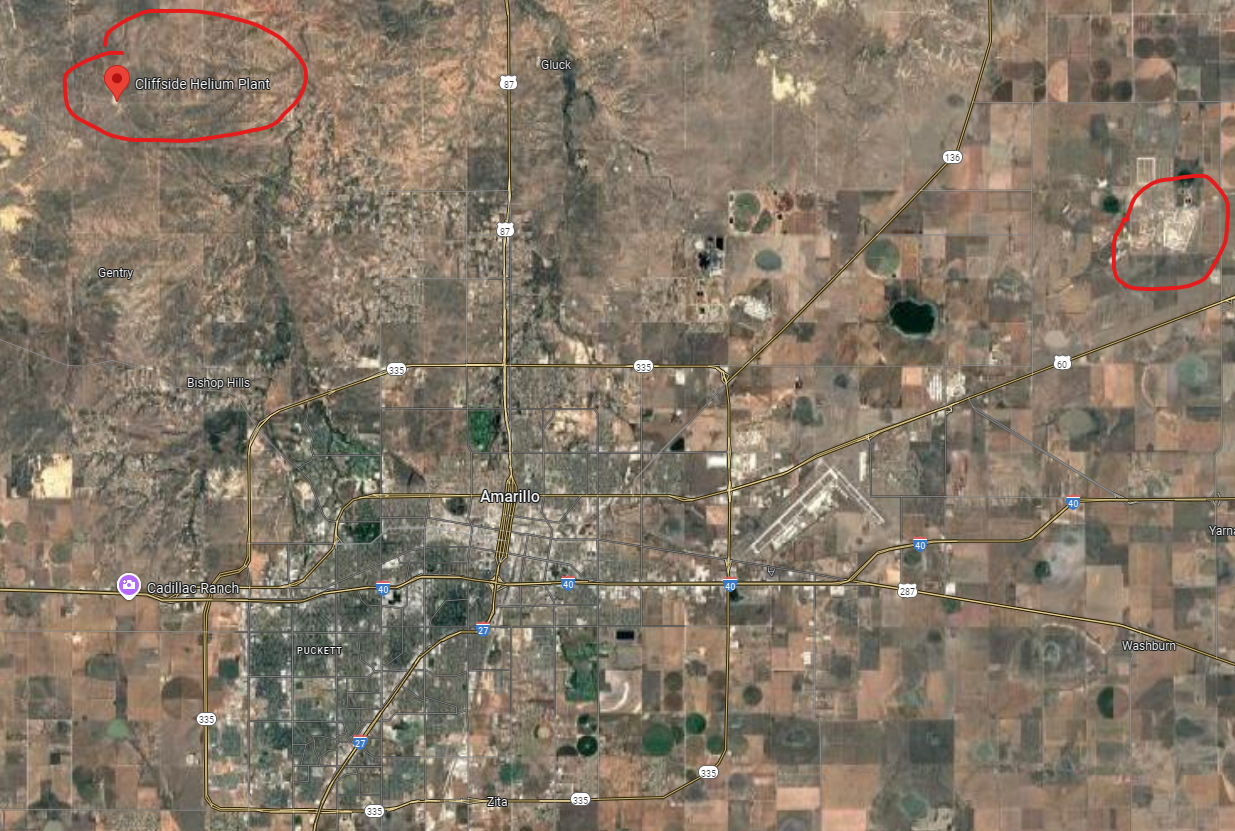
Helium is isolated from natural gas. According to the American Chemical Society, the US, Algeria and Qatar have the major the helium reserves while the US, Russia and Algeria are the top suppliers of helium. The majority of US reserves are in the Texas & Oklahoma panhandles and Kansas. The Cliffside helium plant is located a 15 miles NNW of Amarillo, TX, over the Cliffside dome. It is in the red circle on the upper left in the photo.
The Amarillo Helium Plant got its start in 1929 when the federal government bought 50,000 acres NNW of Amarillo for a helium extraction plant. The motivation was to accumulate helium for lighter than air aircraft like balloons and blimps.
Source: Google Maps. Cliffside Helium Plant, Amarillo, and Pantex.
It is interesting to note that the Pantex nuclear weapons plant is about the same distance but to the NE of Amarillo, TX. It is circled in red in the upper right. It is the primary site in the US where nuclear weapons are assembled, disassembled or modified. Uranium, plutonium and tritium bearing components are stockpiled there. Weapons that use tritium in their booster gas have a shelf-life constraint due to tritium’s very short half-life, so the gas must be periodically upgraded.
The facility opened in 1942 for the manufacture of conventional bombs and was shut down shortly after the Japanese surrendered in 1945. The site was purchased in 1949 by what is now Texas Tech and used for research in cattle-feeding operations. In 1951 it was surrendered to the Atomic Energy Commission (now the National Nuclear Security Administration) under a recapture clause.
So, we might ask the question: Why was anyone looking for helium in natural gas at the time? The easy answer is that nobody was looking for it. In May of 1903 in Dexter, Kansas, a crowd had gathered at a natural gas well to celebrate this exciting economic find. A celebration had been planned and the towns folk were there to see it ignited. It was called “a howling gasser” and there was much anticipation of a spectacular fire. After much ballyhoo and speeches, a burning bale of hay was pushed up to it in anticipation of ignition of the gas jet, but the burning bale was extinguished. This was repeated several times, but no fire. The disappointed crowd wandered off. Later Erasmus Haworth, the State Geologist and geology faculty member at the University of Kansas, got word of this curious event and managed to get a steel cylinder of gas sent to the university.
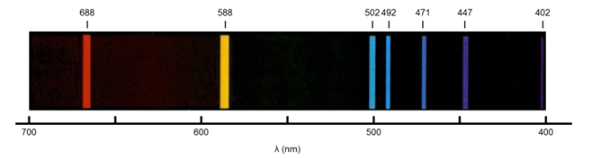
At the University Haworth and chemistry professor David F. McFarland determined that the composition of the Dexter gas was 72 % nitrogen, 15 % methane and 12 % of an “inert residue.” Soon, McFarland and chemistry department colleague Hamilton P. Cady began “removing the nitrogen from the gas sample by applying a spark discharge with oxygen over an alkaline solution.” This tedious procedure was soon replaced by using a glass bulb of coconut charcoal immersed in liquid air. This method had been shown to adsorb all atmospheric gases except helium, hydrogen, and neon at the temperature of boiling liquid air” (-310° F). The unabsorbed gas was collected in a glass tube and examined by emission spectroscopy. The spectrum showed all of the optical lines of helium. This discovery by McFarland and Cady showed that sizeable quantities of helium did exist on the Earth. The total amount of helium in the Dexter gas was 1.84 %.
The nagging question I have is how did the nitrogen content in the Dexter sample come to be? The thinking is that N2 gas found in natural gas derives from chemical alteration of organic ammonium compounds deep in the natural gas forming strata. To a chemist “ammonium” has a specific meaning. To a geologist it may just mean “amine”: hard to tell. N2 molecules are in a deep thermodynamic well, meaning that once formed, the nitrogen is very stable and not readily altered without large energy inputs. So, the formation equilibrium of N2 could favor its formation rather than returning to a precursor.
The removal of nitrogen, called nitrogen rejection, is a normal part of natural gas processing. The incentive for its removal is that it lowers the BTU content and thus the value of the gas. According to one source, the Midland gas field in the Permian formation of Texas is unusually high in nitrogen, from 1 % to 5 %. Given that the usual specification for nitrogen content is 3 %, excessive nitrogen must either be reduced by dilution or removed.
The problem of nitrogen becomes especially acute for gas that is condensed to LNG (Liquified Natural Gas). Natural gas that has too much nitrogen in it has a higher partial pressure of nitrogen and as a result it occupies space in a pipeline or LNG carrier that could be occupied by a gas that pays- natural gas. Non-combustible gas in the liquefaction train at the LNG terminal wastes its processing capacity. The specification mentioned above becomes more problematic when it is realized that the N2 content of natural gas may vary considerably from one wellhead to the next, adding to the overhead cost of quality control of the output gas.
Back to the Howling Gasser, the fact that the natural gas screaming out of the wellhead wouldn’t ignite was an extreme example of the effect of nitrogen in the formation. What saved the day was the high enrichment in helium. But, you would have to know to look for it. That a curious geologist and two chemists were able to isolate the helium and perform emission spectroscopy on it without a clue as to what it was stands as an excellent example of what curious, knowledgeable folks can do when given the resources. The state of Kansas is to be congratulated as well for providing the research facilities at the University of Kansas in Lawrence, KS.
After reading a biography of the Russian Marshal of the Soviet Union, Georgy Zhukov, it becomes apparent that there are parallels between Soviet tactics in WWII and those used in the Putin-Ukraine conflict. Beyond the deployment of similarly vintaged tanks and weaponry, General Zhukov was notorious for committing his forces to battle with little regard for casualties. Similarly, Putin’s military has been characterized by the use of inadequately trained and equipped conscripts. Additionally, it has been reported that Putin’s forces have positioned troops behind the front lines to prevent or even target any deserting or retreating frontline soldiers. Zhukov’s approach often involved rapidly advancing battalions and armor to the front with minimal planning, depending on the attrition of Nazi forces. This tactic was typically executed under Stalin’s direct orders, though sometimes initiated by Zhukov independently.
The conflict between Putin and Ukraine has evolved into a war of attrition. Initially, Putin thought he could swiftly deploy tanks and troops as he did in southern Ukraine in 2014, seizing territory through sheer intimidation. However, he miscalculated the armaments, determination and tenacity of the Ukrainian forces. Since 2014, tens of thousands of Ukrainian soldiers have received training from Western nations. By February 2022, they were significantly better prepared and less intimidated by Putin’s military. In conventional warfare, the Russian military turned out to be a paper tiger, at least with its conventional non-nuclear forces, that is. The Putin-Ukraine war is still unfolding but Russia will come out of it severely stunted win or lose and possibly with new leadership. Whatever the outcome, the winner will have a great deal of de-mining to do. The conflict continues to unfold, but regardless of the outcome, Russia is likely to emerge greatly weakened, potentially with a change in leadership.
Putin is a smart guy. Certainly he knows the consequences of releasing as much as a single low yield tactical nuclear weapon, even if it’s limited to a demonstration. Pandora’s box would swing wide open and out would slink an ever-expanding series of repeats of above ground nuclear blasts until a city would be hit. Then all out nuclear war could happen in the old eye-for-an-eye fashion. Dark days would follow indeed.
Putin surely realizes the dangerous situation his county is in with mounting military losses, the brain-drain of skilled workers leaving the country and a crumbling oil and minerals-based economy. Yet he wears the neutral expression of the Sphinx in public because he must. He has painted himself and his nation into a corner. He even resorted to making nice with the plump North Korean dictator which must have been a nauseating demotion for him.
A bit of history
The Magna Carta was an agreement signed in England on June 10th, 1215, at Runnymede along the River Thames. This agreement had the unique provision of the enforcement of limitations on the sovereign. Rather than a simple recitation of grievances by the barons, the Magna Carta contained ‘security clause 61’ which provided for the barons the authority to seize the castles and lands of King John and hold them until such time as he held to his responsibilities as agreed upon in the signed document.
The Magna Carta was not just a contract between wealthy barons and King John, rather it was a step change towards political reform that provided for enforcement on the King. From Wikipedia–
“First drafted by the Archbishop of Canterbury, Cardinal Stephen Langton, to make peace between the unpopular king and a group of rebel barons, it promised the protection of church rights, protection for the barons from illegal imprisonment, access to swift and impartial justice, and limitations on feudal payments to the Crown, to be implemented through a council of 25 barons.”
Unfortunately, the distrust between the barons and the Crown, compounded by the annulment from Pope Innocent III, led to its swift failure. Just a few months after the agreement fell apart, the First Baron’s War erupted. However, this was not the final chapter. The document was reissued in successive versions, with the more radical language removed, in 1217, 1225, and finally in 1297, when its remaining elements were incorporated into England’s statute law. It was not unique in its attempt to limit the power of the Crown; similar efforts were seen elsewhere. Over time, the Parliament of England enacted laws that overshadowed the original document, diminishing its significance.
Back to Russia
The point of highlighting the Magna Carta, despite its failure, is that nothing of this type of significance happened in the history of Russia, at least until the Bolshevik Revolution. Perhaps this comparison is too facile, causing real historians to choke on their Starbuck’s latte. But allow me to finish. The Magna Carta was not entirely unique for its era. However, it was notable for including a provision that enforced the good faith by the King. It represented a collective bargaining effort by the 25 barons with King John to alleviate some of the monarchy’s oppression and, in doing so, progress the political atmosphere for a short time with fits and starts. As kings often do, King John protested to the Pope, who then exerted his authority in a manner only a Pope could. The Pope excommunicated the Barons and nullified the agreement, having been persuaded by King John that it undermined the Church’s authority.
Russia seems not to have a tradition of producing successful popular uprisings to the power of the Tsar. of course, the Bolshevik revolution is the shining counterexample. Not in the sense of overthrow so much, but as an enforceable agreement to relieve a measure of oppression by the monarchy at all levels. In contradiction to this sweeping generalization is the case of Tsars Alexander I and II. Alexander I introduced minor social reforms but he was a strict Russian nationalist and Slavophile. Many of the reforms he instituted early in his career were retracted later.
Tsar Alexander II , however, instituted many liberal reforms but is possibly most revered for his Emancipation of the Serfs in 1861. In the US, he is remembered as the Tsar who sold us Alaska. He was a supporter of the Union in the American Civil War and even sent ships to New York Harbor and San Francisco Bay to deter Confederate warships. Eventually he was assassinated in Saint Petersburg on March 13, 1881. The first assassin’s bomb thrown under his armored carriage left him dazed but uninjured. The second assassin’s bomb thrown shortly thereafter delivered the fatal injuries as he stepped out to investigate. The third assassin’s bomb was unused.
Zooming forward to the present, what actions can the Russian populace take regarding Tsar Putin? After centuries of political oppression aided by new thinking, modern technology, and nuclear weapons the current Tsar has built a deep and wide moat around himself and his allies within the Kremlin establishment. Beyond this moat stands a population conditioned to obedience by fear, a legacy of decades of Soviet rule. I believe that national pride will deter them from emulating Western forms of civil society and governance. And why can’t they develop an authentically Russian something-something ‘democracy’, or whatever? Russia has deep foundation of cultural, artistic and scientific achievements to take pride in, despite its history of authoritarian governance. Whatever Russia eventually does, it will be heavily Slavic and Eastern Orthodox.
Russians are just as pleasant and smart as everyone else in the world, obviously. Russian hospitality is first rate as I have personally experienced. They just have the heavy blanket of oppressive leadership over them that continues to drag through the generations. Even if Putin falls out of power, there is a line of replacements cut from the same cloth. Perhaps a leader of a reform movement could rebuild Russia? It could happen but just as likely it could revert into a system that is better at prosecuting a war of aggression and suppression of the population. The replacement of Putin could be good for the world, or it could go sour. The world has to wait it out and see. In the meantime, it is critical to keep Putin out of Ukraine, Poland and the Baltic states.
The Putin government is like a toxic gas- it will expand into all of the space available. After the decades-long stand down in tension since the collapse of the Soviet Union, the problem of an aggressive Russia arises again. The West must remain the sturdy counter example to the authoritarian culture of Putin’s Russia. We in the USA, especially, need to do a better job as the shining city on the hill. Lately the shine is wearing off.
9/11/24. At present numerous oil production platforms in the Gulf of Mexico have been evacuated because of Hurricane Francine. One of them is the “Who Dat” O&G field. The Who Dat field produces O&G with low wax content and no asphaltene flocculation. The origin of the phrase “Who Dat” comes from the Acadiana region of Louisiana. There are numerous claims to the origin of the phrase and there have been legal spats as to the trademark ownership of the phrase. The NFL in particular has thrown its ponderous weight around in the matter. The reader is encouraged dive into ‘controversy’ for themselves.
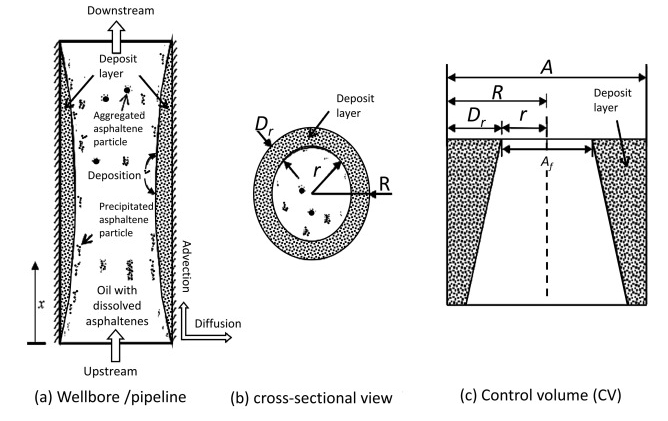
The low asphaltene-flocculation of the Who Dat field is fortuitous since asphaltenes can accumulate and choke the well bore or downstream piping, interfering with recovery. The graphic below is borrowed from a book chapter by Abdullah Hussein, Essentials of Flow Assurance Solids in Oil and Gas Operation, published by ScienceDirect in 2023. Fouling by asphaltenes can be removed by dissolution in aromatic hydrocarbons or detergents.
As asphaltene-bearing oil rises in the wellbore, it will begin to depressurize and cool causing the asphaltenes to precipitate out of solution and aggregate, resulting in flocculation and fouling of the wellbore, downstream equipment and pipelines.
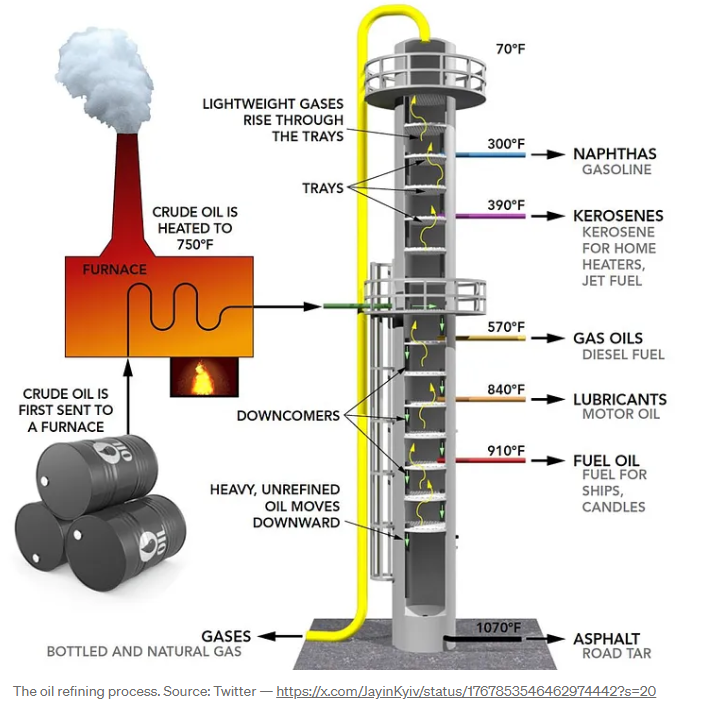
Graphic: Note that the higher the boiling point (heavies), the lower on the column a fraction is drawn from. In particular the asphalt fraction must remain quite hot to assure that it can flow away. The low boiling point fractions (lights) are vented off and sent elsewhere for processing. The graphic is sourced from here under the Fair Use Doctrine.
The simplified cartoon of a distillation column above shows that used in petroleum refining to isolate hydrocarbon components (fractions) in broad groupings by boiling point. These columns are quite tall and can be spotted easily as you drive by a refinery. Crude oil has suspended solids that are removed by water extraction which is then vaporized in a separate furnace under pressure. This hot, crude vapor is then pumped into the bottom of the distillation tower. For the non-industrial chemists out there who are accustomed to heating a reaction or distillation vessel directly nested in a heating mantle, this offset heat exchange approach is quite common. The fuel for the furnace can be several in-house sources.
Crude oil is a highly complex mixture of hydrocarbons and NSOs (nitrogen, sulfur, oxygen and heavy metals) with a broad range of structures and boiling points. These petroleum hydrocarbons contain a bit of nitrogen, sulfur and oxygen, produced water, natural gas, and inorganics. The hydrocarbons are further divided into linear, branched, aromatic/nonaromatic and cyclic carbon skeletons in which each can be subdivided again into differing molecular formulas and degrees of unsaturation. At this point the reader may need to take a cool refreshing dip into the pool of chemical bonding and the covalent bond in particular because this has a direct bearing on degrees of unsaturation.
A swerve into the weeds of chemical bonding
Here is the long and short of how the different types of chemical bonds affect the formula and structure of a molecule. Carbon atoms make up the skeleton of a molecule and are connected through the sharing of electron pairs. The shared electrons in a bond spend some fraction of their time in orbit between the two carbon nuclei and as such continue to screen out some of the mutual repulsion of the two nuclei. But that is not all. It turns out that this is where quantum mechanics rises from the murky depths of reality. The two bonding electrons are each able to occupy more space than what is available in the individual atoms and so drop in overall energy just a bit. This energy drop is manifested as heat which diffuses into the local environment. The amount of energy lost consists of a discrete quantity of electron orbital energy and occurs in a stepwise manner. This discrete step change is a “quantum jump”. [Note: a ‘quantum jump’ is often portrayed in the popular media as some type of Disneyesque dramatic and abrupt big shift in something or other. In reality it refers to a discrete step change in energy at the sub-nanometer scale.]
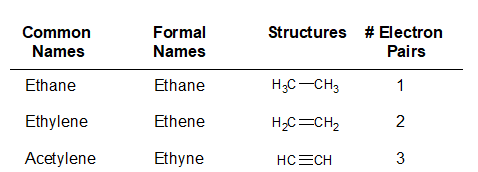
Graphics by Fred Ziffel. Each line between the Carbon atoms represents one pair of bonding electrons.
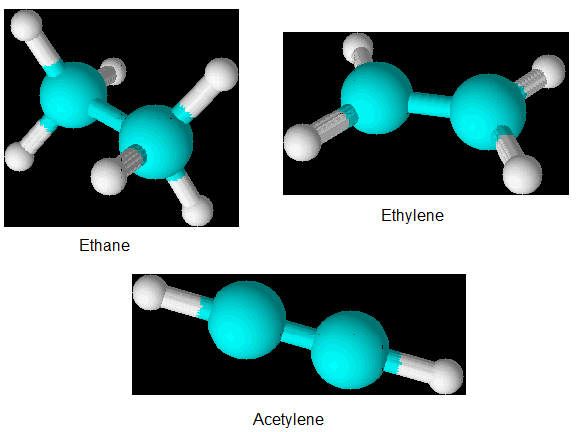
The number of bonds between the carbon atoms has consequences in the 3D shape of the molecule. In the 3 ball and stick representations below, only skeletal single bonds are shown (for reasons known only to ChemSketch).
Graphics by Arnold Ziffel. Bonds number 2 and 3 are omitted in Ethylene and Acetylene to emphasize the shapes. Note the flat planar shape of Ethylene compared to Ethane.
But what do you mean by ‘aromatic’?
The aromatic feature of a molecule is very special. It has a unique type of pi-bonding involving ‘special’ numbers of bonding electrons arranged in a ring and limited by the formula (4n + 2), where n is a counting integer. For n = 0, 1 2, etc., the numbers of electrons involved will be 2, 6 and 10 bonding electrons alternating in a ring. The most frequent ‘special’ number of electrons is 6, as in 3 alternating pairs of 2 electrons. Here, aromatic does not refer to fragrance, although many aromatic compounds like vanillin do have a fragrance. A cyclic group of 3 alternating bonding pairs of electrons will spontaneously ‘delocalize’ and occupy a lower energy level- a much-favored situation. That is, they will circulate around in a continuous ring and occupy a space above and below the ring atoms in a ‘sandwich’ fashion. Okay, we’re drifting a little too far into the weeds.
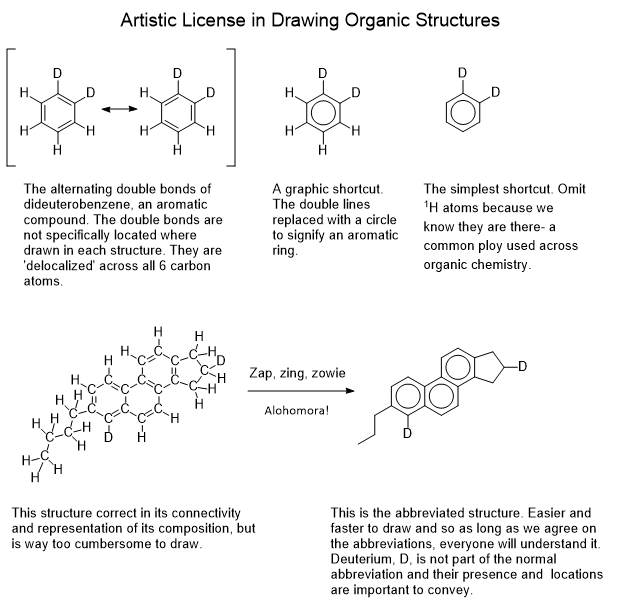
Graphics by Arnold Ziffel. Organic chemists draw a lot of chemical structures and, frankly, it can become tedious. To make life easier, certain graphical norms have arisen to stem the tedium.
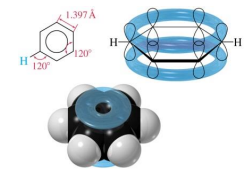
Knowing full well that I am presenting a highly truncated explanation of aromaticity, I have borrowed 3 representations below of the aromatic compound benzene. Given that single C-C bonds are longer than double C=C bonds, one might expect to find that with both C-C and C=C bonds present, 3 bonds would be longer than the other 3. But this isn’t what’s observed. Measurements show that all 6 CC bonds are of the same length, 1.397 Angstroms. And the CC bond angles are all 120 degrees, again different from C-C bond angles. These observations tell us that all 6 CC bonds are equivalent yet different from isolated CC bonds. Note in the upper right structure the 2 blue rings situated above and below the carbon skeleton. These rings represent delocalized electrons that are off-axis to the C-C bonds. They sandwich the carbon skeleton of C-C bonds. The blue rings show the space where the 6 C=C bonding electrons may be found. The bottom structure is a space filling model showing approximately the space occupied by the electron cloud. Think of it as the location of where another molecule will collide with it.
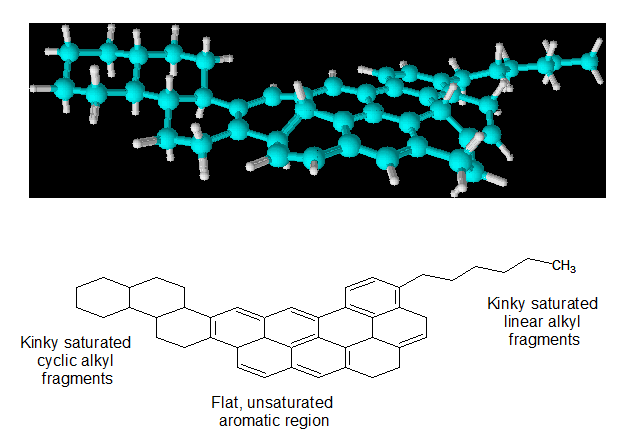
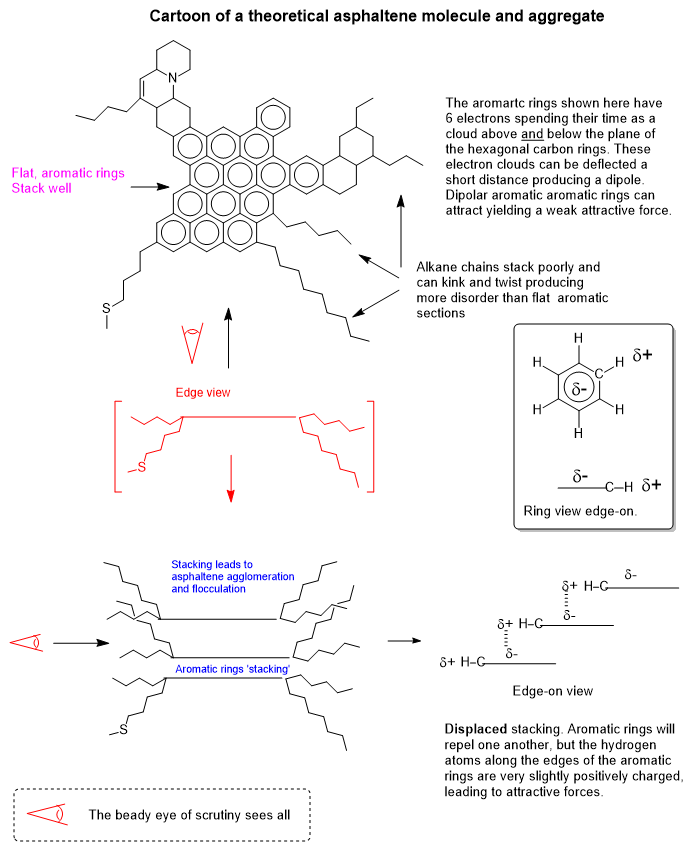
The imaginary large molecule shown below consists of a central region that is flat and two domains that are kinked and bristling with hydrogen atoms. The structure is shown stationary but in reality, it is vibrating vigorously, tumbling in solution, being battered by adjacent molecules and mashing its way through any liquid that may be around it. You know, the usual liquid scenario. The cyclic alkyl groups on the left are locked in space allowing only limited wagging motion, but the alkyl group on the right is free to rotate about all of the C-C bonds allowing the chain to writhe and snake around in its immediate 3D space.
Graphics by Sam Hill. 3D and 2D structures of an imaginary asphaltene. The aromatic section of the molecule is flat while the alkyl parts are kinked and bristly.
Above I referred to “… the sharing of a pair of electrons.” This is only just 1 part in a story of several kinds of chemical bonding. One carbon atom can bond to another carbon atom with 1, 2 or 3 pairs of electrons, producing 1, 2 or 3 chemical bonds. Carbon can also bond by sharing electrons (covalent bonding) with other atoms like nitrogen, oxygen and sulfur to form single or multiple covalent bonds. Atoms like hydrogen, boron, fluorine, chlorine, silicon, phosphorus, bromine and iodine bond well with carbon but with only a single bond. In general, as we move to the left and down on the periodic table the sharing of electron pairs becomes more and more one sided favoring the atom nearest to the upper right of the table. [Note to the purists: we are going to ignore carbanions, carbocations and carbenes in this post.]
Back to our regularly scheduled program
So what does all this bonding jazz have to do with asphaltenes? The type of chemical bond that makes aromatic rings flat, the pi-bond, is very abundant in asphaltenes. An aromatic ring of 6 carbon atoms has 3 alternating pi-bonds. Such compounds are commonly referred to ‘unsaturated’ meaning they have multiple bonds between carbon atoms rather than bonds with hydrogen- they are unsaturated with hydrogen atoms. These molecules consisting of hexagonal arrays, sharing edges like a thin honeycomb and are able to stack on one another- sometimes called pi-stacking.
Graphics by Arnold Ziffel. Agglomeration is when stacks of asphaltene begin to form. Flocculation is when groups of agglomerated asphaltenes mass together.
The asphaltene component of asphaltene (!?!) has been defined as that fraction which is soluble in aromatic solvents like benzene, toluene and xylene, etc., but not in alkane solvents. From this link, “Asphaltenes are referred to [as] the poly-dispersed distribution of the heaviest and most polarizable fraction of the crude oil.” This property derives from the large fraction of aromatic structures in the asphaltene.
Asphaltenes are a complex mixture of hydrocarbons containing variable amounts of nitrogen and sulfur atoms built into the structures. As a category, asphaltenes are substantially aromatic in nature with rather high molecular weights but may have cyclic and acyclic saturated hydrocarbon, or alkyl, fragments attached. These alkyl fragments lend solubility of individual asphaltene components in saturated hydrocarbon solvents (alkanes) and thus offer a means of semi-selective isolation. Maltenes are asphaltene components that are viscous liquids soluble in n-alkane solvents. Maltenes provide the adhesive qualities in asphalt. Asphaltene is divided into 2 fractions: Asphaltene and Maltene.
The words asphalt and bitumen are sometimes used interchangeably, both referring to the same material. Asphalt is the American English version. To help avoid confusion, the terms “liquid asphalt”, “asphalt binder” or “asphalt cement” are used in the U.S. to distinguish it from asphalt concrete. We recall that concrete is comprised of aggregate held together by cement.
Colloquially, various forms of bitumen are sometimes incorrectly referred to as “tar“. Asphalt or bitumen occurs naturally or can be manufactured. The roadbeds we drive on are “asphalt concrete” where stone aggregate is mixed with hot liquid asphalt as a binder that upon cooling forms a hard, durable surface. In common usage “asphalt concrete” is shortened to asphalt while the British call it tarmac.
Thus far, we have been talking about crude oil-based asphalt. Roughly similar materials like tar or coal tars are derived from sources other than petroleum. Generally, the words tar and pitch are used interchangeably but each can be considered specific to separate starting materials. Tar is a dark brown or black viscous liquid and is the result of the destructive distillation of a wide range of organic materials like wood, peat, coal. or petroleum. Pitch derives just from plant material.
In the early 1960’s, Dr. Fritz Rostler and coworkers of the Golden Bear Oil Company, now Tricor Refining LLC, discovered the cause of asphalt deterioration. He found that during the heat treatment used in asphalt processing and/or under prolonged exposure to sunlight in the presence of oxygen, the maltenes are degraded and their adhesive attribute is diminished, allowing the asphalt/aggregate components to crumble.
According to the online news source “Upstream“, what is at the time of writing the Category 2 Hurricane Francine spinning northeastward in the Gulf of Mexico has resulted in the shutdown of approximately 23.5 % of gulf oil and 26.6 % of gas production. Approximately 35 % of the 371 manned platforms in the gulf have been evacuated according to the US Bureau of Safety and Environmental Enforcement (BSEE).
Francine is projected to make landfall along the Louisiana coast Wednesday on 9/11/24 and move up through Mississippi. That is, unless Trump gets out his Sharpie marker and wills it in another direction ...
The “Who Dat Field” and more
Naturally, when investigating the gulf shutdown I saw mention of the “Who Dat Field“, I had to look into it. It is located in the Mississippi Canyon (MC) blocks 503 / 504 / 547 in the Gulf of Mexico (GOM) in water depths of 945m.
The Who Dat Field is made up of ten stacked reservoirs of the Pliocene and Upper Miocene age. Its reservoirs are located at a depth of 10,000ft-17,000ft, with pressures ranging between 6,000 psi and 12,500 psi.
The three wells drilled at the field encountered more than 700ft of net pay in the reservoirs. The wells flowed at the rate of 10,000 barrels a day of oil and 60 million cubic feet a day of non-associated gas. Source: “Who Dat Field“.
The origin of the phrase “Who Dat” comes from the Acadiana region of Louisiana. There are numerous claims to the origin of the phrase and there have been legal spats concerning the trademark ownership of the phrase. The NFL in particular has thrown its ponderous weight around in the matter. The reader is encouraged dive into controversy.
[Note: This is an updated version of an earlier post.]
Recently I spent some time tracing the very early history of gunpowder or Huo Yao (China, ca 850 AD). It turns out that the earliest clear description of a gunpowder-like composition was described in a document produced during the Tang Dynasty. A document titled “Classified Essentials of the Mysterious Tao of the True Origins of Things” contained a list of particularly dangerous elixirs. A comprehensive history of Chinese science can be found in “Science and Civilisation in China, Volume 5: Chemistry and Chemical Technology, Part 4, Spagyrical Discovery and Invention: Apparatus, Theories and Gifts” by Joseph Needham. Within this list of hazardous compositions, a warning was offered citing the dangers of mixing and heating together realgar, salt peter, sulfur, and honey. The document tells of alchemists mixing this combination and heating it, resulting in a deflagration leading to burnt beards, faces, and hands as well as the loss of the structure to fire. This mixture has been translated as “fire-drug”.
There are earlier references to admixtures that could produce a violent effect, but the compositions are not disclosed. The information in the 850 AD document clearly describes the components of classic gunpowder- a nitrate oxidizer, sulfur or sulfide for low ignition temperature, and a carbohydrate reducing agent- honey. What is notable about gunpowder is that is a self-contained redox system containing two sides of the fire triangle– fuel and oxidizer in intimate contact. All that is needed for an exothermic reaction is initiation with some kind of energy stimulus.
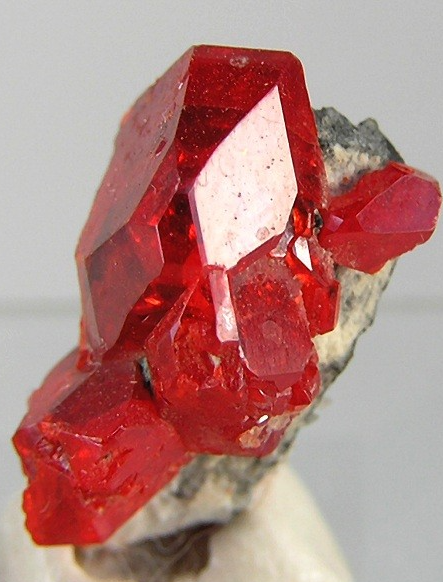
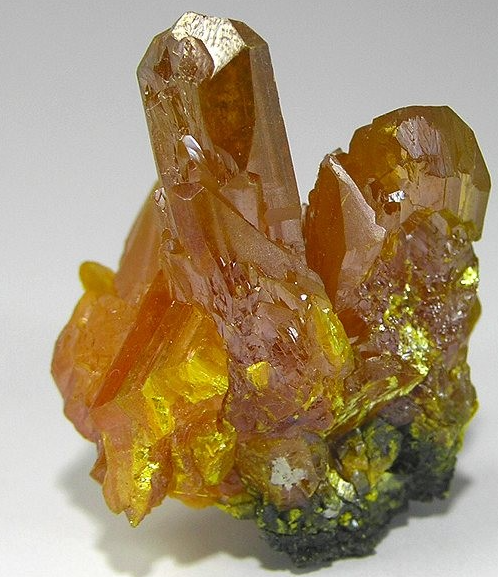
A couple of thoughts on the realgar present in the mix. First, alchemists were commonly in the apothecary trade and made their living preparing medicaments, not so much searching for the philosopher’s stone. It is not unreasonable to suppose that the composition was intended for some medicinal effect. Realgar is red tetraarsenic tetrasulfide (As4S4), possibly with some amount of yellow Orpiment (As2S3), and may have been a common apothecary ingredient of the time. Crystalline realgar is a ruby-like, eye-catching substance and it is not surprising that it captured the fancy of alchemists.
Second, realgar and orpiment are found in hydrothermal deposits as are copper, gold, silver, and mercury sulfides (metal sulfides as a group were referred to then by the obsolete term sulphuret). Back when roasting ore was widely practiced (and legal), it was common for miners in American lode gold districts to heap sulphuretted ores onto a wood pile and set it alight directly or air oxidize it in a reverberatory furnace. This process would actually ignite the sulphureted ore and in the case of gold and mercury, release the native metal. The point is that sulphuretted arsenic would be expected to contribute to the combustion process as a reducer of nitrate or just as a spectator fuel.
My understanding of sulfur’s role in gunpowder is that of a low-melting, combustible substance which, when ignited, maintains intimate thermal contact with the solid nitrate and carbon elements, transferring heat to trigger and sustain the deflagration or explosive redox reaction.
In medieval times, before blasting with gunpowder was available, it was common in hard rock mining to fracture rock by creating a large fire adjacent to a rock face to get it hot, then water was splashed on it in an attempt to fracture the hot rock by thermal shock. [In my lonely voice squeaking out from under my rock along the riverbank, I would offer that this activity might have presented the opportunity to discover that some (sulphuretted) minerals were combustible. Alternatively, building a ring of sulfuretted rock around a campfire may have led to the same discovery.]
Just WOW!! A team from Nagoya University in Japan performing synchrotron X-ray diffraction experiments at SPring-8 were able to selectively extract an image of valence level electron density in the amino acid glycine. Did you get that? And guess what they found? The valence electrons were occupying a space the shape of a molecular orbital also derived from computation!! Amazing.
The aerial view of the facility is shown below. Despite the ring being situated on bedrock, the alignment of the magnets in the storage ring is so precise that the moon’s tidal forces can have a measurable impact on the ring’s performance.
Source: Spring-8. Schematic of the overall beamline.
Source: Spring-8. There are 62 beamlines coming from the synchrotron storage ring.
The experimental work in question is that of Takeshi Hara, Masatoshi Hasebe, Takao Tsuneda, Toshio Naito, Yuiga Nakamura, Naoyuki Katayama, Tetsuya Taketsugu, and Hiroshi Sawa*, “Unveiling the Nature of Chemical Bonds in Real Space”, Journal of the American Chemical Society, accepted July 10, 2024. https://doi.org/10.1021/jacs.4c05673. As of this writing the full journal citation was not available.
Density Function Theory (DFT) calculations were performed with Gaussian 16, revision A.03.
Below is an illustration by a Riken artist comparing the theoretical valence level molecular orbital (MO) of glycine by DFT calculations and the experimental valence electron density distribution, or VED, collected by synchrotron x-ray diffraction at SPring-8.
Credit: Reiko Matsushita / RIKEN. Results from the XRD study of glycine.
If you’ve been through college chemistry, then no doubt you are familiar with atomic orbital theory beginning with Linear Combination of Atomic Orbitals, LCAO. Beyond LCAO is MO theory which goes on to help in the understanding of optical, electronic, magnetic and bonding properties of molecules. In the 1980’s and 90’s commercial software became available (and affordable)
Experimental details from the JACS paper-
Single Crystal XRD Experiments and Structure Analysis. Single crystal XRD experiments were conducted at BL02B1 beamline in SPring-8, using the quarter-circle diffractometer (Rigaku Co., Japan), with diffraction reflections detected by a two-dimensional semiconductor detector, PILATUS3 X CdTe (DECTRIS Ltd., Switzerland). X-ray energies of 40 and 37 keV were used for Glycine and Cytidine, respectively. Temperature variation was achieved using a helium-gas-blowing device (Japan Thermal Engineering Co., Ltd., Japan). The intensities of Bragg reflections were collected by CrysAlisPro program. Diffraction reflection averaging and crystal structure analysis were performed using SORTAV program and JANA2006 program, respectively. VESTA program was employed for drawing the crystal structure and electron density. The structural analyses of Glycine and Cytidine were performed at 45 and 35 K, respectively. In the present XRD experiments, the resolution limit of Glycine was dmin = 0.28 Å [(sin θ/λ)max = 1.786 Å−1] and that of Cytidine was dmin = 0.30 Å [(sin θ/λ)max = 1.6565 Å−1]. Accurate determination of structure factor Fcal(K) is crucial for the VED analysis using the CDFS method to obtain phase terms of crystal structure factors. To achieve this requirement, we refined the structure parameters using only high-angle data, a technique known as “high-angle refinement” (Section S1).
VED Analysis Using the CDFS Method. The CDFS method, a technique for directly observing a 3D VED in crystals, employs single crystal X-ray diffraction data obtained from synchrotron radiation. A detailed explanation can be found in previous papers. In this method, the experimental VED distribution is derived by subtracting the calculated core electron density from the experimental total electron density. In both cases, Glycine (C2H3NO3) and Cytidine (C5H9N2O3), the core electron density corresponds to 1s2 orbital density of C, N, and O atoms. Therefore, the phase relationship and distribution of the hybridized orbitals by 2s and 2p should be visible. DFT Calculation. Theoretical valence orbital calculations were performed using DFT with LC-BLYP functional (μ = 0.47)36 and ccpVTZ basis set by Gaussian 16 Revision A.03 program. The structure parameters determined in the present XRD experiments were used for the calculations (Tables S2 and S5). The structures, orbitals, and electron densities are illustrated using ChemCraft program, while the contour plots are drawn using the VESTA program.
Source: The Sawa paper cited above. The experiment was a single crystal X-ray Diffraction (XRD) study using the very narrow x-ray beam available from the synchrotron ring. The underlined text above reveals that the 1s2 orbital electron density was subtracted from the total experimental electron density. This would leave the partially filled 2s and 2p valence level MOs in isolation.
While structural determination by x-ray diffraction has been around for a very long time, what makes this work notable is the detection and imaging of electron density in valence level MOs and the close correlation to computational modeling.
For more information about the SPring-8 synchrotron storage ring, visit their website. The name stems from “Super Photon ring–8 GeV”.
Historically, scientific papers have been not where loud, confident proclamations are made about academic research results. The trend has been a sort of unpretentious modesty to avoid overconfidence and exaggerated claims. A sort of snobismus. Instead, conclusions from research results tend to be more guarded in the interpretation of data. An article in the Scienceinsider section of the AAAS journal Sciencepublished 28 July, 2023, has reported that of 2600 papers published in Science between 1997 and 2021, there was a drop of about 40 % in the use of hedging language. Researchers in the study scanned for about 50 terms including “might,” “probably,” “could,” “approximately,” “appear to” and “seem.” They found that these hedging words dropped from 115.8 per 10,0000 to 67.42 per 10,000.
Analyses of other scientific journals and a 2022 paper that examined nearly the same group of papers from Science have found growing use of a positive, promotional tone—expressed with superlatives such as “groundbreaking” and “unprecedented”—which may lead to exaggerated claims.
The authors suggested that researchers are increasingly unwilling to undersell their work and instead, are using more hyperbolic language such as “groundbreaking” and “unprecedented.”
In an earlier study by C.H. Vinkers et al., published in BMJ, 2015, finished his paper with the following paragraph-
“Currently, most research findings could be false or exaggerated, and research resources are often wasted. Overestimation of research findings directly impairs the ability of science to find true effects and leads to an unnecessary focus on research marketability. This is supported by a recent finding that superlatives are commonly used in news coverage of both approved and non-approved cancer drugs. The consequences of this exaggeration are worrisome since it makes research a survival of the fittest: the person who is best able to sell their results might be the most successful. It is time for a new academic culture that rewards quality over quantity and stimulates researchers to revere nuance and objectivity. Despite the steady increase of superlatives in science, this finding should not detract us from the fact we need bright, unique, innovative, creative, and excellent scientists.”
If you sit through a week of presentation sessions at an American Chemical Society national meeting or walk through a poster session, you’ll see a mix of enthusiastic young chemists standing next to their posters and you’ll sit through talks by more established researchers anxious to emphasize the importance of their work. Giving a talk or a poster at a meeting is inherently a promotional activity. It is getting the word out about you and your work in a particular area in front the scientific community and possibly some influential people. It also is something to add to your resume.
Self-promotion by scientific publishing and participation in meetings, called “ballyhoo” in the movie business, is a great way to expose yourself to greater and more frequent opportunity. Make no mistake, the quality and frequency of publications is a very important metric of your accomplishments and potential. This is a sad reality for some and a fortunate reality for a few, but it is reality.
It is hard to draw much from the above research on the hedging frequency as a metric of … what, the unseemly disappearance of proper modesty? The competitive environment of “big academic science” for funds and exposure to impress colleagues and the rank and tenure committee is inevitable. It has been like that for a very long time, but perhaps hidden under the veil of snobbery.
You never know who you might meet at these venues for academic ballyhoo. I once loaned my laser pointer to Al Cotton (who kept it!) and I met Glenn Seaborg at a poster session at the Disney Hotel in Anaheim, CA. I had too many gin & tonics before I spoke with Seaborg and I’m sure that it showed. At a symposium at Purdue University in honor of H.C. Brown (in attendance), I got to see two prominent scientists get into a rather strong “discussion” during a question-and-answer period about who discovered what first. Professor Suzuki (Suzuki coupling) from Japan said something that got under the skin of prof Negishi (Negishi coupling) from Purdue, so they began with point-counter-point exchange (a type of coupling?) which soon accelerated into an argument. As it got more contentious, they switched to speaking Japanese and continued their argument. After a short time, they realized it was best to just sit down as they were providing a “Clash of the Titans” spectacle. This is not a criticism, just an amusing anecdote. Guys like this should battle it out in public more often.
Self-promotion using exuberant language isn’t inherently bad. It is likely that others have already judged you based on far smaller misperceptions. If someone wants to embarrass themselves, let ’em.
Note: Not residing in Russia, I cannot grasp the full extent of the events and mood unfolding there. All that remains is to perch on a power pole across the polar cap and try to discern fact from fiction.
>>> Let’s ask a very basic question about today’s Russia. Why can’t Russia Putin play nice? <<<
Like most, I have anxiously watched Putin’s invasion of Ukraine. The prevailing Russian narrative is trying to say that the sovereign nation known as Ukraine has historically been a part of Russia or some earlier Russian empire, a view promoted by Putin. Following the Bolshevik Revolution, Lenin directed the Bolsheviks to seize the territory now recognized as Ukraine. The goal was to claim territory for the Soviet Union, but also territory that was extremely fertile. Stalin ordered that Ukrainian industry and agriculture were to be collectivized. An independent Ukrainian government was briefly established but just as quickly collapsed. After several years of intense Ukrainian resistance and significant suffering, Lenin conceded and established Soviet Ukraine, enabling its incorporation into the Soviet Union as a constituent republic.
In the current action, with the support of an extensive security apparatus, Vladimir Putin has resolved that what is now Ukraine will be assimilated into a growing Russian empire. The process will methodically transform its Ukrainian identity through Russification, transforming it into southwestern Russia. Ukraine is expected to become an agricultural hub and potentially a strategic forward base for further military operations into Poland the Baltic states, and likely Moldova.
Why does Putin desire Ukraine when there is considerable open land to the east and north? Well, it’s the geography. The land beyond to the north and east of Moscow consists of vast stretches of challenging subarctic taiga and arctic permafrost, much of which is now thawing, making it unsuitable for roads, urban development, agriculture, and industry. In contrast, Ukraine boasts rich, productive farmland with significant annual grain exports. Additionally, along its southern coast, including Crimea, Ukraine possesses the only warm water ports available in the region, other than possibly the Neva River to the north which are vital for commerce and the military.
Historically, western European colonization was driven by the prospect of trade opportunity including raw materials, cheap labor as well as power projection. Like all countries, Russia would like room for its prosperity to grow. It is desirable that agricultural and industrial capacity also rise. However, Russia has learned the hard way the value of having a buffer zone between Moscow and Western Europe. The relative ease with which both Napolean and Hitler crossed the Eastern European territory enroute to Moscow, Leningrad and other cities through greater Russia did not go unnoticed by Stalin. By absorbing the Eastern European territories after WWII, Stalin built a picket fence protecting the Soviet state.
As the Nazi’s Operation Barbarossa was failing and Stalin’s Red Army began pushing the Germans into a westward retreat, the Soviets took advantage of the opportunity to install Soviet political structure in captured Nazi territory like the Baltic states, Eastern Europe and the eastern half of Germany. While Stalin did not share Hitler’s enthusiasm for exterminating Jews, he did act to eliminate preexisting local political structures which included substantial Jewish presence. This meant executions and large-scale banishment of politically unreliable people to the Russian gulag system. Poland was hit particularly hard by both Hitler and Stalin because it was directly between Russia and Germany and had a large Jewish population.
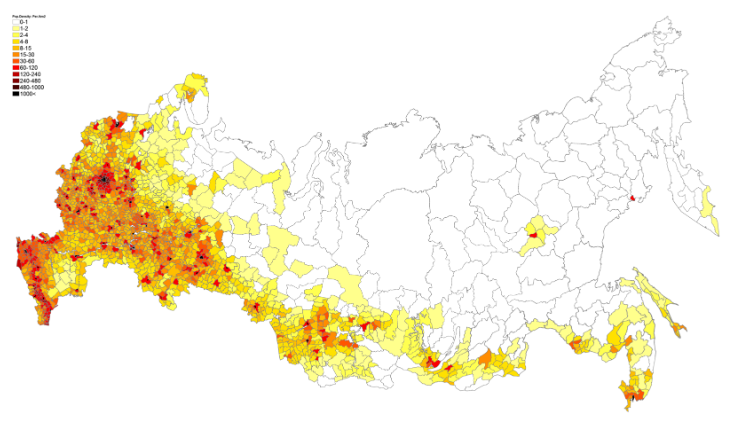
The above map shows the population density of Russia. A substantial fraction of Russians live in the southern and western regions of the country. If you assume that people are living there because it is at least somewhat livable, then the map shows the extent of land poorly suited for habitation.
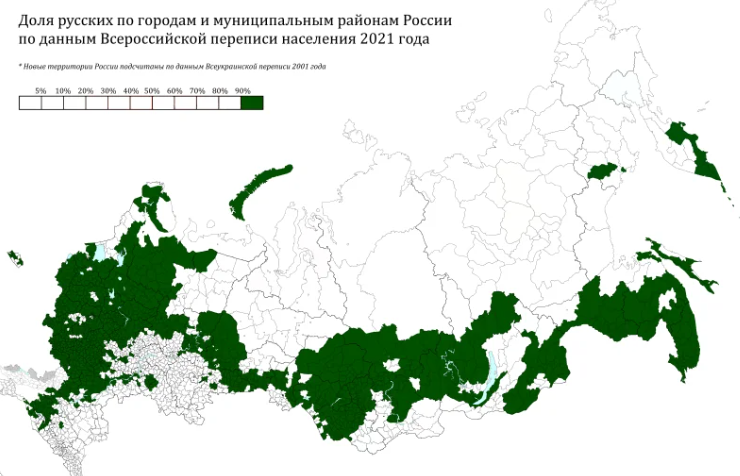
Map of Russia showing areas that are 90 % populated by ethnic Russians.
Russia has a great deal of acreage but the livable turf is much smaller.
Putin views the world partially from the old cold war perspective. It’s Russia against the aggressive, corrupt and immoral west, but without the fever dream of a Soviet-style socialist world. Putin’s state-controlled media endlessly repeats that the west wants what the Russians have and stokes the fires of fear. For the Soviets, “aggressive, corrupt and immoral” included resistance to Soviet influence.
In my many years of trying to be as informed as possible in many areas in a free and open society, not once have I heard anyone suggest “Gosh, I wish the USA could occupy Russia (or the USSR) as an American territory and take all of their stuff.” Imagine the scope of the folly in stupidity of such an attempt. It is mindbogglingly absurd to believe that one could or would want to do such a thing. Russia is for the Russians. Maybe one day they will hit upon a way to craft a free and open society.
The Soviets were ardent promoters of global socialism. Although not overtly socialist, Putin appears more focused on preserving Russian culture and dominance from across a substantial territorial buffer with the West. He asserts his aim to shield Russia from Western cultural influences and what he perceives as a “belligerent” military stance.
The “belligerent military stance” of the West amounts to NATO responding to Soviet adventurism and their habit of hybrid warfare. They would say the same thing from their perspective, but which side was the more authoritarian?
Historically, Russia has endured invasions by King Charles XII of Sweden, Napoleon, and later Hitler. The history of the Kievan Rus from 830 to 1241 is jammed with bloody feuds, wars and invasions. From the Principality of Moscow in 1281 to the end of the Tsardom in 1917, and even beyond into the era of the Soviet Union and into Putin’s time, near continuous conflict has plagued the Russian people. Fortunately, Russia’s northern geography and harsh winters have often played to its advantage, compelling invaders into prolonged conflicts and misery with eventual withdrawal. But not always.
Most nations would like to have global hegemony. Putin is fond of saying that Russia has suffered greatly from American and Western hegemony since WWII and hopes to put an end to it. He has reestablished a Soviet-like security state apparatus with strict media control when he assumed power after the 8 years of Yeltsin’s chaos following the collapse of the Soviet Union. He is trying to resume for present day Russia the former Soviet Union’s international status but largely without the manpower and resources of the former adjacent Soviet states.
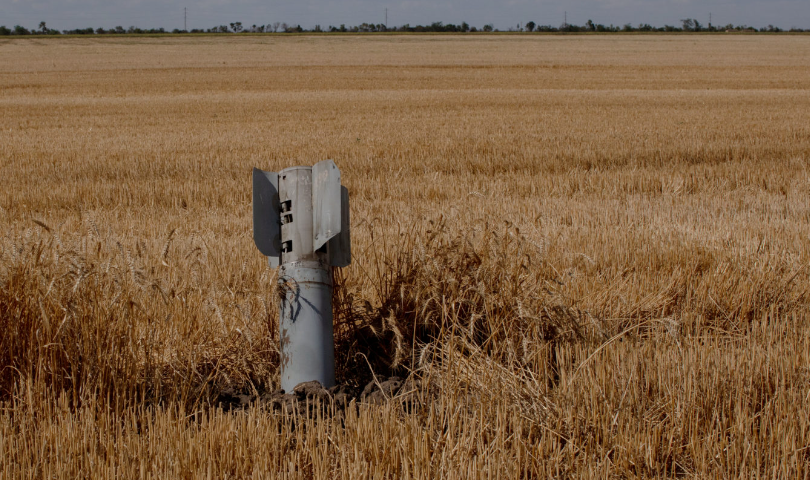
Source: The Fuller Project. Unexploded cluster bomb in Ukrainian wheatfield.
Like his Soviet predecessors, Putin both envies and worries about overreach of western hegemony and is moving to unseat the West. For that matter, so is China. This is only natural. I believe they resent western influence generally. The English language as the global lingua franca and the US dollar as the standard international currency are seen as an annoying affront to their own cultures, sovereignty and political significance. Again, this is only natural. And so is the temptation to use power projection or coercive propaganda to achieve their own hegemony. Casualties would be considered the West’s fault for being in the way.
Both Russia and China have long been critical of the West for internal propaganda purposes but to be fair there has been some valid criticism as well. In truth, the US has done some bone-headed things that we should not be proud of and that hardly serve to highlight our presumed “special” nature. But in fairness, most all cultures can look back at regrettable conduct in their history. Neither Chairman Mao’s China or Stalin’s USSR have sparkling clean histories either. Often the benefit of hindsight doesn’t come into focus until far down the timeline.
The Soviet Union in the person of Joseph Stalin, had brutalized Ukraine previously in an attempt to halt its independence. The Holodomor, meaning death by starvation, of 1932-33 is estimated by scholars to have killed 3.5 to 5 million people. This period of time is marked by forced collectivization of agriculture and industry in the USSR and Ukraine. Collectivization meant taking control of farmland owned by the peasants (especially the Kulaks), many times banishing them to the gulags never to be seen again. Already by 1931, Moscow had taken 42 % of the Ukrainian grain harvest, forcing some locations even to turn over seed for the following harvest. By early 1932 some districts in Ukraine were already experiencing famine. The governing committees in Ukraine in 1932 believed that the 6 million tons of grain demanded by Moscow was unachievable, yet they ratified the plan anyway.
The current brutal murder and devastation of Ukrainian citizens and their infrastructure and agriculture will take a generation or more to repair even if Russia prevails. Russia has done great damage to the Ukrainian environment in addition to the many casualties. Much of the country is cratered, littered with destroyed vehicles and war debris, denuded of vegetation, and rendered deadly by the landmines.
The great equalizer among the leading nations is Mutual Assured Destruction, or MAD, by virtue of the threat of the use of nuclear weapons for mutual annihilation. Sometimes just called “the bomb”, it was indeed invented by an international cast of scientists and engineers using American uranium and Plutonium and first used in successive releases by the US on Japan near the end of WWII in the Pacific theater. This will darken a stretch of American history indefinitely. Some continue to argue that the bombing was not necessary because Japan was soon to surrender, but it happened, and nothing can change that. However, to our credit, the US has never used it since and has actively sought with other nations to suppress the proliferation of nuclear weapons and remove the hair triggers for their use. That said, the US remains a no-first-use country but will participate in the principle of Mutual Assured Destruction as needed.
A Nuclear Sidebar
Very soon after the discovery of nuclear fission in December, 1938, in Nazi Germany by German-born chemists Hahn and Strassmann, and Austrian-born physicists Meitner and Frisch, the theoretical potential of using the vast energy output of nuclear fission for a bomb was quickly realized. On May 4, 1939, Frédéric Joliot-Curie, H. Von Halban and L. Kowarski in Paris filed for three patents using a fission chain reaction. Two involved power generation and the third was for an atomic bomb, patent No. 445686. Fission was experimentally discovered in Dec. 1938, theoretically explained in January 1939, and a patent for the atomic bomb was filed on May 4, 1939.
The point of this atomic interlude is to highlight the short time interval between the discovery of nuclear fission, conceiving the idea of the atomic bomb and filing for a patent by scientists. On August 2, 1939, a letter written by Leo Szilard and signed by Albert Einstein was sent to President Franklin D. Roosevelt warning that Germany may be developing an atomic bomb. This led to the Manhattan Project and America’s entry into nuclear weaponry.
During and after the Manhattan Project, Stalin’s spies detected and infiltrated the American bomb project and presumably used important stolen information for their own nuclear program. This was an important shortcut benefitting the Soviets greatly. The first Soviet atomic bomb burst so soon after the war shocked the world.
Humans have a gift for the invention and use of weapons. I’m sure it has always been that way for humans. The inclination for war and conquest is also an ancient instinct. It is hard to see how aggression will ever change. In view of this distressing thought, how are we to proceed?
Looking forward
In the short term we in the west must continue to discourage Putin’s expansionist push. A win for Ukraine will set a precedent that might even unseat Putin. It is up to the many good people in Russia to be rid of him. However, Russian citizens will have to struggle against the vast authoritarian political machine in place just like the Poles, East Germans and the other Soviet states had to do in the late 1980’s. The intimidation and resources of the Putin authoritarian state are a huge obstacle.
My guess is that in general, doing the “right thing” in a culture of normalized authoritarianism, bribery and corruption is more difficult to accomplish than doing the “right thing” in a free and open culture where doing the right thing is occasionally practiced and always admired.
To a westerner like me, Russian withdrawal from Ukraine seems like the optimal solution to Russia’s present economic and military race to the bottom. Even in winning, Russia will inherit a devastated region that will require vast resources and a decade to repair, as well as a population of angry and vengeful citizens looking to kill a Russian or two. Then there are all of the land mines to contend with. There is amputation or death by landmines in the future for many unsuspecting people regardless of who wins.
A cessation of hostilities led by Putin is likely to end his career. Thus far, Putin’s invasion has led to over 500,000 Russian casualties, of which there have been over 80,000 Russian fatalities. In a way, this pales in comparison to Stalin’s murderous handiwork, but the comparison is really more like “terrible versus really, really terrible.”
Whether or not Putin is a reanimated Soviet leader or “just” another Tsar isn’t a question to dwell on. He is a creature of his time who happens to be a former Soviet KGB officer but has rejected Marxist/Leninism and rules by a roughly mafia-style kleptocracy behind closed doors in the Moscow Kremlin. For Russian citizens, the rule of thumb is if you stay out of political business, the government will stay out of your business.



 Lamentations on Chemistry
