The Chemical Entrepreneur. Part 1.

The modern mythos of 20th century American industry includes many stories of businesses being founded in a garage. As the stories go, a few plucky founders will construct a widget in their garage and, with prototype in hand, look for a way to get the product to customers. Famously, Apple computer and Hewlett Packard were founded in this manner.

What you don’t often hear about is the extent to which the founders might have performed a market study to ascertain the potential demand in the market. Possibly because the frequency of this ground work is near zero. Certainly the founders had some sense that like-minded folk would want copies of their products. In other words, if you build it, at least a few will come.

Similarly, one doesn’t hear so much about the rate of failure either. How many storage lockers are crammed with the remains of a failed business plan?  Probably more than a few.

What every technological entrepreneur eventually has to come to grips with is this- who are the customers and how can you get the message of new capability to them? Seth Godin has some interesting ideas about this. Godin suggests that in todays information saturated market place, the critical customers are the innovators and the early adopters.

So here is the big question- Why don’t we hear more about chemists launching businesses out of a garage?  Better yet, how might the chemical industry be different if more chemists did start a chemical business in this celebrated manner?  Most might agree that the culture of entrepreurialism that Wozniak, Jobs, Packard, Hewlett, and Gates picked up and ran with dramatically accelerated the growth of the electronics industry. But fewer might agree on what clues these founders took as their cue to risk everything. How does a fledgeling chemical entrepreneur know if the idea, process, or material of interest is worthy of risking the family nest egg?

On the next posting, we’ll talk about some of the factors that a chemical entrepreneur might face in getting started.
CERN to Light Up Large Hadron Collider

CERN has announced that the first injection of particles into the Large Hadron Collider (LHC) will occur between 9:00 and 10:00 Wednesday, September 10th, 2008.  Fears of spurious black hole formation have been discounted. The final synchronization was a success. Safety has been reiterated.

This is big time science, man. While in Geneva you won’t be able to spit without hitting a particle physicist.

How do they keep the superconducting magnets chilled? Air Liquide was selected to provide the liquid helium supply to maintain the 1.8 K operating temperature of the magnets over the 27 km length of the LHC.

According to CERN, the cool down phase of LHC preparation required 10,000 tonnes of liquid nitrogen and 130 tonnes of liquid helium to fill the 8 magnet sectors.

The peak beam parameters are quite interesting. Check out this link to PhD Comics.

Bagpipes, Bangers, and Beer!

7 September, 2008, Estes Park, Colorado.  It is the last day of the Scottish Festival in Estes Park. Th’ Gaussling and family made way to this annual festival to hear bagpipe music and to see the spectacle.  There were several quite decent bands as well as a variety of highland games to watch. You could even lunch on haggis.

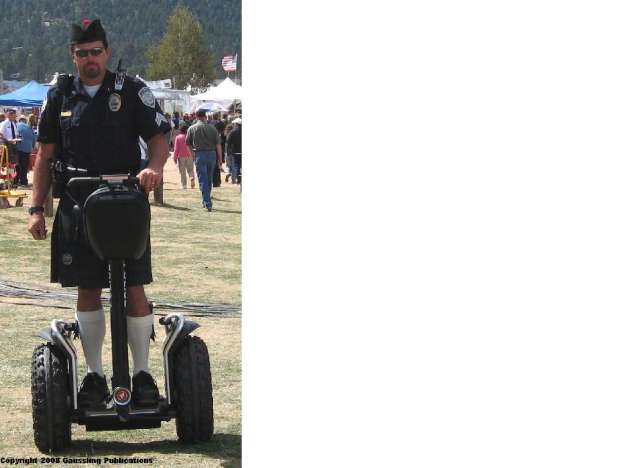
It was interesting to see a police officer dressed up in a kilt and scooting around on a Segway. Then there was the curious juxtaposition of holstered stun gun and a kilt.
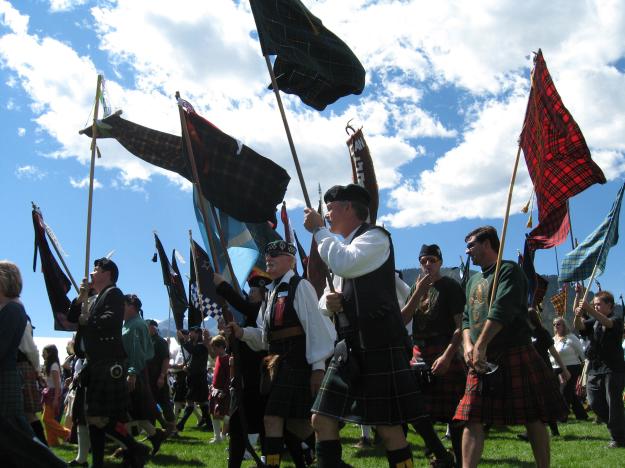
Parade of the Clans

Parade of the Clans

These highland festivals seem to involve quite a bit of pomp and circumstance. The Marine Corp Marching band put on a show bobbing and weaving to the tuba playing a jazzy beat. Cannons were fired on the top of every hour and a collection of siege engines (wooden trebuchets) hurled stones towards an inflatable Nessie floating in Loch Estes. And at noon, a pair of WWII training aircraft did a formation flyover. Airplanes, beer & bangers, and bagpipes. It just doesn’t get any better than that!


BASF Launches Organozinc Product Line

Eurogiant BASF recently announced the launch of their new organozinc halide capability. BASF is offering a portfolio of organozinc halide reagents on the strength of a licensing agreement with Rieke Metals of Lincoln, Nebraska. The value proposition that BASF is pushing is the compatibility of organozinc species with functional groups that are normally incompatible with organolithium or organomagnesium reagents. Likewise, the zinc reagents will undergo a variety of coupling and Michael-type reactions, though apparently with additives.

It is interesting to speculate as to the basis of the license. Does Rieke have a proprietary process to license? Is it based upon trade secrecy or a patent? Certainly Rieke Metals has considerable expertise with organozinc chemistry plus a grip on its trademarked Rieke ®Zinc

A perusal of the patent literature comes up with only one patent application by Rieke Metals as the assignee. However, Prof Rieke has been patenting for the University of Nebraska and obtained fifteen patents as of this date. The most recent patent is US 5,964,919 issued Oct. 12, 1999.  A number of them could contain the value that BASF would require to step into this venture.

Of interest is US patent 6,603,034 issued to “Consortium fr Elektrochemische Industrie GmbH” for “A process for preparing organozinc halides in a solvent, comprising reacting a reactive halogen compound with zinc in at least one carboxylic ester, to produce a solution.”  Hmmm.

I’m a distant admirer of Rieke Metals. I respect how they have grown into their niche and have remained focused on the prize. I hope the venture goes well for all concerned.

Palin Delivers to RNC Smugfest

Until last night, I thought that an Obama win was uncertain only by how big the margin would be. After listening to the speech by VP candidate Palin, I’m not so sure now.  Palin delivered what can only be regarded as a superb speech in terms of a crisp delivery and scrappy rhetorical barbs. With the best speech writers PAC money can buy, and with a large dollop of natural Ability, she delivered at the big event. Check out Mudflats for a fun post.

The St. Paul event center was packed to the rafters with plump, pasty-faced plutocrats and a few blond Barbie-Doll delegates within easy camera range. Conventions are engineered specifically for television and both the DNC and RNC have talented empressarios to put on a memorable show.

No matter what you think of any of the candidates, it is bound to be an interesting home stretch to election day.

US Patent Allowances to Foreign Entities

The United States Patent & Trademark Office collates and makes available online statistics relating to patent office activity. The data provided by the patent office could be thought of as a mine of information. A few companies make a business of collecting USPTO data and subjecting it to analysis.

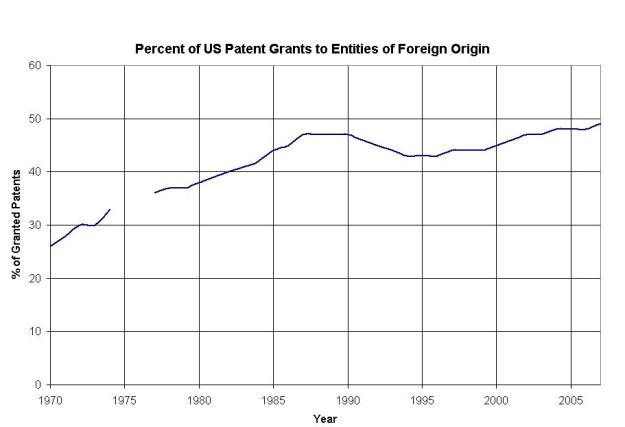
One of the more interesting things to be found is the % fraction of patents granted to foreign entities. As of 2007, the fraction of allowances to foreign entities is 49 %. The above graph shows the tend over time. The gap in the curve is due to the absence of data for 1975-1976 in the published data set.

The fraction of foreign patent allowances has remained approximately constant since ca 1985.  There was a dip in the 1990’s that may correspond to some sort of pullback in R&D activity. This drop off in issued patents lags by several years due to pendency.

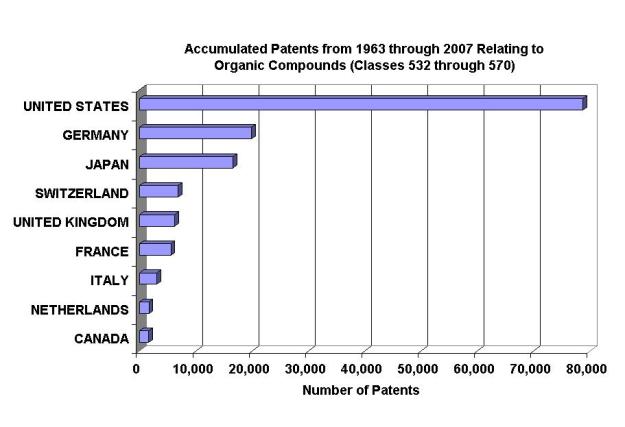
The above graph uses data published by the USPTO. Here we see the accumulated patent allowances to various nations over the period from 1963 through 2007. The data set is limited to Organic Compound classes 532 through 570 under the US classification system. For brevity, only the top 8 foreign applicants are shown in comparison to the US.

Very obviously Germany and Japan have the leading foreign awardees of US patents in this segment of R&D. I have not looked at how the reciprocal situation compares under PCT filings abroad by US applicants. 

What is of greatest interest is seen in the top graph: 50 % of the patent real estate being staked out at the USPTO is going to foreign interests.

A unique feature of chemical patents is the Markush claim. Markush claims allow the claiming of a  potentially large huge number of analogs defined by compact symbolism and covering vast swaths of the periodic table. 

It is thus possible for a professor in Osaka to own the composition of matter of a Markush set of hundreds or thousands compounds that would then bar a company in New Jersey from making even an obscure member. Under the PCT, the same is true in the other direction.

The reach of property rights in the world of invention has become so extensive, and the data provided by the various patent agencies and abstracting services is so inadequate, that the act of performing a due diligence search is nearly comical. In truth, you look for low to middle hanging fruit and hope that an obscure sentence somewhere doesn’t blow a hole below your waterline one day.

Chemical patents are in dire need of reform in terms of the nature of the disclosure. Patent offices must find a way to facilitate the extraction of crucial information so the public has a fair chance of understanding what is off limits.

We need a more lucid recitation of claimed compositions and better use of language in the detailing of processes. Patents should be written with abstracting in mind. It should be made possible to extract processes and compositions into a form that can be accumulated in databases for rapid review. This has to begin in the drafting phase of the application.

[For some great feedback, check out the comments- Th’ Gaussling]

Review: “Little Women” at the Lyceum

August 30, 2008, Arrow Rock, Missouri.  Like most boys, I failed to read Louisa May Alcott’s novel Little Women.  Okay, to be fair, a slight elaboration is needed. I failed to summon the interest in reading it.

So imagine my surprise when I learned that we were going to drive 744 miles (one way) to see a musical based on the book. The musical production of this story was staged at the Lyceum Theatre in Arrow Rock, Missouri. The theatre is a refurbished church and sits on a bluff overlooking the Missouri River valley. Lewis & Clark stopped there according to the historical markers.

Arrow Rock is a charming though obscure tourist village configured with a handfull of antique shops, B & B’s, and minor eateries. The town was a mid-19th century river port. Numerous warehouses and transport operations were once in operation. Eventually, the town went into a prolonged quiescent phase with the coming of rail transport. As if to cement its extinction, the Missouri River later changed its course and moved a mile away.

The town is now part of the Arrow Rock State Historic Site. The historic site status of the area has brought some traffic into this sleepy little hamlet.

And then there is the Lyceum Theatre. What is notable about this Theatre is not so much the setting as the quality of the actors it attracts. The productions are Actors Equity operations and the casting calls are in New York City. The actors fly in and reside in a dormitory in Arrow Rock for the duration of the production.

The result is a musical talent pool of high quality. We found the production of Little Women to be cleanly energetic and very crisp.  The stagecraft was very professional and relied on a liberal use of scrims and lighting.

The vocal talent across the cast was superb. The actor playing sister and lead character “Jo” was Mallory Hawks. She captured considerable depth in the part and displayed a verve that never failed to charm. This actor’s voice was exceptionally strong and clear. She was cannily emotive and lead the audience through an emotional series of highs and lows during the performance. I wish her well in her career.

For accomodations I would recommend the Down Over Bed and Breakfast in Arrow Rock. It is run by a charming retired couple who present a fantastic breakfast spread. It is reasonably priced and provides a relaxing setting for chronically twittered city folk.

Roadtrip

Th’ Gaussling & family are off on a road trip to the darkest interior of Missouri. With any luck, we’ll spot some of the fabled “hill people” at the nearby Road Kill Festival. We’ll partake in the local custom of dining on tree climbing mammals tenderized by an ’82 Chevy pickup.

I’ll be teaching a Festival shortcourse called HB-302 “Advanced Hillbilly Engineering Methods”, in the big white tent. Bring your own duct tape and uni-strut.

I have a dream too!

I have a dream. I dream of a time when election crazed talking heads find some new metaphores. I dream of a time when networks lengthen the news sampling interval from 5 minutes to something greater. I dream of a time when microanalysis of the faintest political nuance is recognized for what it is- gossip. I dream of a time when broadcast news people understand the concept of signal to noise ratio.

Finally, I dream of a time when people focus on the core of MLK’s dream- nonviolence- rather than the attention deficit parroting of the 4 words for the sake of loftiness.