Hanford B Reactor Designated a National Landmark

August 25, 2008.  The Department of the Interior along with the Department of Energy has announced that the Hanford B Reactor has been designated as a National Historic Landmark.

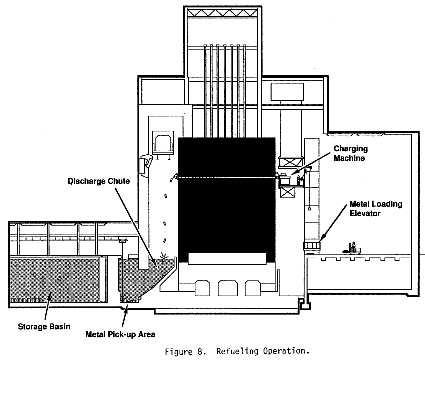
A pdf download details the history of area 100-B.  In this document there is a figure that shows how new fuel elements were pushed in one side and how the spent elements came out the other side into a water basin with the aid of the local (and free) gravitational field.

This seems very clever. I fear that a modern solution would involve 10 years of studies and would result in a half billion dollar high tech solution. Contractors would lock on to the DOE tit and hang there for decades with service contracts and spec’d in consumables.

 Hanford Refueling Process

Climbus Maximus

Th’ Gaussling just received this photo of his good friend Paul on the summit of Mt. Kilimanjaro. This is a real accomplishment and my hat is off to him.  Paul is a tenured perfesser of chemistry and is accustomed to slogging up endless slopes in the rarified air.  We overlap in our fascination with asymmetric lactam enolate alkylations and pyridazine chemistry.

Paul on Top of Africa

Paul on Top of Africa

The Speedy Speedo

A detailed description of the swim suits worn by the US Olympic Team can be found in the US patent application by Speedo International, US 2008/0141431.  These sophisticated garments are multilayer, multipanel affairs that the inventors claim will reduce surface and form drag in the water. According to section [0066] of the description, the stretch constant of a given panel can be defined by the manufacturer so as to provide more or less compression to a particular part of the torso.

Scotty and Gordo Lost in Their Second Launch Disaster Together

August 2, 2008. Kwajalein Atoll.  In the third failure in the fledgeling commercial SpaceX launch program, a Falcon 1 lifter failed to achieve orbit shortly after liftoff.  The payload package consisted of two NASA packages, one DoD package, and one package for Celestis, Inc. The Celestis payload consisted of ca 208 vials of the cremated remains of customers who paid to have their ashes delivered into orbit.

Among those disappointed customers were the late actor James Doohan (“Scotty” from Star Trek) and astronaut Gordon Cooper. Curiously, this was their second successive space disaster together.  The package of remains previously fell to earth and landed in the White Sands area in May of 2007 following an earlier failure of a launch vehicle.

Wende Doohan, James Doohan’s widow, told the Associated Press news agency her late husband “probably wished he could have stayed [in orbit]”.   -BBC

Internet mogul Elon Musk said, “It was obviously a big disappointment not to reach orbit”. Musk is a founder of SpaceX and PayPal.  According to SpaceX, the failure occured when a thrust transient during first stage shutdown caused it to recontact the second stage soon after separation. This contact perturbation caused the vehicle to fail to reach orbit.

“Laddy! Would ya be needin’ a little somethun’ to wash that doon with?” 

-Cmdr Montgomery Scott

Down Gauging Plastic Films

The world of commodity goods and services may seem static to outside observers, but behind the curtain there is almost always a seething churn of battles occuring between competitors and with vendors. In the high volume, low margin world of commodity polymer manufacture, the price of resin (or “plastic”) feedstocks is subject to the variability of the global hydrocarbon market.  The market determines your price and your costs. The trick is to avoid getting squeezed when unit costs and prices converge.

In the resin film and injection molding business, the ability to raise prices is constrained by the complex relationship between the manufacturer of polymer resins and the buying side of the market. The relationship between thermoplastic polymer (i.e., PE, PP, PS) manufacturers and the end user is not always direct. 

The actual manufacturers of thermoplastic polymers produce their resin product in the form of squat little beads. There are several reasons for this. Beads are what you get when you cut extruded spaghetti noodles from the output side of the polymer reactor. This cutting process happens in a stream of water to remove process heat. The water rapidly cools the resin and prevents the beads from agglomerating. It also provides a means of conveyance to move the beads elsewhere in the processing facility.

The beads are removed from the water and subsequently moved to silos by pneumatic conveyance.  Beads have the happy property of flowability. You can pour beads into a properly designed hopper and they will flow by gravity into a rail car or an extruder.

There is an intermediary customer called the converter. The converter buys resin beads from a manufacturer or distributor and converts them into higher value forms. Converters make films and injection molded items from these resin beads. Converters practice a high art. Some of their products, like films, may be pure resin.  But a great many other products in the injection molding arena are highly modified with additives that provide desired attributes in the molding process itself or in the finished good. Additives are the output of a highly specialized industry.

Because the polymer market is very competitive, it is difficult for any given producer or converter to simply raise their prices. One of the tricks of the trade is something called “down gauging”.  It is simple to understand. To improve manufacturing economics, converters will make their films thinner (in resonse to marketers of films) so as to make more sq meters of film with the same material input. The reader may have noticed that over time, plastic bags or wrappers have gotten much thinner. This is the result of down gauging.

Converters have to face material limitations in their resin feedstocks. For films, melt strength is one of the key parameters in processability and a big selling point for manufacturers of resin feedstocks. When you make a blown polymer film, your are actually extruding molten resin through an annular die to form a cylindrical bubble. The bubble rapidly cools to form a continuous tube of film that is then rolled as is, or slit to form a continuous sheet. This is a very common technique for making commodity films. If the molten bubble is not strong enough to withstand the effects of gravity and processing forces, it will collapse and fail.

One of the improvements to come along beginning in the early 1990’s is the availability of metallocene polymers, specifically mPE.  This technology provides for greater control over the molecular structure of the polymer and subsequently, greater control of the rheology of polymer melts. Improvements in melt strength can lead to greater processing controllability for the converter and more options in gauge.

If you want to understand the PE and PP industry, you have to understand the relationship between resin manufacturers and converters. While converters do not drive the boat exclusively, they do have a large input into which direction the boat is pointed.

Zambian Copper Mine to Boost Output

Zambia’s largest mining operation, Konkola Copper Mines plc (KCM), is nearly ready to commission the Konkola Deep Mining Project.  This mine expansion project, in combination with the new Nchanga Smelter, will increase the mine’s output from 200,000 tonnes per year to 500,000 tonnes per year by 2010. 

In order to enable the increase in ore output, a new shaft was sunk. The new production shaft # 4 reaches to 1,490 meters below the surface and will service production levels at 1050, 1150, 1250, and 1350 meters depth.  The company anticipates returning 40 % of the tailings back underground for remediation purposes.

The Konkola underground mine is known as the wettest mine in the world. The mine must be continuously pumped to remove the copious water seepage.  Underground improvements will increase the “water make” from 290,000 cubic meters of water to 430,000 cubic meters of water per day.  The water pumps are expected to draw 90 MW of continuous power to do their job.

KCM has invested US$12 million in new sulfuric acid capacity at Chingola. This sulfur burning plant will produce 500 tonnes per day of sulfuric acid for use in the Nchanga Tailings Leach Plant.

KCM also operates an open pit mine nearby.

Lead Couture

In case any of my dear colleagues in the blogosphere are in the market for a lead brasserie or heavy metal codpiece, there is one supplier of goods meant to protect those delicate regions from radiation. By way of style, I’d put the design in the 19th century Amish or Mormon settler category. But, that is beside the point.  This habillement de mode de plumbum [thanks BabelFish!] is meant to protect the more tender regions from ionization.

PGM Prices Tumble During Summer of 2008

22 August, 2008.  It is a remarkable collapse in pricing. Rhodium has fallen from a high of US$10,100/toz (toz = troy ounce) in early June of 2008 to opening price of US$3950/toz on 21 August, 2008, on the EIB.  Bad news from automotive manufacturers General Motors, BMW, and Nissan is cited by Reuters and posted on Mineweb as the principle cause of the collapse. According to Reuters, the automotive industry accounts for 80 % of the demand for rhodium. 

Other reasons are cited as contributing to the price fall.  Electrical distribution problems interrupting mine activities has reportedly eased, reducing the jitteryness of buyers.

The rhodium market is small and illiquid, and few traders are prepared to speculate on a floor for prices.

The metal’s recent price falls have been blamed by some traders on forward selling, or hedging, by producers. If this is the case, the market should stabilise as these sales tail off.

Mineweb, 15 August, 2008

Ruthenium prices have been sitting at US$300/toz for months now. Apparently the news that sparked the major uptick in Ru prices last year has failed to produce real demand.

Gold opened on the EIB yesterday at US$835.57/toz. This is down considerably from mid July, no doubt adding some tarnish to the spate of ads urging consumers to buy gold.

Palladium has fallen to US$295/toz from the recent high of US$480/toz in mid June of ’08. This is good news for the chemical industry and chemical researchers.

Finally, Platinum has seen a price decline as well, opening at US$1465/toz against the Feb ’08 high of US$2275/toz. This is also good news for the chemical industry. Hopefully chemical buyers are in a position to hedge their PGM positions a bit.


Self-Imposed Complexity and the Ratchet Principle

The portfolio of laws that American citizens are subject to seems to grow without bounds. Every year our congress drafts a new collection of laws to submit to the process of enactment. State legislatures, county and city governments all are able to add new rules and constraints on our degrees of freedom. As if that weren’t enough, people willingly move into convenant controlled communities where they sign away basic freedoms like the freedom to choose house paint or to leave the garage door open.

We are gradually fencing in all of the free space where conduct is unregulated. Our Nanny State leaders are scaring the bejeebers out of us through defense initiatives and dire warnings about what could happen if terrorists took an interest in disrupting industry and infrastructure.

Our town of 6,000 has to comply with Homeland Security requirements by fencing in the town water tank in a certain way.  Some terrorist could poison the water. In fact, that fiend would probably be a psychotic local citizen bent on retribution, not a Shiite saboteur in sandals. Collectively, we are at much more risk from fellow citizens than from foreign bad guys. Perhaps that is the hidden agenda.

Citizens are turning over priceless freedom artifacts in exchange for promissory notes claiming to protect the bearer. Once we give up degrees of freedom in the conduct of our lives, we can never get them back. Govennment will not refund units of control.  As we increase the complexity of our world through an ever increasing statutory web of control, we forfeit degrees of freedom. It is like a ratchet. You can click forward, but there is no going back.

New subject. Read Jim Kunstlers post “Reality Bites“.

Geriatric Body Art

The number of young adults walking around with piercings, tatoos, and those curious discs in their ear lobes continues to grow. Whereas tatoos were once popular only among cannibals and sailors, todays suburban tatoo fashionistas come from all walks of life and sport technicolor displays of fantasy art that make a point of in-your-face incongruence. And with much of it on locations where the wearer can’t view it themselves.

I can’t help but imagine rest homes of the future where geezers and codgers will dodder in their twilight years, festoons of ear hair sprouting over gaping holes in their pendulous ear lobes like Amazonian witch doctors. The urine scented hallways will be populated with crones and the occasional geezer sporting once provocative tats, now blurred with age, protruding from private locations and shared only with the floor nurse.

It seems to me that the tatoo money would be better spent on a round of antibiotics after a trip to Phuket. At least it would have been a genuine experience of life on the edge rather than just an illustration of one.