My Growing Resentment Towards Norton AntiVirus

I grow weary of wasting heartbeats while Norton AntiVirus screens every packet of data streaming my way.  There must be a better way. We need a Robin Hood character who can seek out and expose all of these miserable wieners who write malicious code. Their pimpled, smirking faces should be plastered all over the web. We should return to the puritanical method of locking them in stocks in the public square for all to come by and hurl epithets and rotten cabbages at them.

PGM Cu-Ni Strike Near Thunder Bay

10 September, 2008. Anglo American has acquired a 12 % stake in the Australian mining firm Magma Metals Limited. Magma Metals had previously announced “spectacular” results August 11, 2008, in its exploratory drilling activities in the Current Lake intrusive complex north of Thunder Bay, Ontario, Canada.

Magma reports a 2.5 kilometer long strike zone with mineralization varying from 5.6 g/ton to 26.5 g/ton of Pt + Pd from one drill hole. The drilling revealed concentrations as high as several percent of Cu and Ni as well. Magma Metals reports that it has been undergoing a 24,000 meter drilling program to map the Thunder Bay claims.

Destroying Munitions with Solvated Electrons

Blundering through the patent literature I took a wrong turn and tripped over a patent that claims an interesting use of ammonia solutions of electrons. The patent, US 6080907, is assigned to Teledyne Commodore and teaches a method that uses ammonia as a fluid metal cutting medium for the safe destruction of bombs and the explosives inside. The inventor claims that ammonia is superior to water as a cutting fluid. Apparently Teledyne employs a few chemists because it dawned on someone that ammonia will also dissolve certain metals and provide a means of conveyance for a reducing agent to enter the bomb casing and reduce the nitro groups on the explosives. It is a clever idea. A new use for the Birch reduction.

 I wonder if it is in operation?

The Chemical Entrepreneur. Part 2.

There are many reasons not to start a business. It’s risky. It inevitably requires many long hours sweating all of the ten thousand details. Building a company from scratch requires wildly diverse skills that are not commonly possessed by a single person. And it usually requires more resources than a typical wage earner can easily muster.

A chemical entrepreneur with an eye on manufacturing faces some unique challenges that, say, a fledgling purveyor of roasted coffee beans could avoid. Most obvious it the issue of a physical plant. Not only must the chemist or engineer have a workable chemical process, but also have a highly specialized facility in which to do the processing. This requires suitably zoned land, local review boards, environmental permits, a local work force, process equipment, a minimum of raw material inventory, and buildings to contain it all.

Then the entrepreneur must provide an infrastructure of chillers, boilers, electrical distribution, liquid nitrogen for inert gas, an analytical facility, an R&D facility, quality control, as well as administration, sales, and technical staff.  There must be a steady stream of cash flow to provide a steady payroll. Taxes must be estimated and paid in advance.

There are many sobering reasons not to go forward with a chemical business plan if one is risk averse or, shall we say, comfortable. Indeed, one of the common character traits of people who are analytically-minded is the tendancy to rattle off all of the reasons why something won’t work. We’ve all experienced this in meetings. A problem arises and meetings are called. After the problem is identified, much of the remaining time is spent in a recital of the additional problems that are expected. Soon, the problem mushrooms into a phantasm with imaginary components of awesome magnitude.

We’re all good at digging up reasons why something won’t work. And chemists suffer no lack of ability here.

But this is where the true entrepreneur stands out from the herd. One mark of a successful entrepreneur is the ability to ignore, or filter out, pessimistic predictions of an outcome. There is a spark within the some people that compels them to go forward. Sometimes it is a special insight. But just as likely the entrepreneur has an inner drive- some might unflatteringly call it “narcissism”- that moves them forward because they are certain of the outcome. It is not uncommon for an entrepreneur to consider him or herself the smartest person in the room.

In Part 3 we’ll look at examples of what kinds of businesses chemical entrepreneurs have started.

The Chemical Entrepreneur. Part 1.

The modern mythos of 20th century American industry includes many stories of businesses being founded in a garage. As the stories go, a few plucky founders will construct a widget in their garage and, with prototype in hand, look for a way to get the product to customers. Famously, Apple computer and Hewlett Packard were founded in this manner.

What you don’t often hear about is the extent to which the founders might have performed a market study to ascertain the potential demand in the market. Possibly because the frequency of this ground work is near zero. Certainly the founders had some sense that like-minded folk would want copies of their products. In other words, if you build it, at least a few will come.

Similarly, one doesn’t hear so much about the rate of failure either. How many storage lockers are crammed with the remains of a failed business plan?  Probably more than a few.

What every technological entrepreneur eventually has to come to grips with is this- who are the customers and how can you get the message of new capability to them? Seth Godin has some interesting ideas about this. Godin suggests that in todays information saturated market place, the critical customers are the innovators and the early adopters.

So here is the big question- Why don’t we hear more about chemists launching businesses out of a garage?  Better yet, how might the chemical industry be different if more chemists did start a chemical business in this celebrated manner?  Most might agree that the culture of entrepreurialism that Wozniak, Jobs, Packard, Hewlett, and Gates picked up and ran with dramatically accelerated the growth of the electronics industry. But fewer might agree on what clues these founders took as their cue to risk everything. How does a fledgeling chemical entrepreneur know if the idea, process, or material of interest is worthy of risking the family nest egg?

On the next posting, we’ll talk about some of the factors that a chemical entrepreneur might face in getting started.

CERN to Light Up Large Hadron Collider

CERN has announced that the first injection of particles into the Large Hadron Collider (LHC) will occur between 9:00 and 10:00 Wednesday, September 10th, 2008.  Fears of spurious black hole formation have been discounted. The final synchronization was a success. Safety has been reiterated.

This is big time science, man. While in Geneva you won’t be able to spit without hitting a particle physicist.

How do they keep the superconducting magnets chilled? Air Liquide was selected to provide the liquid helium supply to maintain the 1.8 K operating temperature of the magnets over the 27 km length of the LHC.

According to CERN, the cool down phase of LHC preparation required 10,000 tonnes of liquid nitrogen and 130 tonnes of liquid helium to fill the 8 magnet sectors.

The peak beam parameters are quite interesting. Check out this link to PhD Comics.

Bagpipes, Bangers, and Beer!

7 September, 2008, Estes Park, Colorado.  It is the last day of the Scottish Festival in Estes Park. Th’ Gaussling and family made way to this annual festival to hear bagpipe music and to see the spectacle.  There were several quite decent bands as well as a variety of highland games to watch. You could even lunch on haggis.

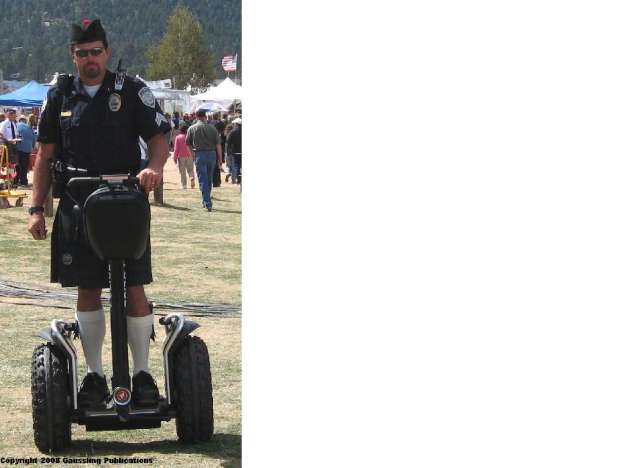
It was interesting to see a police officer dressed up in a kilt and scooting around on a Segway. Then there was the curious juxtaposition of holstered stun gun and a kilt.
Parade of the Clans

Parade of the Clans

These highland festivals seem to involve quite a bit of pomp and circumstance. The Marine Corp Marching band put on a show bobbing and weaving to the tuba playing a jazzy beat. Cannons were fired on the top of every hour and a collection of siege engines (wooden trebuchets) hurled stones towards an inflatable Nessie floating in Loch Estes. And at noon, a pair of WWII training aircraft did a formation flyover. Airplanes, beer & bangers, and bagpipes. It just doesn’t get any better than that!