Water Vapor Identified as Major Greenhouse Gas

23 July, 2008. NCAR, Boulder, Colorado.  Scientists at the National Center for Atmospheric Research (NCAR) announced today at a press conference that a major greenhouse gas has been identified. Dr. Simon Sayes, Director of the Stratosphere and co-chairman of the Vice President’s Office on Gases, Vapors, and Mists, stated before an international press corps that a previously ignored component of the atmosphere apparently absorbed a “… whole bunch of solar energy”.

“While we were preoccupied with anthropogenic CO2, we failed to consider the effects of water vapor in the atmosphere,” said Dr. Sayes. As Director of the Stratosphere, Dr. Sayes has regulatory enforcement responsibility in matters pertaining to that lofty body of air above the jetstream. Because water is also a combustion product, Dr. Sayes suggests that a switch to hydrogen and ethanol fuels would only exacerbate the problem of global warming.

“We have no enforcement plans finalized yet. However, we are investigating the use of dessicator packs to be fitted onto commercial aircraft,” stated Brian Cohen, Tropospheric Liason to the Office of the Stratosphere. “There has been some initial pushback by the airlines” Cohen added, “but we believe that the problem can be surmounted with a suitable tax package and passenger fees.”

Carbonated Beverages as Greenhouse Gas Source

18 July, 2008. The Hague, Netherlands.  Discussions are underway concerning a new proposal to ban carbonated beverages due to mounting evidence of their combined contribution to the global greenhouse gas inventory. The startling new proposal submitted by Olivier Lawrentz, the President of Tudaloo, an island-state in the French Wayward Islands.  The document was submitted to the Ad Hoc Working Group on Further Commitments for Annex I Parties under the Kyoto Protocol (AWG-KP) just prior to Fridays deadline for the 2009 conference in the Slobovian capital of Nyeznok.

President Lawrentz stated in his address that the carbonated beverage ban proposal is meant to address the cumulative atmospheric effects of efforvescence in all manner of beverages- beer, champagne, sparkling water, and soft drinks.  “It is a simple matter of math, no? How much CO2 are we putting into the air because we demand a fizzy drink with our frittes?” asked Lawrentz, president of an island with an average elevation of 1 foot.

The reaction around the world was swift and highly critical. Arlene Kelpwalker, CEO of Cola Industries International, a softdrink trade group, stated that her member companies were shocked and disappointed at the news. “Flat sodas are not going to go down well with the public, if you’ll pardon the pun,” Kelpwalker joked.

Most telling was a press release by the Belgian beverage giant OnBev, who would only disclose that they were in discussions with the American security firm Darkwater. When pressed for more information, a spokesman for OnBev said cryptically that their response to this move by Tudaloo would be soon be apparent.

Organic and Inorganic Carbon??

Thanks to a friend in Grand Rapids, I was linked to a blog hosted by the NY Times called Tierneylab.com.  The writer of the post was sounding off about a pet peeve relating to the use of the term “Organic”.  It seems that there is some confusion as to the use of the adjective organic in relation to certain carbon-containing substances. Tempest in a teapot, you ask? Let the chemistry community decide.

The problem begins to show itself when astronomers and planetary scientists start describing carbon containing materials found in planetary exploration as organic.  Back on earth, the word organic is burdened with both common and scientific usage. So, when descriptions of organic materials found on other worlds begin to arise in discourse, the intent of the usage becomes unclear.

For instance, it could suggest to people that such discovered materials were put in place by some kind of life form. It could suggest to nondiscriminating audiences that the presence of carbon implies life, past, present, or future. Or it might well suggest to higher level audiences that biology-ready raw materials are in place.

The scientists working with the Phoenix Lander have an interesting analytical chore in front of them. Using a robotic platform on Mars, they want to distinguish the presence of organic vs inorganic carbon. What is meant by organic and inorganic is less than clear. But it seems that organic refers to something other than CO2 and carbonate.

In the relatively few journal articles I’ve seen relating to this, the authors are not always precise about the kinds of molecules they are referring to as organic. Irrespective of what is said in the articles, when this work gets to a public forum, the meaning behind the word organic becomes even less clear.   

The TierneyLab post does bring up an interesting question about what is necessary for a substance to be considered organic.  Do graphite, diamond, Buckyball, or soot forms of carbon qualify as organic? What about CO2, CS2, carbonates, CO, HCN, or calcium carbide? Does it make more sense to refer to organic and inorganic carbon, where inorganic carbon is defined as … well, what? 

Seriously, what would it be? CO2? Carbon dioxide is incorporated into glucose by plants and this seems quite organic.  Carbonate? This anion is used to balance our blood pH. Our own metabolic CO2 helps to provide carbonate. This product of metabolism should qualify as organic. CO? Well, Carbon monoxide undergoes Fischer-Tropsch reactions to produce aldehydes. This seems very organic as well. Perhaps the target is a substance with C-H bonds?

There is nothing inherently biological about the C-H bond. The Saturnian moon Titan is blanketed with a thick layer of CH4 (methane) and it seems unlikely that it is of biological origin. Indeed, hydrogen is the most abundant element in the universe and carbon the 4th. That hydrogen and carbon atoms could find each other to form trace methane in a proto solar system isn’t too much of a stretch.

Organic and Inorganic Carbon.  How about we just leave it all as organic? 

Here is what I think. It does matter if a scientist or writer is using language in an imprecise way. If writing or speech implies, for instance, that Mars is rich in life giving organic nutrients when in fact Martian organic matter is really carbonate and CO2, then I believe the language must be altered to reflect that condition. A writer should not leave an impression of past or incipient planetary fecundity when in fact the planet may be an inert ball of metal silicates dusted with a bit of carbonate when the 6 torr CO2 atmosphere kicks up a breeze.

California to Decriminalize LSD

San Francisco, California. 11 July, 2008. In a landmark decision, the California Supreme Court ruled in favor of decriminalizing the psychedelic drug LSD.  The divided court ruled 4 to 3 in favor of striking down as unconstitutional the 48 year old statute banning recreational use of the substance.

Supporters and opponents alike held a contentious vigil outside the Earl Warren Building in San Francisco friday afternoon. The long anticipated Ergotte-v-State of California case has been a lightning rod for criticism and praise around the nation.

Dr. Besnik Keukomber, Chiquita Professor of Economics and Olfactory Studies at Pultroon College in Guapo, AZ, stated in an interview with CNN reporter Robert Stiphey that “This change is welcome in some large market sectors. LSD prices have been distorted by the unfortunate statutory freeze rendering the product illegal. The action of the court has put the supply of this product back on a rational economic basis. We are concerned, however, on the negative effect it will have on sellers of the LSD once the price drops.”

Pilsner Pharma Group stocks rose 5 % today on news that the pharmaceutical giant would start construction on a lysergamide processing facility in Quasimont, California. “We have been anticipating this for quite some time” stated CEO Hedrick van Preener.

Harriott Hotel Group announced that they will offer Psychedelic Suites in flagship hotels in selected California cities. Guests will have the opportunity to relax in the safety and comfort of a plushly padded suite and experience the pleasure of a supervised psychedelic experience. For the safety of the guests, psychedelic suite balconies have been replaced with a computer animated view courtesy of Industrial Light and Magic.  The initial floor of Psychedelic Suites will open at the Marquis in Los Angeles in Late 2010.

Not all are pleased, however.  Ephraim “Scarface” Erdstein, a South Bend, IN, drug kingpin operating out of a laundromat storefront said through his attorney that he plans on waging an appeal to the US Supreme Court in an effort to support prices by halting this unfortunate trend toward legalization. 

Roland Basbo, spokesman for “Tatoo Nation”, the national Tatoo Parlor trade association, expressed concern for declining business. Basbo said “We believe that as the demographics of LSD users moves upscale, the demand for body art will see a modest decline. We’ve noticed that boomers are freaked out by skin art in the middle of an acid trip”.

Jupiter Launch Vehicle Proposal. Safer, Simpler, Sooner.

The Space Shuttle Program is scheduled for shutdown sometime in 2010. At that time the reusable, tiled spaceplane concept (STS) will be put to rest in favor of the capsule-on-a-rocket design.  According to plans, there will be a 5 year interlude between the retirement of the shuttle and the implementation of a new man-certified lifter. Many have suggested that this idle period with no manned launch activity could lead to a brain drain in the ranks of skilled aerospace workers.

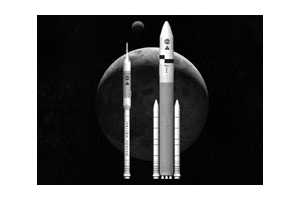
The successor to STS is the Ares Launch system consisting of a man lifter (Ares I) and a cargo lifter (Ares V).  Ares I is a two-stage system that will take a crew of 4 to 6 into low earth orbit. This vehicle will carry  55,000 lbs of provisions and astronauts to the ISS.  Additionally, it will be used to lift a lunar exploration team into orbit for docking with the lander module placed into orbit by the Ares V lifter. 

Ares V is a heavy lifter and is expected to be able to place 414,000 lbs into low earth orbit or send 157,000 pounds of payload to the moon.  Ares V uses two solid rocket boosters derived from STS and a central H2/O2 liquid fueled rocket using a cluster of 6 engines derived from the Delta IV system.

Ares I & V. Photo Credit- NASA

NASA has awarded contracts for this program and work is underway.

What has recently transpired is an alternative system proposed by a group of engineers. This system is called DIRECT, and involves the use of a single lifter called Jupiter.  The Jupiter lifter is derived directly from the STS lifter which consists of two solid rocket motors and a central H2/O2 tank which feeds the shuttle engines.  The DIRECT system would take advantage of existing technology, but with the addition of an O2 tank extension, a cargo section, and a cluster of engines to the existing liquid fuel tank. The proponents of this system claim that their system could get the next phase of manned space flight going sooner, simpler, and safer.

It is an interesting proposal. I hope it gets some serious consideration by the Congress.

InBev Chugs St Louis Utility Beer Maker

It is surely a sign of the End Times. Just as sure as the Four Horsemen of the Apocalypse and cats sleeping with dogs. A Belgian company buys Anheuser-Busch.  Wow.  Just the thought of it is too much for me to get my arms around. Michelob now has a kissin’ cousin named Stella Artois. 

What was that old brain teaser an Austrian colleague once asked-

Can you name 10 famous Belgians? 

I agree. It is a bit outrageous. I’m sure there are as many as 20 famous Belgians.

Who knows? This may be the European connection NASCAR has been looking for.  Watery beer, fast cars, and drunken hooligans. It’s universal.

Nuclear Chemistry Article in Daily Kos

For those of use who carry around an interest in nuclear science, there is a short but interesting article in the Daily Kos written by a chemist on the topic of the Hanford site in Washington.  Of particular interest is the link describing a radiological assay of a chemist who died at age 76 of cardiovascular disease.  At the time of death they found 540 kBq of activity in his body- 90 % in his skeleton. The gentleman had been involved in a glovebox explosion involving exposure to 241-Am at age 64.

What do you do with a radioactive corpse? One option is to donate your body to science. The WSU College of Pharmacy maintains a registry of data culled from uranium and plutonium workers. A recent description of donated bodies is found in this pdf. One donation is from a plutonium worker who was present in the 1965 fire at Rocky Flats. He retained an estimated 6.8 kBq of lung burden. They did not specify how this was determined.  Rocky Flats did have state of the art whole-body monitoring and a substantial health physics department.

Pu detection is a little tricky because one of the important markers for Pu contamination is 241-Am, an alpha and gamma emitter (Pu is a bad actor mostly because of internal alpha exposure).  Residual and highly active 241-Pu (104 Ci/g) beta decays to the highly active 241-Am.  Unfortunately, not all Pu isotopes decay into Americium. This Am isotope allows for gamma ray spectra to be gathered so an estimate of Pu exposure can be calculated. The ever popular 239-Pu isotope alpha decays to 235-U without much gamma emission. So, the calculation of Pu exposure and dose depends on knowing the purity of the Pu at issue.

Virgin Galactic’s 200 k$ Shuttlecock Ride

Pack your bags, boys and girls. Virgin Galactic is going to display their SpaceShipTwo at the upcoming AirVenture show in Oshkosh.  For 200 k$ you can strap a reusable rocket plane to your backside and take a suborbital flight. The AirVenture website has an animated video of a flight that is worth seeing. (The animators left out the floating vomitus that is sure to be a part of the experience.)

The designer and builder is none other than Burt Rutan’s Scaled Composites. This second generation suborbital vehicle uses the same reentry stabilization scheme that the first vehicle used. The lifting craft has 4 engines- two outboard of each of the twin fuselage sections. It has 4 engines instead of two to protect against the undesirable situation of loss of thrust from one side of the plane. With the engines so far from the centerline, the asymmmetric thrust that would result would make the plane difficult to fly.

The space vehicle is carried to a suitably high altitude (ca 50,000 ft) for release followed by an 80 second boost from the rocket motor. The boost phase sends the craft into a suborbital arc carrying the craft to a projected 361,000 ft peak altitude.  The passengers are treated to a period of weightlessness between the moment the rocket motor quits and when the reentry phase begins to encounter significant atmospheric drag.

At some point after the boost is complete, the tail booms pitch into an elevated position quite far from the centerline of the craft. The craft has reaction motors that stabilize the flight attitude during the phase in which the aerodynamic control surfaces are ineffective.

The reentry attitude is one in which the underbody of the craft faces in the direction of motion so as to provide maximum drag. The elevated, or “feathered” tail elements serve to stabilize the motion of the craft as it accelerates belly first into the ever thickening atmosphere.  The stabilization that the feathered empannage provides is much like the stabilization afforded a shuttlecock.

The feathering configuration helps the crew manage the kinetic energy developed during reentry to the atmosphere. The scheme includes a deadstick landing, so energy management is quite important.  Eventually, the tail booms retract to the in-line position and the craft transitions to a gliding condition with conventional flight control surfaces.

A critique on scale-up suitability

In my quest to stimulate bench chemists to think like industrialists, I like to bring examples of chemistry from the literature to highlight a point I’m trying to make. The literature is full of transformations and research that serve as positive and negative examples of good scale-up thinking.

There are examples, however, that are less than choice in terms of green processing or good scale-up thinking. As I have said previously, green chemistry and good scale-up principles may not be equivalent concepts, but they can and often do run in parallel.

An interesting transformation is featured in the recent article entitled Efficient 1,2-Addition of Aryl and Alkenylboronic Acids to Aldehydes Catalyzed by the Palladium/Thioether-Imidazolinium Chloride System, by Kuriyama, Shimazawa, and Shirai, J. Org. Chem., 2008, 73, 1597-1600. [My apologies to the authors for their unanticipated role in this analysis.]

In this article a bond forming reaction between 1.5 eq of a boronic acid and 1.0 eq of an aldehyde is described affording a secondary alcohol. The transformation is catalyzed by 0.5 % Palladium allyl chloride dimer with 1 % of a custom imidazole carbene precursor in the presence of 2 eq CsF as base. The reaction mixture is heated to 80 C in dioxane and the chemistry is reported to be over in ca 20 minutes.

I am somewhat reluctant to be critical of chemistry that is done catalytically and is high yielding. But this transformation, solid science though it may be, would be difficult to justify taking to scale-up without an examination of alternative schemes.  Let me explain my thinking.

First, on the basis of atom efficiency alone, this process requires that a lot of different elements find their way into the pot. The tally is C, H, N, O, Cl, B, Pd, Cs, F, and S to just make a C-C bond to produce a benzyl alcohol. A scale-up chemist would have to ask, why not use a Grignard and the aldehyde? Granted, there may be incompatible functional groups on either Ar1 or Ar2 that would not tolerate a Grignard reagent. However, it is worth pointing out that the conventional way of making boronic acids is by addition of a boronic ester or fluoride to RMgX or RLi followed by hydrolysis. Compatibility is an issue there as well.

One might object that many of the diverse atoms used in the reaction are at a catalytic level and as such may not constitute a major cost or environmental insult. True enough for the user of the process. But the metal complex must be manufactured somewhere at a larger scale for distribution. Pd mining and beneficiation requires energy inputs and generates wastes. The same idea applies to the imidazolinium salt.

The reaction does seem to require 1.5 equivalents of boronic acid and 2 equivalents of cesium fluoride. Boronic acids are specialty synthetic intermediates whose manufacture generates its own waste stream. Furthermore, boronic acids can be on the expensive side. The use of a boronic acid as a latent nucleophile for a straightforward addition to an aldehyde seems somewhat extravagant.

Cesium fluoride residues (2 equivalents) will find their way into the aqueous waste stream and possibly to an incinerator where the solids may end up in roadway pavement or a landfill. While fluoride is an efficient base in this case, common sense suggests that carbonate may have a more benign fate in the environment owing to the fact that it decomposes to water and CO2. Unfortunately, the best yields are with cesium as cation.

Chemists seeking to apply this kind of coupling chemistry would be well advised to be extra careful in their IP diligence. The use of metal catalyzed coupling reactions may already be patented or applications may be pending for patents. The same comment applies to the use of imidazolinium carbenes. Industrial chemists would be well advised to look deeply into the carbene species for process and composition of matter claims. Ever since the Bayh-Dole Act, university patents have been popping up like dandelions.

I do not want to be too critical of this chemistry. It is an interesting transformation and certainly may be of use for some kind of product. But for scale-up, at first pass it seems too far from earth, air, fire, and water. I would say that for maximum profit, this process is more of a Plan B or Plan C scheme.