Amphibidiene

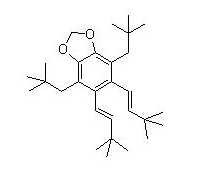
I finally cracked the secret of getting ChemDraw structures into a post without having to buy anything. It’s not perfect, but it is a start.

Paste a structure into Microsoft Paint which is found in Accessories in the Start Menu. Save as a jpeg. Then, re-open in Microsoft Photo Editor, crop, and save again. Finally, import to wordpress as a jpeg. Whew!

Be nice. I’m a little slow sometimes.

Meat and Cheese Explosives

So, I’m blundering through the literature on a snipe hunt when I run into this ICI patent- US 5,456,729. In the description, they teach a method of preparing an explosive composition using “lactic casein”. Having been in the dairy business long ago, and specifically having worked in a cottage cheese plant, I recognized this component as … cheese. Well, mostly. Example 5 discloses a composition comprising 25 % ammonium nitrate and 3 % lactic casein.

Unless you have lactose intolerance, cheese is not ordinarily an explosive. In the patent, the lactic casein is one of many examples of a foam stabilizer. Other stabilizers include animal and fish proteins as well as collagens. A collection of other chemical additives rounds off the list.

If they had specified gluten, they could have claimed the use of a pastrami and cheese on rye sandwich as stabilizer feedstock for their explosive composition.

Farewell George Carlin

June 22, 2008, Santa Monica, California. Comedian and satirist George Carlin died sunday evening after checking into a Santa Monica hospital complaining of chest pains. He was 71.

Carlin was a brilliant social satirist and comic. He had the ability to look at ordinary things from a different angle and see the obvious obsurdity in things most of us accept as simple background noise. This is one of the key attributes of a successful satirist and comedian.

I think it’s the duty of the comedian to find out where the line is drawn and cross it deliberately. 

The very existence of flamethrowers proves that some time, somewhere, someone said to themselves, “You know, I want to set those people over there on fire, but I’m just not close enough to get the job done.”

I went to a bookstore and asked the saleswoman, “Where’s the self-help section?” She said if she told me, it would defeat the purpose.

There’s no present. There’s only the immediate future and the recent past.

Not only do I not know what’s going on, I wouldn’t know what to do about it if I did.

-George Carlin

Carlin was a serial quipster who pushed the boundaries of social norms. His Seven Dirty Words ended up as the center of a 1978 Supreme Court ruling that affirmed the right of the state to bar “indecent” of speech on the public airwaves.

While it is common for contemporary comedians to exploit “indecent” speech for shock value today, few seem to have the facility with language that Carlin had. He was able to reduce to a few short humorous sentences the dark uncertainties that many of us have with common subjects.  Carlin’s observations on taboo subjects put him well ahead of his time.

Structural diversity of organic chemistry

The recent issue of Journal of Organic Chemistry, (JOC, 2008, 73(12)) has a few articles that are particularly interesting.

The article by Lipkus, et al., entitled Structural Diversity of Organic Chemistry. A Scaffold Analysis of the CAS Registry, JOC, 2008,73, 4443-4451, is a particularly ambitious bit of work that only CAS could do. This article describes a scaffold survey of more than 24 million organic compounds in the CAS Registry.

The data set was limited to carbon-based structures containing the heteroatoms H, B, Si, N, P, As, O, S, Se, Te, and the halogens.  Moreover, the work was further limited to framework structures containing rings or linked rings. Acyclic compounds were not included owing to the inapplicability of the framework definition in the search algorithm. Multicomponent substances and polymers are ignored as well.

Lipkus and coworkers found that half of the graph frameworks analyzed are described by only 143 framework shapes.  The remaining half are described by 836,565 graphs.

One of the key conclusions is quoted here-

“It is not surprising that some frameworks occur much more frequently than others. However, the extreme unevenness in the way frameworks are distributed among organic compounds is somewhat surprising. This is particularly true at the graph level, where it is found that only 143 framework shapes can describe half of the compounds. The fact that both graph and hetero frameworks have very topheavy distributions tells us that the exploration of organic chemistry space has tended to concentrate on relatively small numbers of structural motifs.”

Lipkus concludes that cost minimization is one of the drivers of this “… shaping the known universe of organic chemistry.” He comes to this conclusion due to the presence of a power law which describes this distribution. The power law he refers to is a linear log-log relationship that is indicative of what they refer to as the “rich-get-richer process”.

If I understand this correctly, a relatively small number of easily made or commercially available early precursors are comprised of ring graphs that, by virtue of modification, propagate into more complex analogs that retain the original graph. This has the effect of multiplying the frequency of a given graph.

The cost minimization aspect comes from the benefits of familiar chemistry and the commercial availability of a fairly limited set of ring graphs. Adding more rings will usually mean adding more molecular weight and adding problematic synthesis and separation issues.

The authors conclude that the lopsided distribution of organic compounds toward only 143 graphs comprises a bottleneck in drug discovery. They further suggest that more exploration in other areas of chemistry space may be worthwhile.

My dinner with a meteorite

Last night I found myself sitting at a restaurant with astronomers for the occasion of viewing a meteorite. Customarily, a few observatory folk have dinner with the speaker and then we go to the observatory for a public star night. While waiting for our entrees we passed the object carefully amongst ourselves, cherishing a few moments of close contact with this rare object.

Astronomers seem to be prone to public displays of humility. I would estimate that the humility quotient was near 0.8 (8 out of 10 Sagans- the Sagan is the international unit of humility). It is generally agreed that the Buddha achieved a Sagan quotient of unity. Okay, I’m kidding.

The curious 936 gram achondrite is from the recent Berthoud, Colorado, fall.  Meteor enthusiasts refer to the arrival of a meteorite as a “fall”.  This is one of only 5 witnessed falls in Colorado. A section of the meteor has been cut off and has been the subject of investigation at the University of Arizona.

Based on the composition of the object (olivine, plagioclase, ilmenite, chromite) and based on the reflectance spectra of various asteroids, the Berthoud meteorite is thought to be a fragment of the asteroid Vesta. Imagery of Vesta suggests that a portion of this object may have been shattered by an impact in the past.

The family whose property the stone landed on are somewhat bewildered by the event. They have been the subject of much unwanted attention, so the object is kept secure at an unknown location. In October of 2004, in the early afternoon several family members were standing outside their home when they heard a whistling sound and thump. Following the direction of the sound, they found the impact site less than 100 feet from where they were standing and in a spot where one member had just walked through. Only a small part of the object protruded upward through the disturbed topsoil.

Reportedly, it was cool to the touch immediately after arrival. This is counter-intuitive given the fiery appearance of most meteors. However, the object was quite cold prior to entry into the atmosphere and the rapid transit through the air didn’t allow for heat saturation. And, ablation carries away much of the friction energy.

The low iron object has a dark fusion crust over a grey, mottled composition. Other than the crust, it is not that unusual in its appearance. 


Law Review Issue on Nonobviousness

The summer 2008 issue of the Lewis & Clark (Vol 12, No. 2) Law Review is dedicated to the matter of nonobviousness in patent law- Business Law Forum: Nonobviousness — The Shape of Things to Come.

The papers are scholarly articles and are very densely written (sorta like some posts in this blog!!). But if you can tolerate that style or are an insomniac, some of the work seems to be worth plowing through.

Nonobviousness is one of the most vexing aspects of patent law. I find that my natural inclinations about what constitutes obviousness are completely inapplicable to patents. Perhaps one day I’ll get it.

Secular Marriage. Gaussling’s 8th Epistle to the Bohemians.

Below is a comment that I left on the Volokh Conspiracy some time ago. Rather than squander perfectly good ramblings there, I have reproduced it here and attached a link.  Th’ Gaussling

Broadly, we have two kinds of marriage in the USA. One is before a god and the other is before the state. Marriage before a god is a supernatural arrangement that is beyond the scope of this letter.

It would seem that the states compelling interest in marriage is mostly confined to the disposition of debts, assets, and minor children during the marriage and in the event the marriage fails. Married partners have an obligation to the welfare of minor children born to them or adopted. Married partners also have a status that allows for decision-making in critical care situations. It seems to be a kind of partnership whereupon responsibility for the secular aspects of married life are defined. After all, the state is called in to make decisions as to the disposition of civil matters in the event of a divorce. Surely the state can clearly define certain basic responsibilities and privileges in advance.

The moral/spiritual aspects of marriage “can” be interpreted as being perpendicular or orthogonal (like the x and y axes in a graph) to the legal dimension of property rights and other secular aspects of married partners. The state is without supernatural powers, thankfully, so it is inherently impotent in the spiritual dimension. If that is the case, and in the absence of a uniform interpretation of supernatural governance, it should be silent on spiritual matters.

The state should have no interest in how married partners conduct their lawful affairs beyond the normal confines of civil and criminal law.

A code defining the responsibilities of married partners in a variety of configurations could be modeled easily. If you accept the premise that secular marriage is confined to the mundane matters that are already contestable in a court, then it is a simple matter to imagine same sex or plural marriages under the same constraints. What is the compelling interest of the state in barring same sex partners from having automatic authority in giving comfort to a dying partner? We already have codes regulating many other kinds of complex relationships between people- corporations, partnerships, LLC’s, government, etc. Minimally, the state should entertain the prospect of recognizing limited entry of some new definitions of marriage to adult parties wanting to be responsible members of society with the rights and responsibilities thereto appertaining.

Verbund Manufacturing

German manufacturing culture does many things very well, but a few things particularly stand out. One of these items pertains to the concept of verbund manufacturing. Verbund simply means “integrated” or “linked”. Verbund manufacturing sites are clusters of manufacturing units that take advantage of proximity. Clustering can offer certain logistic and energy advantages if done intelligently.

A cluster of manufacturing sites can operate and share a co-generation plant for the distribution of steam, waste heat, and electricity. Large capital items like steam plants can be shared so funds can be plowed into larger scale for better economy. Rail operations and other transportation resources can be shared as well. Clustering also provides for the possibility of vertically integrated manufacturing on site and a reduction in transportation costs.

Clustered manufacturing may also have the effect of concentrating the supply of skilled workers for the labor pool. A manufacturing nexus can attract community colleges and other vocational opportunities for the next generation of employees.

The USA has many manufacturing sites where similar industries congregate. Look at the Gulf coast with all of the refinery locations. But the extent to which there are synergistic interactions between companies is unclear.

In the US, corporations tend to behave as the Republic of Exxon or the Republic of the Union Pacific. This kind of a fragmented confederation of corporate states is becoming obsolete as we go up against nationalized business entities that control key resources and trade. The key to future vitality is greater efficiency with resources. Synergistic cooperation is one model that is available. But to do this requires trust and the desire to cooperate for mutual benefit. Competition begets gamesmanship and posturing which works against the verbund model for US businesses.

US corporations have much to learn from this business model.

Good Stink, Bad Stink, and Weird Stink

There is tempest in a teapot brewing in regard to the chemical safety of shower curtains. It seems that someone got curious about the composition of the “new shower curtain smell”.  The alert has sounded and the troops are scrambling to general quarters. A lurking menace in the bathroom hangs there unnoticed, quietly off-gassing a cruel industrial bouquet of death vapors.

A Google survey of the issue turns up quite a number of hits, all reporting the same meager bowl of gruel. Over 100 toxic chemicals have been detected in the fragrance, they say. It would be interesting to see the actual data.

OK. This is the feedback that the manufacturer needs to reformulate the composition of their product. PVC is extremely useful in manufacturing. But the deal with the devil you have to make if you want durable and flexible PVC is the incorporation of plasticizers. The PVC industry has steadfastly outlived many predictions of its demise. It will outlive this toxic curtain episode as well. However, they will have to address this matter of odor in their products, hazardous or not.

I smell opportunity for manufacturers of other polymers to step in and exploit the fear and loathing over PVC curtains.

It may be foolish to offer an opinion here, but it seems to me that the population at greatest risk are the factory and warehouse workers.  They face potentially chronic occupational exposure.