
Filthy Lucre

As usual, Th’ Gaussling’s most interesting observations of the ACS meeting are of a proprietary nature and will have to go with me to the grave. Our student and professorly friends can expound openly on what lights their fires. The lusty satisfaction of compelling oratory in the darkened halls of convention centers is part of the reward for the cardinals of the academy.  Members of the merchant class have to be satisfied with better dining.

People who are involved in personnel issues often speak of an employees “deliverables” as their work product. For those lucky enough to be in the academy, the work product includes teaching young minds, conducting research, and participating in the dissemination of the results in the form of papers and conferences.

For we chemists who did the deal with the devil in exchange for filthy lucre, our performance is rated somewhat differently.  Our performance metric only includes some understanding of science. Once it is possible to begin understanding a thing, the task of transforming a process or material property into an item of value begins. An industrial scientist’s deliverables includes many tasks that guide the company toward its goal of profitability and reward for the shareholders.

The part of the brain that sees a stick on the forest floor that resembles a tool is the same part of the brain that scans a molecule and sees latent functionality. The extraction of value from a composition or a process is a complex anthropological activity. Product development is anthropological because it involves the use of tools and organizational structure to provide products or services that are exchanged between groups.  

An industrial science group has to isolate value in some material property and contrive to bring some product or service into being.  But to get it to market, the science tribe has to cooperate with those with other skills. Organizations often resemble a confederation of tribes who cooperate with complex rituals and methods of exchange.



Fire Fountain

Fire & Water Fountain

This is a fountain at Pat O’Brien’s on Bourbon Street in New Orleans. The more you drink the more appealing is the notion of having one in your back yard. This snapshot was taken with a hand held digital camera with no flash. It’s a wonder that it is as clear as it is.

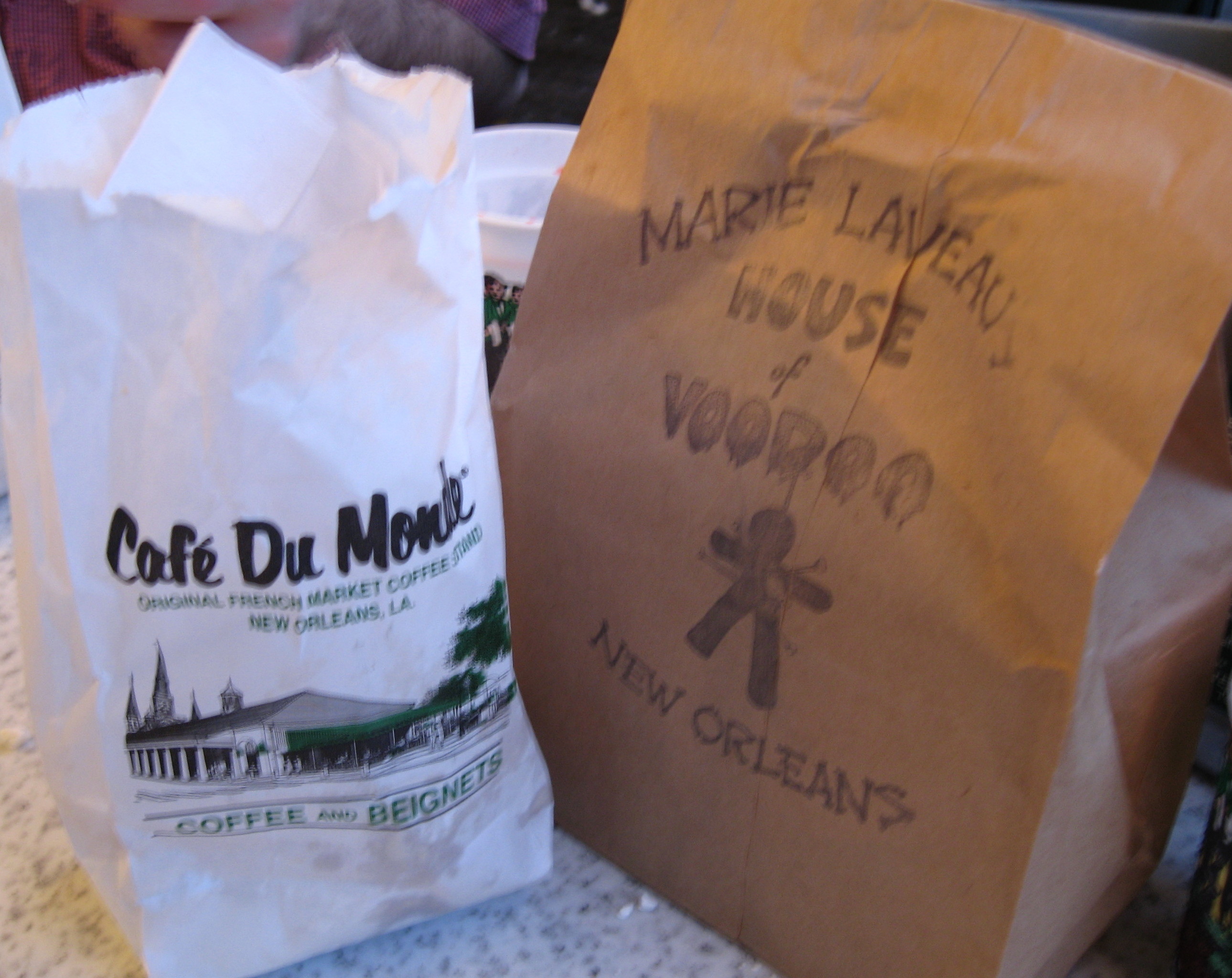
Beignets and VooDoo

If you go to the French Quarter, you have to visit Cafe Du Mond for Beignets and Coffee. I’m sure they have banned trans fats …. \;-)

I have to say that despite the bawdy novelty of Bourbon Street, my main impression of the place is that it’s pretty unhealthy.  Not so much for the tourists, but for the folks who work there. It’s amusing to visit for a few days, but as a lifestyle it is quite corrosive.


Olympic Boycott. Lunacy of the Week.

The talk of an olympic boycott by the US president in the opening ceremony in China is ridiculous.  It would surely have zero effect on Chinese policy toward Tibet.  It is naive beyond description to think that those sitting in power will reverse policy in such matters. To reverse a policy regarding sovereignty that has been defended with violence is to admit a shocking error in judgement and to accept responsibility for a wrong that is possibly criminal.  Autocratic governments never do this. Ever.

China has supported considerable US debt and continues to do so. We’re going to publically humiliate our bankers? We’re going to poke a finger in the eyes of those who have been supporting America’s deficit spending and military adventurism in the sandy spots of the world? I don’t think so. 

Buying fewer goods made in China is one good response. Put the money in the bank. Feed the pig.

NOLA ACS Meeting. Tuesday

Tuesdays meetings included an awards symposium extravaganza in the organic division. F. Dean Toste was the recipient of the Elias J. Corey Award for Original Contribution in Organic Synthesis by a Young Investigator. Illuminati of the likes of Trost, Sarpong, and Grubbs gave their talks in honor of the awardee. Toste’s talk was on his work in the area of Au(I) catalysis. These gold (I) catalysts show an extraordinary propensity for coordination of alkynes and facilitating nucleophilic addition to the triple bond.

The reactivity of Au(I) is attributed to relativistic effects causing contraction of the 6s orbital and destabilization of the 5d orbitals. The result is a large aptitude for pi->M coordination and relatively low M->pi* backbonding.

Relative to Pt and Rh, gold is cheap. 

NOLA ACS Meeting. Monday.

The talk by Frederic Stanley Kipping Awardee T. Don Tilley was worth the time to see. This UC Berkeley chemistry prof has accumulated a substantial list of results on in the organometallic chemistry arena, much of it with the use of silanes.

The ACS Awardee in Organometallic Chemistry, G. Parkin of Columbia University, was equally interesting. Parkin described his work with kinetic isotope effects and had some caveats for those attempting to draw mechanistic conclusions from such studies. The reaction temperature used in the study can give a positive effect, no effect, or a negative effect. Hmmm.

George Whitesides (GW) gave a talk entitled “Questions about questions about the origins of life”.  It was actually a kind of homily summarizing his summaries. Ok. Let’s see if I can do better than that.  GW has been ruminating on the origins of life and has come to the conclusion that neither the physicists or the biologists are equipped to solve the problem. 

The first matter that he paraded before the audience was this- is it enough to say that the world is bifurcated into two domains- alive and not alive? Is it binary or continuous? GW thinks it is continuous.  It just occured to me that prions may be a good present day exception to the assertion that it is binary. But what really matters is the question of whether life was continuous or binary during the peribiotic period while life was forming.

GW suggested that it is important for us to find examples of chemical fossils.  These would be chemical compositions left intact from that era. The problem of the origin of life cannot be answered by simple extrapolation backward from present biology because the peribiotic conditions in which life arose have not been present for several billion years. We are far from understanding the chemical and redox makeup of the peribiotic world.

The origin of life arose from reaction networks that afforded molecular species that could self amplify or self replicate in an anoxic, reductive environment.

The question of the mechanistic origins of life is vastly different from the question of the mechanistic evolution of life.

Both are chemical phenomena and a mechanistic picture of both will ultimately be assembled by chemists of one sort or other.

NOLA ACS Meeting. Sunday.

Spent a good deal of  time in the INORG section talks. The Cotton Symposium talks have brought many friends and alumni of the Cotton Experience. Tobin Marks kicked off the symposium this morning with his usual overwhelming flood of results. Listening to a Marks talk is like trying to sip from a fire hose.  What always impresses me about the talks by Marks, Bergman, et al., is the large amount of kinetic and thermodynamic data presented to support the proposed mechanisms. 

The talk on the functional mobility of ribosomes by Yonath was just amazing. The Yonath group has been able to use heteropolymetallates to aid in the understanding of the conformational changes in the mechanism of transfer RNA mobility across the ribosome. 

My background did not include kinetic studies and I have always regretted this. The path to understanding is with kinetics and thermodynamics experiments, not just a simple report of yields and conditions. Once before they bury me, I want to do this.

The Kipping Symposium Honoring T. Don Tilly offered some interesting talks as well. Gelest  had a sponsoring role in this symposium.

Chemical Insult

I’m not an apologist for the chemical industry. Chemical industry has a checkered past in many ways. The pesticide, petrochemicals, and mining industries have left a deep and abiding foul taste in the mouths of many communities. In a previous era, heavy industry has fouled rivers, lakes, air, and ground water. It has lead to illness, death, and loss of livelihood to many people.

But in the modern era much of this wanton issuance of hazardous industrial material into the air and waters has been halted or greatly diminished. And it is not because industry suddenly found religion. The “regulatory environment” became so compelling a liability cost factor that industry set its mind to engineering plants into compliance. 

I would make the observation that today, the major chemical health issues before us are not so much about bulk environmental pollution by waste products. Rather, I would offer that the most important matter has to do with the chronic exposure of consumers to various levels of manufactured chemical products. High fructose corn sweeteners, veterinary antibiotic residues, endocrine disrupters, smoking, highly potent pharmaceuticals, and volatiles from polymers and adhesives to name a few.

Modern life has come to require the consumption of many things.  A modern nation must have a thriving chemical industry to sustain at least some of its need for manufactured materials. It is quite difficult and isolating to live a life free of paint and plastics or diesel and drugs. Choosing paper over plastic at the supermarket requires a difficult calculation of comparative environmental insults. Pulp manufacture vs polymer manufacture- which is the least evil? I’m not sure.  

The path to a cleaner and safer life in these modern times is surely a life that pursues fewer consumables. Less throw-away stuff.  Less calorie intake and greater calorie expenditure. Reduced consumption of foods engineered by modifiers and additives.

Given the expectation of multitasking in our culture, it is increasingly difficult to arrange to prepare fresh foods. Meal preparation time eats into commuting time.

Now that I think it through, maybe it’s our culture that is killing us? Maybe our adverse exposure to deleterious substances is an artifact of a cultural requirement for increased productivity.

At the outset, I said I was not an apologist for the chemical industry. But I am not a Luddite either. Modern material science (which includes chemistry) has brought aid against a great many of the hazards and inconveniences of life. As we pass through the age of increasing population and peak oil we must adjust our expectations of the benefits of manufactured goods in the betterment of our lives. Linear extrapolations such as “more = better” begin to fail at high levels of consumption. That is the lesson that I’ve taken.

Good Morning, NOLA. Pass Me Some Advil.

The math of Bourbon Street is painfully evident this morning. 1 Hurricane = 1 hangover. The sliders with the hot peppers didn’t help, either. I should probably start thinking about chemistry again. Bourbon Street is a very naughty place. The prospect of beads can cause ordinarily prudent people to expose their anatomy. A fellow can get into serious trouble here.

Speaking of pain, I’m reminded of a recent dinner conversation with an astrophysicist. This fellow is a senior player in the astrophysics circuit. He has been involved in the development and use of many “science packages” that are now hurtling through the vacuum of space.

Like physicists often do, he took delight in reminding me that chemistry is derived from physics. When asked why a chemist was interested in astronomy, I blurted out that I thought there was a goodly bit of chemistry happening in the universe and much for a chemist to try to understand. Between bites of beef medallions and the chomping of his bearded jowls, he shot a patronizing glance over his glasses at me and suggested that it was all ultimately physics. 

Ah, a reductionist! Not wanting to make a scene, I let this comment float into the ether where it belonged. But I would offer that if one had a headache and needed to wait for a physicist to invent and make some aspirin, you’d still be waiting.

NOLA ACS

Th’ Gaussling is heading for fabulous New Orleans, LA, to that gathering of eagles we call the National ACS Meeting. It’s an extravaganza. Chemistry overlords and underlings awkwardly walking about in their wrinkled dress-up clothes.  Undergrads on their first professional trip, lugging plastic bags loaded with trade show trinkets.  It’s an orgy of PowerPoint presentations disclosing all of the latest “firsts” and “remarkable” results. 

The National ACS meeting is a harmonic convergence of the illustrious grandees of the First Tier of universities together with those perched in lesser stations.  Th’ Gaussling, a 2nd rate molecule merchant, will be staying within hurling distance of Bourbon Street.  NOLA is a place where it is still cool to play the tuba.  Ya gotta love a place like that.

Solar Warming

Here is an interesting analysis of solar min/max data. I can’t vouch for the kind of analysis that was performed. But it is interesting to see. The effects of variations in the solar flux on global temperatures seems to be neglected in discussions I run into. Among other things, these folks suggest that a lesser known 66 year solar cycle may come into play.

One commentor in a previous post suggested that we are approaching the end of the current interglacial period. He said that recent interglacial periods were characterized by polar cap melting followed by entry into the glacial side of the cycle.

Even if the solar output was constant, the interplay of the ocean heat reservoir with the atmosphere, greenhouse gases, vulcanism, asteroids, and the earth’s albedo is complex enough.  Heap on top of that the subtle thermal modulation by the sun and you have a really complex problem.

Global warming could reduce to an equation where one of the components of the sum derives from anthropogenic greenhouse emissions. 

I keep having this thought that Al Gore is eventually going to have a long talk with Tipper about returning the medal to Sweden.