Patents as Publications?

At a conference a few years ago I was discussing chemistry over gin and tonics with an assoc. prof from the University of XYZ. This fellow was one of the solid journeyman chemists in our field with a good eye for projects and opportunity, but like most of us, he is a warm-up band and not a headliner.  Eventually, the prof confided that he was patenting his work partly to extend his publication list- like sawdust in flour.  He had done some interesting work with a late transition metal. As the evening wore on, I could see the fire of gold fever in his eyes.  He believed that his patents would bring a stream of money and notoriety to his program. It’s natural.

Big things can happen with university IP. Some universities have substantial royalty streams filling their coffers. The institutions are able to capture value from the inventiveness of their faculty and students. When it works, it can fund new buildings, institutes, chaired faculty, and a horde of students and post-docs. When it doesn’t work, and most patents do not lead to cash flow, universities have to pay the cost of the patent plus maintanance fees out of strained budgets. Foreign fees can add up to large cash payouts every year.

At a dinner recently, I had the good fortune to dine with one of the rock stars of our field- a true headliner. This fellow had met the King of Sweden and has basked in the accolades of we minor players and roadies ever since.  For good reason- he was exceptionally productive.

After the sixth bottle of wine had been drained at our table, jaws were wagging and bad jokes and war stories were making the rounds. Eventually the rock star lamented that he was tired of writing patents and wanted to get away from intellectual property.  Working with lawyers just took too much time.

Another acquaintance is also a rock star who has met the King of Sweden. He actually is in the licensing business with a company on the side and students who do, or at least used to do, research for their degrees that was also considered to be intellectual property.  He too has a list of patents longer than your arm.

I am betraying no secrets here. Patents are public documents. University patenting is well down the road since the public law changed.

I’ve written about this topic before. The nature of IP and the academy has changed considerably since Bayh-Dole has allowed universities to apply for patents that were funded with public funds.

But the question for today is this:  Of what value are patents on an academic resume? Should a WO patent weigh as much as a JACS paper. Should a US patent weight the same as a JOC paper? What if a candidate has more patents than papers? Should patents lead to tenure? How should this calculation work?

A patent is not trivial or cheap. A patent application has to survive a large amount of a certain type of rigor in the examination process. A patent may have involved a good deal of scholarship. A good patent may teach and claim compositions of matter and processes that are truly ground breaking.

But a bad patent based on work that was never actually done can share the same playing field as one that is genuine and valuable. The rigor of examination is more of a statutory process relating to obviousness, novelty, and utility. A citizen or organization is entitled to a patent under the Constitution, provided that certain conditions are met.

Nobody is entitled to a scientific paper. Scientific societies are in the business of encouraging scholarship by providing a venue for the screening and dissemination of written works by investigators. There is a pecking order in all fields, and chemistry is no different. A layered ordering of prestige and glory definitely exists and few are shy in their opinions about such ranking.

It is hard to argue that the scholarly path is not in the direction of maximum credibility. Patents are not officially peer reviewed by fellow workers in the field. But the patent literature is a vast reservoir of credible technical information that I think may be widely underappreciated.

So while a patent probably shouldn’t carry the same weight as a refereed paper in terms of scholarship, a patent can in principle represent a large amount of successful R&D. I would argue that it can be regarded as a type of commercial accomplishment that is worthy of a place on a resume.

A patent is, after all, a property right that can be bought and sold like a mining claim or mineral rights. It is a type of holding owned by the assignee but not necessarily the inventor. Patents also enjoy the assumption of validity by the courts, so knocking one down requires some determination and money by a challenger. A scholarly work requires only another paper contradicting the results to be brought under the unblinking eye of scrutiny.

In summary, I would offer that a published paper confers a sort of warranty of scholarship, knowledge, and expertise. A patent confers a property right. A patent may teach a good deal about certain arts and may well be bullet-proof in its authenticity. But a patent is not in the same league as a paper and shouldn’t be regarded as equivalent to a scholarly publication. However, a patent does represent a very real type of accomplishment that may be substantial, so discounting them should not be done either. Actually, a patent is one of the few real measures of accomplishment in a secretive industry. Patents are a plus and should figure into the total profile of a candidate.

Shermer’s “Mind of the Market”

Google has been posting a series of interesting talks by contemporary authors. This talk is by Michael Shermer, author of Mind of the Market, and editor of the popular magazine Skeptic. It is a lengthy 53 minute video, but I would highly recommend it. I think Shermer has a good grasp on the anthropology of our present world.

This is off-topic, but useful. This link gives a bunch of really good hints on how to save money for your start-up company.

Incident Attenuation in Chemical Plant Design

If you work in a location that handles or processes hazardous materials, eventually you have to come to grips with the matter of risk and accidents. It is possible to design procedures that prevent certain kinds of accidents and casualties.  It is possible to install devices and automated contrivances that can eliminate specific failures and the resulting cascade of multistage calamities that might follow.

Over time and with plenty of thought, a chemical plant can be fool-proofed to a large extent. But in the end, residual margins of safety depend on the man-machine interface. People have to undergo recurrent training and certain staff must be assigned to specialize in safety.

All devices have a failure rate. The rate may be small or large. A device may fail safely or not. Most chemical plants are, to a large extent, hand built. They are fabricated by skilled tradesmen who connect pre-fabricated parts to one-of-a-kind assemblies built on-site. In this way, expertise is captured from the plant designers, contractors, and the manufacturers of the installed equipment.  In the end though, it is up to the designers to assure that there is compatibility and some margin of overdesign in the finished facility.

While it is possible to assemble a facility from the very best equipment, the fascinating question of design for the attenuation of accident propagation is not often discussed, at least openly.  Accidents can usually be reduced to a few characteristic phases. They are initiation, propagation, and termination. 

An incident begins with an initiating event. Some release of hazardous energy is presented to the surroundings that may begin a propagation of undesired events. Events can propagate in series or parallel chains.  Hazardous energy can be electrical, chemical, or mechanical. The initiation is the tipping of a domino as a triggering event that causes the release of other hazardous conditions to ensue. Eventually, the propagation of the hazardous energy release is suppressed, extinguished, or simply exhausted in the termination phase.

One of the best ways of learning about the phenomenon of accidents is reading about them. A website worth visiting is the US Chemical and Hazard Investigation Board. It is useful for chemists and engineers to study the anlyses of the CSB and gain useful insight into the dynamics of chemical plant accidents.

It is possible to configure a chemical plant in such a manner as to attenuate the propagation of hazardous energy during an incident. In general, a large distance between reservoirs of potential energy is the easiest solution. Explosives manufacturers have known this for a long time. One well known German manufacturer of energetic materials has a manufacturing site spread over a large rural area and has built in bunkers with berms and trees to attenuate the propagation of shockwaves and allow flying fragments to land safely in an uninhabited area.  Fortunately, not many manufacturers have processes and products requiring this kind of design consideration.

Situations of “ordinary” risk magnitude do require some thought, however. Consider the storage of drums of flammable materials. Most companies that handle palletized drums of flammable liquids meet the minimal fire and insurance codes for the handling of these materials.

But consider this. What if a forklift driver spears a drum of solvent with his lift, and then in a panic, backs up and pulls the fork out of the drum resulting in a spill? At this point, policy and regulations are irrelevant. The only question is this-  Where does the liquid and the potential fire go?

Indoor storage of flammable materials requires fire suppression. Fire suppression is not the same as fire extinguishment. It is about knocking down the fire to a manageable level for emergency egress, to suppress the spread of the fire, and for firefighters to make some kind of attempt to extinguish the blaze. This is routine firefighter stuff.

What is less than routine, however, is the issue of BLEVE’s. I have written on this phenomenon previously.  Fire suppression is one thing, but BLEVE’s – Boiling Liquid Expanding Vapor Explosions- are quite another matter to deal with.

This is where a well designed facility with passive architectural features to attenuate the spread of hazardous energy can be helpful. An indoor BLEVE is virtually assured to accelerate the pace of a disaster.  So, in the planning phase of a plant, it is important to consider how energy release during an accident may propagate.  Drummed flammable liquids should be isolated from work areas and egress paths. This is pretty obvious to initial designers, but not necessarily years down the road during an expansion.

Consideration should be given to the anticipated direction in which energy is released. Where possible, energy should be released away from populated areas and away from major capital equipment. A fire in a materials storage area shouldn’t lead to an extended plant shutdown due to damaged process equipment. Segregation is key to plant safety and business viability.

Smoke is a potential killer and there are architectural tricks that can add provide slightly greater safety margins. Ceilings designed to collect and channel smoke out of the space could reduce the likelihood of suffocation of stranded workers and suppress the chances of a flashover. Smoke curtains properly placed can channel smoke away from hallways and the resulting spread.

Another concern is the fate of spilled flammable liquids in a storage area. Where should the spill go? Should the spill be concentrated in a small space or channeled to another space where a fire can burn with lower negative consequence? Nobody likes to pay for an overengineered warehouse, but fire resistant partitions in a solvent storage area can go a long way toward the isolation of a fire and attenuation of a larger scale calamity.

One major plant accident I am familiar with has a number of attributes that other operators would do well to consider.  A 750 gallon reactor explosion resulted in the complete fragmentation of the vessel.  A few pieces ejected from the hole in the roof were found lodged in the walls of neighboring structures off-site.  Fortunately, this reactor was in an enclosed space with no other reactors or stored hazardous materials. In one way, this accident was isolated due to passive attributes. However, the building space was interconnected to other spaces by a series of adjacent rooms and hallways. While fragmentation and fire damage were contained due to the happy fortune of isolation, the shockwave was able to follow all of the connected and enclosed pathways.  The connected pathways were a convenience to the workers, but this feature channeled a pressure wave throughout the entire facility, lifting the roof enough to damage large -remote- sections of it as well as badly damaging overhead doors and windows throughout the facility.

Take home lessons? 1) Leave open space walkways between production and storage buildings and the rest of the facility. Collateral damage is likely to be suppressed with this cheap, passive feature. 2) isolate and dedicate certain vessels to hazardous operations. 3) Store hazardous materials well away from processing areas. Storage and processing have their own hazards and a disaster in one area should not be allowed to propagate to the other.

The matter of flammable solvent storage and accident attenuation is only partially solved with enclosed flammable materials lockers. It seems to me that some research should be done to advance the level of best practices in this area.

Sigh

What a horrible week.  >>>>>>***Sarcastic comment stricken from the record***<<<<<  Things have gotten too Machiavellian.

Let’s talk about sunshine and daisies instead:  Some things about Th’ Gaussling that may not be widely known- I wear a Mickey Mouse watch, even on business trips, and I am a daily user of a pocket protector. My current pocket protector is emblazoned with the logo “Buca di Beppo”.  I’m considering having some Lamentations on Chemistry pocket protectors printed up for distribution from this site.

Email Etiquette- Going Nuclear

A pet peeve I have with my some fellow adult co-workers is their bad habit of excessive cc’ing people on emails. The most pernicious version of this is an email where a list of grievances is sent around with the conspicuous presence of some upper level manager carbon copied, or worse, blind copied.

This habit is a transparent kind of tattle-tale leverage used in the art of persuasion. Once someone has “publically” complained to upper level folks, everyone else has no choice but to opt for CYA.  It is like a nulcear weapon- once released, it knocks everyone down. I refer to these situations as “going nuclear”.

People feel that they have to respond in kind.  One email escalates to many. Soon, there is a flurry of emails clogging the inboxes of those trapped in this fetid tidal pool. Eventually, the tempest dies down leaving the boss wondering about the judgement and temperament of the staff. 

The worst kind of cc is the bc, or blind copy. This method is favored by practitioners of the dark arts. It is a truly reprehensible practice and people who do it should be hunted down like the rabid  curs they are and tarred and feathered. Neutered, maybe.

Ab Initio Chemical Plant Design

So, dear reader. If you were going to design a general/multi-purpose chemical plant capable of doing a wide variety of chemical transformations, what kind of features would you install now that you’ve had some experience in the field? No high pressure vessels, just ambient to 80 or 100 psi. I’m talking about a plant with 50 to 2000 gallon reactors- say, 8 of them. What kind of configurations would be desirable starting from the ground up?

No GMP capacity- too bloody expensive. We don’t want to do API’s.  No gas phase chemistry. No scary oxidation chemistry or energetic materials.  Just the kind of garden variety specialty organic or inorganic compounds and transformations that you might find in the Aldrich catalog.  Synthons, reagents, etc.

One interesting thing to ponder are possibilities with the use of passive architectural features to attenuate the propagation of upset or emergency conditions. 

PGM Prices Remain Strong

The Platinum Group Metals (PGM’s) continue to trend upwards.  Last friday 0n the EIB rhodium opened at US$9,050.00/toz. Rh remains in strong technical demand and prices are propped by a great many overlapping factors. Uncertainties in the mining business in South Africa buoy uncertainty among investors. Recent electrical distribution shortfalls and blackouts have interrupted production as have mine floods, labor disputes, and a shortage of experienced miners and managers.

Automotive pollution catalytic converters dominate the demand for platinum and rhodium. As demand for Pt and Rh continues to grow, look for companies to switch to palladium in key applications.  Russia holds a strong position in Pd inventories. As demand for Pd rises, look for Russia to exercise its muscle.

As Au and Pt prices continue to climb, look for jewelry demand for these metals to taper off.  Asian demand for these metals is substantial. Eventually, jewelry prices will temper demand for gold and platinum.  Meanwhile, interest grows in North American PGM resources.

Password Blues

Our IT guy has been hounding us to make better choices for login passwords into the company information system. More characters, digits, and the use of mixed case is recommended. Like many people, I have accounts in diverse systems that are not connected. Not every system gives me a choice of login names and passwords.  Eventually one ends up with a variety of codewords that one has to keep straight. Soon it becomes a little burdensome.

There is a website that purports to provide random character strings. It is Random.org.  The operator of the site is a lecturer in computer science at Trinity College and uses atmospheric noise from a group of radios to capture random events that are somehow translated into character strings.

If you need strings of random digits, there is von Neumann’s middle square method. It can be done on a calculator. While it is hard to guarantee that there isn’t some kind of periodicity, von Neumann felt this method suited his needs.

I wonder to what extent the shaky state of internet security depends on the structure and prevalence of Microsoft code?  I have no idea.

Literature Swim. The Guo-Liu Catalyst.

Guo & Liu Catalyst

The literature train station is overflowing with diverse catalysts for the large variety of coupling reactions out there, as is the patent literature. Parties scramble to get window seats on the IP Express, the high speed non-stop to that Golden City on the Hill. 

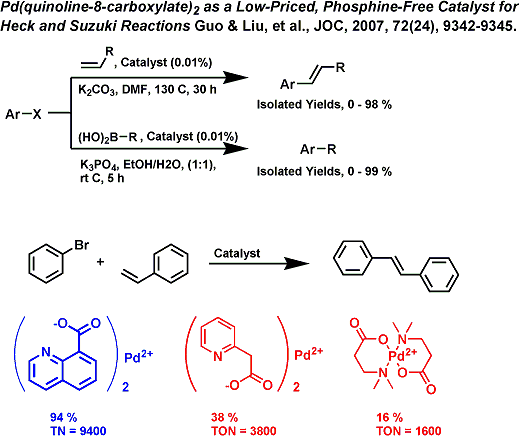
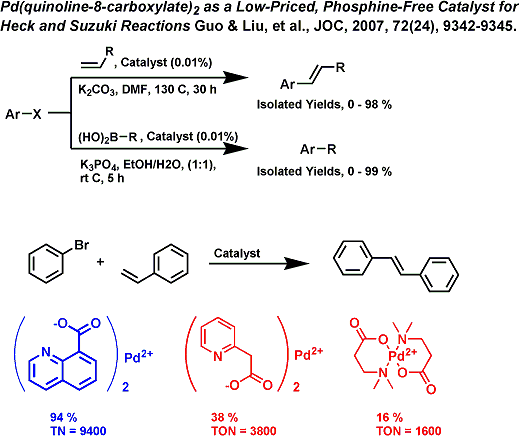
A recent JOC article disclosing an inexpensive catalyst system that struck me as interesting.  The article by Guo and Liu emphasizes economy and so discloses a phosphorus-free bidentate ligand system that affords Heck and Suzuki-type coupled products.  There are pluses and minuses to this system, as is the case for most catalysts.

On the plus side with the Heck and Suzuki reactions, both activated and deactivated aryls gave decent yields. On the minus side, the Heck coupling reaction is a bit slow. A fair amount of energy input was needed- 130 C in DMF over 30 hours. On the Suzuki side, most reported reactions resulted in good yields, except for the aryl chlorides. The relative inertness of chlorides is not particularly unusual, but it may cause this catalyst to be passed over in some applications where the less atom-efficient bromides and iodides have been targeted for replacement.

Finally, the apparent requirement of DMF is rarely happy news. Regardless, I have no doubt that this catalyst will find its way into the future literature and many clever applications will be revealed.  As of this writing, I was unable to find a US patent by inventors Guo and Liu claiming this technology. Since there is a 1 year limit on the filing of a patent application following disclosure, this technology could be in patent prosecution at present. Or not. Wouldn’t it be a happy thing for it to be in the public domain?