[Note: This is an updated post from the original posted one year ago.]
March 22, 2022. Swiss drugmaker Novartis has released Pluvicto, “the first FDA-approved targeted radioligand therapy (RLT) for eligible patients with mCRPC that combines a targeting compound (ligand) with a therapeutic radioisotope (a radioactive particle). Pluvicto is expected to be available to physicians and patients within weeks.“
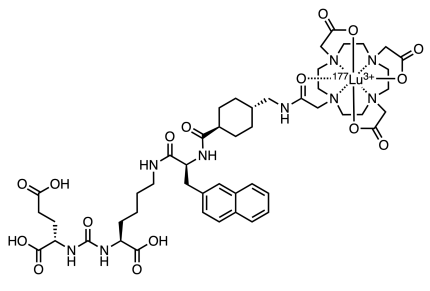
Pluvicto features a chelated 177Lutetium ion (half-life 6.7 days) which is the source of the molecule’s radioactivity. Lutetium is the heaviest of the lanthanide elements and the name comes from the Latin Lutetia Parisiorum which was the predecessor to the city of Paris, France.
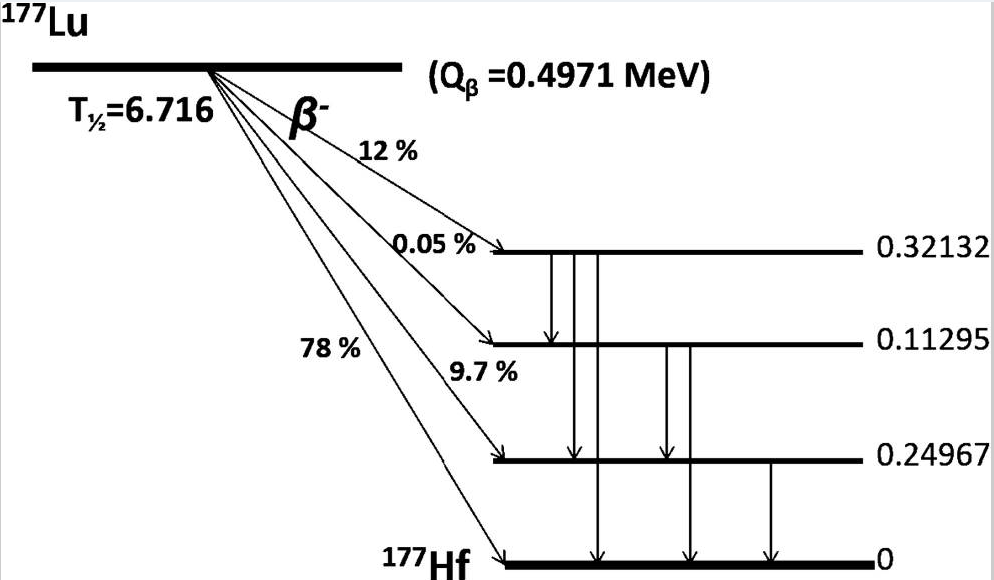
Pluvicto has been approved in the US for the treatment of metastatic prostate cancer. Several things are notable about the Pluvicto molecule. The molecule contains a PSMA-specific peptidomimetic feature with an attached therapeutic radionuclide, where PSMA stands for Prostate Specific Membrane Antigen. Peptidomimetic refers to a small chain that resembles a stretch of protein forming amino acids. This peptidomimetic fragment, which interestingly contains a urea linker, is designed as the tumor targeting piece of the drug. Connected to it is a chelated radioactive 177Lutetium cation (below, upper right). The tumor targeting fragment binds to the cancer cell. While bound to the cell, the short-lived radioisotope undergoes two modes of decay. The 177Lu has two decay modes. One emits a medium energy beta particle (Eβmax = 0.497 MeV) which is limited to a maximum of 0.670 millimeters of travel. This is the kill shot that will damage the attached and nearby target cells. The short path length of the beta ray in vivo limits the extent of surrounding damage by any given decay. Once the 177Lu emits a beta particle it becomes 177Hafnium.
Source: Ashutosh, et al. 177Lu decays to ground state 177hafnium 78 % of the time. In the three other beta decays to three hafnium excited states, each collapses to ground state by 6 possible gamma emissions.
The other mode of 177Lu decay is gamma emission by 177mLu, a nuclear isomer or metastable form of 177Lu. Gamma radiation is much more penetrating than beta radiation. The gammas can be detected from the outside of the patient allowing monitoring of dose and location of the drug. Even though gamma rays are more penetrating than beta rays, they produce many fewer ion pairs per centimeter as they traverse the tissue making them less effective per photon in tissue destruction compared to alpha and beta particles. For instance, alpha particles from therapeutic radionuclides like 223Radium used to treat prostate cancer are much more destructive because they produce many ion pairs per centimeter.
A Small Side-Track into Radon Decay
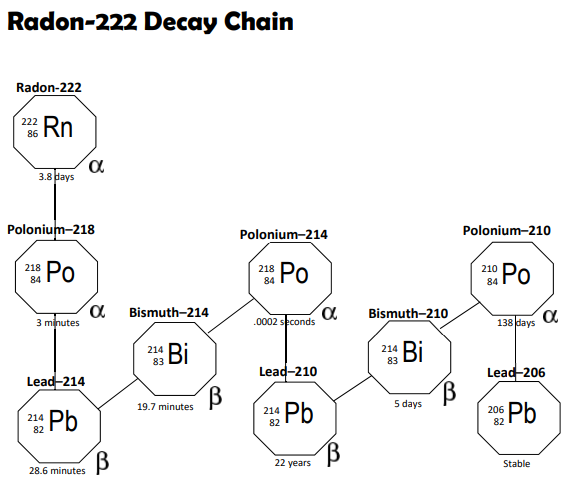
Not all radioactive isotopes are alike. Some, like 177Lu, offer only a single decay event while others are part of a domino series of decays. The decay of naturally occurring 222Radon begins a series of decay events (Radon’s daughters), with some decays being quite rapid, multiplying the radiological effect per initiating atom. Inhaling an alpha emitter like 222Radon is a gamble. Until the 222Rn decays, it is just an inert noble gas. But when it alpha decays in your lungs, it is converted to the 218Polonium which alpha decays to 214Lead which beta decays to 214Bismuth which beta decays to 214 Polonium which alpha decays to 210Lead which beta decays to 210Bismuth which beta decays to 210Polonium which alpha decays to stable 206Lead where the chain stops. Each of the daughter products is a reactive, nonvolatile metal.
Each 222Radon atom gives rise to 8 successive radiation emissions, 4 of which are alpha emissions. These new radioactive elements are called “Radon’s daughters”. This makes radon especially insidious. Note the half-lives in the graphic. Source: EPA.
Neutron Activation of 176Lutetium
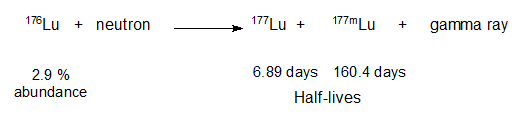
How does one obtain 177Lu? There are two pathways of nuclear chemistry that can be used, each with plus and minus attributes. The easiest pathway to execute would be the absorption of a thermal neutron by the lighter lutetium isotope 176Lu followed by a gamma emission from the new 177Lu. Gamma emissions result from metastable coproduct 177mLu that is in an excited state. It can de-excite by losing the excited state energy by the release of a gamma photon.
Where does one get thermal neutrons and what is “thermal” about them? Thermal neutrons are produced in a water-cooled nuclear reactor. It turns out that nature has bestowed a wonderful gift on 176Lu. It has a very large neutron capture cross section of 2090 barns for producing 177Lu. The metastable 177mLu isomer has a cross section of only 2.8 barns.
The unit “barn” is the unit of the effective target area of a nucleus and is equivalent to 10-28 m2, or 100 square femtometers. The capture cross section of a nucleus is dependent on the energy (or temperature) of a neutron and is proportional to the probability of a collision. Here is a brief reference on nuclear cross sections. The colorful etymology of the term “barn” is recalled here.
For comparison, the capture cross section of 239Plutonium is on the order of 750 barns with 0.025 electron volt neutrons. We can see that the capture cross section of the 176Lu is much larger than that of 239Pu. The word “thermal” comes from the kinetic energy corresponding to the most probable speed of a free neutron at a temperature of 290 K (17 °C or 62 °F).
The transmutation [176Lu + 0n —> 177Lu + 177mLu] is clean and direct with no other chemical elements to interfere. With its large capture cross section,176Lu is well suited to absorb a neutron. The down side is that the isotopic abundance of 176Lu is only 2.8 %. The other 97.2 % of Lu can also undergo neutron activation leading to chemical and radiological contamination of the desired 177Lu. Isotopic separation of 176Lu from the other Lu isotopes is difficult and not very scalable. By the way, the lutetium is neutron activated as the refractory oxide, Lu2O3. These lanthanide oxides are simple to prepare and can be dissolved in acid afterwards to produce Lu3+ cation for further chemistry.
Neutron Activation of 176Ytterbium
The other major channel to 177Lutetium is from neutron activation of 176Ytterbium, 176Yb. Generally speaking, the heavy lanthanides like Yb and Lu are less abundant than the light lanthanides on the left side of the series. All of the lanthanides have a 3+ oxidation state and similar ionic radii making them difficult to chemically separate, where “difficult” means that numerous steps are needed in purification often resulting in low yields. A few of the lanthanides have oxidation states other than +3. It turns out that Yb3+ can be selectively reduced by chemistry to Yb2+ in the presence of Lu3+ using sodium amalgam as the reductant. This happy fact allows for plausible chemical separation of Lu from Yb. Furthermore, Yb will amalgamate while Lu does not.
A Google search of Pluvicto or 177Lutetium will produce many good links of a technical and non-technical nature.
Pluvicto, PSMA-targeted radiotherapy (lutetium 177Lu vipivotide tetraxetan) for PSMA-positive prostate cancer 7.4 GBq (200 mCi) IV Q6W up to 6 doses
Something new to be neurotic about- temple hollowing. Among facial reconstruction professionals, this is not news. It hardly ranks as a disfigurement, just one of many effects of aging.
Just when I thought I’d heard of everything, along comes the aesthetic condition of temple hollowing. This condition results from the underlying tissues of the temple thinning to produce a hollowed-out effect. The result is an older, more peanut shaped or skeletal appearance to one’s head.
It is a normal consequence of aging or excessive exercise. By injecting a filler, temple hollowing can be filled in to produce a more youthful appearance.
I’ll place this in either the “Who knew?” or the “Who cares?” basket.
Now that I am aware of this aesthetic anomaly, I suppose I will see it everywhere.
Guapo, Arizona. Journal of Interesting Constraints: Dark Matter (JICDM) Editor-in-Chief Prof. Ralph Huey of Poltroon University Physics Department (PU) has announced that he will be retiring from the Editor-in-Chief position after 12 years of service. Prof. Huey has been appointed to the Regent Registrar endowed chair at PU beginning in August, 2024.
JICDM is dedicated to the rapid communication of negative results and theoretical dead ends discovered in the field of dark matter. Scientists wishing to announce evidence-constrained research of dark matter/dark energy physics are invited to submit their manuscripts and vitae. A Journal of Interesting Constraints for both Quantum Gravity and String Theory are being contemplated with an announcement expected after the 2024 Nobel Prise awards are announced.
A poster session beginning at 2:00 PM highlighting Dr. Huey’s work in the field of Quantum Word Processing followed by a colloquium with guest speaker Professor Irwin Corey from the University of Kornhole, Kentucky, speaking on “Quantum Yarn Theory: The Burlap Model of Space-Time” in honor of Dr. Huey’s retirement from JICDM. The lecture begins at 4:00 PM, August 2, 2024 in the Timothy Leary Memorial Auditorium, Potato Science Building, Poltroon University. Open bar begins at 3:30.
_
**Thanks to Sabine Hossenfelder for the interesting constraints idea.
Note: I’m having a difficult time not posting on the many ways I’m sickened by you-know-who. This is one more but is blessedly short.
To my great chagrin, there are tens of millions of US citizens who can look at the photo below and not sicken at the patronizing spectacle of a former real estate mogul turned reality TV showman’s hamming it up with a clownish embrace of the flag and laying on a fully puckered kiss for good measure. The guy is a one-man traveling burlesque show. This picture is part of his brand.
#45 Smoochin’ Old Glory.
This is a pose cynically staged to appeal to the many citizens who cannot recognize a charlatan when he is standing in front of them. It is an exaggerated and garish display of idolatry posing as patriotism. Patriotism is many things but not this.
The reverberations of Trump’s South Carolina comments on NATO continue. Being a thuggish racketeer himself, he sees something like freeloading or racketeering in the motives of the NATO states. With his disparaging rants about NATO and proposing that the US stands back while Putin pushes west, he emboldens the Kremlin to maintain their aggression in the hope of the US standing down. There should be no mistaking Putin’s motives- he wants to recover the territory once controlled by the Soviet Union. Some suspect that Belarus will be annexed next.
Isolationism has been a Republican reflex since before the formation of NATO. It seems to be a part of the libertarian worldview of the isolated and rugged individualist. Either they do not care about the global balance of power or are ignorant of it. We are seeing a wave of Russian aggression disguised as self-defense or the defense of “ethnic Russians” living across borders. Hitler used this trick to grease the skids for his takeover of the Sudetenland in neighboring Czechoslovakia in 1938.
Putin’s invasion of Ukraine was partly justified with the lie that Ukraine is infested with Nazis who are threatening Mother Russia. In 2014 Putin had slyly marched into southern Ukraine annexing the Crimean Oblast. Shielded from critics by his extensive blackout of international media, Putin dispatched troops for the “Special Military Operation”.
On September 30, 2022, Putin gave a speech declaring annexation of Donetsk, Kherson, Luhansk and Zaporizhzhia. In an angry, ranting speech Putin said “They don’t want us to be free, they want us to be a colony; they don’t want equal partnership, they want to steal from us,”
In Ukraine, Russia has inadvertently revealed itself to the world as a paper tiger. However, they are still in possession of a large stockpile of tactical and strategic nuclear weapons with its own triad of delivery systems. Russia’s policy has always been to use nuclear weapons in the event of the possible downfall of the state. By that they mean the downfall of Putin by outside forces. Russia is not burdened by having a policy of “no first use” of nuclear weapons like the West.
So what about Putin’s comment that “They don’t want us to be free …”. This is the autocrat who has shut down all independent news reporting within Russia, disconnected internet access to much of the world, normalized defenestration and has criminalized even the smallest whiff of dissent. Like autocrats often do, he accuses others of what he does himself. His rationale is that harsh measures are necessary to resist outside threats. He also claims that the West wants to steal from Russia. When you are an isolated and naturally secretive country, accusations of thievery are a soft sell. Accusations like this are part of the feedback loop of paranoia, hardening resolve to resist by being more secretive and brutal.
Imagine the ridiculous folly of attempting to invade or colonize Russia or take resources from it for any reason. Really, who the hell wants to be in control of Russia other than some Russian? What would a foreign invader of Russia hope to accomplish by taking control of this giant, multiethnic country? Decades of bickering, insurgency and violence? The taiga? It is a stupid plan, yet Putin frightens the population with visions of American attack and along with its sexual perversion.
Putin’s lessons from history come from Soviet times when the KGB watched for spies behind every tree and surveillance of the citizenry was justified for “state security”, a catchall for close control of its citizens. Escape from the USSR was difficult and getting caught could mean long imprisonment in a gulag.
Putin’s protestations are little more than a trademark display of strongman fulminations meant to justify the slaughter of his own military in Ukraine. I’m surprised he doesn’t do it shirtless on horseback to display his lean and mean musculature.
The Russian people deserve much better than a long history and an extended future of oppression. The region has seen immense suffering over the decades from invasion by Hitler, deadly oppression from Stalin and privation and imprisonment by its own leadership. Today, the strong arm of the Kremlin regime reaches deep into their lives, preventing a popular uprising or just expressions of discontent. What Russia lacks is an army of martyrs willing to die for freedom because that is what it would take. Putin keeps them comfortable enough to stay out of politics.
As I bumble and tumble through the chemical literature I frequently run into interesting chemicals and chemistry. Today’s moment of chemistry is with the “Wine Lactone”, so called because it is found in, well, wine. Interestingly it was first identified in koala urine. I saw that this was an opportunity also to dissect the chemical name of the Wine Lactone and perhaps answer questions that you didn’t know you had.
There are numerous forms of the wine lactone that have seemingly minor differences but have different odors. Some of the other “forms” are called stereoisomers and others positional isomers. The atomic composition is the same, but the atoms and their bonds are arranged in a slightly different way. It is not uncommon for these differences to result in a change to the odor or some other property.
The problem with chemical names (nomenclature) for people outside of chemistry is that they seem to be over-complicated polysyllabic tongue twisters with numbers and sometimes Greek letters that are impossible to pronounce or remember. Indeed, they are very often complex and seem to have a mysterious origin. This is where chemistry has strayed away from medieval naming “habits” and supplanted it with a systematic naming system that describes the exact atomic composition, how the atoms are connected and, if necessary, the particular shape in three dimensions.
For thoroughness I’ll point out the molecular formula style like CxHyNzOt where x y, z and t are variable numbers. Other elements were left out for convenient description here. Any organic molecule can be described by the numbers of carbon, hydrogen, nitrogen, oxygen and other atoms present. While the molecular formula is an accurate representation and is necessary for calculating molecular weight, as a unique identifier it is not very useful. Any given polyatomic molecule may have more than one structure that fits the molecular formula.
There are several groups that have been influential in chemical databases and nomenclature around the world. German chemists were on top of this early on with the German language Beilstein database and system of nomenclature (1881) for organic substances, now maintained by Elsevier Information Systems in Frankfurt. For inorganic and organometallic substances, there is the Gmelin database (1817) which is maintained by Elsevier MDL.
The systematic nomenclatures I will be referring to are IUPAC (International Union of Pure and Applied Chemistry) and CAS (Chemical Abstracts Service) supported by the American Chemical Society. I am unaware of the volume of usage of Beilstein and Gmelin databases today. They appear to be ongoing. Not being a German speaker, I’ll use first CAS then IUPAC in that order of priority. CAS and the few other databases use a numbering system for each unique substance in addition to the name. The CAS registry number, CASRN, is used around the world for authoritative identification of chemical substances. This includes academic R&D, industry, Safety Data Sheets, transportation, emergency response and not just in the USA. CAS also manages the TSCA registry list for EPA.
3-D model by PubChem. Line structure by Gaussling.
Many chemicals have names that pre-date systematic modern naming conventions like toluol or methylbenzol (methylbenzene, toluene) or vinegar acid (acetic or ethanoic acid). These older, trivial names are deeply entrenched in common usage and the secret cabal of nomenclature mandarins lets it pass uncontested.
Above is a ball and stick 3-D model of the Wine Lactone and next to it is a diagram of the numbering system for the molecule. While any fool could number the atoms, it takes a special one to make it official. The heading of the graphic gives the IUPAC name of the lactone as done by a chemical graphics application called ChemSketch. For comparison, the CAS name is given as well. The CAS database entry for the structure gives a very slightly different version of the same thing.
R&S designations can be omitted if they are not known. Adding R&S to the structure gives a spatially accurate view. It is not uncommon for a structure to be disclosed and given a CASRN before any R or S features are known.
The starting point for assigning a name is to decide what the core structure is, noodle through its numbering and then begin identifying the fragments on it. Somebody in the murky depths of time determined that the core structure of the Wine Lactone is a variety of 5-membered ring called a “furanone” (FYUR an own). The C=O (carbonyl, CAR bun eel) part could be in two places so we’ll have to account for that. With non-carbon atoms in the ring, the non-carbon atom is usually given the place number of “1”.
Both CAS and IUPAC have publications on organic ring structures, however in my experience IUPAC does not show the numbering scheme as CAS would. CAS holds a list of all known ring systems.
Question: Why doesn’t sophomore organic chemistry teach CAS nomenclature rather than IUPAC. Answer: I don’t know other than IUPAC has been taught for a good long time and is usually limited to fairly simple molecules in class. I suspect that the professor’s background as well as the textbook content are involved.
Before we go on, we notice that a hexagonal 6-membered ring is attached at two adjacent places to the 5-membered ring. This is a “ring fusion” and fused 6-membered rings are often given the radical “benzo”. So, the core structure is a type of “benzofuranone”. Oh yes, here a radical is a word fragment added to a name to indicate the presence of something.
Starting with oxygen at position 1 we go around the edge of the fused ring skeleton clockwise and attach numbers to the carbon atoms that are not part of the ring fusion. In the graphic above you can see that there were ring atoms that received simple digits. The atoms that make up the fusion are named by taking the number of the atom that precedes it and adding the character “a” to it.
So, what do we know already? We have a benzofuranone with C=O (carbonyl) at position 2. The “one” radical of furanone indicates that the furan ring has a carbonyl group in it.
Next we must account for the way in which the molecule is arranged in 3-dimensions. Carbon atoms need to have 4 bonds (lines) connected to them. If all of the lines are single, the carbon has 4 atoms arranged around it in the shape of a tetrahedron with the attached atoms at the 4 vertices. A wedged line means that the atom at the end is jutting up and out of the plane of the page. Dashed lines indicate that the group on the end is jutting down below the plane of the page, but the artistic license here is that the dases are omitted. Notice that there are 3 wedged lines at positions 3, 3a and7a. The two hydrogen atoms (H) are projecting up out of the page as is the CH3 (methyl) group. This tells us that the two rings are jutting behind the page, so this molecule is not flat but bent. The name of the molecule has to indicate this.
Molecular handedness. While the two molecules have the molecular formula and 2-dimensional connectivity, one cannot be superimposed on the other to give the identical shape in 3-D, like your hands or gloves.
The carbon atoms at 3, 3a, and 7a are called stereocenters because they have molecular handedness. Note that each is connected to four different groups in the molecule. It sounds like crazy talk but it is quite important. We won’t burrow into details here. Suffice it to say that these atoms will have an extra letter to designate what kind of “handedness” they have. R is for rectus meaning right-handed and S is for sinister meaning left-handed. There are rules for determining R vs S which we will not go into here.
Handedness in a molecule isn’t important except in how they interact with other molecules with handedness. The two nonsuperimposable (chiral) mirror images are said to be “enantiomers” (eh NAN tee oh mers). This is an issue for crystal structure and for many biomolecules. Outside of this, it isn’t much of a concern.
We now have (3S, 3aS, 7aR) to be plopped into the name. This group is shown in parentheses.
Next, we tackle the “tetrahydro” radical- it indicates 4 more hydrogen atoms are present than what would otherwise not be there. In nomenclature they start with rings that are unsaturated in hydrogen, meaning that the carbon skeleton is not connected to as many hydrogen atoms as it could. The four positions where a single hydrogen has appeared are 3a, 4, 5, 7a on what would otherwise be double bonds. There is one more to account for. The namesake furan molecule would have a double bond at position 3. In this molecule there is a hydrogen atom in place of the double bond, so 3H is added with the CH3 group.
Graphic by Gaussling
So far we have (3S, 3aS, 7aR) and 3a, 4, 5, 7a-tetrahydro and 2-benzofuranone.
At positions 3 and 6 there are two CH3 or methyl groups. To account for position and the fact there are two of them leads to this part of the name- “3,6-dimethyl-“. Elsewhere in the name we denote the R or S configuration, if any. The CH3 at carbon 6 is flat so it lies in the plane pf the page- it is neither R nor S. But the CH3 at carbon 3 juts out of the page at us rather then pointing downward. It has been given the S configuration.
Putting it all together in the CAS name, the configurations at relevant atoms are given first followed by a hyphen then the hydrogen locations followed by a hyphen then the word “tetrahydro”. After tetrahydro radical and a hyphen, the methyl positions 3,6 are added followed by a hyphen then radical “di” attached to the radical “methyl” followed by a hyphen then the core structure 2(3H)-Benzofuranone. The “2(3H)” feature indicates that the carbonyl is at position 2 and an H is at position 3, indicating that the furan ring is connected by single bonds.
I describe here the name of the Wine Lactone in its extended CAS form rather than the parsed form. If you want to sort numbered chemical names alphabetically, leading digits just complicate the sorting. So if you sort alphabetically by the core structure, you rearrange the name to lead with Benzofuranone followed by the details trailing off in the distance as in the first graphic.
I’m sure that deep within the lower catacombs at Chemical Abstracts in Columbus, OH, there are grizzled old nomenclature wizards who may quibble with my explanations, but let them materialize before me in a puff of smoke and discuss the error of my ways.
For a few months I have been avoiding my normal radio listening habits. I have been an NPR news listener from the late 1970’s until very recently. It isn’t NPR itself that I’m avoiding but the news. I still think NPR is a first-rate operation. Everywhere the news has become all-election all-Trump all-the-time and it turns my stomach.
This morning I grew tired of listening to the song of the open road so I switched away from FM and entered a place I never go- the AM radio band. I stopped on several talk radio and religious stations. There were a few gravel-throated guys yammering non-stop about sports minutiae or some anti-liberal diatribe. One station featured an author who was interviewed by the preacher-man host. The guest had written a book about -as always- the collapse of American values and the negative role of liberal progressivism from the evangelical Christian point of view. This is the doom and devilry so beloved by evangelicals. The idea that they are being oppressed for their faith gets their Christian soldier juices flowing and the preachers know it. The threat of the Jesus team hanging on by a thread unifies the flock and gives them the vigor to continue accelerating the second coming of Christ through Christian Zionism, book banning, prayer in school, reproductive issues and running the government by “biblical law”.
In particular the guest spoke of Marxism in America and how liberal/progressives are, among other things, forcing gay and transgender permissiveness down the throats of good citizens and school districts across the country. The emphasis, they claim, is not on teaching tolerance but on outright conversion of innocent children to a trans lifestyle.
In the mid 19th century in Germany, Marx and Engles contended that there was a practical materialistic conflict between capitalists (bourgeoisie) and the workers (proletariat). According to Vladimir Lenin–
“the principal content of Marxism” was “Marx’s economic doctrine. “Marx demonstrated how the capitalist bourgeoisie and their economists were promoting what he saw as the lie that “the interests of the capitalist and of the worker are … one and the same.” He believed that they did this by purporting the concept that “the fastest possible growth of productive capital” was best for wealthy capitalists and workers because it provided them with employment. Source: Wikipedia.
The radio author’s Marxism angle included the demise of individualism which he claimed to be a goal of the alleged Marxist liberals. This was contrasted with the Declaration of Independence and its emphasis on the rights of the individual. Raising the specter of Marxism in America and misusing the meaning of it is useful rhetorical leverage for his argument to an audience slow to fact check.
While there is no definitive Marxist theory, conservative evangelicals like the author on the radio like to use the word Marxism as a dog whistle to frighten the masses of the poorly informed.
Marxism is the theoretical underpinning of communism and socialism. Some of it seems to make sense as a critique of capitalism. You know, capitalism is great if you have capital. But, the application of Marxism to revolution and government takeover is always performed by flawed human beings who usually resort to totalitarianism. It has yet to be demonstrated that it can be humanely to the application of governance.
Marxism was about fair treatment of workers. Lenin took it way beyond that to governance as well. We all know how that turned out.
Marxism is a social, economic and political philosophy that analyses the impact of the ruling class on the laborers, leading to uneven distribution of wealth and privileges in the society. It stimulates the workers to protest the injustice. Source: The Economic Times.
Socialism is characterized by community ownership or regulation of the means of production, distribution and exchange. Source: Google.
Communism is a subset of socialism that seeks to socialize both production and consumption for economic equality. It is both a form of government and an economic system. Private ownership is not allowed. Source: Google.
The American side of the cold war in the middle of the 20th century was based on dread fear of communism, Soviet socialism or Marxism-Leninism spreading around the world in domino fashion. The Soviets had their own fear-mongering propaganda on the evils of capitalism and American nuclear strike capability. Americans noticed with alarm the trend starting from the Bolshevik revolution to Stalin’s land grab after WWII, to the communist takeover of China, Cuba and North Korea.
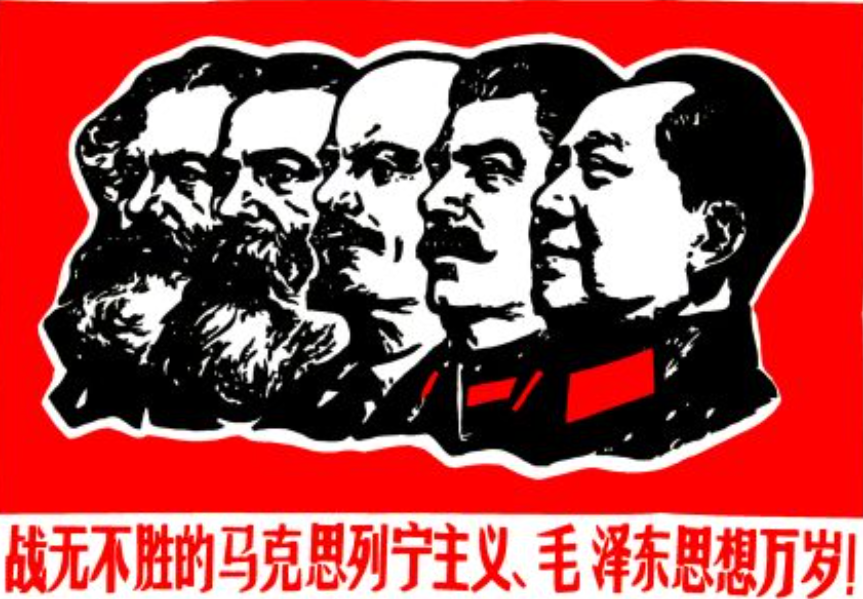
A Chinese poster showing Marx, Engles, Lenin, Stalin and Mao Zedong. Source: The Diplomat.
The communists eventually prevailed in Viet Nam as we all know. The cold war motivated each side into an ever-increasing arms buildup and a few ill-advised military actions on foreign soil. It also gave birth to many successive generations of increasingly deadly weapons systems and advances in aerospace technology to bring the battle to the enemy.
It could be said that both the West and the USSR were guilty of pumping up irrational fear of the other side. Both sides took advantage of the strategic tensions by advancing their own technological prowess in weaponry, aerospace and nuclear weapons design. Both sides had (and have) a government-military-industrial complex that consumes vast amounts of funds.
If necessity is the mother of invention, then war is a mother.
Both sides had political movements that they benefitted and suffered from in their respective arms buildups and political polarization. But that is not to say that they were equivalent in their morality status.
People have struggled to immigrate to the US and Europe for a long time. In the USSR, people struggled to get out. People made their choice and the USSR wasn’t the place to go.
In America, many began to imagine that the Soviets were ten feet tall and made of steel based on their rapid development of both fission and fusion weapons, the massive size of the Warsaw Pact forces as well as their notable firsts in space exploration. But in the end, it wasn’t sustainable. The USSR trotted out for all to see the one thing they were good at and that was its military forces. In the end, the USSR governmental apparatus was rotten to the core and collapsed in on itself. The USSR cracked open spilling out solitary states, including Russia which struggled in a whirlpool of giddiness followed quickly by discontent over 10 years. A few Russians became fabulously wealthy oligarchs. But a market economy was not to be and general dismay with Yeltsin and government support gave a player like Putin the chance to bubble up from the KGB and eventually succeed Yeltsin.
It could be that I’m just ignorant. But I am unaware of a burgeoning Marxist/communist/socialist movement in the US that the GOP refers to. Where are these Marxists and their ideological children the socialists and the communists? Like everywhere else, the US is comprised of a statistical distribution of individuals in its population representing a roughly bell-shaped spectrum of beliefs. I’ve no doubt that there are a few actual Marxists and communists scampering about in America, but seriously, is it a movement?
Trump and others have seized upon the epithets “Marxism, communism and socialism” in their rhetoric along with “immigrants who murder, rob, rape and terrorize” the good citizens of the US. This dark variety of persuasion has been used with success probably as far back as humans have had language. Fear of uncertainty and of “others” is a fundamental human weakness and will live on.
Marxism-Leninism collapsed with the USSR on 26 December, 1991. Communist China remains a unitary communist state, but they have morphed into a controlled capitalistic economy. Viet Nam is a one-party socialist republic that is a popular with tourists. North Korea remains a backwards and closed totalitarian state. Cuba, according to Wikipedia, is a Unitary Marxist–Leninist one-party, semi-presidential socialist republic.
What kind of fool would propose to convert to a state based on Marxism today? Where is the successful example from history that you could point to? Or communism or just socialism. All of these “-isms” have any number of variants.
The US has long operated state-run organizations like fire departments, police departments, street maintenance, postal service, social security, the military, the US mint, water and sewer utilities, and more very successfully. It seems to work pretty well, overall.
Despite what you may hear, a great many things in the USA do work very well or well enough. Don’t let perfect be the enemy of the good. I don’t see anything so bad that it is worth dumping democracy for the totalitarian pipe dream of the Neo-Republicans or some despicable clown like Trump.
In a preliminary report by the Rhodium Group, the US GDP expanded by a projected 2.4 % as 2023 greenhouse gas emissions were down by 1.9 % across the economy, from 2022 levels. The report says that in 2023 the winter was relatively mild and emissions from coal fired power plants were down. That said, industrial emissions were up by 1 % and in the transportation sector, fuel consumption was below pre-pandemic levels while transportation emissions were up by 1.6 %. The uptick in transportation emissions is attributed mostly to a rebound of jet fuel consumption after the pandemic.
Driving the overall decrease in 2023 emissions was an 8 % decrease in the power sector and a 4 % drop in greenhouse gas emissions from commercial and residential buildings.
Ominously, natural gas power generation grew twice as fast in 2023 as did renewable generation. Oil and gas production is expected to rise in 2024.
Wind turbine installations are on track for one half to one third of the previous year, but utility-scale battery installations are projected to have a good year in 2023.
The bulk of industrial emissions was attributed to leaking, venting and flaring of methane and CO2 during production and transportation of oil and gas in 2023. Just an FYI: natural gas leaks can be fixed but in oil and gas production there are places in the process where pressure arising from volatiles like methane must be relieved for safety purposes.
This can be done with venting the pressure into the air or by flaring the gases. A big problem with venting flammable natural gas or other volatiles from equipment is the possibility of a fire or explosion. Flaring is a common way of avoiding this hazard. Flaring catches everyone’s attention as an obvious source of pollution and it is. What it should tell you is that problematic volatiles are being discharged and burned. At least it converts natural gas into CO2 which is the lesser of two evils as far as greenhouse potential.
Running vented natural gas into a gas pipeline poses many practical problems. For the many remote locations, where does the gas go? Refineries tend to cluster around seaports. Unusable natural gas is called “stranded gas.” Building an extensive network of gas pipelines from gas fields is not economically feasible in most cases. Liquifying natural gas to a smaller volume of liquid for over-the-road trucking is a great idea but there is an immediate and expensive problem. Liquifying natural gas to LNG requires refrigeration. Retrofitting existing upstream gas field equipment is a nonstarter due to cost.
Reducing fossil fuel consumption will do the trick. Less demand, less production, and less fugitive emissions of greenhouse gases. Sadly, our stone age emotions haven’t caught up with our modern technology. Liquid fossil fuels are energy dense and can easily be piped to where they are needed. This provides immediate gratification of our desires. Need cigarettes and beer? Hop in the F250 and drive 5 miles to the 7/11.
Recently Trump has compared his troubles to that of Alexei Navalny, the recently deceased political opponent of Putin. Fox News aired a Trump interview with Laura Ingram where she asked how he is going to pay his enormous legal costs. He described his troubles as “a form of Navalny” and quickly pivoted to his large-scale legal woes. He stated that “We are turning into a communist country in many ways.”
First, 4 grand juries of fellow citizens in 4 jurisdictions indicted him on 91 felony counts. He has been given due process. For, Navalny, not so much. He was poisoned with nerve agent in 2020 (a particularly Russian trick) but managed to survive. Following treatment abroad, he returned to Russia where he was quickly apprehended, convicted and sentenced to 19 years in a maximum security prison for recidivists and those with life sentences for violence.
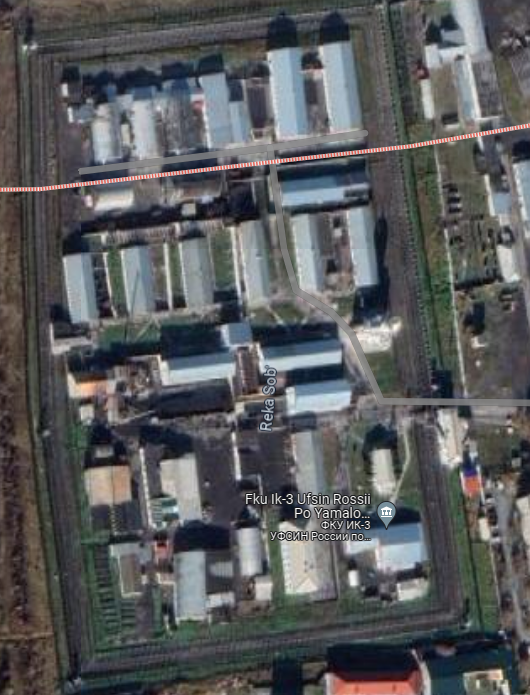
Source: Google Maps. The Fku-Ik3 facility in Kharp, Russia, Yamalo-Nenets Autonomous Okrug.
He was sent to penal colony number 3, a distant arctic prison in the Yamalo-Nenets Autonomous Okrug. According to Hugh Williamson of Human Rights Watch, “The Russian authorities have abandoned any pretense of justice in dealing with dissenters, and with Navalny they have thrown a litany of charges against him, each more brazenly absurd than the next.
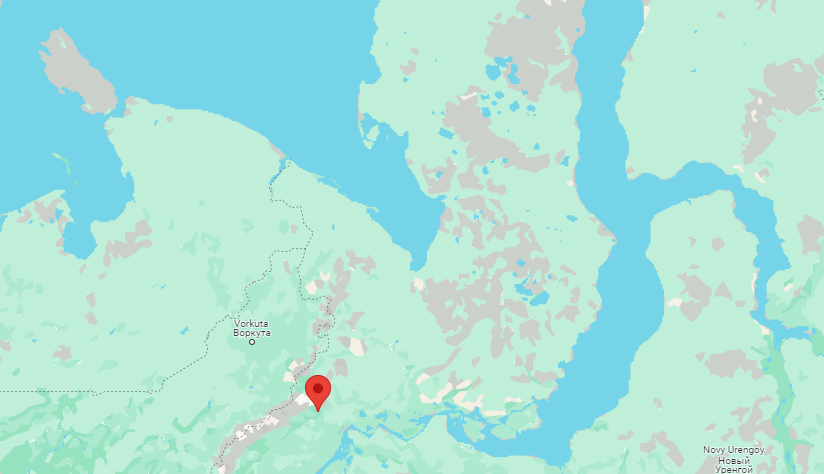
Source: Google maps. Navalny’s Polar Wolf penal colony was in the town of Kharp in north central Russia, as indicated on the map. The town was built by Gulag prisoners in the Stalin era.
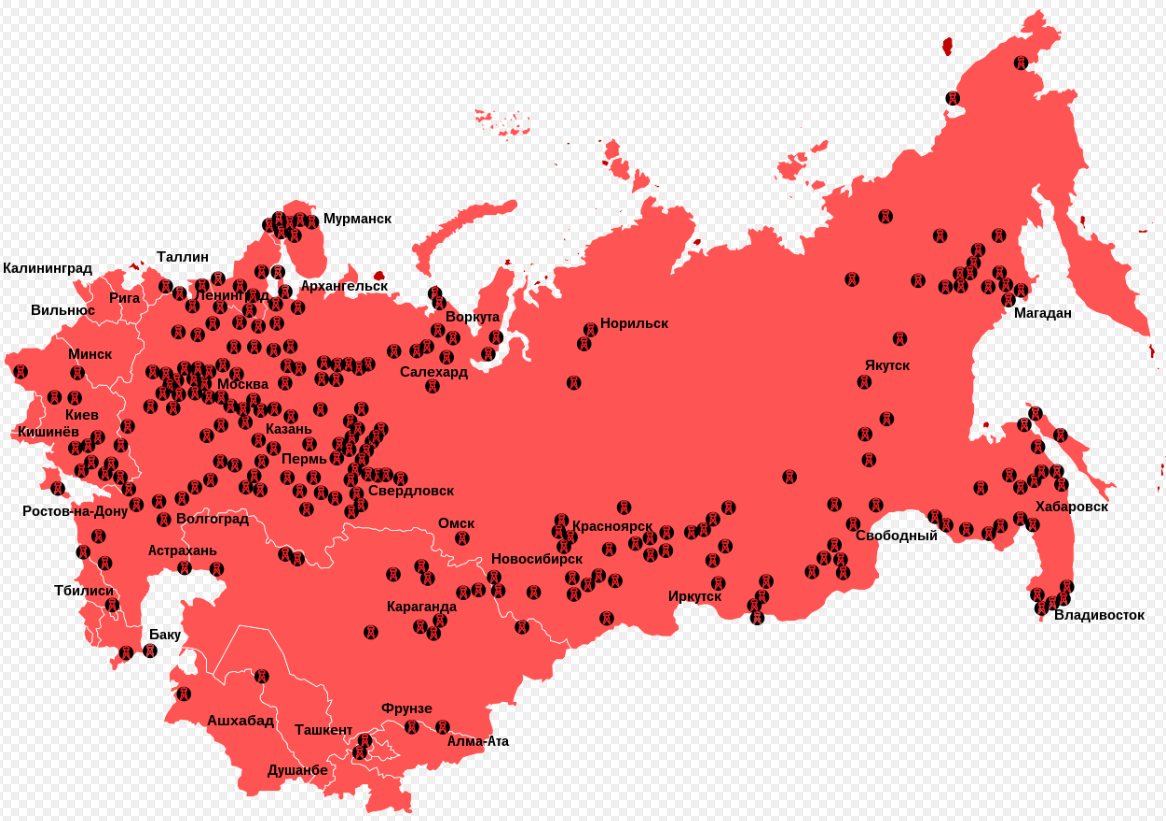
The Soviet Union had a large number of Gulags prior to its collapse. The map below shows the locations of the camps. During Operation Barbarossa in WWII, Hitlers army and Himmler’s SS were under orders to kill all Jews encountered and they did. Many non-Jewish Poles, Ukrainians and Belarusians were murdered during Hitler’s advance to Moscow and subsequent retreat. Poland in particular suffered greatly during this time. Some fraction of Jews were sent to various concentration camps but a great many were collected into groups and shot en masse just outside of their villages. As the Red Army moved into Poland killing and pushing the Germans west, Stalin gave orders to take over control of the country and establish a communist government. The participants of the weak non-communist provisional government of Poland were captured and killed by the Soviets and the Polish government was taken over under communist control. Many, many Poles were captured and sent into forced labor in the Gulag system. Poland was savaged by both the Soviets and Germans.
Source: Wikipedia, Gulag. According to Wikipedia, the Soviets had 423 labor camps as of March, 1940. It is said that 18 million people passed through the camps and 1.6 million died due to detention.
As an American, I have been exposed to the history of both the western European and Pacific theaters of WWII. However, the history of Central and Eastern Europe, especially from WWI through WWII has largely been absent in my experience. I just finished reading the 2010 Bloodlandsby Timothy Snyder. Snyder is a Yale historian and writes in detail on the period in the Central and Eastern European regions between the times of the Bolshevik revolution and the end of WWII.
The period of 1932 to 1933 (the Holodomor) in Ukraine is particularly interesting and sheds light on the fear and revulsion Ukrainians must feel at the prospect of once again coming under Russian rule. During this time the Soviets, on orders from the Kremlin in Moscow, blocked any exit from Ukrainian territory and starved the Ukrainians in an effort to speed collectivization. Their agricultural products were stolen leaving Ukrainians to starve. Many tens of thousands were killed or sent to the gulags. Being sent to the gulags entailed being packed into rail cars and shipped off without food or warmth. Sometimes when they arrived, they found that they would be forced to build the prison camp they would be imprisoned in.
Some critics complained that the book presents nothing new. It is after all heavily referenced to extensive existing literature. Nonetheless, it is a very compelling read for we non-scholars. For Americans in general, this bit of history is probably unheard of.
For Trump to compare his “treatment” by the American Justice system to that of Navalny betrays great ignorance of the history and contemporary politics of Russia. His lack of compassion for Ukraine is only a small slice of his overall absence of compassion.
Trump bitches that his troubles are of political origin. I agree, they are. Our democratic republic is in part a political system of government. Citizen voting and the legislative process are inherently political, but adherence to the law require is absolute. This political structure has a built-in justice system based on due process and the presumption of innocence with many checks and balances- perhaps to the point of generousness. Trump and his legal team routinely take advantage of our due process by filing for delays, dismissals, objections, nuances in civil trial procedure and lawsuits for the purpose of delaying judgement. He learned from his first attorney, Roy Cohn, former chief counsel to Senator Joseph McCarthy. Trump and his squad of attorneys are very good at it. Trump is a very ignorant and narcissistic man-child who attracts national news coverage because of his outrageous behavior. It’s cheaper than advertising, just like in the 2016 campaign. For him to compare his predicament to that of Alexei Navalny is preposterous. In Trump’s portfolio of legal trouble, where there is smoke, there is fire.
Handing over the presidency of the USA again to Trump would be a tragic mistake that might not be recoverable.
Prologue: I want to give my bona fides on appreciation of the “US space program.” For as long as I can remember I have been a space enthusiast. I followed projects Mercury, Gemini, Apollo, Skylab, X-15, Space Shuttle, ISS, Voyager’s 1 & 2, Cassini and others in real time. Even though space publicists mention scientific research, they never go into more than the very least they can get away with for fear of MEGO- My Eyes Glaze Over. To its credit NASA posts annual lists of research papers with links disclosing research results from R&D conducted in the orbital environment. Here is such a list. Much of the research might seem arcane but it is important to realize that the practical value is likely to come later as others incorporate it into their subsequent research and product development. This is how R&D works.
A few words about Elon Musk’s plans on moving mankind to Mars. As everyone knows, Musk is actively engaged in developing space craft large enough, numerous enough and powerful enough to take a great many people to Mars. His stated dream for humanity is to transport a large number of people to the red planet to establish a permanent settlement- a sort of Earth 2.0 for humans. There is even fanciful talk of terraforming Mars for more convenient and safer occupation. This is a colossal job, even for a small world like Mars.
All energy produced and consumed on Mars will be electrical via nuclear energy, solar, or maybe wind (??) generation. Combustion as we know it is out due to the absence of combustible materials and abundant oxygen. Solar power generation will be limited by reduced solar energy shining on Mars and by the practical problem of dust accumulation. Thermoelectric generation from a Radioisotope Thermoelectric Generator (RTG) has been the solution used on many Mars landers and deep space probes.
The best radioisotopes for RTG are alpha emitters. Alpha particles are +2 charged helium nuclei which cause a large amount of ionization over a short distance as it crams its way through matter, stopping in a short distance. Because they lose energy over short distances even in air, alphas require very little shielding, unlike beta and especially gamma radiation.
Betas themselves are easily shielded, but as they decelerate in matter, they can generate radiation called braking radiation, or bremsstrahlung x-rays, which are more penetrating. This is how x-rays are generated in an x-ray tube. Electrons impacting a target like copper generates x-rays. The effect is more pronounced in higher atomic number (high Z) elements like copper, but in low Z materials like plexiglass x-ray generation is much reduced. Consequently, beta emitters are commonly shielded with plexiglass.
The main downside to RTG is the low efficiency in converting thermal energy to electrical energy via the Seebeck effect– about 3-5 % currently according to most sources. So, for every 100 watts of thermal energy production, only 3-5 watts of electrical energy are available. This puts pressure on the supply of scarce radioisotopes.
On the good side of RTGs, they are stable, reliable and long lasting. Waste heat can be used to provide warmth for proper operating temperature in the craft or facility. The Mars lander Curiosity uses 4.8 kg of 238PuO2 to produce 100 watts of electrical power.
The deal with the devil you have to make with RTG power generation is that the best heat generating isotopes in terms of power density (watts/g) also have the shortest half-lives. For instance, 210-Po has a high power density of 140 watts/g but a half-life of only 0.38 years. It undergoes a 5.6 MeV alpha decay directly to stable 206-Pb, emitting a gamma only once in 100,000 alpha decays. Gamma emission poses shielding weight penalties and radiation hazards both in manufacture and operation in space. Even with no humans around, there is still the matter of electronic components that are sensitive to radiation. The more commonly used alpha emitter 238-Pu has a lower power density of 0.54 watts/g but a reasonably lengthy half-life of 87.7 years and minimal shielding requirements.
The background radiation environment in space by itself demands that shielding and radiation hardened electronics be used. Any added radiation from an on-board RTG only compounds the problem. The amount of shielding any given material provides is measured in half-thickness, not “full thickness” and is dependent on the type and energy of the particle. This value is the thickness of a specific material required to reduce the intensity to half of the incident radiation, not the total radiation emerging from the shielding material. This is because scattering can occur within the shielding material contributing to or minimizing the total flux. The point of this is that shielding only attenuates radiation to acceptable levels and not to zero.
238-Pu is a synthetic isotope that must be isolated from other Pu isotopes as well as a dog’s lunch of other elements in spent nuclear fuel or be selectively synthesized by nuclear chemistry. Isotopic separation of 238-Pu from other plutonium isotopes is difficult, slow and not the preferred method of producing it at scale. Nuclear chemistry that provides exclusively 238-Pu from a single transformation as with like 237-Np, offers a more productive route. This allows good old regular, valence-electron chemistry to effect the separation needed.
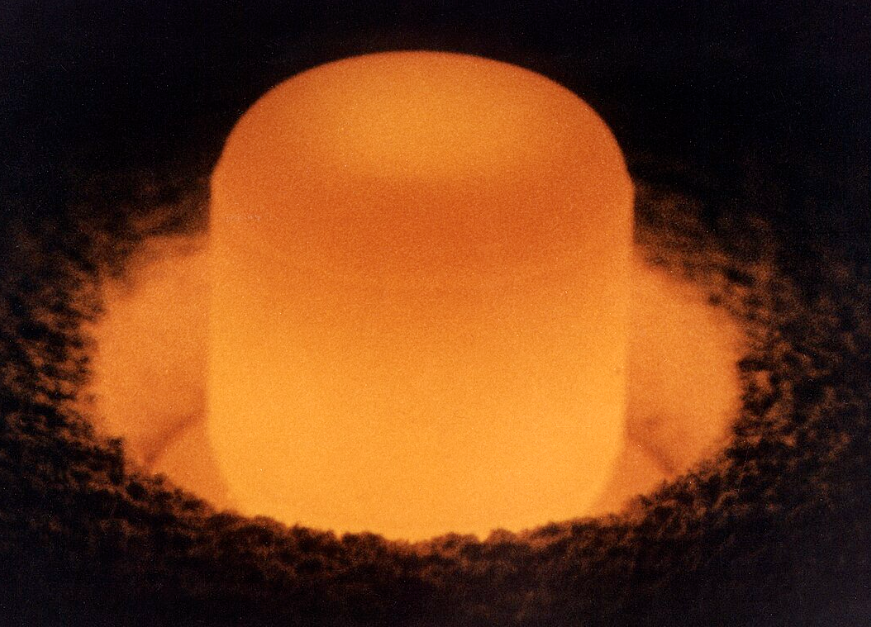
Source: Wikipedia. A pellet of 238PuO2 glowing from decay heat.
238-Pu is produced by neutron irradiation of 237-Np producing transient 238-Np with its 2-day half-life and subsequent beta decay to the 238-Pu. Chemical separation of the plutonium from residual neptunium is straightforward but, like all chemistry with radioisotopes, burdened by the need for radiation shielding for safety.
238-Pu is presently in short supply in the US. The Savannah River Site was producing “bulk” 238-Pu but was shut down in 1988. After closing of Savannah, the US purchased 238-Pu from Russia but the word is that Russia is short on it as well. In recent years other sites have been scaling up production where “scaling up” means producing in the several hundred grams to a few kilograms in a campaign.
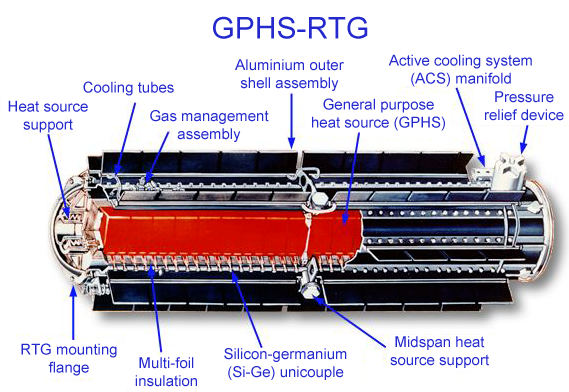
Source: Wikipedia. Just an example of an existing RTG generator.
In the RTG, plutonium is not used in the metallic state but as the oxide which is a ceramic or refractory** material like most heavy metal oxides. The plutonium is oxidized to 238PuO2, pelletized and clad in corrosion resistant iridium. According to NASA, this refractory form of plutonium is resistant to an accidental release in a variety of accident scenarios including Earth reentry and rocket propellant fires.
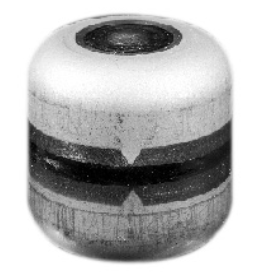
Source: NASA. 238-Pu clad in iridium for use in RTGs.
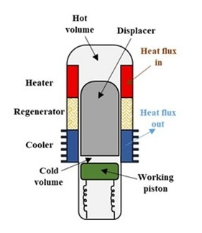
The Seebeck effect is not the only means of producing electrical energy from radioactive decay heat. The free piston Stirling Radioisotope Generator can use decay heat to drive a piston in a Stirling engine using helium gas as the working fluid. Waste heat is dumped at the cooled end of the engine and the linear reciprocating motion of the free piston is used to generate electrical power in the adjacent alternator.
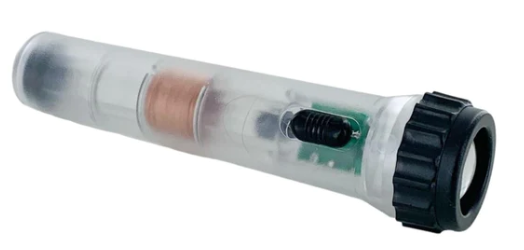
The electric alternator is similar to the electromagnetic flashlight on the market. It works on the ordinary induction principle buy moving a magnet through a coil. You shake the flashlight to recharge it, causing the internal magnet to move back and forth through a coil. Shake it for 1 minute to get 4 minutes of light. The Stirling radioisotope free piston linear alternator operating in this manner can produce 4 times the electrical power of an RGT.
Source: Free-Piston Stirling Engine Technologies and Models: A Review, Carmela Perozziello; Lavinia Grosu; Bianca Maria Vaglieco, Energies2021, 14(21), 7009; https://doi.org/10.3390/en14217009
In 2020 workers Wong and Wilson at the NASA Glenn Research Center reported that they were able to operate a Stirling radioisotope power convertor for 14 years maintenance-free.
Off we go!
Some thought will be needed on screening potential migrants to Mars for age, various physical ailments, dental health, genetic predispositions, sociability and underlying psychological issues. A manic crew member could drive fellow crew members to a murderous rage over time. Such screening has been done with astronauts for a long time. I wonder if choosing to migrate to Mars isn’t a sign of some precarious psychological condition in itself, after all the likelihood of a return to Earth may be slim. It would resemble going to jail in some ways.
Over time, the masses of new Martians living in Muskville will have to decide on what to do with themselves beyond exploratory geology, meteorology and engineering studies of Martian accommodations. Mars is a big, arid and frigid desert with no breathable air. But it may offer a few choices for recreation such as spacesuit hiking and shuffleboard. The outdoor choices will be limited by the Muskvillager’s battery, heating and oxygen supplies as well as ability to get around.
Eventually, all manner of psychological, social and physical maladies will manifest in Muskville and will have to be dealt with. People will spontaneously form cliques eventually giving us-vs-them issues requiring mediation. Unless the New Martian settlers are sterilized, pregnancy is a near certainty. An entire book could be written on complications this would bring. The alternative is to limit the inhabitants to a single gender or to gay individuals- most likely a non-starter.
Death on Mars means that your remains will need to rest somewhere outside the facility. A fresh body will freeze stiff in the Martian cold and remain that way indefinitely. Digging a grave will require energy expenditure and digging tools. Cremation will consume considerable power and may be out of reach.
Something like a hospital with medical supplies and trained staff will have to be present. The few physicians who might be present will be required to be generalists with exceptional diagnostic and surgical skills. A full medicine cabinet to cover a range of maladies will be needed to support this.
As Muskvillagers age out, the range of health problems will widen and require care. Diabetes, cancer, dementia etc. will fade in and people will age and die. This will leave job openings and duties behind which will have to be filled.
In general, the conveniences of modern living will be seriously cut short for the New Martians for a long time. A supply line with Earth that can withstand politics, business failure and war must be maintained.
If I were planning a migration to Mars, I’d worry about maintenance and spare parts for everything. Mechanical things will break. Perhaps an orange-colored Home Depot module will hitched to the back of the lander and sent along with a load of duct tape, assorted bolts and screws, sealant, O-rings, hand tools and cleaning supplies. Don’t forget a few bags of peanut M&Ms.
Wherein I jump to conclusions.
The human capacity for folly knows no bound. Woven in with folly are variable education, emotional inputs and diverse belief systems. The migrants will carry religious and political predispositions that they may or may not reveal in screening for candidates. Friends and relatives on Earth will sicken, age and eventually die but access to a return trip to earth may be severely restricted or effectively impossible.
On reflection, establishing even a modest Mars base will involve large energy inputs. Getting to the surface of Mars with enough reserve propellant for the return trip, the establishment of shelter, oxygen and water supplies are the priorities. Beyond just surviving day-to-day, there is interest in the possibility of putting Martian minerals to use as building materials or even water and oxygen production.
There are indications of frozen water on the surface of Mars in certain limited locations. Where there is water there is the possibility of using electric power to produce oxygen. The hydrogen produced may have utility somewhere but its use for combustion seems unlikely due to the corresponding amount of oxygen needed.
Anywhere you have silicates, aluminates and metal oxides, you have oxygen. Silicon and aluminum both have a strong affinity for oxygen and as such represent a thermodynamic well requiring steep energy inputs for oxygen extraction from minerals. Even worse, many silicates and aluminates are oligomers, chain polymers or network polymers that render them insoluble solids with high melting points. Silicates, aluminates and metal oxides are all comprised of a central atom- silicon, aluminum, or a metal -that are electron deficient by virtue of being connected to oxygen anions. In order to liberate oxide from oxidized silicon, aluminum or a metal, something negatively charged needs to come in and displace the oxide species. Metal oxides like the iron oxides are very often refractory requiring high temperatures to react. Then there is a long list of oxyanions like sulfate, phosphate, hydroxide, chromate, ferrates, molybdates, titanates, tungstates, manganates, etc., each with metal cations. After these there are the polyoxyanions …
The point is that there are a wide variety of oxide species to be found in rock and soil with differing properties. In the end, a negatively charged oxide anion must be oxidized to produce molecular oxygen.
A thermodynamic well resides in a substance where atoms come together to form strong chemical bonds and release a great deal of heat into the surroundings. The same amount of energy that was released is minimally what would be needed to drive the reaction in the reverse direction. This bond forming heat energy is dispersed amongst the large number of surrounding molecules. The heat evolved in forming the original bond produces a high temperature locally, but as it spreads out each succeeding layer of neighboring molecules gets a smaller and smaller share of the original energy. As the bond forming energy release is spread over more and more molecules, the resulting temperature rise of the succeeding layers get smaller and smaller.
Newton’s Law of Cooling says that rate of heat flow is directly proportional to the temperature difference between contacting objects. The greater the temperature difference, the more useful work (heat and work are both energy) that can be done. Large temperature differences transfer large quantities of energy. Low temperature differences result in less energy transferred. As the heat spreads to the surroundings it produces decreasing temperatures as the heat conducts away and the ability to do work diminishes. This constrains the recovery of waste heat.
The diffusion of energy in this manner is what entropy is about- the irreversible loss of energy to the surroundings. If you are tempted to talk about entropy, consider that it has to be consistent with its unit of measure: Entropy, S, equals energy per degree Kelvin or Joules/Kelvin (J/K).
In order to get molecular oxygen from minerals it will require a great deal of energy expenditure per kilogram of oxygen. Not only that but specialized equipment and chemicals. Any oxygen produced will have to purified and compressed into cylinders.
MOXIE
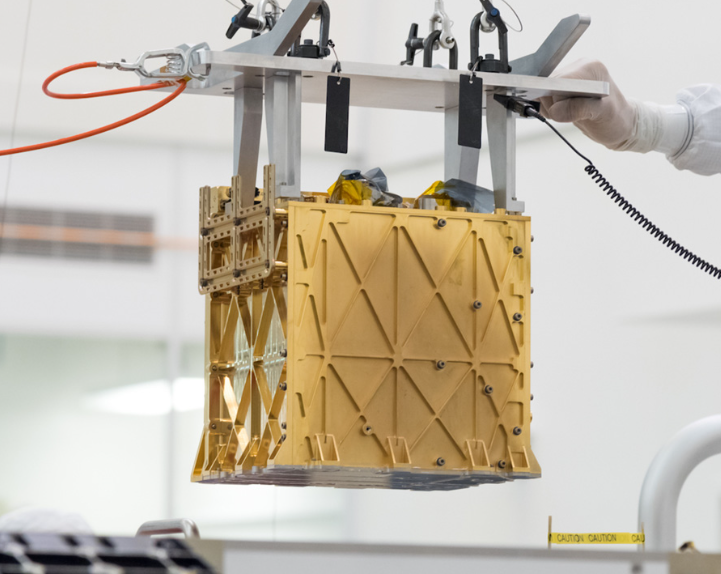
The extraction of molecular oxygen from the abundant carbon dioxide atmosphere seems desirable and has actually been put to the test on Mars. A prototype molecular oxygen generator called MOXIE went to Mars on the Perseverance rover and successfully produced oxygen from carbon dioxide beginning in 2021.
Source: NASA. The MOXIE package installed on the Perseverance rover.
The MOXIE oxygen generator is a solid oxide electrolysis device that operates at 800 oC and uses a stack of scandia stabilized zirconia ceramic electrolyte. An excellent source of information on MOXIE can be found at this Science site.
About 10 % yttria (Y2O3) or scandia (Sc2O3) will prevent the zirconia (Zr2O4) electrolyte from undergoing a phase change that causes the ceramic to fail at high temperature. From personal experience I know that scandia is chosen as a better diluent for zirconia because it allows lower temperature operation than yttria by perhaps 200 oC. The lower operating temperature with scandia allows for better sealing of the cell. High temperature seals are very problematic at these operating temperatures.
The MOXIE electrolysis cell uses a nickel coated cathode for reduction of the CO2, a ceramic zirconia/scandia electrolyte that allows oxygen anions to selectively pass through, and an anode where the anions are oxidized and combine to form O2 where it is captured. MOXIE produced O2 at a rate of 6-8 g/hr while on Mars. The process vents carbon monoxide waste as well as unreacted CO2 at the cathode where it is vented.
A limiting factor in operating MOXIE is the operating voltage across the cathode and anode. Two kinds of chemistry can occur within MOXIE. Carbon dioxide can be reduced to form oxide or carbon, depending on the flow rate of CO2 and the operating voltage. The Nernst voltage, VN, is the minimum voltage necessary to do the chemistry. At about 1.1 volts the cell will reduce CO waste biproduct to carbon on the cathode. This is called “coking”. Carbon formation on the cathode impedes the function of the cathode and reduces the output of the cell. The voltage for coking varies very little with flow rate.
The VN for the desired reduction of CO2 to oxide (O–) and CO at a low flow rate is around 1.0 volts and at high flow rates drops to about 0.95 volts or just a bit lower. So, the “normal” operating voltage range then would be between 1.0 and 1.1 volts to prevent fouling the cathode with coke. The operating voltage window seems a bit narrow. It was found that while a stable operating voltage could be supplied, the resistance of the cell was very sensitive to temperature making stable operation a bit delicate.
Pyrochemistry
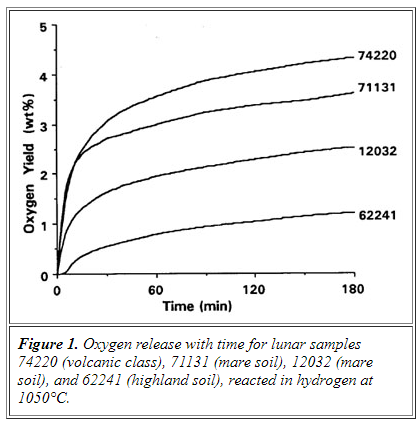
Extraction of oxygen from lunar mineral samples has been done previously (below). All of the mineral samples were iron rich and gave yields of 2 to 5 % in the form of water. The samples were from Apollo 17 and consisted of ilmenite (FeTiO3), basalt, soil and volcanic glass. The process uses hydrogen at a reaction temperature of 1050 oC producing H2O. Presumably the water vapor is mixed with hydrogen during and after the reaction. The water can be isolated by simple condensation in the presence of the hydrogen.
Reduction of Ilmenite: FeTiO3 + H2 — > Fe + TiO2 + H2O
To use the process described above, high temperature is required for the hydrogen reduction in a refractory vessel. This requires considerable electrical energy input to heat the thermal mass of the vessel and the regolith. Spent material will have to be removed and discarded. Perhaps the heat can be recovered for general facility heating. Oh yes, the recovered water will need to be electrolyzed to produce molecular oxygen and hydrogen. This process will use plenty of electric power as well as for the compressors to store the O2 in pressure bottles. In principle the hydrogen can be recovered for reuse in the hydrogenation vessel.
The above process applied to ilmenite produces metallic iron and titanium dioxide, a white pigment. FYI, ilmenite is a common raw material for high purity titanium dioxide production. It is high purity because the titanium dioxide is prepared from titanium tetrachloride which is isolated by distillation from the ore matrix after fluidized bed chlorination.
The first Martian settlers will have to bring every single thing necessary to live on the planet. That includes launching it and landing it on the surface intact. Landing on Mars is tricky because the atmosphere is too thin to provide much aerobraking. The Martian surface pressure is the same as the Earth’s at 80,000 ft altitude and the temperatures are frigid.
Let’s say we successfully land a crew and set up housekeeping. What are they going to do with their time? These missions are supposed to last about 2 years including a lengthy transit time. They can collect various kinds of data on Martian geology and weather and send it back to earth. Somebody will get publications out of it. Eventually, somebody will decide that there must be other things to do besides geology and meteorology. Naturally there will be much ongoing R&D on the pragmatics of living on a remote Martian outpost in a crowded pressure can.
Eventually, the question of what non-research living will look like. Shelter will need construction from some kind of materials. Every new section of shelter will need to be airtight and equipped with environmental controls, sanitation and power. Bulkheads between sections will need to be in place to isolate calamities.
Support staff will be needed one day to provide critical services and perform facilities maintenance. This would also include medical staff, emergency care, food & sanitary support, electronics and IT support and administrative staff for the inevitable paperwork. The lander will need rocket engineers for upkeep and repairs to assure launch reliability for the return trip. Do rockets exist that can sit for a year fueled and then reliably launch and insert into a trajectory back to Earth? There are many, many problems to be resolved in many areas.
After some period of time, a crime will happen on Mars. It could be petty theft, assault or even murder. Someone will have to be appointed to look after law and order. An astronaut-sheriff, sergeant at arms or just the po-leese. What kind of due process will be available to a suspect in a Martian colony? Guns will be too risky to have in the settlement given that a bullet could pass right through a bad guy and rip through the structure creating a leak.
On earth, doing independent research requires getting academic credentials, finding a position, grading exams for goddammed freshman chemistry, executing an R&D program, and then going home every day to refresh and have a social life. Imbedded in all of this we have courtships, marriage, mortgages, babies and divorce. We manage the ten thousand details of modern life and interact with our families and social networks. We mourn those we lose and celebrate our achievements. We enjoy good health and suffer injury and sickness and eventual death.
On Mars, the equation will be a bit different. Many of the above life elements will apply, but from a great distance. Instead, we will be confined to a small space with an unchanging group of fellow crew members. The distance to Earth from Mars is constantly changing and there will be a period absent any communication when the earth is behind the sun.
Eventually, research on living in space or on Mars will wind down to minutae if it hasn’t already and people will have to find other things to do. The funding for living off-world will have to switch from R&D to … what, a lifestyle?
I wonder if there will ever be room for commerce and jobs on Mars. I can see running a canteen or restaurant for profit but stocking them with earth supplies will be prohibitively expensive and infrequent.
What joy can there be living in a pressure can on a hostile planet? What few hermit-astronauts there may be might find it acceptable if they never need a dentist. Perhaps dentures or implants should be routinely fitted to all visitors to Mars.
The second stage of Mars exploration will have to ramp up progress on sustainability. Using Martian soil as raw materials for construction and for crops. As the Martian population rises beyond the first few rotating crews, what will the immigrants do with their time in can-living on a hostile world? Would going to Mars to lead an utterly confined life with nothing to do be an attractive draw?
Epilog
I think that settling on Mars is not such a great idea overall and specifically would be wasteful of resources that should be applied to the rehabilitation of the biosphere on our home world. It would somewhat resemble living on the Amundson-Scott Station on the south pole but without the benefits of breathable air or supplies regularly shipped in. Further, the lack of radiation shielding on the surface of Mars will offer 40-50 times the background radiation as on Earth, not counting the occasional storm of angry solar protons the sun flings out now and then.
** NASA does not use the terms “ceramic or refractory” in its description of the 238-Pu heat source. This is my choice of words.





 Lamentations on Chemistry