Astronaut burns up on re-entry to life

The sad story of astronaut Lisa Nowak continues to unfold.  This thing seems to have many layers of complexity to it. It is interesting to see how the news media have approached it. People in the news business seem to have a set of tools in their bag from which they shape stories.  Some reporters are grilling NASA about fraternizing policy while others focus on the lurid detail about the diaper.  Perhaps someone will eventually make the connection with the Mercury program and how the astronauts wore diapers on these early flights.  It is just a concession to the pragmatics of long endurance travel. Pretty clever, really.  But regardless of her clever determination, using violence to resolve this kind of conflict has no valid excuse. 

It is rather painful to watch.

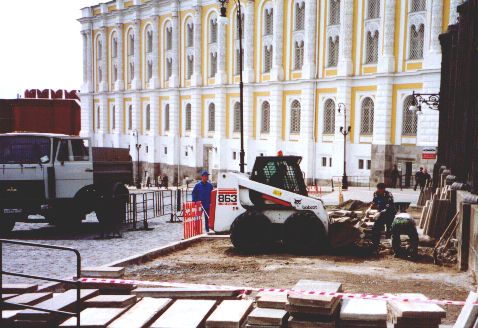
Moskva

Here is a picture of a younger Gaussling with chums Leon, Joe, and Karl.  Of course, Leon was never quite “right” again after his tragic incident with the ice-axe. 

Trotsky

[Editors note: Many thanks to Les for the image “enhancement”. ]

Cheers!

A Bunch of Blarney

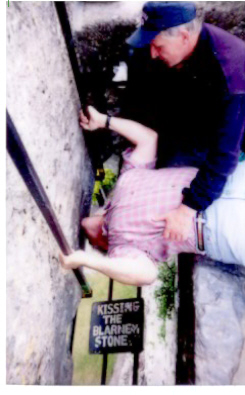
I thought I’d disclose a picture of Th’ Gaussling for the one or two miscreants who might actually be interested.  I had the opportunity to visit Blarney Castle in Ireland a few years back. The Blarney stone is said to be part of the Stone of Scone given to Cormac McCarthy by Robert the Bruce of Scotland in 1314 as a reward for support in the Battle of Bannockburn. Yada yada. It is supposed to confer the power of eloquence.

I try not to think of all of the thousands of sweaty tourists that have hung backwards high in the air to kiss that clammy, dank stone. Yeah, I kissed it. Didn’t do a damned bit of good, though.

Blarney Stone

Cheers!

On Extracting Abstractions from the Abstracts

One of the chores that must be done when developing a new technology is “Due Diligence” as applied to intellectual property.  In the fabulous world of industrial chemistry, there is an overlapping of the three great magisteria- Business, Chemical Science, and Law.  In order to get a new product or process on stream, we must find a line of sight through the many hoops and past the many gatekeepers of those magisteria that can obstruct our path the fame and fortune. 

First, allow me to pay homage to two great and wondrous database services- the United States Patent and Trademark Office (USPTO) and Chemical Abstracts Service (CAS).  They are the custodians of data generated by some of the most cantankerous and unruly people on earth- lawyers and chemists.  Their task is complex and effectively endless. 

In actually trying to do a reliable due diligence analysis, a searcher must ascertain that a proposed bit of IP does not conflict with claims in valid patents owned by others.  In a chemical IP search, one can divide the claim universe into 2 domains- composition of matter claims and process claims.  In the patent, the first sentence will state whether a composition is being claimed or that a process is being claimed. Some patents have both composition claims and process claims.

So here is the problem.  Let’s say that you are trying to determine whether or not you have the right to manufacture a particular molecule. This apparently simple question actually deconvolutes to two fundamental questions: 1) Is the composition of matter in the public domain? And, 2) are there claimed processes for it’s manufacture? 

There is a third domain and that relates to the use of the composition.  However, this does not impinge on the right to manufacture the material, just it’s use.

If the material is claimed as a 1) composition of matter in a valid patent, then you cannot lawfully make it or possess it (for commercial use, though precendence is being set for a bar on R&D use as well) without the permission of the assignee of the patent. Note that the owner of the patent is the assignee, not the inventor(s). If the composition of matter is not claimed, then it is in the public domain, assuming that you did not learn of it under trade secrecy. 

So, let’s say then that your target material is in the public domain. Now the question is 2); does your proposed method for its manufacture infringe on claimed methods? This may be a hard or expensive question to answer, and the reason is plain.  When you execute a search for IP issues related to a substance, you search path is limited to fields, key words, structures, CASRN’s, etc. that are flagged in the major databases. 

A CAS search on a given compound will lead to patent families that mention the compound, its preparation, or its use. But you have no way of knowing whether the patent reference claims the composition, its preparation, or its use.  It could very well be that there are no claims pertaining to the compound of interest- it was just cited as an example of some sort.

A CAS search is highly accurate in terms of the focus on a particular compound.  However, a USPTO search is not. A chemical search of the USPTO public database (USPTO.gov) is pretty much limited to a search for specific character strings.  It is possible to narrow down the scope of a search by concentrating on classification numbers, but I have never been convinced of its thoroughness.

After all of this set up, here is my point.  The problem we all face in doing our IP due diligence is that there is no direct means for determining from an indication in a database search report whether or not a composition is in the public domain. A CAS search will not yield a clear yes or no, and the USPTO database search only retrieves hits that have the requested strings.  Despite the advances in database technology, the user still has to collect all of the patent citations pertaining to the material and sift through them and interpret the claim language. 

Wouldn’t it be useful to the public if an applicant for a US patent were required to collate the claimed compositions for uplink into a database?  With such a “field” in a CAS or Beilstein search, you could tell in an instant if the composition was claimed. The same argument holds true for processes.  At present, the “retrievability” of claimed art is poor.

Patent attorneys are likely to object along the following arguments: not all patents that you retrieve from a search on CAS or USPTO will be valid.  Some patents will have expired naturally, others will have expired for non-payment of fees, and still others will have serious weaknesses that will only be apparent from an examination of the prosecution history as revealed in the file wrapper.  Abandonment may be difficult to detect for abstracting services, as would flaws in the prosecution as documented by the wrapper.

Another objection that is unlikely to be openly identified is the matter of clarity.  There is may be advantage conferred to assignees when a claim is a bit fuzzy.  This may afford some manuevering room during an infringement action, though it might be hard to say who the beneficiary would really be. I would estimate that whomever had the most persuasive attorneys would prevail.

It would be interesting to hear from others about this matter.

The Veneer of Civilization

It is easy to be lulled into the notion that the USA has reached a transcendent state of modernism; a place where people have come to adopt pluralism and tolerance. When you drive along the highways and fly the skyways of the USA, when you navigate the streets lined with familiar businesses and institutions there is this comforting though superficial vibe that you are in an advanced culture that is fairly progressive and forward thinking.

American culture has produced some of the most stunning changes in the history of life on earth.  Electricity, drug design, advanced materials, aerospace, computers, semiconductors, and on and on. Yet, there is this underlying ache, a subterranean twinge out there that is disturbing in it’s potential.

While I cannot accept the cosmology of supernatural beings or the physics of miracles, I have been known to attend a meeting of the Religious Society of Friends (Quakers) on a social basis. It is soothing to sit in silence and meditate in a group setting with highly civilized people like the Quakers. I remember some years ago at a Friends Meeting in Boulder, CO, listening to Kenneth Boulding (now deceased) make a comment during the meeting.  It was in another context, but the thrust of it is relevant nonetheless.  He pointed out that a few miles below the serenity of the nearby mountains there exists magma that, if given the chance, will flow to the surface and erupt. He observed that below the surface people also have raw and violent forces that sometimes escape. His point was more of a lyrical acceptance of this human frailty than one of condemnation. Examples of this condition are too numerous to count.

I was reminded of this comment of Boulding when I encountered some commentary on a recent editorial from the Wall Street Journal.  I can’t afford to subscribe to the WJS- I found it in the popular blog Pharyngula. The author of this exceptional blog has added commentary and I won’t spoil it for the reader. It is worth linking over there to read it.  Beneath the surface of consciousness of many, many people is the need to strike out at those have a different view of things.

Few points of view will evoke as vigorous a negative response as atheism does from believers in the Big 3 religions that originated in the middle east.  To these people, atheism is a kind of poke in the eye. The very presence of atheism seems to be a kind of pestilence or a corrosive influence on society itself. Believers in a supernatural being are convinced that without a diety, there can be no moral frame of reference.

It is much like the number line with its positive numbers, it’s negative numbers, and, importantly, zero.  To theists, God is the zero of the moral number line. It represents the demarcation of the positive and the negative realms.  As the theists would assert, without a frame of reference anchored from a higher plane, man is hopelessly absent a moral compass.

One thing is certain. I’m not going to solve this matter tonight.  I do know that civilization is one millimeter thick and there are plenty of places on earth where it has worn off to reveal the troubled underlayment of our species. This week, in the land of Nebuchadnezzar and the gardens of Babylon, many good people have died for no good reason.

Importing Chemicals From Asia

When you are involved with sales, you have to wake up with three words on your mind every morning- Sell, Sell, Sell. In the fabulous world of chemical business you can either make stuff or re-sell stuff. Sometimes you do both. After all, you can’t make everything.

A well run mature chemical business will have more opportunities than capacity. By contrast, an immature company may have more capacity than opportunities.  Many companies get to the point where they have to start choosing which customers they want to make the happiest because they are low on capacity. During the ups and downs of the business cycle, plant capacity goes from abundant to slim and back. It is the job of the sales person to keep the plant booked solid.

When your plant is at capacity, a funny thing happens.  It occurs to people that not all products are equally desirable. That is, some products are more profitable than others. When this is the case, management will start to wonder why they are spending scarce reactor time with products that are the least profitable.  Suddenly, products that have been steady money makers over the years begin to look a little anemic.  Pretty soon, these products are seen to be liabilities of a sort.  There is loose talk about pushing them back on the timeline; of offering 12 week lead times rather than 4-6 weeks. Then one day, they are off the production schedule. It has been decided that we can no longer afford to “neglect” other products because of these lower dollar products.

So what do you do? There is still a market out there for these orphaned products. Here is one option.  You outsource the product and resell it.  The trick is to find a supplier whose price is low enough to allow for a decent profit when you resell it.  In fact, this is a way to increase plant capacity without having to buy any real estate or pots & pans. If you can pull it off, you might even come out looking like a flippin’ genius.

The trick is to find a low cost source- preferably one whose selling price is less than or equal to your old manufacturing cost. This allows for the profits that are the same or better than before. So where do you go?  Commodity feedstock costs tend to be similar around the world. But in some countries, labor costs and overhead may be dramatically lower.  At the present time, Asia- China and India- are attractive locations for low cost manufacturing.

But, buying from Asia may be trickier than you think and for reasons that you have not considered.  Neglecting import duties which may add 0 % to 10 % (or much higher) to the cost, and neglecting tranportation costs and delays, you have to think about how the actual business transaction is going to work. 

Here is the problem:  You want to start buying from a new manufacturer or trading company in Asia.  Now, I’m not talking about the the pharma business- I’m talking about fine chemicals. There is a good chance that whomever you contact on the web is not going to be a factory person. It is likely that your contact will be a trader of some kind. This is very common in Asia. My experience has been that these traders will represent a “stable” of manufacturers who have some kind of agreement with the trading firm.  In fact, making a direct manufacturer could prove to be difficult if you are limited to internet searches.  The best way to meet manufacturers is at a trade show.

The contact is likely to want prepayment at least initially, unless your name is Pfizer or DuPont. So, you will have to send a purchase order and do a wire transfer of some funds. That’s easy enough.

The question is, do you really want to do a prepayment? What if there is a SNAFU and your payment is taken, but the product isn’t shipped? In the US, you’d have some recourse in the civil courts.  Or, what if the quality is inferior?  You might find that getting a replacement or a refund is … difficult.

I have not yet had a really terrible experience with importing. At least not involving anything underhanded. Most of the problems that I have seen involve logistics. Yes Mr or Ms chemist, if you are to be involved with outsourcing in a non-trivial way, you will have to learn about the transport of hazardous goods. International transport of chemicals, hazardous or not, is a multimodal affair involving ground transport on both sides and air or ocean in between- trucks, planes, container ships, FedEx, UPS, DHL, etc.  Some things you can ship internationally by air and others have to go by boat. Remember, there is no overnight to Asia or Europe. At least without hiring a private jet.

Outsourcing involves way more than just finding a vendor and a good price.  Before you commit funds to the purchase, you MUST ascertain that the stuff will arrive in a timely fashion.  It has been my experience that Asian chemical suppliers I am familiar with  have gotten really good in the manufacturing part, but they are often lacking in the logistics part. 

When you contact a new Asian supplier from the USA, it is critical to drill in to find out just how they intend to ship the materials and what the Incoterms are. And here is a really important part, so put down your yogurt and pay attention. You have to get familiar with Incoterms. It is critical that you understand who is responsible for arranging for what and where you take ownership of the goods.  The sellers price will vary depending on the Incoterms. 

A common term might be “Ex-Works”, meaning that the seller makes the goods available on the sellers premises, and it is the buyers responsibility and risk to arrange for transport from there.  EXW strongly favors the seller.  Other terms include CFR, “Cost and Freight”; CIF, “Cost, Insurance, and Freight”; FOB, “Free on Board”; DDU, “Delivered, Duties Unpaid”; and DDP, “Delivered, Duties Paid”.  All of these terms have specific meanings with the responsibilities and liabilities defined. These terms may be negotiable.

For an R&D sample, these transportation details are not a big deal.  But for bulk materials, you can experience failure modes you never dreamed existed. There are companies that specialize in the international movement of materials. It is always best to engage a logistics firm to help with the coordination. For example, if you were going to send a cylinder of butyllithium to Argentina, how would you do it?  See what I mean?