
Watts and Watts of Ice

Many years ago I had the chance to visit the National Maritime Museum in London. It is a fantastic museum and if you’re ever in London, try to take a day to visit.  The Royal Greenwich Observatory is nearby as well, so you can see the prime meridian and the transit telescope. I seem to recall that Christopher Wren was the architect of the Observatory. Anyway, I remember a visit to the cafeteria there and an observation that I made while buying lunch. 

As an American in Europe, your presence is obvious to everyone. Well, to everyone but a few who may suspect you’re a Canadian.  And a more awkward bunch of preening land lubbers you’ll never find than American tourists abroad. So, standing there at the food counter with fish & chips and waiting for my aliquot of Coca Cola, the matron behind the counter noted that I was an American and asked if I required ice. Yes indeed, says I. She nods and hobbles over to a small ice bucket, not unlike the kind you see in a motel room. She brings the bucket and using a pair of tongs, reaches in and fetches a single ice cube for my 300 mL portion of the blessed nectar. 

At first I was struck with their miserly approach to dispensing ice. They didn’t invest in a commercial high output ice machine like even the most modest American mom & pop cafe had. But sitting there munching on my deep fried cod, I started to think about the vast resources Americans consume in order to have a ready supply of ice.

Just think of it. How many restaurants are there in the USA? According to Datanetwork there are 516,326 restaurants in their database for the USA. If you assume that each restaurant has 1 ice machine, and the ice machine draws, say, 12 amps at 120 VAC, and using the rms value for AC voltage (0.707 * 120 V = 84.84 Vrms) we can use Ohms law to calculate the wattage: power = EI = (84.84 Vrms * 12 Amps) = 1018 watts while in operation. Obviously, there are wide variations in parameters out there in the field. This is just a SWAG- Scientific Wild Assed Guess.

So, multiplying the number of restaurants times the wattage: 516,326 * 1018 watts = 525,619,868 watts, or ~ 526 megawatts of demand.  Assuming that the power distribution losses  in the grid are ~20 % (just a guess!), that means that the utilities have to generate 657 megawatts at the plant so that 526 megawatts get to the consumers.  But it gets better.

The thermodynamic efficiency of a power plant is approximately 33 %, so 657 megawatts/0.33 = 1991 megawatts thermal have to be consumed to to generate the 657 megawatts electrical.  Let’s assume a typical ice maching runs 25 % 0f the time, or 6 hrs per day: Energy consumption for one day is 1991 megawatts * 6 hours = 11,946 megawatt hrs thermal per day. So, lets get down to coal and oil consumption-

(11,946 MWHr * 3,412,000 BTU/MWHr) = 40.76 E9 BTU ==> (40.76E9 BTU/13,000 BTU per lb bituminous coal) = 3,135,000 lbs of bituminous coal per day, or 1568 tons per day, or 572,000 tons per year. The metric conversion is 1.1025 tons per metric ton. So, 572,000 tons/1.1025 = 518,821 metric tons per year.  For conversion to equivalent barrels of crude oil, use 4.879 barrels equivalent crude oil per metric ton of coal.  Thus, 518,821 MT coal * 4.879 bbl crude oil/MT of coal = 2.53 million barrels of oil per year to energize ice machines for our cokes and Slurpies. 

So, 2.53 million barrels of oil * 60$/barrel= $151.8 million. A drop in the bucket in a $10 trillion economy. But it is just a tiny sliver of the whole spectrum of profligate uses of energy.  What we need is to summon some sensibility and reduce our individual consumption of energy.  Think of all of the devices the typical home now has that are always on- anything with a clock, DVD  players and televisions that can be activated by remote, plug in cell phone chargers, etc.- all consume a trickle current.

So forgive me for asking the following question. If we are more than happy to commit the brightest minds in our country to find new energy souces, develop more potent weaponry, teach urban combat in our war colleges, invade savage and squalid middle eastern “countries”, resurrect the nuclear power industry, invent hybrid automobiles, etc., then why can’t we commit a small portion of that effort to reducing demand for resources whose scarcity can trigger a war?

Oh yea, reducing consumption means buying fewer goods and services. How do you reduce consumption while maintaining growth? There is the fly in the ointment.

[Note: this posting makes a lot of assumptions. It is meant to be an order of magnitude estimate of the consequences of our fetish for ice cold drinks.  I value and welcome corrections, comments, and dialog. Th’ Gaussling]
Into the Bezosphere, Gradatim Ferociter

The founder of Amazon.com, Jeff Bezos, is certainly an enterprising fellow. He has started his own space program and is making actual progress.  He bought 165,000 acres of Texas, started a company called Blue Origin, and has hired the best rocket and propulsion people he can find.  The first space race began post-WWII, when there was a frenzied dash by the US and the Soviets to nab the best German rocket scientists their armies could round up.  In the present commercial Space Race, Bezos and other billionaires can pick and choose their staff from the best and brightest space cadets that money can buy.

The link above contains some footage of the spacecraft lifting to a modest altitude and returning gently to the ground.  It lifts off vertically and uses a powered reverse decent to touch down.  The footage shows a launch where the exhaust gasses are not obviously incandescent and there is little or no “smoke”. This suggests to me that there is little in the way of carbonaceous components in the propellant. I wonder if it uses hydrogen peroxide as the propellant, like the famed jet packs use. Anyway, it’s all very hush-hush.

The slogan of the Bezonauts will be Gradatim Ferociter- step by step, fiercely.

Sign me up, boys. I’ll take a window seat.

[Revised 1/10/06]

Pomegranate Juice UV-Vis Spectrum

Odwalla Pomegranate Juice

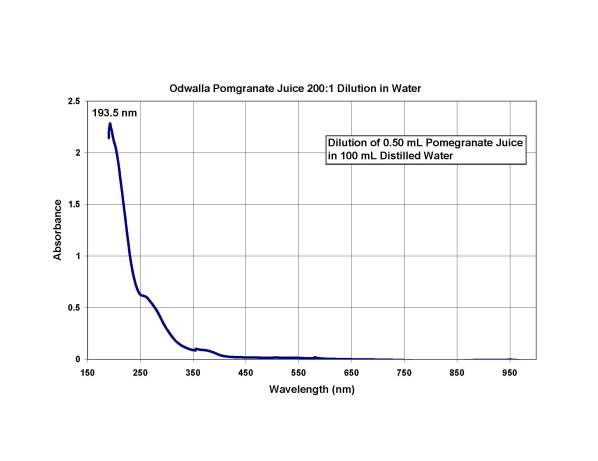
I’ve been really curious about the UV/Vis Spectrum of Pomegranate juice, so I finally broke down and ran the spectrum.  I bought commercially available Odwalla Pomegranate Juice from Safeway and diluted 0.50 mL of this juice in 100 mL (+/- 1 mL) of distilled H2O.  It is approximately 200 to 1 dilution. This commercial juice is also mixed with Chokecherry, Elderberry, Blueberry, Black Currant, and Apple juices, as well as a bit of citric acid. I’m going to try to get plain pomegranate juice for comparison.

I took a bit of the diluted soln and added some metals to it to see if there were any shifts in peak wavelength.  The two shoulders (~250 and ~350 nm) were unchanged in wavelength and extinction, but the extinction of the peak at 193 nm was increased. The metals were SnCl2, ZnCl2, FeCl3, and MnOAc2.  The Mn(II) Acetate has a fair extinction at ~195 nm but drops sharply at ca 200 nm. In all cases the shoulders remained. I would have to run a control to see if the consistent uptick in extinction at 193 nm is due to the metal ions.

When the dilute juice soln was treated with a few grains of NaIO4, the shoulders disappeared and the soln promptly took a clear yellow color. So it should be possible to follow the oxidative degradation of these solutions by UV/Vis.  Since the juice is a complex mix of chromaphores, there is no telling what species are involved and what exactly is being oxidized.  I’m sure that someone has sorted out what is in pomegranate juice. 

This is what I did with a saturday afternoon.

Buy Side Sell Side

In the business world, most people will claim to appreciate the value of competition. Everybody understands how competition causes prices to trend downwards . And everybody has a basic grasp on the argument that monopoly domination of a market is ultimately stifling to innovation.  But despite this understanding of the merits of competition, people still try to get as close to monopoly as they are allowed. 

There are two sides to any business- the sell side and the buy side. The sell side hates competition and the buy side loves it. The sell side wants to eliminate competition and grab as much market share as it can.  The buy side wants to promote competition to drive down the cost of raw materials and services.  All businesses have this sort of left brain, right brain relationship with competition.

The sales folk know all too well the blinding power of competition.  I remember many meetings where I have made heartfelt and sincere presentations to reassure a customer that our company is there for them , but regrettably the product we had been supplying for years was going to suffer a minor price increase.  My Swiss Army knife of sales tools was wide open and all of the tools had gouge marks on them. The customer seemed pursuaded.  But this was the calm before the storm. 

At first, and with a hurt look on his face and an alligator tear running down his cheek, he’ll exclaim that it has come to his attention that there are two other vendors with substantially better pricing. Then, stiffening up noticeably, he’ll go on to say that apparently they had been paying far too much for far too long.  Some procurement people will even accuse you of making them look bad in front of their management. Others will just shrug and sit there staring at you silently, waiting for you to hack up a price concession.

This is the point where the skilled sales person gives a performance worthy of Lawrence Olivier. You regain your composure and put on the most cheerful face you can.  Here is where your collection of euphamisms comes in handy.  My personal favorite- “Well, we’ll have to go back and sharpen our pencils and see what we can do.  We’ll be in touch soon”.  Did you get that? Sharpen our pencils?  The really smooth purchasing people will use it first- “We think you need to sharpen your pencils on this pricing…”.

When a purchasing person says this to you, it is actually a gift. It is a graceful way of saying that you need to stop being stupid and requote a fair price. It is a gift because they haven’t disqualified you just yet. It is a last chance.  Some purchasing people are very haughty and take high prices personally. When you ship a quote to them that was out of line, they won’t even bother to reply or try to negotiate.  Like a fly, they just hop over to the next hot dung pile.

Better answers to better questions by the PITA

It is hard for a fellow to comprehend just how much of a pain-in-the-ass (PITA) he can be to everyone unless he’s been married for a while. One of the “benefits” of being married is the constant feedback you get. Heart-felt exclamations of wonderment: How could you not know that? What were you thinking? Why didn’t you _____ ? (fill in the blank) … The list has been truncated to save bandwidth.

Something that I have noticed over the last few years is the manner in which I answer questions.  My natural inclination is to offer answers to questions that I wish had been asked.  This is the professor in me and sometimes it is okay to do. But it does confound some people. It bears some resemblance to the sport of fencing. The question comes jabbing into your scoring zone so you parry and thrust into theirs.  It seems a bit too competitive.

This competitive manner of conversation was polished to a high gloss in grad school.  I was in a large research group (20-25) with post-docs and grad students from all over the world.  To survive intellectually, you had to defend yourself and your ideas- sometimes very aggressively.  A residue of this forcefulness survives to this day. The trick is to keep it sheathed when speaking with ones spouse.  

Starting a Chemical Business

Starting a chemical business seems so reasonable.  Get some space, build or buy a hood, get the basic stuff- glassware, a rotovap, a vacuum pump, some chemicals, and start to work.  We chemists are able to do the lab stuff.  Basic transformations, separations, purifications, etc.  We exist to do these things.  But transmuting matter is the easy part.

There are many other things to do beyond mere synthesis when you have a company. You have to manage a physical facility. Deal with the state health department to get a haz waste permit so someone will come get your waste.  Bring in the fire department to inspect the place, review your emergency plans and MSDS collection so they can arrive informed of what to expect in an emergency.  You need to find an insurance carrier to provide some basic insurance coverage for the site.  

Cash flow is life itself. You need to have cash in reserve to pay for raw materials well in advance of shipping your product out the door.  It’s called working capital.  Figure on carrying the cost of raw materials for several months before you actually get paid for your product.  Once you do get the product shipped, the payment terms clock begins. Most companies offer 30 days net.  This is called commercial credit and do not expect to get it easily from your suppliers.  Of course, your customer will expect 60 days net. 

To get commercial credit, you’ll have to get a Dunn & Bradstreet number. Then you’ll have to fill out applications and hope that you can get approximately decent terms. Chemical companies have a certain amount of due diligence to do when starting a new account. They will allow a modest credit initially (eg., $1000 for 30 days net) to protect their financial position. But they also have some responsibility to the safety of the public in regard to where they send hazardous shipments to.  Their nightmare is to send hazardous materials to some 14 year old puke in Cleveland who found a tattered copy of “The Anarchists Cookbook” in his Grandpa’s attic and decided that he wants to make a nitro ester to impress his friends. To avoid this, some locations may be barred for shipment of hazardous materials.  So make sure that your site is zoned properly.

Collecting payment from a customer can go smoothly or very poorly. Customers who do not manange their working capital very well may strapped for cash until they get paid for their product. Accountants in the receivables department refer to their “aging schedule” to keep track of how late various accounts are.  Getting timely payment can be a problem. Some companies will offer terms like a 1 or 2 % discount for payment in 10 days.

One of the most important hires you bring on is the receivables person.  It is best to hire the most savage accounting troll you can find for this position.  Their job is to watch the accounts aging and to call and threaten bodily harm to the slackers who are behind on their payments.  A long list of past due accounts can bring you down like a lead balloon. Take no prisoners. This is life and death.

For a startup, following a synthesis procedure is straightforward.  However, if you need an NMR spectrum, you are going to have to be clever.  You can pay through the nose to have a commercial lab get you one. But if you have to follow a purification by NMR, it can get to be problematic fast. This is where your grad school experience can let you down. By that I mean, an over-reliance on NMR. For a lean & mean startup, you can’t rely on expensive spectroscopic methods to get you to an endpoint. That is, unless you’re flush with money.

Which brings up a philosophical point.  Many people start a business on the assumption that they need venture capitalists to rain money on them to do the startup. If you can possibly avoid it, do so.  If you have to get venture capital, then consider bringing on a professional business manager to deal with it. Venture capitalists are not merely smart, they are cagey.  They exact a large toll on the shares of ownership of a startup they fund.  You can find yourself as the founder being a minority shareholder.  These people serve a valuable purpose in the startup world. But remember, there is a price to be paid for using their money.

Market Pull and Technology Push

The chemical business is, after all, a business.  You have to make something that somebody wants. Brilliant ideas are a dime a dozen. Getting a new product to market is harder than you might expect, even if you have a purchase order in hand. The transition from bench to 1000 gallon reactor is often full of unanticipated problems.  The process of forcing a new product or technology on a market that didn’t exactly ask for might be called “Technology Push”.  The process of responding directly to a clear market demand is called “Market Pull”.

Market pull is a force that business types, especially the MBA’s, feel best about.  It is easy to justify the allocation of resources to launch into a product development cycle that addresses a clear and quantifiable demand.  Duh. It’s a no-brainer. That is, if there are no bottlenecks to get through. The merits of market pull are only valid if the proposed technology has been shown to work to specifications. Beware of the inventor who cannot produce a prototype to back his/her patent.

Technology push is a circumstance wherein a company has a product or technology that might stimulate demand if it were marketed properly.  Now, an economist might say that there is no such thing as stimulating demand. They’ll patiently explain that this only stimulates an underlying demand that may not have been articulated. Whatever formalism you prefer, it is possible to dazzle potential customers with a new capability.  Clever people can dream up applications that the original inventors could have never anticipated. Look at Symyx with their fantastic technology package for high throughput experimentation.

It is a bit easier to write a business plan based on market pull because the job of forecasting revenue flows should be based on measurable market conditions. Again, the assumption is that the proposed response to the market pull is a technology that works.

A business plan based on technology push has to incorporate estimates of acceptance of change. You see, technology push is the realm of the paradigm shift.  Predicting outcomes from the early side of the timeline is very tricky.  Customers for paradigm shift technologies may be scarce.  Not all companies are interested in being an early adopter or a buyer of first generation technology. 

Market pull is the domain of orthodoxy, of the rightous and proper company president who is also a CPA and who worked his way up the ladder from the accounts receivable department. Technology push is the domain of the engineers and scientists.  These are the dreamers who know in their hearts that if you build it, they will come.

Successful technology companies are somehow able to give a voice to the technology people in the allocation of resources.  Very often, these companies are managed by chemical engineers. While ChemE’s may not be trained in advanced synthesis R&D, they are involved in the scale up and economics of new processes.  Chemists live in a 2-dimensional world of space and time.  Chemical engineers live in the 3-dimensional world of space, time, and money.  Their knowledge of economics is what causes them to rise to the top of the corporate ladder more frequently than chemists.

It seems to me that companies that thrive today are those who do both market pull and technology push. Market pull is the cash cow.  Technology push is the seed corn for next years crop.

Greener Chemistry Through Catalysis

Recently a colleague and I were debating the reality of a fuzzy concept referred to as “green chemistry”. Being in the specialty chemical business, as opposed to the commodity chemical business, our discussion was naturally biased to the medium batch reactor scale.  This is no trivial distinction.  Raw material consumption and side product streams from commodity continuous-process trains can be astronomical in comparison to batch reaction operations.

There was the suggestion that the whole concept was absurd and was just the latest incarnation of a tree hugging export from CA.  I’m a little bit more circumspect about it, but one thing is obvious- economics will be the driver of any green process changeover.

I’m not an expert in the green chemistry field, but some of the concepts seem clear and highly desirable.  The goal is to minimize the total chemical insult to the environment. To achieve this, a green process has to be as atom efficient as possible in the assembly of the target product, recycle solvents to the greatest extent possible, avoid all toxic metals (Pb, Hg, Cd, Cr(VI), etc., metals are forever), eliminate fugitive emissions, and probably 6 or 8 other things I can’t think of right now.

As far as I know, certain metals are already on the path to extinction as reagents in chemcial processing- mercury and lead are the obvious ones. The battery industry still uses some unfortunate metals, mostly because of the reality of the electromotive series. There are only so many electrode combinations that are feasble for commercial batteries.

One of the obvious approaches that will get us to a greener chemistry is the continued adoption of catalyzed processes. I’m not thinking about acid protons, I’m thinking of highly selective transition metal catalysts.  Synthesis chemistry is about managing reactivity through the choice of appropriate functional groups and the sequence in which they appear. The chemist has to contend with the inverse relationship of reactivity and selectivity. Catalytic reactions form reactive intermediates from otherwise docile functional groups (olefins, boronic acids, or aryl halides, for example) and bring them together into close proximity in the coordination sphere of the metal. This is a kind of tuned reactivity management that reacts functional groups that, absent the catalyst, are relatively inert. All kinds of coupling reactions come to mind- the Suzuki coupling, etc. 

Now, to be fair, to get a substrate suitably functionalized for a green transformation might require some brutish and not-so-green chemistry- preparation of specialty aryls, acetylenes, and olefins; borylation reactions; the chemistry needed to make these whizbang ligands for Pd; and, well you get the point. The final greenness has to be measured as the sum of all the green steps from some common level, if not the oil well in Kuwait itself. 

Catalysis has the benefit of allowing the activation of relatively inert functionalities for subsequent transformations. Rather than making bulk quantities of highly reactive species, a catalyst can generate it in situ and do the deed straight away.  That is certainly in the direction of green.

On the cosmic shore

One of the really cool things about living near Boulder, Colorado, is all of the science that happens there.  Boulder is a COLLEGE TOWN.  I put this in capital letters because the effect of the campus on the area has been substantial; in fact it has in many ways defined the area. The campus and the “Boulder Lifestyle” along the Front Range has attracted many institutions and companies to the Boulder area. Boulder is sort of the Berkeley of Colorado.

Boulder was hit hard by the hippy movement in the 1960’s and has never fully recovered. Today you can still spot old hippies wearing tie-dye and grey pony tails, gimping out of their BMW’s and into their expensive condo’s.  I’ll never forget when the Danskin craze hit Boulder in the late 1970’s.  My god …. I was nearly blinded.

Boulder has a NIST (National Institue of Standards and Technology) facility, formerly the National Bureau of Standards, which broadcasts time signals from the atomic clock on radio station WWV.

Within spitting distance of NIST is NCAR– National Center for Atmospheric Research. A small bit of the Woody Allen movie “Sleeper” was filmed on the Mesa Laboratory site.  In addition to watching the earth’s atmosphere, they also monitor the sun.

NOAA also has a facility in Boulder.  I’m not sure exactly what the mission of NOAA is relative to NCAR, but I do know that they are concerned with the interaction of the oceans with the climate.

The University of Colorado at Boulder hosts JILA, the Joint Institute for Laboratory Astrophysics, as well as LASP, the Laboratory for Atmospheric and Space Physics.  The upshot is that a lot of folks go to CU Boulder to study space science. I went to a few colloquia where Carl Sagan gave talks about various space probes. It was sublime.

Well, I really didn’t mean to write a valentine to Boulder, but there is a lot of cool stuff happening there.  Anyway, I recall as a part time student at CU in the late 1970’s going into some departmental office in Duane Physics and plopping down at a table to look at print copies of the Palomar Sky Survey.

These prints were negative prints of the sky, where the stars and galaxies were black against a white background. And what an amazing thing they record!  My gawd.  Galaxies and clusters of galaxies of all descriptions. Spirals and barred spirals and irregulars. These weren’t just “things”, they were “places”!  When you take the time to examine a deep sky survey, the thing that hits you is the large number of galaxies that are out there.  In fact, it is mind boggling.

It is impossible to view these images and not give it some metaphysical processing.  The notion that this big universe was fabricated by some cranky, jealous diety to host a nudist garden of eden on planet earth so that a pair of hairless bipeds can spend their time heaping praise upon him is simply what it appears to be. It is just absurd.  

The biblical story of creation is what you might expect from a people whose known universe was geographically limited to a circle of a few hundred miles radius.  The human brain is well adapted to note contrasts and dichotomy.  Light and dark. Warm and cold. Pain and pleasure. Left and right. North and south. Up and down.  We are enchanted by extrema and boundary conditions.  It seems to me that the archetypes of good and evil are a default dichotomy that human consciousness (or neurology)  spontaneously organizes when looking at the external world. 

The conclusion that the world must have been “created” is the result of a self imposed limitation in scope. The notion of cosmic creation by an anthropomorphic diety as opposed to an evolutionary process of nature is what you might expect of a culture that does not embrace the process of rational analysis and falsifiable conclusions.  Religion relies on the sacred, which is to say claims that are transcendent and beyond worldly analysis.  Religion has already made it’s conclusions and religious scholarship seems to consist of justifications of the conclusions.

Science is built on clay feet. A new tide of data arrives and the foundations are washed away to allow for new structures of understanding. Part of the great intellectual adventure of life is to decide where you stand. On the ready-made pillar of religion or barefoot on the beach of science.

Note: This is a distillation of my thoughts on religious matters. I’m sure that not a single concept or even blank space between the words above is an original thought, given the long and tired history of the topic.