
Chemistry Blogs

There has been a significant uptick in the number and quality of chemistry related blogs during the fall of 2006.  In my case, I was motivated to start by following the blog “Tenderbutton” maintained by Dylan Stiles, a Trost grad student. This genuine and charming blog was abruptly discontinued earlier in the fall.  The blog was somewhat revealing- though never negative- with regard to the lab culture and the chemical supplies of this world-class research group.  In all likelihood, the advisor called a “come to Jesus” type of meeting where he was reminded of his pending thesis defense. I could be completely wrong, but it is the kind of thing a research advisor would do.

Some blogs are operated as a node- that is, the blogger will collect and comment on interesting links elsewhere on the web.  Other blogs are more pedagogical in nature. The blogger will write on various topics with the intent of carrying on a kind of blog lecture series.  There are more than a few blogs that follow the chemical literature, publishing analyses of chemical transformations.  I think that these in particular are great blogs, but they do seem to be a lot of work for the blogger. The blog “Totally Synthetic” is a good example of a solid meat and potatoes style of synthesis blog. You leave this satisfying blog feeling like you’ve been in the literature that day.

Some blogs seem to be platforms for broadcasting various kinds of outrage. I have even done this myself. Sometimes a person just has to vent. But you also need to know when to stop. It is easy to step across the line from amusing to pathetic.

Some bloggers are prodigous writers, shoveling out great steaming heaps of output on whatever topic catches their fancy. Obviously, this is where “Lamentations on Chemistry” is parked.  My interest is in writing essays on science and politics.  Others are more talented at reviewing the chemical literature than I.  I view the human enterprise as a kind of tragic comedy and I take no small delight in reducing slices of it to words.
Dealey Plaza

I had the bad judgement to visit the Texas Book Depository in Dallas a day after Christmas last year. What an incredible downer. Anyway, after paying the fee to go into what is now a museum, we made our way to the famous corner on the sixth floor by the window, behind stacks of boxes, and had a look down range to see the line of fire enjoyed by Oswald.  After a lifetime of watching programs on the JFK shooting and listening to endless drivel about it, there it was. It was evident to me that the distance from the window to the presidential limo, while not so short, isn’t really so long either. I would believe that a circle the size of a torso at that range could contain 90 % 0f the shots fired at the center of the circle. Randomness is a funny thing.  Oswald might have just been lucky that day. 

The Coming Nuclear Caliphate

So, here we go. You know the nauseating feeling and that metallic tang sensation you get on your tongue when you’ve narrowly averted a car crash or had some other close call? Well, a recent news article has left me with the same feeling.  

According to an article in the Jerusalem Post, a group of middle eastern countries have signalled to the IAEA that they are interested in establishing a “common program in the area for nuclear energy for peaceful purposes”. 

The subtext of the Israeli article is that this move is a kind of equilibration by Sunni populations in response to Iranian/Persian Shi’ite nuclear development.  The countries in question are Egypt, Morocco, Algeria, Saudi Arabia, Tunesia, and the United Arab Emirates. 

According to the IAEA, 29 nuclear reactors are under construction in the world today.  Seven of them are in India, which plans to increase their number 8-fold by 2022. China has four reactors under construction and reportedly plans a 5-fold expansion in the next 15 years.  The IAEA keeps a handy list of new and retired reactors around the world.

Here is a nuclear joke you can tell to entertain your friends! Question: How many nuclear engineers does it take to replace a lightbulb? Answer: Fifty! One to replace the bulb and forty nine to figure what to do with the old one! 

On the one hand, it is logically and morally precarious to deny others what you yourself have enjoyed since the end of WWII. That would be the reassuring hum of nuclear electricity and prospect of security through the overwhelming firepower afforded by fission. 

On the other hand, the existing nuclear states have built infrastructure for the safe movement of nuclear materials through the system and folding new states into it may not be so hard.  However, the existing nuclear states have a compelling interest in avoiding disruption of the nuclear fuel cycle. More demand means higher prices.  Maybe the existing nuclear states should form something like OPEC to regulate the supply of nuclear fuel? 

I’ll admit that I’m a bit nervous about the prospect of Middle Eastern states becoming handy in the nuclear arts.  Any given “Atoms for Peace” program could degrade into a shell game that could hide a nuclear weapons effort. 

A plain reading of history seems to show that if someone else is helping with some of the enrichment, straight fission bombs are not as hard to develop as one might have supposed. It’s hard if you start ab initio with a pitchblende mine, a cloud chamber,  and F=ma.  But if you can outsource reactors and fuel, it’s a lot easier. The art in bomb design appears to be wringing out the biggest bang for the smallest amount of fissile material. Fortunately for everyone, thermonuclear bombs seem to be substantially trickier to make- my conclusion based on the open literature. 

If you think about it, a pre-nuclear state will almost certainly conclude that not having a nuclear weapon is tantamount to suicide. So the pressure to build nuclear weapons is irresistable to many regimes.

A nuclear arms buildup among the theocratic states seems especially worrisome, even though secular states like the USSR and North Korea make a poor case for secular stewardship.  Like it or not, the notion of MAD- Mutual Assured Distruction- did provide balance in the cold war between NATO and the Warsaw Pact.  Maybe what we are seeing is a nascent MAD in the middle east.

The worst case would be where the much desired Islamic Caliphate would have a “nuclear option”.  We can only hope that islamic theocratic fever is quenched by the pragmatics of economic prosperity. This is where a levelheaded US government could lead the way.

He leadeth me to walk beside the radiant pastures …

Chins are wagging over the what is being called a slip-up by Israeli Prime Minister Ehud Olmert.  According to the New York Times, during an interview with a German cable news channel, Olmert reportedly said

“Iran openly, explicitly and publicly threatens to wipe Israel off the map. Can you say that this is the same level, when they are aspiring to have nuclear weapons as America, France, Israel, Russia?” [Italics by Th’ Gaussling]

Oops! How do you say “Faux pas” in Hebrew? 

It’s kind of silly that this is even an issue.  For quite some time the only real questions have been- 1) How many coats of Turtle Wax are on the bomb casings? And, 2) Did they buy the extended warranty?

It’s an open question as to whether or not speaking publicly about its nukes enhances their deterrent effect for Israel. Look at that fetid Stalinist shrimp, Kim Jung Il.  He waves his nuclear capability around like a brain damaged test monkey with a turd on a stick. And, of course, we afford him the courtesies alloted to a brain damaged test monkey. A’hem.

Going postal over patents

There was intellectual property-related death and mayhem in Chicago recently. A couple of patent attorneys and an office assistant were blown away by a disgruntled client. The 59 year old inventorhad evidently invested a considerable sum in lawyers fees trying to get a patent on his improved toilet for truck drivers.  At some point the inventor learned that he had been pooper scooped by others who had been issued a patent.

The client crossed the tipping point somewhere and went non-linear.   The enraged inventor entered the law offices and murdered 3 people. He was taken out by a SWAT shooter.

There is some interesting buzz over at the Volokh Conspiracy related to this matter.

Some posts back I made the plea for inventors to be more knowledgeable about the patenting process.  The attorney should be asking the question- “What’s next?”, not the client. That is to say, the client really needs to take a more hands-on approach to patent research and prosecution.  When it becomes a black box for the client, and the only part of it you can understand is the law firms invoice, it is a set up for misunderstanding.  Every inventor seeking a patent should spend time at the USPTO website doing a prior art search themselves. 

The attorney has ethical obligations in representing the client and they are institutionalized.  On the other hand, an inventor has some obligation to be informed about the basics of patenting and what constitutes realistic expectations.

CAS Polysyllabic[multi(digital)poly(character)]nomenclature

I write to lament the state of chemical nomenclature today.  There are several forces in the nomenclature world- Chemical Abstracts, Beilstein, and IUPAC.  Near as I can tell, with the globalization of CASRN’s, CAS nomenclature is the predominant nomenclature in the world.  At least the world open to English language.  I have no idea of how the nomenclature works in texts written in Mongolian, Tagalog, or Ubangie. Are there translations or transliterations- I don’t know or care much, truthfully.

I can say that the introduction of new chemical entities into commerce presents the issue of what to call a thing.  A name that has 80 characters, including greek letters like mu or kappa, strings of digits delimited by layers of commas, brackets, dashes, and parentheses, poses certain practical problems with business data systems and catalogs.  It also poses problems for the many non-chemical people who have to deal with it on a daily basis.  It becomes hard for people to understand what the hell they are referring to. In fact, it actually intimidates non-chemists to the point of locking up. They become convinced that the slightest error will lead them down the merry path of ruin.

One of my duties is to define nomenclature for products at my day job. We dutifully collect the 9CI names for the TSCA nightmare, and then we decide what we’re going to call it on a commercial basis.  I’m finding myself using the IUPAC nomenclature module of ChemDraw more and more.  The nomenclature coming out of it seems more human friendly.

I once contacted CAS in Colombus and spoke to a helpful and sincere person who explained that CAS doesn’t offer a handbook that would explain how CAS does its nomenclature.  I haven’t researched this too deeply, but I have not yet found a CAS publication that defines the taxonomy that CAS uses.  Of course, CAS will happily charge you for an official name assignment. I guess for a $26 charge I could look it up in SciFinder.

Whining about nomenclature is like complaining about the weather. CAS has to do something with all of the species cited in the literature.  I just regret the high cost associated with using CAS services. 

All of this feeds into my nagging feeling that ACS and it’s lovechild, Chemical Abstracts Service, has gotten a bit unwieldy and maybe even too big for its britches.  With the publishing and the registry database business, it has grown to be the major force in the sales and distribution of chemical knowledge. It is an economic engine.  Maybe even monopolistic.  Oops, there is that word.

Back in the USSR

Alexander Litvinenko’s death, now deemed a murder by Scotland Yard, brings the topic of “what’s up with Russia?” right up onto the table. It’s like finding an earwig in your half eaten salad.  I gather from the tone of news articles that many are startled not just by the criminal use of a radionuclide, but by the layers of intrigue that are beginning to peel away.

Concurrent with Litvinenko’s demise, former Russian Prime Minister Yegor Gaidar suffered an event in Dublin that may have been a poisoning. His recounting of the episode in a Financial Times article is interesting. 

In some ways the transfiguration of the USSR into contemporary Russia was less of a transition from some larval stage into a butterfly than it was the color change of a chameleon. To be sure, there were substantial changes in the geopolitical tectonics. But their rigid sphere of influence is definitely smaller than in the Soviet days. 

I visited Russia not so long ago.  I had studied Russian language as an undergraduate, so I wasn’t completely helpless. Nevertheless, I had to rely on Russian speakers to help with the details of travel. Russians are like everyone else- cynical towards their own politicians, but deeply patriotic.  Truly, to know Russia is to love Russia. I love the people and the rich culture. But, in my view, to know Russia is to fear it a bit as well.

As a post-doc I sat with Soviet colleagues and watched CNN coverage of the collapse of the USSR.   We watched coverage of the rise of Yeltsin in Moscow and the failure of Scud Missiles in Gulf War I.  My friends came to the US as Soviets and returned as Russians.  It was an odd time.

So, this matter with Litvinenko is surprising but not surprising.  That this place could produce a Putin and a Gorbachev within a few years of each other is not unexpected.  What does surprise me is the low priority that the west apparently places on constructive engagement with Russia.  The west has wasted a golden opportunity following the collapse of the USSR.  

The Smell of Xylene in the Morning

I’m on of those freaks who worked for a few years before entering college. I made poor choices in utero with regard to the family I was born into and consequently have had to do everything the hard way. A few weeks before I started my freshman year in college I completed my pilots license (single engine, land).  The goal was to get a flying slot in USAF and then move into a flying career with the airlines.  My nearsightedness killed that dream deader than a rat.  Who wants to be in USAF if you can’t fly jets?  Crimony. So I went into chemistry by accident. Some would say that it has been a major accident.

Flying is an amazingly fun thing to do. In fact it is odd that more people don’t try it.  It is an adrenaline rush to taxi an aircraft onto a runway, point the nose down the centerline, and push the throttle to the firewall and fly off the ground. To have such raw, barely-contained power mashing you against the seat is a real thrill.  Once you lift off the realization dawns on you that the only way you’re going to survive this is by the skillful application of your wits.  Getting the aircraft configured for landing and rolling onto final approach and coasting down the glide slope to a touchdown on the numbers is true poetry.  It is an intellectual and emotional stimulation with which few things compare.

The fuel that piston driven aircraft use has a higher octane rating than that used by automobile engines.  The longer the stroke of the piston, the more power the engine can deliver to the propeller. But the longer the stroke, the greater the compression and the greater the need for higher octane. Consequently aromatic additives are put in Avgas to decrease the tendency for predetonation. One of those additives is is xylene.

One of the rituals of flying is the preflight walkaround of the aircraft.  You inspect the flight control surfaces, the leading edges of the prop for cracks or chips, the wing for tell-tale wrinkles, bugs in the pitot tube, and you drain a bit of the fuel from a low point in the fuel line.  You drain a fuel sample because you are looking for water droplets. Water in the fuel could lead to a loss of power during the flight, which is regarded as bad. 

During the fuel inspection, you get a whiff of the aromatic tang of avgas. It is the smell of adventure. The faint smell of avgas is in the cockpit as you strap the airplane to your backside and begin the engine start checklist. It is there during the taxi roll to the run-up pad where you try to convince yourself that the engine is operating nominally. Only after this when the task of takeoff is imminent do you ignore this smell and concentrate on the act of takeoff.

The other day I ran a reaction in the lab using xylenes. Without even realizing it I got a whiff of xylenes and my mind drifted off into the realm of flight.  For a moment I could smell the scent and hear the sound of an airplane clawing full throttle for altitude. I could rememeber trimming the airplane for cruise and dialing in the VORTAC frequencies for navigation.  I remember the dreamy sensation while cruising at 10,500 feet, listening to the Morse code of the VORTAC on the radio intruding into my consciousness over the comforting drone of the engine.  I recalled the words of my instructor- “Attitude, altitude, crosscheck…” and “keep your head on a swivel”. 

Then I realized that the solution in my sep funnel had emulsified so I set it down for a while and became lost in the memory of flight.

Fabulous PGMs

I don’t know what other people out there think but I have this nagging grievance with Platinum Group Metals- PGMs. They’re too expensive.  I receive a weekly newsletter from BASF Catalysts listing prices of the various precious metals.  Some of them have taken an astounding uptick in price in the last year.

As of last friday, ruthenium was at $375 per troy oz.  Rhodium continues to be in the stratosphere at $4925.  Platinum is down a bit at $1159. Pt prices are greatly affected by demand in Asia for Pt jewelry, according to the newsletter. Osmium and iridium have been at $400 per troy oz for quite a long time. Gold was at $650.50 and even silver was a lustrous $14.07 per troy oz. Palladium is at $328.

Don’t get me wrong. PGM catalysts are fantastic in almost every way.  I’m not so cold hearted that tears don’t well up at the sight of an X-ray of some resplendent Rhodium complex proudly thrusting its phosphines about. My god it is beautiful.  How could I be against PGMs?  My post-doc was doing rhodium chemistry.

It’s just that they’ve gotten so darned EXPENSIVE. Price out some rhodium (II) acetate sometime, but try to be sitting down.  The price volatility is not the fault of companies like BASF or Matthey. There is just a deficiency in supply. These metals are traded in the world market place.  BASF and Matthey are venerable and upstanding companies.  I have no beef with them.

But, here is what we need.  We industrial folk need to try harder to implement transformations catalyzed by the other metals- Ti, Zr, Fe, Co, Ni, Cu, or zeolites, etc.  Part of the problem is familiarity. All of the important textbooks on organometallic chemistry, advanced synthesis, etc., cover the mechanisms of catalytic transformations, but they highlight the PGM mechanisms. That’s not a bad thing, but we all get out of grad school with “palladium on the brain”. 

Yes, of course, there are some things that will probably always be done with PGMs. But what about the beautiful coupling chemistry using Grignards by Furstner, Kambe, or Knochel? 

Take a walk on the wild side. Try something different.

Polonium Facts

One of the interesting parts of having a blog is that you get to see the search terms that people use to find your site.  We’ve been getting lots of hits lately from persons trying to squeeze polonium information out of the web.  I went through some venerable reference books on my shelf and collated some general fun factoids on that fashionable metal – polonium.

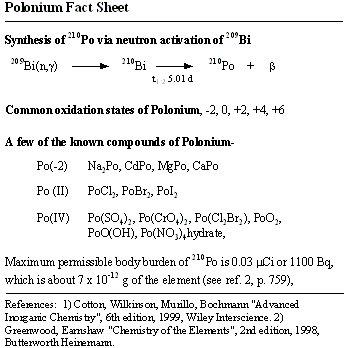
Polonium Table

Polonium is actually a natural element found in thorium and uranium deposits.  In the Radiation Health Handbook I count 33 isotope entries for polonium, 7 of which are metastable, or isomeric, states. The known isotopes are Po-193 through Po-218. Po-209 has the longest half-life at 103 years.   Bismuth 209 is the heaviest stable nuclide. Nuclei heavier than bismuth often emit alpha particles, and do so exothermically or spontaneously.  Polonium, one atomic number above Bi, has no stable isotope. 

Loss of an alpha particle results in a drop of atomic weight of 4 and atomic number of 2.  You can think of an alpha particle, or helium nucleus, as a good leaving group.

Polonium is very scarce.  Its discovery, well known for being famous, was by Marie Curie and was accomplished by isolation from tons of ore. It was named after her home country of Poland. Today the the production of Po is effectively limited to Po-210  and is bred in nuclear reactiors via the transmutation of Bi-209 by neutron absorption to afford Bi-210.  Neutron rich nuclides can drop their neutron count through the emission of beta particles (electrons) with a subsequent uptick of atomic number by one. So the Bi-210 nucleus transforms to Po-210 by beta emission.  The polonium is isolated by fractional distillation from the remaining bismuth.

One gram of pure Po-210 is said to evolve 141 watts of heat. Consequently, one use of Po-210 has been for thermal electric power generation. It’s near exclusive emission of alpha’s minimizes shielding problems.  Another important use of alpha emitters is for the generation of neutrons. This interesting process uses alpha particles to interact with beryllium nuclei to afford the extrusion of neutrons.  In this way it is possible to have a compact neutron source.  Place the source in a tank of water or paraffin, arrange for an opening, and presto! You have a cheap neutron beam source- sometimes called a neutron Howitzer.  Plutonium-beryllium (PuBe) is more common than polonium because of the long half-life of available non-fissile plutonium sources. The neutron Howitzer is commonly used in neutron activation studies.

The chemistry of polonium is exotic by virtue of it rarity and the pragmatics relating to its high specific activity.  It’s high specific activity causes it to radiolyze the solvent that the reaction or other manipulation is occuring in.  This is especially problematic for organic solvents. The high activity will pose serious safety risks for the chemist in handling. Advances in organopolonium chemistry have been complicated by the pyrolysis of the organic fragments via radiolysis.  This also complicates the preparation of crystals for x-ray crystallography. A properly equipped facility night have a remote manipulation setup for handling high activity materials.  This is especially critical when the permissable body burdens are in the picogram range.