
Gas Music from Jupiter

For the last few months I’ve been taken with what is becoming an unwieldy fascination.  It’s called radio astronomy. Turns out to be something that amateurs can actually take up.  There are a few websites devoted to the subject.  It’s not like antique cars or photography for which there are hordes of devotees and whole industries supplying equipment.  Oh no.  This field requires some freakish overlaps of interest- e.g., RF electronics and astronomy.

Lost in Space

For some years now I have been a volunteer at a local observatory. It is a very nice facility and it is operated by some gifted folk. We have a custom setup featuring an 18 inch Cassegrain in an automated dome.  Because of other obligations my participation waxes and wanes like the phases of Venus.  We volunteers give star talks to visitors who arrive in great squirming masses for a glimpse of the cosmos.  We give star talks because we often have to wait for the sky to darken or for the clouds to pass. When the sky opens up, we take a dozen visitors up into the dome and skate around the celestial sphere for the eye candy.

Being a chemist and not an astronomer, I have to avoid delving too deeply into the science during a star talk because, again, I’m not an astronomer.  But this business of being a chemist (an atom scientist) in an observatory has forced me to think about what it is that we’re really trying to do in introducing the public to astronomy. 

It is very easy to present astronomy as the science of telescopes and constellations.  After all, we navigate the skies by referencing the constellations and we look at the interesting objects through an impressively large, yet nimble, optical device.  People leave after an evening of viewing being greatly impressed with the telescope and the observatory.  You can’t help it.  It’s cool stuff.

But the telescopes and all the assorted apparatus are really not the focus of the activity. Astronomy is really about the stuff that is across the vast distance in deep space. How much stuff is out there? What is the stuff doing? And, what kind of stuff is it? They’re George Carlin questions. These are really the central questions of astronomy but we largely pass by the details of the stuff in favor of the show business aspect- the whizbang stuff that you need to keep everyones attention for 45 minutes.  But, the goal is to capture the fancy of K-12 students, so juicing up the show with some mind blowing stuff is OK.  It is fascinating to note that it is the adults that have the hardest time keeping on track.

Whizbang astronomy is necessary to keep the public coming in because most visitors do not have a physics background. To really appreciate the subtleties it helps to have some book learnin’.  Public outreach is not about true learning.  True learning requires struggle and most people are not inclined to struggle with a physics concept for very long. Public outreach is about info-tainment.  

This isn’t a condemnation or criticism. It just stems from the nature of population interest distributions and the bell curve.  I’d fall asleep at a car show or a botany conference.

So, the goal is to evaluate a modest radio telescope capability.  There are several parts of the spectrum that offer signals to detect that are within the realm of possibility for a hacker like myself.  One band is from 20 to 24 MHz. The other is the H(I) line at 1420 MHz, or 21 cm. The sun and Jupiter are active in the 20 MHz range. There is a program sponsored by NASA devoted to solar and Jovian radio observation called Radio Jove.  For a few hundred dollars it is possible to assemble a radio telescope- a receiver and a dipole antennna- to listen to 20 MHz signals eminating from Jupiter and Io.  Picking up 21 cm radiation will likely require a 3 meter dish in order to get enough decibels of signal gain going into the detector. Anyway, this antenna technology is part of my learning curve.

Introducing folks to radio astronomy will serve as a kind of counterpoint and will require that people venture away from the narrow optical band. It requires that we think about the observation of signals that have no visual counterpart and what clues it may afford regarding the condition of matter.
Litvinenko

The story of Alexander Litvinenko, the Russian who recently died of apparent acute radiation poisoning in London, is fast becoming the most bizarre and compelling story in recent memory.  Litvinenko was an ex-patriot former KGB Colonel who was especially critical of the Putin regime. 

A website called Frontline contains a video of a meeting wherein Litvinenko flatly accuses Putin of being behind the murder of Anna Politkovskaya.  Politkovskaya was a journalist writing for Novaya Gazeta and was bitterly critical of Putin and his policies surrounding Chechnya. She was found murdered on October 7, 2006, in the elevator of her apartment complex in central Moscow.

Interestingly, according to a reference in Wikipedia, none other than Mikhail Gorbachev spoke out morning the loss of Politkovskaya-

Gorbachev told the Russian news agency Interfax about this assassination: “It is a savage crime against a professional and serious journalist and a courageous woman”, “It is a blow to the entire democratic, independent press. It is a grave crime against the country, against all of us.”

The whole thing is turning into one of those ponderous Russian sagas written deep in the snowy birch forests of eastern Russia. 

Already the radiological evidence is accumulating tying together the players in this startling tale of assassination.  Several BA jets have yielded clues as to the presence of radioactive materials on passengers. 

I’m guessing that the Brits will do a first class job sorting this one out.  Hopefully, the details will be made public.

Academic IP

Some years back I was an assistant professor of chemistry. I had a series of sabbatical replacement gigs and as a result had the opportunity to teach in a variety of chemistry departments across the USA. Eventually I got a tenure track slot at a department that had the critical enabler for an organikker- an FTNMR. It was interesting to compare the departments up close.  Honestly, I was treated warmly at every post I held. 

So, zooming back to the present, I can’t help but ponder the opportunities for academics and industry to collaborate.  From a distance, there would appear to be a great many benefits from academic/industrial alliances.  Synergies, even.  But now that I’ve been on both sides, my enthusiasm is limited.

At the most basic level, the imperatives of industrial and academic scientists are quite different. I am limiting my comments to experimentalists.  The unmistakable sign of progress for an industrial scientist is getting a profitable product to market. For an academic scientist, it is uncovering some insight and getting a publication.  Industrial scientists develop proprietary technologies and carefully guard company secrets.  Academic scientists develop technologies with the intent of folding the work into the big picture. 

In general, when industry wants something special from an academic, they want it kept quiet.  The academic must agree to the strictures of secrecy in order to play the game.  In fact, it is somewhat complicated for industry to engage an academic for some problem solving.  There is the problem of the ownership of inventions that may arise.  What if you engage the professor and his/her group to work on a problem and they invent something? 

For the professor, this is a kind of freelancing that the university may or may not be pleased about.  Who owns the invention? Most universities will require a professor to turn over the ownership of an invention to the university.  Who gets paid for work done in the university lab? Can the student use the work towards a dissertation? How do you handle having the professors work done in the same lab as the proprietary industrial work- do they have separate secret and open group meetings? Secret and public lab notebooks?  Is the professor being absolutely scrupulous about disclosure, documentation, and inventorship?  All of this can float to the surface during litigation and sink a patent or clinch a charge of infringement. 

If the company owns the IP, what’s in it for the university and the students involved?  If the University owns the IP, why should an outside company commit resources to fund it’s development? Licensing a university’s IP could work well, or it could tie your ankle to a boat anchor when competitors jump in the water, as they have a maddening habit of doing. 

One way to handle this matter is for universities to back business startups with their own IP.  This technology incubator approach been going on for quite a while now with some schools racking up spectacular results.  In the early Reagan days the Dole-Bayh Act enabled universities to patent work funded by grants from federal agencies. There are a few strings, but generally it isn’t onerous.

So, what is wrong with this? Seems like a vigorous way to get technologies and industries on stream.  Well, in a sense, it is.  But, think about it from a public policy perspective.  Is this what our universities should be doing? That is, using public grant monies for patenting compositions and processes and receiving a 20 year monopoly on its use? That is, barring the taxpayers who paid for it from practicing it?

Our university system is a key structural element of our vitality as an advanced technological culture.  Until recently it was accepted  by our society that resources are set aside for centers of learning and research and from this the culture as a whole reaps the advances through open access.  Most students pass through the system and move on to contribute productive activity in our industrial culture.  But the system will snare unusually productive persons who will make step changes that advance the system into new paradigms.  Their work in particular has been available for everyone to apply to the advancement of our culture.

Until recently, that is.  If you’re paying attention to this, and you do if you’re in industry, you’ll see more and more that the fabulous reactions found in journal articles may be claimed in one or more patents.  And these patents may not surface for several years.  I have yet to see an journal article where the authors are up front about this matter. 

It is quite possible for a company to adopt a literature transformation into a process only to find out well after the due diligence research that the process they have been practicing is suddenly claimed in a freshly issued patent. 

So here is the situation in a nutshell.  We pay taxes that fund a variety of grants that enable research at university institutions both public and private. We pay Chemical Abstracts Service to have access to the literature.  We pay ACS for memberships and journal subscriptions or downloads.  The work gets patented and we are either barred outright or are required to enter into a licensing agreement.  We pay fees up front to enter the agreement and pay royalities on sales.  Quite possibly, the technology has an exclusive licensee who then has a monopolistic hold on the technology and the public pays a premium for products manufactured under the monopoly. 

Oh, there is more. Since the university requires the faculty member to assign inventions to the institution, the institution pays for the patent prosecution and for the annuities for the lifetime of the patent.  For a US patent prosecution, figure nominally $15k to $50 k. But for foreign patents, there could be dozens of countries with many foreign law firms doing office actions that are orchestrated from the US patent attorney.  This means big bucks flow away from the institution years before any of that elusive royalty stream comes in.  The annuities on foreign patents come up every year, unlike US patents, so an institution is burdened with annual payments to keep the foreign patents valid.  And Gawd help you if there is litigation- US or off shore. That is when you open a big vein and the real bleeding starts.

The run up to litigation can be fantastically expensive.  At this point, you have many attorneys involved- a lead attorney, junior attorneys, mock trial specialists, jury consultants, videographers & transcript stenographers to record depositions, contractors who do graphics for presentation to the jury, and maybe even specialist litigators. Even IP specialists in companies have trouble grasping the possibilities.

One of the joys of owning a patent is paying defend it. In fact, seasoned patent experts will say that a patent is only as good as the last attempt to bring it down.

In the end, why does a unversity need to defend its IP?  Who is it defending it from?  The public? 

But that is the wrong question.  Universities get involved in patenting because they think that a revenue stream can be tapped from an invention.  There are cases where some inventions have paid huge royalties. But if you ask the patent office, they’ll tell you that they estimate that only 2 or 3 thousand of the million and a half or so patents in force actually make a profit for the owner. 

The matter of academic IP seems to be poor public policy and more people need to raise hell about it. If an academic wants to be a business person, then he/she should be a business person.  Raise the money and take the risks like the rest of us do.

Ninnies

If you don’t read The Atlantic magazine, you should.  The writing is good and the content seems to be reasonably researched.  James Fallows is especially amusing to read.  A while back he wrote an essay called a “Nation of Ninnies“.  Perhaps my fondness derives from the fact that this essay expresses my own sentiments on risk and how we respond to threats.  Fallows observes that whereas at one time our national character might have been exemplified by the Gary Cooper persona, we now resemble Mr. Bean or Pee Wee Herman. 

When uncertain, when in doubt, run in circles, scream and shout

There has been another outbreak of good news.  Dr. Senator Bill Frist, M.D., is returning to the healing arts and away from a run in the 2008 presidential campaign.  Somehow the prospect of being up to his elbows in smelly bowel resections or skewering goiters was preferable to running for president.  It’s just my opinion, a shameless personal bias really, but I’d like to see someone from north of the Mason Dixon line live in the White House for a term or two. We could all use a breather.

Finally, the US has banned the sale of iPods to North Korea.  Darned tootin’.  That’ll fix their wagons.  Makin’ nuculer weapons … we’ll show ’em.  According to the AP, this was designed to personally aggravate that tufted Stalinist weasel, Kim Jung Il. OK, I’m for that.

One Quantum Unit of Radiological Terror

I keep thinking about this Alexander Litvinenko character who, as the media reports, was mortally radiolyzed.  Irrespective of the intent of the bad guys, the effect of it may go far beyond the mans unfortunate death.  It is a kind of vignetted picture of what terror with radioactive materials might look like. 

In a quiet location, a lab perhaps, or a public storage shed, the bad guys had to formulate some kind of potion, some kind of concentrate that could be added to Litvinenko’s food or drink without alerting him to the change.  And I think it is reasonable to assume that the perpetrators are not “suicide poisoners”, so they would have to do the deed without contaminating themselves. So either the poison was prepared in the field by the perpetrators, or it was prepared in advance by others elsewhere.  It might even be that the person(s) who administrated the poison were unaware that it was a radiological hazard.

Because Po-210 only emits alpha’s, in principle a hermetically sealed container with a small quantity could be moved past radiation detectors at ports of entry without triggering alarms made to detect gamma radiation. This assumes that the polonium is highly pure. Trace contaminants that are gamma emitters could be detectable.  And because Po-210  as the pure nuclide is a strict alpha emitter, it’s shielding requirements would be minimal.  This nuclide seems well suited for villany.   

On the plus side to this scary scenario is the short half-life of Po-210.  Admittedy, this offers scant comfort for those who might ingest or inhale the material.  But, by comparison with gamma radiation where heavy shielding and/or a goodly distance from the source is needed, the short half-life of Po-210 and the poor penetrating ability of alpha particles makes remediation a little easier, at least in principle.  Inhalation and ingestion are the main exposure problems with alpha emitters.

It will be interesting to see if the Chicken Littles in congress will rush back to the hen house extrapolating furiously (flapping and clucking noises) about this “new threat” to homeland security.  Lordy.   Let’s hope they don’t screw up things too badly for legitimate users of radioactive materials.

It is hard to say just how widespread radiological crimes could become.  Because of the short 138 day half-life of Po-210, an accumulated stockpile would rapidly dilute with Pb-206. This event may result in a tightening of the supply of such materials.  My guess is that terrorists will look to other rad materials for their maleavolent designs. The Litvinenko murder has the appearance of an assasination by an organization that actually has a mailing address.

An ionizing death

The mind boggles at the recent passing of Alexander Litvinenko in London.  This poor sod was evidently dosed with some radiological hellbroth, possibly at a sushi bar. Crimony. Authorities found the radionuclide Polonium-210 in his urine.  According to the Radiological Health Handbook, US Department of Health, Education, & Welfare, January 1970, Po-210 is an alpha emitter (5.31 MeV) with a half-life of 138.4 days. It decays to Lead-206 which is stable. The specific activity of Po-210 is about 4,500 Curies per gram. 

This bad actor has a half-life long enough to handle, but short enough to be intensely radioactive.  Like the proverbial ice dagger, the evidence rapidly decays to the asymptote of the background.  And, alpha particles are more problematic in their detection, given their low penetration ability.  Not all survey counters will pick up alpha’s, so samples must be taken and prepared for analysis.  And, someone must first have cause to suspect radiological mischief. 

Obviously, this is the work of some fiendish mind. 

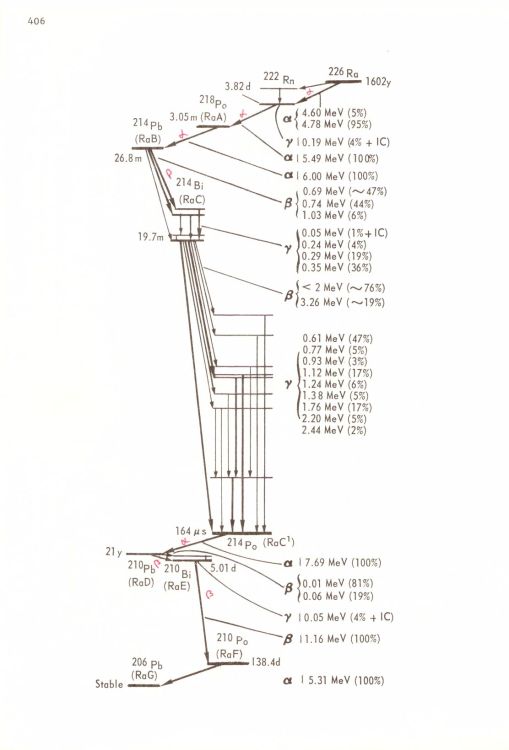
 Decay Table from Radium to Lead

The decay table shows the decay events from Radium-226 to Lead-206.  The decay of Polonium-210 is the last decay in the series.  This graphic is from the Radiation Health Handbook.  Unfortunately, the 1970 edition of the Handbook does not give a target organ.  I have no clue as to common chemical forms of polonium compounds.  However, given it’s high specific activity, chemical toxicity may be negligable relative to the radiological insult. 

I show the decay table only because some might find it interesting to see where Po-210 comes from.  Hopefully, the health physics people who investigate this might find other nuclides that could give a hint as to the production source of the Po-210.

This reprehensible action reminds us that civilization is a veneer that is only a millimeter in thickness.  A radiological assault of this sort is especially sneaky in its execution and savage in its effects.

(*Weasel words- I am not a health physics person. My experience is limited to a semester course in radioisotope techniques and safety in grad school given by a radiation biology department.*)

Propinquity

Process development and scale-up isn’t one of those things a young, freshly minted synthesis chemist generally aims for.  I recall the heady days in grad school when we thought “drug design” was the ultimate gig for a synthetic organic chemist.  Landing a slot in a first tier pharmaceutical discovery group was like landing a spot on the cast of a Broadway play.  And, in fact it is like that.  I have many friends and fellow students who have found fantastic careers doing just such a thing.

In the late 80’s and early 90’s, asymmetric synthesis was hitting its stride and anyone who could make heterocycles with chiral shrubbery attached somewhere was golden. Even better, if you had studied “Enzymatic Reaction Mechanisms” by Christopher Walsh and you could name all of the amino acids, you definitely had a future.  Most of us were lucky to be able to pronounce propinquity after consuming four pounds of Killians after a long day of research.

This time period that I refer to is before the introduction of high throughput experimentation (HTE), or CombiChem.  It was a kind of gilded age where reductionists prevailed.  If only we had enough data on the geometry of the active site, we could design a suicide substrate inhibitor to shut the enzyme down. We had CAChe(R) and SAR to help with the design of pharmacophores- it was a heady time.

It was an age when giants walked the laboratories- Corey, Evans, Nakanishi, Seebach, OppolzerMeyers, etc.  Some of these fellows still do.  But things would fundamentally change when a new experimental methodology rolled into town. The age of automation had arrived.

HTE would spawn new ways of thinking in discovery.  To methyl, ethyl, butyl, … futyl would be attached an exponent.  It would become possible to do and analyze a thousand reactions in a day.  Pharma companies invested heavily in this technology and, I understand, some of it is actually paying off.

But while the elite discovery krewes were spending down these giant R&D budgets that exceeded the GNP of a third world nation, a different group was quietly laboring with that most favored transformation of all.  Actually turning chemicals into money.  The most prized alchemy.

The activity to which I refer is, of course, process development and scale-up.  This field requires a slightly different mind-set.  It is not the domain of the show-horse. It is the world of the plow horse. And, by the prinicple of propinquity, I have developed a taste for it. 

More to follow.

NASA! Where is the Beef?

This post is about NASA. Yes, the National Aeronautics and Space Administration.  I have been watching NASA-TV for a few months and have experienced a kind of crippling inverse rapture.  NASA-TV is video pageantry designed to spread the gospel of rocketry and aerospace and I guess that is fine.  But it is mostly whizbang content that lacks a bit of substance.

Well, duh.  Of course.  They’re in the launch business, dummy.

I’m actually not going negative on NASA.  I believe in what the agency is doing and I’m pleased to pay taxes to support it.  But if you listen to what NASA people say, much of what they do is related to supporting the “science package”.  This is because space scientists need rocketeers to hurtle things out of the gravity well for them.

But this NASA venue never seems to pony up the science itself.  I have yet to see NASA-generated programming that offers much of the actual scientific grits and gravy.  Obviously, every morsel is written up in journal articles and fashioned into PowerPoint presentations to be scrutinized by squinting fuss-budgets (you know, “scientists”) in colloquia everywhere.  If you want to see the actual scientific results then you have to plop down at a university library with a journal and read the article or pay to download copy.  That’s fine, but this only serves the specialists.

It may be due to the nature of the funding. A PI comes in with a big wad of cash from a grant and basically NASA just provides the launch and control services.  NASA has no particular claim over the data or its disposition. Perhaps someone can set me straight on this.

Irrespective of how NASA works, here is what I’m frustrated with. Seeing the drama of the launch, the machinations of getting a probe to it’s destination, and then receiving the pretty pictures as the only reward. It puts me into insulin shock.  NASA is good at programming this kind of content- the Hope and Crosby road trip angle. But what are the results? What measurements were taken and what did we learn? NASA teases us with the show business end of space exploration but comes up short in communicating the scientific results.

So, here is what I’d like to see.  I would like to see a few researchers, with the support of NASA, periodically present their results to the public on NASA TV. I’d like to see the data and their conclusions and uncertainties- warts and all.  The public needs to see this.  Endless footage of exuberant space reseachers gushing at the potential benefits for mankind have worn thin.  It is time for these folks to tell us exactly what they are finding.

But some suggest that maybe raw science is too advanced for the public audience.  I’ve heard this sentiment before and can only argue that it is not NASA’s job to decide if we’re smart enough to understand the results from this research.  If the launch is important enough to spend $300 million on, then lets see what we learned.

The message we give people is that space science is the science of telescopes and rockets. This equipment is inportant, but it is not the focus of the activity. We launch these packages so we can study the stuff that is out there. How much stuff is there, what is the stuff doing and, what is that stuff anyway?  Let’s hear more about the stuff.

The public needs to see how data is collected and how it is reduced to some kind of conclusion.  Much of NASA TV consists of video feed from the ISS.  It is often mind numbing in it’s tedium, watching astronauts floating in front of a work station twiddling this or that. To hell with that.  Let’s see some data.  Let’s hear the scientists interpret their results.  Let’s all experience the buzz of enlightenment as a new concept washes over our consciousness. That is the true excitement of science.   

On the Road

I often think back to my college days and wonder what coursework I might have taken that would have been beneficial for a more lucrative mid-career.  I am presently over the great plains in the suborbital arc of my career- somewhere between Memphis and Kansas City, westbound to that Golden State on the horizon.  At some point in a chemists career he must mix metaphors and make a choice at the great fork in the road.  To remain in the lab or to move on to the crystal city on the hill:  Sales & marketing.  I chose sales and marketing, well, because I had to.   

Chemical sales is a odd field. One is neither a full member of the R&D tribe or the business tribe.  You become a chimera- a half man, half beast of burden that lopes through the B2B high plains sniffing for the stray morsel or rotting carcass.  In principle you are a member of an elite strike force, one in possession of the sacred knowledge of molecule marketing. On business trips you can mingle in the company of professors or supply-chain managers with equal ease. Your tongue can bend words with both the old ones- the blessed faculty- and those keepers of the elusive coin. 

But in your sterile cubicle, you are just another salesman.  Many companies have computer software that can be rigged to specifically to watch your every keystroke, even how frequently you move the mouse. This malevolent utility will time your calls, refuse to budge unless you set a deadline for a task, and collate every infraction from your self-imposed calendar into a tidy report for review by the taskmaster. Back in the dreamtime, you crafted covalent bonds and imbued molecules with chirality.  Today you fuss about “making the numbers”. 

As a sales man you take short courses on telemarketing and you learn how to deftly worm your way into the calendars of decision makers.  You develop a script for making the dreaded cold-call.  Your daytimer brims over with business cards. Early on you learn how to get past cold hearted administrative assistants who screen your calls and stonewall your well honed charms. 

You have become a road warrier, conversant in the codespeak of frequent flyer miles, airport hotels, and rental car companies. You learn to navigate in strange cities and how to find your way through the squirrel warren industrial parks. Your heart hardens in some ways and softens in others.  Welcome to the fabulous life of the sales man.

Due Diligence rev 1.1

In the fabulous world of business, there is thunderous demand and there is sweet supply.  People start businesses to satisfy some particular demand.  Along the way they hope to recover some of the elusive spondulix.  This is what makes the world go round.

In the glamorous world of custom chemical manufacture, a company seeks to make new material exclusively for a single customer or application.  Let me say that this essay is not about the byzantine world of pharmaceutical manufacturing or drug development. Pharma is a brutal and cutthroat business and it absolutely escapes me why any sane person would launch a pharma business today.

Bringing a new chemical entity to the market for commercial use is technically challenging and increasingly complicated due to regulatory requirements.  We’ll leave the regulatory nightmare for another time and focus on intellectual property.

Here is a common scenario:  Customer X emails and makes the following query- “Gimme a price for 10, 100, and 500 kg of QRT”.  The sales guy squints at the email and says “Cripes, we gotta figure out how to make this stuff, if we can make it, and SWAG (Scientific Wild-Assed Guess) a price!” It is the “if we can make it” part that is of concern today.

Before a manufacturer can actually offer a material or use a process to execute a sale, they must first perform their Due Diligence.  Due diligence has many manifestations and if you want a lecture on it, just get a recent MBA drunk and ask for a detailed explanation (I am preparing a blistering diatribe on MBA’s for a later essay).

In the matter of intellectual property, a manufacturer has a responsibility to determine if they are barred from practicing some process or making a particular composition of matter.  Given the gigantic body of literature that can be searched by SciFinder or Beilstein, you’d think getting a clear answer would be an easy, if not tedious, thing to do. Sometimes it is easy.  Other times you follow Alice down the rabbit hole.

The key question for the chemical vendor to resolve is this: Are there patent claims out there that are in force that would bar a manufacturer from practice?  To resolve this, we have to deconvolute the query into at least four questions- 1) Can we think of key words or structures that, when put into the sorting hierarchy, will lead us to the answer set? 2) Do the claims cover a process or a composition of matter? 3) Is the patent still in force? And 4) If we fail to find claims, are we confident in our search?

The USPTO website may not be that helpful and, in my experience, might give a false sense of security when your search comes up empty. The search engine at the PTO site will search for character strings in a variety of fields, and while this is useful, it is possible to miss a compound if it has an unanticipated name or is represented in some other fashion.

A common thing to find in the chemical patent literature is the Markush claim. In this representation, a set of analogs are claimed from which a preferred embodiment may be taken. A Markush group is depicted by a formula with generic substituents and each generic substituent is subsequently defined as being comprised of particular groups in chemical taxonomy, e.g., hydrocarbyl groups.  Here is a simple example of a Markush Group- “QR(4-n)Xn, where n= 0 to 4. Q is a tetravalent member of Group IV of the Periodic Table of the Elements; R is a hydrocarbyl group consisting of C1 to C12; and X is a member of Group VII of the periodic Table fo the Elements”. 

I’ve noticed that lawyers and USPTO people tend to use the patent classification system to sort the technology or the composition. Lawyers may also use specialists who have proprietary databases or some dark art known only to them.  Unless a chemist has spent time with the PTO system of taxonomy, it may be a bit daunting and less than useful. 

SciFinder collates patent data into patent family output and provides a very useful entry into the patent literature. Nevertheless, it is still a fairly blunt instrument and many patents may have to be viewed by hand.  Perhaps someone can comment.

It would be great if SciFinder had a way of flagging any given compound for the presence of process claims and composition of matter claims. This would be extremely useful to those trying to verify that they are not in infringement. 

A very useful tool for those seeking pdf downloads of patents can be found on pat2pdf.org.  It takes the individual pdf pages from the PTO site and assembles them into a single pdf  file. And it’s free.