I did some digging into the phenomenon of atmospheric rivers and learned a bit about the atmospheric river (AR) currently underway in the Los Angeles area. Fun facts to share about the AR-
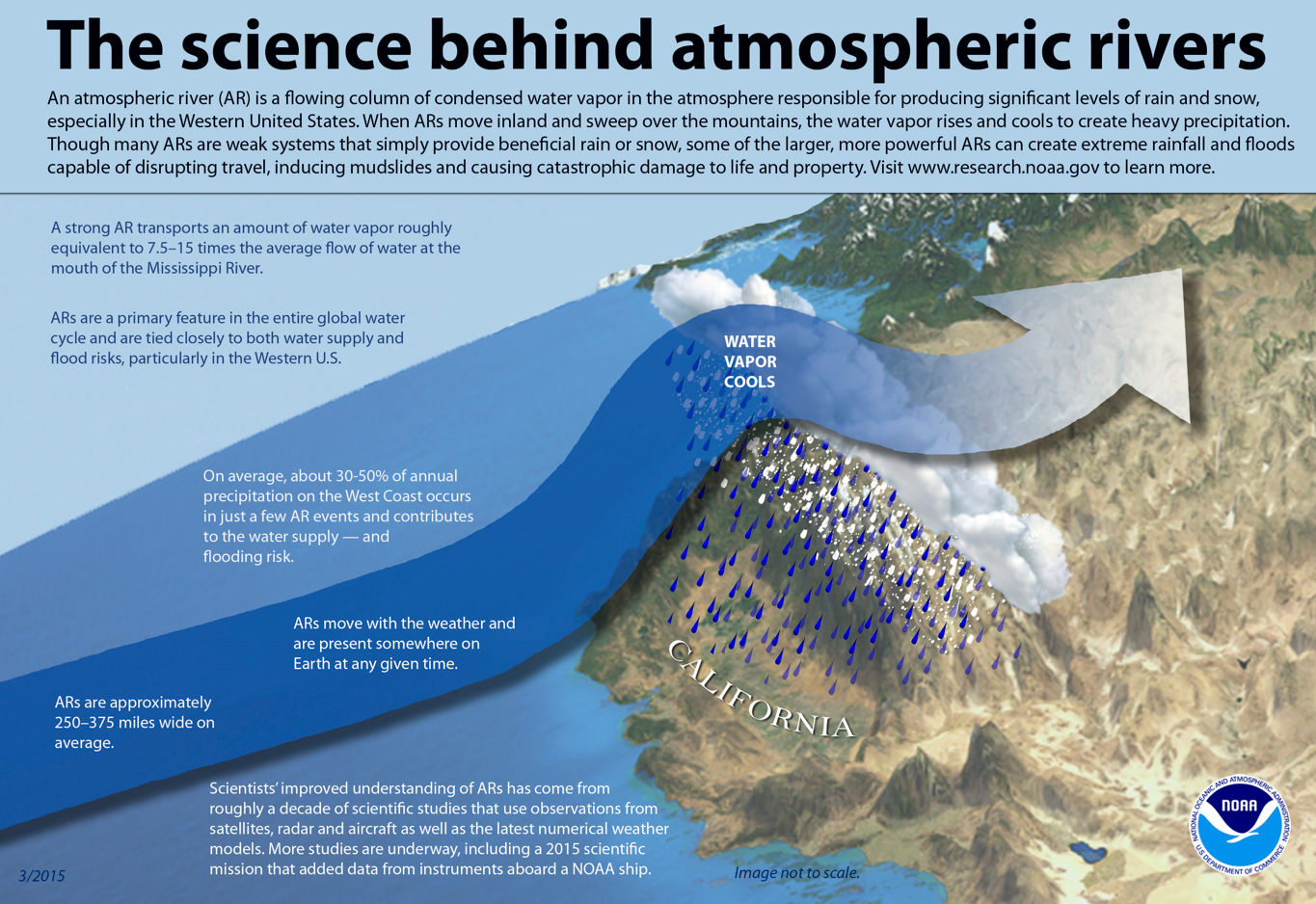
On average, ARs provide 30-50 % of the annual precipitation to the west coast
A strong AR transports 7.5 to 15 times the amount in water vapor as the average liquid water output at the mouth of the Mississippi River
The AR is a normal feature of the global water cycle and there is one occurring somewhere on the Earth every day.
An AR can be as much as 3200 km long and 400 to 600 km wide and flowing at 10,000 ft
The AR is the result of moist tropical air transported to the upper latitudes as in the case of the Pineapple Express.
Source: Animation of an atmospheric river event from the Physical Sciences Laboratory at National Oceanic & Atmospheric Administration, NOAA.
The graphic below is from the NOAA website on ARs and shows some general characteristics of an AR in play in California at present.
If weather is of interest to you, surfing through the various web sites put up by NOAA is worthwhile. NOAA does public outreach very well.
I would reproduce some memorable text from Carl Sagan’s book The Pale Blue Dot, but that would be a copyright violation. Instead, I’ll chime in and echo his intent. That would be for all of us to pause occasionally to reflect on our tiny spherical paradise amidst the barren expanses of the universe. Earth continues to harbor life because it can. The right distance from an average star for liquid water, the planetary magnetic field protecting the atmosphere from being stripped away, the right combination of chemical elements for the ignition and propagation of life, and the long-term climate that allowed life to survive.
Image of Earth captured by Voyager 1 on Feb. 14th, 1990, just before the camera was shut down to conserve energy as it sped from the solar system. The bands of dim light are artifacts of the camera lens due to the angular proximity of the sun.
In 1989 Carl Sagan requested that an image of Earth be taken from a great distance even though the scientific value was nil. After some internal haggling, the administrator of NASA, Richard Truly, interceded and the imaging was approved. In 1990, the decision was made to allot time to image the Earth just before the camera Vidicon tube was scheduled to be switched off to conserve energy. Just 60 images were taken and stored on an onboard tape recorder until they were later relayed to Earth between March and May, 1990. The signal was received by the Deep Space Network after 5 1/2 hours of transit time.
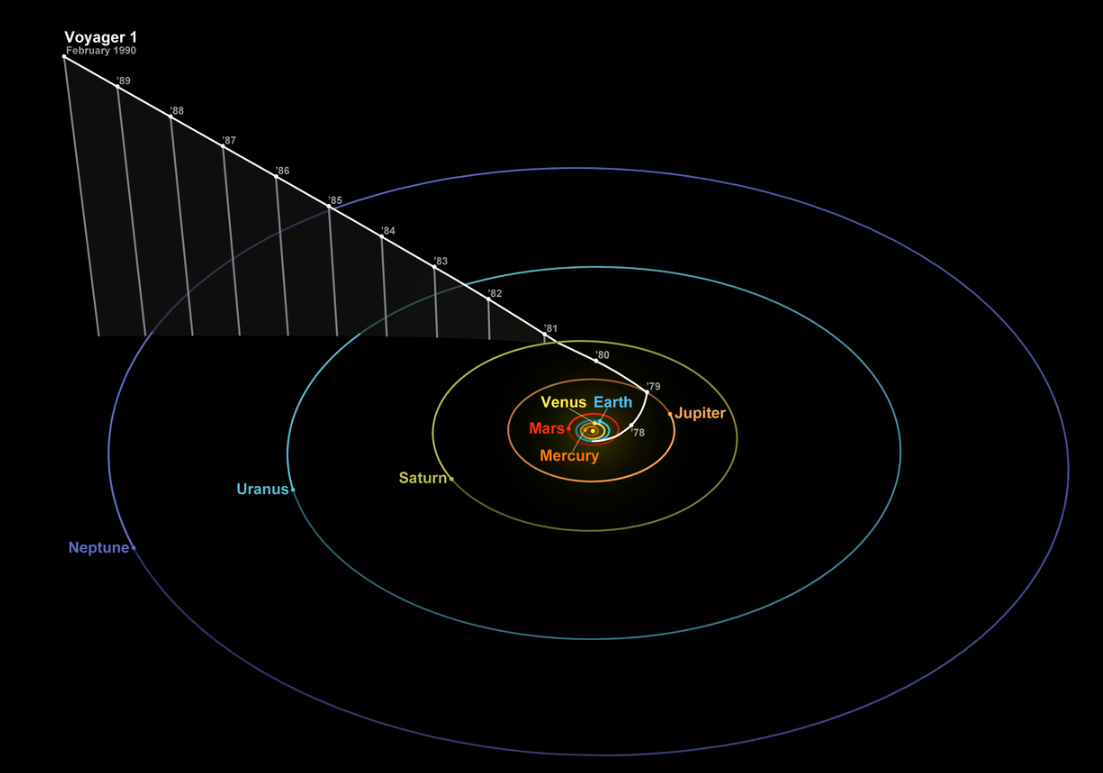
Image Credit: from Wikipedia. The vertical bars are represent 1 year intervals. Voyager was launched in 1977 and was 40.47 astronomical units (AU) from earth by Feb. 14, 1990, when the image was taken.
Just looking at the image without any concern given to what is happening there at present, the Pale Blue Dot appears unremarkable. On the cosmic scale, it is just a tiny ball of wet rock. Yet with the right elements, compounds and plenty of time this bit of rock spawned sentient beings allowing the universe to become self-aware.
With all of the conflict and tension on Earth, someone has to stand up for the Earth’s biosphere. No matter what people do, nukes and all, planet Earth will remain in orbit spinning about its axis. It is civilization and the web of life -the carbon-based parts- that are serious risk. It is the birthright of each creature to share in the fruits of the earth. Politics and economics must adapt to a healthy and sustaining biosphere, not the other way around.
With the indecisive wars in Korea, Viet Nam, Iraq and Afghanistan, the US has been served many slices of humble pie. Yet, are we learning? Presently we are drawn deeper into the bottomless pit of the Israeli/Palestinian conflict. We have hitched our wagon to an Israel that pushed out the inhabitants of a piece of someone else’s land and colonized it. It is an undeniable historical fact. It should surprise no one that 2 million people now forcibly concentrated into a small patch of unproductive land and are militarily, politically and economically isolated are deeply resentful with their lot in life. As they have done many times in the past, the Palestinians have pushed back violently but this time with the help of others either directly or by proxy. The whole thing is further complicated by religious zeal on the part of both sides. Both claim to be doing God’s work, but to different ends. Magical thinking enforced by guns.
Elsewhere on the Pale Blue Dot, Putin’s savage invasion of Ukraine has thus far brought Russia only death and humiliation, though outwardly Putin postures himself as unworried. He is in tight control of a nation that has been under tight control for most of its history. Putin’s conventional military has surprised many by its brittle collapse in the invasion of Ukraine. As with the Soviet regime before him, much of his power rests only on the sandy pedestal of propaganda and the large bureaucracy to monitor or punish everyone. Putin’s real strength is his nuclear arsenal and his expressed willingness to use it.
The last time the Russian populace rose up to successfully overthrow tyranny was the Bolshevik revolution in 1917. Tsar Nicholas II was overthrown, murdered and replaced with a new type of totalitarian regime- The Union of Soviet Socialist Republics. Over time the USSR was able to modernize the state into a spacefaring, nuclear power but always retained and refined its authoritarian grip on its people.
Meanwhile in the west, a hornet’s nest of anger in the US has been awakened by a single charismatic and malignant narcissist who has attracted a dedicated following of the vocally disenfranchised. While his stunningly bad conduct should be obvious to anyone older than 12, no amount of pettiness, lies and over the top behavior seems to detract from his popularity. It has been said that he validates what his supporters believe. If that is true, then Trump is just the tip of a terrible iceberg.
Many 20th century dictatorships in history have been led by a charismatic idealist who understood the dark zeitgeist. Lenin, Mussolini and Hitler among others have risen to power and directed brutal attacks on whom they chose, sometimes driven by greed for power and other times by utopian fantasies. While Stalin didn’t author the Bolshevik revolution as Lenin did, he set the high-water mark for murder and cruelty in Russia. As bad as these actors were, all somehow avoided the assassin’s bullet during their heyday. One little piece of lead could have disrupted the timeline of terror each journeyed. Civilization does not have a provision that encourages this, though.
For crying out loud, people. Get a grip on how rare and special the Earth’s biosphere is. If there is another wonderous place like Earth, we are unaware of it and may never become aware. The earth is to be treasured.
At a Republican district 4 congressional primary debate in Ft Lupton, CO, last Thursday, Colorado’s very own US Representative Lauren “Bobo” Boebert (R-CO) took fifth place out of 5 in a small straw poll, grabbing 12, or 10 % of the votes. The word “carpet bagger” was mentioned a few times. Given that her home district Democratic opponent has accumulated a large war chest, she decided the odds in the 2024 election were poor. So she loaded up the pickup truck, truck nuts and all, and crashed the party in district 4.
Boebert hails from Silt, CO, but was born in Florida. For today I’ll leave this nugget alone.
Let me back up. Boebert was elected twice in Colorado district 3 to the US House of Representatives, most recently in 2022 by a very slim margin. District 3 lies in the much less populous western third of the state. Most all of it is high, dry and approaching vertical in many places. A 65 % majority of the population is rural and mostly conservative.
The tragic comedy that is Boebert is available on Google so I won’t take time to repeat any of it. Suffice it to say that she is even unpopular among Republicans in District 4 as we saw Thursday.
It appears as though the depth of shame isn’t bottomless among district 4 Republicans. Who knows which straw it was that broke the camel’s back. I’m guessing it was the frisky hijinks at a certain musical that did it.
Here she is: Boebert.house.gov
Colorado is peaceful enough nearly everywhere that a sidearm is just dead weight that you carry around needlessly. Like everywhere else, the coppers need to carry a sidearm because the threshold for stupid behavior continues to drop. Otherwise, it is a form of peacock plumage displayed to make a statement. If the Taliban were hunkered down in Boulder or if I had to move in next to a strip joint in Denver, I suppose I’d carry one too.
As expected, New Hampshire Republicans rallied for their Golden Calf yesterday. Naturally, media people are using this to boldly predict the future. I’ve had to abandon NPR because they are serving wall-to-wall election coverage as though nothing else has happened. Despite the years of legal actions against the Orange Jesus, his popularity endures and Republican politicians and candidates continue to rally around him, hoping some of magic rubs off on them.
In interviews, Trumpsters confidently say that things were better during his presidency than under Biden’s despite what the numbers say about the economy at present. Even though inflation has dropped from 9.1 % to 3.2 % over the last year according to the AP, many consumers apparently expect prices to come down as well. Are the Trumpsters really upset about the economy or are they just angry that he lost the 2020 election?
“We don’t care about no stinkin’ 91 felony indictments. Yes, he’s committed fraud and sexual assault. But, but, but he is going to drain the swamp and halt immigration!!”
Reducing prices is not something that business people will do to make life easier for people. What industry will be the first to reduce their prices willingly because it is a “nice idea?” Prices are always set to what the customer is willing to pay. A common nightmare of a business person is that they may have left money at the table during a negotiation or a sale. Businesses charge as much as they can all the time. People who leave money at the table are not the people who rise into the thin air of the C-suite of business.
During the pandemic, supply chain interruptions helped trigger inflation. Businesses ratcheted up their prices to grow or maintain their margins. Many businesses had to raise their prices because their costs had risen, but not evenly across the board. Why waste a good opportunity to raise prices if others are doing it? For essentials, consumers soon adapted to it because they had little choice. Strangely, the economy has shown unexpected vigor during this inflationary period. Some products like pickup trucks and real estate, however, are suffering badly.
Along comes the Federal Reserve to slay the dragon of inflation. They pulled their one big tool out of its sheath for staunching inflation- raising interest rates. And so they did with success. The down-side is that it hurts those seeking a mortgage or other loans due to increased interest rates.
Another effect of the pandemic is the continuing trend of employees working from home. According to one source, the 1Q23 vacancy rate for NYC office space was 22.2 %. Remote work activity has caused businesses to reconsider the size of the office space they are leasing. Many are opting not to automatically renew their leases in favor of leveraging better terms or outright downsizing their space requirements. The new workforce shift has had a negative effect on surrounding businesses who rely on the daily flood of office workers to buy lunch and shop. It also has a big effect on the owners of office buildings who likely had business models and loans relying on higher occupancy rates. The knock-on effect is that the banks who made the commercial loans to the office building owners are beginning to see an increase in loan defaults. Commercial borrowers also face significantly higher interest rates than they started out with. News reports are very pessimistic for a reprieve in the near term.
The term that was coined for this is the urban “doom loop.” Reduced office occupancy leads to reduced tax revenue for municipalities who supply services like transit, police and street maintenance. But I don’t want to spoil it- Google “urban doom loop.”
Back to the Golden Calf.
I would offer that there is a portion of the grand American bell curve that probably shouldn’t be left in charge of a vast international economic and nuclear superpower wielding a military machine the likes of which the world has never seen before. Further, I would offer that just possibly many of the followers of #45 are comfortably squatting on that side of the bell curve.
As I see it, the Golden Calf getting back into office will adversely swerve the fate of Europe, the Balkan and the Baltic states into direct conflict with an expanding Russian Empire. Putin is obviously trying to reestablish and reenergize the reach of the former Soviet Union. He has little care for the lives of Russian soldiers as they fight and die on the battlefield, and even less for those who defy his wishes. They are expendable in the grand scheme of a Great Russian Empire of Tsar Putin.
The State of Ukraine traces back to October of 1917 when the Bolsheviks tried to capture Kyiv and failed. By January of 1918 the Ukranian revolutionary parliament declared the formation of Ukrainian People’s Republic. After much conflict, Ukraine was made part of the USSR.
In the 1930’s there was the Holodomor, or the “Great Ukrainian Famine” of 1932-33 with continued mass killing and exile of Ukrainian Kulaks to the east for the rest of the decade. The collectivization forced on Ukraine was brutal. Many thousands of Ukrainians were exiled to the east and disappeared. As Hitler invaded Poland and continued with Operation Barbarossa to Moscow, his plan to exterminate Jews went with him. The wholesale slaughter of Jews in Poland and Ukraine wasn’t limited to the concentration camps. Villages were captured by the Nazis and Jewish citizens were marched by the many tens of thousands into the woods and executed by a bullet to the head, falling into pits where they would be buried. No age or gender was spared. Hitler gave orders to Himmler to carry out the Final Solution in eastern Europe and Russia and he did with a vengeance.
A large scale international concern is with Putin’s latest invasion of Ukraine. Russia has a long history of conflict with Ukraine starting after the Bolshevik Revolution. Putin does not recognize their sovereignty and further claims that there is no Ukraine, only Russia. He seeks to establish the boundaries of the former Soviet Union and Ukraine is the first step. To allow Putin to conquer Ukraine will enable him to go after the Baltic states, the Balkans and Poland along with their manpower and resources to fortify the depleted Russian military-industrial complex.
Trump has a record of stating his disinterest in protecting the European Union and remaining in NATO. American retreat from the EU and NATO would only serve to telegraph to Putin that the US will not interfere with further Russian conquests. A massive Russian dictatorship butted up against western Europe will not lead to an enduring peace. A Russian dictatorship the size of the USSR will be no friend of the western powers.
An America that withdraws from international affairs is an America in steep decline. After all that we have accomplished and learned, under Trump and his ilk we will step down from our international platform and slink away into some imaginary Libertarian Southern Baptist utopia with the inmates running the asylum. No thank you.
The election of Trump has a ghastly downside for western civilization that is largely kept quiet by the popular media. In their desire to portray fairness, they tend to avoid topics like this for fear of the accusation of bias..
This evening I begin my first acting class. What is odd about this is that I’ve been in 17 productions already since about 2011 and, oh yes, retired from acting about 5 years ago. But, on a lark, I’ve decided to heed the advice of a director years ago and take a class out of curiosity. Our text is by Stanislavski.
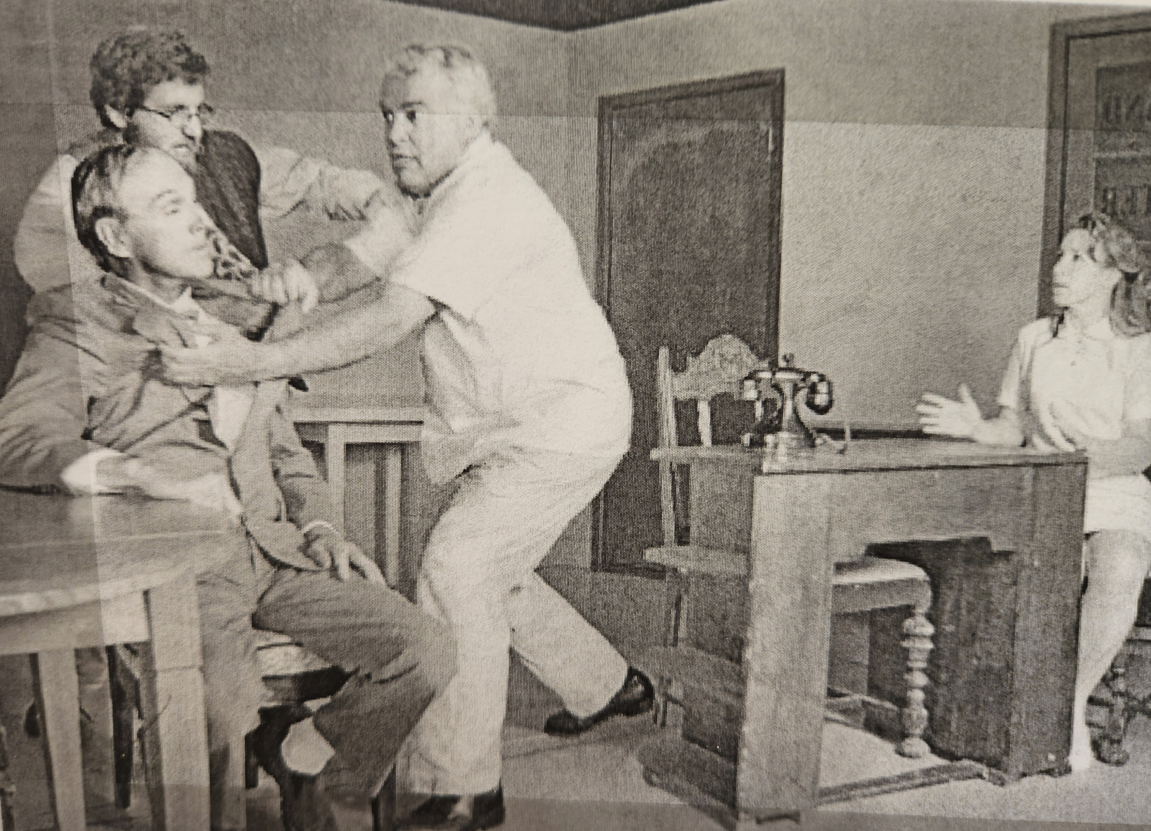
Scene from the play Harvey. I won’t say who I am but this was a memorable scene.
I’ve been on the community theater stage enough to have lost most of my fear of it. I’ve played a drunken Scotsman, several British detectives, sheriff Tate in To Kill a Mockingbird, a mute king in Once Upon a Mattress, a bishop and a cardinal in A Man for All Seasons, and someone in Harvey, among other plays.
Acting is quite a bit more involved than one might think. Obviously, you must memorize your own lines, but you must also know many of the lines of others in order to recognize your cues. The goal is to suspend disbelief and give a convincing portrayal of your character and contribute to the overall emotion of the scene.
One of the most difficult situations to come along on stage is when you or another actor forgets their lines. Unless somebody says something quick, a dark and silent pause washes over the audience, damaging the 4th wall. The other actor may cover for you by continuing with the dialog hoping you can pick up on it. Sometimes the other actor may skip a whole page of dialog leaving you to recognize the unexpected gap and carry on.
The best actors I’ve been around are able to fill a lapse with improvised language that covers the slip up long enough for the other actor to catch up. I’m taking the class because I was never good at improvising to cover a memory lapse. But no matter how good the other actor is, you still must slip back into dialog as seamlessly as possible. Inconceivably, audiences don’t always notice slip ups.
Improvising lines as opposed to sticking with the playwright’s text is very unappreciated and frowned upon. On a fundamental level, the playwright owns the content and every word is put there on purpose by the writer. On a practical level, other actors depend on you to say their cue lines properly. It is a good way to become unwelcome.
Another difficulty for me were the rapid back and forth dialogs with the other actor as would happen an argument. The scene is very satisfying when done fast and with verve, but a total loss of dramatic effect when done slowly.
Theater is a blast and theater people are fun to hang out with.
Unfortunately, when someone utters something in conversation that is wildly divergent from reason, they make the claim in mere seconds. A proper rebuttal, though, can take paragraphs of content to dredge up facts and compile reasoning to refute the reckless assertion. Spouting nonsense is much easier than attempting to convincingly invalidate it. Many people avoid contradicting someone with doubtful assertions because either they don’t want to be disrespectful or they’re afraid to push the matter.
As a result, fools sermonizing nonsense often wander off with a false sense of victory because nobody pushed back. We all have friends and family that somehow went into the weeds and picked up some wild ideas.
One way to deal with fools spouting nonsense is to turn around and leave. Other times a gentle change of the subject can lead someone to a better topic. To expect someone to have an epiphany about some closely held yet nonsensical notion leading to a higher plane of awareness standing right there is unreasonable. Most of us fools will stand our ground and argue. Yes, that includes me. Despite being in a hole, I also have been known to keep digging the hole, though not so much anymore.
Wherein I digress.
College is a great place to pick up debating skills. My research group in grad school was a quite assertive and international group of people. Today most of them are either full professors or VPs of R&D at some pharma company. Since I decided against pharma early on, I was thankfully able to avoid the east coast. At that time there wasn’t much non-biopharma elsewhere. To thrive, I need to be around some interesting topography like here in the west.
In grad school I learned to pitch back as much guff as I received. By assertive I don’t mean quarrelsome, usually. I mean debate. Knowledge and reasoning had to be there, as it should be. Most of these “energetic discussions” were at the chalkboard where we preposed reaction mechanisms by pushing electrons. Fermented beverages were often present. Since it was a natural product and stereochemistry group, we had to be able to render our chalk structures in pseudo “3-D.” Our research professor was a master at this. He could draw complicated alkaloids and diastereomeric transition states with chalk to show stereochemical mechanisms as well as anyone.
Back to the BS people spew.
Back to the topic of the post. I’ve lost much of the desire I once had to debate people who espouse outright stupidity. An example would be a MAGA follower. My working theory is that once someone has tasted the Trump Koolaid, they are likely lost for good. They’ll live their lives out as Trumpers and go to their graves that way. Some Trumpers do have a revelation and recover, but most don’t.
Attempting to educate MAGA people for the sake of truth and accuracy is a waste of time. Is this a pessimistic view of life? Yes.
As wondrous as our physical and chemical senses are, they are severely constrained in a few fundamental ways. Our vision is limited to our retinal response to a narrow, 1-octave wide band of electromagnetic radiation. As it happens, this band of light can be absorbed non-destructively by or stimulate change in the outer, valence level of inorganic and organic molecules. Electrons can be promoted to higher energy levels and in doing so temporarily store potential energy which can then do work on features at the molecular level. In the retina, this stimulates a polarization wave that propagates along the nervous system.
Owing to the constraints of the optics of the band of light we can sense, we cannot see atoms or molecules with the naked eye. This is because the wavelengths in the narrow range of visible light are larger than objects at the atomic scale. Instead, we perceive matter as a continuous mass of material with no indication of atomic scale structures. No void can be seen between the nucleus and the electrons. For the overwhelming majority of human history, we had no notion of atoms and molecules.
Democritus (ca 460-370 BCE) famously asserted that there exist only atoms and vacuum, everything else is opinion. The link provides more detail. The point is that atoms and vacuum were proposed more than 2000 years ago in Greece. The words of Democritus have survived over time but I’ll hazard a guess that the words were not influential in the rise of modern atomic theory in the 19th and 20th centuries. A good question for another day.
In all chemistry, energy is added to the valence level of a molecule as electronic, rotational, vibrational or translational energy.
Thumbnail Sketch of the Interaction of Light and Matter
Radio waves are a band of long wavelength that can interact with electrically conductive materials. Electromagnetic waves having a wavelength greater than 1 meter are considered to be radio waves. As a radio wave encounters a conductor, the oscillating electric field of the wave causes charge to oscillate in the conductor and at a rate matching the radio wave. Radio waves, whether in electronic devices or in space, are formed by the acceleration of charged particles. Recall that when you cause a charged particle to change it’s direction of motion, e.g., by a magnetic field, it is undergoing an acceleration. It is useful to know that radio waves are non-ionizing.
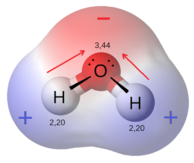
Microwave energy causes dipolar molecules to rotate back and forth by torsion as the waves pass. This rotational energy can be transferred to translational and vibrational energy through collisions, raising the temperature. The molecule does not need fully separated charges like a zwitterion, but molecules may have less than full charge on one side and a less than a full opposite charge on the other side, like water. This is a dipole. Water has a strong dipole and is susceptible to absorbing energy from microwaves.
Water molecule with dipole indicated.
Infrared radiation causes individual chemical bonds and entire frameworks to vibrate in specific ways. The Wikipedia link for this topic is quite good. When a molecule absorbs heat energy, it is partitioned into a variety of vibrational modes which can bleed off into other energy modes, raising the temperature.
Ultraviolet light is energetic enough to break chemical bonds into a pair of “radicals”- single valence electron species. These radicals are exceedingly reactive over their very short lifetime and may or may not collapse back into the original bond. Instead they can diffuse away and react with features that are not normally reactive, leading to the alteration of other molecules. UV light is very disruptive to biomolecules.
X-rays are more energetic than ultraviolet light and can cause destructive ionization of molecules along their path. They can dislodge inner electrons leaving an inner shell vacancy. An outer shell electron can collapse into the inner vacancy and release energy that can eject a valence level electron, called an Auger electron. This alters the atom by ionization and giving a change in reactivity. X-rays are also produced by the deceleration of electrons against a solid like copper though lighter targets can also produce x-rays.
Gamma radiation originates from atomic nuclei and their energy transitions. They are the highest energy form of electromagnetic radiation and cover a broad range of energies at <0.01 nanometer wavelengths. Many radioactive elements emit only gamma rays as a result of their nuclei being in an unstable state. Some nuclei can emit an alpha or beta particle resulting in an unstable nucleus that will then emit a gamma to relax.
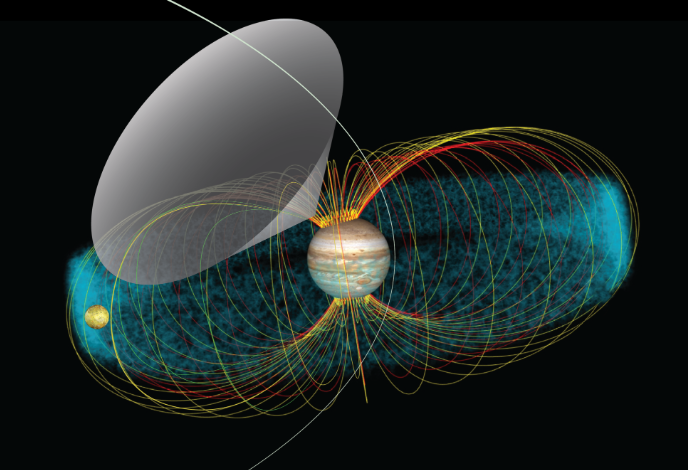
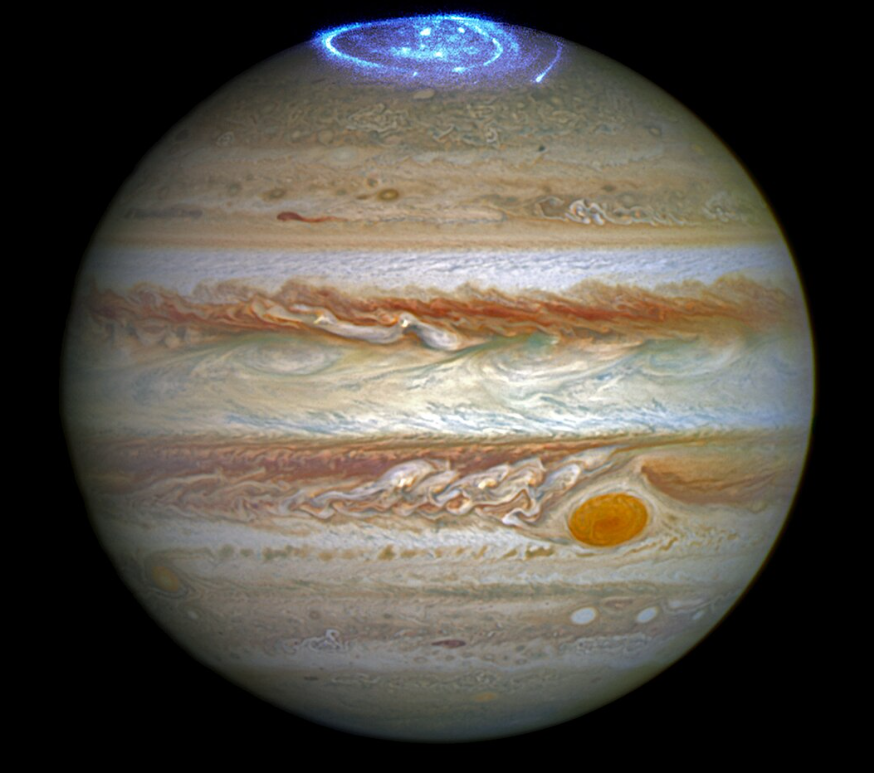
The wavelengths of radio waves are too long and too weak to interact with biomolecules. Some radio waves come from the synchrotron effect where charged particles like electrons will corkscrew around magnetic field lines of a planet and release energy in the form of radio waves. In the case of Jupiter and it’s moon Io, a stream moving charged particles are accelerated by a magnetic field, the particles will emit mainly in the 10 to 40 MHz (decametric) range of radio waves as they spiral around the magnetic field lines into Jupiter. Jupiter’s volcanic moon Io sends charged particles into the planet’s polar regions where the magnetic field lines bunch up. This leaves a visible trace of borealis-like gas that glows. That radiation is emitted in the shape of a conical surface. It is only detectable here when the cone sweeps past earth as Io obits Jupiter.
Image from NASA. “This is a representation of the Jupiter-Io system and interaction. The blue cloud is the Io plasma torus, which is a region of higher concentration of ions and electrons located at Io’s orbit. This conceptual image shows the radio emission pattern from Jupiter. The multi-colored lines represent the magnetic field lines that link Io’s orbit with Jupiter’s atmosphere. The radio waves emerge from the source which is located at the line of force in the magnetic field and propagate along the walls of a hollow cone (grey area). Juno receives the signal only when Jupiter’s rotation sweeps that cone over the spacecraft, in the same way a lighthouse beacon shines briefly upon a ship at sea. Juno’s orbit is represented by the white line crossing the cone.” NASA/GSFC/Jay Friedlander
Jupiter’s volcanic moon Io funnels charged particles into the planet’s polar regions where the magnetic field is strongest. This leaves a visible trace of borealis-like trails that glow. Source: NASA.
An atomic nucleus can absorb or emit gamma rays. For instance the gamma emitter Antimony-124 emits a 1.7 MeV gamma that can be absorbed by a Beryllium-9 nucleus which photodisintegrates into a 24 kiloelectron volt neutron and two stable He-4 nuclei. This nuclear reaction can be used for surveying for beryllium ore deposits by detecting neutron backscatter.
The purpose of this cooks tour of the electromagnetic spectrum is to suggest that visible light band is uniquely suited to interact with matter just enough to induce valence-level chemical changes. The change can be charge separation or an alteration in the composition or shape of a molecule. The changes may be reversible or not.
Ok, done with that.
So, not all electromagnetic radiation plays nicely or at all with any given chemical substance. The narrow visible band of light is uniquely well suited to interact non-destructively, mostly, with living things. Chemistry is about the behavior of the outer, valence level of electrons around and between atoms and molecules.
The retinas in our eyes send signals to the brain continuously that result in a very curious thing- our perception of color registers instead of just a grey scale. Not just the colors of the rainbow, but also more nuanced perceptions like pastels, brown and in their many textures- all with binocular vision!
The constraints on human vision depend on the chemical composition and anatomical structures of the retina as well as the construction of the brain. As the description of the various bands of electromagnetic radiation suggest, there is much to the universe that our senses cannot detect. We do not directly view the radio, microwave, infrared, ultraviolet, x-ray or gamma ray views of the universe.
Our daily understanding of the universe is mostly framed by what we can see with the unique biochemistry and anatomy of the retina. It’s not a bad thing with its limitations, but for an appreciation of the true scope of the universe we would have to find ways to view in the other electromagnetic radiation bands. And, we do. With radio telescopes and satellites that pickup x-ray and UV energy to give images. Now with JWST, we’re peering deeper into the universe as revealed by infrared energy. The longer wavelengths of infrared can pass through clouds of dust particles that previously blocked our view in the optical spectrum.
The structures of the atom and molecules are characterized by the very large fraction of “empty” space they contain2. Electrons seem to be point charges with no measurable size. Yet they have mass, spin and the same magnitude of charge but opposite that of the much heavier proton. And, the proton is not even a fundamental particle but a composite particle. It’s like a bag with three hard objects in it.
The universe is wildly different from what our senses present to us. All matter1 is made of mostly empty space. What we see as color doesn’t exist outside of our brains. Our sensation of smell is the same. Cold is not a thing. It is just the absence of heat energy. Finally, our consciousness exists only in our brains. It is a natural phenomenon that is highly confined, self-aware and may be imaged through its electrical activity or F-19 MRI with fluorinated tracers. This wondrous thing is happening on the pale blue dot floating in the vastness of empty space. So far, we can’t find anywhere else in the observable universe where this occurs.
It is good to remember that we search for extraterrestrial intelligence to a large extent with radio telescopes. On earth, the use of radio communication is a very recent thing, tracing back to the beginning of radio in 1886 in the laboratory of Professor Heinrich Rudolf Hertz at the University of Karlsruhe. Hertz would generate a spark and find that another spark would occur separately.
By 1894, Marconi was working on his scheme to produce wireless transmissions over long distances. The wider development of radio transmissions/receiving is well documented, and the reader can find a rabbit hole into its history here.
In order for the discovery of radio transmission to occur, several other things must have been developed first. The discovery of electricity had to precede the development of devices to generate stable sources of electricity on demand and with sufficient power. Then there is the matter of DC vs AC. Some minimal awareness of Coulombs, voltage, current, electromagnetism, conductors and insulators, and wire manufacturing is necessary to build induction coils for spark generation.
James Clerk Maxwell had developed a series of equations before the discovery of wireless transmission by Hertz. Hertz was very familiar with the work of Maxwell from his PhD studies and post doc under Kirchhoff and Helmholtz. Hertz was well prepared in regard to the theory of electromagnetism and was asking the right questions that guided his experimental work.
Radio transmission came to be after a period of study and experimentation by people like Marconi, Tesla and many others who had curiosity, resources and drive to advance the technology. As the field of electronics grew, so did the field of radio transmission. It’s not enough to build a transmitter- a receiver was required as well. Transmitter power and receiver sensitivity were the pragmatics of the day.
This was how we did it on earth. It was facilitated by the combined use of our brains, limbs, opposable thumbs and grasping hands. Also, an interest in novelty and ingenuity during this period of the industrial revolution was popular. While people who lived 10,000 years ago could certainly have pulled it off as well as we did, the knowledge base necessary for even dreaming up the concepts was not present and wouldn’t be for thousands of years. The material science, mathematics, understanding of physics, and maybe even cultures that prized curiosity and invention were not yet in place.
In order for extraterrestrials reaching out to send radio signals that Earthlings could detect, they would have to develop enough technology to broadcast (and receive) powerful radio transmissions. If you consider every single mechanical and electrical component necessary for this, each will have had to result from a long line of previous developmental work. Materials of construction like electrical conductors could only arise from the previous development of mining, smelting and refining as a prelude to conductor fabrication to produce a way of moving electrical current around.
Radio transmission requires electrical power generation and at least some distribution. None of this could have been in place without the necessary materials of construction, mechanical and electrical components already in place. Most of the materials would have to have been mined and smelted previously. Electrical power generators need to be energized by something else to provide electricity. On earth we use coal or natural gas to produce steam that drives generator turbines to make electricity. Also, there is nuclear and hydroelectric power. ETs would face a similar problem for the generation of electrical power.
If you follow the timeline leading to every single component of an operating radio transmitter, you’ll see that it requires the application of other technologies and materials. It seems as though a radio transmission from extraterrestrial home planets need something like an industrial base to get started.
What if there were intelligent extraterrestrials who were not anatomically suited to constructing radio transmitters for their own Search for Extraterrestrial Intelligence or just for local use? Perhaps they are +very intelligent but not far along enough yet to have developed radio. Or, what if they were just disinterested in radio? What if they used radio for a short window in time and have been using something else not detectable from earth, like what we do with optical cable? The point is that we would never hear them by radio, yet they would be there.
Surely there is a non-zero probability of this happening. This dearth of signal may be so prevalent that we will conclude that we are alone in our local region of space. Perhaps funding will be cut and we’ll quit looking. We can take that finding to fuel our sadness of being alone in the cosmos. Or we could use it to appreciate just how unique life is and take better care of ourselves.
Instead of buying into Elon Musk’s vision of colonizing Mars and somehow terraforming it, why don’t we terraform Earth back into a place where the biosphere is more stable and pollution is pushed back to some lower level? A utopian vision for sure, but it also has a non-zero probability of happening.
1. Not including dark matter, if it really exists. I remain skeptical.
2. I’ve come around on this business of the atom being almost entirely empty space. This is a firmly established bit of folklore in chemistry. It makes sense only if we look at the electron as a solid or material object buzzing around the nucleus which it is not. The electron is a point charge manifestation of the electromagnetic force. It is a disturbance in the electric field. It doesn’t fly like a ball, it propagates in the manner of a wave. It has none of what humans think of as material substance, rather it is purely a quantum mechanical manifestation. It is shaped by 3-dimensional probability density standing waves surrounding the nucleus. This probability density is defined by a spherical harmonic wave series. We chemists know this harmonic series as s, p, d and f “orbitals”. Electron probability density extends from the nucleus to the frontier orbitals of the atom with s, p, d, and f orbitals occupying space according to its unique wave equation.
Much has been written about the gas & oil industry in the US. My aim only is to highlight the leaking, not actively producing, oil & gas wells.
Many states have a problem with orphaned and zombie wells. Big ole Texas has a problem with orphaned and “zombie” oil wells also. Over time, oil and gas companies have been abandoning uncapped oil and gas wells in their eternal haste to produce “Black Gold, Texas Tea.” Inactive or non-compliant wells with delinquent organizational reports (Form P-5) for more than 12 months are called “orphan” wells in Texas. The state of Texas does have procedures for the disposition of orphan wells. Wells may be abandoned because of low output or the owners going bankrupt. It is possible to take over an orphaned well, though why would someone takeover a depleted orphan well or a low output well?
What’s worse, even the capped wells have begun to leak because of the corrosion and decay of well casings and plug material. The leak may be far down the hole or near the surface. These abandoned wells that are now leaking are called “zombie” wells. The zombie wells push up brackish water along with hydrocarbon liquids and vapors into the atmosphere and the surface soil as well as underground into the water table. Some underground flows are large enough that sinkholes form and fill up with polluted water.
The Oil & Gas division of the Texas Railroad Commission is responsible for “Regulating the exploration, production, & transportation of oil and natural gas in Texas.”
In a September 14, 2022, article in the Houston Chronicle, James Osborne writes
Following up, Amanda Drane writes in her July 17, 2023, article in the Houston Chronicle
“The Railroad Commission plugged 1,068 wells during fiscal 2022 at a cost of $29.5 million, and added another 944 over the same period. During the second quarter, it said it plugged 363 wells at a cost of $11.7 million — 119 wells with state funds and 244 wells with money from the federal Infrastructure Investment and Jobs Act, which has promised Texas nearly $320 million in phased disbursements.”
“the oil and natural gas industry has paid hundreds of millions of dollars to have orphaned wells properly plugged… We welcome federal funding to enhance what industry has already contributed to address orphaned wells.”
As can be seen, the Texas Oil & Gas Association seems to feel that it has done its job with orphaned wells. The Teflon-coated Texas Oil & Gas trade association did what trade groups are supposed to do- shield their members from public blame and immense liability.
One component of crude oil & gas is hydrogen sulfide (H2S) which resides in both the liquid and vapor phases. This component is capable of both oxidation in the air to form a series of variously oxidized sulfur products as well as elemental sulfur itself. Hydrogen sulfide is extremely toxic and prone to cause olfactory fatigue in humans. The odor threshold is extremely low which could lead one to safely vacate the area, but the “nose numbing” effect on the sense of smell can lead to a false sense of security and continued exposure. Most cases of intoxication occur in confined spaces, however.
In a way, drilling for and striking oil & gas is like opening Pandora’s box. The well can produce valuable oil & gas, but along with it comes produced water with undesired dissolved minerals, petroleum and drilling residues. It seems clear that the State has a compelling interest in the final disposition of the well. The driller or party who owns the drilling rights to the well should be financially responsible for its clean shutdown. Bankruptcy should not absolve a company from responsibility for trouble the well brings.
Industry and people are like a gas- they expand to occupy the space available to them.
This post is limited to the issue in Texas but it can exist anywhere oil & gas drilling has occurred. Obviously, the oil & gas industry represents a massive amount of economic activity and consequently it has enjoyed a privileged position in American industry in terms of regulations. It is doubtful this will change but that doesn’t mean that the beady eye of scrutiny should blink.
Even if hydrocarbon vapors and other gaseous substances blowing out of wells were not greenhouse gases, can’t a case be made for capping-off wells just to prevent pollution? There is a mentality out there that holds that if some pollution action is not mandatory, then it is not necessary. Their response to a problem is often that they “met regulatory standards.” That is, they would have done less if they could have.
There is a video on Truth Social posted by Trump or one of his lackies made by a fan with a soundtrack that sounds suspiciously like the radio broadcaster Paul Harvey from the days of old. It is a hagiography, a Valentine to #45 repeating over and over that God chose Trump to rescue America from a long list of troubles nagging at conservatives. Good heavens, there are even Marxists out there!
God took the time to plan this out for the sake of right-thinking Americans. The Big Guy who set the galaxies spinning and is the author of quantum entanglement and irritable bowel syndrome is also mucking about in Republican politics here on the pale blue dot.
This was released just prior to the Iowa caucuses to wheedle the Republican faithful to take heed and turn out to vote ’cause it’d please the Big Guy.
I am a little annoyed by the breathless attention given to Defense Secretary Austin for his “failure” to release a notice of his absence due to illness. Yes, he is the SecDef after all and he is an important player in our national defense establishment and US foreign policy. But if any organization has an extensive chain of command it is the Defense Department. His position can be covered by his direct-reports while he is out. To say that the Pentagon depends on a single person every moment of the day for critical decisions only he personally can make is to say that SecDef represents a single-point failure for the entire military apparatus of the US. This is absurd.
Could it be that the news media are hyperventilating over this? Are they so daft as to believe that this was some kind of close call? It seems likely that in the Pentagon’s PR office handbook on protocol there is a paragraph on notifications like this. Well, they muffed it. Some poor fool will get their tit in a wringer over this. Big Freaking Deal. Move on.
I imagine that in 6 AM staff meetings in newsrooms across the country, staffers buzzing on 4 cups of Folgers coffee were trying to come up with fresh news “stories”. In some eager beaver’s mind they imagined that a breach of protocol at the Pentagon involving SecDef was going to attract attention. And if one broadcaster does it, they all have to. Are you listening NPR? I think some 4th estate swimmers dove into the pool and scraped their noses on the bottom.






 Lamentations on Chemistry
