As I approach retirement in a year or so, I’m overcome with intrusive thoughts as I inventory my accomplishments and failures. Questions like “what have I done with my life?” or “why the hell did I do that?” are dangling in my consciousness more than usual. It’s normal sentient-being stuff I suppose. I never had the impression that farm animals agonized over such things. One lucky benefit of being a bovine.
I find myself disappointed over not having chosen a career path that might have led to a more impactful life. The closest I got was as a chemistry prof helping students get through organic chemistry. It was very satisfying and I managed to meet many wonderful students and faculty. Chemical science has provided a comfortable and intellectually stimulating lifestyle. One negative I suppose is that a chemist isn’t much good without an institution from which to practice chemistry within. Outside of an organization with no lab and no free access to Chemical Abstracts, how is a person to remain connected to chemistry? I guess you just don’t. Some say that a I could be an adjunct prof somewhere. But that is just being a hired hand in a school too cheap to pay much. I wouldn’t be surprised if they picked up adjuncts at Home Depot early in the morning for day labor. The poor sods would load up in the back of an old Ford pickup and trundle off with their sack lunches.
One of my faults as a person is a deficiency in recreation and doing vacations. The fact is that I’m perfectly happy at home reading or watching YouTube videos on geology, writing this silly blog, war reporting on Ukraine or following Itchy Boots. The problem is that guys who don’t stay active during retirement tend to die soon thereafter. I’m not ready to croak just yet so I decided to stay on for another year.
My memory begins in the early 1960’s. One of my earliest memories is watching the funeral of JFK on black and white television. Up until age 14 most of my time was spent on a hog, corn and soybean farm in Iowa. I grew up very aware of the US space program on television and was captivated by it. My father was a private pilot/farmer so airplanes were in our lives. I recall him in his friend Daryl’s Stearman buzzing our farm. They would drop a roll of toilet paper producing a long streamer of paper sailing to the ground and then fly back to the airport. We would go to flight breakfasts at the local airport where we would feast on pancakes, sausage and scrambled eggs inside someone’s hanger. Afterwards they gave kids airplane rides for a penny a pound.
Source: Corn picker mounted on a tractor. Public Domain.
My family still used machines like the corn picker above when I was a kid. For a kid interested in space, these machines made fantastic spaceships of the imagination when sitting in the machine shed. Why didn’t I try to be an astronaut? I did, sort of. I got a pilots license then entered Air Force ROTC in college in 1980. Between nearsightedness and a superabundance of qualified candidates with perfect vision from the Air Force Academy down in the Springs, the odds looked poor. My civilian pilots license was sneered at and valued as less than nothing, but I could train to be the GIB- Guy In Back, handling weapons systems and electronic countermeasures. While blowing things up could be exciting, what do you do when you get out? Naah.
Instead they tried to funnel most of us off into some missile squadron up at F.E. Warren AFB in Cheyenne, WY. It is an honorable slot for many good Americans, just not me. I lived an hour from there and had no interest in southeastern Wyoming or the Dakotas. There would be long stretches underground with someone authorized to shoot you if they doubt your sanity. The whole point of missileer training was to get the launch orders confirmed and the bird launched before the silo got cratered when Soviet MIRVs came sailing in from over the north pole. You can drive by missile silos in northeastern Colorado. Just don’t linger at the fence or a USAF vehicle with armed military police will pull up with considerable urgency and ask just exactly WTF you are doing.
A civilian commercial airline flying career in the 1970’s was complicated by the number of retired Viet Nam pilots who dominated the flying slots at the airlines, or so I was told. They had turbine engine time in complex, very fast aircraft and I had time with a 100 hp Lycoming horizontally opposed 4-cylinder engine poking holes in the sky at 95 knots. I was overly concerned about this I think.
Anyway, organic chemistry captured my fancy and I went for it. This was a constructive career whereas blowing things up was destructive. I chose the former.
The difficulties black citizens encounter with law enforcement are numerous and many have been severe. More than a few end up dead from a police encounter. Everybody has seen this in the news. I am not a legal scholar and have no official experience in law enforcement. I know only what I have observed.
What I have observed on video are episodes of escalating tension followed by a step change to violence over the course of an individual’s encounter with the police. A traffic stop results in a request for the driver’s documents. Sometimes the driver is reluctant to hand them over for some particular reason. The driver could have trouble with authority figures generally or is angered by the tone with which he is being spoken to. The driver could be frightened and given to poor judgement. Or, the driver could be wanted for some warrant or crime and is unwilling to be apprehended.
The driver could be perfectly innocent of crimes and just speeding a bit or could be carrying contraband in the vehicle. The officer is likely to be unsure of who they have stopped or may have found a vehicle they have been looking for. Officers need to be extremely careful in all interactions with the public.
What seems to happen in many of these violent encounters with police is that the officer repeatedly tries to get information from the citizen and something snaps. Either the officer loses patience or the citizen gets combative or both. Whatever the case, the officer at some point feels threatened and wants to restrain the citizen according to procedure. The citizen, not comprehending why this is happening and fearing the worst, resists following the directions of the officer. The officer notices the resistance and ratchets up the intensity. This is where things can go south.
At some point the officer may call in for other officers to help with the situation. Whether alone or with several officers present, an officer will repeatedly demand instant obedience. If there is not prompt obedience, the officer may escalate and draw and point a stun gun or service pistol at the citizen. If the citizen is agitated and out of control or threatens the officer, they might be subject to a stun or worse.
If the officer attempts to forcibly remove the citizen from the car, a struggle may ensue. In videos broadcast to the public, the officer remains with the citizen struggling for control, shouting instructions at the citizen. By this time the citizen is likely in a state of panic or anger and is irrational. The citizen could lash out violently or attempt to escape. Prompt and absolute yielding to force and shouting isn’t necessarily natural to the citizen.
It seems to be in the nature of police training that once a non-compliant citizen has been encountered, the police will not stop until they apprehend them. This approach can escalate to physical harm or the death of the suspect or the officer. Also evident, the method police use is what I can only refer to as a “shock and awe” approach. It is meant to confuse and overwhelm the suspect with police power and authority. The problem is that it doesn’t always work. As the suspect continues to struggle the officer(s) may begin to fear for injury or death. Or, the officer(s) may become unable to contain their rage. Whatever the case, a service pistol may be drawn and discharged. Pardon my ignorance, but it has never appeared to me that the police shoot to wound or disable- only to kill.
It appears that the requirement perceived by the officer is that once they have a suspect in hand they may apply whatever it takes, even as much as shooting, if they are unable to control the suspect in a reasonable time.
We have to ask, is an apprehension technique that relies on arresting officers to overwhelm and outwrestle the citizen the only technique available? Officers do not start with this shock and awe. They ask for license, registration and proof of insurance first. During that time the citizen has time to think about how he or she will react to the situation.
What happens in other countries?
Plainly, a law enforcement agency will not interact in a way that would let the citizen escape if things became difficult. In principle, the law must always prevail lest it be known that all you have to do is struggle and you can get away. This seems reasonable, except that the officer may end up the judge, jury and executioner. Should a suspect die from a kill shot delivered by the arresting officer if the officer is just out of patience? Or if the suspect is physically too powerful? Is it ever OK for the officer to relent and let the citizen escape into the wind?
How can we educate people to avoid escalating an encounter with a police officer before the point where the officer pulls their gun? Either the citizen or the officer or both can suffer from hot headedness. But in the exchange between you and the police officer, the law will always get the upper hand eventually.
The police have a responsibility to use good judgement and the training to execute their duties. But I’d say that when citizens are stopped by the police, they must realize that they are in a situation where things could go irreversibly for them if they make some poor choices. That means knowing when to stop arguing and yield to the officer(s). If the officer has engaged you in a traffic situation, they have already called in your plates for warrants and other information. If a polite exchange of information has not convinced the officer to let you be on your way, then further haggling is likely to go badly for you. At this point, you’ve already lost the game and should relent.
The reason behind this essay is to explore the idea of shock and awe as an apprehension method. How often does it work? What do criminologists say about it?
Obviously, asking citizens to behave better is not an easy strategy. But physical actions by the police that confuse and frighten the citizen puts them on alert and may trigger a violent reply. Does any agency or other organization try to have a discussion with the public about this?
It’s not all about heavy handed officers out there. Citizens must learn that there are poor choices that will ruin or end their lives and that there may well be a time for submission. Due process still exists.
The news media are devoting virtually all of their bandwidth to the savage Hamas-Israeli sh*t storm in Gaza and especially on the status of the Israeli hostages. After some digging, it is possible to learn that many Islamic militia groups in the region have been attempting to strike at Israel from far outside of the Israeli border. This is being coordinated by Iran.
The thing that I’m learning is that the historical facts aren’t so hard to understand, it’s just a large hairball of intertwined details. The emotional depths, however, are deep and abiding. It long ago morphed into a battle between certain Islamic fundamentalists and the “invaders”. The momentum to begin the State of Israel began well before 1948. The formation and settlement of Israel, Zionism, was a planned movement to first colonize the area of present-day Israel and gradually push out the residing Palestinian Arabs. There are early references to the settlement of European Jews of the First Aliyah between 1881 and 1903 to Ottoman Syria. These people were traditional Jews not necessarily interested in Zionism. It’s important to note that Zionism and Judaism are not equivalent.
According to Wikipedia, the Zionist movement is thought to have originated with Theodor Hertzl in 1897. Even before, there were Jewish villages established in Palestine, ibid. He was an Austro-Hungarian journalist and Jew who promoted immigration to Palestine for the purpose of establishing a homeland. The link gives some good background.
The formal establishment of the Israeli state from the Israeli side is well documented and is left for the reader to access. Palestinians refer to this as the Nakba, or “catastrophe”.
It seems well documented that the establishment of the state of Israel was a systematic movement to form a Jewish homeland- Zionism. This process inevitably involved the forced displacement of Palestinian Arabs from what was greater Palestine and into smaller reservations for the displaced- Gaza and the West Bank. The West Bank is being slowly but vigorously absorbed by Israeli settlers.
It will be impossible for the Palestinians to just roll over and forgive and forget. Much has to heal. Gaza has been called an apartheid concentration camp to contain and control the Palestinians and I cannot see why this is an exaggeration. The brutal Israeli reprisal on Hamas and civilian Gazans after the October 7th attack by Hamas will extend the conflict. This is driven by the Netanyahu political movement.
How can I, an American with no interest in any of the Abrahamic religions possibly know about this? Hey man, I’m tryin’. Obviously this thing has to settle down and casualties on both sides stop, just nobody knows how to make it happen. The incessant and violent meddling by Iran is inflammatory and has to be suppressed. Their interest is in sowing chaos is unrelenting and dangerous.
The state of Israel will not shut down for any reason and leave the Levant. They are there for good. To Islamic extremists, this means that all they can do is kill all of the Israelis and share the misery. It’s like two guys standing in gasoline and each threatening to light a match. This will take some realpolitik over decades on both sides to solve. Pure ideology will lead nowhere.
Unwavering American government allegiance to the state of Israel, in public at least, and the influence of AIPAC must be pushed aside to provide effective, balanced and trusted leadership in the region. Many US states have already passed laws banning the criticism of Israel or its businesses. This type of statutory tribalism is not helpful and must stop. Reflexive opposition to the Palestinians leads only to the next 100 year’s war.
Biased US leadership in the Middle East only fuels continuous conflict and strengthens the proxy war of Iran against the US. Our steadfast bias should be for a negotiated peace. There is substantial support for Israel by American Evangelical Protestant Christian nationalists whose religious beliefs require strong support for the state of Israel. It is a part of their Calvinistic dominionism theology and the return of the Messiah. This is the third leg of a serious religious conflict. Israelis understand this interference by the pesky Christian chicken coop across the Atlantic, but they need the eggs.
Back in graduate school we had a postdoc in the group who was a chemistry professor on a 1-year sabbatical from the Beijing Normal School in China. He was a great guy, but like most professors, a bit rusty in the lab. One day a few of us were exchanging our respective backgrounds. When my turn came around I mentioned that as a child I grew up on an Iowa farm where we raised the usual spectrum of crops and livestock- Corn, soybeans, hogs, cattle, sheep, a couple of horses and 5 kids. He looked at me for a moment and then said with a grin “Ah, peasant!”
I was startled for a moment because I had never considered this description before. I had always thought of peasant as mildly derisive, but as I thought about it, he was exactly right. Our income was low and we subsisted on what we could grow and sell. We always had home grown beef and pork in the meat locker in town and apples, walnuts and canned veggies in the cellar. Summer evenings we would go to the lake, eat fresh watermelon while swatting the mosquitos and do a bit of fishing for bullheads. It was ordinary rural life like millions of others had. I was a young peasant boy.
Well, so what? As I watch Trump’s festering MAGA movement infect its way across the US and begin to spread and flex its muscles, I’ve been looking for the right words to describe it. For me, finding the right words for something has always been at the entrance to the path of understanding. Last night I finally found the right description- Peasant Uprising.
The electronic media tends to focus on MAGA people wearing their uber-patriotic apparel. My inner snark keeps whispering that they may not be on the higher end of the bell curve as far as smarts go. Many are attracted to QAnon and its bulging pantry of wacky conspiracy theories. It is easy to be lazy and make sweeping generalizations about idiocy, ignorance or stupidity. To be sure, there are highly educated people who are also aligned with Trump’s MAGA handwaving. Some may actually believe the conspiracy theories but others are just surfing the populist wave.
Throughout European history there are instances of peasant folk, serfs and artisans rallying together to put an end to the rigid control of landlords and upper echelons of society that keep them in poverty. Violence would often erupt and the rebellion would be put down or some compromise would arise. It didn’t always end well for the peasant class.
1573 Peasant Revolt reenactment in Croatia. A contemporary revolt in the US wouldn’t be as squalid and it will be televised unlike those of centuries past. Hacking and stabbing wounds will be replaced with gunshot wounds. January 6 was a prelude.
I’m not suggesting that what has evolved in the US since WWII is the same. But what has happened in the US is that the opportunity to accumulate wealth today remains out of reach for a large fraction of citizens. Tens of millions of citizens are living paycheck to paycheck with debt piled high, assuming they could get the credit to get that way. Inflation has pushed up prices across the board irrespective of whether or not business expenses actually rose in proportion to the inflation rate. An inflationary period is a great opportunity to raise prices because customers will go along with it. Prices are always what the customer is willing to pay.
What I am suggesting is that there is a large fraction of the population in the US who have been passed by as ever advancing technology is improving our way of life. This has created previously unheard-of job opportunities but only for those with the right education. Organizations have required 4-year degrees or 2-5 years of experience in the field. A degree may or may not have educated the applicant in the particular field, but it does provide a credible credential that an applicant can start a challenging task and complete it over set timespan. I would say that this credential is nearly as important as the knowledge gained in college in judging the fortitude and character of an applicant. Obviously there are exceptions.
Many people find themselves stranded in modernity without sufficiently strong credentials to advance with the times. Anyone over 25 might face the prospect of enrolling in college to get the right credentials for a new profession or just to advance. This is difficult for most people to pull off. Children and debt can totally shut down this option for them. My guess is that a great many of Trump’s MAGA followers fit this description. Thus the comparison with a peasant uprising.
The MAGA movement may remain mostly bloodless or not. They represent a large group of angry and dissatisfied people who have an extremely varied level of understanding of civics. Many hold unfounded beliefs that are nothing more than boat anchors holding them back.
Libertarian utopianism suggests that everyone has the option of starting their own business. Some can do this, but most will find themselves under-capitalized and with no properly zoned facility in which to work. Yes, some people do get by making burritos and cupcakes in their kitchens or doing handyman work. But the market is limited for these services. The reality of rent/mortgages and health insurance make the cash flow requirements difficult to meet.
As a former peasant boy, this is what I’m observing.
The continuing drought in Panama has caused the Panama Canal Authority to restrict traffic to smaller and smaller vessels. The critical variable is the draft of the ship. The water in Gatun Lake which feeds the locks is getting shallower with the drought. Traffic is down to 60 % of capacity at present and is expected to drop to 45 % by early next year.
The most affected US traffic are those going between the Gulf of Mexico and Asia-Pacific ports. This has also intensified the bidding war for smaller tankers able to make the Panama Canal transit, increasing transportation rates and lengthening shipping times.
Some companies are opting to send their ships through the more expensive Suez Canal. This adds 10 days to a voyage in some cases.
This transportation bottleneck is also negatively affecting US liquified petroleum gas (LPG) and natural gas liquids (NGL). According to the US Energy Information Agency (USEIA), Asia accounts for 53.8 % of US gas liquids shipments abroad this year at 2.6 million barrels per day. Compounding the problem, vessels carrying gas liquids have lower priority than larger vessels paying larger tolls. Ships can bid to cut in line but the prices are steep, up to $2.5 million for an LNG tanker and $100k to $500k for medium sized tankers.
Former president #45 has proclaimed on his Truth Social post of 11/18/23 that 2024 will be” the final battle.” Below is a quote from him while in Iowa-
“2024 is our final battle. With you at my side, we will demolish the Deep State, we will expel the warmongers from our government, we will drive out the globalists, we will cast out the Communists, Marxists, and Fascists, we will throw off the sick political class that hates our Country, we will rout the Fake News Media, we will evict Joe Biden from the White House, and we will FINISH THE JOB ONCE AND FOR ALL! ia.donaldjtrump.com/,” Trump posted on his social media platform Truth Social on Saturday.
Many questions come to mind. Who is this political class that hates America? He continues to infer that liberals hate America, but where are these people? The people who hate the US are mostly elsewhere in the world.
What about his claim that he will cast out the Communists, Marxists and Fascists. Communism is practiced by China in some despotic form, but most of the world is free from the threat of communism. Marxism? Oh please. C’mon Donald, name 5 American Marxists. Marxism is long dead. The Soviets abandoned it and communism when the USSR collapsed in the early 1990’s. And fascism? Does he understand what fascism is? It doesn’t sound like it. Fascism is ultranationalism and who arms themselves to the teeth and parades around draped in the stars & stripes or the Confederate battle flag? It ain’t liberals.
The “Fake News Media”? #45 should be nicer to these people. They’ve given him half a billion dollars in free publicity since 2016. It’s helped the Democrats somewhat, but the media has been quite uncritical in their decisions on televising his rolling freakshow. His bombastic bellowing and verbal assaults make him a sure bet for good viewer numbers. He is a completely noxious human being but that makes him worth televising for ratings. The continuous reporting of his words and actions simply validates to his followers that he’s the right man to make Washington, DC, work right.
Many American conservatives are under the spell of #45 and are probably irretrievable. These people will have to live out their natural lives and go to the grave as Trump supporters. If you listen to them they are cock sure that Trump speaks the truth. But the fact is that the Republican party gets the most donations and most support from the people who have the money. And, right now that money is funneling into groups that support Trump because he has the numbers.
What doesn’t help America is that most of the fundamentalist, protestant Christian nationalists in the US can support Trump for religious reasons. They believe that somehow, despite his worldly troubles, he is the one who will spur on the prophesied return of Christ- the Second Coming. They believe that “the apocalypse” will happen in Israel and soon. Christian nationalists are eager to support Israel for reasons like this. Their end-of-the-world theology involves support for Israel.
The problem with Christian nationalism is that it stems from an apocalyptic religion. Why should anyone entrust them to govern America when they believe that the end is near? I’ve been watching this develop since the late 1970’s and especially into the 1980’s during the Reagan years and the rise of the Moral Majority. It was a chimera of orthodox Republicanism and protestant conservative evangelical organizations. The Southern Baptist Convention, in particular. This is a political force having its way in America presently. They are eating the elephant one bite at a time.
For myself, the fundamental theorem of Americanism is democracy, life, liberty and the pursuit of happiness. Conservatives are beginning to discount the practice of democracy because they find it does not seem to provide a path to their utopian vision for America. Democracy is messy and allows for a broad spectrum of ideas and practices. A theocratic and libertarian world is a place where the control of civilization and power belongs to the wealthy and righteous. It is theocratic and controlled by a few. This is a regression to the closing decades of the American 19th century when industrial barons held sway.
In conclusion, this Republican Christian nationalism must be defeated or encouraged to die on the vine. Christianity or any other religion are not about democracy. The Republican party is showing little interest in democracy. They have learned that they cannot have their way just through elections. They are at work chipping away at our democratic institutions. Democracy must be preserved. The airwaves, churches and congress are full of doomsayers claiming that America is in a crisis and that only conservative Christian values can make it better. The spell of apocalyptic politics must be broken.
I was an elementary school student during the 1960s. In the Midwest where we lived the social climate was rather conservative and not especially contemplative. Rock-n-Roll music and race riots were not something that we cozied up to. Adults were generally uncomfortable with the Beatles and their long hair as well as the noisy “racket” they made on stage. Many adults were still spitting with rage at communists who were hiding behind every tree.
The Viet Nam war was raging in Southeast Asia and much of America bought into the Domino Principle cited by politicians. The John Wayne movieThe Green Berets was playing in theaters and it resonated with a great many Americans.
We watched Lawrence Welk and Mutual of Omaha’s Wild Kingdom on the television which was broadcast out of Des Moines. It was the lovely Lennon Sisters on Saturday evening and all of the accordion you could stand followed by Wild Kingdom’sJim Fowler wrestling alligators on Sunday. They always had some ridiculous pretense for capturing the wildlife but we eagerly bought into it.
After the adventurous Wild Kingdom on Sunday was the congenial face and lilting voice of Walt Disney on The Wonderful World of Disney. Walt would always start the show with a few minutes of grandfatherly monologue introducing the show. When Walt spoke, all seemed right with the world, at least for a kid.
In the absence of travel or a more worldly family, this kind of TV programming expanded our knowledge of the outside world, albeit along some very narrow and artificial pathways. In those days the TV network censors were very strict and did not allow controversial or titillating content onto the airwaves. In some ways television propagated stereotypical behaviors and notions of social norms and in other ways it went past older norms and explored new ways of thinking. This is especially true with the advance of women’s rights.
In my world of the 1960s, women’s fashion was to evolve beyond the stodgier clothing of the 1950s. Dresses were giving way to pants, mini-skirts and short shorts. In those days, we were led to believe by puritanical adults that a slip showing below the hem of a dress was a social faux pas and worthy of a snicker.
But away from home in junior high school, things were changing. Most of the girls were experimenting with the new fashion and we boys were uniformly agog over it, though the teachers thought the girls were walking on the wild side.
By 9th grade, I had already been to a few house parties with black lights and fluorescent posters as well as painfully loud acid rock music blaring away. During this time I developed a taste for Jimi Hendrix, Led Zeppelin and classical music. Some kids were smoking tobacco and there were even open containers of beer scattered around. If there was pot smoking, I wouldn’t have recognized it even though marijuana plants were plentiful in the countryside. Just another weed to kill.
In 1972 I moved to another state and fell in with a different group of people in high school. Science nerds they were and electronics was the thing. Discrete components were just giving way to integrated circuits and you could buy chips at Radio Shack with AND, OR, NAND or NOR gates to build logic circuits. Still, discrete components like transistors, diodes, capacitors and resistors were yet in large-scale use.
During this time Bobby Fisher was playing Boris Spassky in Reykjavik, Iceland, for the world chess championship. In high school at this time I actually started a chess club and we even played a tournament with another school. We got demolished 5 1/2 to 1/2. I scored the draw.
I can now understand the puzzlement my older relatives had with the way the newer generations are going. But, this is how the US has been in the 20th and into the 21st centuries. We’ve been riding a wave of great change since at least the revolutionary war and it is the birthright of each young person to explore the opportunities before them. Despite the grim looking global conflicts of today, we have much to look forward to. As someone famous said, we are standing on the shoulders of giants.
The current Israeli-Hamas conflict is difficult to fully appreciate. Being a secular humanist who speaks a different language in the middle of a distant continent, I’ll never get the full import of the situation in all of its confusion and misery. Like most others, I’m left with interpreting this hairball of violence secondhand from what I can read and view on video. My only personal connection is an Israeli colleague in Haifa who I am worried about. He is not a fan of Netanyahu at all. That whole political mess has been put aside for a while.
We westerners have recoiled from the abhorrent, murderous Hamas attack on October 7th. Such savage acts are beyond comprehension but are far from unprecedented in the world. The case for better treatment and a homeland for the Palestinians was set back years by the action of Hamas.
According to the Times of IsraelNetanyahu has supported Hamas with funds over the years with an eye on the long-term strategy of driving a wedge between Gaza and Hezbollah in the West Bank. How will he survive this?
The Times of Israel said that the Israeli military strategy is to destroy all of Hamas’ tunnels. The entrances to these tunnels are quite frequently in buildings and homes of noncombatant Gazans. One report shows the entrance to a tunnel below the floorboards in a child’s bedroom. This Hamas strategy seems to take advantage whatever lingering reluctance there may be of the IDF to bomb civilians. Innocent Palestinian casualties only works against Israel.
The US and Coalition forces ran into this blending-in with noncombatants in Afghanistan and Iraq. The French resistance in WWII and Viet Cong did this as well. It is a useful strategy for under-resourced forces. Hide in plain sight. At least there is the element of surprise working for them. But it only works if the attackers desire to avoid civilian casualties. Israel is on an aggressive war footing and concern for civilians is not at the top of the list.
While Hamas planned and executed a horrific act of mass-murder, the Israeli response of aggressively rooting out and killing every last Hamas member in Gaza continues to result in mass casualties of the general population. Evidently, there is little in Gaza that is immune from bombing. Hamas can huddle in their tunnels or blend into the civilian population. It’s a bug hunt. Hamas must have been fully aware that something like this would happen, yet they mass-murdered anyway. Was it part of a grand strategy or just an improved act of bloodlust?
The US and allies invaded and occupied Afghanistan and Iraq soon after the 9/11 attack in the US. Whatever good we might have done was temporary and must be measured against the unanticipated consequences of an extended insurgency and urban warfare. Hundreds of thousands of civilians died in these actions. To the Afghans and Iraqis, we were simply heathen invaders marauding through their countries, unwanted and despised, destroying their culture and economies. It was yet the latest imposition of westerners on their lands. Most Iraqis were grateful to see Saddam Hussein thrown out of power, but the insurgencies that followed quickly turned into deadly and prolonged urban warfare. Suicide bombing is alien to the western mind. These are smart bombs with blood and guts.
The October 7th attack was started by Hamas who claims to oppose Zionism but not Judaism. Hamas claims to represent the Palestinians. But Hamas is an arm of Islam by their very own charter. What it cannot devolve into is Judaism versus Islam, though I suspect that has been a fraction of it for a long time.
All that remains to be done by outsiders is to continue to persuade Israel to back off on civilian casualties and for them to plan for the state of post-war Gaza. The Gaza strip will be materially and psychologically devastated and the population has been in great need of assistance since this started. Any previous good-will of the Palestinians towards Israel will have vanished and be replaced with rage. The Levant will be a be an open sore for decades to come.
[Note: I changed the name of this post to something more suitable.]
Back in 1976 and a year out of high school I got a part time job at a single screen movie theater as a projectionist. The first movie I ran by myself was a Roman Polanski movie called The Tenant. It was the third in a trilogy of Polanski horror movies after Repulsionand Rosemary’s Baby. Both films had won critical acclaim. I can only assume this is why the owner of the local theater chain company booked it.
Over the stretch of 6 days we sold 7 tickets, of which 5 walked out during the show. One night we ran the movie for no one. The owner was watching this unfold and by the 7th day, we had a new movie to show. Low ticket sales also meant low concession sales. Minimal staff meant a manager to supervise and work ticket sales, a concessionaire, and a projectionist. On the bright side for the janitor, there was little to clean up.
Spoiler warning. The Tenant wasn’t a happy movie. There is a scene where the main character begins to take on the symptoms of madness that the previous tenant had. Eventually he throws himself out of his apartment window and survives like the previous tenant did. But, not one to easily give up he drags his broken body up the stairs to try again. The second attempt doesn’t work either. But that isn’t the end of it. You’ll have to see it.
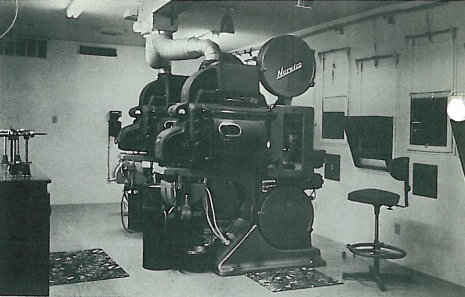
My first theater had two of what were at the time relatively new 35 mm Norelco projectors. At this time theaters commonly used two 35 mm projectors sitting side by side in the darkened upstairs projection booth. Movies were shipped in one or more metal shipping containers in roughly 5 to 7 20-minute reels. Since the Norelco projector used 1-hour reels, three shipping reels were spliced head to tail and wound onto the larger reel. Usually there was only one changeover. We spliced in short preview clips on the first reel. This gave folks time to hear the movie begin and rush to their seats after getting concessions. When customers weren’t bitching about the price of popcorn, they would complain about the previews. We ignored them. That decision was way over our heads.
Older model Norelco projectors in a typical projection booth. Source: Norelco.
Two projectors were used to avoid interruptions between reels. Near the very end of a reel, a black spot would appear twice in the upper right-hand corner of the image. The first time was the signal to be sure the lamp was lit and to get the motor rolling on the other projector. Shortly after this was the second appearance of the black spot. This time it was the signal for the changeover. This was the cue to drop the dowser on the first projector and block the light while simultaneously opening the dowser on the other letting light through the next reel. At the same time the sound was shut off from the first projector and activated on the second projector. The result was smooth continuity of image and sound between reels.
At this point, the take-up reel was rewound and put away, ready for the next run. Leaving unrewound reels for the next guy was a major faux pas. Wash, rinse and repeat.
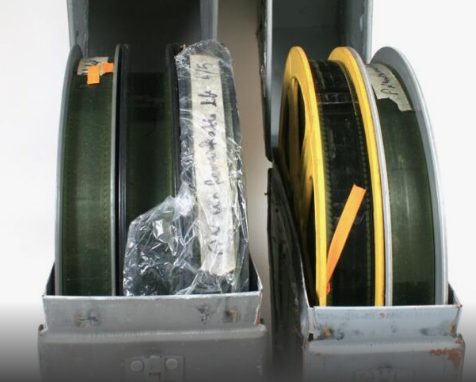
35 mm movies shipping reels. Source: ebay.
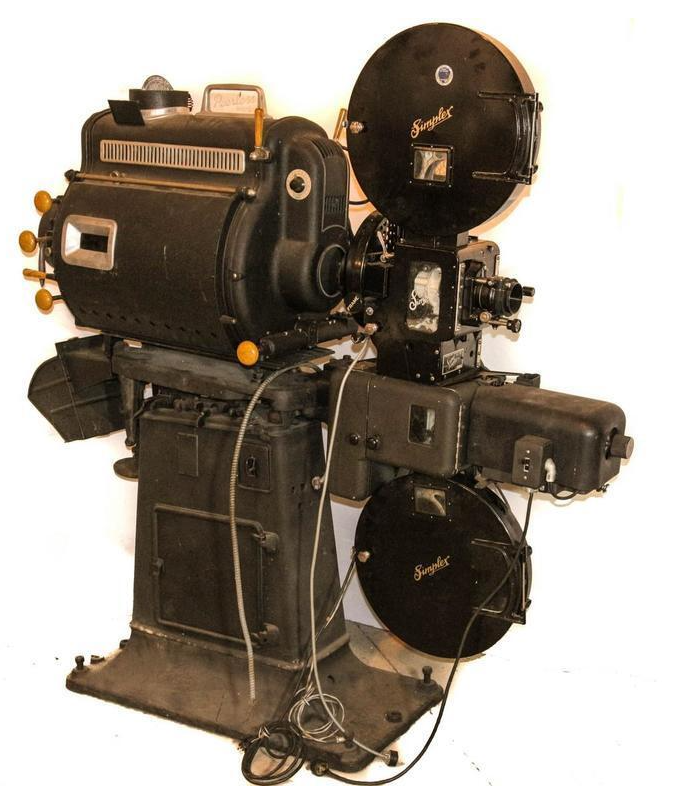
Most movies arrived on 5 to 7 reels in 2 or 3 shipping cans. The more common brand of projectors, Simplex 35’s, were designed to run the shipping-reel sized reels on the upper feed side directly. We’d use our own better-quality reels for use. The Simplex projectors came with carbon-arc lamphouses that required some attention when they were lit up.
A Simplex projector. It looks old because it is old.
Above is a common example of the Simplex 35 mm movie projector. It is comprised of a lamphouse, the upper feed reel, the intermittent movement and film gate, the spinning shutter, the optical sound pickup is below and slightly behind the image in time. The take-up reel is at the bottom. Between the shutter and the light is the dowser. There was one for manual use and later, one for automatic use. The purpose of these black pieces of thin metal was simply to block the light from getting to the gate where the film passed through. One reason is to avoid projecting an undesired image or white light onto the screen. It’s unprofessional and bad showmanship. The other reason is to prevent light getting to the film if the motor gives out and the film stops in the gate. Lamphouses generate considerable heat and a stationary piece of film will begin to melt within a second or two. Naturally, this fiasco will show up on the screen for God and everyone to see.
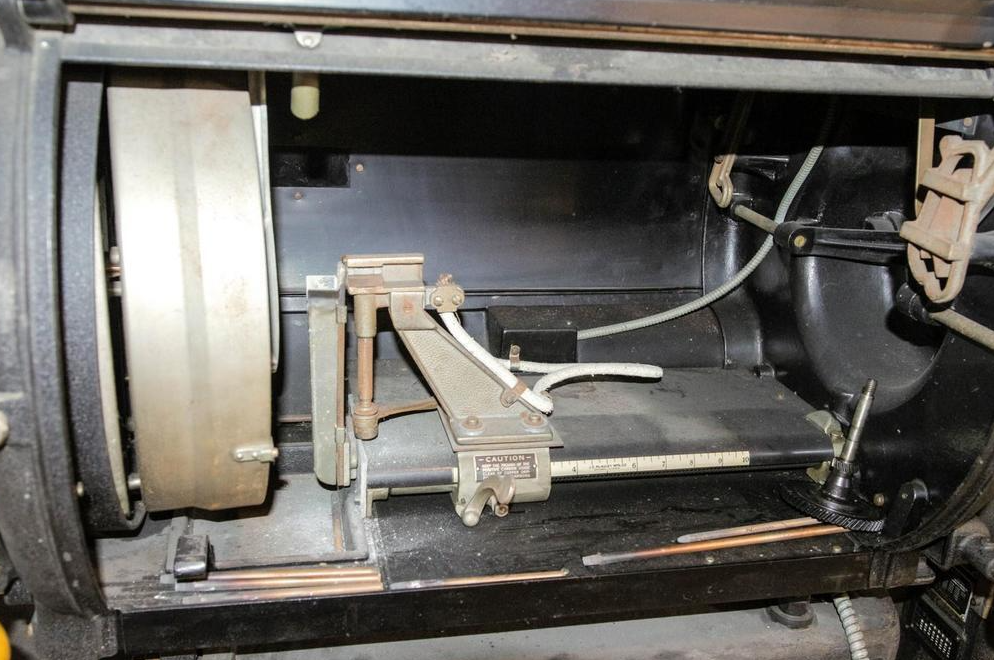
Inside view of the Simplex 35 carbon arc lamphouse.
The component in the center (above) of the housing held two copper-clad carbon rods which were slowly fed towards one another with one rod penetrating the mirror. The position of the rods was continuously moved towards the focal point as the rods burned up in the arc. Good ventilation was required. The purpose of the motion was to keep the size and shape of the arc constant and in the focal point of the parabolic mirror. Once the arc moved away from the focal point, the brightness of the projected image would diminish. If the gap between the rods became too long, the arc would wander around and become unstable causing flickering to appear on the movie screen. The arc lamp for our indoor theater used 70 to 80 amps DC. The high DC power was supplied by a vacuum tube rectifier. The projectors for our drive-in theater used 120 to 140 amps DC. Longer throw and larger screen.
Copper clad carbon rods for arc lighting in a movie projector.
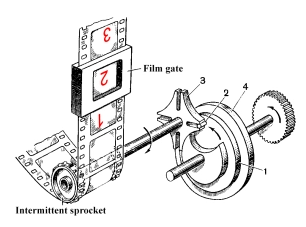
The gate mechanism was interesting. At its heart was a Maltese cross intermittent movement. It would twist a sprocket enough to pull the film down by one frame and then leave it there for a short time. While stationary, the shutter blades would alternate letting light pass through and blocking it. The frame rate was 24 frames per second, but to prevent flickering, each frame is shown twice. While the shutter blocks the light, the gate mechanism pulls down the next frame.
The intermittent movement pulled the film through the “ gate” for steady projection.
The intermittent movement pulled the film through the film gate and stopped momentarily in time with the shutter. The purpose of the gate was to clamp the film stationary in the focal plane for a moment while the light passes through. It was built to hold the film firmly in place but not adversely affect the movement of the film or damage it. Movie prints are expensive and not always replaceable, especially if they are older. One side of the gate had two smooth, polished steel sliding surfaces for the film sprocket-hole sides to slide on and the opposite side had two flexible steel bands sitting over the polished slides to apply light pressure to the film to prevent chattering.
The gate also holds the aperture which determines the shape of the light beam giving the image on the screen. It is just a thin black metal plate that has a precise rectangular hole in it. The idea is to put image on as much of the screen as possible. Apertures are defined by their aspect ratio, or the ratio of length to width. The most common aspect ratios are the normal 1.85 to 1 and the anamorphic wide screen ratio of 2.39 to 1. We used to refer to the anamorphic image as “Cinemascope.” The 1.85 ratio works well both in cinema and television. Movie theater screens were adjustable in width by black curtains called “masking.” There were two positions for the masking- fully open for wide screen Cinemascope and partially closed for the regular format. Theaters could have used fully exposed screens like they do today, but the aesthetics then was to cover unused screen at that time. The 2.39 to 1 Cinemascope format works well in the theater but adjustments have to be made for it on television screens. They will either lop off the left and right sides and convert it to 1.85 to 1, or they will broadcast the movie in letterbox form, preserving the entire image, but making it smaller vertically on the TV screen.
Some theaters use curved screens but most do not. If you think about it, the distance of the film plane to a flat screen is minimum from the film to the center of the screen. This distance, however, increases from the center to the edges of the screen. So, it isn’t possible to focus the center and the edges simultaneously. In practice, the center of the screen is put in focus. A concave screen overcomes this problem. The larger the screen the more obvious the improvement in focus will appear.
Projecting a large image onto a large screen has certain problems to contend with. A large image from a 35 mm frame will magnify any imperfections in the image like graininess and focus but also you will come up against limits on brightness of the image. The image on the film should be what the director intended- perfect and usually it’s quite good. Focus is mostly a theater problem. Focus degrades with image size inherently but also with how well the operator can use the focus knob on the projector.
When a complaint came in about the focus, I would check it right away. Usually, the image on the screen was already at the optimum focus. To show the audience we were attending to the issue, I would crank it way out of focus, then back through focus and to the other extreme. Then I would then bring the image back into focus carefully, demonstrating that the image on the screen was as good as it could get. At one theater we had a 960-seat auditorium with a large, curved screen. The large size of the screen image came from a 35 mm piece of film meaning the magnification was very large. Focus and graininess were always an issue.
The anamorphic lens will take a distorted image from the film and spread it out to give a proper wide screen image. On TV they refer to these movies as letterbox movies due to the wide image but narrow height on a TV screen.
So, what’s the deal with the noise? Projectors make a characteristic clattering noise that isn’t always very quiet. The film is fed to the upper end of the gate at a constant speed, but the film has to stop every 24th of a second so a stable image can be shown twice. The film motion into and out of the gate area goes from constant-feed to intermittent-movement to constant feed-out. To do this, a loop of film is placed a above and below the gate forming two bits of slack in the film. The slack is alternately fed in and out and pulled in by the intermittent mechanism. It’s a bit noisy, but the customers never hear it. There might be other noise from the motors and gearing mechanisms as well.
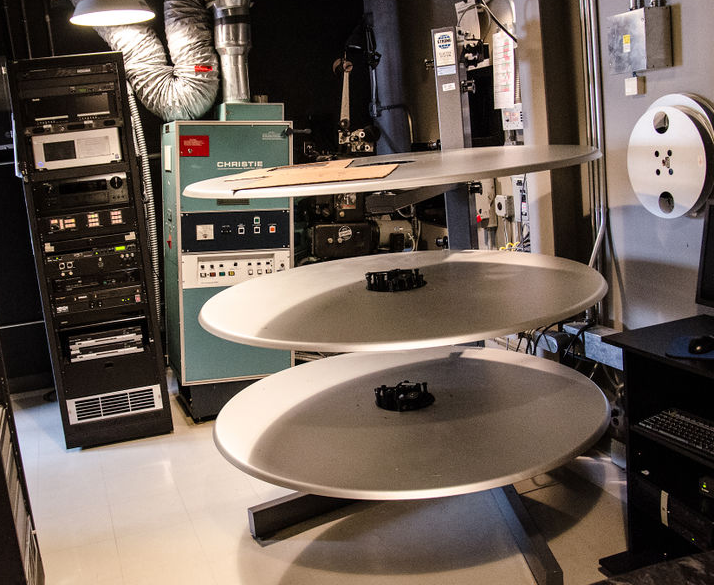
Platter projection systems eventually came along with better automation for easier use by people with a broader job description in the movie house.
A single projector system with platters feeding and taking up film, No rewinding or changeovers. Source: Sprocket School.
The platter system came to our neck of the woods in the late 1970s. Our platters were air driven so they made a constant whining sound. The entire film was spliced together with heads in the middle and tales on the outside. One platter fed the film to the projector and a second one was the take-up platter. The film fed through a speed control mechanism in the center of the platter and then on to the projector. Out of the bottom of the projector, the film threaded through a speed controller and then rewound on the take-up platter. The third platter was a make-up platter for putting together the next movie. This system was not so good for the projectionist profession but did allow the theater to have a manager run the projectors and take care of everything in the lobby as well. I used to be a manager/projectionist at a duplex theater then later at a 4-plex theater while I was an undergraduate. If there was a power trip and the projectors dropped out, I would have 4 auditoriums of upset folks to content with. The house lights would automatically dim up so the crow could conveniently find their way out to complain. Lucky for me I was in one of the two projection booths getting the projectors running and away from the mob spilling out into the lobby. On the good side they usually bought concessions while pacing in the lobby.
When splicing film reels together it was convenient to mark the splice location along the edge so it could be seen wound onto the reel. We used white shoe polish to mark 2 ft of edge. When we were breaking down a print to ship out, unless there was a mark between reels, you could easily pass the splice as you were rewinding onto the shipping reels. We saved the head and tail leaders and spliced them back on for shipment. This was always done late Thursday night during and after the last show. Any previews had to be returned as well. Over time, movies came with previews attached.
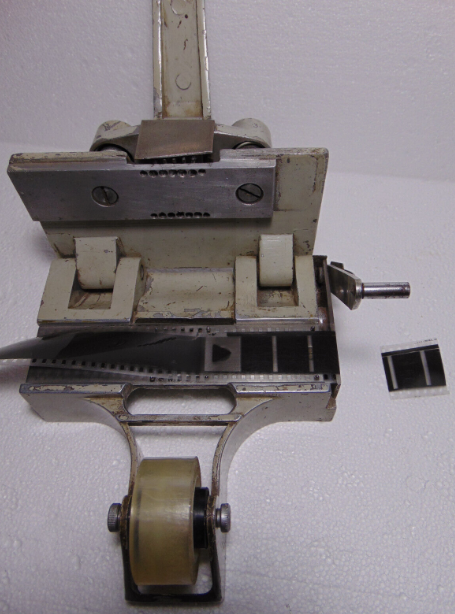
Tape splicer for 35 mm movie prints. There is a cutter on the right side for getting clean, square edges, and a roll of tape at the splice point. We would overlap the splices by 1 sprocket hole for strength. Butt splices were prone to failure after too many flexures but did not show during projection. Both sides of the print were taped. Note the holes on the top part. Punches would come out when in use to punch out the sprocket holes. Image from ebay.
The film lab where prints are made would do lab splices when a new roll of stock was needed in the middle of a reel. These splices were overlapped about 1/2 a sprocket length and were either thermally fused or glued. Normally you never noticed them.
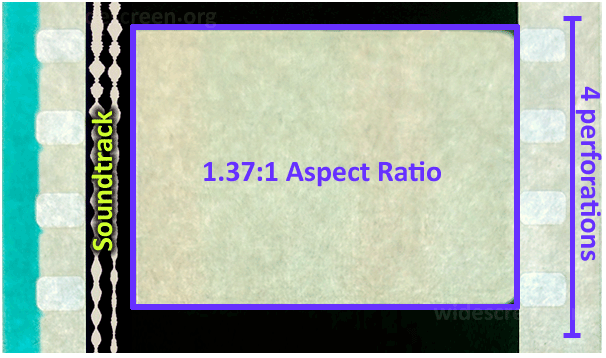
A “normal” movie print has one or two parallel optical soundtracks along one side that passes over the sound head. The sound head consisted of a lensed light source and a photodetector. The soundtrack(s) are black with variable transparent area that changes in proportion to the magnitude and frequency of the sound. Movies came with a single track early on and eventually changed to dual track stereo sound. In recent decades other schemes came along like Dolby sound and others. There are other sites where this is explained in more detail and with copy written graphics.
A 35mm movie print frame with dual soundtracks. The two soundtracks are different as you would expect stereo channels to be.
The Saturday Night fever Disaster.
On the opening Friday night ofSaturday Night Feverback in late 1977, I had just started the first showing. In the other theater, I started a sci-fi movie called Coma, written by Michael Crichton. Seeing that they were both running on our platter systems nicely, as manager/projectionist I had to attend to the lobby to check the ticket booth and grab some of the larger bills from the cash drawer and then the same at the concession stand. About 60 minutes later and into the third reel of Saturday Night Fever I went into the booth to check the projectors. Coma looked just fine. What I saw at the other projector floored me. I couldn’t believe it. Never had I dreamed that such a thing was possible.
What I saw was on the take-up platter of Saturday Night Fever. There was part of the film that was half gone across the film width. The film wound up smoothly as usual and the top surface looked smooth as it always did, except for maybe 80 % of a reel where the top half of the print was just gone! It looked like a gutter was gouged into the print. I looked everywhere in a panic for the missing film, many hundreds of feet of it, but it was not to be found anywhere. So I began to look closer at the print on the take-up platter. Where the next reel began (remember the shoe polish?), the layers of the film had a slightly different texture.
Feeling nauseated and incredulous all at once that I had destroyed a print of a blockbuster movie that people were dying to see during the very first showing, I stopped the projector, refunded 210 very hacked-off customers and halted sales for the next show. Turns out this was not really necessary but I did it in panic. Then I called the owner of the theater and explained what had happened. He was already pissed about something- taxes maybe- so my news just threw gasoline on the fire.
While he was on the way, I began to sort out what had happened. By the next day when I very laboriously removed the print, and instantly say what had happened. Early into reel 2 a lab splice had torn halfway across the width of the print, then down the middle for 80 % of the reel. It only stopped when it came to my tape splice between reels 2 and 3. So, this 80 % of reel two had piled onto the floor then at the beginning of reel 3 began to be pulled off the floor and onto the take-up platter where it neatly rolled up between layers of reel 3. Because it was from the top of reel 2 and layered along the top of reel 3, it wasn’t easily visible. Nobody had heard of such a failure before. Usually a print tore completely across and the projector automatically shut down.
The Simplex 35 platter projectors we had were equipped with a failsafe feature below the sound head. By this time, projectors had long had failsafe mechanisms, but they only detected tension in the film. This device did two things- it detected broken film and it detected a thin piece of conductive tape along the edge that would signal the automation to close the dowser and shut off the lamp to block the light, shut off the sound, dim up the background music (Neil Diamond, usually), signal the house lights to dim up, reset the masking curtains, and close the main curtains in front of the screen. The sensor consisted of two curved paddles that sat in the film path and across and against the film as it left the projector below the sound head. The stationary paddle picked up the shut-down metal tape that triggered the automation and the other spring-loaded paddle sensed the loss of film coming out of the projector. But it only sensed the presence of one side of the film. If the other side was somehow missing, there would be no film breakage detected. And that’s what happened.
The big problem was that we had an empty screen and needed a movie to throw on it. All 1400 of the Saturday Night Fever prints were in use across the world. There were no more, or so we were told. What we did to keep butts in seats was to show one print in 2 theaters simultaneously. Both projectors had Selsyn motors that would cause the two projectors run synchronously without creating or losing slack in the print between projectors. We called it “running in synch”. So, for 6 days we ran Coma on both screens. The cast included Geneviève Bujold, Michael Douglas, Elizabeth Ashley, Richard Widmark, and Rip Torn. Among the actors in smaller roles were Tom Selleck, Lois Chiles, and Ed Harris. It was pretty good.
There is an old saying that goes “necessity is the mother of invention.” Its meaning is obvious. It says that when you run into a problem, you can invent your way around it. Or at least try to. The other solution to a problem is simply to live with it.
I recall that during the Apollo project in the late 1960’s, many conservatives would complain about the cost of going to the moon. Social progressives likewise made a complaint that was directed at shifting those NASA funds to social programs here on earth. Technology progressives would retort that it is worth it because of all of the spin-offs that were appearing out of the effort. The reply to this was that if you wanted some shiny new widget, just invent it. You don’t have to go to the moon.
Presently I can look back at the two major research domains, academic and industrial, and make comparisons. In academia, a professor’s work product is split between research, teaching and service to the school. Research is commonly measured by the number of papers published, especially in the prestigious journals. In some institutions, patenting is also taken into account. As for teaching, there are student evaluations and performance reviews by the department chair or the dean. This includes past performance in committees. A motivation in the first few years is to get tenure. Academic research includes putting research results in the public literature for all to use.
In business there is “technology push” or “market pull.” Technology push means that you want a market to grow around your product or service. It will require some customers to be early adopters of first-generation product. Not everyone is eager to do this. Market pull, by contrast, means entering an existing market with your particular version of a product. Price and service are especially important in known-product sales.
So, what about the mother of invention? Generally, in chemistry an invention comes from some kind of investigative activity, curiosity or need. Sometimes you may want to invent around an active patent rather than go into a licensing agreement.
The US patent office allows only one invention per application. If you choose, you can lop off your other invention and file it separately as a divisional patent. You would do this because the patent examiner will have raised an objection to your original filing. Doing a divisional filing allows you to use content from the first, or parent, patent application and you get the filing date of the parent as well. Early filing dates are very important.
Sometimes patents are written very narrowly and leave “white space” or potential claims around them. This is not always desirable so the matter can be solved by the use of “picket fence patents.” You patent your core art as broadly as the patent office will allow, then you file for patents that cover related art that a competitor could conceivably patent that would allow them to compete against you. By raising the cost of entry into your market or narrowing the scope of new art, you can dissuade competitors from entry or at least make them pay a heavy price for it. Who knows, maybe they’ll decide to buy a license from you or even an entire patent. An argument against picket fence patenting is that patents can be very expensive.
Academic research has a high reliance on external funding. This requires that the funding organization recognizes the novelty and p[otential intellectual value of the research proposal. Industrial research has a high reliance on market potential of an invention. What is the breakeven time and sales potential of the invention? Will demand last long enough for the invention to provide a healthy return on investment?
Academics can and do patent their work on occasion, especially if the university pays for it. The thing I object to is that a great deal of research is paid for by the taxpayers. We pay for the research and then it gets patented and its use is restricted for 20 years. Maybe taxpayers (businesses) can enter into a licensing agreement, but maybe someone else has bought exclusive rights. Licenses can be somewhere between reasonable to absurdly restrictive, depending on the terms of the agreement. Many will want to add an extra fee based on the sales income of the product. This means that there will be an annual audit with pencil neck auditors poking around your business. It’s like having a ferret in your shorts. Avoid if at all possible.
But, many companies leverage their output through licensing agreements of technology they have no interest in developing.
Industrial research is quite different in terms of administration of the endeavor. Industrial chemists are supervised by an R&D director and use in-house technology and science and/or what they learned in college, but here the results are aimed at producing something for sale or improving the profit margin of a process. There is no desire to share information. Industrial research produces in-house expertise as well as, hopefully, patentable inventions. Industrial invention can be driven by competition in existing markets or by expansion into something entirely new. Often it is to provide continuous margin growth if market expansion is slow.
The argument can be made to keep everything as a trade secret. Publishing your art in the patent literature can help competitors have their own brainstorms about the subject, or some may even be tempted to infringe on your art that is carefully laid out in front of their eyes. Competitors may be cued into a new product’s capabilities and gives insight into new products.
Both academic and industrial chemists invent. The difference is that in industry some inventions or art are held in trade secrecy, even if they never get commercialized. Academic researchers can and do keep secrets when they are aiming for a patent, at least until the patent is granted. Compartmentalization in a research group is critical, since disputes about inventorship can kill a patent. Once issued, academics will publish as many papers about the patented art as possible. Commonly, patents are assigned to whoever pays for it- usually an organization. An academic patent is assigned to the inventor’s institution while in industry the company is the assignee. In both cases the inventor is usually awarded only a token of appreciation and the “satisfaction” of having a patent.
So, what about “necessity is the mother of invention”? There are some inventive projects that are too large or risky for a business or even a consortium of businesses to handle. I’m thinking of the Apollo Moon Landing program. The project required the resources of a government. A great deal of invention by many players allowed the moon landing to happen. The necessity for all of this invention was that the US government set a goal and farmed out thousands of contracts with vendors to make it happen. Much wealth was spread around into the coffers of industry, but with contracts having stringent specifications for man-rated spaceflight and tight timelines to be met.
That’s one of the values of having a government like we had in the 1960’s. They created the necessity and private industry made it happen. Despite the cultural upset of the 1960’s and the Viet Nam war, the Apollo Project worked. No astronauts died in space. This necessity/invention pressure does work.





 Lamentations on Chemistry
