For your viewing pleasure I have provided a link to a short but interesting video. It shows the disposal of large drums of wartime metallic sodium into a lake in Washington. It has that WWII news reel sound.
“Wartime sodium” in Washington suggests that the Na is from Hanford. Just a guess.
Engineers at the Gas Coalification Institute at Poltroon University in Guapo, AZ, have produced a breakthrough in the coalification of natural gas (CNG). Professor Horst Graben, Director of the GCI, announced a breakthrough in the carbonization of desulfurized natural gas. Graben said that using existing rail infrastructure to transport bulk carbonized natural gas would be more economically feasible than building gas pipelines to remaining coal fired power plants. He went on to say that plants burning this new fuel would not generate water vapor, eliminating a source of corrosion. The conversion from coal to CNG would require minimal modification of equipment.
Graben also disclosed a new process for the capture of CO2 and its direct incorporation into beer and soft drinks. Graben said that CO2-capture breweries and soft drink bottling plants could be built alongside the CNG power plants. The plans call for power plant exhaust to be piped across the fence to the beverage plants for immediate CO2 capture, eliminating the need for storage. Major bottling companies have already expressed interest.
The GCI plans to start up a pilot-scale plant in Confounded, Montana, in the second quarter of 2024. A 100 million metric ton per year plant is currently in the design phase.
It is guaranteed that if you write anything on the internet that is less than high praise for the American 2nd Amendment to the constitution, you will shake the crazy tree and trolls will tumble out all around you. So, here goes.
A dear friend has been piping up on Facebook lately with urgent warnings about many of his ultraconservative beliefs. Today it was a somber warning about the danger of losing the 2nd Amendment. Like many, he truly believes that we are in imminent danger of losing it to some dark and secret government conspiracy. I could offer in the comments that this is highly unlikely, that trying it could lead to a civil war and the demise of our democratic republic. As far as secret conspiracies go, it is worth remembering that three people can keep a secret if two of them are dead.
Commenting would only be ineffective and inflammatory and would result in damaging our lifelong friendship if I crossed swords with him. I don’t want this outcome even though I believe that he has gone off the deep end. I won’t offer criticism to his plainly crazy rantings. Why do I feel the need to comment?
Here is where it all goes nonlinear. To people like my friend, not falling in line with his 2nd Amendment belief is equivalent to giving support for eliminating guns. I have always had a nagging suspicion that there can be such a thing as an unhealthy fascination with weapons and their use. Even though I am not a gun enthusiast, I realize that attempting to remove guns from citizens would be like digging up a badger’s burrow bare handed and trying to yank the angry creature out while avoiding its dangerous gnashing teeth and sharp claws. It would be a fool’s errand and would end in a draw.
My friend’s early fascination with firearms fed his interest in joining the Navy when in his 20’s where he served on a missile frigate. There he learned a valuable trade that would later lead him to a highly technical career in the semiconductor field with much international travel. He chose well and did well. He has a strong moral center based on deeply conservative principles. I’m proud to know him.
While my friend served in the Navy facing actual hostility, I was in college thrashing around studying chemistry. His time was spent honorably defending the country. I spent a year in Air Force ROTC only to realize that I wasn’t military material. He gets to speak about preserving our rights with some authority and I get to speak about organic chemistry, with questionable authority.
In reality, we both get to voice our opinions about our democratic culture but the greater credibility can often go to the military veteran. They put their lives on the line for all of us- a very concrete contribution. My choice of becoming a scientist and contributing to the understanding of the molecular universe is much more abstract and remote. It can be hard for many to see the social benefit of a lifetime of contributing to science. In some ways scholarship is very self-centered and even hedonistic. My contribution seems to have been to help in the safe operation of a chemical plant and to help fellow employees maintain a comfortable living. Seems pretty tame.
It has been my experience that many boys pick up an interest in the martial arts and weapons in middle school. I think there is a legitimate nature or nurture question here but that is for someone else to consider. Middle school is an awkward time of hormones and conflicting behaviors and feelings. The feeling of control over your surroundings with new skills in fighting and weapons is natural and strong. This is an awakening that many boys experience.
After an NRA course in hunter safety as an early teen, I recall walking around a river bottom in the countryside alone with a .22 caliber rifle looking desperately for something to shoot. It was exhilarating. Luckily for the wildlife, no living targets appeared. Just having the gun in my possession made me want to fire it. And therein may be the problem.
It seems to me that the pure exhilaration of handling and shooting a firearm is an irresistible attraction to some people. You know, like sport shooting. There are people who just need to shoot at things. I’ve experienced it. Within the limits of lawful behavior, it’s not wrong to shoot at inorganic things.
The problem arises when people shoot other people as a way to resolve conflict against a background of law and order. The ability to commit violence from a safe distance is a plus with firearms that is lost on no one. Perhaps we should just yield to it and bring back dueling with pistols between consenting parties?
So, here is my conclusion. The US will continue to suffer through individual and mass shootings well into the future. As a society, there will remain a critical mass of people who will oppose any sort of gun control despite the positive counter examples from other countries. Empirical evidence doesn’t matter, only voting does and even that is now in question. The mindless gun violence will subside only when we stop wanting to display our personal power with threats of violence. There must be a large-scale phase change in psychology and some reasonable alterations in the legal environment behind it. Perhaps after a devastating world war Americans, or whoever is left, will decide to lay down their arms and choose non-violence. But I doubt even then it would happen. Violence is a primate thing that is hard wired into our brains.
This is a guest post written by a good friend and colleague who retired as an executive from the specialty chemical industry. He is an author and editor of a respected book on Grignard chemistry. It is an honor for me to post his recollections on this site with his permission.
========================================
The TOXCO Story – Part I
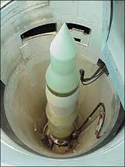
I suppose this story begins during the Cold War. The US had developed a triad of defense capabilities to deter Soviet aggression. We had the Air Force B-52 bombers armed with atomic weapons, the submarine based Trident missiles, and the land based ICBMs–first the liquid fuel Atlas rockets and later the solid fuel Minuteman missiles hidden is silos in North Dakota and elsewhere.
Then came 1989, the destruction of the Berlin Wall, the subsequent collapse of the Soviet Union and, suddenly, the Russians were no longer the dreaded foes whom we once feared. Maybe it was time to “stand down” our hair-trigger defense posture.
Those solid fuel Minuteman rockets were designed to be launched on short notice. Firing them required a significant amount of electricity. This was to come from the electric power grid. But our military, recognizing that this source of power could be compromised in the tense times leading up to a nuclear confrontation, needed a backup. As a result, each missile silo was equipped with a diesel powered electric generator, just in case.
But things could go wrong. The diesel fuel might be contaminated, or sabotaged by Russian saboteurs, or any of a number of other problems. So, in an overabundance of precaution, the military insisted on a “backup to the backup”. And what could be better or more reliable as a source of electricity, than a battery. To be sure, these would have to be BIG batteries, bigger and more powerful than any produced thus far, but they would be certain.
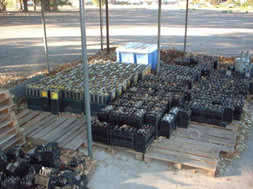
And so, the Defense Department commissioned the production of the world’s largest and most powerful batteries. These were based on lithium-thionyl chloride chemistry[1]. Each primary cell contained sheets of elemental lithium, surrounded by gallons of thionyl chloride, a reactive liquid which on contact with water produces a mixture of sulfuric acid and hydrochloric acid—really nasty stuff. These primary cells were each about the size of a coffin and it took three, ganged together to generate the power needed to initiate a missile launch. The government contracted for thousands of them and Union Carbide supplied them.
Apparently, at some point, there was a fatal incident involving a 10,000 amp Minuteman battery being drained and replaced[2] and this contributed to a decision in the early-mid 1990s to dispose of these hazardous items. The DOD issued a Request for Proposals (RFP) which caught the attention of a group of businessmen and entrepreneurs in southern California.
Operating in Orange County, California, headquartered in Anaheim, near Disneyland, were three affiliated companies. Adams Steel was in the ferrous metal recycling business-old washing machines, refrigerators, scrapped cars. Before you scrap a car, you remove the lead-acid battery and the catalytic converter. The battery, containing lead metal, lead salts and sulfuric acid is a hazardous waste and its disposal is regulated by the EPA. The catalytic converter contains precious metals such as platinum, rhodium and iridium. These two items (batteries and catalytic converters) were handled by Kinsbursky Brothers. Non-ferrous metals (common ones such as copper and aluminum and non-common ones like tantalum and gallium from electronic devices) were processed by Alpert & Alpert. The companies had worked together for a number of years.
Principals at Adams Steel and Kinsbursky decided to form a joint venture to bid on the lithium battery disposal opportunity. They created TOXCO for this purpose. It was headed by Terry Adams (the youngest sibling in the Adams family) and Steve Kinsbursky. And they won the bid. The government would pay TOXCO millions of dollars to dispose of these batteries that the government had paid millions of dollars to manufacture some years earlier. Your tax dollars at work.
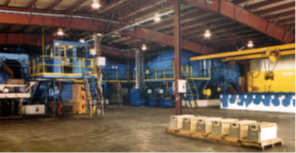
So, how do you dispose of a lithium-thionyl chloride cell weighing hundreds of pound and filled with dangerous and explosive ingredients? Well, if you are a mechanical engineer, trained at USC (as Terry Adams was), you take a mechanical engineering approach the problem. You have to neutralize the thionyl chloride and the lithium by reaction with water. And reactions take place more slowly (and more safely) at lower temperatures. So, the answer is to chill the cell in liquid nitrogen down to 77°K, put it in a large container filled with water and chop it apart with big mechanical knives (like you chop an automobile into small pieces for scrap). This actually works. Provided you’re certain that the cells have been fully discharged first. But don’t take the military’s word for it. If you do, there may be an embarrassing incident, as there was in 2000, during the disposal process.[3]
Next question. Where do you do this disposal? The TOXCO team discovered that there was an underused industrial site in Trail, British Columbia, on the Canadian side of the Idaho border. It had been part of the Cominco Smelter operations and was one of the most heavily polluted sites in North America[4]. What better place to site a hazardous battery disposal plant? If something went wrong, who would notice?
And so, TOXCO went into business, disposing of lithium batteries, successfully (except for a few incidents like the one incident alluded to above).
One of the by-products of this process was a stream of aqueous lithium salts. These had value and could be recovered and that put TOXCO into the lithium chemicals business. But that’s part II of this story.
The TOXCO Story – Part II (the Lithchem Story)
This story also begins in the Cold War. Even as the atomic bomb (the uranium and the plutonium fission bomb) was being engineered into reality at Los Alamos in the mid 1940s, plans were being made for the next generation weapon—a fusion bomb.
The first H-bomb, based on the concept of fusing light nuclei, was tested at Eniwetok in the South Pacific in 1953. Improvements in the initial “clunky” design quickly followed. One way to boost the power of the explosion was to surround the core of the bomb with a layer of lithium deuteride, LiD. Lithium is, well, the element lithium, atomic number 3 in the Periodic Chart. And deuterium is the name for “heavy hydrogen”, an atom of hydrogen, atomic number 1, but also containing an uncharged neutron[5]. Provided that the lithium used was of atomic weight 6, the fusion of the lithium(6) and the deuterium(2) would produce two nuclei of helium(4), plus lots of energy.
This would only work if you used lithium-6. Unfortunately, the lithium available to us on this planet in mineral form, deposited around the globe, is a mixture of lithium-6 and lithium-7 (the same element, but with one extra neutron). And God, in His infinite wisdom, chose to endow the earth with mostly lithium-7. Of the naturally occurring deposits of lithium, 93% is lithium-7.
So, if you need to use just Li-6, you have to separate it out from the more abundant, naturally occurring Li-7. And the US government proceeded to do just that. Starting in the 1950s, they processed millions of pounds of lithium containing minerals to extract the less abundant isotope that was required for its military purpose. For every hundred pounds of lithium salt they processed, they got, at most, 6 pounds of lithium-6 salt[6].
And what do you do with the “leftover” 94+ pounds. Well, you can’t just turn it back into the lithium chemicals marketplace. For one thing, it’s “depleted” lithium (missing its naturally occurring share of Li-6.) This would be easily noticed by someone using the lithium for routine chemical purposes. The extent of “depletion”, that is, of extraction of the Li-6 would be measureable, and that information was a secret[7]. Moreover, if the quantity of depleted Li were ever realized, that number could be used to infer the number of LiD containing bombs, and that too was a secret.
So, for more than five decades, for more than half a century, the US government simply stockpiled the “by-product” depleted lithium in a warehouse, in the form of the simple salt, lithium hydroxide monohydrate, LiOH•H2O. Millions of pounds of it. Packaged in poly lined, 55 gallon fiber drums.
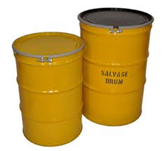
In later years, the cardboard drums began to deteriorate. Some of them were damaged during handling and relocation. Sometime in the 1980s the decision was made to repack the inventory in bright yellow steel “overpack” drums.
Now comes the early 1990s. The Cold War is over. Our nuclear secrets, at least those from the 1950s, are far less precious. And the Clinton administration is looking through Fibber McGee’s closet[8] to see what can be disposed of, and maybe generate a revenue stream for the government in the process.
What they discover is 100,000,000 pounds of “depleted” lithium hydroxide monohydrate, with a potential market value approaching $1 per pound. And so, it goes out for bids.
The terms of the sealed bid auction were that the final sale would be split 70-30 between the highest bidder (who would get 70% of the inventory) and the second highest bidder (who would get 30%, but at the high bid price).
This was a perfect set up. At that time there were only two lithium companies operating in the US who could handle this quantity of inventory—Lithium Corporation of America[9] and Foote Mineral Company[10]. And both of them knew that there was no incentive for overbidding since even the loser would get 30% of the supply.
And that’s where Lithchem appeared on the scene. The TOXCO team was already in the “recovered lithium” business. All they had to do was bid one penny more per pound than the other two majors and they would be awarded the lion’s share of the inventory. They incorporated Lithchem for that purpose. I’m told that LCA and Foote each bid the same number, somewhere in the 20+ cents per pound range, and Lithchem bid one cent more. As a result, Lithchem became the proud owner of 70,000,000 pounds of depleted lithium hydroxide monohydrate.
Now what? The principal use of LiOH is in the manufacture of high performance lithium greases, used in heavy industrial applications-heavy trucks, railroads, etc. Much of the market for lithium greases is in the third world and quality is less of a concern than price.
Still, to be sold on the open market, the LiOH from the government stockpile had to meet certain specifications. Some of the yellow drums contained beautiful white crystalline powder. Others contained dead cats and cigarette butts. It was “government quality” inventory.
One condition of the bid was that the winning bidder had to remove the inventory from its location in a government warehouse (in southeast Ohio[11]) within 12 months of the successful bid. I had the occasion to visit that warehouse, before the stock was removed and it was a memorable sight.
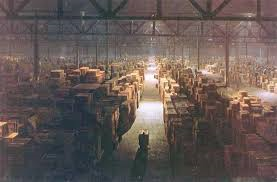
If you recall the final scene in the movie “Raiders of the Lost Ark”, the Ark of the Covenant is being stored in a gigantic government warehouse, filled floor to ceiling with identical gray boxes. A warehouse stretching far into the next county. Now replace those gray boxes with yellow overpack drums, stacked 6 or 8 high, stretching far into the next county. That’s what it was like. That’s what 70,000,000 pounds of LiOH hydrate looked like.
[1] The lithium – thionyl chloride primary cell has a high voltage (3.5 V) and a high current density.
[2]Battery Hazards and Accident Prevention, By S.C. Levy, P. Bro
[3] In November 2009 a fire broke out at the Trail BC facility in a storage shed containing lithium batteries slated for disposal. It was their sixth fire in fifteen years. Prior to that, a major fire in 1995 destroyed 40,000 kg of batteries at the facility. Three fires occurred in 2000, including one caused by some lithium batteries. This was during the summer when negotiations were underway between Toxco and Atochem for the acquisition of the Ozark business. http://www.cbc.ca/news/canada/british-columbia/trail-battery-recycling-fire-leaves-questions-1.805780
[5] Elements with the same atomic number but different weights are called isotopes. Heavy hydrogen (with an atomic weight 2) is an isotope of hydrogen (atomic number 1). Another example is carbon-14, useful for radiocarbon dating. It’s a heavier version of the more common version of carbon, C-12.
[6] Actually less than 6 pounds. The extraction process was less than perfectly efficient. The actual yield of Li-6 was a closely guarded national secret.
[7] In depleted lithium (with the Li-6 removed), the relative abundance of lithium-6 can be reduced to as little as 20 percent of its normal value, giving the measured atomic mass ranging from 6.94 Da to 7.00 Da.
Reuters: Tesla announced that they will begin mass producing the Cybertruck, their ugly monstrosity of a pickup, by the end of 2023. Oh joy. Maybe with any luck it will go the way of the Edsel. I condemn the vehicle solely on the basis of styling. It looks like something from a 1970’s low budget made for TV SciFi movie.
DW News: That fetid little pouch mouse leader of North Korea fired more than a dozen missiles across the Northern Limit Line in a single day as well as 100 rounds of artillery shells, rattling the nerves of South Korea and Japan. There is speculation that the scurvy little pustule intends to test another nuclear weapon soon. The guy seems anxious for a fight. One day he’ll get it.
Reuters: I just don’t understand Israeli politics. Netanyahu is close to winning a majority of seats in the Knesset in Israel’s 5th election in 4 years. I thought he was shown to be corrupt and thrown out of power.
Reuters: In the trial of the January 6 incident, the Oath Keepers defendant said “I felt it was like a Bastille time in history,” referring to the raid on the Bastille in Paris that led to the French revolution. I don’t think that these guys understand just what “tyrannical” really means. Thinking of the milquetoast Biden as a tyrannical leader seems, well, stupid.
An organization called the Well Done Foundation is working to cap abandoned and orphaned oil and gas wells spread across the country. The organization will adopt a well and get it plugged. This informative video gives an idea of what the foundation does. Forbes magazine has written an informative article on the subject. It would just be redundant to rattle off what is already on the interwebs so have a look at the Forbes article.
Reuters has reported that 4 of the 5 largest oil companies have reported a combined total of almost $50 billion in net income for the third quarter of 2022. Chevron reported a quarterly profit of $11.2 billion, its second highest ever, even against declining production over a year ago.
Exxon reported nearly $20 billion in net income while Shell earned $9 billion in 3Q2022. France’s TotalEnergies reported a record $10 billion in profits for the quarter.
This stark picture is one of record gas & oil company profits versus citizens struggling against the headwinds of rampant global inflation. One could counter that there is no such thing as too much profit. After all, companies always strive to maximize their profit margins to the greatest extent possible and that this is ‘normal’ behavior with a favorable outcome. Companies take risks and get rewarded with extraordinary cash flows now and then.
The reality is that sellers will always charge as much as the market will bear. This is ECON 101. But buyers control the release of cash from their pockets, most of the time. Petroleum distillates are an essential ingredient of life for most of us. If you cannot walk or bicycle to work, then some motorized vehicle must take you there. Zoning practices in the US make walking to work in a commercial or industrial zone problematic in most locations.
Politicians can hurl accusations of price gouging and maybe they will have some effect. A better approach is the reduction in consumption by consumers. It’s not always comfortable but it does work. We do have a handle to pull in this situation, but who wants to go first?
Today we hear about lithium batteries ad nauseum. Everyone is anxious to achieve a bright battery-powered electric future for happy motoring. Mineral exploration has revealed a few new sources of lithium and mines are increasing production. Battery factories are ramping up and R&D keeps turning out tweaks in battery technology. Many are betting on or prophesying the eventual phase-out of hydrocarbon fueled motor vehicles.
Lithium is quite scarce and is the 25th most abundant element on earth with about the same crustal abundance as chlorine although this may vary with the source. For the most part, lithium is fairly widely dispersed in the earth’s crust but it is subject to concentration by hydrothermal transport, forming evaporite deposits or briny ground water. Lithium is also a component of the mineral spodumene which can be found in pegmatites within some host formation. An uncommonly rich site was at the Foote Company Mine in the Kings Mountain Mining District of North Carolina. This operation produced lithium carbonate, Li2CO3. This is a common finished product because it can be removed from a solution of lithium chloride by treatment with sodium carbonate to precipitate the poorly soluble lithium carbonate.
This light metal has many chemical uses apart from batteries. For instance, organolithium reagents are a vital part of the chemical industry clocking in at about $1 billion per year in sales. Organolithium reagents are an indispensable part of organic synthesis. Switching to a reagent with a different metal usually does not work well, giving poor results or the wrong reactivity.
Today we’re seeing organolithium prices rise dramatically with little expectation that it will ever come back and no clue of how it plays out in the future. If a few select lithium reagents, e.g., LiAlH4 or n-butyllithium, go off the market, it will be a bad day for the organic synthetic industry as well as for chemical R&D in general. It is an unexpected consequence of the switch to reduced carbon EVs.
Vlad Putin has been ominously reminding us that he will not rule out the use of nuclear weapons if the Russian state is under existential threat, whatever that means. Maybe now is a good time to review just a few basics of nuclear weapons and what they do.
There are a large number of internet sites that go into great detail about the dark art and history of nuclear weapons. No need to duplicate that here. I’ll just give my take on a few points.
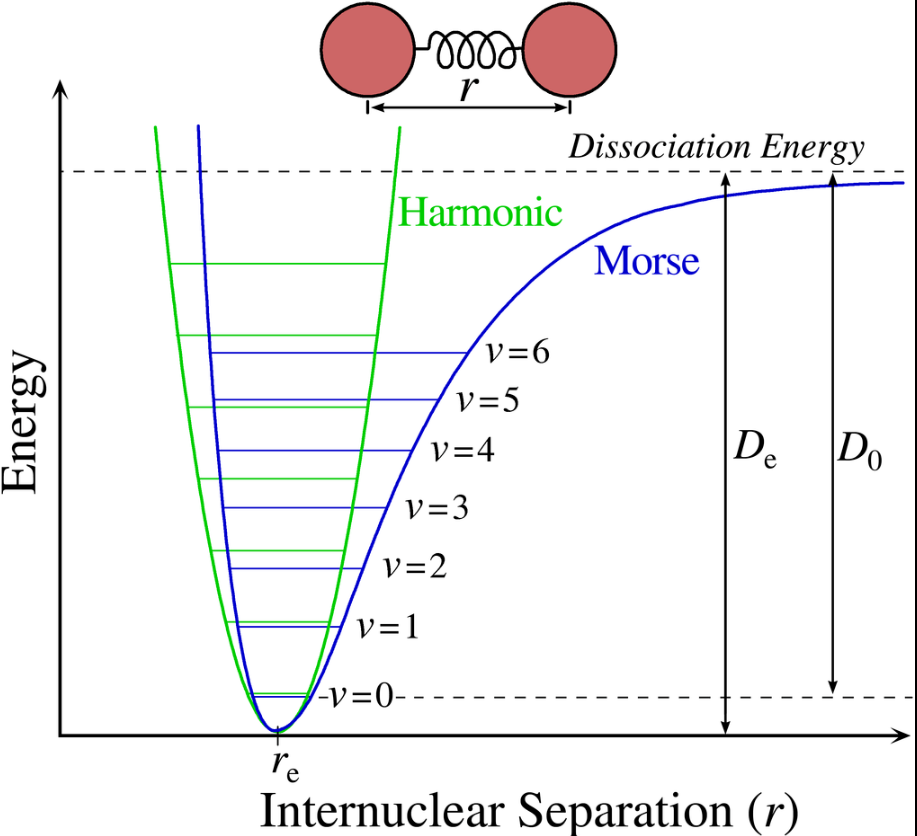
Remember the Morse curve from freshman chemistry? It describes the potential energy versus distance of two atoms at the scale of chemical bonds. The left side of the blue curve shows how steeply the repulsive energy potential rises (exponentially) with diminishing internuclear distance. By contrast, the attractive potential on the right of the blue curve flattens out with increasing interatomic distances. Keep this in mind.
When a fissile uranium-235 nucleus absorbs a neutron, the nucleus momentarily becomes unstable uranium-236. A stable nucleus has repulsive Coulomb forces between nucleons that are balanced at close proximity by the attractive strong nuclear force. The liquid drop model is useful for visualizing a nucleus as it fissions. On absorption of a neutron the uranium nucleus will distort to an elongated dumbbell shape leading to an imbalance of attractive and repulsive forces between nucleons. This can take the nucleus past the distance where the strong nuclear force attraction can hold it together. The strong nuclear force holding together nuclear particles (nucleons) falls off much faster with distance than does the Coulombic repulsion of protons. At the instant the nucleus separates into adjacent fragments, the two highly positively charged nuclei find themselves in very close proximity and are now only subject to net repulsive force. From the left side of the Morse Curve we can see that the repulsive force is exceedingly high in this moment. The highly repulsive potential energy is converted to kinetic energy at the moment the nucleus splits. The nuclear fragments fly apart at high velocity along with neutrons and dump thermal energy into the surrounding bulk material. But the kinetic energy of the fragments is not the only source of energy output.
Nuclear fission fragments are released in a highly excited state. Apart from their kinetic energy, nuclei have different energy levels with differing stabilities. A nucleus can undergo energy transitions from one state to another. These higher energy levels are called nuclear isomers and their stability can be expressed in terms of half-life. As fission fragments are formed they shed energy in the form of alpha, beta, gamma, and neutron emissions. Neutrinos are left out of this discussion for simplicity. As nuclei decay, they get closer to a stable ground state. Unstable nuclear fission products will decay in their characteristic ways, contributing to the overall energy release.
One challenge to weapons designers is to cause as many nuclei as possible to fission before the weapon undergoes “hydrodynamic disassembly” over the first 1 microsecond or less. After ignition the rapidly expanding plasma of the bomb core increases in volume and the probability of neutron collisions with nuclei diminishes rapidly. When a uranium or plutonium nucleus fissions, 2 or 3 neutrons are emitted which go on to strike other nuclei and induce fission in them. The cascading generations result in an avalanche of fissions. One of the ways to ensure that enough generations of fissions occur with enough neutrons flying about inside the supercritical assembly is to surround the core with neutron reflecting material. Ways of doing this can be found elsewhere.
One more thing about the strong nuclear force. This quote is from the Wikipedia entry for the strong interaction–
“The residual strong force is thus a minor residuum of the strong force that binds quarks together into protons and neutrons. This same force is much weaker between neutrons and protons, because it is mostly neutralized within them, in the same way that electromagnetic forces between neutral atoms (van der Waals forces) are much weaker than the electromagnetic forces that hold electrons in association with the nucleus, forming the atoms.“
A nuclear weapon produces a near instantaneous point source of energy release. These bombs can be detonated at or below ground or water level, or they can be set off in the atmosphere or space. The choice of where to do it depends on the intended effects. Subsurface bursts consume much of the explosive energy in moving soil or water which provides some radiation shielding to the surrounding area. Furthermore, bursts in contact with soil or water, especially when the fireball contacts the soil, tend to produce more fallout than air bursts. Air bursts deliver EMP, radiation and blast effects to a wider area, where “radiation” refers to neutrons, gamma and longer wavelengths of electromagnetic radiation. Thermal and blast effects produce considerable prompt destruction in the area surrounding the blast. As an approximate point source of energy, the intensity of the radiant energy falls off as some inverse square law. On an encouraging note, this means that radiation exposure falls off rapidly with distance. Distance is your friend.
There are numerous variations on the nuclear weapons theme. In the early cold war days, so called A-Bombs and H-Bombs were in the news. H-Bombs are also referred to as “hydrogen bombs or thermonuclear weapons.” An A-bomb, A for Atomic, was a basic implosion-type fission explosive and it was the typically the least powerful of the two. The H-Bomb was a nuclear fusion explosive that was triggered by a fission “primary.” That is, a fission trigger would be used to generate x-rays that would be “focused” onto fusion fuel, the “secondary,” which would initiate a runaway nuclear fusion explosion. The explosive yield of these bombs is much higher and can deliver a devastating blast to a larger area. Over time, the efficiency and compactness of these bombs has been greatly optimized.
The fusion explosive element was lithium-6 deuteride. The lithium atom would absorb a neutron, become unstable and decay into a helium-4 nucleus and a tritium (helium-3) nucleus. On a side note, in grad school I attended a seminar by Dieter Seebach from ETH, Zurich, who was talking about mechanistic work they’d done with lithium enolate complexes. He mentioned in passing that at that time, the mid-80’s, they had to be careful with stoichiometry because the commercial lithium that was available was often depleted of lithium-6 which was accumulated by the government for diversion to weapons. It was an unexpected brush with the cold war.
The main deleterious effect of radiation on human tissue lies in the formation of ions and radical pairs along the path of the penetrating radiation. The molecules of life are dissociated into ion pairs or radicals which may or may not collapse back to the original molecules. Given the amount of energy transferred into molecular dissociation along with random diffusion, the molecular destruction cannot be reversed. Heavy radiation particles like alpha particles produce a great many ions per centimeter of tissue penetrated. Penetrating, energetic photons like gamma rays produce relatively few.
There are 6 forms of hazardous radiation commonly considered- alpha, beta, gamma, x-ray, ultraviolet and neutrons. Of these 6, alpha, beta, gamma and neutrons are of nuclear origin. X-ray and ultraviolet are “electronic” in origin, that is they arise from electron transitions outside of the nucleus. The matter of the origin of x-rays is often confused in the literature with some authors implying that x-rays are from the nucleus. I prefer to define x-rays as resulting from electron transitions at the atomic level.
Of the 4 nuclear radiation types mentioned above, alpha, beta, and neutrons are particles. Gamma rays are photons. The atomic nucleus is comprised of so-called nucleons which are protons and neutrons. Nucleons are composite particles comprised of quarks and can bind by the strong nuclear force. Alpha particles are helium-4 nuclei and neutrons are neutral particles with approximately the same mass as a proton or about 1 atomic mass unit. Neutrons are not stable outside of the nucleus and have a half-life of about 15 minutes. Free neutrons will undergo radioactive decay into a proton, an electron, and an electron antineutrino.
Like gamma rays, neutrons are neutral in charge and have great penetrating ability. However, neutrons are effectively scattered by collisions with the hydrogen atoms of biomolecules and water. As a result neutrons can be very destructive to living tissue. As a side note, paraffin wax and water are effective shielding materials for neutrons due to the high concentration of hydrogen atoms. The collisions with hydrogen atoms in living tissues is a means of dumping neutron kinetic energy into the bulk matter, resulting in dissociation of biomolecules.
The so-called “neutron bomb” was an explosive that was designed to produce an abundance of neutrons at the expense of explosive yield. During the early Reagan years in the US there was much public handwringing about these bombs and their ability to kill people but leave buildings standing. People seemed indignant that somehow this reduced the value of human life below that of material things in the grand calculation of destruction.
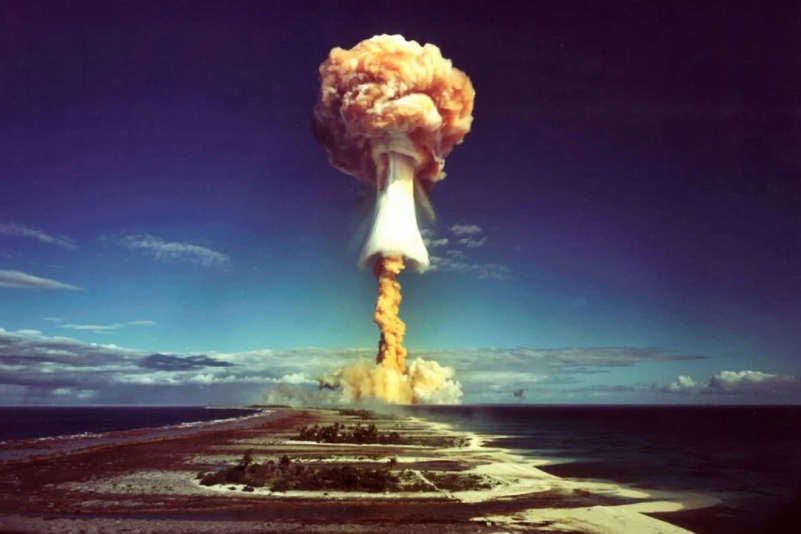
The characteristic mushroom shape rising to the sky after a nuclear air burst is just the result of a rapid release of energy and bomb debris in the air, but close enough to the ground to suck up soil. The “cap” of the mushroom results from the convectively rising point-source expansion of incandescent, debris-filled air from the point of energy release. The “stem” of the mushroom is a column of air that has rushed in to replace the rapidly rising fireball, picking up soil as it does so. There is nothing intrinsically nuclear about a mushroom cloud. Chemical explosives can do this as well.
Initially the fireball produces a strong pulse of thermal radiation. As this fireball develops, there is a momentary drop in radiant thermal energy due to the increasing opacity of the fireball. With further expansion the opacity of the fireball decreases and the thermal output increases. The shock wave and out-rush of air is obviously destructive, but the radiant thermal effects are not to be underestimated.
Another major effect of a nuclear blast is nuclear fallout. A nuclear blast unavoidably produces radioactive substances from the fission process and from neutron activation. A low altitude air burst is particularly troublesome because ground debris is sucked up into the air and contaminated with radionuclides. This material does what all suspended solids do, namely it is carried by the wind and falls back to earth gradually, contaminating a wide swath of ground. The finest particles remain suspended and are transported long distances, eventually falling out with rain or snow.
Finally, there are psychological effects associated with “the bomb.” It inevitably produces dread fear in people. This fear buttresses the idea of Mutually Assured Destruction or MAD.
Now that we are in a nuclear state of mind, let’s turn to what Putin intends to do with his nuclear arsenal. The Russians are not suicidal. Putin is neither crazy nor stupid. Russians have long understood where a nuclear confrontation with the West can go. They know escalation of nuclear war to full-scale would lead to mutual destruction of Russia and the West. The Russians know that the West has a policy of no first use with nuclear weapons and that we are extremely reluctant to use them. For the West, there is a firebreak between conventional and nuclear weapons. For the Russians, it is more of a continuum. They know that sabre rattling with their nuclear arsenal creates a good deal of anxiety in the rest of the world and Putin has been pushing this threat envelope to new levels and will keep doing so. Once a KGB guy, always a KGB guy. Putin obviously understands the pragmatics of coercion and the influential value of torture.
What nobody knows for sure is what happens when a Russian nuclear war shot is released. What does the West do? Respond in kind quickly or play the long game and see what happens next. How much planning has gone into nuclear conflict between two states outside of NATO? When would NATO step in? NATO is presently taking the side of Ukraine in terms of supplying money and arms but is studiously avoiding direct conflict with Russia. On the positive side, at least right now we aren’t bogged down with an endless middle east whack-a-mole exercise.
The best use of nuclear arms has always been and remains the threat of their use. Russia has been using this threat aggressively, even going so far as to blame Ukraine for planning a false flag operation with a “dirty bomb.”
Putin wants to see the alliance of the US and Europe disintegrate. He wants to see the American hegemony in place since WW II collapse. He wants to see the dominance of US culture, military reach, the influential dollar and prevalence of the default English language peel away. He wants to see Novorossiya rise from the ashes of the fallen USSR. But his vision requires the conquest of territory and cultural domination. The armed extinction project for Ukraine in process now will be followed by rebuilding the captured land with Russian infrastructure, political leaders and culture.
Russia, in its constant state of paranoia, wrings its hands about the “threat” of NATO at its border. The cruel irony is that it is hard to imagine that the West would find the conquest Russia possible or even desirable. The US-lead coalition was unable to get the medieval opium poppy kingdom of Afganistan under control with conventional weapons. How is it possible that we could even consider a preemptive invasion of Russia? Russia’s historical paranoia seems entirely self-serving for its authoritarian leaders.
One way to tear apart western alliances is to help them along with the demise of liberal democracy. Quietly support the internal cultural rot of individual nations by encouraging radical nationalism, white supremacy and political disharmony. It is happening all around us and especially here in the US. As badly as I’d love to entirely blame #45, I have to admit that he has only prodded a sleeping dragon. The MAGA and QAnon crowds were already out there. #45 has rallied them and validated their seething anger and indignation.
Today we have many people of great influence like Tucker Carlson, Alex Jones, Sean Hannity, nationalistic religious broadcasters, a stable of fringe political figures, and a mass of MAGA foot soldiers winning down-ticket elections moving their nationalistic and religious conservative agenda forward. Post-war baby boomers are being replaced with crowds and leaders who reject America’s present liberal democratic culture and leadership role in the world. There is growing open admiration for strongman authoritarian leadership. America’s experiment with fascism has already begun. Surprisingly, many Americans have expressed support for Putin.
Putin’s vicious attack on Ukraine, the rise of Trumpism with American fascism and a viral pandemic have overlapped within a narrow window of time- any one of which is a big problem by itself. It seems doubtful that MAGA right-wing crowds will have a change of heart in their vision for America. They will live out their lives within the same closed ideological space they are in presently. A political depolarization of America seems unlikely in the near term.
In this depressing global political climate it is more important than ever for the US to maintain its role as a thriving democratic culture and defender of those seeking democracy. Our leadership role in NATO must not waver against Russian aggression and expansionism. Russian expansionism will not end with Ukraine.
What will Putin do if he sees his internal political power structure collapsing? Will he ramp up the war to distract his opponents and rally the country? The present situation in Russia seems to suggest that rallying the population is more difficult than he anticipated.
It is hard to believe that Putin and his inner circle will change their ways in their lifetimes. They’ve painted themselves into a corner with their aggression and, like a trapped animal, will fight to the death. The cruel and murderous Joseph Stalin died in power. There is no reason to believe that Putin will be any different.
Russia sent a letter to the United Nations accusing Ukraine of preparing to use a ‘dirty bomb’ in their battle with Russia. Western countries have claimed that this is nothing but a transparent attempt by Russia to provide a pretext for their own use of a dirty bomb or some other offensive action.
This issue resembles the matter of Weapons of Mass Destruction (WMD) that the Bush administration in the US contrived as a pretext for taking down Saddam Hussein. A great many innocent people died and we damaged our moral authority in the world by that and other wars. It was an obvious lie to a great many Americans and allies yet the Bush administration went forward with the invasion. No WMDs were found.
According to Wikipedia, a dirty bomb is a conventional explosive packed with radioactive material that, on detonation, disperses the dangerous material in the target area. Such a thing could be made portable or assembled on site. It is not to be confused with a nuclear bomb. A dirty bomb blast would be a radiological calamity wherever it is set off as well as downwind of the explosion. Being non-nuclear, dispersion by a conventional explosive would be extremely limited in range in terms of blast effects, but intensely radioactive. As with any sudden generation of dust and smoke, there would be a plume of radioactive material (RAM) extending downwind from the release. Water soluble radioactive materials would pollute the watershed and possibly groundwater. Contaminated soil would exclude the area from farming for many decades if not longer. Great harm would befall the biosphere.
Construction of a dirty bomb could be quite problematic for its builders. Assuming the builders of the bomb are not suicidal, collecting RAM, assembling and delivering the bomb could be tricky. On one end of the scale, spent nuclear fuel could be used as the source of RAM. Assembly could be as simple as packing explosives around a container of RAM. To prevent serious exposure to the workers, there would have to be some kind of shielding present during the handling of the RAM. On the lower end, a small RAM source from a medical device could be used. Whatever the case, the containment must be fragile enough to rupture in the explosion but dense enough to provide some level of shielding for the handlers.
The harmful effects of a dirty bomb would be both radiological and psychological. On the psychological end, it is sure to cause dread fear in the general population and sway public sentiment toward one side or the other. Importantly, its use would be releasing the nuclear weapons genie from its bottle. It would lower the threshold and allow war planners everywhere to reconsider their own use of nuclear strategy and tactics because a precedent has been set. Once the genie is out, there is no putting it back, or so the saying goes.
In all of the war gaming and planning NATO has done over the decades, I wonder how much attention has been given to responding to nuclear conflict between non-NATO states? What should the NATO countries do if other actors engage in nuclear conflict? As always, it depends on the circumstances.
==========================
I have chosen to avoid using the term “explosive device” because I feel it has a certain sanitizing effect. A thing that is meant to cause death and destruction by the explosive release of energy is just a f*cking bomb with all of the meaning and negative connotation associated with the word. Even grudging admiration for someone’s cleverness should not be awarded for putting together a “device.”


 Lamentations on Chemistry
