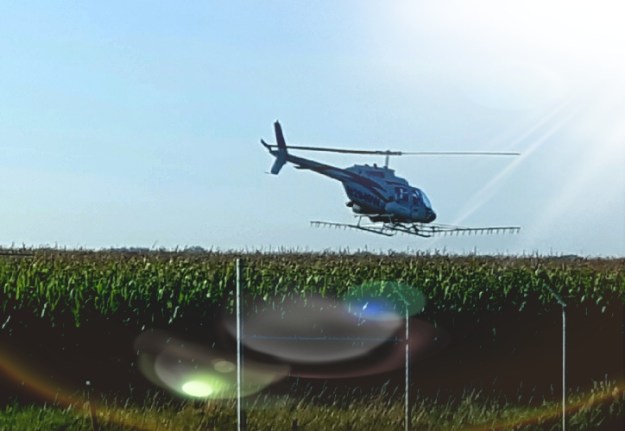
I get to enjoy a commute through farm country every work day. It is my habit to pull over and watch the crop dusters when they’re out. I’m secretly jealous of them as they zoom with their wheels just above the crop in a powerful turboprop aircraft. In the fall of 2017 I caught this fellow spraying what I estimate is an antifungal onto a corn crop near the end of the growing season. The negative image seemed more interesting than the positive.
Duster in Negative Space
Helicopters show up now and again. These folks can do a 180 turn at the end of a pass faster and in a tighter space than can a fixed wing aircraft. Also they can pause to think about things whereas a fixed wing aircraft cannot.
Crop Dusting Chopper
Think what you will about spraying. If they’re out there, I’m going out to watch, but not so close as to smell the spray.
As I look back on the chemistry coursework I took as an undergrad, a few classes stand out as especially useful over my career. First some qualifications: I became an organic chemist because I found it to be a good “fit” for my brain. So, organically oriented courses were obviously useful. The chemistry department at my alma mater followed guidelines for the ACS Certified curriculum. Thus required coursework was prescribed and completed.
Chemistry coursework of enduring value.
Sophomore Organic Chemistry: Fortuitously, I took 2/3 of my general chemistry in the preceding summer, so I was able to take organic chemistry in my freshman fall term. This was the great awakening. It was crystal clear that this was what I was meant to do. The benefits from a course on organic chemistry are many. Foremost on the list is that it is structurally and mechanistically oriented. The cognitive benefit is that a structural and mechanistic approach can render the subject a bit less abstract. At least to highly visual people like myself.
Molecules are tiny objects with even tinier places on them where certain things can happen. Reaction chemistry is revealed as a graphic sequence of specific events on specific objects. This allows the mind to put together patterns of functional groups and reaction motifs. In my view, a year of organic chemistry is the reward for slogging through a year of general chemistry. Gen Chem doesn’t make you a chemist. A tech perhaps. But gen chem is to the chemistry curriculum as The Hobbit is to The Lord of the Rings- a necessary prelude. That is what I used to tell students, anyway.
Qualitative Analysis: This was the third quarter of a 3-quarter sequence of freshman chemistry. It was heavily lab oriented with a focus on the separation and identification of inorganic cations and anions. It was substantially descriptive chemistry where clever schemes were used to isolate ionic species.
Analytical Chemistry: This is where you really begin to feel like a chemist. We all learn skills in this class that last. It is measurement science and error analysis. Every chemical scientist should have a solid foundation in wet chemistry.
Instrumental Analysis: This class was taken after Analytical Chemistry and built upon learnings from it. I’d offer that time spent on learning how your detectors work and their limitations is invaluable.
Organic Qualitative Analysis: I’ve come to learn that this class was an unusual experience. We learned to identify organic substances using fundamental means for 1982. Melting points, melting points of derivatives, NMR (60 MHz!!) & IR spectra, solubility, sodium fusion, Lucas Test, 2,4-DNP-hydrazones etc. We were required to get three data points per unknown to conclude that we had identified the substance. An indispensable resource was a compendium of derivative properties. A challenging but good experience.
Undergraduate Research: Two years of this experience was invaluable as a prelude to grad school. The asymmetric reduction of ketones (1982-84) work here lead to my doing a doctorate in asymmetric C-C bond forming chemistry and a postdoc in catalyzed C-H insertion chemistry. This activity is a must for those who want to pursue post-graduate work.
Advanced Organic Chemistry: What can I say?
Advanced Inorganic Lab: Good experience. Did some glass blowing. Worked on a vac line, tube furnace, and in a glove box. Good intro to airless work which would be important in grad school.
Chemistry coursework that was inadequate.
Inorganic Chemistry: I took this class in a time when symmetry and spectroscopy topics were an emphasis in the textbooks. Maybe it is still like that. But I wish we could’ve spent more time on descriptive and preparative inorganic chemistry.
Physical Chemistry: At the time it seemed as though the mathematical manipulations were more important than what the relationships actually meant. Statistical mechanics was played down in favor of more time on quantum mechanics. On entrance to grad school of the 5 qualifier exams taken, stat mech was the only one I failed.
Coursework outside of chemistry that has been of enduring value.
Microbiology: My only college bio class. I swear that this class has saved me from food self-poisoning more than I realize. That is a lifelong benefit, but so was the insight into a fascinating world. The course included an intro to immunology which also has been useful.
Communications: I made great strides in learning how to do public speaking.
Russian Language: Took only 1 year- just enough to be dangerous. It was of nearly zero help when I eventually visited Russia years later on a business trip. I was interested in the history and politics of Soviet Russia in that slice of time during the cold war.
Computer Programming: Should have taken more classes. In the early eighties we had to use either punch cards or the DEC terminal. Oh, I hear that FORTRAN still sucks.
Air Force ROTC: The biggest benefit was that I learned I am not military material in any sense. But, the communication skills and the history of air power were useful. I couldn’t march to save my life. I was Gomer Pyle.
One of my work duties is to give safety training on the principles of electrostatic safety: ESD training we call it. The group of people who go through my training are new employees. These folks come from all walks of life with education ranging from high school/GED to BS chemists & engineers to PhD chemists & engineers. In order to be compliant with OSHA and with what we understand to be best practices, we give personnel who will be working with chemicals extensive training in all of the customary environmental, health and safety areas.
I have instructed perhaps 80 to 100 people in the last 6 years. At the beginning of each session I query the group for their backgrounds and ask if it includes any electricity or electronics study or hobbies. With the exception of two electricians in the group, this survey has turned up a resounding zero positive responses.
Admittedly, there could be some selection bias here. It could be that people with electrical knowledge generally do not end up in the chemical industry. My informal observations support this. But I’m not referring to experts in the electrical field. I refer to people who recall ever having heard of Ohm’s law. One might have guessed that the science requirements for high school graduation may have included rudimentary electrical concepts. One might have further suspected that hobby electronics could have occupied the earlier years of a few attendees. Evidently not. And it does not appear that parents have been very influential in this matter either.
I’m struggling to be circumspect rather than righteous. It is not necessary for any given individual to have learned any particular field of study. It is not even necessary for most people to have studied electricity. But it is important for a core of individuals to have done so. So, where are they? And why aren’t more people curious enough to strike out on their own in the acquisition of electrical knowledge?
Back to electrostatics. In order to have a working grasp of electrostatic principles, the concept of the Coulomb has to be conveyed. Why the Coulomb? Because it is the missing piece that renders electrostatic concepts as mechanistic. It is my contention that a mechanistic grasp of anything can help a person to reason their way through a question. The alternative is rote memorization. The mechanistic approach is what drives learning in the natural sciences.
To be safe but still effective as an employee, a person needs to be able to discriminate what will and what will not generate and hold static charge to at least some degree in a novel circumstance. By that I mean how accumulated or stranded charge can form and what kind of materials can be effectively grounded. If you are working with bulk flammables, your reflexes need to be primed continuously to recognize a faulty ground path in the equipment around you. At the point of operation, somebody’s head has to be on a swivel looking for off-normal conditions.
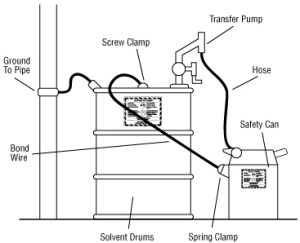
It is possible to cause people to freeze in fear and over-react to unseen hazards like static electricity. But mindless spooking is a disservice to everyone. To work around flammable materials safely requires that a person understand and respect the operating boundaries of flammable material handling. Those boundaries are grounding and bonding (see NFPA 77), avoiding all ignition sources, good housekeeping, and maintaining an inert atmosphere over the flammable material.
Much of electrostatic safety in practice rests on awareness of the fire triangle and how to avoid constructing it.
Back to electrical education. There are numerous elements of a basic understanding of electricity that will aid in a person’s life, including safely working around flammable materials. One element is the concept of conduction and what kinds of materials conduct electric current. Another is the concept of a circuit and continuity. Voltage and its relationship to current follows from the previous concepts.
I would offer that the ability to operate software or computers is secondary to basic knowledge of how things work.
Connecting these ideas to electrostatics are the Coulomb and the Joule. One volt of potential will add one Joule of energy to one Coulomb of charges. One Ampere of current is one Coulomb of charges passing a point over one second. Finally, one Ohm is that resistance which will allow one Ampere of charge to move by the application of one volt.
For a given substance- dust or vapor- a minimum amount of spark energy (Joules) must be rapidly released in order to cause an ignition. This is referred to as MIE, Minimum Ignition Energy, and is commonly measured in milliJoules, mJ.
A discussion on sparking leads naturally into the concept of power as the rate of energy transfer in Watts (Joules per second), connecting to both the Joule and Ohm’s Law. Rapid energy transfer is better able to be incendive owing to the finite time needed for energy to disperse. Slow energy transfer may not be incendive simply because the energy needed to initiate and sustain combustion promptly disperses into the surroundings.
A discussion of energy and power is useful for a side discussion on how the electric company charges for energy in units of kilowatt hours (kWh). This is a connection of physics to money.
The overall point is that a rudimentary knowledge of electrical phenomena is of general use, even in the world of chemical manufacturing. I often hear people talk about the importance of “tech” in regard to K-12 education. By that they seem to say that using software is the critical skill. I would offer that the ability to operate software or computers is secondary to basic knowledge of how things work. Anyone with a well rounded education should be able to learn to use software as they need it.
Addendum 8/16/18. Since I wrote this essay, I’ve taught another 2 groups of trainees and not a single one of the 12 individuals could say that they had heard of Ohm’s law. All were high school grads over an age range of 22 to ~50. One had fresh BS Chem. E. degree. Evidently none had enough inclination in their travels to noodle their way through a rudimentary grasp of volts, ohms, amperes and basic electronic components. I find this incredible given the penetration of electrical contrivances in our lives.
This feeds into a pet theory of mine that true expertise is being replaced with software skills. I know this because it seems to be happening to me as well. Is this an aspect of the Dunning-Kruger effect?
Interesting. I know two chemists and an engineer from my miniscule spheroid who have recently joined the marijuana extraction industry here in Colorado. Crimony, it makes me wonder what my problem is. Alright, it turns out that’s easy to explain. I really dig reaction chemistry and thermo, you know, real sciency stuff. Not much of that in the retail or wholesale extractives business. I have this suspicion that it will soon – if not already – be corporatized, IPO’d, and raced full throttle by scheming finance MBA’s like every other growth business. They can have it. Capitalism is like a stomach- it has no brain. All it can do is endlessly demand more.
After another tedious weekly teleconference our group adjourned and stood up from the table in the conference room. I was furthest from the door but my normally rapid pace put me in the lead to exit. All at once mid-stride, just as my rearward foot began to move forward, it caught a phone cord that became taut instantly. Consider that a walking stride is a series of balance/off-balance conditions where the walker is constantly catching his/her balance. I had been caught off-balance at the wrong moment in my step.
My recollection of that falling moment brings to mind the droll voice of the bowl of petunias in The Hitchhiker’s Guide to the Galaxy. Resigned to its fate, its final lament is “Oh no, not again.” I can relate.
Mid-fall my lips came within a hairs breadth of landing face first on an armrest. Luckily I hadn’t shaved that day so I actually had that hairs breadth. On impact with the carpeted floor my first emotion was one of anger. I had successfully negotiated the cords for nigh on eleven years. But this day it was not to be. This day I would tip like a sack of dirt in front of a room full of colleagues.
After a moment on the floor I spouted an incredulous “Mother F**ker!!“ followed by an equally enthused “Son of a B*tch!!” Truth be told, it was an utterly sincere cleansing of my dismay. My screens were down and the profanities leapt into the ether. After a few awkward moments I got up and repaired to the solitary confines of my office.
Later I jokingly apologized for my “gravitationally-induced Tourette’s.” I gathered that the unexpected outburst had provided a welcome bit of mirth after a highly technical meeting.
In the course of my forays into chemical sourcing or searching for data, I have begun to notice something about product entries in the online Sigma-Aldrich catalog. I’m finding that since the acquisition of Sigma Aldrich by Merck KGaA, MilliporeSigma as it is now known, many of the compounds that I find listed say the product has been discontinued. Is it just fortuitous, or is it not? Is the catalog collection being trimmed?
Have I been collecting data? Pffft! Of course not, silly. It’s just the subjective experience of having found few if any Aldrich catalog entries labeled as discontinued over the past few decades. Recently I’m landing on the pages of discontinued products. Hmmm.
Over the many years, buying reagents from Aldrich has saved countless chemist-days in lab productivity. In fact, the availability of their huge collection of chemicals has driven the direction of much research out there based simply on the availability of reagents for purchase.
I blame the MBA’s. This has the smell of overly smart weasels marketing people.
A recent paper (free) in Geophysical Research Letters reports the discovery of long anticipated ionospheric disturbances caused by the passing of the moon’s shadow over the earth during an eclipse. The paper, submitted by the MIT’s Haystack Observatory, reports the occurrence of ionospheric bow waves associated with the shadow ground-track of the August, 2017, North American eclipse. The online source, MIT News, summarized the discovery.
I’ve been using a Mettler-Toledo (MT) RC1e reaction calorimeter for about 6 years. Our system came with MT’s iControl software, RTCal, and 2 feed pumps with balances. Overall it has proven its worth for chemical process safety and has helped us understand and adjust the thermal profile of diverse reactions. Like everything else, MT’s RC1e has many strengths and a few weaknesses.
The RC1e’s mechanical side seems reasonably robust. Our instrument sits in a walk-in fume hood resting on a low lab benchtop supported by an excess of cinder blocks- it is a heavy beast. During installation we discovered that the unit would not achieve stable calibration with the hood sash closed. The control box mounted on the instrument didn’t work properly on installation. After a trip to the repair shop, the box was returned as functional but without finding the fault.
Recently we had a mixing valve fail in the heat transfer plumbing, resulting in down time. Diagnosis of this was unsuccessful over the email and phone, necessitating a service call. Parts may not be inventoried in the US and consequently must come from Switzerland. Expect Swiss prices and less than snappy delivery. Hey, it’s been my experience.
Addendum, 5/4/22: After a nearly 1 year period of down time the RC1 was reinstalled at another location. Due to temperature regulation problems after the move, a technician from MT visited and repaired the instrument. It turns out that swapping one of the hot legs on the 208 3 phase feed for another can cause the stir motor to reverse direction. A relief valve related to the heat transfer system had failed in the partially open condition. It was fixed and the instrument now performs as expected.
Addendum 2, 6/10/22: The RC1 has failed again. The “fix” didn’t work. Same problem as before. Maybe in the next repair they’ll replace the bloody valve rather than just “unstick” it. Unrelated gripe- Getting parts from Mettler-Toledo in Switzerland has been frustrating. They have always been very slow. So much for Swiss efficiency.
A chiller unit is required for RC1 operation and can add 15-30 k$ to the setup cost. Users will have to contend with the loss of floor/hood space in the lab for the chiller and RC1. The chiller must be powerful enough to contend with the exotherms that may be generated in the instrument. Chillers can take many hours to get down to the set temperature. Given that RC1 experiments can also be lengthy, plan accordingly. Our (brand new Neslab 80) chiller requires nearly 2 and 1/2 hours to get from +20 C to -20 C, which is the lower chiller temperature we use, depending on the reaction chemistry. For reactions that are on the sporty side, we’ll drop the chiller to – 50 C. This is near the minimum temperature for the water-based chilling fluid we use. Early on I opted for an aqueous potassium formate solution with a very low freezing point. The instrument comes with a panic button that switches to full cooling in an emergency.
The chiller required the wiring-in of a dedicated single-phase 208 VAC circuit. With the chiller using single-phase and the RC1e using 3-phase 208 VAC, it is important to assure that one cannot inadvertently connect into the wrong power circuit (idiot proofing). The chiller plug design should already prevent this. It is critical that the electrician is alert to this and does NOT jury-rig the plugs to use the same style of connectors because he has only one style in the parts bin.
Some comments on the collection and interpretation of RC1 thermograms.
It is critical that those who request RC1 experiments understand the limitations of the instrument. For instance, we use a 2 Liter reaction vessel with a 400 mL minimum fill volume. Refluxing is not allowed owing to the huge thermal noise input from the reflux return stream. Special equipment is said to be available for reflux.
Experiments must be carefully designed to elicit results that can answer questions about feed rates and energy accumulation.
Like many instruments, the RC1 needs a dedicated keeper and contact person for inside and outside communication. A maintenance logbook should be kept next to the instrument if for no other reason than to pass along learnings from previous issues.
If thermokinetic measurement is part of your organization’s development SOP, someone on staff should be reasonably familiar with some chemical thermodynamics. That can be a chemical engineer, as may often be the case.
The users of thermal data are likely to need help with interpretation of the results. Be prepared to offer advice on interpreting the data, taking care not to over-interpret. If you don’t know, say so. It is easier to claw back “I don’t know” than “yeah, go ahead and do that …”.
Do not be anxious to singlehandedly bear the weight of responsibility for safety. Safety is a group responsibility.
Be curious. How do the insights and learnings from the data translate into best practices? What changes, if any, can the process chemists make to nudge the process for better safety and yields? A credible specialist in RC can make comments or ask questions that lead to better discussions on thermal hazards. Be a fly in the ointment.
Never forget that a reaction calorimeter is a blunt instrument for the understanding of a reaction. An RC1 thermogram is a composite of overlapping solution-phase phenomena. Interpretation of results can be greatly refined by pulling timely aliquots for NMR, GC/MS, or HPLC analysis.
A database should be constructed to collect and immortalize learnings from all safety work and RC1 learnings fall into that group.
There is the question of who collects and presents the data. An engineer or a chemist? Engineering thermodynamics is a big part of a chemical engineer’s education and skill set. As a plus, an engineer can take thermal data and apply it to scale-up design for safety and sizing of equipment and utilities. You know, the engineering part. On the down side, there may not be many chemical engineers who are comfortable with doing reaction chemistry.
Do not be anxious to singlehandedly bear the weight of responsibility for safety. Alpha males- are you listening?? Safety is a group responsibility that should originate from a healthy group dynamic.
There’s a good argument for a chemist to conduct RC experiments as well. A trained synthesis chemist is qualified to conduct chemical reactions within their organization. That includes sourcing raw materials, handling them, running the reaction, and safely cleaning up the equipment afterwards. But interpreting RC1 data has a physical chemistry component. In my experience, run of the mill inorganic/organic synthesis people may have seen PChem as an obstacle rather than a focus in their college education. Their skill set is in instrumental analysis like NMR and chromatography, mechanisms, and reaction chemistry. I would recommend having a PhD chemist in a leadership role when calorimetry is a key part of a busy process safety environment.
Safety data can be collected and archived all day long. The crucial and often tricky part is how to develop best practices from the data. I would offer that this is inherently a cross-disciplinary problem. Calorimetric data from reaction chemistry can be collected readily, especially with the diverse and excellent instrumentation available today. Adiabatic temperature rise, ΔTad, is a key measurement. A lab group may be interested in the maximum (adiabatic) heat rise for a given reaction. A smooth and efficient technology transfer from lab to plant happens when good communication skills are used. Yes, SOP’s must be in place for consistency and safety. But the positive effect of individuals who have good social skills and are prone to volunteering information cannot be underestimated.
An automated Windows update disrupted my life today. It swooped in overnight like a winged wraith, did its dark deeds, and flapped quietly back to the dank hole from whence it came. My RC1 data may yet reside unscrambled on the disk drive, but it lies orphaned from the mother iControl application which mockingly professes no recollection of 18 hours of sweet data lovingly produced. The curs in IT can only “tsk, tsk” in their antiseptic way while bobbing pointed heads in faux dismay. Another first-world difficulty uncovered for all to see.
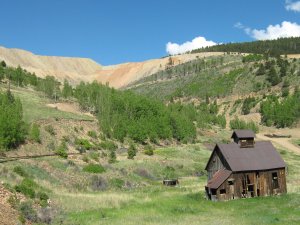
A Blacksmith shop is all that remains of Anaconda, Colorado.
The discovery of gold in the early 1890’s west of Pikes Peak at Cripple Creek was the last major gold rush in Colorado. This discovery coincided with the repeal of the Sherman Silver Act which compelled the government to guarantee a price for silver. The repeal of the Sherman Silver Act led to an immediate collapse in silver prices and the crash of virtually all silver mining operations. As a result, miners in the area made their way to Cripple Creek for newly discovered gold.
Today many of the valleys around Cripple Creek and Victor are largely regrown and quiet. Little indication remains of the towns and mills that once covered the area. Many mining towns were consumed by fire and a few were rebuilt. Once town left to extinction is Anaconda.
In the winter of 1904 a fire consumed the mining town of Anaconda. Today, all that remains is the shell of a blacksmith shop. This abandoned building sits at the end of the line on the Cripple Creek and Victor Narrow Gauge Railroad (CC&V). Near Anaconda were a number of significant mines- the Mary McKinney, the Doctor Jack Pot, the Chickenhawk, the Anaconda mine and others.
Nearby is the Mollie Kathleen mine which is open for tours. This tour involves piling into a small-man lift and dropping 1000 ft into the mine. This puts you below the level of Cripple Creek, located in the valley below. If you are very lucky, the big open pit gold mine on the other side of the mountain will do some bench blasting while you are down there. It’s very exciting. The mountain between the big CC&V mine and the Mollie Kathleen is riddled with shafts and drifts.
The Cripple Creek & Victor Gold Mine east of Cripple Creek is a large open pit gold mining operation run by Newmont Mining Corporation. The gold in the mine is highly disseminated in microscopic form and is recovered by cyanide heap extraction. The CC&V deposit is the remnant of an extinct volcano that is highly brecciated. Hydrothermal water has extracted and transported gold throughout the throat of the volcano and into the surrounding rock. However, much of the gold (ca 30 %) is tied up as gold telluride, AuTe2, also known as calaverite. The gold in calaverite cannot be extracted with cyanide and must be left behind. The tellurium can be removed by roasting and burning off the oxide, but this is highly polluting. This gold formation is where the famous CressonVug was located. It was a cavity in the formation that yielded 60,000 troy ounces of gold.
CC&V Steam Engine
The CC&V railroad is a modest tourist attraction located on the outskirts of Cripple Creek. The line has several operating steam locomotives that take passengers on a 45 minute trip into the countryside. Our engineer estimated the horsepower of the engine above to be ca 20 hp. Narrow gauge rail was popular in mountainous areas as opposed to standard gauge owing to the ability to negotiate a tighter turn radius.



 Lamentations on Chemistry