God in the image of man

The portentous return of American protestant evangelical politics on the coattails of the Trump win has certainly been startling to me at least. As if to underscore this return is the announcement that the Supreme Court of the United States (SCOTUS) will take on the case No. 16-111 Masterpiece Cakeshop, Ltd., et al., v. Colorado Civil Rights Commission, et al. Petitioners.

According to the petition for a Writ of Certiorari, at issue is the following:

Whether applying Colorado’s public accommodations law to compel Phillips to create expression that violates his sincerely held religious beliefs about marriage violates the Free Speech or Free Exercise Clauses of the First Amendment

I for one sympathize with both parties. I would like to think that as a business man I had some control in the business arrangements I enter into. On the other hand, it seems quite reasonable that an order for a wedding cake should not be complicated by the theology of the baker. I gather that the sign over the door did not say “Bakery for Observant Christians Only”.

Having been in sales, I know there are a hundred ways to purposely kill a sale without it descending into a fight or bad feelings. A sky high price, a ridiculously long delivery time, kitchen remodeling, a diseased baker, etc. Ok, so it is a lie. It happens.

From my purchasing experience I know it is possible for a careful buyer to disclose as little information as possible so as not to cue a vendor to raise the price or decline to make an offer. The couple in question could have discretely asked for a cake without giving away their relationship or could have sent in a proxy. The figurine of a gay couple on top of the cake could have been purchased separately and set in place at a different location. Alternatively, the gay couple could have simply found another baker willing to do the job, say in Boulder to the north.

Yes, yes, yes. I know. Neither side should have to use subterfuge to complete this simple transaction. And neither side, in principle, should have to fear the consequences of their core values. But for crying out loud, this is Colorado Springs. A more conservative Christian enclave would be hard to find. The city is full of conservative retired military and a number of fundamentalist Christianist organization headquarters like Focus on the Family among others. But what are you going to do? Fight to the death everyone you find disagreeable? Does everything have to be consecrated to God? Crimony! Can’t there be secular activities like putting a lug nut on a bolt or buying baked goods?

If SCOTUS rules against Colorado’s public accommodations law to compel the petitioner to create expression that violates his sincerely held religious beliefs about marriage, then they will have set back the cause of LGBTQ rights, possibly for generations. Likewise, a ruling for the respondent might do similar damage for the conservative cause. Both sides could live with some ambiguity in this matter.

The notion that baking a cake for a gay couple somehow validates LGBTQ values seems to be a bit of a stretch. It seems to me that a conception of a God who would see the act of baking this cake with so negative a view as to impose an existential threat to the baker’s eternal salvation is to conjure up a very strange picture of the deity. If a human were to wield this kind of existential threat to the baker, that human might be regarded as psychopathic.

In my view, American evangelical Christianists have constructed a model of God in the image of a very cranky, peevish male human. A God who set the galaxies spinning, ignited our sun, breathed life into inanimate earth, and accounts for every flea riding the tail feathers of every bird would certainly have the insight and fatherly patience to see this gay Wedding Cake matter as a tempest in a teapot. Yes? Maybe? But perhaps that is me constructing God in the image of a mensch.

I like that- God as a mensch.


Operation Teapot – Turk 28112

The short video above is of LLNL atmospheric test shot Turk in Operation Teapot in 1955 at the Nevada Test Site. The test was of the primary for the XW-27D thermonuclear weapon, giving a 43 kt yield.

What struck me about the footage was that it captured detail of the expanding fireball as it contacted the ground. Turk was a tower shot with the explosive sitting at 150 m above the ground. As the roughly spherical fireball expanded, jets of roiling material protrude radially from the growing incandescent ball. In particular a conical extension of incandescent material protrudes from and is overtaken by the expanding fireball.

A commenter below offered what seems to me a quite plausible explanation of the conical “jet” observed in the footage. It is a cable from the tower caught in the act of cooking off into plasma from the much faster radiant energy.

Addendum 6/28/17. Thanks to a link supplied by commenter K, we find there is a name for this phenomenon- it is called the “rope trick”. See this link for more information.

Who speaks for the biosphere?

What seems to have gotten lost in the public acrimony over anthropogenic global warming is the disposition and fate of the overall web of life- the biosphere. We hear bits and pieces about the bleaching of reefs, endangered apex predators, and the loss of Amazon rain forest. These are important of course, but they are components of the entire biosphere.

Recently the Whanganui River in New Zealand has been granted the same rights as a human being. Likewise, the government of India has granted legal rights to the Ganges and the Yamuna Rivers. According to an article in The Guardian, this new legal status in India will allow the ” … courts broader scope for intervention in the river’s management.” It remains to be seen how the new status will affect the current practice of discharging raw sewage and industrial waste in to the rivers.

Naturally, this assignment of legal status to rivers is an anathema to right-thinking capitalists or political parties. After all, to the capitalist what is the countryside but a map of interlocking private properties of which on the surface, crops are grown and subdivisions are built. And what is the ground beneath our feet but a cache of mineral resources to “recover” and soil to be farmed to exhaustion as we please.

The concept of private property is sacrosanct in the capitalist countries. Western cultures have evolved very elaborate rules and customs around ownership. Briefly, to own something is to have the exclusive right to use and enjoy an object, land, or intellectual property. The firmament supporting this custom is the existence of an accepted codex of practices and statutes backed by the authority of the state. The thing to note is that ownership relies on cooperation, volunteered or enforced. Ownership is not based on physics. It is a concept that exists only to the extent that there is broad agreement that it not be violated.

In exchange for living in a stable society with career opportunities and lifestyle options, those of us not born into wealth are disinclined to rob or attack those with large fortunes. That is part of civilization. But here is a question. What if an egalitarian and wealthy nation, where comfort and safety is at least possible through hard and steady work, becomes unavailable through machinations by undisclosed self-interested parties?  Like boiling the frog, a slow transition from better times to poorer times may happen without panic and civil unrest.

What happens when well educated young people graduate from college having completed a course of studies also taken by their parents and they find that the career paradigm has changed. In fact, the system of paying for career skills and credentials has changed dramatically in since the 1970’s. Today much more of the cost of higher education has been shifted to the student and family. At one time higher education was viewed as something the state substantially supported. Over time, through competition for students, schools have upgraded their facilities and have added premium offerings in terms of programs staff, and facilities. It is a kind of creeping featurism that organizations are prone to.

If clear thinking citizens are alarmed about this but cannot get the attention of political figures, what are they to do? The indebtedness of college graduates has become a serious threat to their futures. This is a serious societal issue that is not self-healing. How much restraint and respect for the system and the people behind the curtain who run it are they entitled to? I’m beginning to believe that civil disobedience or the threat of it is all we have left.

What has happened more than once in history is that an uprising occurs when an underclass or other aggrieved or marauding groups decide that they will no longer abide by the agreements supporting the ownership of property. One element of the French Revolution giving rise to the overthrow of Louis VXI was that the French aristocracy and clergy were not paying taxes to the King. The state was going bankrupt and food was in short supply.

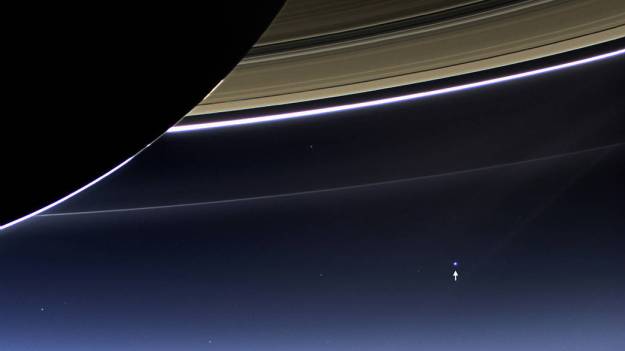
The Earth-Moon oasis as viewed from Saturn.  Image Credit:  NASA/JPL-Caltech/Space Science Institute

Desperate people did what desperate people will do- they revolted. Heads actually rolled and the establishment fell. The question for the USA, by analogy, is this: what is the limit of tolerance to income inequality and decreasing spending power that the 98 or 99 % of the US population are willing to withstand? As the middle class continues to collapse and wealth continues to accumulate in the hands of a small number of groups, at what point is revolution the only option? Add to this the increasingly remote and inaccessible legislative and executive bodies and you have an established oligarchy or plutocracy that finds itself in a defensive posture.

Are baby boomers an aberration?

Perhaps the post WWII American middle class expansion is the exception to the rule? Maybe great wealth inequality is the natural condition absent something like the baby boom after WWII. I would offer that one of the conditions that was different about the US baby boom period is that the transition from 1930’s technology to 1950’s technology resulting from the war was exceptionally rich in new industrial goods. This period saw the birth of the nuclear industry including power, weapons, materials, mining, propulsion and medicine. Advancements in aviation and aerospace grew dramatically through the war and has kept going to the present day. The invention of the transistor and the television became huge economic drivers as well.

It is good practice to return to fundamentals now and again. The earth is an oasis of life on a wet rock in the vast vacuum of space. Presently, it is the only habitable spot for as far as anyone can see in any direction. We living things are stuck here with nowhere else to go. Plants, animals, insects, birds, and microbes are born, live, and die here. Who is to say that one or other living species should be forced into extinction? Who are humans to thoughtlessly poison or crowd out other living things?

Unfortunately, our species has evolved stories whose passages claim that we have dominion over the earth and its living things. Taken literally this doctrine has given license to ignore the rights of all the other living things. We could sit back and allow habitats to collapse, fresh water supplies to become polluted and scarce, populations to rise, and mindless consumption of resources to accelerate. Or not.

Think about how people perceive the world around them. The atmosphere looks infinite when you direct your gaze upwards. No upper boundary can be viewed. But it is a fact that the 500 millibar level (1/2 atmospheric pressure) of the atmosphere is at 18,000 feet (+/- a bit) in altitude above sea level.  At this altitude, approximately half of the molecules in the atmosphere are at 18,000 ft or below. This altitude is only 2000 ft below the summit of Denali in Alaska. Certainly nowhere near infinity.

Given the reality of the limited depth of half of our atmosphere, anthropogenic warming might seem a little less implausible. Now add to the picture the world-wide loss of land habitat through development, depletion of the fisheries, the recent sharp decline in insect populations, agricultural monoculture, desertification, etc. While people are preoccupied with belligerent politics, exponential economic development, and just their own lives, the biosphere is continually loosing vitality.

These deleterious human-induced trends will eventually self-correct through wars, famine, epidemics, and other unthinkable events. The question is then, what does it take to arrest a slide into a more cruel and uncivilized world?

We can begin by reminding people that a few decades ago a there was a social movement in the US that recognized the merits of resource conservation. Reduced consumption is the only way that we can maintain our advanced civilization in the face of rising global population. More at a later date


Gotta wonder what these folks is thinkin’

I have to wonder what kind of internal monologue runs through the heads of Trump supporters these days. Here are some fictional quotes based on what I’ve heard-

Virginia, 52 y, Kearney, NE: “I know he has some problems, but he is shaking up Washington. Give him time to catch his stride.”

Ben, 73 y, Henderson, NV:  “Don’t care what he does long as he puts that dishonest Hill’ry in jail where she belongs.”

Arlene, 68 y, Webster City, IA: “I wish’d Ted Cruz was president … ”

Sheree, 31 y, Livonia, MI: ” No real choice but to vote for Trump.”

Lenny, 47, Russellville, AL: ” … shee-yit, cain’t believe Dale Junior is gonna retire …”

Boyce, 77 y, Rock Hill, SC: ” Billionaire oughta be able ta run th’ country. Heck-fire, O-bama did it, sorta.”

Cassie, 48 y, Sheboygan, WI: “… can’t get over my husband votin’ for that disgusting SOB…”

Allen, 56 y, Fargo, ND: ” Trump said he’s gonna put us back to work. Gotta keep drillin’. Oil is what keeps this country runnin’.”

Emma, 39 y, Abilene, TX: “Pastor said to vote for Trump. We’re prayin’ he’ll pull through these rough patches of fake news.”

You really can’t tell what Trump people are now thinking about this real-estate-billionaire-as-president debacle being broadcast 24/7. Our better angels might have whispered a soothing assurance that there would be widespread wailing and parades of contrition by now. But no, it’s not happening. In my experience the great masses of Trump believers have either clammed up or express no misgivings. A very strange picture against the backdrop of blatant bad behavior on a daily basis.

Seems obvious as hell that an autocratic hand-waving “Chairman of the Board” approach to executive governance is not going to work. Obvious to everyone but the Trump fans. Why would folks think that a business management template could be applied to the government? Government as we know it is not a profit oriented endeavor. It is a not-for-profit enterprise serving the many needs of society. The word ‘democracy’ has been used to describe the American system, although oligarchy, plutocracy, corporatist, and the like have gain favor in recent years.

A business organization is not a democratic structure. It is autocratic by nature. There is no freedom of speech in business. Due process is sketchy. No bill of rights in regard to your career path. It is very Darwinian and anti-democratic, yet Americans have adapted to the many small dictatorships that govern up our working lives.

It is a curious thing to see flag-waving conservative evangelicals embracing capitalism and American corporatism when it is so antithetical to the common though childish narrative of American virtues of egalitarianism and freedom.

The notion that governments can and should be operated as a businesslike organization is a utopian fantasy. It is preached by wealthy neoliberals who seek to absorb land and natural resources (i.e., control) which are now in the public domain. It’s reminiscent of the Oklahoma land rush, except that few of us are invited. An example of the neoliberal players would be the Koch brothers, among others, who are steeped in some variant of the Austrian school of economics mixed with John Birch Society ‘nuance’. The goal of these devotees is to deconstruct the present government to a greatly diminished level that will then guide the privatization of the public domain, meaning public lands, public schools, and the mineral wealth of the continent. Remember the words of Grover Norquist: “I don’t want to abolish government. I simply want to reduce it to the size where I can drag it into the bathroom and drown it in the bathtub.”  Norquist got a lot of publicity from this statement. Unfortunately it shows an incredible ignorance of history.

“Government exists to protect us from each other. Where government has gone beyond its limits is in deciding to protect us from ourselves.”  Ronald Reagan

I think Reagan was right in his comment about protecting us from each other. However, I think that the next sentence is dead wrong. As a precocious species we continue to accelerate the depletion of resources and the injection of waste onto our small planet. We are tipping the balance of the biosphere in measureable ways. Mankind is lurching forward in a way that is not sustainable and will eventually end in social collapse as resource scarcity triggers international conflict.

If we were limited to spears and stone axes, large scale conflict might be recoverable. But something terrible lurks in the background. A handful of nations, several with serious disputes, have a large number of nuclear weapons waiting 24/7 for instructions. No nuclear armed country facing certain doom by invasion or destruction will perish with its nuclear arsenal sitting in storage. It is imperative that the knowledge and responsibility for restraint and wise stewardship of our nuclear heritage be passed with fidelity down through the generations to come. We really do need to protect us from ourselves.


Nerve Agents vs Bombs. Why ban one and not the other?

The recent news footage out of Syria showing victims of a chemical attack is haunting. When I first saw it I couldn’t quite comprehend what I was looking at. But after a minute of increasing discomfort I began to grasp the horror of the situation. Victims lying on the ground in puddles of water or in the midst of being flushed with a stream of water, gasping for air and limbs quivering in wide-eyed disbelief and fear of what they were experiencing. Others were unconscious or dead. Rescuers were moving around the victims not knowing what to do beyond rinsing off the bodies. Those handling the water, I’m sure, were grateful to be giving some kind of aid no matter how small.

It is interesting to see how people, myself included, react to this kind of news. I mean, this shouldn’t be happening. After all, the world has international conventions and treaties banning the use of chemical and biological agents in warfare. Humanity has gone to some length to bar the use of war shots designed to release toxic gas or aerosols over anyone anywhere.

When we shudder and express sincere horror at the barbarity of a chemical attack on civilians, along what track is our thinking guided? What kind of decision process might lead us to believe that a sarin attack is a higher level of depravity than a bomb blast? Could it be true that people who release chemical agents are actually guilty of a higher crime than those who send bombs in the direction of a civilian neighborhood or even just 50 caliber bullets?

Explosives are chemicals that unleash kinetic and thermal violence for a few seconds per explosion. Nerve agents move like the wind, breathing lethal aerosols or gas as they flow and leaving who knows how much contaminated … everything … and for how long. Bombs can be aimed, a gas cloud not so much. Bomb violence is much more common than death by acetylcholinesterase inhibition, yet our attention is always drawn to chemical violence.

We have an industry called show business that exploits bomb violence in its entertainment products. And we the viewing audience have become desensitized to the horrific effects of explosions by sheer repetition of highly staged portrayals. Perhaps it is the very novelty of a chemical attack that captures our attention. If you survive a bomb blast, there is a chance that you can be sewn back together again. If you receive an exposure to sarin, well, what do you do to stop the inhibition of an enzyme? Find a dose of atropine if possible from someone who knows it’s in stock somewhere.

The acceptance of explosives but not chemical agents as legitimate weapons of war is at best a false dichotomy. But, we are a world of men and women and weaponized conflict. If a ban on chemical and biological weapons can be negotiated faster than a ban on the use of explosives, then we take what we can get. But let us not get desensitized to high explosives and the horrific tragedies they produce.

Oh, one pet peeve. They’re not ‘explosive devices”, they are bombs. The former may infer skillful and clinical dispassion. The latter suggests dumb, blunt force. The latter seems more to the point.

An organic chemist looks at evolution

I wrote this essay a few years ago but did not publish it. I don’t remember why. This is not written for evolutionary biologists. For better or worse, here it is.

On weekends I check in on C-SPAN 1 and 2 to see what folks are talking about. A couple of weekends ago on Earth Day there was a C-SPAN 1 broadcast of an April 19th, 2017, panel discussion on the ” March for Science and Threats to Science.” The segment was hosted by The Heritage Foundation and featured a number of well dressed folks who were quite authoritative and highly skilled in the rhetorical arts. Curious thing that the Heritage Foundation chose this topic to weigh in on.

The discussion followed various lines of conservative analysis of the 4/22/17 March for Science and touched on the New Atheism, Neo-Darwinism, with allusions to a supposed endemic misanthropy of some March for Science participants.

One of the panelists was a fellow named Stephen C. Meyer who is a senior Fellow and founder of the Discovery Institute. Meyer is a very articulate and persuasive proponent of creationism. His contribution to the discussion was a recitation of the pro-creationist argument on the weakness’s of Neo-Darwinism. The thrust of his argument centered on the disagreement among scientists meme in the field of biological evolution and how this delegitimizes the whole concept. This line of argument is a common (dare I say standard?) rhetorical trick used by creationists to cast doubt on the science of evolution.

Pro-creationist adherents have learned that they do not have to prove evolution is incorrect. They need only make a case for disagreement in the scientific community of its veracity or infer scientific misconduct. As a friend once quipped, they stir up a dust cloud and then complain because they can’t see anything.

Darwin and the story of the expedition of the HMS Beagle is a tale of 19th century discovery that is inspirational and iconic. Too often, however, Darwin’s writings on natural selection is not portrayed in the historical context relative to modern molecular biology. When I hear creationists discuss evolution, the discussion seems to remain with the work of Darwin. I would maintain that if Darwin and Lamarck had not developed their work on natural selection, modern molecular biologists would have had to postulate evolution themselves.

Public discussion of evolution in the limited context of Darwin is frequently burdened with misinterpretations and half-truths by adherents and deniers alike. It is not unusual for people to become confused by the use of imprecise language when discussing evolution-as-Darwinism. For instance, I’ve heard knowledgeable people assert “… the species evolved (such and so) in order to adapt …”. Well, yes and no. The species may well have over time evolved some adaptation. However, the words “… the species evolved …” may be misinterpreted by some as meaning that a species, when presented with some survival challenge, may have taken the chance to unsheath some mechanism to respond by rejiggering its genetics in a way that would lead to survival of subsequent generations. A more accurate description might be that fortuitous genetic mutations in the past have allowed the organism to survive challenges presented by a changing environment. There is a critical qualifier, however. The lucky mutation must be survivable and facilitate the continued reproduction of the critical trait to subsequent generations. Mutations occurring after the possibility of reproduction lead only to an evolutionary dead end.  Evolution is blind going forward. Descriptive language must be built around that concept.

Rather than consuming time and bandwidth reciting the history and elements of Darwinism, the reader is invited to pick this up elsewhere. Instead, I would like to throw an idea on the table. Perhaps writers and public figures should deemphasize Darwin’s work and emphasize the mutability of the genome.

If we consider that the large scale structural morphologies of organisms are an emergent phenomenon and arise as a result of molecular and cellular scale structures, then we can begin to see evolution much like a performing symphony orchestra is comprised of many instruments, each with characteristic effects. The overall effect is the sum total of all the contributing instruments. Evolution then becomes a matter of changing the score a bit here and there to produce variants. The notion of life as an emergent phenomenon is itself evolving to a high level of theory. See: Pier Luigi Luisi, The Emergence of Life: From Chemical Origins to Synthetic Biology 2nd Edition, 2016, Cambridge University Press.

With 19th century Darwinian theory, we are limited to observing evidence of change at the macroscopic level but with no credible mechanism for the manner of change or a cause for initiating a change. Without a mechanism, plausibility is a tough sell to students, teachers, and the rest of the lay public. Darwinism is a tidy package with an appealing story. However, without mention of its mechanism it resembles magic. Evolution at the molecular scale can offer mechanisms and measurements. I would offer that Darwinism could be treated in a historical context, but a transition to the level of  molecules appropriate to the intended audience should happen. Evolution rests on the mutability of genes.

Another troublesome aspect of explaining evolution is the plausibility of random change leading to organisms of greater complexity. The notion that the human eye or hand is the result of random change is simply too incredible for non-sciency people to accept. For them, it is an intellectual cul-de-sac that, in parallel with their religion, only validates “creation implies creator”. To folks firmly affixed in concrete reasoning, the notion of non-living, disorganized matter somehow spontaneously organizing to form elaborate life forms is beyond comprehension. This argument is often brought up as a coup de grace against evolution. Randomness as a successful driver seems so implausible.

Perhaps Darwinism is better expressed as only an introduction to the story of  molecular evolution.

Standing in the way of a mature understanding of evolution is the plausibility of random change giving way to greater complexity. What exactly do we mean by random? Does random change imply an infinite range of categories of influence and outcome? What exactly is it that is random? This is difficult even for scientists, let alone the lay public. Let’s consider some relevant aspects of the world of the molecule.

Axiom 1: The initiation of life may be a quite different chemical mechanism from the reproduction of life.

The origin of life and the evolution of life are different processes. The physical conditions and available substances amenable to evolution necessarily diverge from those present when and where life arose.  Origins and subsequent evolution must be pulled apart into separate arguments for the sake of clarity.

Axiom 2: Evolution is a molecular phenomenon.

In order to have macroscopic change there must be microscopic change. The DNA molecule is well established as the repository of stable organizational information necessary for the construction and operation of living things. If change characteristics are to be passed along through successive generations, then DNA has to change accordingly. DNA is ordinary matter and subject to the constraints of chemistry and physics. A part of being subject to chemical change is the effect of adverse conditions to contend with in general (bio)chemical synthesis. Biochemistry is largely aqueous chemistry with all of the constraints and degrees of freedom that follow: Solubility, Gibbs free energy, transition states, polarity, acidity, concentration, catalysis, stability in an aqueous environment, reaction rates, stoichiometry, time, temperature, and reduction/oxidation potential.

All of the parameters listed above represent variables with their own range of values that must be in alignment in order for life to happen. Rather than be overwhelmed by them, they could be considered as a finite number of channels in which a limited range of inputs give rise to a limited range of outputs.

Axiom 3: Atoms and molecules must collide in order to react.

A generalization in chemistry is that atomic and molecular interactions require the components to collide at some range of favorable trajectories. The mobility necessary for atomic and molecular interactions to occur is available in fluids but not solids. If molecules are held in place in a bulk solid phase, then they don’t have the opportunity to bump into one another just right and interact. The most abundant element in the universe is hydrogen. Water, H2O, is comprised of the most cosmically abundant element bonded to oxygen, the most abundant terrestrial heavy element.  A planet that has water with a climate and pressure amenable to the liquid phase is a planet that has a start on supporting life. Life is substantially a solution phase phenomenon.

Axiom 4: There is a menu of limitations in the behavior of molecules.

  1. The set of atoms necessary for constructing life on earth is of limited number and variety
  2. The behavior and properties of a given atom is based on the physics of electric charges and the best description of how and where electrons spend their time. This is successfully described by quantum mechanics.
  3. Because of physics and more to the point, quantum mechanics, the electrons which do the chemistry are capable of a finite variety of allowed states according to selection rules.
  4. There is a limited set of ways that a given atom can attach to other atoms to make chemical bonds under ordinary terrestrial conditions.
  5. Molecules are made of atoms. These atoms naturally form a set of characteristic groupings within a molecule that are energetically preferred and thus common. The groupings are called moieties or functional groups. Examples are stable 5 and 6 member rings of atoms (pentagons and hexagons), carbon chains long and short, single, double, and triple chemical bonds. The variety of connected atoms in living systems include carbon-oxygen, carbon-carbon, carbon-nitrogen, carbon-sulfur, carbon-phosphorus, oxygen-phosphorus, oxygen-hydrogen, carbon-hydrogen, nitrogen-hydrogen, sulfur-hydrogen, and maybe a few more. Atoms can connect or disconnect, but in a finite number of ways. The atoms that make up “biomolecules” have certain features that make them amenable to dissolution in water. In particular nitrogen and oxygen have non-bonding electron pairs that attract certain hydrogen groups to make something called a hydrogen bond. This behavior lends water solubility to biomolecules.
  6. Certain groupings of molecules can intimately comingle indefinitely in the liquid state, but other groupings spontaneously separate into separate “phases” or layers to minimize contact. Consider oil and vinegar and how they spontaneously separate for minimum contact in salad dressing. Molecules that have a charged end and a long water insoluble end may form organized structures called micelles in water. It bears a resemblance to the cell wall. It is an example of spontaneous organization because it is energetically favorable.
  7. The assembly, behavior, and disassembly of biomolecules follows finite, definable chemical interactions. Synthetic biomolecules are indistinguishable from the biological version.
  8. A limited number of liquids are compatible with living systems. Life as we know it requires that molecules are mobile during certain periods. Living things reproduce and grow. This requires changes that are only possible if molecules can move within the system. Movement happens within a fluid system.

The list above sketches out some limitations that atoms and molecules are subject to. It is useful to note that the atoms and molecules of life are subject to constraints that prevent them from behaving in a completely random fashion. Molecules in general will not form in every conceivable connective permutation under terrestrial conditions. Particular routes and end-states are energetically preferred. Things that have only specific behaviors are things that will always behave or react in a particular set of ways to give a limited range of products. Products from molecules that react along alternative pathways will favor the end-state of the fastest pathway. That means that there is exclusion of some molecular products. This is another loss of randomness overall.

Contrary to your camp counselor’s advice, not just anything is possible. What makes the universe sensible and relatively stable is the fact that objects and events interact or unfold in ways characteristic to their building blocks. What follows from the limitations of objects and events is that many forms of behavior or channels of interaction are therefore excluded. That is, there are not an infinite number of ways that a biomolecule can behave. The interactions in which a biomolecule can behave is channeled through a limited number of pathways due to the nature of the chemical pathways that are energetically favorable. The universe is surely chaotic, but not entirely so. Organization in biomolecules, or should we say a finite number of energetically favored structures, are the result of the limited number of ways that molecules can interact under terrestrial conditions.

Is is a common assertion by creationists that the odds of a hand or eyeball spontaneously forming could result from random interactions is 1 in some extremely large number. To the contrary, there is a case to be made that the hand or eyeball is the result of a series of natural molecular collisions, each constrained to a limited range of reaction possibilities over a very, very long period of time. What’s more, a molecule at room temperature is colliding with another molecule at maybe a frequency of 10^12 or 10^14 per second*. Scale that up to 1 million years and you have a tremendous number of opportunities to produce change.

* These frequencies may be off a bit, but it is what I seem to remember.

Lamar, my boy, show ’em how it’s done.

Dear Rep. Lamar Smith,

Yer a smart feller there, Lamar. Ya have a BA from Yale and that JD from SMU. Ya passed the bar exam and started private practice in San Antone. In 11 years ya worked yer way up ta national ‘lected office.  It’s an accomplishment no matter how’ya look at it. And that America Invents Act piled on some mighty fine improvements ta the patentin’ process. That was good work there boy.

As chair of the House Committee on Science, Space and Tech-nology, ya been perty skeptical ’bout them snooty climate science boys with their jar-gon and their uppity attitudes actin’ all high’n mighty-like ’bout climate n’such. A good ole’ boy from the Hill Country ought ta be able to pick up on that fancy c’mputer modelin’, right?

I think that ya ought ta throw some of yer many talents inta climate modelin’ yerself. You’d be doin’ the scientific folks a favor. You’d roll up yer sleeves an’ dig in ta clean’n up that po-litically correct climate data. Darn tootin’ you would. I’m sure the folks at NOAA would give ya a desk er somethin’ ta do yer cipherin’.

Give it some thought, Lamar. Shouldn’t take more’n a few Saturday afternoons ta make a big dent innit. Don’tcha think? Keep yer head on a swivel.

Th’ Gausslin’


(Texican language services provided by Elroy)


A fossil fuel job justifies X units of pollution

A lot of science is about trying to find the best questions. Because the best questions can lead us to better answers. So, in the spirit of better questions here goes.

By loosening environmental regulations aimed at pollution prevention or remediation, the mandarins reporting to POTUS 45 have apparently made the calculation decided that some resulting uptick in pollution is justified by the jobs created thereby.

Question 1: For any given relaxation in regulations that result in an adverse biological, chemical or physical insult to the environment, what is the limit of tolerable adverse effect?

Question 2: How will the upper limit of acceptable environmental insult be determined?

Question 3: Will the upper limit of acceptable environmental insult be determined before or after the beginning of the adverse effect?

For a given situation there should be some ratio of jobs to acceptable environmental damage.

Example: By relaxing the rules on the release of coal mining waste into a river, X jobs are created and, as a result, Y households are denied potable drinking water. What is an acceptable ratio of X to Y?

Those are enough questions for now. Discuss amongst yourselves.

The Amateur Scientist by C.L. Stong: A Remembrance.

Of the 1332 posts I have polluted cyberspace with, the most frequently visited is a post on the topic of neutron lethargy written in May of 2008. The post is titled Neutron Lethargy- This Weeks Obscure Dimensionless Quantity. My intent was to write about some of the obscure yet interesting factoids and concepts that I run into in my daily travails.

I’ve been drawn to nuclear topics since junior high school. Sometime in 8th grade I began to to build several scientific projects as described in the Scientific American column The Amateur Scientist written by C.L. Stong. Stong published a collection of articles in a book titled The Scientific American Book of Projects for the Amateur Scientist, 1960, Simon and Shuster. This book was (is) a treasure trove of information on how to assemble equipment for scientific investigation.

In jr high I spent some time trying to assemble an “Atom Smasher” (p 344). It was an evacuated glass tube with filament electron source a meter away from the positively charged target. The target was a 3 x 1/4 inch disk of aluminum with many perforations over which aluminum foil would serve to seal in the vacuum. The aluminum foil was to serve as a window through which electrons could collide with a sample on the exterior. Sadly the project eventually ended due to the lack of access to a McLeod gauge, bulk mercury, and a diffusion pump. The required Van de Graff generator was available for a few hundred dollars. The failure was perhaps fortuitous because even if I had managed to assemble the thing, I might have been exposed to x-rays during the accelerator’s operation.

Turning my attention to more feasible projects I did manage to do some biology experiments. The most interesting was growing protozoans from an infusion of grass and soil in standing water. After several days the water would turn cloudy and fetid. Using a decent Christmas microscope we were able to view a magical world of microorganisms scooting around in their herky-jerky manner. It was mesmerizing.

A glove box project afforded a place for growing microorganisms with petri dishes purchased at a hobby shop. I was able to grow mold and some blend of bacteria on Jello in the petri dishes, but the microscope didn’t have the resolution for bacteria. Since I had no interest in pathogens, the glove box was not really needed. But it looked cool.

By 10th grade I did manage to successfully build the cloud chamber project (p 307). Unfortunately I only witnessed stray cosmic rays and background radiation. As it turned out, the polonium 210 alpha source loaned to me by a physics teacher had long since decayed to inactivity. Building the chamber was a tremendous learning experience made possible through the use of the metal shop at school. It was of sheet metal construction with a dry ice and methanol coolant chamber built in. The actual chamber was made from  the bottom quarter of a Folgers coffee can cut and fitted with a glass viewing port and Plexiglass illumination ports. As I recall, the most problematic aspect of the construction was finding an adhesive that would not detach at dry ice temperature.

An electromagnet was built in an attempt to bend the path of the particles by a magnetic field, but was wholly inadequate for the job. Learned another lesson there too.

The book by Stong was something that lit up my curiosity and put a fire in the belly to explore. This was the beginning of what turned out to be life-long career in science. Strangely, the total lack of interest by the adults around me only strengthened my resolve to build and learn.

In support of the US Chemical Safety Board

A grim message from Chairperson Vanessa Allen Sutherland of the US Chemical Safety Board reads-

“The U.S. Chemical Safety Board (CSB) is disappointed to see the President’s budget proposal to eliminate the agency.  The CSB is an independent agency whose sole mission is to investigate accidents in the chemical industry and to make recommendations to prevent future accidents and improve safety.  For over 20 years, the CSB has conducted hundreds of investigations of high consequence chemical incidents, such as the Deepwater Horizon and West Fertilizer disasters.  Our investigations and recommendations have had an enormous effect on improving public safety.   Our recommendations have resulted in banned natural gas blows in Connecticut, an improved fire code in New York City, and increased public safety at oil and gas sites across the State of Mississippi.  The CSB has been able to accomplish all of this with a small and limited budget.  The American public is safer today as a result of the work of the dedicated and professional staff of the CSB.  As this process moves forward, we hope that the important mission of this agency will be preserved. ”     -posted 3/20/17

I want to voice my support generally for this elite group of accident investigators. As a chemical safety professional myself I am disappointed to see the CSB regarded low enough by the President’s budget writers to warrant being in the proposal for elimination. The job of the CSB is to investigate the cause(s) of chemical, petrochemical, or other facilities that handle materials having the potential to produce serious accidents. Having done accident investigations myself, albeit at much reduced scale from a petrochemical refinery, I appreciate what a difficult job this is and the great value of the disseminating findings to the industry.

The value of any given CSB report is the story of how an accident is initiated, how it propagates, and how it may couple with diverse systems. As a crucial part of the report is a detailed dissection of the relevant operational systems and human/machine interfaces and how they may have coupled to the event. It is educational and very useful for the safety community to learn how unfamiliar failure modes initiate and how knock-on effects may steer the accident in directions that are difficult to predict.

Planning for process safety involves input from the fields of chemistry, engineering and operations. Importantly, it requires imagination because planning safe operations is about predicting the future. Shutting down CSB investigations will deprive the engineering and safety community of a valuable resource detailing subtle or non-obvious ways in which complex systems can fail.

Recall the Apollo 1 fire or the Challenger explosion and how inquiry into those events lead to better appreciation of failure modes and the layers of protection that can be put in place to prevent the failure. If this kind of investigation is kept confidential, the advance of safe system design will stagnate.