Amusing.
The Sheri Sangji Case
Many readers know that research assistant Sheri Sangji died from burns sustained in a laboratory fire in the lab of UCLA professor Patrick Harran. Harran and university Regents are up on felony charges for their part in the incident. I understand that the charges are based on occupational health and safety violations related to the incident.
[The excellent blog Chemjobber has been following this story. I might add that this blog should be put on your Favorites list if it isn’t already there. The author puts a lot of work into it and it shows.]
Sangji was transferring t-butyllithium when her plastic syringe came apart and a quantity of the pyrophoric solution was splashed on her and ignited. She sustained fatal burns when her clothing caught fire and she died 18 days later.
Syringe techniques are common and the use of plastic syringes in such transfers of lithium alkyls is not unusual or automatically over-dangerous. However, some syringes have what is called a Luer tip where a syringe needle is attached solely by friction.
Another design has a Luer lock where the needle is affixed with a twist of the needle into a friction lock. The former design, with the tubular tip and no locking mechanism is prone to disconnection under tension and on withdrawl of the needle from the septum on a pressurized bottle, the needle is likely to squirt bottle contents onto the worker. The Luer lock largely prevents this type of accident.
Another failure mode is when the plunger is inadvertantly withdrawn completely from the barrel of the syringe. Minimally, this would release the contents from the barrel, possibly on the operator. If the plunger is pulled completely out while the needle is still in a pressurized bottle, a fountain of liquid may discharge, possibly on the operator.
Syringe plungers with a rubber tip are prone to swelling in organic solvents and may become difficult to move during a single use. If the plunger is pulled with great force, it might release suddenly causing it to come out of the barrel along with the contents.
Other syringes have plungers that provide a seal by plastic-on-plastic pressure. The seal depends on the elasticity of the barrel to accomodate the slightly oversized plunger. These syringes do not come with Luer locks and as such, are not forgiving of less than skillful use.
I do not know exactly what technique Sangji was using. Aldrich distributes literature on the use of a cannula in the transfer of air sensitive liquids. That is fine, but if you want 0.1 to 60 mL of RLi, a syringe is the most expeditious method for delivering a precise aliquot in my opinion.
Experimentalists are often stricken with a cowboy mentality. If you have never had a serious incident with a material, it is easy to get a bit cavalier. But handling metal alkyls is a lot like handling rattle snakes- you have to be careful every single time.
A subsequent post offers suggestions on due diligence for ressearch professors.
Scientific Fraud Allegations at Pultroon University
Pultroon University, Guapo, Arizona. A scandal has rocked the Institute of Quantum Spot Physics at Pultroon University. A graduate student and supervising faculty member stand accused of academic fraud. The office of University Chancellor Blodwin A. Gatwick has released a statement indicating the matter was under internal investigation.
Associate professor Corey Irwin was placed on administrative leave while the graduate student, Ragnar Ostrom, faces possible suspension.
Irwin and Ostrom were initially accused of falsifying results from a series of thought experiments published in Physics Expecta Acta, 2007, Section B, 256-278. However, it was later determined that the falsified thought experiment results were in fact plagiarized from a future thought experiment by Faroe Island physicists Spotsandottir and Dotsson. The two Faroe Island physicists were surprised to learn that their plans to falsify data were usurped by previous workers.
The Society of Thought Experimentation was contacted for comment but issued a press release stating the Society was still imagining what it’s position would be.
Plasma
Today I found myself peering at the lovely lavender glow of opaque argon plasma through the viewing screen of a gleaming new instrument. The light-emitting 8000 K plasma sits apparently still alongside the conical metal skimmer. Somewhere a Dewar was quietly releasing a stream of argon into a steel tube that was bent in crisp military angles into and through walls and across the busy spaces above the suspended ceiling. Another cylinder quietly blows a faint draught of helium into the collision cell. A chiller courses cooled water through the zones heated by the quiet but savage plasma. Inside a turbo pump labors to rush the sparse gases out of the mass analyzer and into the inlet of the rough pump and up the exhaust stack.
Up on the roof, the heavy and invisible argon spills along the cobbles of roofing stones until it rolls off the roof onto the ground where the rabbits scamper and prairie dogs yap. The helium atoms begin their random walk into space. The argon shuffles anonymously into the breeze and becomes part of the weather.
All of the delicate arrangements; all of the contrivances and computer controls in place to tune and play this 21st century marvel. And a wonderment it is. The ICPMS obliterates solutes into a plasma state and then taps a miniscule stream of the heavy incandescent argon breath that trickles into the vacuous electronic salsa dance hall of the quadrapole. All the heat and rhythm for the sake of screening and counting atomic ions. What a exotic artifact of anthropology it is. And it all began in a rift zone in Africa millions of years ago.
Bubble bubble, Windows trouble
The latest rev of Windows 7 and MS office is driving me freaking nuts. Used to be that I could do a graph in Excel and copy it cleanly into Word. That convenience seems to be absent in the latest rev. What fails to copy are the arrows and text boxes that I add to the graph. Not only do some of them fail to transfer, but the graph reformats and they arrive all cattywompus.
What works is to save the Excel document as a pdf and then cut out the graph and paste it into Word. Fancy that.
So, Microsoft, if I could make the dollars I pay for software change form inside your bank account, say, from dollars into Congolese francs, I’d do it this moment.
Fox Investigates Chem Labs
Good God. Fox News in Philly is now investigating university chemistry labs for “high risk” chemicals. The shabby quality of this piece is beyond words. The entire thrust is this- Chemicals as bomb raw materials. An invitation to walk right in and grab all the corrosives and explosives you can.
Note the law enforcement images alluding to sinister threats and the fear mongering. It’s what these people do. Manufacturing consent.
Rhodochrosite Sample
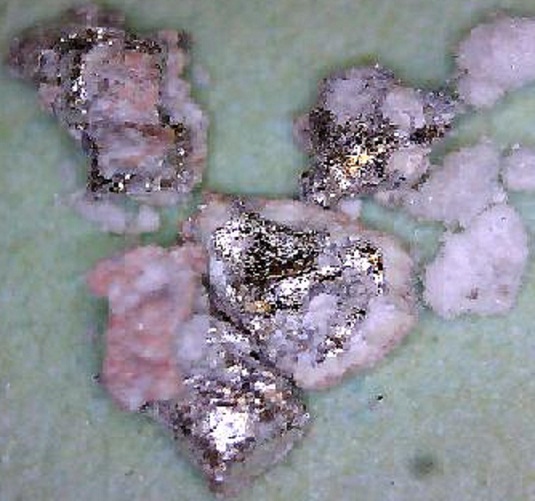
Rhodochrosite is a mineral composed of MnCO3. The specimen above is in no way exceptional, other than as a curio. The mass is comprised of rhodochrosite, galena, pyrite, what looks like quartz, and possibly a trace of a gold colored metal.
The photo below shows the galena, or PbS.
The photos were taken with a USB microscope.
What a Key Supply-Sider Says Now
Here is a link to an interesting interview of Bruce Bartlett, one of Jack Kemp’s architects of supply side economics. Certainly no liberal, Bartlett has many insider views on current republican intentions on taxation and the deconstruction of federal government.
If certain politicians and their backers aren’t more careful, their plan to deconstruct government by intentionally bankrupting it and reconstructing American society is going to precipitate civil unrest unlike anything seen before in this country. These people are playing a very dangerous game capable of outcomes well beyond their control.
Respecting liquid hydrocarbons as a natural wonder
I just had a conversation with a colleague who is somewhat mainstream in his/her thinking. The question came up as to why can’t we be energy independent. What is taking so long with the electric cars and natural gas powered … everything? When can we break away from middle eastern petroleum?
In the public sphere, all I hear are the questioners seeking reassurance that there are energy forms out there that will allow us to maintain our current level of consumption. They rarely put it exactly that way, but that is the heart of the issue.
I think multiple generations of people have failed to appreciate the natural wonder of liquid hydrocarbons. The C7-C10 fractions of petroleum, whether directly from the ground or from a cat cracker or reformer, are the motive basis for most of our ground transportation. These liquid hydrocarbons are of a reasonably low vapor pressure and high enough boiling point to allow their use in everything from go-carts and lawn mowers to automobiles and caterpillars. Teenagers and grandmothers can pump hydrocarbons into an inexpensive and simple tank for use at ambient pressure and temperature. This liquid has a melting point low enough to make it flowable under nearly all earthly conditions.
The high energy density and the liquid state of gasoline is what makes it nearly perfect for propulsion. The energy density of gasoline is 34.8 mega-Joules per liter (MJ/L), as opposed to 21.2 MJ/L for ethanol.
Yeah, gasoline is cheaper per liter than the bottled water inside the convenience store. That perversion is just a temporary historical aberration. This will change.
Cosmically, hydrocarbons in the C7-C10 range suitable for automotive use are quite scarce in the local stellar neighborhood. Some small hydrocarbon molecules like methane have been spotted in the gas giant planets and on Titan. But for the most part, the only supply of hydrocarbons we have are found in porous deposits below the surface of the only place we can get to- Earth.
We should appreciate our hydrocarbon resources for the true natural wonder that it is and be a bit more reluctant to squander it. I doubt we’ll ever find a source of energy that is as cheap and convenient to use with such a high energy density. Battery technology may get close, but innovation there is a highly specialized art that is beyond the scope of most shade tree mechanics. Common lead acid batteries require material and energy inputs, like everything else, and have somewhat low energy density and a high weight penalty.
Lithium batteries, with their higher energy density require a variety of manufactured and relatively exotic substances. And, they require lithium which is fairly scarce, both cosmically and on earth. We really should be recycling lithium scrap. Seriously, we need to have great respect and appreciation for lithium as well. There really isn’t enough lithium to support everyone’s high energy density lifestyle.
Pinch Predicted in the Uranium Market
According to an article in Mineweb, the remaining cold war era uranium will be consumed in the next few years, leaving the nuclear industry with inadequate supply streams from mining. Thomas Drolet of Drolet & Associates Energy Services, said that in 2010 mining produced 118 million pounds of uranium against a demand of 190 million pounds. Obviously, the balance was made up from decomissioned nuclear weapons stockpiles. The article did not say whether the numbers represented lbs of U or of U3O8. The oxide is commonly cited in relation to uranium mine production.
Drolet suggests that Japan will have to restart ca 30 of its 50 or so reactors in order to meet power demand.
It is my sense that the Fukushima disaster will not be the stake in the heart of nuclear power. The location of the Fukushima plant and a list of easily identifiable design features allowed the initiation and propagation of the incident. While the future of reactor operation in Japan may be stunted, most reactors elsewhere in the world are not located in tsunami flood zones. Regrettably, some are located in fault zones. But the insatiable demand for kilowatt hours will override everything. Commercial fission will continue into the indefinite future.