Oil Well Torpedoes and Grubbin’ Stumps

We tend to think of some things as being relatively new. I’m thinking of the gas and oil extraction technique of fracturing, or fracking.  In the 1884 third edition of The Modern High Explosives, Nitro-glycerine and Dynamite by Manuel Eissler, p 311, there is a mention of the practice of exploding nitroglycerine charges at the bottom of oil and water wells to renew or increase the flow. The author states that this is a popular technique in Pennsylvania at the time of writing.

On p 318 of the same book, Eissler describes the economics of blasting stumps. In general, the process of removing stumps was called “grubbing”. Enterprising fellows knowledgeable with nitroglycerine took little time in applying the explosive power of this oily liquid to clearing the land of stumps.  

Eissler describes the economics of explosive grubbing as follows:  Three pounds of No. 1 dynamite cost $1.50, labor cost 20 cents per hour, 25 ft of fuse cost 1 cent per foot, and 17 percussion caps cost 1 cent each.  Grubbing 17 oak stumps cost $22.52 with 99 man hours for chopping and piling the pieces.  Grubbing with an axe took 142 man hours and cost $28.40.  No. 1 dynamite was comprised of 75 % nitroglycerin and 25 % absorbent.

Bertholet’s discovery of potassium chlorate (oxygenized muriate of potash) happened in 1785. He observed

“that it appears to include the elements of thunder in its particles; and Nature seems to have concentrated all her powers of detonation, fulmination, and inflammation in this terrible compound”. 

Eissler goes on to say that attempts to prepare gunpowder or blasting powder with potassium chlorate lead only to loss of life and limb for the luckless experimenters with this compound.  Two of Bertholet’s artisans employed to do experiments with this material were killed in 1788.  The hazards associated with both manufacture and use of compositions of potassium chlorate were too great to allow this substance to see much commercial application by the 1880’s.

Unfortunate trigonometry and dynamic blind spots.

Near miss on the highway last night. I averted a high speed T-bone impact by a meter or two as Music from the Hearts of Space played on the radio. Good gravy- I was crashing to space music.  My Cherokee is quite stable in an emergency braking maneuver moving straight forward. But if swerving is required, then vehicle sway begins to couple into the steering. Never thought of this control problem before.

Imagine you are sitting at a stop sign waiting to turn left onto a 4 lane highway. To your left is a deceleration lane for traffic moving left to right.  Now, imagine your line of sight as a line extending from your eyes across your left shoulder and into the distance.  Got that?

Now, imagine a car in the deceleration lane on your left slowing to make a right turn at your intersection. A line can be drawn from your eyes to that car. As the car moves toward you, the line extending from your eyes to that car sweeps clockwise across the landscape. Still with me?

Now consider this.  There exists a third vehicle (me) moving from left to right exactly along your line of sight, but behind and eclipsed by the vehicle in the turn lane. As the turn lane vehicle slows down in preparation for a turn, the third vehicle is at a distance and speed such that it continues to remain along the sight line yet remain eclipsed by the turning vehicle.  As the turning vehicle approaches, it’s angular size increases, obstructing even more space behind it.

That is the condition I was in last night. The perversity of trigonometry allows for a set of velocities and alignments that presents a dynamic obstruction of view to evolve.  If the driver at the stop sign grows impatient and attempts to cross the two lanes of traffic before the vehicle in the turn lane completes the turn, he is doing so on the assumption that the blind space is clear. Last night I was in that blind space while an impatient driver pulled in front of me. 

As the driver pulled out, he saw me and hesitated in my (right) lane, causing me to apply heavy braking and to swerve around his rear and away from oncoming traffic. Fortunately for all of us, he stepped on the gas and got out of the way. With the sway of my vehicle with the maneuvering loads, I was on the verge of a loss of control and may have hit him anyway. 

It is interesting how a steady state cruise along the highway can evolve into a complex set of events in just seconds.  In fact, I had anticipated this problem of visibility as I approached the intersection. I disengaged the cruise control and began to decelerate when I saw that the waiting vehicle could not see me. I now think that my deceleration kept me in the blind spot even longer, aggravating and tightening the coupling of the event.  I was barely able to avoid this failure mode even though I was aware of it.  That is scary.

In praise of polyolefins

Being a person nestled in the dark and humid recesses of industry, I find myself boggling at certain things out in the bright and sunny world.  Truly, it boggles my mind how little appreciation people have for polyolefin resins. That is to say, polyethylene, polypropylene and all the myriad copolymers and formulations found thereto.  Ok, let’s throw PVC and polystyrene in the mix as well.

Why do I boggle at this? What makes my head spin in puzzlement? I’m so glad someone asked.  Polyolefin films look innocent enough to be ignored. In their uncompounded state they are clear and colorless or they may be white.  Polyolefin films and extruded components are ubiquitous in packaging and thus are not normally an object of desire. They serve the object of desire. They occupy a lesser state interest in nearly all contexts.   They are made inexpensively enough to be torn asunder from the desired object and tossed wantonly to the side for later clean up.

But if the uneducated user of polyolefins only knew the extent to which modern science and engineering had been carefully applied to the lowly stretch wrap or the roll of 1 mil PE film. If they only knew the scientists and engineers who carefully devised the ethylene crackers to produce high purity ethylene, or if they knew the highly educated people who devise the polymerization process, they might have heard an account of the long march to produce water white films with properties matched to the end use.

Puncture resistance, elongation, fish-eyes, haze, modulus, crystallinity, glass transition temperatures, melt points, low volatiles, melt viscosity and strength- all attributes carefully tended to so that the film appears invisible to the consumer. High gloss, low haze films to make the product look even better.  Low volatiles and residues for food contact use.  Polyolefins engineered for specific densities for the global market.

All of the attributes above to attend to with a continuous polymerization loop that spews 50,000 to 80,000 lbs per hour of pellets into silos and rail cars. Pellets that will eventually go to converters who will blow films and extrude widgets all day long.  All so the consumer product can arrive at its destination wrapped unscuffed and free of dust.

Polyolefin materials are incredibly useful and amazing in their own right. We should have more appreciation for these materials and how they serve our needs.

Seeking simplicity in process scale-up

My graduate school mentor use to say that you could synthesize anything if you had the right precursors. With enough clever reagent artistry, most small molecules can be assembled, though if only enough for an NMR spectrum.  With chromatography and small glassware, it is not unreasonable to do a few reactions on 1 mg of material and recover enough mass to get a proton and carbon NMR.  Yes, I know that with microfluidics and labs on a chip, much lower quantities can be handled. But I refer to getting your hands on enough material to see.

What most of us who came through graduate chemistry have learned is that there are enough acids, bases, protecting groups, oxidants, reducers, latent functionalities, and catalysts out there to choose from so that some combination should get you to an endpoint in your synthesis.  If not, then  NMR, mass spec, IR, and imagination (with ample hand waving) should at least give an idea of why something won’t work.

Reaction chemistry (not including biochemical transformations!!) can be thought to occupy two broad domains- 1) low temperature, ambient pressure transformations with highly reactive species (preferably named after dead chemists), and 2) high pressure, high temperature transformations with lower reactive species. Most chemists fresh out of school know the former better than the latter. And that drives our problem solving strategies: Finding reactive intermediates that will react between -30 C and 150 C with a 5 lb nitrogen sweep in a kettle reactor.

Sometimes, the dumber brute force approach is worth considering.  What can be done under pressure and at elevated temperature?  Or, what can be done at high temperature and short contact time?  That dusty Parr reactor sitting in the corner may be capable of a goodly bit of magic.  Behind a shield. It is good to visit the high temperature, high pressure world now and then. Of course, our engineering friends already know this.

As far as the search for simplicity goes, consider what merits there may be in thermally driven transformations. Every once in a while it may be a viable avenue for something useful. Try thinking of heat as a kind of reagent. Chemical plants are good at producing heat.


Windows 7 and Office 2007. Grrrr.

Th’ Gaussling was upgraded to Windows 7 and Windows Office 2007 recently. I wish I could report that it has gone smoothly, but it has not.  Like millions of others I have been using the Office suite of software for a long while. The latest upgrade seems to have made a largish stepchange in alteration of features in Word, Excel, Access, etc.  While it is plain even to a caveman like me that the upgrades are generally for the better, I am having a bit of difficulty absorbing the changes and altering my keyboard habits.

It may not be that functions have come and gone, but rather it is that the access or arrangement of the functions have been “improved”.  Just this morning I was unable to plot a graph from a table of data as I had done a thousand times before. The manner in which curve data and axes are defined has been re-jiggered and re-rigged so that I have to do it differently now. It is very much like a different piece of software.

It is hard to say anything defensibly negative about these changes because I can see how it might be viewed as an improvement. 

 But it is an improvement of the sort when you rearrange the furniture in a blind persons house. Yes, the couch and end tables are in a better place, but somebody is going to bang up their shins and maybe fall on their face trying to figure it out.

The gift that Microsoft has given American business is the means for the elimination of administrative assistants.  Today, it could be argued that everyone can do their own correspondence, writing, and ciphers in the same or less time than it takes to supervise the execution of the work by an admin. 

What has resulted from this benefit bestowed upon us by the geniuses at Microsoft is that we must all strive to keep up with a never ending parade of features and software upgrades, online access and passwords. In my immediate area I now have 6 computers driving different pieces of apparatus with multiple software packages across a network and into the clouds.  At home I have two more computers to maintain and internet banking to keep up with.  My freaking computers really don’t belong to me- they all talk to the clouds on their own schedule and have routines that they do for Gawd knows what purpose.  I don’t think this is too unusual.

It’s getting to be too much for a caveman like me.  I have the urge to spear some cloven hooved beast and roast its flesh on a big fire and feast under the moonlight amidst the smoke and grunts of satisfaction of my hairy cohorts with thick eye brows. This is something that Microsoft has yet to provide for me.

Encounter with the K-T Boundary

Th’ Gaussling drove to the southern border of Colorado to have an up close and personal view of an exposure of the K-T boundary. The coordinates are N 37º 7.335′, W 104° 36.248′. This exposure is perhaps 150 meters in length and is no more than a quarter mile hike from the parking area. The exposure is within Trinidad Lake State Park, so a $7 one day park pass is required for entry.

The term “K-T boundary” refers to both a layer of sediment and to a step change transition in paleoecology. The sediment layer was laid down at a time coincident with an extensive plant and animal extinction event. This period and the sediments put down then make up the boundary between the Cretaceous and Tertiary periods. Nomenclature alert:  According to some sources, the use of Tertiary time or rock is discouraged in favor of Paleogene and Neogene. Under this terminology, it is referred to as the K-Pg boundary.

It is widely accepted that a large impactor collided with the earth forming the Chicxulub Crater approximately 65.5 MA.  The Chicxulub  (CHEEK sheh loob) crater was first observed from gravity mapping by Robert Baltosser in the 1960’s and later rediscovered by geophysicists Camargo and Penfield while doing geomagnetic work for Pemex in 1978.  Pemex would not allow the disclosure of the data supporting the presence of the crater for several years. Eventually, Penfield was allowed to disclose their work at a conference.

The Chicxulub crater is found below the surface along the northern coast of the Yucatan Peninsula in Mexico.  Gravity maps show evidence of a circular feature consistent with an impact crater. Sediment associated with the impact contains tektites, shocked quartz, vitrification and elevated levels of iridium. A common mistake propagated in the popular literature is that the layer consists of iridium. In fact the layer contains variously ppt or ppb levels of this platinum group element.

The theory of asteroid impact arose from the anomalous Ir content of the thin sediment layer found to have been deposited at the time of the K-T extinction. Geologist Walter Alvarez, son of non-other than Manhattan Project physicist Louis Alvarez, determined that significant iridium was found only in the K-T boundary layer and not in the layers above and below.  The determination was had via neutron activation analysis and was carried out at Lawrence Berkeley Laboratories.  After a variety of postulates were considered, the theory of asteroid impact ending the age of dinosaurs was born.  The theory was disclosed in 1980, but was met mostly with derision. However, with the disclosure of the Chicxulub crater in the late 1980’s, the theory has since met with widespread acceptance.

Across the earth in what is now India and roughly contemporaneous (68 to 60 MA) with the Chicxulub event was a prolonged period of extensive vulcanism. The formation from that period that remains today is the Deccan Traps.  According to one source, the word “trap” is a geological term from the Swedish word for “stairs”. This period of vulcanism is thought to have produced enough atmospheric pollutants to have raised the average atmospheric temperature by 2º C and enough lava to have covered half of present day India.

Whether or not the fullness of the transition from Cretaceous to Paleogene is due to the Chicxulub event or in combination with the Deccan vulcanism is unclear. What is clear is that the Chicxulub impactor delivered an estimated 4.0 E17 MJ jolt of energy to the planet, resulting in mega-tsunamis throughout what is now the Caribbean basin and the injection of vast amounts of dust and aerosols into the atmosphere.

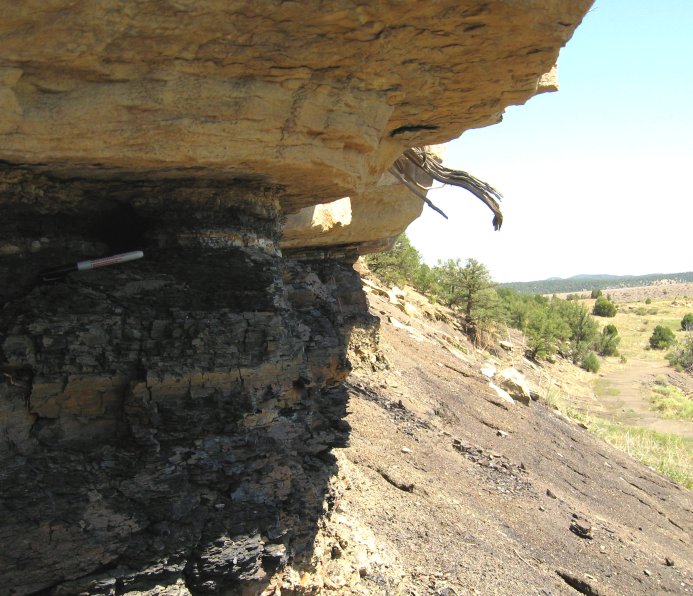
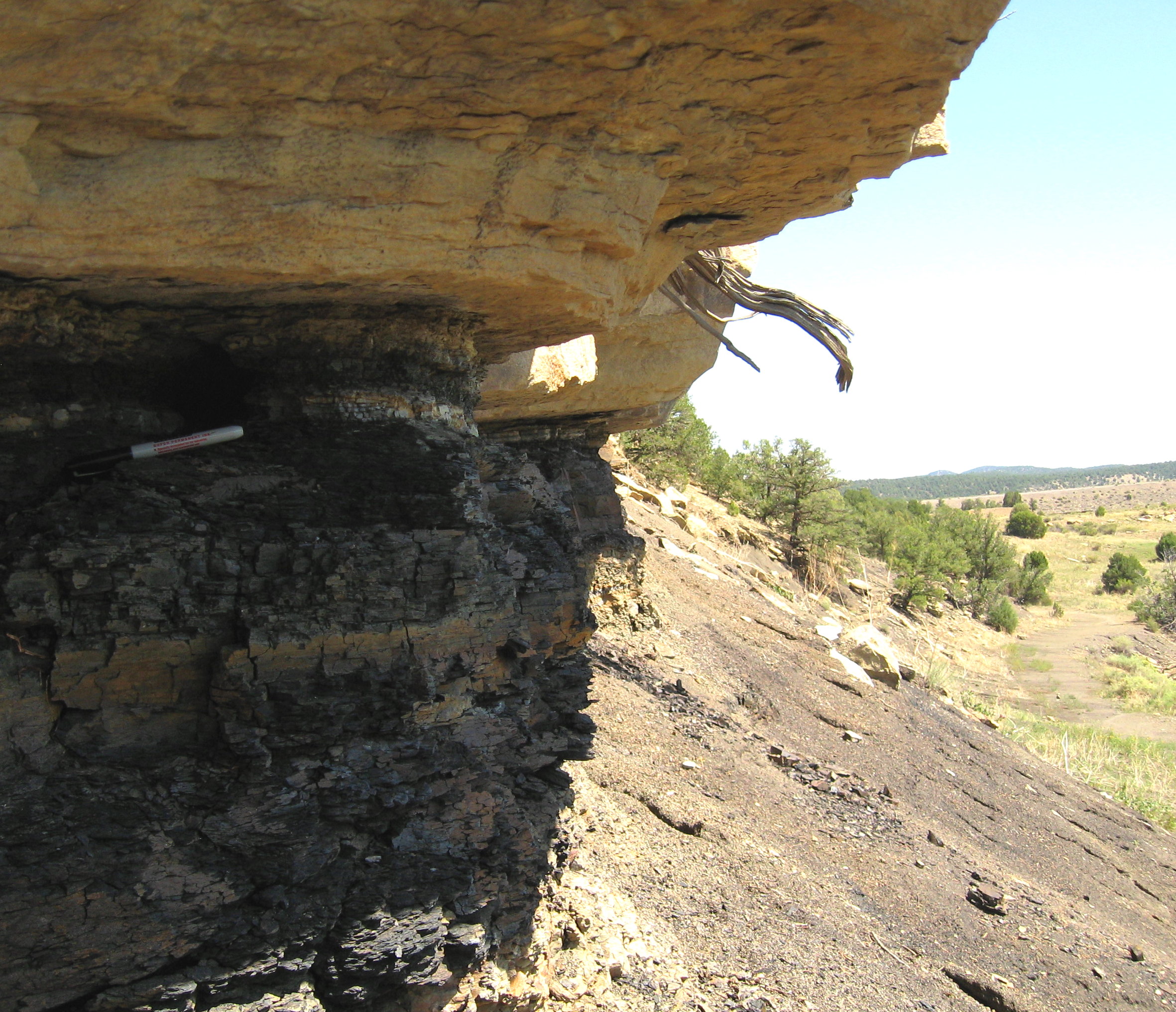
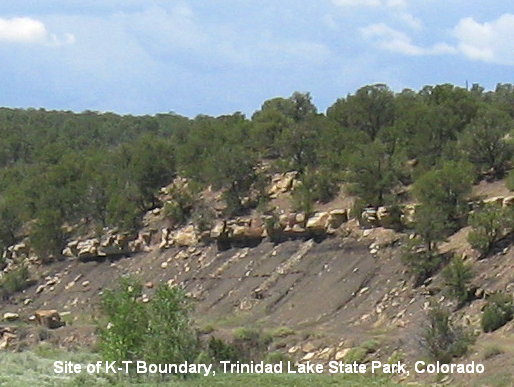
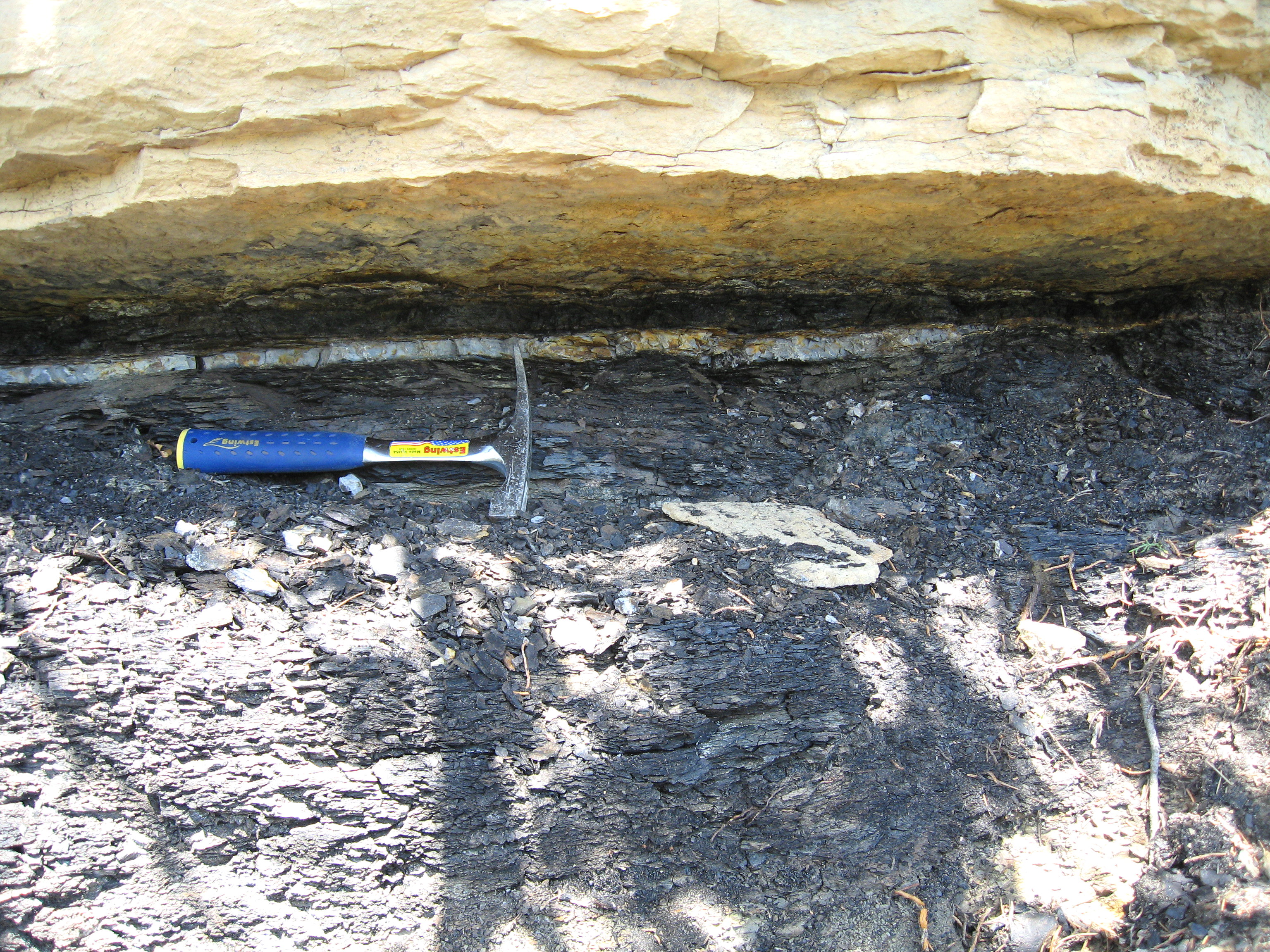
An exposure of the K-T boundary can be found in an outcrop just west of Trinidad Lake in southern Colorado. The thin, off white layer lies within a seam of coal and under a cap of sandstone at this location. Note the rock hammer for scale.
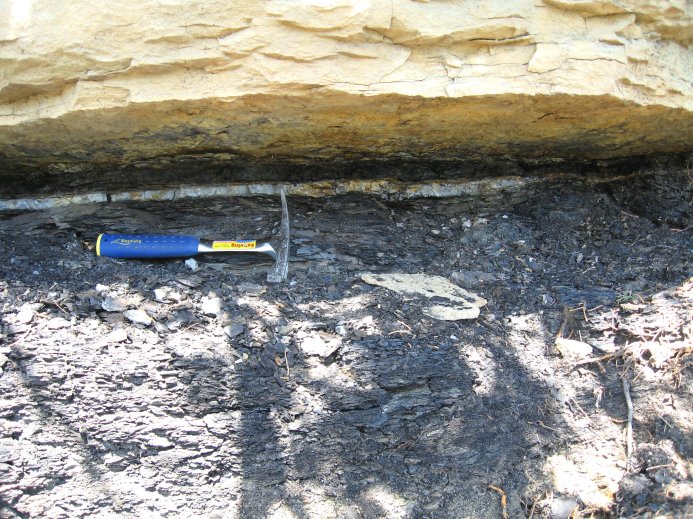
Exposure of the K-T Boundary, Trinidad, Colorado.

View of the K-T Boundary sitting under a cap of sandstone. Note Sharpie marker just below layer.
K-T layer in context.

The K-T layer at the Trinidad site is comprised of claystone which is weathered and crumbles easily. If the material contains parts per trillion quantities of iridium, then sending a sample out for GDMS is likely to be futile.

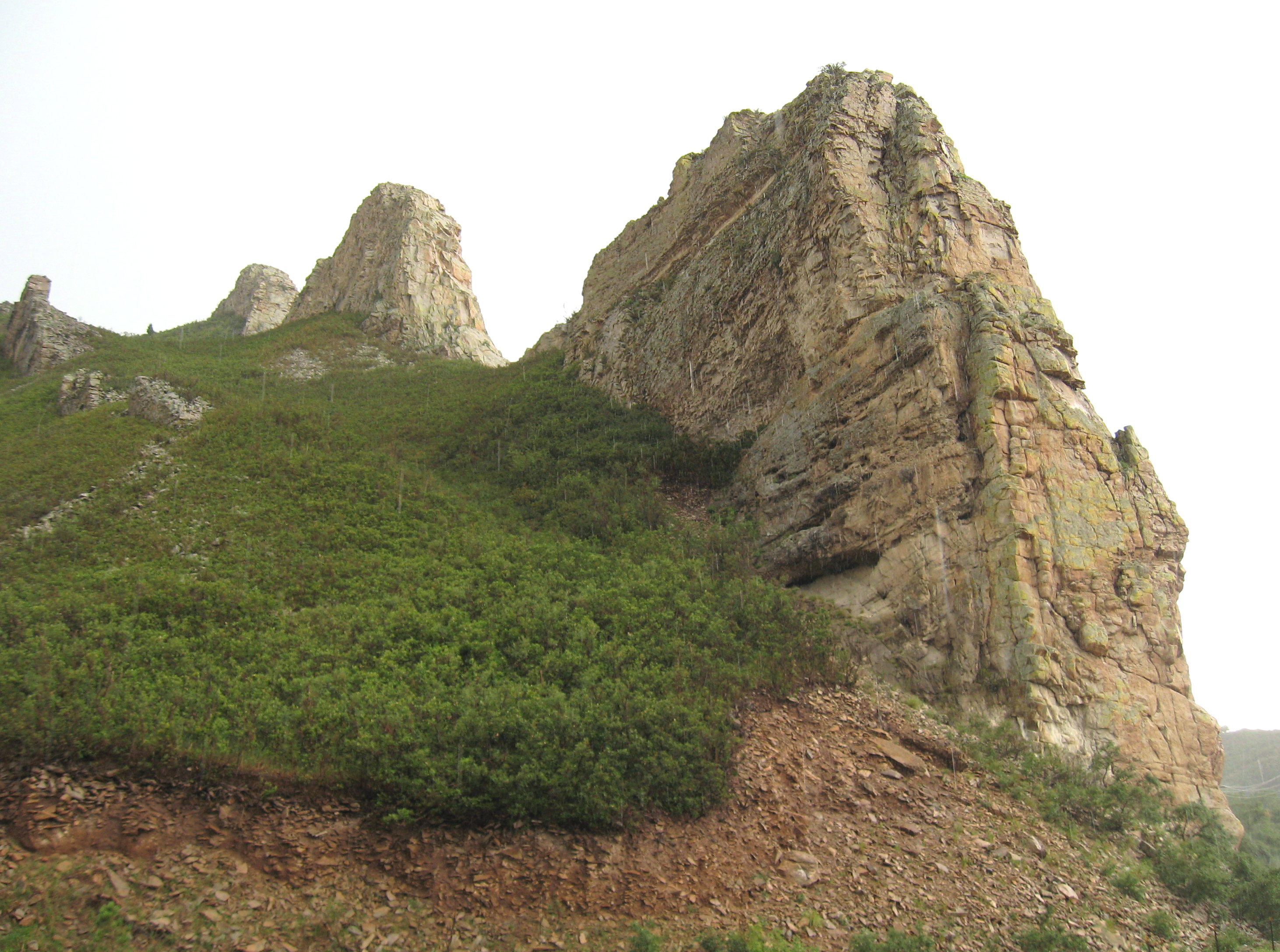
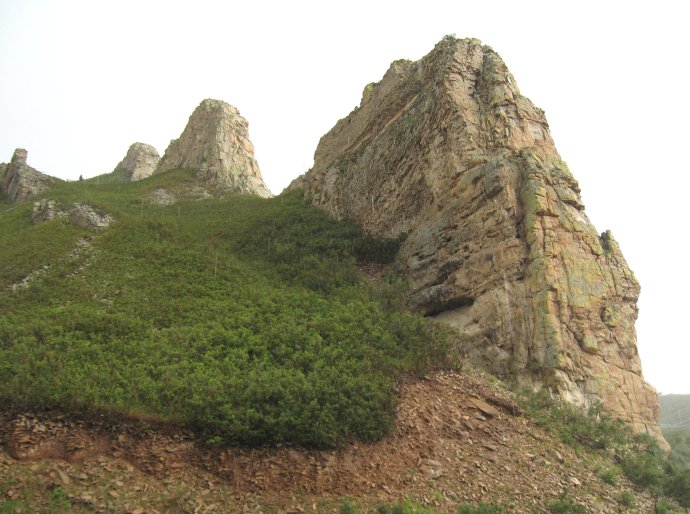
North of Trinidad are the Spanish Peaks. These peaks are of volcanic origin and are associated with a substantial array of dikes, a great many of them visible from the road. The photo below was snapped from a roadcut during a recent rainstorm. To the west is the Sangre de Cristo Mountain range. This range is what is called a horst, which is an uplifted block of crust. Just west of this range is the San Luis Valley containing the Rio Grande rift formation.
Dike formation south of La Veta, Colorado

Dike formation south of La Veta, Colorado.

Recently on an airplane I sat next to a 1948 chemistry graduate of UC Berkeley. We were enroute to John Wayne airport from Denver.  As we both marveled at the majestic topography of the Grand Canyon below she told me of her experience of having both Luis Alvarez and Glenn Seaborg as professors. Alvarez, she said, gave an exam with 7 % as the high score. She shook her head, laughed, and asked, “can you imagine”?

Play it forward. Science as an extended subsidy.

I search chemical abstracts nearly every day. What occurs to me is that this vast treasure of knowledge is substantially the result of tax revenue channeled into scientific research by numerous technologically advanced societies. While at the time of any given publication, the value might seem minimal. But over time people like me, people in applied industrial science, consume this treasure for the purpose of generating new goods and services. Rather than reinvent the wheel, we consult the subsidized results of other workers in the field. Subsidies of the past play forward to subsidies of the future. If we can’t lift an exact procedure from the scientific literature, then often we can apply new substrates to known transformation. 

In a very real sense, a resource like Chemical Abstracts is an engine of ingenuity. It’s content provides the means to innovation by outright disclosure or by sparking the imagination.  This work is enabled by government organizations funding people and institutions for the purpose of placing technology into the public domain.

While industrial or private organizations have the ability to generate a knowledge base as substantial and as in-depth, the fact is that the imperatives of private business are not in the direction of public disclosure. The imperative of the private sector is to channel wealth to the ownership. The free exchange of knowledge, in the context of business, is discouraged in that it amounts to the free distribution of cash. 

I hear people saying or implying that all things government are bad and that the private sector is inherently “more efficient” and therefore more meritorious.  What we have gotten from government subsidized science is an everlasting fountain of knowledge available to all to put into practice for whatever lawful purpose they can envision. 

An efficient life seems like a puritanical and regimented life.  And the application of efficiency will always fall under the control of the dominant social order. Is this really so desirable?  

Intellectual property has two sides. On one side, the generators of intellectual property can have the right to a timed monopoly on their art via patents. On the opposite side, the public treasury releases national treasure in order to educate the citizens who then generate proprietary art that is withheld from public use.  This amounts to a subsidy of the private sector.  It is a subsidy that sees little acknowledgement in the politics of today.  But such a thing has actually worked well for generations.  

What we are seeing in contemporary politics is the attempt to vilify and deconstruct government. But government has been central to the technological and consequently the economic expansion in the post WWII era.  The mechanism of collecting resources and focusing them on the solution of certain kinds of problems cannot be matched by the private sector. How would you operate the Centers for Disease Control on a greed based system like capitalism? 

Libertarians are always acknowledging the fundamental nature of greed and how it can be channeled into the efficient use of goods and services. I don’t disagree. What I take issue with is that greed must then be acknowledged as the dominant and true influencing force in society. We cannot allow this to be true. We must make provisions for tight control of greed. It is a useful but savage animal. 

In my view, the generation of knowledge and expertise is time and resource consuming. In order to have a particular amount of practical expertise on any given thing, you have to turn over a great many stones and learn an amount of art that is in large excess of the problem of the day. This actually applies to a definition of expertise- the ability to deal with problems that at first seem to be bigger than you can get your arms around. Expertise brings knowledge in the form of facts and problem solving skills. In order to attain expertise you have to absorb to information that at the moment seems superfluous.  In the end, the expert has a grasp of the length and breadth of a topic in excess to any given problem.

Our national system of scientific discovery and information abstracting serves to provide the reservoir of information that serves users into the future.  This information forms the basis of economic growth well into the future. As we go forward with the seemingly inevitable deconstruction of government, let us not forget what government has given us.

Texican on the move

So Tejas governor Rick Perry is going to throw his hat into the ring for the republican nomination. Really, people?  Are you kidding me? A smarmy, neo-confederate, evangelical Texican praying for a resolution to the debt crisis? I have no doubt that Jesus Christ himself would tell us in lilting Aramaic to pull our thumbs out of our asses and reach for a settlement, not stand around in a stadium groveling for forgiveness of our sins with outstretched arms. Fix the bloody thing and save your wishes prayers for grandma’s recovery from hip surgery.

Christians should be grateful for the concept of sin. The whole religion is built on it. Sin is the denominator of Christianity- if it collapses to zero the whole religion becomes undefined. Without sin, our cherished fraternal hatreds would resolve to mere anthropology and lose that zesty cosmic fizz that we so enjoy.

The New Theatre Season

Our theatre group has (finally) locked in the upcoming season. I just ordered scripts for Dearly Departed and for Kitchen Witches. We’ll do another play in the spring written by a fellow board member. Later this month we’ll do a reading of another one of his plays for some theatre folks in Denver. It’s called Cow Dung Dust and is about an odd collection of characters hitchhiking on a cattle trailer along Route 66.

Recently I was part of a public reading of a screenplay set in the 1870’s. It was about the US expedition to Korea. It’s historical fiction told through the eyes of a photographer. It’s fun to dissect the story and look at it from the movie making point of view.

The Quicksilver Monopoly

Hydrargyrum, also known as mercury (Hg) or more colloquially as quicksilver, was in the 19th century the object of monopolistic desire by a large banking concern. In 1835 the Rothschilds acquired the rights from the Spanish monarchy to manage the production of quicksilver in the village of Almaden, located approximately halfway between Seville and Madrid.

The Rothschilds, being ever more interested in controlling their bullion trade, understood that the key to the control of the silver market lay in the disposition of quicksilver. The liquid metal was crucial in the extraction and refining of silver. Silver was purified by amalgamation with quicksilver. Control over the distribution and price of quicksilver in America would put the market in their pocket. They were monopolists- it’s what they do.

Quicksilver has been known for more than 2000 years.  Since Roman times it has been known that everything but gold will float on a pool of quicksilver.  Artisans in Idria, an important old-world reserve of cinnabar in what is now Slovenia, observed quicksilver in its native form in1497.  Quicksilver was mined in earnest in Almaden, Spain, since perhaps the 4th century BC or earlier, according to Pliny. 

Alternating conquests transferred control of Almaden from the Romans to the Visigoths to the Moors and to the crown of Spain, among others.  Having been the seat of mercurial desire for two thousand years, the Almaden cinnabar mines have only recently shut down in the name of public health. Spain’s epic quest for silver and gold in the new world was made feasible through it’s own natural abundance of quicksilver.

Quicksilver was discovered in California in 1845. The New Almaden and subsequently the New Idria mines were quickly pressed into production. The smelting of cinnabar (HgS) into fluid quicksilver is simple in concept and relatively uncomplicated in practice.  A stream of hot flue gases are played over a bed of crushed cinnabar. Oxidation of the sulfide to oxide and subsequent thermal decomposition produces mercury vapor which flows to a condenser surface (brick) where it is knocked down into the liquid state and collected.  Simple technology to perform in undeveloped territory.  Quicksilver was sold in 76 pound lots called a flask. This is thought by some to represent what a laborer (or slave) could reasonably carry.

Within a short time the Californian supply of quicksilver robbed the Rothschilds of their monopoly, resulting in strong price pressure on the European suppliers.  For a few decades, the American quicksilver dominated the Pacific rim. Chinese demand for quicksilver or cinnabar for vermilion was strong.  Silver mining in Mexico and the Andean districts to the south was dependent on quicksilver, most of which was controlled by Spain and later Mexico after its independence. Eventually, the Rothschilds regained control of the market, but at a time when cyanidation and chlorination were playing a larger role in gold extraction. The Rothschilds relenquished their hold on Almaden in 1921.

It is interesting to note that quicksilver, so crucial to the isolation and refinement of gold and silver, was discovered a few years before the discovery of placer gold at Sutters Mill. This happy circumstance surely facilitated the prompt extraction of wealth from the gold and silver mining districts that opened up in the west.