Thursday links

Do the Math has a zesty essay on the physical limits to economic and technological growth.  Rabid libertarians and free market triumphalists may need a maintenance shot of Viagra after reading this. I’m just sayin’ …

Have you noticed that numerous states with conservative governments (especially Ohio and Wisconsin) are on strikingly similar trajectories? You can thank ALEC for that. I think that the authorship of legislation should be transparent. On any given bill, the sponsors should be able to cough up the names of those who wrote the code.

Have you read any of Pliny’s Natural History?  Pliny the Elder (23-79 AD) was an amazing fellow. He was a Roman polymath who commanded military regiments yet found time to chronicle an encyclopedic collection of writings on life as a Roman. His Natural History is a detailed recollection of customs, medicaments, natural history and metallurgy. I’ve been reading his chapter on metallurgy in the 1855 translation by Bostock and Riley.  Pliny died in the eruption of Mt Vesuvius in 79 AD. His body was found covered in pumice. Had the Romans known how to sail up wind, he would have survived.

David Ogilvy, founder of Ogilvy and Mather, was a master of advertising. This link is a distillation of his thinking on the enterprise of advertising.

Before I pass from this earth I want to take a tour of Iceland.

Kunstler is the Master

James Howard Kunstler is the master. There comes a time when one must step back and acknowledge your betters. This is such a time for Th’ Gaussling.

Europe is arguably worse off money-wise, more broke, flimsier, crapped out, crippled, and paralyzed. Sad, because in outward appearance Europe  is – how shall I put this? – better turned out than America. Europe is a fit, silver-haired gentleman in a sleek Italian suit and a pair of Michael Toschi swing lace wingtips, holding a serious-looking Chiarugi leather briefcase. America is pear-shaped blob of semi-formed male flesh, in ankle-length cargo shorts, a black T-shirt featuring skull motifs, tattoos randomly assigned (as if by lottery) to visible flesh, a Sluggo buzz-cut, and a low-rider sports cap designed to make your head look flat. In other words, he lacks a certain savoir-faire compared to his European cousin. But both are broke. Neither has any idea what he will do next – though, for the American, it will probably involve the ingestion of melted cheese or drugs (or both). When the European collapses, a certain air of delicacy will attend his demise; the expired American will go up in flames in a trailer and they’ll have to sort out his remains from the melted goop of his dwelling-place with a front-end loader.

Eruption on Mount Etna

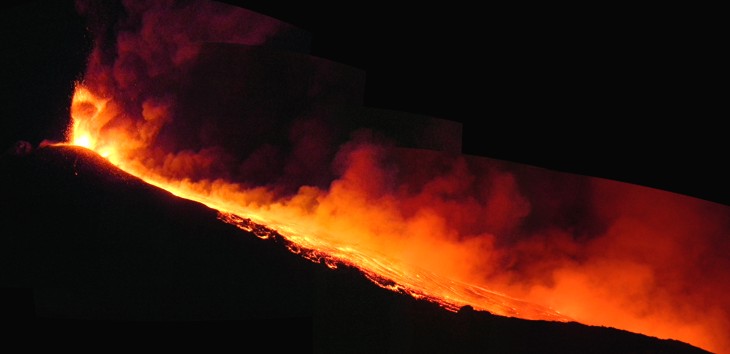
Mount Etna in Italy has been in an eruptive phase since July 30 of this year. A good video clip taken from near the site of the eruption can be found at this link. Sadly, I was unable to plant the video clip into this post, \;-(.  An excellent blog to keep up to date on global volcanism is Eruptions.

Etna Mosaic 7/31/11. Photo credit- Etna Observatory.

I have to wonder how much combustion of reduced magmatic components is occuring as the magma enters contact with the atmosphere.  Certainly the sulfide components must combust at the surface. 

Carbonates are prone to thermal decomposition as well, though from disproportionation to metal oxides and CO2.  At some depth from the surface, the formation of CO2 must begin to produce at least some amount of PV work on the magma column.

The influence of a committed minority

A paper recently published in Physical Review Letters E is stirring some attention on the web.  The citation and abstract are below.  The work was funded by the Army Research laboratory.

J. Xie1, S. Sreenivasan1,2,*, G. Korniss2, W. Zhang3, C. Lim3, and B. K. Szymanski1
1Department of Computer Science, Rensselaer Polytechnic Institute, 110 8th Street, Troy, New York 12180, USA
2Department of Physics, Rensselaer Polytechnic Institute, 110 8th Street, Troy, New York 12180, USA
3Department of Mathematics, Rensselaer Polytechnic Institute, 110 8th Street, Troy, New York 12180, USA

Received 17 February 2011; revised 25 April 2011; published 22 July 2011

We show how the prevailing majority opinion in a population can be rapidly reversed by a small fraction p of randomly distributed committed agents who consistently proselytize the opposing opinion and are immune to influence. Specifically, we show that when the committed fraction grows beyond a critical value pc≈10%, there is a dramatic decrease in the time Tc taken for the entire population to adopt the committed opinion. In particular, for complete graphs we show that when p<pc, Tc~exp[α(p)N], whereas for p>pc, Tc~lnN. We conclude with simulation results for Erdős-Rényi random graphs and scale-free networks which show qualitatively similar behavior.

I’ll confess that I have not paid for a download nor have I been to the local university library to look at the paper.  There is an RPI website that details the highlights of the paper. 

The results of the work seem very intriguing, though. And making a tie to current events is all too easy, so I’ll attempt to restrain myself.

If you have ever done simulation work, you know not to confuse simulation with reality.  However, the great value of simulation is that it forces one to think hard about the parameters of a system and to develop quantatative relationships. This is especially useful in iterative or non-linear processes where intuition easily breaks down.  Even if you do not succeed making a bullet proof model, you have almost certainly come to understand the system better.

Thr RPI article goes on to say-

Once the networks were built, the scientists then “sprinkled” in some true believers throughout each of the networks. These people were completely set in their views and unflappable in modifying those beliefs. As those true believers began to converse with those who held the traditional belief system, the tides gradually and then very abruptly began to shift.

“In general, people do not like to have an unpopular opinion and are always seeking to try locally to come to consensus. We set up this dynamic in each of our models,” said SCNARC Research Associate and corresponding paper author Sameet Sreenivasan. To accomplish this, each of the individuals in the models “talked” to each other about their opinion. If the listener held the same opinions as the speaker, it reinforced the listener’s belief. If the opinion was different, the listener considered it and moved on to talk to another person. If that person also held this new belief, the listener then adopted that belief.

This seems to connect quite naturally with Chomsky’s notion of the “Manufacture of Consent” by the ever burgeoning political-media complex in operation today.  My guess is that the backers of conservative media have had an intuitive grasp of the benefits of repetition and existential certainty for a long while.  When you claim to have the “founders” and a deity on your side, logic and reasoning becomes distinctly non-linear.

Visit to the Hidee Mine near Central City, Colorado

The Hidee mine is a tourist gold mine in Russel Gulch in the middle of the fabulously rich Central City gold mining district of the Colorado mineral belt. Like most mines in the district, the Hidee is located at an auriferous pyrite deposit which is characterized by oxidized ore near the surface and a pyritic sulfide composition at depth.

The Hidee adit was initially part of the adjacent Pittsburg mine, a mine that produced considerable gold.  An adit and drift was dug to intercept the Pittsburg underground workings, but owing to labor problems was soon left abandoned for many decades. In the early 1980’s the claim was purchased and the mine converted to a tourist mine. A drift was cut to intercept the original shaft and in the course of digging, the Fay vein was discovered.

In the photo below, the Fay vein can be seen in the upper half of the image as a gold colored vertical band of pyrite which contains, according to the operators, 2 to 2.5 ounces of gold per ton. On either side of the vein copper mineral can be seen as the blue/green material.

Fay Vein of the Hidee Mine, Central City Mining District.

Early mining characteristically removed the oxidized ore near the surface first which was more easily extracted by relatively simple means. That is, comminution by ball milling and isolation by shaker table or amalgamation.  The deeper gold deposits, below the level of oxidized ore, were tied up in pyrite.  This ore was much more complex to extract and required resources that many mine operators simply did not have.  In the early days, the absence of rail or even passable roads impeded the sale of ore to mills and smelters.

Sulfide ores are commonly rid of the sulfur by roasting.  This smelting process volatilizes the oxidized sulfur, replacing sulfide with oxide.  Oxide ores may be pulverized and the gold separated by numerous methods. Common techniques applicable to oxide ores produced poor results with sulphuretted ores.

Today, the Hidee is operated as a tourist mine despite its relatively rich lode of gold. This is due to the cost of starting up a mine. Not only are there considerable costs associated with the mining process, the regulatory compliance costs are so substantial to a startup operation that very few people attempt to try it. 

Even if one were able to navigate the regulatory compliance maze on a reasonable budget in a reasonable interval, the matter of smelting the ore to provide a crude bullion is a show stopper all by itself. For all intents and purposes, there is no gold smelting capacity in the US.

All in all, the Hidee Mine is well worth a visit. The guides were quite knowledgeable and very friendly. Many tourist mines dumb down the tour, but these fellows were on the level about technical details of the mine and geology. They especially like people who show an interest and some knowledge on the topic.  They scheduled an extra tour for us at the end of the day and were cheerful about it.

Adiabatic Delta T

We ran our first experiments in the reaction calorimeter today. They were very elementary, involving only the metering one reactant into another at constant reaction temperature.  The results suggested strongly that the reactants were consumed promptly and that good control of temperature is obtained by adjustment of the feed rate. Halt the feed and Qr falls off promptly. This is a very desirable attribute in semi-batch processing. 

From the data workup we determined the adiabatic ΔT, or ΔTad, and were able to follow the heat evolution measured in several ways, but most interestingly in watts per liter. It is desirable to know how many watts of heat evolution your reactor is capable of removing. Engineers think in terms of heat evolution as watts per unit volume. Calibration of a reaction vessel can tell you how many watts of heat the reactor can remove at a defined level of fill and agitator speed.  RC1 data can tell engineering how many watts per liter the reaction mass is capable of. 

Next we ran the reactor in adiabatic mode where the jacket temperature is programmed to follow the reaction mass temperature. The idea is to exert dynamic temperature control via the jacket to make the vessel behave as a Dewar.  We predicted the maximum reaction temperature  by simply adding the ΔTad to the initial temperature. We allowed the reaction enthalpy to ramp the temperature.

The actual endpoint temperature was within two degrees of the predicted temperature and below the bp of THF. This is a measure of the potential for runaway.  If the Maximum Temperature of the Synthetic Reaction (MTSR) is below the solvent bp, then you are in a lesser hazard zone. This temperature would be achieved in an adiabatic system.

A few observations- the heat capacity, Cp, is not constant over the course of a reaction. A little reflection should suggest this.  But it does not automatically follow that the Cp increases in magnitude over the reaction progress, which would offer some thermal buffering capacity.

A Fine Caloric

I’m getting to know the RTCal software that animates my RC1.  Thinking about reactions in terms of their enthalpy profile continues to provide deeper insights for an organikker like me.  It is yet another indication that P-Chem is the central pillar of the central science.  

Our culture is driven foreward by exothermicity. We energize the machines of progress and of war by harnessing the exothermic drivers, be they nuclear or chemical.  

Our exothermic sun pumps a global weather machine that provides the motive force to spin the wind turbines to energize our iPads. The sun evaporates water for it’s eventual depostion at high gravitational potential for the release of hydroelectrically accelerated electrons.  Hydroelectric power is an expression of stellar nuclear exothermicity.

The thermal web of our world is an eternal equilibrium of latent and sensible heat flows.  Water’s latent heat of condensation helps to ramp up thunderstorm formation with the result of flowers and high fructose corn syrup and tornados.  The metabolic heat of formation of water and CO2 warms our bodies and provides animation for our desires and our many methods of locomotion.   Dancing and laughter and lust thrive because of exothermicity.

Our lives are spent in the semi-fluid atomic matrix of our bodies while a continual stream of energy flows through them, energizing  metabolism through the magic of ATP and then diffusing into the surroundings.  This energy has resulted in the universe becoming self-aware through the sentience of material beings.

Eventually, because of the disorder accumulated by the large number of exothermic transformations inherent to continuous metabolism, our legs will stiffen and our jaws will lock shut in death as the stream of energy ceases to issue from us. The transience of sentience is rooted in thermodynamics.  How this can be is still quite mysterious.

Borders Books to close its doors this week.

The Borders books chain is set to liquidate, possibly this Friday according to this link. But, like the elk with a broken leg, if the grizzlies don’t get it, the winter surely will. According to reports, the firm was beset with poor management, superior competition, a paradigm shift in buying behavior, and a crummy overall economic picture. The creditors- publishers to a large extent- must be satisfied.

As a frequent patron of Amazon, I hold some personal responsibility for this. I did enjoy browsing in the local store. I bought my issues of Nuts and Volts, Asimov’s Science Fiction, and Kitplanes. But in the end, Amazon had the selection I wanted to spend money on. Obscure print-on-demand books from the 19th century. Not your basic consumer fare at a Borders.

For we browsers of the world, this is a definite loss. Of course, the lesson for browsers is to actually buy something while in the store. That way they can keep the doors open. Or so I’ve heard.

Afganistan: US Fights While China Mines Copper

From an article by reporter Alex Rodriquez in the Tuesday, July 12, 2007, LA Times entitled “History succumbing to the allure of ore”.  The article describes efforts by archeologists to dig sites in an area southeast of Kabul soon to be razed by bulldozers in preparation for copper mining.

So, I understand the part about saving the archeology.

What I fail to understand is why the US is fighting in Afganistan, expending national treasure consisting of the lives of soldiers, equipment, and mountains of cash, while the China Metallurgical Group is busily extracting copper.

USA fights for “freedom”, expending vast treasure.  China’s communism overrides freedom yet digs and extracts treasure.  Really now.

Are we congenital fools?  Are the Chinese at least thanking us for making Afganistan safer for them?  The wars in Afganistan, Iraq, and Pakistan are estimated to cost the US 3.7 trillion dollars.  These wars have produced wealth for defense contractors and for China through it’s mining.  At home republicans are busy sheltering corporations and the wealthy from tax liability while trying to apply wingnut libertarian economic theory to justify why we can’t commit resources at home. 

Most republicans are not wealthy. Yet, republican ranks are jam packed with people of modest means who support a doctrine and a silent power base of wealth who will not reciprocate the support.  It’s utterly irrational.

This is too crazy for words.

Ways to be a chemical entrepreneur

I had a discussion with some professor friends recently about the subject of entrepreneurialism among chemists.  I made my usual points about how people become captains of industry. Be more like an engineer. Preferably one with an MBA.  Naturally, my professorly friends were unmoved. Having spent their entire careers in academia, they just didn’t know about this. I didn’t expect them to.

After I made a gross generalization about the lack of entrepreneurialism among chemists, one prof pointed out that in her field of research, there were indeed people who were starting ventures.  I do not doubt this. But it made me think.  People, perhaps especially those in higher education or just advanced technology, naturally conclude that an entrepreneurial venture has to be based on new technology.  Yes, we need people to start businesses in nanotechnology or what ever you call the latest iteration of biochemistry. We need to have a constant churn of people trying to put new products and capabilities on the table.

But we also need businesses who are able to make polysubstituted phenols, anilines, pyridines, alcohols, ketones, aldehydes, halides, and all of the other “ordinary” raw materials and intermediates that are now largely made in Asia. We need companies who will make 100 kg or 1 MT of some obscure organic material.  Entrepreneurialism isn’t just about the bleeding edge. It is about having a dream and seizing opportunity.  It can be cookies or chemicals.

For the most part, intermediates have moved to Asia because of the economics of batch processing fine chemicals. And a moribund approach to chemical manufacturing in the USA. Chemical manufacturing in the USA is complicated. There are environmental permits, TSCA, high waste disposal costs, high labor costs, expensive processing equipment, and layers of business structure to manufacture safely and with high quality. A chemist faced with navigating the maze of regulations, engineering details, and business operations is a busy person indeed.  Few people can do all of it alone.

There are two fundamental approaches to starting a technology company- Market pull and technology push.  Market pull is an activity where one builds manufacturing capacity with the intent of filling it by making exsting items of commerce. Technology push is where one intends to construct a new kind of technology in the form of a service or widget. Market pull is an approach wherein customers buy known technology. Technology push is the activity where the customer is asked to buy into a new product or service. In this case, you’re necessarily asking customers to be first adopters or to find new forms of value.

I’ve seen startups fail because their one-act pony didn’t work. Instead of trying to make a go of it with a one-act pony, a whole circus of acts should be going at once.  A batch reactor is capable of making many things. A plant built around one product is entirely dependent on that one product.  Batch reactors occupied with products from many market segments are batch reactors that will remain busy over a variety of market conditions.

Pharmaceutical intermediate manufacturing is a business weighed down with substantial overhead and structural immobility.  It is not automatically a great place to start. The GMP world is very complex and peppered with many operational land mines. Many early intermediates are not covered under GMP. That is a good place to start. 

ISO certification is another area where I take issue. While ISO certification brings good business practices, it also brings layers of administrative structure. It is possible to mimic this structure without formally adopting it. The ISO label on you advertising will impress some buyers, but a surprising niumber will be indifferent. If you want to be in pharma intermediates, this will be necessary.  What an ISO certification says is that you will do what you say you are going to do. That is a good idea regardless.

What has to change is the economics of manufacturing in the USA. One way to do this is automated synthesis.  A good example of a problem:  How would one automate the synthesis of an OLED chemical like 1 MT of 8-hydroxyquinoline? This is an existing item of commerce, so entry into the market means taking share from someone else. You’ll probably have to best the market price by 10 % at minimum to induce someone to switch vendors. 

The chemistry isn’t cutting edge, but the processing economics may be. This is an example of how entrepreneurialism can and should  tackle manufacturing problems and gain a competitive edge. Since labor cost is a huge driver, find a way to shave off labor. An entrepreneur’s competitive edge may be process cost savings alone. You don’t have to wait for a scientific paradigm shift.

Part of success is just showing up. Just having capacity and a knack for a particular transformation can attract buyers. If you are handy with borylation and are flexible, somebody will call and want a quote. And maybe a sample. Pretty soon you have a PO and a deadline.

It is good to consider that an advance may be in the form of processing economics, not just the science.