
Memorial Day and Inventors Conscience

Here is an interesting post called When Chemists go to War.  It is a good reminder of how our work can be taken to places where we ourselves wouldn’t go.  Ever develop chemistry that has killed someone? What would you do if you developed a substance that was used for destructive purposes? Would it bother you?  Some scientists from the Manhattan Project were troubled by their work on the bomb, but others slept quite well.

I suppose it could be considered similar to the situation with the inventor of the baseball bat. Could this inventor have forseen the use of the bat in committing violence? Probably didn’t cross his mind.  But if you’re inventing new military explosives, how do you cope with the knowledge that your invention’s use is specifically for more precise application of killing power?  The fact is that there are many scientists who have no difficulty with this at all. I’ve met a few of them and they are very sober folks. They know exactly what their invention does and they are eager to do even better.

I think it is this ability to stand behind the abstract technical details, sheltered from the blood and guts reality, that allows scientists to rationalize their work on killing technology. Scientists will never have to carry with them the olfactory battlefield  memories of bomb smoke and shredded bowel.  Weapons labs are relatively safe places to work.  The weapons scientists biggest hazard, realistically, is the commute to and from the lab. Perhaps weapons designers and munitions manufacturers should have to clean up after a car bomb or carry bodies from the scene so as to emphasize the exact consequences of this work.

Maybe the most important thing we can do to honor soldiers lost and wounded in battle is to resolve that we will produce fewer dead and wounded soldiers. One approach embraced by many is to make war more effiicient and more automated. Send machines into battle rather than people. The other approach is to be a bit less warlike. Throttle back on weapons spending. Take the view that war isn’t really glorious, but rather that it is an uncivilized duty we are called upon to do on occasion. 

Amassing huge armed forces presents the temptation to use them.  The goal for our national leaders should be … lead us not into temptation.
Cyanide-Based Legislative Voting Machine

The US patent literature is full of wondrous inventions and its easy access by computer-machine over the internets is a real boon to historians and hacks like myself.  In the course of my studies into 19th century gold metallurgy, I stumbled across US 7,521, issued July 22, 1850. This patent was issued to Albert N. Henderson of Buffalo, NY.  Mr. Henderson’s invention is entitled IMPROVEMENT IN THE APPLICATION OF ELECTRO-CHEMICAL PRINTING IN COLORS FOR TAKING AYES AND NOES. 

Henderson describes an apparatus for taking the ayes and noes by galvanic electricity and specifically proposed it for use in legislative assemblies. The concept was that at each desk in the assembly would be two keys (switches, as we now call them) for voting either Aye of No. The member would press one of the keys when called to vote, with the result of an electric current passing to a central apparatus with specially treated paper pressed between electrodes. The action of the current in the damp treated paper would be that a vote would be registered as a mark on the paper, recording the vote of the member.  In the end, the only gold connection in the patent related to gold electrodes as a preferred embodiment.

Claim 1.  This patent claims a mode of imprinting words, letters, & figures, etc, upon paper or other fibrous substances between two surfaces of a metal which is not acted upon by the substances employed, on one of which the letters or figures are raised by passing a current of galvanic electricity through the prepared material, substantially as above described.

Claim 2. Passing the electric current between metallic surfaces, as above described, through damp paper otherwise unprepared, and afterward applying a chemical solution, by which the effect of the electricity becomes visible whenever it has passed through the paper, for the purposes above described- telegraphing, etc.

Substances which may be used as part of the solution for the preparation of the paper- Copper sulfate (gives black impression), Potassium cyanide which may be acidified with H2SO4 or HNO3 (!!) to impart a green color with the galvanic current.  A strong solution of KCN with Ag chloride gives a green impression. All above leave white paper until acted upon by electricity.  A weak soln of potassium ferrocyanide (prussiate of potassia) colors the paper slightly and leaves a deep blue impression by the electricity. Henderson prefers to use electrodes of gold or platinum.

This invention has a kind of steampunk aspect that I find very appealing. On the other hand, it is hard to know what knowledge the inventor had with regard to the hazards of KCN or acidified solutions thereof. The patent is silent with regard to the chemical safety questions arising from the use of KCN treated paper.

Grimsvötn Eruption

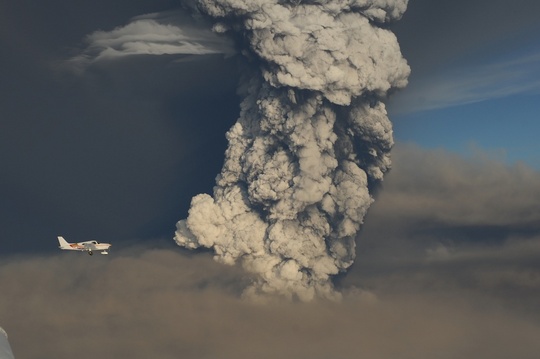
The Grimsvötn eruption in Iceland began its eruption on May 21, 2011 with the injection of considerable ash into the navigable airspace to the east. Excellent photographs can be found at the Icelandic Met Office.  Grimsvötn is a very prolific basaltic volcano located on the southeast part of Iceland. Grimsvötn is the most frequently erupting volcano in Iceland, with the most recent eruption in 2004.

Grimsvötn Eruption in Iceland. (Photo credit- Sigurjónsson, Icelandic Met Office)

According to one source in Iceland, the eruptions have presently subsided to steam venting, though no one is prepared to say that the eruption is over. The safe distance for viewing is said to be 2 km.

Last US Vinyl Mine Closed

The Eureka Vinyl Mine in La Brea, California, closed May 13 of 2011. The mine had been producing natural vinyl since 1896.  Prominent investors included Thomas Edison and Johnny Mercer. The demand for virgin vinyl has steadily dropped since the polycarbonate CD hit the market in 1982 with the release of Billy Joel’s 52nd Street.

Vinyl mining was once a vital part of the manufacturing economy in Southern California.  These rich vinyl deposits produced exceptionally high grades of vinyl late into the 1990’s. Flemish immigrant Goeskin Goossaert discovered a vein of natural vinyl while excavating a foundation in the Pasadena area in 1874.  In it’s natural form, vinylite is dark in color and is grainy and brittle with striations of styrenite. 

Not knowing what the material was, Goossaert set some ore aside for a time.  Eventually Goossaert discovered that the material melted easily and burned with a piercing odor. For a time he sold the ore as fuel under the unfortunate name of Stinkenkool. But the problem with vinylite as a fuel was that it melted and spread burning material throughout the enclosure.  This unfortunate behavior lead to several highly publicized tragedies. Soon the new fuel was shunned in favor of coal or kerosene.

Noting that the material could be molded, Goossaert contacted Thomas Edison and arranged to send samples to the Wizard of Menlo Park for evaluation. Within a short time Edison fashioned a recording cylinder out of it and patented the invention, leaving Goossaert without any share.

Other veins of vinylite were discovered and soon many applications of this thermoplastic substance were found. To a large extent, the recording industry in LA was founded on the availability of this wondrous substance. Goossaert never attained wealth from his discovery and died penniless in 1928.

Misc Sciency Stuff

Think it’s possible to build an electron microscope in your garage?  This guy did it. Ben Krasnow built himself a scanning electron microscope at home with salvaged electronic parts.  This is beyond cool.

Final flight of Endeavor. Cool shot of rocket in the clouds. Could be photoshopped with all of the color saturation, but maybe not.

Neuroscientists in the UK think that the brains of Apple enthusiasts are stimulated by Apple imagery in the same way that religious adherents are stimulated by religious imagery.

It has been suggested that flood plains exist because of flooding.  Something to consider on your next home purchase.

Nasa is floating the idea that there may be more free floating, lone planets than stars.  Sounds very cold.

The destruction of the world commences this weekend.  I guess we’d better get packed.

Texas Justice. Fishing Crimes.

You know, I really do like Texans. I lived there for a few years and I think I have an accurate sense of the place.  But Texans are Texans. It really is “like a whole ‘nother country” sometimes.

The Texas legislature recently passed the Fish Fraud law which specifically addresses the problem of fraud at fishing tournaments. The bill passed the house 142 to 4 and the senate 30 to 1 and awaits signing by the governor.  The bill provides penalties for fraud starting at a Class A Misdemeanor for the first offense to a third degree Felony for fishing crimes involving greater than $10,000 in prize money.  

According to the article, game wardens and prosecutors approached Representative Dan Flynn about  a fish fraud incident at Lake Ray Hubbard east of Dallas in October of 2009. Rep Flynn jumped on this outrage and brought the beady eye of scrutiny to bear on those dark hearted anglers who dare to flim-flam fishing tournaments. Case in point:  A semi-pro angler forced a 1 pound weight into a 9.5 lb bass, misrepresenting the weight of the fish and thus defrauding the tournament organizers. 

Without the benefit of a Fish Fraud law, the crooked angler got 15 days in jail, 5 years of probation, and loss of his fishing license for the duration of his probation.

It certainly seems to me like Texas Justice was swift and unblinking in this case without a special law on the books. The miscreant who perpetrated this act was nabbed by the local constable and thrown behind bars.

Ever wonder why there are so many laws on the books? This is an example of how it happens. Somebody games the system and legislators rush in to pack legislative caulking into a perceived hole in the wall. The Texas legislature has felonized yet somethng else. 

Are we really better off with an ever expanding definition of felonious acts?  The fisherman’s wickedness is plain for all to see. But does this one case merit the enactment of yet one more piece of legislation?  If you are a hammer, everything looks like a nail. Maybe it’s best if we take some time off from inventing new laws and look at what we’ve wrought?

Albemarle enters lithium market

Here is one I didn’t see coming.  Albemarle has announced that it will be entering the lithium carbonate market.  In case you didn’t know, Albemarle has been a leader in bromine and brominated flame retardants for some time.  Economically speaking, if you want to be a bromine specialist or brominator at the commodity scale you should probably be basic in bromine. That is, you get your bromine feedstocks from underground or the Dead Sea.

Everybody likes the benefits of flame retardants but nobody likes to pay much for it, so manufacturing has to be large scale to keep the retardant prices down. The way you do that is to pull bromide from the ground, often as a brine, and oxidize the bromide to bromine and isolate it from your process stream. Albemarle has recent US patent applications for the nth iteration of their technology: see US 2010/0047155 A1.

A quick perusal of Albemarle patents failed to turn up any US patents or published applications indicating that they had been working on this. This press release must have been given special consideration in view of anticipated demand for their lithium. 

Since Albemarle is already tooled up for brine work it is not such a stretch to see that they are piloting lithium extraction from their process streams. According to Specialty Chemicals, a chemical trade publication, the Albemarle brines contain 100-300 ppm of Li and sources say that they are using an exchange resin for the isolation. While the brines at it’s Magnolia, Arkansas, facility are a little on the lean side in lithium, the fact is that they are already set up for brine processing. A large chunk of capital costs for recovery have already been put in place for the bromine operation. So, it’s a matter of setting up a Li extraction train to intercept the brine stream somewhere in the Br process.

Setting up ancillary process trains like this to recover other values is not at all uncommon. According to the Specialty Chemicals article, Albemarle expects to be producing lithium carbonate in 2013.

The USGS publishes annual reviews on the global stockpile situation with economically important minerals, lithium included.  A prominent source of lithium in the US is the Tin-Spodumene belt at King’s Mountain District, NC. Spodumene, LiAlSi2O6, is the principal mineral variety at Kings MountainChemetall Foote, a subsidiary of Rockwood Holdings, now operates at Kings Mountain, NC, in Nevada, and  Salar de Atacama in Chile.

According to Virginia Heffernan at the website Mining Markets, the cost of spodumene processing to afford lithium carbonate is quite high, $5500 per tonne of Li2CO3. Acid roasting is used to process the ore to liberate the lithium.

According to the article at Mining Markets the three major players in global lithium are Chile’s Sociedad Quimica y Minera de Chile (30 %), Chemetall (28 %), and FMC (19%).

Global warming talk

Our local ACS section meeting tonight featured two speakers with opposite views on anthropogenic global warming (AGW).  One was a senior scientist from CIRES and the other was a retired physics prof from UCONN. 

The physicist did what physics profs like to do which is to say, reduce the problem to constituent elements. To make a long story short, the physicist tried to demonstrate that CO2 levels are the result of warming, not the cause.  He applied Henry’s law and did a lot of handwaving and criticism of climate science and modeling as well as some old fashioned back of the envelope calculations. It was a rather good demonstration of the climate deniers art.

The CIRES guy’s talk was really quite comprehensive and tied in observations from a wide variety of types of experiments to support the notion that CO2 has rapidly ramped up coincident with the industrial revolution- say the last 200 years or so. What was most persuasive to me were the isotopic data showing the deficit of C13 in the recent CO2 buildup. This data suggests that the accumulated atmospheric CO2 levels are measurably tipped towards biomass or fossil fuel origin rather than of inorganic origin.

As near as I can tell, much of the audience of chemists seemed to incline towards the climate denier. A vocal few were certainly skeptical of the data in the sense that the limits of the instrumentation had to be accounted for. But this was the normal skepticism one sees chemists display everywhere. I’ve done it myself.

Obviously, I’m not a climate scientist and would never be confused with one. I’ve been on the fence about AGW until tonight. I think I’m tipping slightly towards AGW now based on the isotopic findings. 

What I saw tonight was more like the parable of the three blind men and the elephant. The AGW denying physicist and more than a few in the audience understood at least part of the data and concepts. And from the area of expertise they held, felt they had a unique perspective on the problem. I gathered this from the nature of the questions asked.  

This is emblematic of the situation and in a similar vein to creationist “science”.  Creationism has all kinds of problems as a model of reality.  But what I often observe in its adherents is a limited knowledge of the theory they are trying to defeat.  In fact, I would offer that creationists comprise a kind of scholarly archtype. Creationists have the answer already and spend their time collecting data in support of it. This is characteristic of people who read devotionally rather than analytically.

I think learned people can fall into a kind of intellectual cul-de-sac from which many never escape. A lot of AGW deniers spend their time trying to debunk the IPCC data rather than performing experiments to achieve greater clarity.  AGW deniers are certainly well represented with conservative affiliation.

I was accosted by a coworker the other day who was so disgusted by my liberal ways and neutral attitude towards AGW that he couldn’t be bothered to expend the energy to fully dress me down for it. It just wasn’t worth the effort, apparently. Thanks friend. Where are all of these liberals the conservatives keep bitching about? I’m not seeing them.

Well Endowed Chair

The camel’s nose has been snuffling under the tent at Florida State University.  According to Kris Hundley at tampabay.com, Charles G. Koch pledged $1.5 million a few years ago to support faculty in the economics department.  Not unusual at first glance. But what Koch was able to wangle out of the Dean was the right to screen the faculty he is supporting. They want profs cut from a certain cloth. Of course everybody wants that, but the Koch’s are able to write the checks.

You see, Mr. Koch is very smart.  He knows that to properly manage staff, you have to hire well, write their job description, have them agree to goals, and then follow up with annual evaluations. That’s how they do it in business. Why shouldn’t you expect the same from the academy? It’s about inputs and outputs. And the outputs should always be more valuable than the inputs.  You drop a wad of cash on FSU, you expect a return.

I’m sure Dean Rasmussen is very satisfied with this arrangement. I’m sure that he looks very savvy for making this deal. He said that they are now able to offer 8 more classes because of this.  Deans are a very special kind of academic animal. They are nearly always former profs who caught the allure of administration.  They keep their association with their department, but climb the spiral staircase into the stratosphere of Old Main.   From their lofty perch they herd the frequently squabbling but always loquacious cats through the annual cycles of academic life.  Something happens to people once they become a dean, and it’s not always good. All of a sudden student teaching evaluations become insightful and important.

 As Gaye Tuchman explains in Wannabe U (2009), a case study in the sorrows of academic corporatization, deans, provosts and presidents are no longer professors who cycle through administrative duties and then return to teaching and research. Instead, they have become a separate stratum of managerial careerists, jumping from job to job and organization to organization like any other executive: isolated from the faculty and its values, loyal to an ethos of short-term expansion, and trading in the business blather of measurability, revenue streams, mission statements and the like. They do not have the long-term health of their institutions at heart. They want to pump up the stock price (i.e., U.S. News and World Report ranking) and move on to the next fat post.    William Deresiewicz, The Nation, May 23, 2011 Edition.

The Koch’s are engaged in a kind of social reconstruction through the formation of institutions, the backing of political movements, and now penetration of the academic veil. They have the resources and the self-assurance that comes from being highly successful businessmen.  They are very acquisitive fellows- a natural attribute of wealthy industrialists. 

Their corporate cosmology defines a universe of transaction possibilities.  All the world is a market and greater market share is the raison d’etre.  I’m sure that when the Koch brothers look out the window, they see a landscape of markets and a sky full of profit potential.  People like me see rooftops and air handling units. 

In a market-based society, the only real opposition I can apply to the Koch’s is to quit buying Brawny paper towels, Dixi Cups, or Stainmaster carpeting. The average indivdual’s power in the real marketplace is approximately zero.  Self-determination in the marketplace  is proportional to your wealth.  No wonder the Koch’s and their ilk want to see less gov’t and more market. They get to be in charge.

Notes from the South Pole

A friend is a winter-over staff member this season at the Amundsen-Scott South Pole station. The station is accessable by air only for part of the year.  The last flight left more than a month ago or so. This is her second tour at the south pole.  The elevation there is at 2835 meters above sea level, so not only is the cold due to the low sun angle, but also due to altitude.

Life here at Pole is quite the experience. Today’s winds are up around 20 knots and that knocks visibility down to about nothing. The snow is so dry and icy, any winds kick it up like a sand storm. So no outside treks for yours truly today. In fact, I only make it outside maybe twice or three times a week. If auroras are dancing, I’ll suit up and make the effort because standing under the amazing manifestation of solar winds is just breathtaking.  –South Pole Susan 5/8/11

My friend said that her colleague, Marco Polie, is still skiing every day, but lately it’s too extreme even for him with wind chill temps down to -130 F and zero visibility.  Getting lost in a whiteout would be tragic.

People used to joke that the only difference between going to sea and going to jail is the added risk of drowning. Sounds like a similar thing could be said about wintering at the pole.