Patent links

The blog Patently-O is a worthwhile site to visit periodically.  That is if you’re interested in the arcane cosm of patents like I am. The fellow who writes the blog is Dennis Crouch, Asst Prof. at the University of Missouri School of Law. The post on USPTO guidelines on obviousness is particularly interesting.  I find this to be the most vexing part of patent law. 

EDTexweblog documents patent litigation in the East Texas district. I especially like the litigation haiku.  Reference and comparison is made to Vogon poetry.

Anything Under the Sun, by Russ Krajek, is another useful site to visit if you want to glean useful tidbits on patent practice.  These sites are maintained by people interested in their field and are happy to share insights with others.

Thoughts on Process Development. Outsourcing.

I have not put pen to paper (Okay. Fingers to keys) on process development lately. I can’t discuss much in the way of specifics. But there are some generalizations that can be put on the table for discussion.

When should you outsource a raw material? Depends. Does the process for the raw material match your skill set? Namely, does it require, say, bromination of an olefin or an aromatic ring? This can be deceptively troublesome. It is easy to scribble down a reaction mechanism for a bromination. It can seem like a no-brainer to say “yeah, we can do that”. Same is true for a Sandmeyer or a Friedel-Crafts reaction or some oxidation reaction for instance.

You may not do much of a particular kind of transformation or handle certain reagents enough to have an institutional expertise to safely handle some materials. You may have safety kingpins who will nix some reagents because they don’t like the looks of the MSDS.  Or, your pots and pans may be booked well into the future and you have no opportunity to make the raw material.

The trouble with outsourcing a raw material is that the supplier’s price is your cost which must be passed along to your customer. You may or may not have the margin to play with to do much outsourcing.  If you suddenly need to outsource a raw material, you will have to find a shop that will make the stuff.  Preliminaries include doing a secrecy agreement, a disclosure of the desired material, and possibly disclosing a technology package.  After the disclosures it might transpire that the vendor isn’t interested, they can’t do the job in the desired time frame, or they want too high of a price. Lots of things can go wrong.  Meanwhile, you’re relentlessly screaming down the timeline towards you’re own delivery date. You should be planning your outsourcing 6 to 12 months in advance. Or even 18 months.  Outsourcing always involves the discovery of new failure modes.

Let’s say that they agree to work up a quote. There is the matter of specifications. They’ll need to know some specifications even before they quote a price.  What kind of purity are you needing? Be reasonable now. There is what you want and what you can get by with. OK, you can live with “97 % purity”. What does that mean? Does it include solvent residuals? What about color and haze or mesh size and appearance? If it comes in at 96.8 %, are you sure you want to reject it?  If it can be easily reworked, and you have the time to spare, rejecting the material might be the best choice. But if they are late and you are late, you may have to take the material on waiver.

Apart from the mere chemistry is the matter of TSCA regulations and/or import restrictions. Will your vendor have to file for an LVE (low volume exemption) or is the material already on TSCA?  An LVE will take time even if everything goes well. Need to put these regulatory filings into the timeline.  Want to import bulk Hazardous When Wet materials? Plan on a boat ride across the ocean.

Asking a company to develop a new product for you requires good communication, person to person relationships, and lots of patience.  Your custom vendor may be smaller than you are and may have considerable resources tied up in your order. They’re taking some risks as well. Shoot for win-win.

Salmagundi

The world wide web is a never ending source of wonderment … for the curious.  It’s just email for everyone else.

A 3-D priniting device has been demonstrated using concentrated sunlight to fuse sand into sintered glass structures. In the Sahara. Where there is a lot of sand and sunlight, naturally.

Think you understand why the Soviet Union collapsed in 1991?  Think it was the dynamic duo of Ronnie Reagan, Maggie Thatcher, and their SDI that done em’ in? Well, these two characters had a part in it certainly. But the USSR was at the peak of its power by that time.  And they knew that SDI was decades from implementation. What was the real reason that the powerful and influential USSR collapsed? The article in the July/August issue of Foreign Policy by Aron Leon gives some interesting insights into that period of history,

Malcom Gladwell on spaghetti sauce.

Whither tellurium?

The Onion Wins Pulitzer Prize

The Pulitzer Board today announced that Bob Loblaw, associate editor at The Onion, has been awarded the 2011 Pulitzer Prize for Faux News. Loblaw was recognized for his groundbreaking 300 word essay on faux journalistic integrity in virtual political news reporting. Loblaw’s knack for news aggregation from the internets has encouraged editors throughout the web to extract and publish virtual news.

The Publisher, Editorial Board, and staff of Lamentations on Chemistry wish to congratulate Bob Loblaw and The Onion on this prestigious award.

Retro NMR

We received our picoSpin 45 MHz NMR last week. It’s the size of a toaster and sits on the benchtop next to the computer. We brought in a bunch of chemists to see a demonstration. Most of them were fresh PhD’s on their first job out of grad school. I think they were non-plussed. What on God’s green earth would someone accustomed to using 300-500 MHz NMR want with a low field FT instrument like this?

Let me say that I am a fan of this thing and the company. Yes, it is retro in some ways. It lacks the sensitivity and features many of us are used to. However, it is an FT instrument and can be used to examine a great many substances. In a high field instrument, it seems like everything  is a doublet of doublets. Not in this instrument. For routine analysis of reaction completion, for instance, you may already know the spectrum of your product or starting materials. One or two reasonably isolated diagnostic peaks is all you need to gauge the state of your reaction. You almost never need coupling constants and fancy 2-D spectra at this point. Often, high resolution amounts to excess capacity. And you can have picoSpin in the lab with you. No need to trudge to the NMR room for a routine spectrum. Oh yes, it’s $20,000 for the unit.

We have a high field instrument, but not at my location. Between the GCMS and the picoSpin, I have a good bit of analytical capability.  What I like about this is that the picoSpin offers a lot of analysis per dollar. Of course a high field instrument offers superior capability. But the fact is that most instrumentation on the market today provides considerable excess capacity. For instance, how much of the capability of Microsoft Excel or Word do you actually use? Perhaps 10 %?  I’d offer that a large fraction of the total dollar amount spent on scientific instrumentation worldwide amounts to excess capacity.  People are easily dazzled by the possibilites in a list of features. Sales people know this and actually depend on it.

So, I’m exploring how this miniature marvel can be integrated into daily use in a chemical manufacturing plant. Chemists are a stubborn lot and it may be that I can’t crack this nut. We’ll see.

Screenplay

A friend wrote a screenplay called the” Hermit Kingdom” and a group of us did a public reading of it at the Bas Blue theatre in Ft Collins last night. It is based on the 1871 American Expedition to Korea. It was quite enjoyable to read this and then indulge in a bit of analysis. There were 47 characters involved in many layers of story. 

We’ve done this a few times now with new plays and screenplays. It is interesting to see how these things are written.  Actors and directors get a lot of credit in plays and film, but only after the writers have conceived it and put it in print.

Snow

Wow. The mountains of the Colorado Front Range got a fresh coat of snow last night. Looks like it extends below timberline.   The winter wheat harvest will happen in a few weeks.  By mid-July we will be into the monsoon season here.  That is when pacific moisture brings a bit of rain and moderates temperatures for a few weeks. By August it’s hot and dry like everywhere else.

I had the occasion to go to a barbeque at the farm of a local Coors barley farmer saturday evening.  He has been featured in numerous Coors ads on TV, in part because his family has been growing Coors barley for 52 years, but also because he provides a very striking persona for television.  From the collectors items on display, he is very much an admirer of John Wayne and John Deere.

AF447 Accident information is beginning to reveal the event

The French air safety authority, the BEA, is beginning to put together the picture of what happened to AF447 enroute from Rio de Janeiro to Paris.  Key parts of the wreckage have been found, including the flight data recorder.  The BEA website contains links directing the reader to a more detailed view of many aspects of the investigation.

What has been so unnerving about this particular crash is the lack of detailed understanding of how it initiated and propagated. We know how it terminated.  In particular, the flight is an example of in-flight loss of control of the aircraft.  By all accounts, the airplane was in good working order and well equipped for transoceanic flight.  It had a crew that, by prevailing standards, was well qualified to operate the aircraft. How could there possibly be a loss of control that could confound this well equipped machine with expereienced crew?

The aircraft had more than one crew on board as well as a highly automated flight control system comprised of advanced navigation and communications, auto pilot, and auto throttle systems with the usual redundancies.  Yet with all of the human resources and automation, and with a century of aircraft design knowledge behind it, this passenger aircraft managed to take an excursion into uncontrolled flight and impact the ocean.

The BEA has disclosed a timeline of events in the cockpit as well as a description of the flight attitude of the aircraft.  What I find interesting are the control inputs made by the PF (pilot flying). In the face of indications of a stall, the PF primarily tried to pull the nose up.  This is the wrong control input for a stalled airplane. What makes the incident worthy of note is the interaction of the crew with the automation and sensors.  Aviation Week and Space Technology has a good article worth reading on this very topic.

Fort Calhoun Nuclear Generating Station Alert

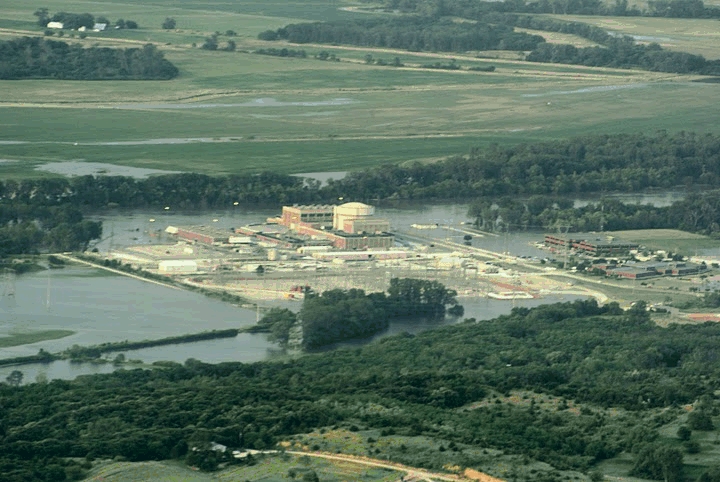
An alert was declared on June 7th, 2011, at the Fort Calhoun nuclear generating plant north of Omaha, NE.  The plant is next to the Missouri River which has been at some level of flood stage recently.  According to the NRC, a fire ocurred briefly affecting some electrical equipment necessary for safe operation of the plant. Within a few hours the plant operators exited the alert when the necessary access to equipment was regained. 

For a short time the plant lost its ability to cool the spent fuel pool cooling water.  While the incident did not result in any unsafe temperature rise in the pool, the licensee was obligated to declare the alert. The plant remained safely shut down during the event, though afterward the plant remained under an Unusual Event Declaration due to the condition of the Missouri River. The FAA issued a temporary flight restriction within two nautical miles of the plant.

Ft Calhoun Nuclear Plant in the Missouri River

Visit to the Argo Mill

After years of driving by the Argo mill in Idaho Springs, Colorado, we decided to turn off of I-70 and take the tour.  Admittedly my interest in the mining history of the west had something to do with it.  

This is a very unusual historical site and is worth a stop for those with an interest in history and mining. The facility consists of a red mill building built along the slope of the mountainside and, separately, access to the entrance of the Argo tunnel.  Adult tickets cost $15 and in exchange for the fee, you get a movie and a talk on the history of the mill by a staffer, and a pack of sand for your gold panning lesson.  The sample of sand is salted with gold flakes so that everyone has a decent chance of recovering some flakes.
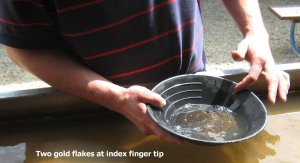
Staff member demonstrating the use of a gold pan.

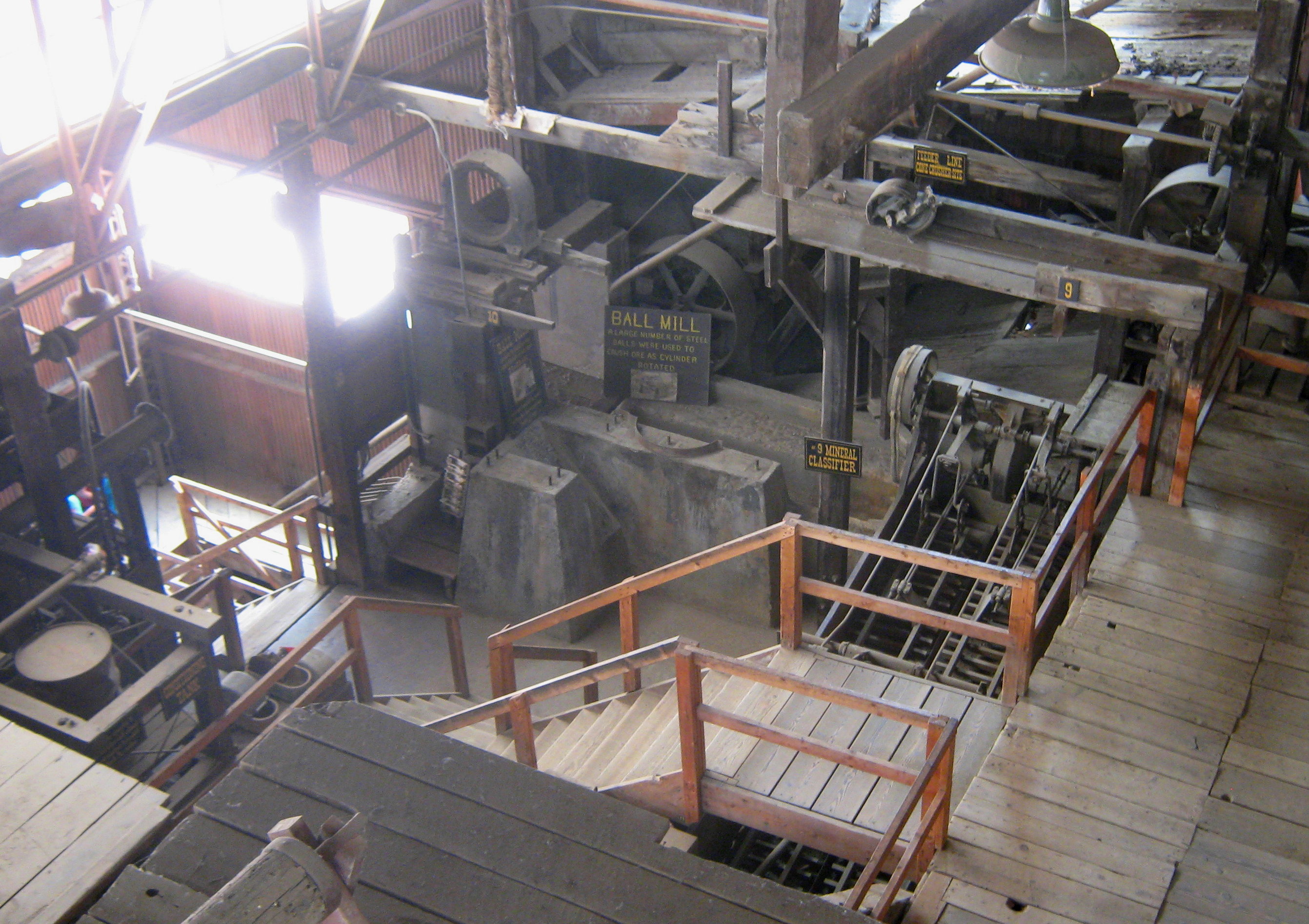
What makes the Argo mill unusual?  Several things. Most obviously, it is a gold mill that is quite well preserved. Most gold-rush era mill sites were in various stages of ruin in the early 2oth century. That this mill has been so well preserved alone makes it worth a visit. Add to that the machinery that is on display and you will get a fairly good idea of what it must have been like to work in such a place.
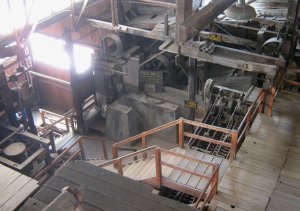
Interior Spaces of Argo Mill. (Copyright 2011 Th' Gaussling)

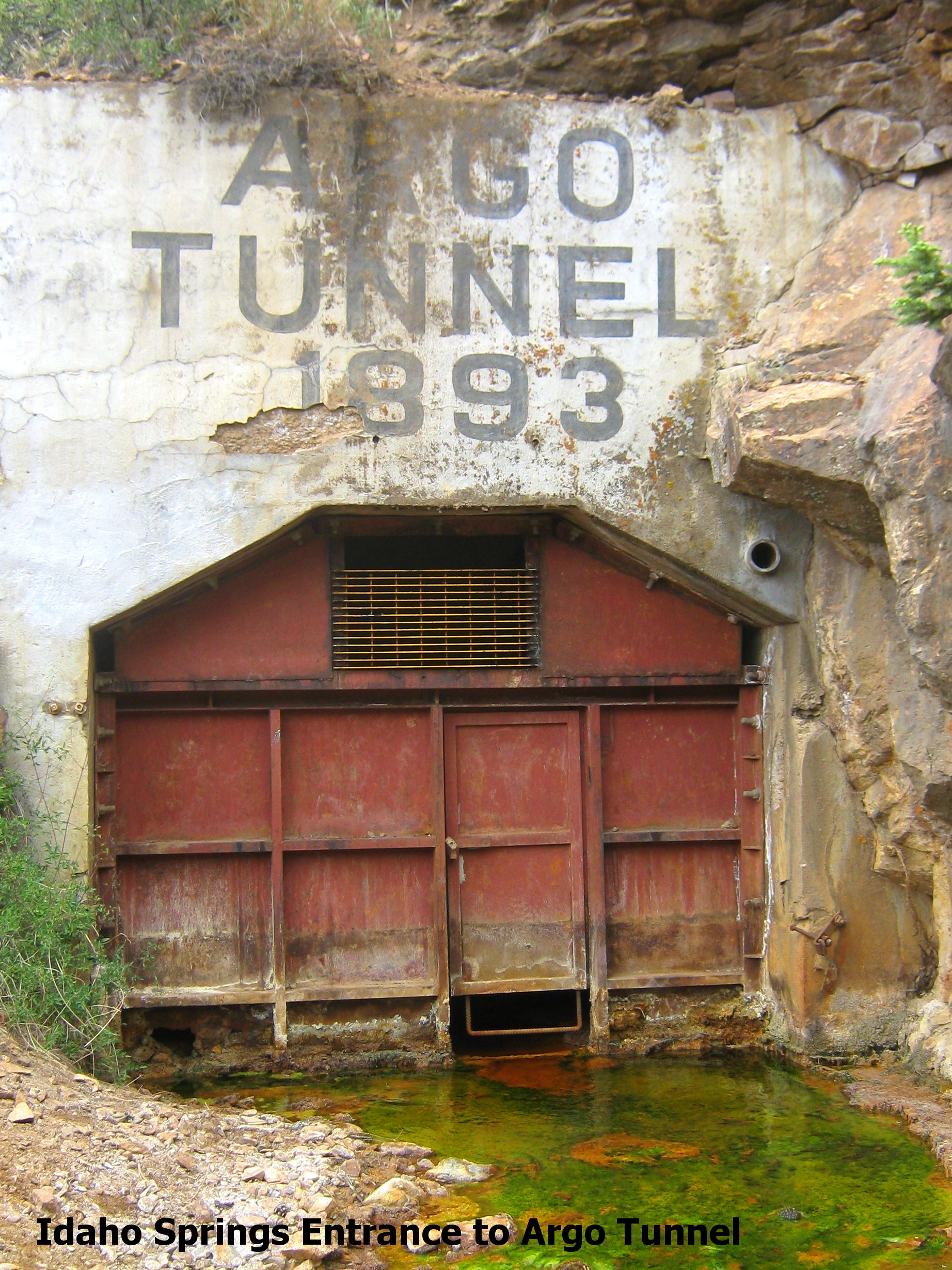
The other major reason for the unique quality of the Argo is it’s association and proximity to the Argo Tunnel.  The 4.16 mile long tunnel was begun in 1893 and completed in 1910. The idea behind the tunnel was both simple and ambitious. In order to provide milling services to the mining districts to the north, a tunnel was constructed below the mines to provide both drainage and easy transportation to a mill.
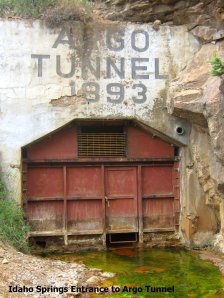
Entrance to the Argo Tunnel (Copyright 2011 Th' Gaussling)

Idaho Springs sits about 2000 ft below nearby Central City and is well situated for such a tunnel. The Central City gold district was a natural phenomenon at it’s peak. This section of the Colorado mineral belt was fabulously rich in gold and beginning with the 1859 discovery of gold, quickly became densely covered with mining claims from Idaho Springs northward to Central city and beyond. Hauling ore from the north to Idaho Springs was problematic owing to the topography.  A major road was the Virginia Canyon road, also called the Oh-My-God road, and was unsuitable for hauling ore. Ideally, a mill should be below the entrance to the mine in order to make maximum use of gravity in the milling operations.
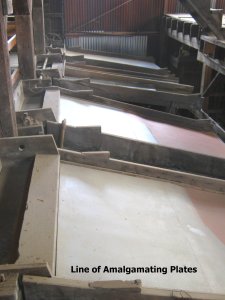
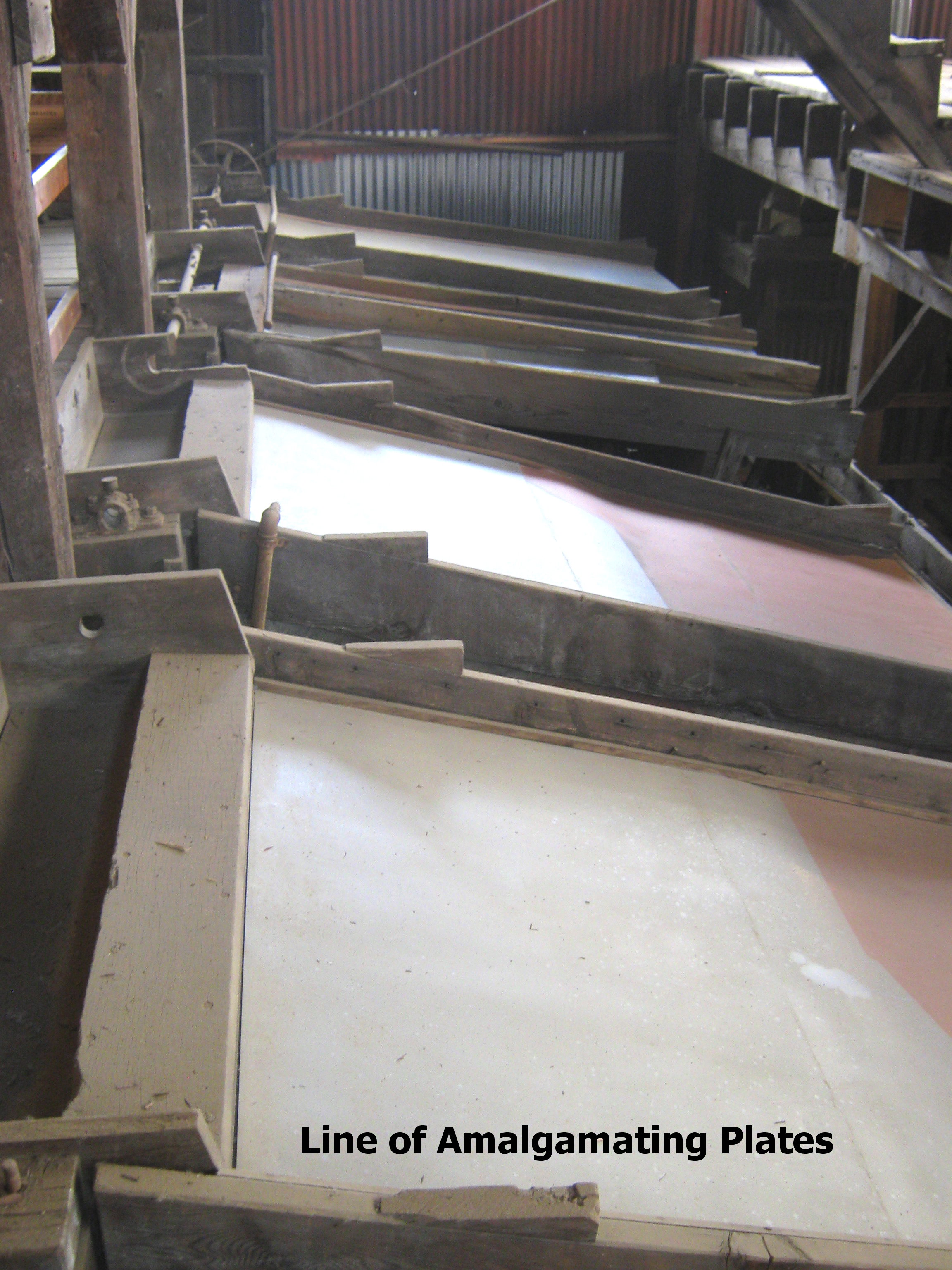
Amalgamation plates. (Copyright 2011 Th' Gaussling)

When completed, ore was moved through the tunnel by ore cart from mines to the north and received at the mill in the tipple house.  The ore delivery was recorded and assayed for gold content.  The business model of the mill was this- ore was purchased from the mines on the basis of assay and extractable gold was recovered.  This model of operation was common. Mills and smelters were customers for the mine operators. Ore was produced at the mine and sold on the basis of assay.
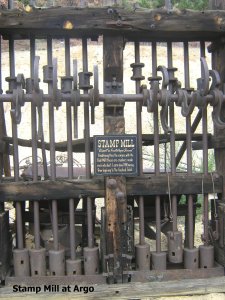
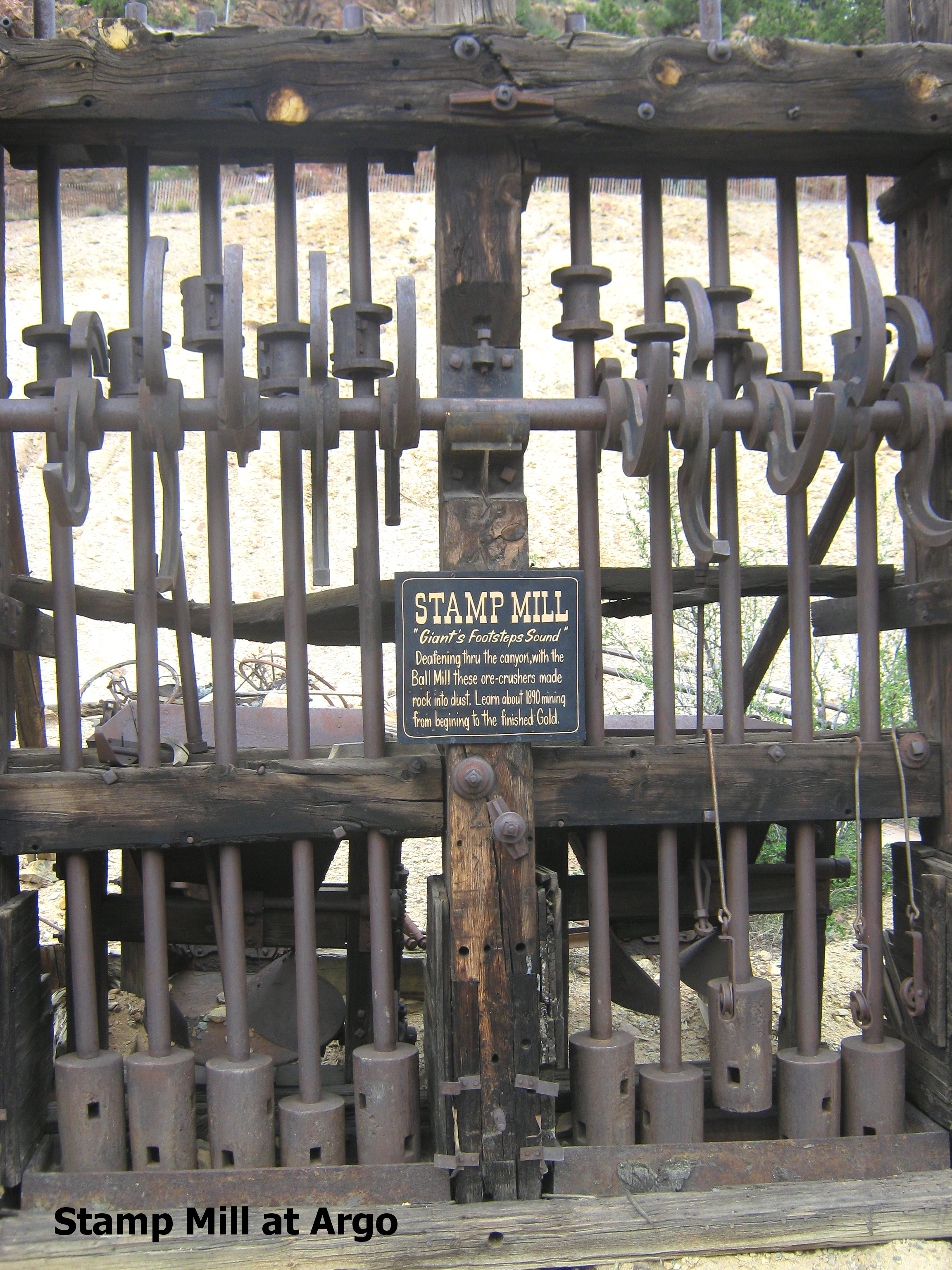
Stamp Mill on display at the Argo. (Copyright 2011 Th' Gaussling)

According to the guide at the mill, amalgamation operations were halted in the 1930’s, allegedly due to health and safety concerns.  The ore was comminuted with a ball mill and subjected to separation of the gold by shaker tables. Maybe the reason cited for ceasing Hg operations is accurate, but I’ll need to see independent verification of that.

Cyanadation was practiced at the mill as well. Not much was disclosed about this process. The guide disclosed that the mill tailings were contaminated with cyanide and mercury. As it happens, cinnabar occurs naturally in the Central City mining district, according to the guide, and can be found in spoils piles. Today this contributes to total package of contaminated leachates which may find their way into the watershed.

All in all, the Argo mill is worth a visit. Like all tourist attractions, however, you have to expect that there will be some dumbing down of the scientific and engineering details. Commonly, the emphasis in a visit to a tourist mine is on the craven details of gold mania and this tour is no different.  However, I am a purist. My interest relates more to the natural history of the chemical elements than the details of blasting and mucking.  So, if you can turn a blind eye to lackluster docent work, such tours are interesting and useful.