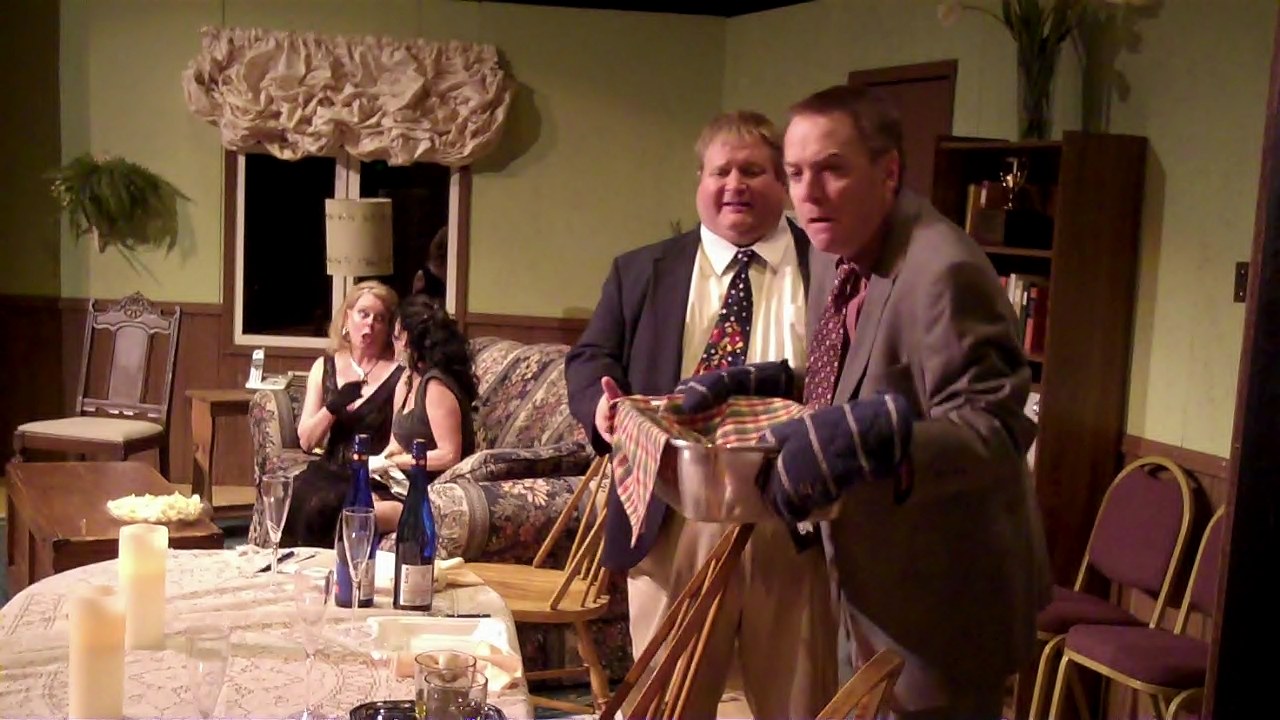
A Great Lumbering Oaf

Wow. I just watched the video of our recent production of Neil Simon’s The Odd Couple. I think overall it came off rather well, especially with the modest resources on the production side. The overall production value and the casting played well, at least in the context of community theatre.

What is sobering to watch is a video of one’s performance on stage.  The difference between your own sense of what is happening around you and what the camera captures can be striking and maybe even a little disturbing.  More to the point, your own sense of how you performed can be drastically different from that recorded by the merciless, unblinking eye of the camera.

This was my fifth play and in all of them I have played a minor character.  What you find in doing such parts is that the director will not lavish much time in closely directing your acting. The director is mostly concerned with bigger problems, like- will the lead characters ever learn their lines? Or, how are we going to tweak the blocking to make the thing look better? So it is possible for the minor characters to give less-than-great performances without much feedback from the director, or maybe anyone.

The upshot is that, like everything else, you have to be self-aware enough to want to improve and take steps in that direction. My goal- to be less oafish. It is a good goal for an actor and for life in general. There you have it.

February Linkkenfest

Did you hear about the polar bear that swam 426 miles? The polar bear and yearling cub swam from near Barrow, Alaska, across the Beaufort Sea to the coast in Canada. The bear was equipped with GPS and a temperature sensor. Investigators say the bear lost 100 lbs in the ordeal. The cub did not survive. Apparently there were no ice floes for the bear to crawl onto.

Tropical cyclone Yasi, a Category 5 storm, has slammed into the coast of Australia in Queensland.

Those wacky libertarians.

Why doing a PhD is often a waste of time, by The Economist.

Robert J. Samuelson at the Wilson Quarterly offers a compelling analysis of the Great Recession.

As for greed and dishonesty, their role in the crisis is exaggerated. Of course, greed was widespread on Wall Street and elsewhere. It always is. There was also much mistaken analysis about the worth of mortgages and the complex securities derived from them. But being wrong is not the same as being dishonest, and being greedy is not the same as being criminal. In general, banks and investment banks weren’t universally offloading mortgage securities known to be overvalued. Some of this happened; testimony before the Financial Crisis Inquiry Commission shows that some banks knew (or should have known) about the poor quality of mortgages. But many big financial institutions kept huge volumes of these securities. They, too, were duped—or duped themselves. That’s why there was a crisis. Merrill Lynch, Bear Stearns, and Wachovia, among others, belonged to this group. –Robert J. Samuelson, Wilson Quarterly, Winter 2011.

Cuppa Noodles

Working late in the lab tonight. Listening to Music from the Hearts of Space on NPR. Couldn’t leave for supper so I had to break into my emergency cup-o-noodles for nourishment, such as it is.  Night is a good time to write reports and tumble deep into the dendritic recesses of the internet. Some companies won’t let you in the building after hours. I’m good as long as I don’t unchain the dragon and let her fly around.

Have to purify some inorganic stuff I made. It’s very problematic. The material has a large coefficient of expansion in the solid phase from room temp up to the mp. The solid mass tends to break the container if you’re not careful.  It’s a real pisser to make some moisture sensitive stuff only to have the jar or flask break on warming.  The earth’s atmosphere will have its way with my lovely anhydrous product and deliquesce it into a corrosive hellbroth.  Glovebags are useful, but not always the answer.  Deliquescent powders have a way of contaminating the interior surfaces of a glovebag, making it sticky like a empty bag of honey-baked ham.

I use glovebags from Aldrich and am less than happy with them. The ziplock fastener always fails after just a few uses no matter how gently I use it.  I’m pretty sure the check we send to SAF for the bags always clears the bank and the funds remain negotiable until they need it. 

And speaking of SAF, I have received many bottles of reagents lately that are absent the usual physical properties printed on the label. You know,  like MW, density, etc. And what print there might be is absolutely microscopic. C”mon guys.

Sharpless dihydroxylation technology now off patent

I noticed that a number of the Sharpless US patents for dihydroxylation processes would appear to be expired. For example, US 5126494, US 4965364, US 5227543, US 5260461, US 4871855, etc. 

I wonder how useful this chemistry is today? It was a minor sensation back when I was in grad school.  Of course, grad students and profs didn’t worry about patent coverage then.

Carbonate Fusions

I’ve been reading about extractive metallurgy in my spare time for the last 18 months. Finally I get to try it. The other day I rediscovered the solvent power of molten sodium carbonate. At 1000 C it dissolves porcelain crucibles. Luckily an hour at 1000 C wasn’t enough for a catastrophic failure, just some melt through on the bottom.

Somehow, seeing your reaction vessel glowing yellow-orange (on purpose) is deeply satisfying and awe inspiring.

At these temperatures, the notion of acidic and basic conditions needs to be recalibrated for low temperature chemists like me. Irrespective of the crucible, I did digest my sample and convert it into a yellowish meteorite shaped like a flattened cupcake.

Carbonate fusions are used to release metals from silicate matrices. Molten carbonate hydrolyzes the silicate matrix and renders the resulting mass amenable to attack and dissolution by mineral acids.  Platinum is the preferred crucible material of construction.  I have such a Pt crucible. It’s beautiful.

On the pitfalls of science outreach to the public

There was a time when I cared about spreading the gospel of the periodic table. I was a believer in the inherent good of knowledge and in chemistry in particular.  I knew in my heart that the examined life was a good life and that knowledge of chemical phenomena could enrich ones life greatly. And for me it has for the most part.

I flamed out a few years ago in the public outreach of science. I was involved in an organization that had some astronomy equipment that was available for public use.  I was enthusiastic about science and gave a lively talk that was often well received by members of the public. I had been an astronomy hobbiest since I was a boy.

But over time, I began to see that a sizeable fraction of people weren’t really too interested at all. Parents there with their kids usually just sat there waiting for it to be over.  The kids, usually boys, wanted to hear about black holes. In fact, we could have gone “All Black Holes All the Time” and could have kept the attendance up. All people wanted to hear about was black holes and aliens, it seemed. On occasion there would be some interest in eclipse phenomena. But how fascinating can a shadow be, anyway? It’s just a shadow people. Let’s move on.

Being bored with black hole talk (or my superficial understanding of them) I began to talk about matter and how it seems to have come about. I read about nucleosynthesis and stellar novae phenomena. I read about the insanely energetic Wolf-Rayet stars and tried to introduce the matter side of things.  People would politely sit and listen for a while, but eventually the squirming kids would blurt out a request to hear about black holes.  So,  I would relent and give the canned spiel.  Nobody was interested in hearing about matter. I was on a fools errand.

Space science people and astronomers would come by now and then and speak about star stuff to the community during an open-house. I became increasingly impatient with this and began to ask questions about the star stuff. What the hell is it? What do you mean when you use the word “ice”. 

I finally realized two things. That I’m not an amateur astronomer and I have no interest whatever in being one. And I was bone-weary of the public.  I was not indifferent to the public. Rather, I was annoyed by the public and had no business standing in front of them trying to sell science because, in the end, I just didn’t care if they got it.

Why was I annoyed? Because they didn’t want to work for their insights. They just wanted to pick through it like a box at the flea market. Screw ’em, I thought. The ones who go home and continue their search will eventually get the prize. That I could respect. The rest are out of luck.

I realized that as a PhD scientist I was a member of a small group of actual freaks who were set well apart from the rest of the bell curve in at least one regard. The willingness to dive into deep and prolonged study on really basic concepts and phenomena. I imagine a similar situation for a sculptor facing a block of marble. The answer is in there, but you have to work to bring it out.

All this being said, what about chemistry?  I have done some classic demonstrations for the public. People like watching flash-bang demo’s or other fairly superficial displays. But what everybody wants to see is razzmatazz. The underlying principles are where the deep and meaningful beauty is. But this is to be enjoyed by the few who are willing to hike deep into the bush for a glimpse of it.   I can’t say for the life of me if my talks and demos made a whit of difference to anyone beyond simple entertainment.

Fact is, society doesn’t need a lot of actual scientists at any given time.  It doesn’t even need too many to be even moderately educated in science.  But we do need to provide opportunity for some to learn and grow in scientific concepts. I’m inclined to think that those who show a natural interest in science are the ones we should take care to educate and cultivate. Most people can lead a perfectly happy life without knowing the work of Newton or Einstein, Seaborg or Woodward. For most of human history, this has been the case. Yet we got to the moon and developed the microprocessor.

The real motivation behind broad science education is in the matter of public funding. We need public funding to support the scientific culture. The public needs to feel that it is important to justify the expenditure. So, to keep up appearances, we beat the drum.

anti-IYC 2011

So, what does it mean to have an International Year of Chemistry?  What should it properly celebrate or advance?

I think we chemists have a bit of a professional inferiority complex. The physicists have control over astronomy and space science with its endless pageant of high profile activities and imagery. Glamor-boy physicists have numerous programs on cable channels. Any synthetic utterance of Steven Hawking turns into a documentary.  Medical science people are glorified to embarrassing levels for the most slender blips of therapeutic progress.  Begoggled chemists do flash-bang demonstrations for whomever will watch.

Who will love us for the gift of cheap and abundant synthetic goods? Who will love and adore us for our facility with bond making and breaking?  How many times has the product of your long endeavor been little more than a clear, colorless oil or a white crystalline solid?  Besides you, who could boggle at this? Who will stop and take in a lingering look and shake their head in admiration and wonderment?

I think chemists should clam up about what it is that makes our field so endlesslly fascinating.  We should resist the urge to share the wonder with the world. We should be stingy with the insights and the beauty.  Call it “The Craft” and make it a mystery.  Create scarcity and let the world pay a premium for us to divulge our hard won wisdom.  If we want to create a buzz, then why not try to be quiet about it?  The world adores a mystery.

On the mysteries of show business. Th’ Gausslings 14th Epistle to the Bohemians.

Last night, our production of The ODD COUPLE had its biggest audience to date. The audience enjoyed the show. They laughed at our delivery of Neil Simon‘s lines and were engaged in the story.  The suspension of disbelief actually happens.
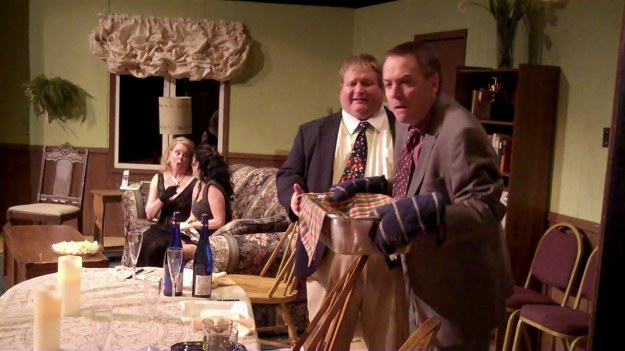
The ODD COUPLE, Felix with burned London broil (1/21/11, Moon Theatre Company)


What is clear to one who is involved in this sort of thing is that once you have the show cast and directed properly, the play takes on a life of its own.  But not all aspects jump to life and run around.

Show business has two sides- the art side and the business side.  As I said above, the art aspect is taken care of by the director.  The business side, the haunting space of the producer, is perhaps more difficult in my experience.

The business side comprises the nuts and bolts of funding cast & crew, props, the venue, set design and construction, etc.  This is very concrete and relatively easy to understand and manage.  What is less than easy to understand is the publicity function. 

Publicity today must be done in the schizophrenic world of print and internet media.  The center of the community theatre-going demographic are the retired people and those over, say, 60 years of age. Go to most any production and you’ll see the Q-tips and Blue Hairs in the seats.

In order to put butts in seats, this group must receive the message and thence be wrenched from the recliner in front of the DirecTV and compelled to go out into the evening traffic, find a parking spot, and buy a ticket. 

After rehearsal the other night, a few of my fellows and I repaired to the local establishment for some beverages. This public house featured an open mike performance by local musicians who were actually quite good. The tables were filled with an entirely different demographic group than we had set our sights upon and the air was full of expectant optimism.

After the waitress delivered my cold glass of liquid bread I put  to her a sincere query.  I asked her what it is that would compel her and her fellows to attend community theatre?  This fine specimen of a 20-something stood there flummoxed. She was accustomed to fending off the unwanted advancements of inebriated customers, but this sort of question was completely unexpected. She left to tend another table, promising an answer on her next visit. 

On her next visit, the waitress, a former theatre major, said that she would be attracted to a production that was … edgy.  That was it.  I acknowledged her comment and asked her if she ever goes to live theatre performances. She said “no”. I asked her how would such a message find its way to her and her compatriots. She thought about it and replied that she didn’t know. There was no single information outlet that percolated up.

I suspect that this interchange represents the situation in miniature. We have so many channels with densely packed data streams pouring into our consciousness that we are overwhelmed with it. Information is cheap and abundant. The value of any given notice of a public event is diluted to an infinitesmal level by the sheer volume of similar such notifications across the multidimensional space of media.

We do suspect that the Blue Hair demographic still reads newspapers and in the future we’ll throw a handful of money at print advertising. But like everyone else, we’ll be uneasy with the expenditure.  It is very difficult to predict the effect of low intensity advertising in any given medium.

High intensity advertising, on the other hand, is a good way to get the message out. But high intensity advertising is high intensity spending and that isn’t an option yet.