Frequently wrong, but never in doubt

At some point, self-confidence more resembles a learning disorder. This is one of the great truths of history, I believe. The unwise advancement into adverse conditions with little more than the loincloth of bravado has lead to the demise of many. In that group of the many are military and political leaders, businessmen, frontiersmen, ponzi scammers, technocrats, and adventurers of all sorts.

We all like to be around people who are self-assured and cool. The air of self-confidence is a necessary attribute for those entrusted with the authority to commit resources on the large scale. But often the authority is not backed with a durable feedback loop for checks and balances. This is a fatal weakness in any system that focuses the authority on a few to delegate resources.  Sweet enthusiasm may quickly ferment into the delerious elixor of greed. Beware those who are frequently wrong, but never in doubt.

This is the Darwinistic force that lead to the evolution of that curious species, the auditor. The auditor is an omnivore with slender and dextrous fingers for prying under the bark to tease out burrowing pests. The large ears of the auditor and cavernous nasal passages evolved to detect burrowing vibrations and the unusual odors of malfeasance.  The bulbous eye stalks have special neural GAAP networks for the detection of tell-tale body language and with laser-like focus, can pierce the corporate veil and lock onto fraudulent transactions.  Woe is he to whom the auditor has taken special interest.

China’s Stealth Fighter Revealed

It is interesting that China’s new J20 stealth aircraft has been revealed before deployment. US stealth aircraft were long a source of UFO reports before they were officially acknowledged.  The Chinese J20 aircraft, called a “fighter” by some, bears a striking resemblance to the US F22 Raptor, though larger and perhaps capable of a fighter-bomber role.

China's J20 Aircraft

While some discount the real maturity of Chinese stealth technology, it is clear that they are on track for parity with the US in this regard.  Stealth technology has as much to do with the shape and angle of surfaces and edges as it does radar absoptive coatings. The Chinese already know what it takes. They just have to come up with flight control systems and manufacturing processes to build the aircraft.

Stealth aircraft and nuclear powered aircraft carriers are a potent combination for the projection of power. Will the sun rise on a Chinese nuclear carrier group patrolling the Atlantic by 2020?  Where will their authoritarian marketplace take them, and us?

Antimony Funnel Formation at Stibnite, Idaho

In the Pnictogen Hall of Fame there is at least one p-block compound with a town named after it. The ghost town of Stibnite, Idaho, sits silently in the Yellow Pine mining district 40 or so miles NW of Cascade, Idaho.  The town of Stibnite is named after the sulfide of antimony- Sb2S3.  The chemical symbol, Sb, is related to this mineral name.

Idaho sits in the great North American cordillera.  A cordillera is a grouping of mountain ranges at the continental scale. In the case of the North American cordillera, it begins ca 103 west longitude and extends to the Pacific ocean. The Black Hills are found somewhat east of 103 degrees, but I’m generalizing again. In the US, the Rockies, Wasatch, Cascades, and the Sierra Nevada ranges are part of the cordillera formation.
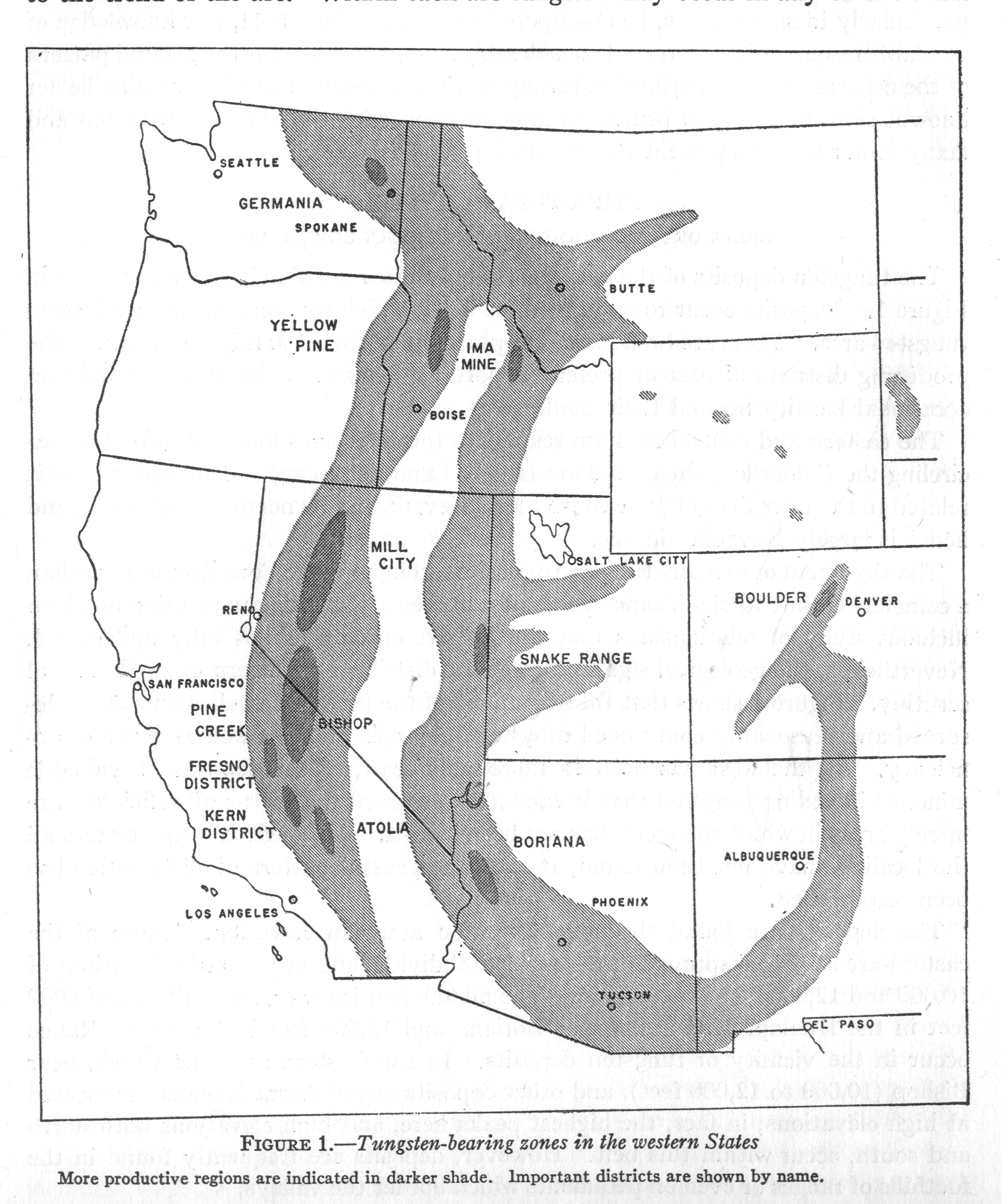
North American Tungsten Belt. From Paul F. Kerr, Tungsten Mineralization in the United States, 1946, Waverly Press.

One characteristic of the cordillera is the broad occurrence of economically important metal deposits. In the illustration above, the occurrence of tungsten is associated with the mountainous regions of the west. An important feature found in economic metal bearing districts within the cordillera are vein deposits. Metals can be disseminated in rock or concentrated in veins. 

In Colorado, the Cripple Creek & Victor mine is situated in the throat of an ancient volcano. This ore body is an example of highly disseminated gold ore which is interlaced with vein structures containing higher concentrations of gold.

Rather than perform underground mining, the economics allow the large  scale removal and crushing of rock to pebble size followed by extraction with cyanide to isolate the value.  This mining technique was not possible until the advent of large scale mechanization. In the early days, the Cripple Creek district was limited to underground mining of vein formations that were more highly enriched in gold.

What is crucial to the placement of a metal ore body is some process that leads to concentration of valuable metals. Recall that the definition of an ore is based on economic considerations.  At some level of dilution all ore becomes just gangue or country rock. Concentration of value in the ore body near the surface can arise from several mechanisms.

A common process that concentrates desirable minerals is hydrothermal deposition. This is found widely in the cordillera. A natural consequence of mountain building is the generation of stresses within the upthrusting  rock. At some point stress gets relieved by fracturing which results in the formation of void spaces within the rock.

Underground water, which at depth is at high temperature and pressure, will dissolve components of rock in contact with the water. This water will naturally convect and flow towards the surface, carrying whatever solutes that were favored by higher solubility.

Deposition occurs as the water flows to the surface within whatever fracture network the waters find themselves in and may continue to deposit until the vein seals itself shut. Over the fullness of time the formations are thrust upwards and erosion wears down the rock to expose outcroppings of the desired mineral at the surface. 

Such processes have put vein lodes in place all over the world, including the American west. Deposits of gold, silver, antimony, iron, mercury, and tungsten are examples of metals that are concentrated in this manner. Ostensibly, this is happening in geothermal hotspots like Yellowstone or Iceland today.

These exposed outcroppings weather and oxidize, generating new mineral compositions. In the case of gold, its relative inertness leads it to form the native metal in these weathered formations and, under the influence of gravity and the hydraulic forces of snowmelt, gold will work its way downhill and into the alluvium.

Other elements besides gold are also mobilized, particularly the sulfides. In the deep crust, well below the depth to which oxygenated meteoric water can flow, is an environment rich in the anionic subunits oxide, sulfide, silicate, and aluminate. Metals and metalloids like Cu, Sb, Ag, As, Pb, Hg, etc., form complexes with the various anions and correspondingly, 3 dimensional networks of inorganic polymeric species. To the extent that a 3-D network of shared atoms, edges, and faces of tetrahedral crystalline subunits can be formed, the resulting bulk material may have a high melting point and high strength.

However, when connectivity is lowered by chain or network terminating constituents, the melting temperature and hardness of the material may be lowered.  An example is soda glass. When silica is diluted with chain or network terminating components like soda or lime, the high strength and high melting point of quartz, which is just pure polysilicate, is lost. The same thing can happen naturally in mineral formation processes.

Other kinds of ore are put in place by fractional melt crystallization and layer deposition by density within a magma chamber. The major ocurrences of platinum group metal (PGM) deposits are an example of such a process. Eventually, tectonic processes raise the frozen and extinct magma chambers to the surface where erosion exposes a narrow banded horizons referred to as a reef.  The Bushveld Igneous Complex in South Africa and the Stillwater Complex in Montana are examples of this mechanism.

The deposits found near Stibnite, Idaho, are comprised of antimony and tungsten as well as lesser amounts of gold and silver. In about 1900 gold, silver, and antimony were discovered in the area, leading to a gold boom at Thunder Mountain.  During the years from 1938 to 1944, the Yellow Pine (W, Sb) and Meadow Creek (Au, Ag, Sb) mines in this part of Idaho were the largest producers of tungsten and antimony in the United States.

The details of this mining district can be found in:

John R. Cooper,  Geology of the Tungsten, Antimony, and Gold Deposits Near Stibnite, Idaho; 1951, Geological Survey Bulletin 969-F.  Stibnite Idaho USGS

In the abstract, Cooper describes the W, Sb, Au, Ag deposits as being confined to an area about 1 mile by 3.5 miles in scope (as of 1951). The principal rock of the area is quartz monzonite which is extensively fractured and has been penetrated by dikes of basalt, quartz latite porphyry, trachyte, and rhyolite.

Cooper describes a deposit whose metallization has taken place in three stages with intervening episodes of fracturing. The first stage is described as extensive replacements by gold-bearing pyrite and arsenopyrite.  The second phase of deposition or replacement is less extensive and is by scheelite (CaWO4) within the gold ore bodies.

The third stage of growth or deposition is of stibnite and silver, largely within the same fracture systems as the scheelite. The ore bodies occur with the Meadow Creek fault and associated subsidiary faults in the quartz monzonite. The tungsten-antimony ore body within the formation took the shape of a

“flat upright funnel flaring to its widest diameter at the surface and tapering to a narrow neck, which extends below the bottom of the minable tungsten ore. The underside of the ore body is very irregular in detail.  The highest grade of tungsten ore was concentrated toward the center of the mass and was surrounded by an envelope of antimony ore containing only a little tungsten.”    – John R. Cooper

The Meadow Creek ore contained 0.23 oz gold per ton and 1.6 percent of antimony.  The Yellow Pine ore contained little gold but 4 percent of antimony and 2 percent of WO3. The Yellow Pine deposit was exhausted of tungsten in 1945, producing 831,829 units of WO3 equivalents in the concentrate. One unit of WO3 is 20 lbs of tungsten trioxide.

Much of the scheelite was found disseminated in brecciated gold ore.  Some scheelite was found in branching stringers and veinlets within the groundmass.

The stibnite occured as “disseminations, microveinlets, stockworks, massive lenses, small fssure-filling quartz stibnite veins, and euhedral crystals coating late fractures. ”  Oxidized antimony minerals such as kermesite (Sb2S2O) were reported as being very scarce.

Comics Saddened Over Launch Failure of Comedy Central Satellite

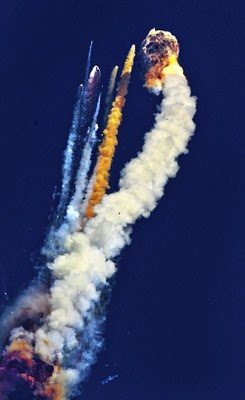
Kennedy Space Center,  January 6, 2011.  Officials at the Kennedy Space Center released spectacular photos of the recent launch and explosion of SITCOM 2WTF. The $300 million comedy satellite was to be the first of 3 satellites to go into geostationary orbit exclusively for the Comedy Channel. Underwriters at Acme Insurance, however, weren’t laughing.

Launch Failure of SITCOM 2WTF

Lewis Black, Director of Launch Operations at the Comedy Central network, was quoted as saying “Sonofabitch!!  We put a bird on orbit dedicated to Law and Order reruns just the other day. What the hell happed to this one?”

A spokesman for Kathy Griffin, Satellite Procurement Officer for Comedy Central, said the comic had been on the phone all morning with Pixar’s Comedy Rocket Motor Division headquarters in Malibu. Griffin is reported to be quite upset and is preparing a Comedy Central tell-all special on her drunken encounters with comedy satellite celebrities like Jerry Seinfeld and George Wallace.

Veteran comic Phillis Diller is reportedly shocked by the event. She was selected to be at the cape to light the fuse for the launch.  Diller was unavailable for comment.

Words from the Great Gondini

I used to work with a sales consultant who would say smart things now and then. As sales manager, consultants were usually the bane of my existance. Not because they were no good- often they were quite competent- but because they were problematic. Management brought them in because, with its all seeing eye, it believed that we foot soldiers were unable to make certain changes.

So when a consultant arrived we had to bring them up to speed and then watch them slowly fail to make the changes. They nearly always failed. Management was looking for change in the lower eschelons but never considered that change at the top was necessary. Ever. One day we’d hear that so-and-so had moved on to other things.

Working for a corporation is very one-sided unless you are at the very top. Employees are expected to be loyal and hard working no matter how outrageous the working environment and no matter how incompetent the management. Fail to impress management and you’ll face the prospect of job hunting without good references.

But I’ve gotten off track. The Great Gondini (I’ve scrambled the letters in his name) used to say this-

Never work for a company as a chemist if chemistry is not their main activity.

He spent much of his career with IBM and later, Lexmark, involved in magnetic coatings for disk drives, charge transfer agents and other xerography chemicals, and toners. IBM and Lexmark are not chemical companies.

The point my friend was trying to make was that professional isolation within a company has consequences. One consequence is that promotion to upper management is difficult owing to the lack of participation in the management of core projects.  It is understood that there are exceptions.

There are benefits to isolation. You get to be the company wizard. Often management is loath to mess with you because, while they know that you do something important, they aren’t really sure what it is. I experienced this phenomenon when I was a chemist in a dairy lab. It can be quite amusing.

The isolation issue exists even for chemists in chemical companies. Your ascendency to upper level positions is stunted if you have not been involved in the major company projects in a significant way. If you’re running an small lab somewhere in the organization, especially if you’re in a service role, it is hard for management to promote you to VP of Chemistry over that project manager whose successful project went to market on time and on budget.

If you’re not interested in this kind of advancement, then it is a moot point.

Some chemist friends have mentioned to me that I make sweeping generalizations and this is surely true. There are exceptions to all but the most specific statements, eg., x = 3 (wait a minute, doesn’t x = 4 as well !!??).  Generalizing is a rhetorical technique. The view from 50,000 feet is meant to show the overall topography.

Chemists love details and, like a pig in shit, we love to roll around in the data. And for some, no detail is too small to bring the show to a complete halt while they wrestle with details. I’ve seen this many times. This makes it difficult for some chemists to make the transition to other job descriptions. It is a simple fact that we sometimes have to move forward with an incomplete picture.

Back to reality.

The holidays are over. The christmas lights are now obsolete. The first big snow storm of the season has come and gone. The cryosphere is unceasing in its wicked attempt to thermally equilibrate my house to a ΔT = 0 across the walls. Only high thermal inertia and a near constant stream of methane into the burners will hold it off.

That jolly elf brought Th’ Gaussling a 1 terabyte external hard drive. Years of pdf downloads and treasured jpeg’s streamed silently onto the drive via the fabulous USB port.  Papers on mining & metallurgy, LiBeB cosmochemistry (on the Lithium dip, one of my fascinations), and thousands of photos.

While picking at the guitar the other day it dawned on me why some people choose to play the base guitar.  Four strings are mechanically easier to play than six. Maybe there are other and better reasons, but this seems like a good one. Then, as you advance, there is playing notes from the fifth fret and above.  My brain plasticity turns vitreous at this level. It comes down to repetition of the basics.

Remember the basics: Task at a time- correction in the right direction;  attitude, altitude, cross check;  and, runway behind you is useless!  Dave Benton, Th’ Gausslings flight instructor, ca 1978.

For me and my day job, 2011 will be very much about thermokinetic issues in process safety. We’re going to install a reaction calorimeter and much time and effort will be needed not only in operating the device, but in folding its use into the development cycle. It is one thing to collect thermochemical data. It is quite another to use it to make decisions concerning engineering and process safety.  Considerable effort in my industrial career has been spent in building structure for information archival rather than just bench chemistry.  I didn’t anticipate that.

Our upcoming production of The ODD COUPLE opens in 2 weeks. I’m still rough with my lines, so there is no shortage of stress there. The thought of opening night and sitting on stage in the lights in front of a darkened audience wonderfully concentrates the mind. Neil Simon wrote some great lines in this play.

Who is best served by the chemistry degree pipeline??

Having interviewed numerous bachelors degree job candidates recently, I’m beginning to question some fundamental assumptions about the value of a BA/BS chemistry degree to industry.  Let me say from the outset that I wasn’t interested in hiring an analyst. There are plenty of analysts out there in the market, especially in the temp agencies. I’d been looking for someone to do synthesis. Both organic and inorganic.

Just to be clear, the slot has been filled, so don’t send your resume to me. Sorry.

I had the experience of interviewing a fresh BS chemist from a good- dare I say “elite”- school this week.  He had fulfilled the requirements for graduation and was sitting there at the table beaming at me with great confidence.  This fellow fared poorly on our application chemistry test, but was undeterred.

When asked as to the length and breadth of his organic synthetic experience in school, he admitted that it was limited to that obtained in sophomore organic chemistry.  He did have a trifle of inorganic synthesis experience- he made ferrocene once.  That being said, his interpretation of the NMR spectrum on the test was wrong, his understanding of carbocation stability trends was wrong, and he couldn’t calculate his way out of a paper bag.

This is not so unsual.

So here is what I have observed in the past 6 or 7 years interviewing BS chemists. Precious few of them had any demonstrable interest in organic chemistry or synthesis. It is not because they were lacking ability- they had not had the opportunity to practice the art. They might have been involved in some kind of research in their senior year, but very often it is involved in some highly specialized work with a very narrow scope. OK. That is the nature of research. It’s specialized.  I believe the college chemistry curriculum and the shifting interests of faculty to ultra specialized research are failing students.

I’m glad to hear that students at the local university have experience in operating a tunneling microscope or picosecond  laser equipment. But what about experience in basic synthetic transformations in actual glassware? How about a reduction of an ester or an amide with LAH? What about a catalytic hydrogenation or running a reaction with a Grignard reagent?  Are students limited to the microscale experience? Do chem majors get to handle greater than 100 mg of reagents? Do they learn to handle hazardous materials in a smart way, other than just learning tofear them?

This graduate that I interviewed had experience in some kind of nanoscience, but couldn’t say much at all about basic synthesis. When asked about Grignard reagents, he could not recall having heard of it.  What the hell good did the professor do for this kid?? The kid burned up his senior year doing deep-niche chemistry with skills of questionable transferability. He should have been doing distillations and crystallizations until he could coax pure subtsances out of a mixture that he/she made. That is what an undergrad should be doing.  An undergrad should be refining basic manipulation skills and accumulation experience in running diverse reactions.  Experience is proportional to the number of experiments run.

I have no reason to believe other than undergraduate chemistry education is failing to prepare bachelors students for the practice of the synthetic arts.  It has been my experience- perhaps yours is different- that students with an interest in synthesis go to grad school.  The problem with that is that it immediately doubles the cost of doing synthetic chemistry per unit chemist in society at large.

So, who is best served today in undergraduate education? The students or the institutions? Chemistry departments are faced with rising costs and diminishing funding, especially in public institutions. Faculty do what they know how to do. They promulgate scholarship. That is the comfort zone. And they develop strong opinions about who should join their ranks- people of like mind for the most part.

The pressure to minimize waste streams in undergraduate labs enabled the transition to microscale lab equipment. The development of computer technology has enabled the accumulation and treatment of data by semi-automated data collection tools and spreadsheets. Some of this is good- drudgery for its own sake is dumb. But we are removing students from contact with the very materials they study.  This is not how to accumulate expertise. This is expertise in automation and not automatically in chemistry. 

These graduates move into important roles in industry. Industry, contrary to a popular academic sentiment, isn’t merely a big sack of tedious details. It is a colossal part of our culture. We’re tool users and chemistry is one of the things that tool-using citizens do to improve our lot in life.  The synthetic arts in the USA are somewhat in decline as industry continues to outsource manufacturing and R&D (!!?) to India and China. The USA needs affordable labor to do synthetic chemistry. Continuing to stamp out PhD’s is not the answer. PhD’s are very expensive to have around, and while perhaps they do most of the critical discovery work, the costs are prohibitive. Just look around.

The USA needs a new cultural paradigm. We need a chemistry labor pool that consists of workers of high and medium skill to bring affordable and competitive products to market. Unless we figure this out we are headed for that realm of self-satisfied mediocrity that some of our neighbors across the Atlantic find themselves in. There are many examples of fallen empire around the world and the US is slouching in that direction.

A Collection of Links

Some interesting links on Th’ Gaussling’s Favorites List-

Many moons ago, as a 9th grader, I built an atomic cloud chamber. I fabricated a galvanized sheet metal reservoir for dry ice and methanol and attached a chamber on the top made from the top of a metal Folgers coffee can. The can had a plexiglass viewing window and three curved plexiglass windows on the side for illumination. The plans were from C.L. Stong’s column “The Amateur Scientist” in Scientific American.

Going into 10th grade I managed to borrow a Polonium-210 source from the physics teacher. It was just a needle with a small spot of radioisotope on one side and a cork on the other. I never did see any activity from the source, but I did see a few stray vapor trails from background radiation. Turns out that the source had a short half life and was long dead.

One of the more interesting websites is United Nuclear.  They sell various nuclear related items, ball mills, as well as NdFeB super magnets. Most notably, they sell a cloud chamber that looks quite well designed. They also sell sources.

The best place to buy electronic cables is MonoPrice.  A USB cord selling for $30 at Best Buy will go for just a  few dollars at MonoPrice.  Same story with HDMI cables.

If you love to listen to speakers talk about exciting ideas and technology, then TED is the place to go.

The MetaFilter community weblog is a treasure trove of unusual links dredged up by many contributors. The site is updated continuously.

Patently-O is a consistently well produced weblog on patent law and worth visiting now and then. 

An excellent aggregator of earth science related news is Geology.com. They are reasonably good at finding rare earth element related news.