Geysers of Enceladus

My day job requires that I can practice the art of calorimetry with some reasonable extent of expertise, so in that vein I have been cracking open some of my dusty p-chem texts and revisiting basic thermo.

The other day while on an excursion to a bricks and mortar bookstore to pick up some of my favorite periodicals (Kitplanes and Vanity Fair), I happened upon a copy Elements of Chemical Thermodynamics by Leonard K. Nash (1970, Dover, $12.95). Feeling bad for Borders and their current run of poor luck, I bought the book as though it would make some difference.

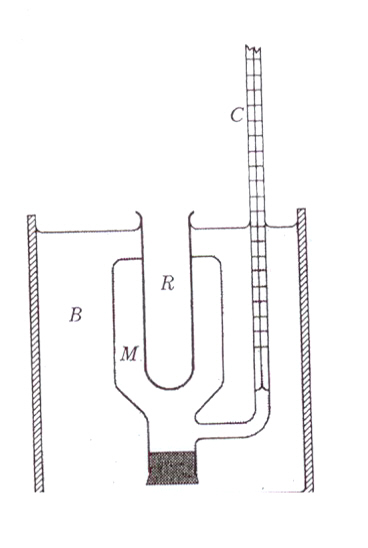
Figure 2 on p 5 (below) shows a schematic of a ice calorimeter.  An ice calorimeter uses a thermally isolated enclosed space M completely filled with liquid and solid water immersed in an insulated tank of ice and water B. The internal, thermally isolated, working volume of water has two important features- it has a small volume sample container R protruding into it and it has a calibrated small inside-diameter expansion capillary C. 
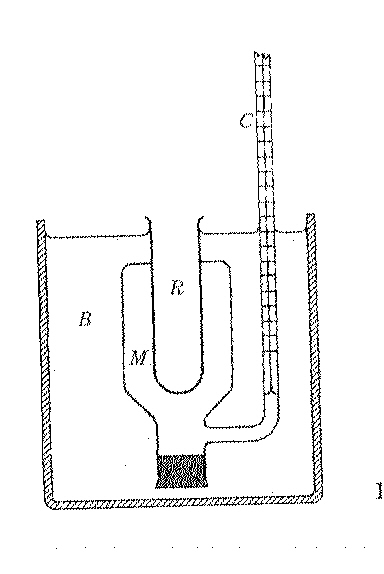
A sample in container R is in thermal contact with reservoir M.  Heat absorbed in M melts some ice and results in the loss of low density ice and the formation of higher density liquid water. The net volume of the contents then decreases and is registered as a column height change in capillary C.

Given the volume change and knowing the density and heat of fusion of water at 0 C, one can calculate the heat absorbed by the reservoir.

So, what about Saturn’s moon Enceladus? The moon is thought to be covered by water ice with liquid water underneath. It’s reasonable to assume that if some volume of water below the ice transitions to the solid phase then the collective volume for liquid water is decreased resulting in an uptick in pressure.

If this happens, it could provide a mechanism for the geyser phenomenon witnessed by the Cassini probe. The geyers could simply be a result of PV work energized by gravity and radiative cooling of the surface and subsequent thickening of the surface ice into the underlying liquid phase.

I’m sure the boys and girls at Cassini have thought of this, but since I’m not tied into the literature I have not heard anybody express it.

Acting workshop

Th’ Gaussling attended his first acting workshop this evening in Boulder. The attendees read monologs and cuttings in front of a director for much needed feedback and coaching.  The four of us from our local theatre group read a variety of things.

I am particularly proud of my colleages, one in particular who read a very intense selection from Shakespeare’s Richard III.  It was astonishing how she captured the frightful urgency and fear in the character. I knew she had a good bit of experience, but I had not personally witnessed her do such a dramatic part.

Another colleague portrayed a mentally disturbed character recounting driving a cab in Manhattan and picking up LBJ and Bob Hope. Her voice work was quite good, but her facial expressions brought it home.

My monolog was about an angry guy working as a department store Santa Claus. I pulled out my Brooklyn accent and mannerisms from The Odd Couple and went to work. It was a lot of fun.

Sanding the Mass Spec

January 19, 2010.  We unpacked our new Agilent GCMS today. It comes with a container of fine alumina abrasive. I’ve never had to maintain one before so this has been an education. It has a triple MSD (mass selective detector) on it for what amounts to a noise cancellation feature. This increases the signal to noise ratio of the output substantially. I never realized that the MSD was off-axis relative to the quadrapole electrodes. The ion beam is steered 90 degrees into the MSD by a 10 kV post that also accelerates the beam.

Oh yes, the abrasive is for polishing the metal surface that sits against the high vacuum seal of the mass analyzer chamber. It struck me as amusing that a mass spec comes with a supply of abrasives. Now it makes sense.

Watson, open the pod bay door please

Now that Watson has mopped up in Jeopardy, can we assume that contestants will finally be able to enjoy their free time doing leisurely activities like strolling through the glade instead of enduring the drudgery of game shows?  Finally, technology has freed humans from the shame and humiliation of standing there under the piercing stare of Alex Trebek. 

IBM’s website states that humans win in this new age battle between John Henry and the steam engine.  Yeah, right. IBM wins. One more thing reduces to a tedious, value added algorithm.

Budget Hand Waving

It is interesting to watch how the various factions of our culture interact on the matter of governmental budgets.  It is though a budget is an end in itself. It is though a budget is the final product of government.  Many apply a puritanical spin on budget and debt concepts. This country produces Cotton Mather characters every generation.

What is important about a budget item is what it does out in the field. OK, elected officials pushed the funding for a particular program or acquisition.  It seems to me that what is of interest is the result of the funding, not the protracted battle for funding.  The headline should be the funded project and the politicians can take their credit in the Congressional Quarterly.

The contrived acrimony over budgets is a battle over abstraction.  People make wild claims as to the market or social imperatives and morality of various magnitudes of spending. Spastic gesticulations and flying spittle get air time on the tube.  But perhaps we should go to the actual object of the budget item and have a look? Who knows what we’ll find?

What the republicans bring to the proceedings is a plan for nothing less than social reconstruction. They plan to wrest control over government so they can kill it.  The Teahadist wing and their antebellum jive appeals to a subset of the electorate more at ease with the Luddite ideals of the John Birch Society than to the social ideals of the 20th century. 

I can’t believe that history will look favorably on the conservatives and their irretrievably antisocial doctrines. People who have benefitted in more ways than they understand from the massive civil infrastructure of the USA now want to stop contributing  to it.

It’s too bad there isn’t a  libertarian confederate homeland for them to go to.  They could spend their days privatizing themselves silly while sitting there in the shade, counting their Krugerrands and sipping Mint Julips. Wait a minute, that sounds pretty relaxing …

I wish I was in the land of cotton, old times there are not forgotten,
Look away, look away, look away, Dixie Land.

BS, MS, or PhD in Applied Chemical Science

Perhaps one solution to the problem of excess chemistry PhD production by our institutions is to take a step away from the path of pure scholarship into the applied sciences. That is, a chemistry program wherein chemical science is integrated with economics and business.  The goal is to support the industrial part of our civilization with scientifically educated people who desire to apply their knowledge to the industrial arts, i.e., manufacturing, sales, management, and distribution. 

I’m suggesting that chemical education could be split into two streams- scholarship and applied science- because that is where the grads go anyway.  Presently, the scholarly route supplies the entire supply of chemistry graduates.  I think there are several reasons for this. Faculty produce graduates along the manner in which they were schooled. Another reason  for this singular path is the effect of the ACS standardized curriculum.  Most chemistry departments struggle to maintain their ACS certification as a validation stamp for their program .  It also serves as a foil for deans who want to gut the chemistry budget because it is typically very costly.  The ACS program has basic requirements and that is that.

An applied science program would require a modification to the usual faculty profile. Instead of having a faculty of stellar Harvard , MIT, and Stanford graduates, the faculty would have a few from Dow, DuPont, Air Products, etc.

An applied chemical science program could include coursework on the manufacturing processes of petroleum feedstocks from crude oil to BTX, polyolefins, and maybe into some fine chemicals or extractive metallurgy.  It would cover the regulatory environment and give students familiarity with EPA and OSHA regulations as well as those regs governing transportation of hazardous goods. 

At some point there should be coursework in basic accounting, marketing, law, and finance. A business minor would be very useful.  A student should know how to calculate the manufacturing cost of a product based labor & overhead as well as the cost of raw materials.  There are many possibilities here to use real life examples. Y ou never know what will happen to a student once they understand how to get a product to market. The just might want to go do it themselves.

It is not inconceivable that a program along these outlines and with the right faculty could produce graduates who are inclined to do a startup. Once you know something about what is required to get a product out the door, it is natural to begin to dream about doing it yourself. 

American chemistry lacks a culture of strong entrepreneurship among chemists. This is not quite as true for chemical engineers, though. Chemists are afraid to start a company because they have not been exposed to much of the business environment because they are partitioned in the lab. They do not know what the issues are or how to attract resources to get the thing started.

I was on the phone with a professor the other day who has $$ in his eyes. He has a customer who wants x kg of his compound and he thinks that he is going to staff a small production campaign with students in a rental space. He admitted he had no idea of what is required once you have employees doing hazardous activities. He had no idea of what workmans compensation insurance was. 

 His business model was simply a larger version of his research lab. The university would pay his students a stipend and he would have them laboring off campus making some stuff that is too nasty for use on campus.  It is much like gold fever.  Otherwise rational people become greedy and foolish when they think there is a pot of gold at the end of the rainbow.

The over arching goal of an applied science degree program is to produce graduates who have a better understanding of our industrial culture and are prepared to strengthen it by a lifetime of effort in making better things for better living.  The future holds the inevitable confrontation with scarcity. We need a layer of educated industrialists who can help fashion a good life in the US with smarter manufacturing that can accomodate reduced energy and materials consumption.

Top chemistry professors get the idea

A recent issue of C&EN (the Specialty Chemicals swimsuit issue, Vol 89, number 5) quotes several top research profs on the topic of the present glut of PhD’s.  Seems that these professors profess to actually grasp the job picture for recent and current grads.  Was there a flash of light or was there a visitor in the night who whispered the situation to them?  These folks have been benefitting from cheap, abundant, and enthusiastic labor to propel their research forward for decades and suddenly they claim to be paying attention to the job picture for their alums. Oh please!

In his column, Rudy Baum concludes that it isn’t so much that that we have too many PhD’s, but that we aren’t teaching them what they need to “succeed and benefit society.” 

OK. I can get on board with that. But it begs the question, who is going to teach them what they need to know, whatever that is? A bunch of academics who have spent their careers grooming students to be academics?  Are you kidding me? The status quo is not capable of adjusting curricula to make this change.  It isn’t in their bag of tricks. It is well beyond their experience.

Imagine trying to convince a group of faculty members of anything, much less that their past efforts are now obsolete?  Just imagine that happening. I can’t.

C&EN is the publicity organ of ACS. Imagine the handwringing and chafing that had to happen before these Polyanna’s came to publish such findings? The horror, the horror.

The university/research apparatus in the USA is the principal system within which basic R&D gets done in this country. Resources by way of tax revenues are plowed into the university system to maintain the research effort. Corporations hire the graduates of this system and benefit from their education by way of invention and innovation.

IBM, Dow, GE, GM, etc, didn’t grow wealthy and successful in a vacuum. Their hires, many of which came from the US university/research infrastructure, brought their eduction to bear on the problems of market penetration faced by these companies.

These companies took advantage of the entire spectrum of American infrastructure available to them. They did not have to build roads, monitor public health, run power distribution lines, build hydroelectric dams, or fight wars on foreign soil themselves. That infrastructure was provided to them. Yet, these and other corporations are unhappy with operations in the USA and, rather than inventing a domestic solution, are happy to export their operations and magic.

Over time, university departments and institutions grow based on state and federal funding. Now, the system finds itself possibly with excess capacity. But who is going to admit it? Who is going to go along with American industry and admit that R&D is too expensive to do in the USA?

Part of the problem with the present dearth of scientific jobs is with the structure and imperatives of the publically owned corporation. Publically owned corporations are owned by absentee landlords. The owners, i.e., we who have 401(k)’s, are only interested in quarterly growth. Absentee landlords don’t want to throw cash at a new roof and an upgraded sewer line. They (we) insist on rapid growth in shareholder value. That imperative isn’t necessarily compatible with the organic growth of a business or a market. So, if outsourcing of R&D offshore will save money, then the CEO better do it. I think we need a new business model that isn’t so anxious to export our magic.

My libertarian friends will say that this is the natural result of market forces, as though whatever the market wants is good by definition. 

The market is like a stomach. It has no brain. It only wants one thing- more.

Is that automatically the only acceptable consequence? I don’t think so. We have civilization to buffer us from the extremes of reality. Those who advocate adherence to pure market logic are missing the point of civilization.

Comments on Gold Rush Alaska Program on the Discovery Channel

The program called Gold Rush Alaska which is being aired on the Discovery Channel is well worth watching if you are curious about what it takes to do placer mining.   In addition to the strenuous task of digging down to the gold bearing layer of sediment, the miners are challenged by the short mining season in Alaska (~100 days or 2400 hours) and the remoteness of the location. 

There are several unit operations in play. The first operation using the trommel classifies or sorts the sediment by size.  This results in cobbles and pebbles being excluded from the sand and silt. This is a classification process that uses gravity to roll the large rocks to a separate location. 

The next step is more of a density driven process wherein the material stream is taken through a shaker station where sedimentation of the dense fines is accelerated by mechanical agitation and the resulting material flow is transferred to a sluice where the heavy gold particles and nuggets are agitated by the riffling action of the water and settle to the bottom. The less dense solids are washed out of the sluice and discharged to a waste pile.

All of the slurry flow is gravity driven, so the process train must begin uphill and work its way down. The sluice section is where the density separation occurs in earnest and this is where the gold will accumulate.

Periodically, the sluice section must be cleaned out and the resulting gold laden silt must be further processed to isolate the gold. The fellows in the program must use panning or a shaker table to isolate the dust and larger pieces of gold.  This a definite disadvantage compared with miners in the past.

The buckets of silt isolated from the sluice would have been treated to amalgamation in times past.  This selective dissolution of gold and silver could be used to accumulate the gold until the amalgam would begin to solidify. This process requires less skilled labor than panning or using a shaker table. The amalgam would eventually be placed in a retort and heated strongly to distill out the mercury leaving the non-volatiles behind.

The gold would then be sold and sent to a smelter for further refinement (i.e., parting) of the crude gold.

Without mercury, present day miners have a rather more complicated task in isolating the gold.

A Great Lumbering Oaf

Wow. I just watched the video of our recent production of Neil Simon’s The Odd Couple. I think overall it came off rather well, especially with the modest resources on the production side. The overall production value and the casting played well, at least in the context of community theatre.

What is sobering to watch is a video of one’s performance on stage.  The difference between your own sense of what is happening around you and what the camera captures can be striking and maybe even a little disturbing.  More to the point, your own sense of how you performed can be drastically different from that recorded by the merciless, unblinking eye of the camera.

This was my fifth play and in all of them I have played a minor character.  What you find in doing such parts is that the director will not lavish much time in closely directing your acting. The director is mostly concerned with bigger problems, like- will the lead characters ever learn their lines? Or, how are we going to tweak the blocking to make the thing look better? So it is possible for the minor characters to give less-than-great performances without much feedback from the director, or maybe anyone.

The upshot is that, like everything else, you have to be self-aware enough to want to improve and take steps in that direction. My goal- to be less oafish. It is a good goal for an actor and for life in general. There you have it.

February Linkkenfest

Did you hear about the polar bear that swam 426 miles? The polar bear and yearling cub swam from near Barrow, Alaska, across the Beaufort Sea to the coast in Canada. The bear was equipped with GPS and a temperature sensor. Investigators say the bear lost 100 lbs in the ordeal. The cub did not survive. Apparently there were no ice floes for the bear to crawl onto.

Tropical cyclone Yasi, a Category 5 storm, has slammed into the coast of Australia in Queensland.

Those wacky libertarians.

Why doing a PhD is often a waste of time, by The Economist.

Robert J. Samuelson at the Wilson Quarterly offers a compelling analysis of the Great Recession.

As for greed and dishonesty, their role in the crisis is exaggerated. Of course, greed was widespread on Wall Street and elsewhere. It always is. There was also much mistaken analysis about the worth of mortgages and the complex securities derived from them. But being wrong is not the same as being dishonest, and being greedy is not the same as being criminal. In general, banks and investment banks weren’t universally offloading mortgage securities known to be overvalued. Some of this happened; testimony before the Financial Crisis Inquiry Commission shows that some banks knew (or should have known) about the poor quality of mortgages. But many big financial institutions kept huge volumes of these securities. They, too, were duped—or duped themselves. That’s why there was a crisis. Merrill Lynch, Bear Stearns, and Wachovia, among others, belonged to this group. –Robert J. Samuelson, Wilson Quarterly, Winter 2011.