Notes from the stage

Our community theatre project has gone from a spare time activity to the Monster that Ate Philadelphia.  Producing, directing, and acting in a production is somewhat more strenuous than it looks. Much more so when you have little budget and multiple jobs. 

The off-stage activity requires some acting as well. You have to convince actors and crew to set aside their natural suspicions and work without pay. You have to coerce local media to cover your upcoming production for free. You have to find lights, props, and materials for stagecraft. And you have to compel the public to plant their ticketed backsides in the seats. All in exchange for an evening of what you’re proposing to call entertainment.

Rehearsals have been brutal.  We have a cast of 19 for You Can’t Take it With You. Turns out that the probability of everyone showing up at any given rehearsal is somewhat less than unity.  Set construction from bare lumber and recycled flats to assembled and decorated flats has taken perhaps a hundred manhours with all of the running around.

Why do it?  Well, it’s Show Business!  What kind of a question is that?

Plutonium Mining

The WordPress blog website comes with a feature on the dashboard that lets you know what key words people are using to find your site. I just got two hits from people looking for “Plutonium Mining”.  Some folks out there are really confused.

My dear fellow: one does not mine plutonium. One mines uranium and breeds it into plutonium.  Plutonium may be had from two successive neutron absorption and beta decay events starting with U-238. Plutonium has two more protons than uranium, so two beta decay events have to occur to increase the proton count by two in the nucleus. And making certain actinide nuclei even more rich in neutrons is one way to encourage beta decay.

The age of the solar system is just too great for the heavy actinides to be left over from regional supernovae atomic weight building events. But imagine if plutonium was found in abundance in ore bodies. No doubt museum shelves would be full of artifacts fashioned from plutoniferous minerals. Glazed pots and fertility fetishes made from the pretty rock.  Perhaps the Egyptians might have had glow-in-the-dark burial artifacts and a hieroglyph for radiation burn or sudden hair loss.

The Illuminating History of Rare Earth Element Technology

Until the invention of the electric lamp, the illumination of living and working space was very much the result of sunlight or of combustion.  Since the development of fire making skills in prehistoric times, the combustion of plant matter, fossil fuels, or animal fat was the only source of lighting available to those who wanted to illuminate the dark spaces in their lives.

From ancient times people had to rely on flames to throw heat and an agreeable yellowish light over reasonable distances. A good deal of technology evolved here and there to optimally capture the heat of combustion to do useful work (stoves, furnaces, and boilers) from readily available fuels.

Lighting technology also evolved to maximally produce illumination from flame.  High energy density fuels that offered a measure of convenience for lamp users evolved as well. Liquid fuels like vegetable oils, various nut oils, whale oil and kerosene could flow to the site of combustion and were in some measure controllable for variable output. The simple wick is just such a “conveyance and metering device” for the control of a lamp flame. Liquid fuels flow along the length of a wick by capillary action to a combustion zone whose size was variable by simple manipulation of the exposed wick surface area.

The first reported claim of the destructive distillation of coal was in 1726 by Dr Stephen Hales in England. Hales records that a substantial quantity of “air” was obtained from the distillation of Newcastle coal. It is possible that condensable components were generated, but Hales did not make arrangements to collect them.  Sixty years earlier an account of a coal mine fire from flammable coal gases (firedamp) highlighted the dangerous association of coal with volatiles. So, flammable “air’ was associated with coal for some time.

By 1826 a few chemists and engineers were examining the use of combustible gases for illumination. The historical record reveals two types of flammable gas that were derived from coal- coal gas and water-gas. Both gases came from the heating of coal, but under different conditions. Coal gas was the result of high temperature treatment of coal in reducing conditions. It is a form of destructive distillation where available volatiles are released.  Depending on the temperature, there was the possibility of pyrolytic cracking of heavies to lights as well.

Water-gas was the result of the contact of steam with red hot coal or coke. The water dissociates into H2 and CO. Water gas is a mixture of hydrogen and carbon monoxide, both of which are combustible. The formation of water-gas is reported to have been discovered by Felice Fontana in 1780.

One of the properties of burning coal gas or water-gas was the notably meager output of light from the flame. Workers like Michael Faraday and others noted that these new coal derived gases provided feeble illumination, but if other carbonaceous materials could be entrained, then a brighter flame could result. It was during the course of investigations on illumination with carburized water-gas that Faraday discovered bicarburet of hydrogen, or benzene.

About this time, an engineer named Donovan also noted that if other carbonaceous materials were to be entrained into water-gas, then the light output was enhanced. So, in 1830, engineer Donovan installed a “carburetted” water-gas lighting system for a short run in Dublin.

Coal gas was first exploited for lighting by the Scottish engineer William Murdoch.  Murdoch began his experiments in 1792 while working for Watt and Boulton in England. By the late 1790’s, Murdoch was commercially producing coal gas lighting systems. His home was the first to be lit with coal gas.

The carburization of water gas eventually became an established industry in America in the second half of the 19th century. The treatment of gases, especially with the discovery of natural gas in Ohio, increased the commercial viability of lighting with gas. Carburization of water gas was aided by the discovery of hydrocarbon cracking to afford light components that could be used for this purpose.

Here is where the subject of this post comes in. Since thorium is frequently associated with rare earth elements (REE)  the connection of REE’s to the issue of illumination begins in the laboratories of Berzelius in about 1825. Berzelius had observed that when thoria and zirconia were heated in non-luminous flames, the metal oxides glowed intensely.  But this was not a new phenomenon. Substances like lime, magnesia, alumina, and zinc oxide were known to produce a similar effect. Goldsworthy Gurney had developed the mechanism of the Limelight a few years before. In the limelight, a hydrogen-oxygen flame played on a piece of lime (calcium oxide) to produce a brilliant white glow.  This effect was soon developed by Drummond to produce a working lamp for surveying.

The work of Berzelius was an important step in the development of enhanced flame illumination. He had extended the range of known incandescent oxides to include those that would eventually form the basis of the incandescent mantle industry.  Thoria (mp 3300 C) and zirconia (mp 2715 C) are refractory metal oxides that retain mechanical integrity at very high temperature. This is a key attribute for commercial feasibility.

Numerous forms of incandescent illumination enhancements were tried in the middle 19th century. Platinum wire had the property of glowing intensely in non-luminous flames. But platinum was not robust enough for extended use and was quite rare and consequently very expensive. By 1885, a PhD chemist named Carl Auer von Welsbach patented an incandescent mantle which was to take the gas light industry to a new level of performance. Welsbach studied under professor Robert Bunsen at the University of Heidelberg.

Welsbach fashioned the incandescent mantle into the form that is familiar to anyone today who has used a Coleman lantern. The original mantle was comprised of a small cellulose nitrate bag that had been impregnated with magnesium oxide, lanthanum oxide, and yttrium oxide in the ratio of 60:20:20.  The mantle gave off a greenish light and was not very popular.

By 1890, Welsbach produced an improved incandescent mantle containing thoria and ceria in a ratio of 99:1. This mantle emitted a much whiter light and was very successful. Many combinations of zirconia, thoria, and REE metal oxides were tried owing to their refractory nature, but the combination of thoria-ceria at the ratio of 99:1 was enduring.

Welsbach made another contribution to the commercialization of REEs. Welsbach had experimented with mischmetal and was interested in its pyrophoric nature. He had determined that a mixture of mischmetal and iron, called ferrocerium, when struck or pulled across a rough surface, afforded sparks. In 1903 Welsbach patented what we now call the flint.  In 1907 he founded Treibacher Chemische Werke GesmbH. Today Treibacher is one of the leading REE suppliers in the world.

See the earlier post on REE’s.

REE’s in Greenland.

REE Bubble?

REE’s in Defense.

REE’s at Duke.

Mole Day Benediction. Gausslings 13th Epistle to the Bohemians.

10/23/10.  Th’ Gaussling is spending a safe and sane Mole Day at an undisclosed location in Colorado. The gaity and frivolity of this years madcap festivities will be left to others. Th’ Gaussling has instead chosen to mark the date with a period of introspection and solemn meditation rather than the customary secular bacchanalian festivus.

Mole Day Benediction

Yea, followers of the Morse Curve and the illuminati Willard Gibbs, be true to the fundamental science and fear ye not. For, while ignorance is all around us, ye shall be rewarded for your toils in our beloved endeavor. Ye shall be granted deep insight and freedom from the terrors suffered by those who follow the ways of mysticism. Fear is not the way of science.

So it was and so it shall be. Thus spake Th’ Gaussling.

Wherein the Vagaries of Rare Earth Elements are Considered

Th’ Gaussling was interested to read the August 30, 2010 issue of C&EN regarding the market situation with the rare earth elements. Or, at least certain rare earth elements (REE). The staff at C&EN has finally picked this matter up on their radar. Significant ore bodies are located in countries prone to reflexive autocracy, i.e., Russia and China.

More sgnificantly, as a friend and colleague recently pointed out, China has decided to exercise its Lanthanide fist in by slapping an embargo on rare earth materials available to much of the global market. The affected technologies include those using neodymium (or rare earth) magnets for power generation or motors. Rare earths are used in optics, ceramics, fuel cell membranes, and catalysts as well. It’s a pretty big deal for the rest of us. Lots of American R&D resources have gone into this technology.

This is the political chemistry of the REE’s. China is doing what China does- exercising national industrial policy through an emphasis on development of its natural resources. The USA, with its deep preference for free markets, is doing what it has done the last few decades- waking up surprised after a night of riotously drunken merrymaking in the marketplace. That is, responding to shortages well after the momentum has begun.

While US technologists were busy inventing things with REE’s, China was busy anticipating the upcoming demand for its REE’s. Why? Because raw mat sourcing is what R&D people do afterwards. They develop a widget and then ask how they will source the thing. Just natural. 

While the US was busy shutting down mining operations in the last decades of the 20th century, China has been systematically developing its resources.  China has an abundance of journals and workers devoted to REE technology.  The big corporate mind set in the US recoiled from investment in mineral wealth at home. A great many of the mining operations in the US are operated by Australians, Canadians, and South Africans. Somehow they are not afraid to extract minerals here, but the sons and daughters of the pioneers seem to be shy about it.

China seems more focused on developing its industrial base rather than its consumer base.  While there are some industrial policy lessons for the west here, the fact is that China is as China does.  We should not be surprised at this behavior.

The signals of a tougher Chinese trade stance come after American trade officials announced on Friday that they would investigate whether China was violating World Trade Organization rules by subsidizing its clean energy exports and limiting clean energy imports. The inquiry includes whether China’s steady reductions in rare earth export quotas since 2005, along with steep export taxes on rare earths, are illegal attempts to force multinational companies to produce more of their high-technology goods in China.

Despite a widely confirmed suspension of rare earth shipments from China to Japan, now nearly a month old, Beijing has continued to deny that any embargo exists.

Industry executives and analysts have interpreted that official denial as a way to wield an undeclared trade weapon without creating a policy trail that could make it easier for other countries to bring a case against China at the World Trade Organization. [Keith Bradsher, 10/19/10, NYT. Italics by Th’ Gaussling]

It’s not all doom and gloom. Molycorp has announced an IPO to raise funds for expansion and modernization of its Mountain Pass REE mine.  The geology of this ore body is described at this Cal Poly link.  One of the issues complicating the extraction of ore from this massive igneous and metamorphic carbonatite complex is the proximity to the Mojave National Preserve.

REE’s in geological context

In the cosmochemical bingo of hadean Earth, the landmass that we now refer to as Asia filled in the abundance bingo card with the rare earth group of elements. The combination of plate tectonics, crystalline partitioning of cooling magma, and erosion have lead to surface occurrences of rock rich in REE’s.   This group of metals is commonly defined so as to include Sc, Y, and the lanthanide metals. Others will include the actinides. All have a valency of  +3 in their natural compositions. A few of the lanthanides can attain +2 (Eu) or +4 (Ce, Pr) oxidation states, but these are unusual.  Sometimes scandium is left of the list. In other instances, both scandium and yttrium are left off the list.

A graph of lanthanide element abundance vs atomic number will show a saw tooth curve where the even atomic numbers will be represented with greater abundance. This phenomenon isn’t limited to the stretch of lanthanides and is referred to as the Oddo-Harkins rule.  One reference translated from Russian lists it as the Oddo-Kharkins rule (Ryabchikov, Ed., Rare Earth Elements, Extraction, Analysis, Applications; 1959, Academy of Sciences, USSR; Chapter by V.I. Gerasimovskii, Geochemistry of the Rare Earth Elements, p. 27).

It is not uncommon for REE’s to occur as a group in the same mineral, though Sc is often absent.  I’m aware of at least one mineral occurrence of Sc that is impoverished in lanthanides.  Among odd-numbered REE’s, Eu is especially low in abundance.

Within the REE group, two subgroups are often defined: the cerium subgroup (La, Ce, Pr, Nd, Pm, Sm, and Eu); and the yttrium subgroup (Gd, Tb, Dy, Ho, Er, Tm, Yb, Ln, and Y).

The REE’s show some interesting attributes. According to the Goldschmidt classification, the REE’s are lithophiles, literally “silicate loving”. More to the point, lithophiles are oxygen loving. The REE’s are known to form refractory oxides.  REE’s are commonly associated with pegmatites and, according to Gerasimovskii,  have a genetic connection with granites and nepheline syenites.

See the later post on the illuminating history of rare earth elements.

The Innate Appeal of Fear

I wrote a post a few years ago about a form of social reconstructionism that I recognized as a rebirth or perhaps, a reinvigoration, of the John Birch Society philosophy in American politics. I have noticed of late that others are making this connection as well. 

With the ascendancy of the confederate vaudevillians Glenn Beck and Sarah Palin as well as the Tea Party, Bircher political philosophy is being rediscovered.  Only, I’m certain that few of its new adherents have realized it has a name and is a 50’s cold war relic.  With scholars like Glenn Beck delivering lectures from his Fox TV lecture hall, the Tea Bag side is busily manufacturing consent by doing what preachers have done for a long time. By preaching that our society is in collapse and that the only way out of the impending disaster is to follow their recommendation.  This might be manifested as a more rigid adherence to teaching, or as has happened since the 1980’s, greater assertion of influence in political and social reconstruction. 

The Sky is Falling!!  -C. Little

There is a certain innate appeal to Bircher Philosophy that satisfies the inner fascist in all of us.  It is a manner of thought that feeds directly and almost unfiltered from the fear cortex of the brainstem. When uncertain, be afraid. No need for thoughtful analysis, just reject the unfamiliar. Distrust everything.  If it ain’t ‘Merican, then it ain’t no damned good. Study these principles devotionally, not analytically.

Bircher doctine serves as a political glove over the hand of protestant Christian evangelical fundamentalists who seek to de-secularize American culture, which includes government and the public arena.  They see our country as an errant Christian state taken off-track and into a condition of fallen righteousness by elitist liberal intellectuals bent on some kind of social buggery.  Listening to these folks, it would seem that they are engaged in a great battle between the forces of Heaven and the liberal leather-winged angels of darkness.  I think they have been watching too many Cecil B. DeMille movies.

Running a secular democratic state like the USA is hard to do. At least some citizens will demand an explanation for any given decision.  And they’ll want to argue. But a state run according to some religious conservative principles, well, that’s different.  Iron age justice is swift and harsh.  And how do the leaders know what to do? God came to them and expressed His conservative wishes. See, isn’t that so much easier? None of this ambiguity. It’s all so easy to understand.

I do agree with the conservative side in one way. The federal government is just too large and over reaching. But killing it while the citizens sleep is not the answer.  Neither is replacing it with market-style dynamics or reverting into a Confederate States of America.  The American experiment does not reduce to just a market phenomenon and was not kept running exclusively by righteous church-going people.  It does not reduce to a mere extension of the principles of the founding fathers either. It is all of that and much more.

It is the result of hundreds of millions of hard working, clever people who were born or naturalized into an enabled society without having to adopt narrow doctrines on how to think or without impermeable social strata. The American phenomenon is an artifact of the bell curve. It is the expression of a statistical distribution of individuals making a contribution to the betterment of our society by improving their own lot.  All citizens have the right to think as they please and we do not need conservative clowns to rally the dark side in all of us so that they can achieve their personal needs.

Some Realities of Modern Placer Gold Mining

Yesterday was spent doing set construction for our upcoming production of You Can’t Take it With You. The spouse of one of the actors is a gold miner and a pretty fair carpenter.  He returned early from a placer mining expedition this summer west of Dawson, YT, Canada, across the border on the US side.

My acquaintance- we’ll call him “Ted” because of confidentiality- was a bit reluctant to discuss the recent expedition only because he felt his part in the thing was minor. In fact, his comments were very telling of the kinds of hardships facing anyone with a fancy for placer mining in Alaska or the Yukon Terrritory.

Ted has plenty of experience in placer mining in Colorado, especially in the Fairplay region west of Denver.  Placer mining has a special appeal to those who want to mine for gold, but don’t want the grief and expense of underground mining of chemically complex ores.

Ted signed up to work for a New Zealand miner who had a sizeable claim an hour outside of Boundary, AK, along the Top of the World Highway. This site is reasonably remote, judging by the fact the nearest city where machine parts could be obtained was Dawson, across the border in Canada. Mining season is 100 days in duration, or 2400 hours. This is because of the climate and the hardships associated with work out in the bush. 

The gold bearing formation is a band of sand and gravel 3-6 ft in thickness and 6 ft below the topsoil. The gold bearing gravels sat atop the bedrock.  The miners use a floating separations plant consisting of a trommel and a sluice. The machine had a long elevator with a belt for transferring gravel and rock from the sluicing operation.

The gold is recovered in a densly knapped carpet positioned along the bottom surface of the sluice. The gold particles are trapped in the fibrous mat and are periodically flushed out into centrifuge bowls for further separation.

The operation requires a good deal of readily available water. Ted recounted that the sluice process water was returned to a pond for reuse.  The position of this pond had to be managed constantly.

Here is how the operation works. The overburden on the claim must be removed well before the sluicing is to begin. This is done with a D-9 Caterpillar. Owning a large piece of machinery in the wilds of Alaska is an expensive proposition. A small mining operation cannot afford a new Cat, so a used machine must be purchased and delivered. This machine consumes X gallons of diesel per hour and suffers from mechanical breakdowns on occasion.

A small mining operator must be able to do maintenance and repairs because having a mechanic on site may not be possible.  The operator must have plenty of working cash on hand to pay for very expensive fuel and parts. Flying parts in will consume much of the short mining season.

The operator must carefully scrape the overburden away to reveal the ore body.  Leaving too much overburden will consume extra sluicing plant time.  Once the ground is scraped a pond must be constructed in order to support a floating sluice plant.

The sluicing plant is fed by an end-loader or back hoe. The gravel and sands are loaded into a trommel to sort the material and remove the large rock. The finer mesh gravels are then washed onto a sluice where a flow of water will wash the material across riffles to cause deposition of the denser components like gold.  Carpet positioned below the riffles will trap the fines and prevent them from being washed away by overexuberant water flows.

Ted said that gold dust recoveries can be as much as 6 ounces per hour when everything was operating smoothly.  While this sounds like a lot of money at the current price of gold, bursts of profitable sluicing can easily be overcome with expenses and downtime due to logistical snags, equipment mishaps, and unanticipated difficulties with the deposit itself.

One of the problems that this kind of mining operation can encounter with subsurface deposits in Alaska is the presence of permafrost. Ted explained that his early departure form the site was due to extensive permafrost in the claim. If you cannot dig up the gravel, you cannot recover the gold from it. Like any other single continuous processing train, downtime leads to a cessation of operating capital.

In Ted’s experience this summer, all of the puzzle pieces were in position except for the condition of the gravel deposit. It happened to be frozen in place.  It remains to be seen if these operators will return next year.

It is what it is

It is funny how I revert back to basic skills I learned in an undergrad class called Organic Qualitative Analysis. Naturally, this course is long extinct. The prof who taught it has retired and all of the newbie profs are experts in hyphenated technologies like nano-_____, bio-_______, and _______-mass spec.  I’m glad that a senior chem major can have the chance to do atomic force microscopy or make nano materials. I wish I had that opportunity. But let’s not forget the basics of our craft- basic physical manipulation of materials.

I just isolated an unusual organic compound as beautiful buff needles by old fashioned hot filtration and recrystallization from 95 % ethanol. Crystallization is something I never tire of doing. The hunt for a solvent system that will throw down the xtals is a kind of chase. Watching the crystals nucleate and grow is one of natures great shows and is very satisfying.  I can retire for the evening and feel like I actually did someting today besides creating files on a hard drive somewhere.

Late Night in DC

Th’ Gaussling is presently watching Bill Maher on HBO in a so-so hotel a mile or so north of the White House in DC.  Richard Dawkins is bantering with Maher pointing out that we’re all African. Meanwhile a chinese food menu slides under the door and helicopers buzz annoyingly overhead. The urgent piping of ambulance sirens bounces off the concrete and glass canyons of the city while the Doppler shifted timbre of the sirens gives a hint of movement.  It reminds me of what a different experience you can have just sitting somewhere else. At home this time of night I can hear the clamorous yapping of coyote pups a few hundred yards in the distance.

I’m in DC for a workshop. It’s not intensely thrilling, admittedly. But I do some volunteer work for the ACS and once in a great while you have to make the pilgrimage to learn the secret handshakes and be fitted for special utility undergarments all ACS volunteers must wear. OK, I’m kidding about the handshakes.

Switching planes in Charlotte, NC, I was pleased to see an encouraging thing in the airport terminal. Along the windows of the food court there were white wooden rocking chairs occupied by travelers rocking away blissfully.

White House

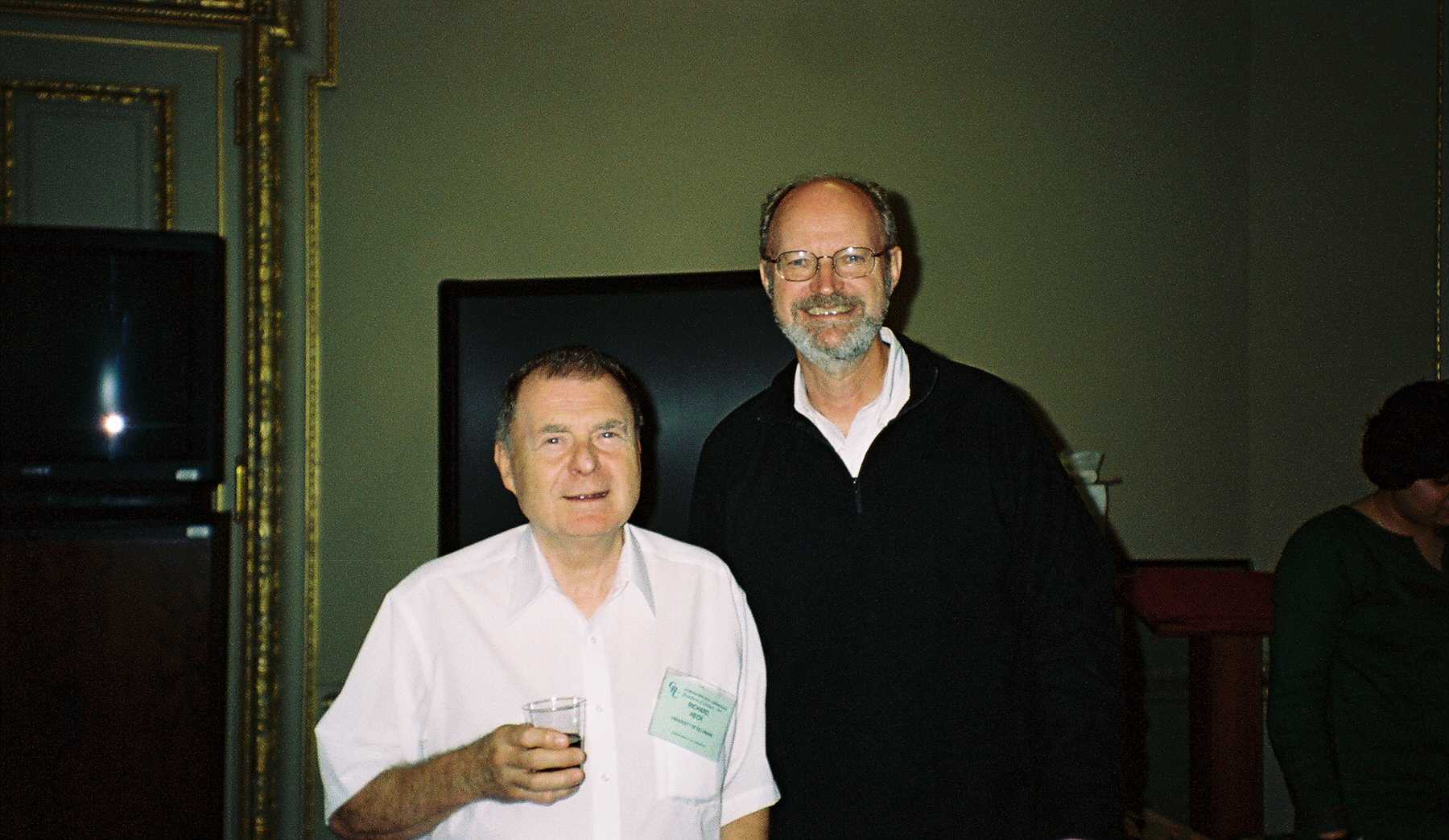
Heck and Grubbs

Richard Heck and Bob Grubbs, Gordon Conference, Salve Regina, 2005

Here is a picture I took of Richard Heck in the spring of 2005 posing with Bob Grubbs before his trip to Sweden. This was taken at the Organometallic Chemistry section of the Gordon Conference at Salve Regina in 2005.  It is a great place to spend a few days giving or listening to chemistry talks, though the dorm accommodations are a bit spartan.

I think the 2010 Nobel Prize in Chemistry for Heck, Suzuki, and Negishi was well deserved.  The coupling reactions they uncovered are a great alternative to some otherwise awkward transformations and have enabled much development around the world.

Here is my question- Is -B(OH)2 a meta or an ortho-para director for electrophilic aromatic substitution? At least in principle. In practice it is difficult to determine due to competing deborylation.

This was taken on one of my very last rolls of Kodacolor film.