2010 Nobel Prize in Chemistry

10/5/10.  Which chemists do you suppose will get the call from Sweden this year? 

I’ll guess Breslow or Whitesides again.

But then, what about some catalyst guys? Heck, Tsuji, Suzuki, Sonogashira, to name a few? (D’oh!! Are they all alive?)  Think about how normal it has become to do an aryl coupling reaction with a boronic acid and a PGM or Ni.  Look at the wide variety of boronates on the market as well as the endless array of catalysts and ligands for coupling transformations.  

This is what happens to industrial chemists mid-career. We lose track of what is hot in the field as a whole. We’re burrowed deep into the hide of one kind of proprietary technology or other and locked into place by the golden shackles of confidentiality. Pretty soon there are entire fields of endeavor that you’ve never heard of and thirty year old rock star professors who sport big grants and hoards of enthusiastic young acolytes.

Staarkrakken Institute to Change the Standard Taper Joint

Guapo, Arizona.  10/1/10.  The Staarkrakken Institute at Pultroon University in cooperation with ThermoFissure Corporation have announced the development of a new ground glass joint standard for the 21st century. The laboratory glassware joints to be retired initially are the 14/20, 24/40, and 29/42 joints. The taper angle will be raised by 1.8 degrees on all subsequent designs. Ball joint design standards will change as well. Look for ball joint standards to change in early 2014.  Additionally, the outside diameter of the joint will be increased, so Keck clips will also undergo a redesign.

This change is the result of years of marketing studies designed to determine how satisfied chemists were with the familiar standard taper joint. Market researchers found that customers rarely had strong opinions about their familiar standard taper joints or simply expressed “boredom” with the topic. So, in an effort to stimulate fresh demand, executives from ThermoFissure Corporation approached the Staarkrakken Institute for design studies that would lead to stimulated sales of lab glassware.

Olaf Staarkrakken, Director of the Staarkrakken Institute and grandson of founder Nels Staarkrakken, commented “this is the right time for change in the worlds laboratories. We believe that this upgrade in glassware will strengthen joints everywhere. The time is now and we’re proud to lead the way.”

Robert “Stone” Hanusly, Director of Sales and Marketing at ThermoFissure, announced the arrival of the Fissure brand of laboratory glassware using the new standard taper joints. Hanusly added that the Fissure brand is expected to be a big hit among R&D workers and that they have built up their inventory of Fissure glassware in anticipation of high demand. Mr. Hanusly commented that a wide array of adapters will be available.

Civic Hygiene

I like to check in on Bruce Schneier’s website now and then. He is a security guy who seems to have a balanced view of these things.  In particular, his post on wire tapping the internet is insightful.

It’s bad civic hygiene to build technologies that could someday be used to facilitate a police state. No matter what the eavesdroppers say, these systems cost too much and put us all at greater risk.  Bruce Schneier, 10/1/10.

The problem with having massive infrastructure for threat assessment is that they’ll always find something, or at least imagine something. It is in the nature of the state security apparatus to rank its survival highest and to take measures to delegate resources to that end first.  

Just how much sympathy should citizens have in regard to the reach and efficiency of state security organs?  Civil liberties are more important than clerical efficiency.  Americans have been watching too many cop shows on television. It feeds a paranoia seated deep in the brainstem and leads to expectations that discount civil liberty.

Meanwhile, in rehearsal …

Our theatre group is producing You Can’t Take it With You in 5 weeks at a modest venue in our small village. We’re heavily into rehearsal now. We have a cast of 19 and all of the attending problems that go with a mob that size. I play a Wall Street business man, so I get to be slightly more bellicose and uppity than normal. We have a handful of very experienced actors from local community theatre.  They have been very gracious in putting up with tedious wannabe’s like myself. Curiously, I am not the only chemist on stage. The other chemist is far more experienced than I and she does a fantastic job.

For me, the hardest part is simply memorizing the lines. Nowhere in my life do I rely on memorizing large amounts of text. Being a scientist, I remember generalities and relationships and reason my way through problems as I encounter them. Recalling tracts of text from auditory cues is wildly outside my comfort zone. But that is what this is all about. Spending time outside the comfort zone and getting my remaining neurons active.

Customer Service. The Fifth Ring of Hell.

Things can go very wrong  for a customer service representative. Especially if I’m at the other end of the phone with the poor sod who picked up the phone. Case in point: I recently had the need to find an analytical testing company to have some material properties measured.  So, I go to my good friend, Mr. Google, for some listings. I find a few hits and begin to make some calls. 

My first contact was the customer service rep from a large international testing operation. I told the young lady what tests I wanted and she told me that before anything could happen, I’d need to send her the MSDS of the material in question. They had many labs all over the world and she would send the MSDS to the approriate lab. Wanting only to talk to a person about their basic capabilities and what is involved, I asked for a number. She declined. It was thursday and I went home. I had no intent of shipping them an MSDS. And evidently they had no intention of deviating from their procedure. Two of the components were edible and the third is commonly used by motorists.

Tuesday morning it was obvious that I needed to call again, so this time I was answered by a young fellow who promptly looked up my email address and stated flatly that they were waiting to receive the MSDS documents. There was a lot of back and forth and it ended with my pulling rank as an indignant customer with the tenor of one who was elder to the customer service rep. I was in angry professor mode.

Later that day I received a call from a sales rep. The salesman said he’d speak to a lab somewhere in TX.

Meanwhile, these  people were diddling around following their protocols and policies, so I found a company who would talk to me about the problem straight away. I received a quote, got approval, and ginned up a purchase request. Raw mats are on the way and the PO should go out today.  The first company I contacted hasn’t even responded yet. They think the ball is still in play.

So, what is the problem?  Having been through multiple consulting episodes with many sales and marketing consultants, I know what kinds of neat and tidy packages are offered by such people.  Business consultants sell plans and protocols. They sell the illusion of order and organization. They make managers feel like their sales organsization can be fashioned into a Teflon-slick, low overhead selling machine. Sometimes this is actually possible. Sales consultants will say that there are customers out there that you do not want to have. Customers who take a disproportionate fraction of your time are to be avoided. Lookers and tire kickers. Hagglers. They all require energy and time.

To optimize the customer contact side, they will devise chutes for the customers to glide into. You recognize this- the accursed automated phone answering systems that large organizations have is one such example. It is a sorting mechanism. A way to channel and rank prospects into a preorganized stream of tiered prospects. It has an important screening function which is separating the wheat from the chaff.

Where this company went wrong was their religious adherence to their protocol. They are prepared to lose customers who will not file up in their queue to shell out the preliminaries. I was brusquely transferred for someone else to deal with.  Sales is a numbers game. The more customer contacts you have the higher the sales numbers will be.  While their system appears to be efficient, they failed to grasp that some customers like myself would really prefer to have a few words with a person. A few minutes of back and forth with the lab guy who got my business assured me that they understood what I needed and could provide it. I rewarded him with a PO.  Customer service is is really customized service. Once the customer calls, your devotion should be to them, not just the protocol.

Sometimes it is dumb to be too smart.

A man, a plan, gossan! A chemist saves the Colorado Au and Ag industry.

I have been nursing a theory about the American gold/silver rush phenomenon of the mid to late 19th century. That theory held that the critical enabler of the gold/silver rush was the development of extraction technology, referred to as extractive metallurgy in the mining business.  Wouldn’t you know that not only has someone else developed this idea, but also written a book on it. A very good book, I might add.

The book I refer to is Ores to Metals, by James E. Fell Jr., 2009 (paperback), University Press of Colorado, ISBN 978-0-87081-946-9.  The books is actually a version of his dissertation. I wish I could publish my dissertation like that, but we won’t go there…

In 1858 groups of prospectors lead by the Georgians William G. Russell and John H. Gregory found placer gold in streams near present day Denver. These prospectors worked their way up Clear Creek and Ralston Creek looking for more placer gold and for the lodes that would be the origin of the placer deposits.  The modest success of the prospectors in locating placer gold quickly spread eastward and lead to the 1859 Pikes Peak Gold Rush.

Prospectors combing the mountains along the creeks soon found lode gold. Gregory is credited with being the first to find a lode on May 6, 1859.  Placer mining soon lead to subterranean workings and within a few years the mining districts of Blackhawk, Central City, Nevadaville, and Idaho Springs were abuzz with activity.

The surface exposures of gold veins were amenable to familiar methods of processing. Soon, stamp mills were built in the vicinity of the mines and ore was hauled to the mills for crushing and further processing.  Since the gold isolated early in the development of the mines contained gold in a form processable to sluicing or amalgamation, great optimism about the future of the districts lead to further relocation of people hoping to cash in on the rush.

However, by the mid-1860’s, the ore pulled from the mines was of a form that was quite resistant to extractive methods then in place. The ore that had been removed first was from a body of rock that had been long exposed to the weathering effects of water and oxygen. This type of altered ore is referred to as gossan.

To miners accustomed to placer mining, the extraction of gold from gossan was feasible in that the gold was found in native form and within a matrix that didn’t interfere with known isolation methods. What local miners had in their toolbox up to that point was comminution, sluicing, and amalgamation.  Within a few years of operation, miners had encountered a form of the ore that would be called a sulfphuret. Sulphuretted ore as it was then called was actually rock consisting of metal sulfide minerals. These metal sulfides were deposited into fractures and faults millions of years ago by the hydrothermal flows from deeper and hotter source rock.

Assay of gold by cupellation would reveal the gold content even in the sulphuret. However, the gold recovery experienced by the mines plummeted when they got to ca 100  ft below the surface and into the sulphuretted zone of the ore body.  By 1867, many mines and mills were shuttered due to the low extraction yields from the new type of ore encountered. The Pikes Peak gold bubble was collapsing and the sulphurets were to blame.

So, along comes a chemist in 1863. Professor Nathaniel P. Hill from Brown University in Rhode Island. Professor Hill had been engaged to go to Colorado by associates of William Gilpin, territorial governor of Colorado, who was investing in mining property. The early 1860’s had seen a wave of hucksters selling snake-oil methods of gold extraction to mine operators frustrated with the sulphurets. These hucksters were referred to as “process men”. Gilpin sought funding and expertise from out east for his own interests. Hill visited the property Gilpin was interested in and reported that the property held little prospect of gold. Hill returned to Providence with a notion of the possibilities in Colorado.

Hill was entranced with the prospects of wealth from the gold district of Central City and left Providence to operate his own mining company. While in Central City, Hill was engaged by an mine operator named James E. Lyon to provide consultation. During that time, ca 1864-5, Lyon had engaged two European smelters to develop and install a smelting process for sulphuretted ore. News of Lyon’s smelters gave the impression of success, but in a few years Lyon’s business failed in part do to poor management.

Meanwhile, Hill returned to Providence to perform experiments on smelting methods. He settled on the Swansea process of smelting to produce a copper matte containing gold and silver, and eventually went to Europe to investigate the technology in greater detail. Hill visited Swansea and learned much about the smelting process. Returning to Providence, Hill pulled together investors and produced a plan for building and operating a smelter in Blackhawk, Colorado, as the Boston and Colorado Mining Company. 

To make a long story short, Hill and coworkers produced a process for the calcining of sulphuretted ore by open pile roasting, followed by higher temperature roasting in a reverberatory furnace. The reverberatory furnace produced a slag layer and a lower layer of melt that was enriched in copper, gold, and silver that could be discharged from below the slag layer. 

This process produced a product called a matte that was then crushed and shipped to Swansea, Wales, for production of bullion. By 1870, Hill had developed and was operating a successful smelting operation that was buying ore from the local mines on a sliding price schedule. The Pikes Peak gold rush was resuscitated and gold and silver production was back.

A few hints on starting a chemical business

I see from the control panel behind the scenes here at the Lamentations on Chemistry control center that in the last few days a few people have found this site with the search words “starting a chemical business”.  I have written a post on this previously and really have little new to add but I will emphasize one important thing:  starting a chemical business is like starting any other business. You have to find a product to sell. Once you do this, it is a matter of pulling together the resources to make it happen.

A few other hints. I would add that the entrepreneur should be wary of much advice from MBA’s. They have B-School sensibilities drawn from academics and nurse considerable dogma about the latest business models that may make the task seem overly complex. Chemical manufacturing is based on a simple concept- buy relatively inexpensive raw materials and use them to make a higher value product for a price that a customer will pay and will afford you a profit.  That’s it.

If you can’t make a gross margin of at least ~50 % (EBITDA), then don’t offer to make the product. There is nothing specific to chemicals about this number, it’s commonly used in manufacturing.  Point is, it is critical to keep costs low. You have pay for employee benefits, taxes, interest, insurance, business trips, analytical costs, and put some money aside for investors and growth. Remember competition will eventually beat down your prices. Be prepared for that. Keep you head on a swivel.

Be an opportunist. Make whatever is profitable. Your pots and pans don’t care if you’re making boronic acids or siloxanes. Don’t offer anything without a front run and an IP search.

Be prepared to grow organically. Stay away from commodities unless you have a big pot of cash and the willingness to go into mass production in a competitive arena.  Pharmaceuticals? Well, it’s an extended nightmare to enter into and I wouldn’t recommend it. But entrepreneurs are characteristically hard headed, so do as you please.

Pick a manufacturing site away from population centers and with zoning that will let you grow. You might have to stay away from desirable urban corridors to do this. The last thing you need is a subdivision next door packed with nosey suburbanites who don’t like the cut of your jib or the smell of fugitive emissions. Take advantage of industrial parks with existing heavy industry.

Make sure that the fire marshal is happy with your operation. Good housekeeping prevents accidents and looks good to insurance underwriters and firemen. 

Resist the temptation to occupy bright and shiny office buildings. Use your resources to attract good people and pay them competitive salaries. If they’re stimulated by the work, they won’t need or miss fancy office spaces.  Use your cash and credit resources to purchase equipment from auctions.  Do your best to keep your D&B rating as good as possible. This will help you get better purchasing terms and conditions from suppliers. Remember that you will need working capital to bridge the gap between ordering raw materials and the receipt of payment from customers.  This is where marginal businesses really get into trouble.

Chemistry isn’t easy

I’m reminded this afternoon of how nothing is simple in chemistry. Everything seems to require a learning curve.  Even in making an apparently simple binary inorganic molecule, nature can put a hitch in yer giddyup.  It’s especially vexing when all you have to determine purity or identity is elemental analysis or perhaps some gravimetric wet chemical method.  I’ve been spoiled rotten by NMR.

Update:  OK. So I have tweaked the reaction conditions and am now able to make this particular metal halide.  I was applying conditions that were too vigorous.  This is an element I’ve never worked with before, so it is new territory for me. Funny how different metals can be … said the organikker.  \;-)

On the manufacture of hazardous materials

How does one decide if a given compound is too hazardous to manufacture at a particular site? The answer to this question is much harder to arrive at than you might imagine.  It is very easy to spout glib, hand waving statements about risk analysis and risk based process safety. It is quite another matter to actually conceive of experiments to tease out the safety data and compile it into knowledge based practice.  For the manufacturer there are two kinds of operating hazards to contend with- 1) physical hazards, and 2) regulatory hazards.  Getting into trouble with either can bring your operation to a halt.

In general, there are two kinds of GO / NO GO approaches to the question of going forward with any given material. One method applies some kind of quantitative risk analysis based on accumulated knowledge combined with hazard thresholds defining acceptable risk. Regulatory compliance and insurance issues may apply, or not.

The other general approach is simply a management decision. The board of directors or CEO decrees that we’ll go forward and do what it takes to operate safely. Or management decrees that we will not go forward with the manufacture. We’ll let someone else have that plum.

I recall being at a propellants conference a few years ago where a representative from a solid propellants manufacturer asked me if we would consider making lead styphnate. I paused for a moment, as if to be carefully weighing my answer, and replied with a flat ‘no’.  The fellow wasn’t surprised and went on his merry way. This was the exercise of an informal method of process safety. Decline to make the obviously hazardous materials.

The threshold for the definition of hazardous materials varies considerably within industries and between them. The spread of hazard types across the manufacturing world is large and perhaps confusing.  Two of the broad types of manufacturing hazards are hazardous energy and toxicity.  Hazardous energy is found in operations with high pressure, flammable materials, mechanical energy, chemical reactivity, electrical energy, and explosive materials which is a combination of chemical reactivity and mechanical energy.

Toxicity

Toxic hazards are a group that cover a wide range of physiological effects and modes of dosing. Toxicity issues relating to manufacture can be a very complex matter and it is best to involve experienced hands to sort out the good sense fom the nonsense. To a large extent, the maufacture of toxic materials is covered by the proper application of personal protection equipment (PPE), good plant hygiene, and a process that keeps toxic materials contained to the greatest extent possible. The pharma people know all about this activity. But in the specialty chemicals business, a good deal of the chemical intermediates that go out the door have poorly understood toxicology.  

Products that are made for dispersal into the environment are subject to much greater oversight by EPA. But the same is not true for a great many chemical intermediates. Chemical intermediates flow through different  regulatory pipelines with some under thorough regulatory scrutiny and others considerably less so. Pharmaceutical intermediates may or may not be covered under FDA GMP rules. Very early intermediates may be items of commerce and not subject to the Byzantine ways of GMP. Later intermediates may have FDA requirements that handcuff you to the bedpost.  It is possible to have a very prosperous career outside of the GMP world.

Chemicals that are not for pharmaceutical or pesticide use may be listed under TSCA.  Chemical Abstracts Service maintains the list and access to entries is had through the CASRN, or the CAS registry number. TSCA is a type of oversight promulgated by the EPA and is intended to provide scrutiny in regard to worker exposure and environmental release during the execution of a chemical process. EPA does consider the toxicology and environmental  literature and is able to model the fate of a release into the air or water by calculation.

While specialty chemicals are subject to TSCA regulations and an approval by EPA, only cursory toxicological examination is customarily performed. TSCA approval is either in the form of a listing or through a low volume exemption. PSM regulations promulgated by OSHA provide regulatory crossfire on the manufacturer in that OSHA regulations require enough safety testing as to provide a safe working environment.  So together, OSHA and EPA cover a great deal of area in manufacturing safety. The rules are meant to be proactive, but they also provide substantial penalties for infractions. There is much more depth to TSCA and PSM than I have mentioned here, obviously. It is important to have people on staff who specialize in regulatory affairs.

Testing for toxicological effects is time and resource consuming. Much planning must go into such testing and it must be started well in advance of plant operations. Substances that pose a potential risk to workers via chronic occupational exposure during manufacture and handling are good candidates for such testing. However, if the substance is not a commodity chemical and if the substance is made only during infrequent campaigns for a limited group of users, it is less than likely that it will have been tested.  The best approach to manufacturing a substance with little data available on toxicity is through the use of precautionary guidelines with layers of protection for the operators. That is, design a process that prevents exposure of the workers to the product and offers redundancy in engineering and administrative controls. The coverage must include production operators, maintenance crews, warehouse workers, chemists, and engineers.

Hazardous Energy

Reactive hazards and hazardous energy issues can and should be investigated by the manufacturer to the greatest extent possible. While such activity can be farmed out to commercial labs, it is very important for management to grasp the benefis of in-house expertise.  Depth of knowledge is important in understanding and preventing  upset conditions. But the accumulation of such depth of knowledge is expensive and subject to throttling by management. It always involves accruing more information than is apparently needed, at least initially.

Science is to a large extent about understanding boundary conditions. In the same way, chemical safety requires understanding the conditions for the release of hazardous energy, decomposition, or other undesirable attributes.  What you’ll find quite often is that a single measurable attribute is not enough to assemble a complete picture of reactive hazards. Most reactive hazards are understood by assemblig a composite of several kinds of experimental results for a more complete appreciation of the dimensions of the reactivity.

To find such boundary conditions one needs to conceive of experiments to tease out the effects. Some kinds of information relating to safety issues can be obtained by instrumentation. Differential Scanning Calorimetry (DSC) is one such technique that gives a quantitative picture of the heat evolution of a substance while it is being heated over a planned temperature range. Thermogravimetric Analysis (TGA) of a test substance gives an indication of mass loss as a function of temperature. Accelerating Rate Calorimetry (ARC) shows heat flows into or out of a sample while recording sample cell pressure.  ARC goes a bit further than DSC in that the evolution of non-condensable gases can be inferred by the shape of a derived Anton curve. ARC also gives an indication of time to maximum rate (TMR), which is a useful parameter in determining the maximum temperature or residence time for a reactive material or mixture. Reaction Calorimetry (RC1)  shows the heat flux profile of an actual reaction mixture over the course of reagnt dosing. RC1 may be used to look for the accumulation of energy in a reactor. There are other tests available, but I cannot attest to them on the basis of personal experience.

Explosivity

Noninstrumental methods of safety appraisal include the tests for explosive properties. There are well defined protocols for explosive testing and they are applied in layers. It is very important for people handling new materials that may have explosive properties to understand the various assays for explosivity. 

Explosivity (or explosability) may be manifested in many ways and there are tests to tease out sensitivity to a measured stimulus. The key point I’m trying to make is that explosivity is a composite property sensitive to multiple kinds of stimulus and physical circumstances. Many materials are explosive only according to a few kinds of tests.

Safety testing for materials that may be energetic include BOM (Bureau of Mines) or BAM fall hammer tests and the BAM friction test. These tests do as the names suggest- look for thresholds for sensitivity to impact or friction.

The Koenen test  looks for explosivity when a material is heated under partial confinement, i.e., material is packed in a metal tube with a small hole in the end. Materials that are merely flammable will decompose and vent through the orifice. Compounds that are explosive may cause the Koenen tube to burst.

The time/pressure test is used in DOT classification and consists of a pressure vessel fitted with nichrome wire and a pressure sensor. The sample is heated with the nichrome wire or flame and the pressure is monitored. A pressure rise from 100 to 300 psi in 30 msec or less is regarded as having rapid deflagration properties and an qualifies as a positive indication for explosivity for transportation purposes. For the process chemical industry, this test gives an indication of the potential for rapid gas formation and the unwanted PV work it may do on your equipment.

There is a  series of tests used for DOT classification of explosive properties that will give useful insight for those who propose to manufacture intended or unintended energetic materials. It is useful to have material tested to assemble the composite picture of the materials sensitivity.  Questions to ask are: 1) does the material show any positive indications at all? 2) If explosive indications are found, is confinement required? 3)  Does the material show any detonability at all? 4) Can you fnd any sensitizers or catalysts to explosivity? 5) Does the material transition from deflagration to detonation? 6)  Is the material sensitive to stimulus by electrostatic discharge (ESD)? 7) What temperature gives a time to maximum rate (TMR) of 24 hours? 8) Do the decomposition products contain non-condensable gases?   There are more questions to ask. Remember not to confuse detonation with explosion.

For the chemist interested in manufacturing a product that has known reactive hazards associated with it, it is useful to have collated the data. The application of knowledge of reactive hazards depends greatly on the kind of equipment to be used and the kind of chemistry to be performed. It is possible nonetheless to make a few useful generalizations.

Accumulation of Hazardous Energy

The execution of a chemical process usually requires that two or more substances be put into physical contact in a solvent. This is a point at which hazardous energy may be evolved. Obviously, for promptly reacting systems the rate of heat generation must be less than the rate of heat removal to avoid a runaway situation. But special care must be taken for reactions that are not prompt and that might allow for the accumulation of unreacted material in the vessel. This unreacted material in a reation vessel represents an accumulation of potentially hazardous energy. Good process R&D will identify reactions with latent periods or reactions that are particularly slow to start. Problematic reactions require good in-process checks to ascertain the state of the rection. Very often, a heat kick is all you need to see to know the reatcion has begun.

Grignard reagent reactions are notorious for being slow to start, tempting operators to “goose” the reaction by adding more RX to the pot. Above about 10 % of RX over Mg, the potential for a runaway initiation is very high.  It is best to limit RX addition to a maximum of 5 %. If no initiation is observed after a reasonable attempt, the chemist must be awakened and hauled to the plant to provide on the spot guidance. Generally, initiation is a matter of time. But but sometimes parlor tricks must be used to activate the Mg. These are well known. It is always best to use these activation tricks prior to addition RX to the pot because otherwise a rapid consumption of RX may occur.

Solids Handling

It is always more desirable to handle sensitive or reactive materials in solution. They can be piped around under inert atmosphere and generally protected from environmental problems. However, sometimes there is no way to avoid the handling of reactive solids. That is, solids that are sensitive to O2 and/or water. The sensitivity may only go as far as quality control and specification problems. Or reactive hazards may be in play.

Solids handling is problematic in certain operations. Charging a reactor with reactive solids requires specialized solids handling equipment. Even non-reactive solids present a problem in handling. Dumping solids into an open manway can result inan  incendive electrostatic disharge. It’s made more serious if there is a flammable solvent in the vessel. Here is th rule- you don’t add solids into a reactor manway of there is the possibility of explosive dusts or flammable solvent in the pot.

Filtration is another problematic operation. Well, let’s say that opening the filter with reactive materials in it is a problem. If you use BuLi orRMgX, you probably have to do a  filtration at some point. Unless you quench the BuLi or RMgX in the pot, you are likely to have a hot filter cake.  While I cannot divulge any particular methods here, I can say that managers have to address this issue one way or another. It is especially exciting if the hot cake is wet with a flammable solvent. So, ESD and other ignition sources must be delt with when the filter is opened. Operators must be grounded and all locations for possible charge isolation must be accounted for.  It is best to open a filter in a location where having a hot cake fire is acceptable.

Filter cakes may be waste or product, depending on the circumstance. Drying operations in the filter must account for the accumulation of electrostatic energy as the material dries. It is important to have decay times for the solids if they are potentially energetic. Energetic materials that accumulate static must be allowed to decay their charge prior to handling. Of course, the prevention of charge accumulation is best. Propellant folks will coat granulated or pelletized product with charcoal or grapite to render the solids conductive.

Packaging

Chemists really hate to have to worry about packaging, but I can attest this is an activity that attracts quality control problems. Obviously reactive materials must be compatible with the  package materials of construction. Containers must seal properly.  Steel drums are useful for many kinds of materials, but the bungs can and do leak with temperature changes, so they can pull in moist air.  In terms of reactive hazards associated with containment, usually some choices have to be made. What kind of leak scenario is plausible and does the proposed container pose any special weaknesses? Drums are notoriously susceptable to being speared by forklifts. Cylinders too. 

What hazards are present for a workman who opens the drum with the hazardous material? Does the operator have to open the drum and put in a dip tube for pumping out the material? Perhaps a cylinder with a built in dip tube is safer.

Another matter to consider, especially with solids, is the issue of static charge generation during filling operations. Is the container or liner  conductive or dissapative? Are ESD procedures in place for safe handling?  Liquids can generate considerable static energy, especially when low dielectric constant liquids travel through a plastic pipe.  Transfer of flammable organic fluids should take place in grounded or bonded conductive pipe to the greatest extent possible to avoid charge isolation.

All equipment should be grounded or bonded via a ground that is periodically tested for integrity. Everything should be at the same potential as the ground.  Cement floors are dissipative, but painted cement floors are not. Wooden pallets and fibreboard packaging are dissipative when sitting on bare concrete.

Reservoir Road Forest Fire

12 September, 2010. A forest fire kept local and state fire fighters busy today. Called the Reservoir Road fire, this fire grew aggressively with the help of easterly surface winds.

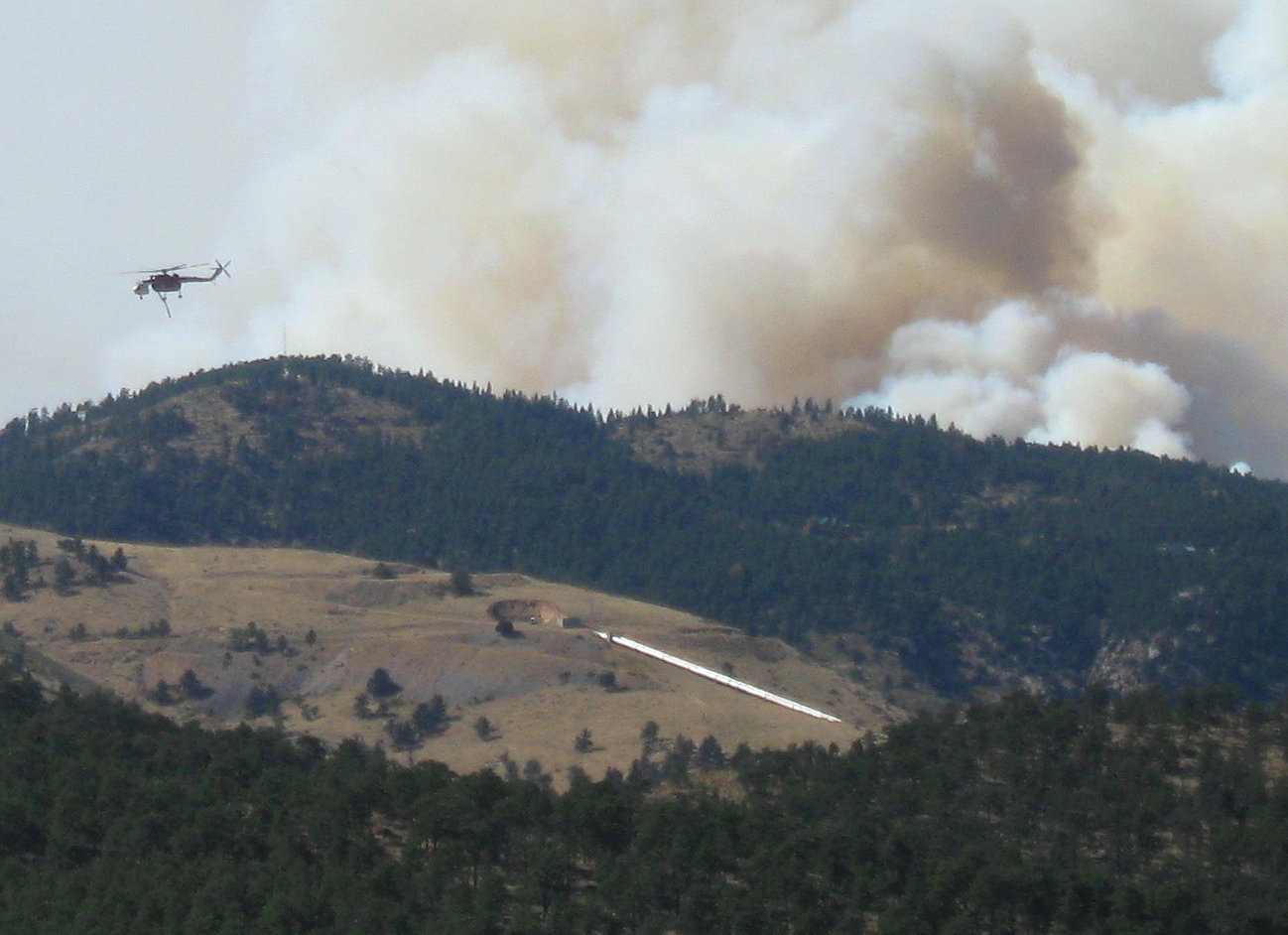
Fire NW of Carter Lake, Loveland, Colorado. Copyright Gaussling 2010.

Carter Lake is one reservoir in a water distribution system that receives western slope water pumped from Grand Lake, Colorado. The water moves down the pipe seen in the photo below (diagonal white line) and into Flatiron power generation station that recovers some of the energy invested in pumping it over the continental divide.  The power station discharges the water into Flatiron Reservoir, wher it is divided into several streams feeding municipalities from Boulder to Ft Collins.

Heavy lift helicopters in action, Reservoir Road fire, 9/12/10. Copyright Gaussling 2010.

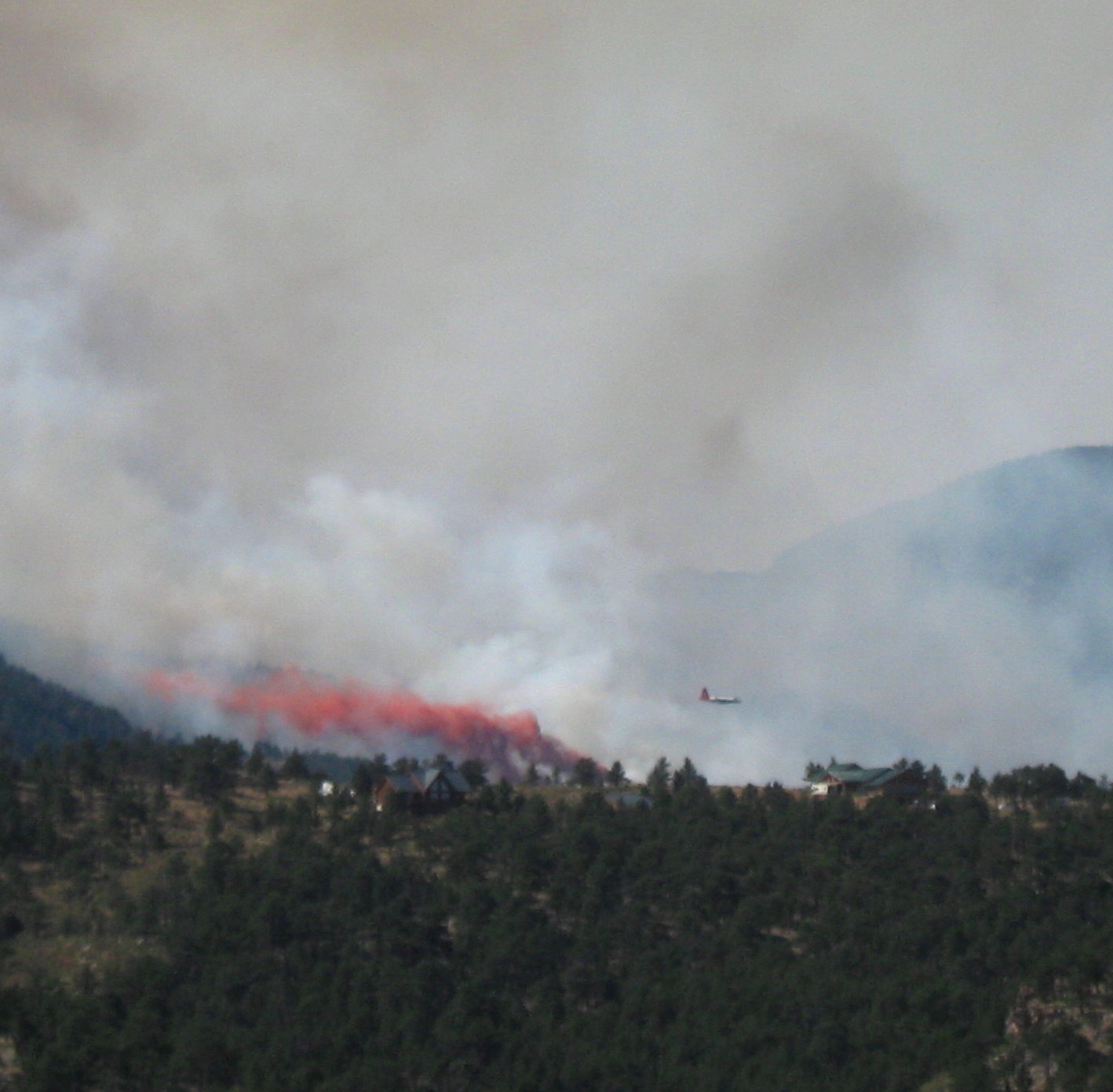
A steady stream of aircraft arrived from the south to deliver red-colored fire retardant to unburned areas adjacent to the fire area. All of the heavy aircraft followed behind light aircraft over the drop zone. All aircraft observed what you might call a left hand pattern over the fire area, meaning that approach was from the SE and only counter-clockwise turns were being conducted.

Slurry Drop, Reservoir Road Fire, Loveland, Colorado, 9/12/10. Copyright Gaussling 2010.

Th’ Gaussling’s brother lives on the edge of the fire warning zone, so there are some nervous moments to bear while this thing plays out.  My brother was on his mountain much of today monitoring the situation. There was a visible uptick in wildlife fleeing the area.

For my brother and sister-in-law, this has been an eventful weekend, starting out with the family dog (puppy) receiving 3 strikes by a rattle snake. The dog and a 2-foot rattler had an encounter resulting in the dog receiving one invenomation in the tongue and two in the jaw. The dog went into deep agony in minutes with his tongue swelling to the size of a medium cucumber within an hour. Luckily, the dog received prompt treatment at the vet hospital and after 30 hours of touch and go, has survived the ordeal.  

The rattler wasn’t so lucky. Tragically, an axe fell on it 8 or 10 times, sharp side down.

The dog, a pure bred of some variety, has been advised that he will soon go into a vigorous breeding program to recoup the several thousand dollars of vet fees. The dog declined to comment.